Hello,
People have been earching for PDP-10 MDL for a long time. Finally, we
found source code for TOPS-20 including slightly bit-rotted ITS support.
It has now been fixed and is up and running in ITS. Twenex people are
welcome to give it a go too. This is published with permission from
Chris Reeve and Tim Anderson:
http://github.com/PDP-10/muddle
Next is, of course, trying to run Zork. How to do that is an entire
research project of its own.
Best regards,
Lars Brinkhoff
Well, the ones listed now have been re-listed at least once. :-(
I was just contacted by the Living Computers Museum. They emphasized they are a 501(c)(3) org. :-)
I donate to the CHM. I will probably give them first shot.
Does anyone in the group have access to documentation for the Cybernex APL-100 video terminal?
All that I've been able to locate is a 4 page brochure for it; they were originally made in Ottawa, Ontario, Canada.
Any help would be greatly appreciated.
I hope this qualifies as classic computing...
Does anyone have the pin-out for the P2 connector on MVME processor boards?
I think that the pin-out would be the same for MVME147, MVME177, MVME162,
etc. and would mate with the P2 adapter board.
David Griffith <dave at 661.org> wrote:
> I'm looking for someone who knows TOPS10 / TOPS20 well enough to figure
> out for me why this test program won't compile. Once that's done, I can
> complete the firmware for the USB Panda Display an its support within
> klh10. I'll then make more copies of the USB Panda Display board (and
> maybe overlays) for whoever wants them.
A couple of observations on the following code:
1/ It is written for, and uses TOPS20 syscalls. If you intend to run this
under TOPS10 change the syscalls (LITES% and DISMS%) to the equvialent
TOPS10 counterparts, can be done by including these lines:
SEARCH UUOSYM
OPDEF LITES% [LIGHTS]
OPDEF DISMS% [HIBER]
2/ The program uses the CIRC instruction, which is not present in stock
DEC processors, and possibly not known to MACRO-10. You could try
OPDEF CIRC [247000,,0]
if that is indeed the problem.
[source code trimmed down]
> David Griffith
--Johnny
Howdy,
It seems to go unmentioned here, so here you are. One guy have set up
a public Multics site.
Access via ssh:
# ~$ ssh dps8 at m.trnsz.com
# The authenticity of host 'm.trnsz.com (139.162.119.37)' can't be
# established.
# ECDSA key fingerprint is
# e7:f6:da:31:eb:a0:a5:0b:50:fc:91:96:32:e7:18:f2.
# Are you sure you want to continue connecting (yes/no)? yes
# Warning: Permanently added 'm.trnsz.com,139.162.119.37' (ECDSA) to the
# list of k
# nown hosts.
# Connection from: AAA.BBB.CCC.DDD
# Session starting now, Fri 20 Apr 2018 at 15:34:42 UTC.
#
# BAN.AI Systems Public Access Multics Service
#
# ? ? ??? ? ?
# ?? ?? ? ? ? ????? ??? ??? ???
# ? ?? ? ? ? ? ? ? ?? ? ? ?
# ? ?? ? ? ? ? ? ? ? ????
# ? ? ????? ??? ??? ?????????? ?????
#
# Visit https://ban.ai/multics/ to request a full user account
# Guest print job output at https://ban.ai/spool/anonymous
# Public anonymous login available. Type "enter Guest" to login
#
#
# Multics MR12.6f: BAN AI Systems (Channel a.h001)
# Load = 10.0 out of 300.0 units: users = 10, 04/20/18 1034.7 est Fri
# enter Guest
# You are protected from preemption until 10:35.
# Anonymous user Guest.Guest logged in 04/20/18 1035.0 est Fri from
# ASCII termin
# \cal "none".
# New messages in message_of_the_day:
#
# Welcome to the BAN AI Systems Public Access Multics Service!
... and so on, and so on ... (the '# ' comes from me, to make screen
dump stand out from my own words)
I have none prior experience with Multics, so it is going to be
interesting. I guess.
Source:
AN.AI's Public Access Multics System
https://lobste.rs/s/4ktahz/ban_ai_s_public_access_multics_systemhttps://ban.ai/multics/
--
Regards,
Tomasz Rola
--
** A C programmer asked whether computer had Buddha's nature. **
** As the answer, master did "rm -rif" on the programmer's home **
** directory. And then the C programmer became enlightened... **
** **
** Tomasz Rola mailto:tomasz_rola at bigfoot.com **
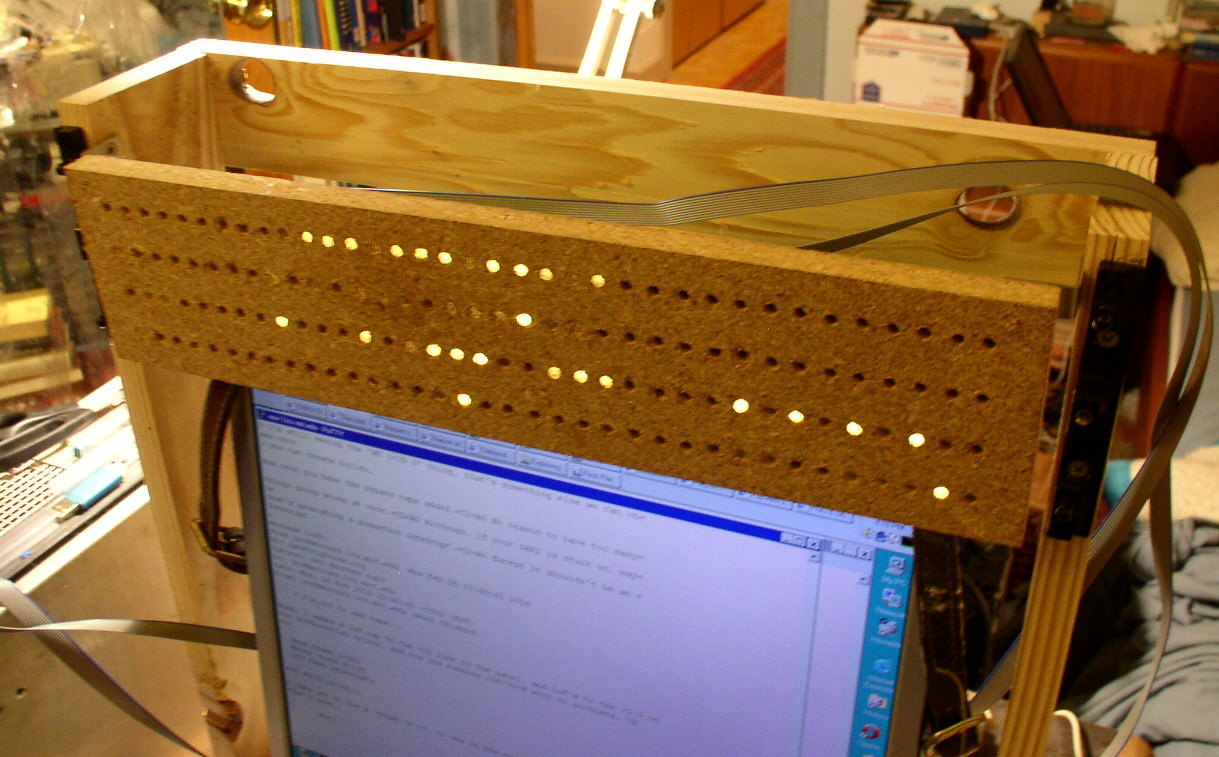
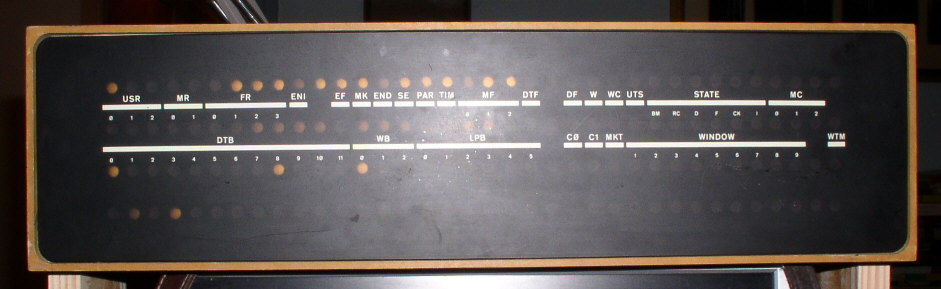
I couple years ago I completed the design for my USB Panda Display[1]
board. This is a modernization of the original Panda Display once
distributed by Spare Time Gizmos[2]. Both devices are intended to be
connected to a more-or-less modern x86-class computer running the klh-10
pdp10 emulator and provide useful blinkenlights. The development of klh10
is once again active, this time on Github[3]. I created my own repo of
klh10 as a means of writing support for my new Panda Display. The
display seems to be recognized and used, but what it displays is
meaningless. I cannot fully test it until I can get the old test program
compiled and working. Once that's done, I'll add my changes to the
PDP-10/klh10 repo and delete my own.
Here's a video of a computer with the old Panda Display running klh10:
https://www.youtube.com/watch?v=g_LcQ5apODg. The creator of that video,
Jan de Rie, got the program that was used to generate that pattern from
Mark Crispin, the creator of the Panda distribution of klh10. That
program appears at the end of this post.
I'm looking for someone who knows TOPS10 / TOPS20 well enough to figure
out for me why this test program won't compile. Once that's done, I can
complete the firmware for the USB Panda Display an its support within
klh10. I'll then make more copies of the USB Panda Display board (and
maybe overlays) for whoever wants them.
TITLE HACK
SEARCH MONSYM
HACK: SKIPA 4,[^D4]
HACK0: SOJL 4,TRAILL
SETZB 1,3
HACK1: TLNE 1,777777
JRST HACK0
MOVE 2,1
CIRC 2,-^D18
SKIPN 4
SKIPA 1,3
IOR 1,3
LITES%
HALT
HRRZ 2,1
MOVEI 1,30
DISMS%
MOVE 1,2
AOJA 1,HACK1
TRAILL: SETZ 1,
TRALL0: LITES%
HALT
MOVE 2,1
MOVEI 1,30
DISMS%
JUMPL 2,TRAILR
LSHC 1,^D37
AOJA 1,TRALL0
TRAILR: MOVSI 1,400000
TRALR0: LITES%
HALT
MOVE 2,1
MOVEI 1,30
DISMS%
MOVE 1,2
TRNE 1,1
JRST HACK
ASH 1,-1
JRST TRALR0
END HACK
[1] https://github.com/DavidGriffith/panda-display
[2] http://sparetimegizmos.com/Hardware/Panda.htm)
[3] https://github.com/PDP-10/klh10/
--
David Griffith
dave at 661.org
A: Because it fouls the order in which people normally read text.
Q: Why is top-posting such a bad thing?
A: Top-posting.
Q: What is the most annoying thing in e-mail?
Hi Jim and all
>Hmm, I guess it does indeed depend on shipping costs, but I am looking
>for a card cage for the 12, and they can be a bit tough to find.
Yea, we tend to use couriers but it runs to a few hundred dollars a pop.
I will send pics off-list sometime next week.
W
Douglas Taylor <dj.taylor4 at comcast.net> wrote:
> I just got one of these and wanted to configure it via the 10
> pin RS232 port on the board.
> Is the port a standard DLV11-J type?
Yes, it is identical. I was the original beta tester on the
SCDC and used it extensively. In fact, the designers called
it "the Frisbie port". :-)
> I have one of those D-bit DLV11-J to DB25 adapters but not
> getting any response.
You may need a null modem. Try swapping pins 2 and 3.
I can send you an genuine Andromeda DB25 adapter if you give
me a mailing address and promise to send me $10. :-)
> Any info on the few jumpers on the board?
They changed between the original Rev. A and final Rev. F
boards. Which one do you have?
I can send you a copy of the manual, complete with all my
editorial comments written on it.
Alan "Packrat" Frisbie
Bill Gunshannon wrote:
> Many of us think that the advent of the x86 architecture is what led to
> masochism.
... or masochism led to the x86 architecture.
> bill
--Johnny
I see some company selling them on eBay for $122.? Are they really worth
anything like that?? I have a couple sitting around here somewhere that I
don't expect to ever use again.? Just wondering if they are worth looking
for to sell.? In this hobby you can always use money for new (well, old
actually)
toys.
bill
3 x DEC Alphas, small deskside models
5 to 6 x Sun pizza boxes one a Sparc 1 prototype
029 IBM Keypunch
The day I can have a 15 cubic yard scrap metal drop box the stuff will
start to be tossed in.
All based on when the rains stop and the ground is hard enough
I can't want much longer
For those that have not seen me post this before
The stuff is near (3 - 4 miles outside of) Banks Oregon USA (look it up on
Google).
I CAN NOT LIFT OVER 10 LBS, PERIOD.
-pete
On Wed, Apr 18, 2018 at 8:17 PM, Mark J. Blair via cctech <
cctech at classiccmp.org> wrote:
> Some of the future reverse engineering projects I have on my to-do list
> involve the CDP1802 processor, which IDA presently doesn't support. When I
> get to them I'll have to decide whether to use dismantler vs. learning how
> to add CDP1802 support to IDA. I'm leaning towards the latter, because IDA
> is so much fancier than dismantler is.
I'd vote for adding it to dismantler.
I had an IDA Pro license at one point, but I seem to have misplaced it, and
it is too old to get me any discount on a new release. I imagine that IDA
has probably improved a lot since back then, but at the time it had a
pretty awful user interface.
If I had an actual business need to reverse-engineer something using a
processor that IDA supported, I'd certainly buy a new IDA license, but I
wouldn't personally invest any time in building add-ons for expensive
commercial software, when there are open source alternatives that may not
be as good, but are generally good enough.
For the 1802, I've used a really crude disassembler written in C. The 1802
instruction set isn't very complicated, so a disassembler for it isn't
either. It's been so many years since I actually disassembled 1802 code
that I'm not sure I still have the disassembler around.
I just got one of these and wanted to configure it via the 10 pin RS232
port on the board.
Is the port a standard DLV11-J type?
I have one of those D-bit DLV11-J to DB25 adapters but not getting any
response.
Any info on the few jumpers on the board?
Doug
These have now been claimed.
Thanks everybody!
Sean I need an address please!
Cindy Croxton
Electronics Plus
1613 Water Street
Kerrville, TX 78028
830-370-3239 cell
sales at elecplus.com
AOL IM elcpls
---
This email has been checked for viruses by Avast antivirus software.
https://www.avast.com/antivirus
TAhanks for that link which fits with my
measurements (nowhere as detailed) of ones actual
ability to do things with "modern" hardware. In
the 1980's I was used to being able to measure
events with 0.2 microsecond precision using a
PDP-11 and my expectation was that the accuracy
was only going to improve as processors got faster.
I ported a program I wrote on the PDP-11 to a
Commodore 64 in 1988 and was using it to measure
finger tapping with a switch array to 1 msec
accuracy. This was done through the simple
expedient of speeding up the sample rate for the
keyboard to 1 KHz and the adding in my 4 external
switches as "keys". Used a 512 K Mac to get the
serial data and display results. To do the same
now would require custom hardware to do the
timing and a USB link to a "modern" CPU or implimentation on a microprocessor
When I attempted to get this same type of timing
accuracy from a PC, found out that it was no
longer easy to get access to interrupts as easily
as before and keyboard latency was longer as now
keystrokes were detected by an on board
microprocessor and sent out as a series of
packets for each keystroke. In DOS and W95 where
one could still easily get at interrupts, then a
serial port could be used to do msec
timing. Once XP and beyond arrived, then the
best temporal precision one can expect from a 3
GHz machine is 15 msec. I suspect the same holds
for Macs and haven't tried running real time
Linux as I either pull out my trusty C64 from
time to time and use it for precision timing
(unfortunately have only one copy of the code on
casette tape so when that goes can't do this
anymore) or I use various microprocessors to do
the job. Have a nice microsecond precision timer
that I wrote for a Propeller chip and feel much
more comfortable programming for it than the
latest windoze bloatware system. The Propeller
has the same amount of RAM as the PDP-11's I
started on, runs 20x faster/core and is fun to
program. The microsecond timer is attached to a
geiger counter to generate random bytes for OTP encryption.
Boris Gimbarzevsky
>On 29 March 2018 at 19:53, Paul Koning via
>cctalk <cctalk at classiccmp.org> wrote:
> >
> > It would be fun to do a "generalized Moore's
> Law" chart, showing not just transistor count
> growth (Moore's subject) but also the many
> other scaling changes of computing: disk
> capacity, recording density, disk IOPS, disk
> bandwidth, ditto those for tape, CPU MIPS,
> memory size, memory bandwidth, network bandwidth...
>
>This is the most telling I've seen in a long time...
>
>https://danluu.com/input-lag/
>
>--
>Liam Proven ? Profile: https://about.me/liamproven
>Email: lproven at cix.co.uk ? Google Mail/Hangouts/Plus: lproven at gmaill.com
>Twitter/Facebook/Flickr: lproven ? Skype/LinkedIn: liamproven
>UK: +44 7939-087884 ? ??R (+ WhatsApp/Telegram/Signal): +420 7002 829 053
I have many cases of SAMS facts schematics and other repair manuals for
everything from stereos, tube TVs, ham radios, turntables, etc. Most apply
to equip from the 60s and 70s or maybe a little earlier. Free to a good home
or they go in the recycle bucket tomorrow.
Cindy Croxton
Electronics Plus
1613 Water Street
Kerrville, TX 78028
830-370-3239 cell
sales at elecplus.com
AOL IM elcpls
---
This email has been checked for viruses by Avast antivirus software.
https://www.avast.com/antivirus
Hi all
I have a TRS-80 Model 2000 B/W Graphics board and a TRS-80 Card Cage
kit (upgrade model 12 to model 16B)
Are either of these worth shipping from the antipodes to anyone?
W
After battling for days with a Dolch 65 that developed the two-tone
beep-of-death on boot, I finally found that it's just my BIOS ROM that has
gone bad. The BIOS happens to be an Award BIOS, says "Award 1998 PCI/PNP
686" on the chip. It's a square chip with pins on the side.
Photo here:
https://drive.google.com/open?id=1OtZ1AU0Hac8RlzTgbgCY4z_qcMlGWXu1
So I thought I might just ask. Anyone has a dead Dolch 65 motherboard from
which I could steal a BIOS chip. The board is actually an Advantech CI6BM-B1
industrial single board computer.
Or alternately, can someone identify what kind of ROM or EEPROM that likely
is, and provide advice on how to read the data from a good chip (I have
another good chip in another Dolch, that's how I found out what my problem
was), and program a similar chip.
Marc
Hi friends. I have a 1990's vintage commercial radio system that uses an 80C85A CPU. I am looking to hopefully modify the firmware to make some small changes in its behavior. The firmware is contained in two EPROMS.
Can anyone recommend a decent disassembler to use with this? Preferably something that ran in windows 10 or windows 7? A dos box would be fine too.
Also, I looked through the dumped contents of the EPROM. In the past I have seen EPROM ascii dumps where most is unintelligible to the naked eye but typically text messages give to the users during interaction with the program are human readable. In this case, the ASCII dump shows only other HEX data. I believe I read that there is a HEX format and that I might need to convert from HEX to BIN before disassembling. Of course, an ideal tool would do both if anyone knows such a thing.
I am not familiar with 8085 stuff but any insight would be appreciated.
Lastly, I wonder if there might be some kind of checksum check to prevent tampering. Is there a common way this is handled in 8085 world? Or is it entirely programmer dependent?
Thanks for your time
Eugene W2HX?
Hey all,
I snagged a Kaypro II a short while ago which I finally got around to
looking at. After some minor TLC to the drives, it's booting.
However, the keyboard appears unresponsive. Pressing keys (with the
exception of caps-lock, the two shifts, and ctrl) results in a buzz/click
>from within the keyboard - if I'm interpreting the schematics right, the
click is actually driven by the system in response to a keypress, which
suggests that my keyswitches are OK (I believe these use a foam disc
approach, which are prone to deterioration) and that keyboard data is being
received OK (at least on some low level).
Any suggestions for possible things to investigate? It doesn't feel like a
memory fault, given that it's using 64kx1 ICs and booting as far as a
prompt, but I suppose it's possible.
On the back of this, I'm in need of three keyswitches, if anyone happens to
have a parts machine and would be willing to sell any. A student of the
machine's previous owner dropped the keyboard years ago and broke three of
the keys off. I have the keycaps, but the switch stems are broken and it
would probably be easier to replace the entire stem portions rather than
attempting to glue things back together.
cheers
Jules
The VAX 4000-200 I exhibited two years ago at VCF East is up for sale:
Restoration Notes:
http://www.vintagecomputer.net/browse_thread.cfm?id=608
I don't need it as much anymore now that it's pretty much a completed
project. It's very upgrade-able though if you have the desire to boost
performance and ports, etc.
The provenance of this machine, I believe, was as part of WVLink a West
Virginia email/gopher/USNET type ISP server in the early-mid 1990's.
I have it set up for telnet communications if interested. Contact me via
http://www.vintagecomputer.net/contact.cfm
Bill
Good condition AlphaServer 300, always been stored in dry conditions.
Photos: https://photos.app.goo.gl/5N66yIlEUCYkuh012
It has a TGA based DEC graphics card that will do 1280x1024 24 bit (it's a
ZLXp-E2 PBXGA-BA) - manual included.
Ultrawide 16-bit SCSI card
Brand new Seagate Cheetah 15K.4 36.7GB,Internal,15000RPM,3.5" (ST336754LW)
HDD
Ultraplex SCSI CDROM drive.
Running OpenVMS Alpha 8.3 with CDE. Can also run tru64 5.x.
All working as it should be. Very quiet system. Can provide copies of media
if required.
?175 + postage at cost.
I can supply an LK461 keyboard and mouse for an additional ?25.
I have one of these, see the photos:
https://photos.app.goo.gl/CnLnSKTCzHETzpOo1
It was bought new by myself a few years back. It can run off a PP9 battery.
?10 shipped in the UK if anyone is interested.
Regards, Mark.
I recently decided to make scan a paperback book that I happen to have two copies of. It is "RSX A Guide for Users by John Pieper? published in 1987 by DEC. I have not seen a copy of it in any of the online sources like bit savers. For anyone just starting out with RSX it is a nice general read that also covers some system topics like backups, etc. similar to the paper back VAX/VMS user and system manager books.
I?d like to make it available online but wasn?t sure how to submit it. It is about 38 MB in size so bigger than an email (at my email).
Since I didn?t have an industrial book shear to remove the binding, I used a belt sander to remove enough go the binding to pull the pages free easily and then used a paper cutter to trim the pages a bit to remove any last traces of glue that would have jammed the scanner. The book is about 360 pages.
Thanks,
Mark Matlock
An interesting 3 hours on PBS last night:
- 'Steve Jobs - One Last Thing': No description necessary.
- 'Long Distance Warrior': McGowan/MCI's David & Goliath battle with AT&T
and disastrous merger with Worldcom.
- 'Digital Man/Digital World': Ken Olsen/DEC's growth and ultimate decline.
(No doubt everyone here except myself had already seen this one ;-)
Interesting comparison of the different styles and personalities of three
men who profoundly influenced the tech world of today and their companies.
Thoroughly enjoyed it.
m
> Lastly, I wonder if there might be some kind of checksum check to prevent tampering. Is there a common way this is handled in 8085 world? Or is it entirely programmer dependent?
One approach that <may> be doable for you is if you have a good ROM with a known checksum, make your changes then calculate the difference between the new and the original checksum and make another change somewhere innocuous to bring the checksum back to the original value. "Innocuous" may be the trick - perhaps some text string you don't care about, copyright notice etc. or maybe there is an empty area in the EPROM you could stick a byte.
Richard Sheppard
On Tue, 4/17/18, Eric Smith via cctalk <cctalk at classiccmp.org> wrote:
> On Mon, Apr 16, 2018 at 7:29 PM, Chuck Guzis via cctalk <cctalk at classiccmp.org> wrote:
>> Disassembly is never lots of fun,
>
> Some of us might disagree.
> But then, some of us might be masochists.
I was just thinking the same thing. This whole discussion
has taken me back to fond memories of writing a 68000
disassembler in AWK (long story).
BLS
> From: Paul Birkel
> the blinky-lights controller panel top-dead-center :->.
Yeah, that's a TC08.
I actually have one of those inlays, it's the only original inlay I have. It
was the model for the large run of blank inlays (black backing with the holes
on the back, but nothing on the front) I just had made. At the moment, it's
sitting in my indicator panel stand with little bits of tape stuck to it:
http://ana-3.lcs.mit.edu/~jnc/tech/QSIC/jpg/PanelMounting.jpghttp://ana-3.lcs.mit.edu/~jnc/tech/QSIC/jpg/DasBlinken2F.jpg
so it can be an inlay for the RKV12. If anyone needs a TC08 inlay, I'd be
happy to trade it for any other inlay (as long as I have one original for
engineering purposes).
Sigh, need to get back to the inlays and take the next step with them!
Dave B and I got derailed trying to find/fix a flaky on the QSIC - on my
prototype, it would occasionally get NXM's running the RK random exerciser I
wrote. I was trying to figure out what the problem was, and I got tired of
the prototype sticking out in my way:
http://ana-3.lcs.mit.edu/~jnc/tech/jpg/tmp/JNCQSIC.jpg
(with the FPGA daughter-board on top, even with short cables, it has to be on
an extender), so I rotated the QBUS chassis 90 degrees so the QSIC was on
top, and took the opportunity to re-order the boards. Bad mistake! Now the
problem has gone away and I can't re-create it!
Noel
> From: Eric Smith
> But then, some of us might be masochists.
I think pretty much by definition if you're into vintage computers, you have
to be a masochist... :-)
Noel
Hi folks,
I know this is a wild long shot, but just in case...
Does anybody have a copy of the source code for the NI Ethernet driver for the AT&T 3B2? AT&T distributed it, but I have never seen a copy in the wild. The package name was "nisrc", if that helps.
If I can't find it, I'll have to reverse engineer the binary. Won't that be fun!
-Seth
--
Seth Morabito
web at loomcom.com
Does anyone know where Motorola's current production chips are described?
http://www.motorola.com/General/prodport.html only partially works and
search is entirely broken because http://search.motorola.com no longer
exists.
--
David Griffith
dave at 661.org
A: Because it fouls the order in which people normally read text.
Q: Why is top-posting such a bad thing?
A: Top-posting.
Q: What is the most annoying thing in e-mail?
I'm pondering upgrading the CPU of a Pacccomm Tiny-2 Mk2 radio packet
controller from a 6Mhz Z80 processor and SIO to 10Mhz parts. My problem
is that the parts already in it appear to be NMOS. The family is still
being made by Zilog, but for 10Mhz parts, CMOS is all they have. Can I
just drop in CMOS, change out the crystal/oscillator and have things work
as expected?
Here's what are fitted to my TNC.
Z84C00BB6
Z80BCPU
29125
Z8440BB1
Z80BSIO-O
29014
--
David Griffith
dave at 661.org
A: Because it fouls the order in which people normally read text.
Q: Why is top-posting such a bad thing?
A: Top-posting.
Q: What is the most annoying thing in e-mail?
I?m not trying to date myself but have things truly sped up? In 1970?s
Toronto I had a classic computer, sorry can?t recall what it was, connected
to a 300 baud modem; by early 80?s had ?zoomed? to 9600 baud. Oh, my! [ A
typical file size to download was probably 1 MB. ] Speed indeed! Yet now,
here in rural Ontario, Canada, I?m at 5MB/s. Yikes! (Friends in Toronto are
at 50MB/s.) We can do the math but content, particularly multimedia, has
swollen in size.[ 1 GB is not unheard of. ] Were classic computing days
that much slower? Happy computing. Murray -:)
<http://www.avg.com/email-signature?utm_medium=email&utm_source=link&utm_cam…>
Virus-free.
www.avg.com
<http://www.avg.com/email-signature?utm_medium=email&utm_source=link&utm_cam…>
<#DAB4FAD8-2DD7-40BB-A1B8-4E2AA1F9FDF2>
As mentioned before , i made a functional copy of the Tektronix 4052 Diagnostic Rom Pack .
PCB's are back, units do work ( minus a small issue with the wrong orientation of the LED's )
Go to
ftp://ftp.dreesen.ch/TEK_DRP
?and find my dokumentation DiagPack_Manual.pdf , decide if this is what you want, and order ( or not...)
Also please read the original TEK doku TEK4052_4054_Diagnostic_Rom_Pack.pdf in order to understand what this unit can and cannot do.
Prices, in short : PCB only 20 Euro/25 USD, populated and tested 60/75, add 20/25 for a fitting 3D printed casing.
And do feel free to construct your own with the data from my FTP site.
This pack should also work on the 4054, but since I do not have such a machine this feature is untested.
Jos, now wondering whether I will ever sell the 20 PCB's I have...
I've found a couple more documents lurking in my desk that I've
completely forgotten about.
The first is a UniSoft Uniplus+ System V User Guide. Circa 1984.
Basically a SysV Unix user's guide. I have no idea what platform this
was intended for, as it's pretty much a generic document. A couple
hundred pages.
The second is a sales kit for CMS Enhancements. Nice slick brochures
for PC, Apple and Sun. No technical documentation, per se--just
something you'd pass out at a trade show (which is probably where I got
it). Circa 1990. Includes the brochure for the CMS 386 PC.
It'll all fit in a USPS PM envelope, I'm guessing.
I want postage only.
--Chuck
Someone in Barnet, North London, post code is EN5 1RJ has two DEC DS-32
drives and IBM Series/1 computer and some drives.
Last wording was Sale or swap.
You may contact them at stuff at pdp8online.com.
Ethan Dicks <ethan.dicks at gmail.com> wrote:
> There are times when video instruction makes sense - describing, for
> example, a chemical reaction that produces major visible change in a
> few moments is better to watch than to try to describe. The vast
> majority of stuff? Teaching programming? I don't want to watch 2
> hours of someone editing text... give me words and perhaps a
> screenshot or two if there's something too complicated to simply write
> about.
How about language courses on audio cassettes?
For instance a course on Macro-10, over several of them?
Yes, it does (or at least did) exist.
> -ethan
--Johnny