On Oct 11 2004, 3:51, mehditk2(a)juno.com wrote:
>
> Hi,
>
> Does anyone have a KDF11-B3 boot rom or any other version which
> can boot RX33 or an MSCP device on my KDF11-BA. I will pay for
> that and I will be very thankful since I have not to buy a Eprom
> programmer to burn the immages.
KDF11-B3 isn't one ROM, it's an upgrade kit consisting of two EPROMs
plus instructions. It's more usual to refer to the ROMs themselves by
the actual numbers or the processor suffix. The ROMs in the -B3 kit
are 23-183E4 and 23-184E4, as far as I remember; that's the -BF
version, but most versions of the KDF11 ROMs work with MSCP devices.
For example, people have used RD31 drives on an RQDX3 with -BE ROMs,
although it wasn't officially supported until -BG. The next version
was 23-380E4 and 23-381E4, which would make the processor a KDF11-BG.
There's a list of ROMs at
http://www.dunnington.u-net.com/public/DECROMs/ (see the file called
ROMlist).
You can see which revisions officially support various MSCP devices in
Micronote 43, which you can find in various places including
http://www.ibiblio.org/pub/academic/computer-science/history/pdp-11/hardwar…
BTW, the EPROMs for a KDF11-B are unusual 24-pin 8Kx8 devices; normal
2764-style 8Kx8 devices will not do because they're 28-pin.
--
Pete Peter Turnbull
Network Manager
University of York
>
Does anyone know anything about 1/2" tape cleaners?
--
Yes, they do pretty much what you describe.
The problem is they used consumable cleaning strips which
have been unobtainium for at least 15 years.
Ed Kelleher <Pres(a)macro-inc.com> wrote:
> My wife, before we were married, used that to set the hook in me.
> [...]
> Girl comes crying into room, "I did PIP/S and not DICOMP/S and ^C'd and
> I've lost all my work!!!".
> (Don't you just love it when they talk like that!)
> Geek boy helps pretty programmer recover data, gets big kiss, etc. etc.
That is soooooooo sweet! Once again proves that not ALL women are
Weendoze pee sea lusers, there DO exist ClassicCmp-friendly and even
ClassicCmp-appreciative ones if you take the time to seek one out and
don't settle for less than what you really deserve.
"Kto vesel, tot smeetsya, kto hochet, tot dob'etsya, kto ischet, tot vsegda
najdet!"
-MS,
who is in the process of preparing the 4.3BSD-Quasijarus version of the
Berkeley UNIX manuals for his new girlfriend. She worked as a UNIX
sysadmin for 10 years but could use a refresher, and it's always good to
have a manual that corresponds exactly to what's actually running.
Steve Gibson shouldn't be a strange name for this list.
Google tells me that SpinRite's been mentioned a few
times in 2003 and 2004.
I recently bought a copy of his SpinRite and I'm trying
to get my head around exactly when it's useful. The manual
isn't much help.
Right now it's chugging away on a circa 1987 floppy that
lost its shutter, rattled around in an envelope, and today
has CRC errors. Not a rare disk, just something I'd like
to see if it can recover. It's busy re-reading bad sectors
hundreds of times to make its best guess at the data.
A few days ago I tried SpinRite on a contemporary PC's hard
drive that would error-out when writing to two spots on
the disk. At its strongest correction level, SpinRite
found the errors but the disk wasn't "repaired" in the
sense that I expected: I thought it would somehow map-out
the areas that had errors, and let me continue to rescue
the drive's data. It didn't. Writing to the drive still
failed.
(I successfully read both partitions with a Knoppix CD and with
R-Studio NE, but I wanted to bring the system back to life
enough to let HP's WinXP create its recovery CDs.)
So to keep this on-topic, when exactly can SpinRite help rescue
old hard drives and floppies?
And to state the obvious, SpinRite can't raise the dead.
I tried it on a drive that was alive enough to be recognized
by the BIOS, but if SpinRite can't make it spin or read,
it can't help.
- John
On Oct 23 2004, 11:12, Gooijen H wrote:
> A short update on my efforts ...
> The Fujitsu-OnRack version did what was to be expected: it checks and
> sees that there is no Fujitsu drive in the PC and stops :-)
> Sorry to say that the version from Pete is for Western Digital drives
> and shows the same behaviour :-(
Oops, wrong one. Sorry, Henk. I *do* have a plain version, somewhere,
that works with Seagate and Toshiba disks (and presumably others, as it
seems to be a non-specific OnTrack version, V.7.09). I've sent another
copy to you.
--
Pete Peter Turnbull
Network Manager
University of York
What C compilers exist for RSTS/E? I'm aware of DEC PDP-11 C V1.2, is there
anything else/newer?
I assume there is no way to get GCC to crank out RSTS/E binaries.
Zane
>From: "Ethan Dicks" <dickset(a)amanda.spole.gov>
>
>On Fri, Oct 22, 2004 at 01:58:22PM -0700, Dwight K. Elvey wrote:
>> Hi Ethan
>> Wouldn't you do daylights saving in the winter instead
>> of the summer?
>
>Everybody does it in their summer, northern hemisphere and southern
>hemisphere... it's summer here *now*.
>
>-ethan
>
Hi Ethan
Of course, your summer is different than mine. What
was I thinking.
Dwight
Hi
I guess the next thing is to find a pinout for
the 23512 to see if they have a select that is inverted
that might need to be patched around to read on
a standard programmer.
Dwight
>From: birs23(a)zeelandnet.nl
>
>Dwight, not missing the discussion ;-)
>
>At 19:15 22-10-2004, you wrote:
>
>> >From: ard(a)p850ug1.demon.co.uk
>> >
>> >>
>> >> Hi,
>> >>
>> >> I know very little about electronics and eproms so this question might be
>> >> really easy. I would like to know what the difference is between a 23512
>> >> eprom and a 27512 and if there are any differences if its possible to
>> make
>> >
>> >I thought the 23512 was the mask-programmed part (not an EPROM), and is
>> >otherwise the same device. You should be able to read it (unless your
>> >programmer tries to be clever and read the manufacturer's ID word, etc).
>> >
>> >-tony
>> >
>>
>>Hi Tony
>> I think you are right about the 23xxx being mask versions.
>>The problem with the newer EPROM parts is that they do not
>>require pulsing of the programming voltage. Many programmers
>>simply leave the programming voltage high while reading or
>>verifying. This is real bad for mask parts. Also, most mask
>>parts use the programming voltage pin as another select.
>>This means that it may need to be in the opposite state that,
>>even a programmer that allows setting of the program voltage,
>>may not be in the right state to read.
>> Also, I think this fellow is off the list and doesn't realize
>>that he is talking to a list. I suspect he is missing our
>>conversations related to his issue.
>>Dwight
>
>
>From: "Ethan Dicks" <dickset(a)amanda.spole.gov>
>
>On Thu, Oct 21, 2004 at 10:54:49PM -0400, John Allain wrote:
>> Hey, here's a semintelligent, if OT, question.
>> What time zone is at the South Pole?
>
>Well... the easy answer is "whichever one we want".
>
>In fact, the one we have selected is the one that matches where our flights
>come from so it's easy to synchronize operations. That means NZST/NZDT,
>since our flights come from McMurdo, and their flights come from Christchurch,
>NZ (yes, we are at GMT+13 right now, and we _do_ observe daylight savings
>time, even though the sun is up 24/7)
>
>-ethan
>
Hi Ethan
Wouldn't you do daylights saving in the winter instead
of the summer?
Dwight
>From: ard(a)p850ug1.demon.co.uk
>
>>
>> Hi,
>>
>> I know very little about electronics and eproms so this question might be
>> really easy. I would like to know what the difference is between a 23512
>> eprom and a 27512 and if there are any differences if its possible to make
>
>I thought the 23512 was the mask-programmed part (not an EPROM), and is
>otherwise the same device. You should be able to read it (unless your
>programmer tries to be clever and read the manufacturer's ID word, etc).
>
>-tony
>
Hi Tony
I think you are right about the 23xxx being mask versions.
The problem with the newer EPROM parts is that they do not
require pulsing of the programming voltage. Many programmers
simply leave the programming voltage high while reading or
verifying. This is real bad for mask parts. Also, most mask
parts use the programming voltage pin as another select.
This means that it may need to be in the opposite state that,
even a programmer that allows setting of the program voltage,
may not be in the right state to read.
Also, I think this fellow is off the list and doesn't realize
that he is talking to a list. I suspect he is missing our
conversations related to his issue.
Dwight
>> I have to admit - I do not have a burning desire to connect to anything
>> at 300 bps --- But I do have a burning desire to see it work.
>
>Understandable. If you really need a serial port, there are faster items
>out there... but AFAIK, at the moment, that's the fastest you have...
I don't *need* a serial port (I have a real one on my SuperPET) ... My point
is that I don't like to just put stuff on the shelf ... I like to get it
working.
>> In this case, I think it would be "cool" to be able to demonstrate a PET
>> connected through the 8010 IEEE modem to my Hayes S-100 modem (also a 103 type)
>> in an Altair running a BBS system - This would show how it really worked!
>> - but I don't expect anyone to actually want to use such a setup for any
>> other purpose.
>
>Sure. I even have a couple of devices that are handy for that - Telephone
>C.O. simulators...
Thats no a problem for me - One of my main lines of "day" work these days is
the development of a small office PBX (www.talkswitch.com) which is very small
and easily portable (good for demos), and provides full switching etc. I also
do dial-up point-of-sale banking terminals, so I have lots of equipment to
simulate and monitor various phone line condition - not that it's really needed
to "make a call" to a demo BBS.
>The other thing I do with vintage equipment is show-and-tell. Mostly at
>home with friends, but I have hauled an -8/L, w/rack, w/ASR-33 to a
>local convention for a computer exhibit (along with lots of C= equipment)
>Unfortunately, some bastard, most likely a hotel employee (or someone
>with a lockpick, since it was after hours from a padlocked room) walked off
>with my Dell P-133 laptop with about two weeks of recent Open Source
>work on it. The show was a success - losing two wireless cards and a
>fully tricked out Linux laptop was a real bite.
That really bites. Agree completely on "show and tell" - I also find it's
a great ice-breaker, I don't know how many people have come to the office
for meetings of one sort or another and almost immediately start talking
about seeing something on my site which was their first computer. Often
said meeting is followed by a trip to the basement to play with the toys.
Regards,
Dave
--
dave04a (at) Dave Dunfield
dunfield (dot) Firmware development services & tools: www.dunfield.com
com Vintage computing equipment collector.
http://www.parse.com/~ddunfield/museum/index.html
I'm a fair designer, but could use a hand at parts selection,
to build a device to suck data off an old rotating memory.
Generally-speaking, I need a little box (black box) that
can slurp serial data off five parallel serial streams,
synchronously. The native data rate is 80KHz, there are 128
sectors (sector = 32-bit word) per track, 4096 bits/track.
Our previous discussion imposing 16X (say) sample rate on
12.5uS/bit is 1.28Msamples/sec, five channels. 4 bits vertically
seems adequate.
All five tracks must be sampled at the same time; internal
machine timing is derived by random logic hung off the timing
tracks. Channel-to-channel skew or offset would render the
data worthless. Can't read one track, then the next, etc.
(That said, it would be possible, if troublesome, to read only
two channels at a time, where one channel is always the clock
track, but that presupposes the clock track is perfect. I think
with all five simultanously sampled I could "fix" a glitch in the
clock track and re-write it, but that process will degrade if not
simultaneous. I don't think the hardware savings are worth it.)
With that assumption, it's 65536 samples/track, five tracks.
With a trivial architecture of one 4-bit sample stored per
memory byte, it's 320K bytes. Seeing how even little SBCs have
a megabyte this will do.
As I see it, my two practical (read: lazy) choices are build
something around a little SBC, or some kludge around a "PC".
The SBC approach: There are many $99 single board computers,
many with A/D, but most of them are obsessed with bit depth (10
to 16) and not samples/sec in the lower-cost range. But sticking
a five 4-bit ADCs on parallel ports, and every sample-interval,
strobing all ADCs and reading 5 nybbles/bytes into local RAM, and
a separate command to dump sampled data to a PC via serial port.
The PC approach is to somehow wangle the five ADCs into the PC
such that it will accept the 65536 5-byte (5-nybble) samples
with ZERO LATENCY. There's plenty of memory, but my guess
is simply adapting 5 ADCs onto the PC parallel port, or funny
hardware to talk USB (and I don't think USB will guarnetee me my
latency) is as much work as the SBC solution, which, if coded
in assembly, will be plenty fast enough and trivial to build
(and easy to test).
I favor the SBC approach, as it would make a useful tool for
others and it's platform independent.
I can't find 4-bit flash ADCs! The smallest ADC on digikey is
8 bits, which is of course fine, but Analog Device's idea of
fast is 2.5uS conversion, and they're $15/each.
Anyone know of 4-bit ADCs? Or am I barking up the wrong tree
here?
I have one sitting in the garage is anyone interested in it?
The drives have been pulled already.
Also a bunch of communications stuff
Cabletrom M8FND with modimm-4, cisco CRM-3E, TPRMIM-36, EMM-E6
Tylink 3250s
Westell A90-311073
Noran Tel NT95008-sij
Gandalf LDS120
InterLynx 3287-NNP
CISCO 1000 lan extender model 1001
--
Collector of vintage computers http://www.ncf.ca/~ba600
Open Source Weekend http://www.osw.ca
Just what you can see looks good ...
Sure would like to know whats in the boxes....
Anyone close to this, Looks interesting. Too Bad
i'm in Seattle.
http://cgi.govliquidation.com/auction/view?id=464866
- Jerry
Hi Tom
>From: "Tom Peters" <tpeters(a)mixcom.com>
>
---snip---
>2. NiCD batteries never had a memory effect either! Read the literature
---snip a lot of good stuff---
Thank you for mentioning this. I think, a lot of what people
think of as memory is caused by unequal charging of battery
stacks. As the cell that has the most charge remaining reaches
full charge, the current through this cell reduces. The cell
that has been lagging behind, never receives a full change.
Flattening the stack lets them all start from a more equal
playing field.
The problem people miss with flattening is that if a cell
is reverse charged, the depolarizers are at the wrong ends
of the cells and the gas pressure builds up causing the burst
seal to fail. Although, immediately after charging, this cell
seems to work fine, within a month or so the cell will fail,
simply because it dries out inside :( It may also leak on
things.
As I stated before, long term storage of NiCads is best done
with them fully discharged. This keeps metal fingers from
developing that cause the shorted cells that we often see.
One can also store them at full charge because this tends
to blow out any metal fingers that grow. The problem is
that storing mostly discharged cell is the worst since there
is both the voltage that causes the metal fingers to grow
and not enough capacity to blow them out when they do short.
Dwight
A while ago I picked up a DEC Station 5000/150 - it was just the main box and a couple of storage expansion boxes - one containing a floppy and hard drive and the other a tape drive and hard drive.
I was most fortunate on the weekend and picked up a 19" colour Monitor for it. All I'm missing now are the keyboard and the mouse.
Can anyone advise if these were proprietary devices for the DEC Stations or can I use something else.
TIA!!!!
++++++++++
Kevin Parker
Web Services Manager
WorkCover Corporation
p: 08 8233 2548
m: 0418 806 166
e: kparker(a)workcover.com
w: www.workcover.com
++++++++++
************************************************************************
This e-mail is intended for the use of the addressee only. It may
contain information that is protected by legislated confidentiality
and/or is legally privileged. If you are not the intended recipient you
are prohibited from disseminating, distributing or copying this e-mail.
Any opinion expressed in this e-mail may not necessarily be that of the
WorkCover Corporation of South Australia. Although precautions have
been taken, the sender cannot warrant that this e-mail or any files
transmitted with it are free of viruses or any other defect.
If you have received this e-mail in error, please notify the sender
immediately by return e-mail and destroy the original e-mail and any
copies.
************************************************************************
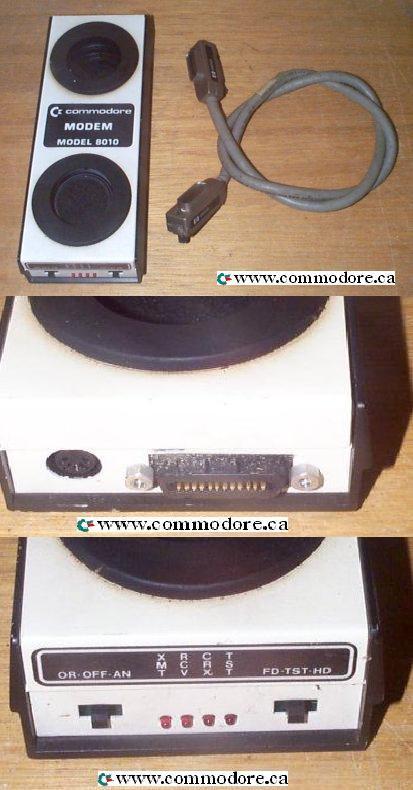
Hi Ethan,
>> I am looking for:
>>
>> - Information on the power supply - I did not get a power supply
>> with the modem - it has a 5-pin DIN type connector. Can anyone
>> give me the pinout and power requirements?
>Can't help there, but worst case, it shouldn't be difficult to
>reverse-engineer the power supply... if there is some kind of
>regulator, it might take a wide range of voltages. If not, then
>one of the pins is probably +5V. It's old enough that I wouldn't
>assume it uses a C-64 supply or even the voltages for the C-64
>(+5VDC, 9VAC), but it's worth looking at.
Thats my plan-B - but I'm hopeing someone has this modem and can
at least measure the supplies - Sometimes older analog stuff uses
"funny" voltages and it might not be obvious what the supplies are
supposed to be - agreed that it should be easy to identify 5V for the
logic - it appears to be "completely manual" with switches for Answer-
Off-Originate, so I don't think there's much logic except for the IEEE
interface.
>> - Documentation? Anyone have a scan of the manual?
>Not me; sorry. Perhaps on funet?
Didn't find anything on funet - but I will continue to look. Not much
mention of this device at all that I could find via google.
>> - Information on how it is used ... What sort of IEEE device does it
>> show up as? Is there "special software" that is used with it? etc.?
>
>Worst case, you could write a quick BASIC program to try OPENing all the
>devices from 4 to 31 and see where it responds (once you get the power
>issue resolved). Without docs, it'll be hard to tell if there are any
>significant secondary addresses, though.
Yeah - not that I have a burning desire to communiate at 300bps, but I
like to get everything that I collect working ... I did find a couple of
references to software for this modem, which I am trying to track down.
I've never used an IEEE modem on a PET, so it might be "interesting" to
try and figure it out on my own...
>Nice find. I've never seen one. Good luck on the hunt for docs.
Here's a picture I found ... I will be adding my own pics to my site on the
next update (but I just updated it so it will be a while):
http://www.commodore.ca/gallery/hardware/pet_acc_coupler1.JPG
Regards,
Dave
--------------------------------------------------------------------
mail2web - Check your email from the web at
http://mail2web.com/ .
>From: "Dave Dunfield" <dave04a(a)dunfield.com>
>
>>>> -- I took apart the 25's battery pack and replaced the nicads with
>>>> nickel metal hydride cells (the same ones I use in my camera)
>>>
>>> Not a good idea. Nickle metal hydrides need different types of
>>> charging. The won't last long with a NiCad charging circuit.
>>
>>I won't charge them in the calculator, they are regular AA cells so I
>>can remove them and put them in a proper charger. :^)
>
>Here's a question for battery guru's ... I have a gadget I built for
>preventing "memory effect" in various nicad powered devices - mainly
>ones like my Digicams which only discharge the battery 1/2 way (or
>less) before complaining that the battery is low.
>
>It is basically two springy metal bars which lets me put up to 10 AA or
>C cells in parallel to discharge (I've got portable @M and 70CM rigs powered
>by a C cell pack), an Ammeter, a low resistance, and a stud rectifier diode.
>
>Basically, it draws about an amp from the cell when they are near fully
>changed, and trickles down to nothing as they approach .7ish volts, and
>never lets them go to zero.
>
Hi
Actually, NiCad's can be discharged to zero without problems. It
is tha back charging in stack, as batteries, that causes the problems.
In fact, NiCad's are often shipped with shorting bars across the
terminals.
>I works REALLY well with nicads - I've got cells that I've been using in
>my radios for many years and they still work very well (Prior to using
>this, they would noticably lose capacity after a while)...
>
>But: It doesn't seem to be quite as effective with NMIH cells ... they
>still seem to be losing capacity ...
These cells shouldn't be discharged to zero. Just different technology.
One thing you might try ( as an experiment ). Hit them with a momentary
high current load. This is done on NiCad's to improve their performance
and may have a similar effect on nickle metal hydrides. It does need
to be controlled because like NiCad's, once the burst seal is broken,
expect them to be worthless in a few months.
Dwight
>
>Any explaination, comments etc.?
>
>Regards,
>Dave
>
>
>--
>dave04a (at) Dave Dunfield
>dunfield (dot) Firmware development services & tools: www.dunfield.com
>com Vintage computing equipment collector.
> http://www.parse.com/~ddunfield/museum/index.html
>
>
>
Hi all,
thanks for all the responses, I have some leads now.
Here is a report what I tried so far.
Searching the Internet, I found the setup files set320p and pwr320p for
the DECpc 320P. Alas, the setup allows several items to be configured,
but the hard disk is not one of them!
Next, I found Ontrack DiskManager versions for IBM and for Microscience,
but the IBM version stops because it does not detect a hard disk of their
brand. BTW, my 2.5" hard disk is from HP, type C2965A.
The Microscience version allows 7 different types to be set, but up till
now I did not get satisfactory results. I can get to 50 Mb, but compared
to the original hard disk (40Mb) that is not much gain, especially when
you think that the C2965A is 420 Mb ...!
I also have the version from Western Digital, EZ-Drive (Data Lifeguard)
but this version also stops because the disk is not from WD.
Not yet tried is a version from Fujitsu, and the version I received from
Pete (thanks Pete!).
I guess it's clear what I will be doing this weekend :-)
thanks for all the help and advice,
- Henk, PA8PDP.
> From: Jay West <jwest(a)huey.classiccmp.org>
> Just got a call from a PDP-11/05 customer in Cleveland OH. They are in a
> crisis situation due to a dead 11/05. They suspect memory problems but
> there may be power supply issues as well.
>
> If there is anyone local to them with 11/05 parts and or expertise, can
> you please call me right away?
>
> Best number to reach me right now is 314-494-7338
>
> This company is willing to pay for help as the 11/05 being down takes
> their milling machine down.
Probably too far away, but some thoughts.
Be careful what cards you pull out as the power supply has a crowbar
arrangement that trips if you have too light a load (DC supply line voltage
rises above trip point). Case of refer to the manual and check the supply
voltages. Relatively easy on the 11/05 if you have the maintenance manual.
The processor & power supply can be checked by storing and executing
instructions from the general registers. If you can't store/read from front
panel you probably have a power supply problem or problems with that logic.
If the problem is down to the processor boards you really need a hex width
extension card and the maintenance cards to single step the processor.
Core memory can be tested and then track down problems with a CRO if you
can't board swap your way out of trouble. If caught with dead
core and you have the 10-1/2" high processor unit can install later generation
MUD then install a MOS memory board. Just have to move the power
cabling.
At 09:42 PM 10/21/2004, you wrote:
> >>> HITS NAIL ON HEAD
>
>1) I know many hardware hackers who don't know a compiler from a debugger
>[Thinking of some of my Ham buddies]....
Debugger? Isn't that what printf("at step
2\r\n"); and while(!kbhit()); are for?
>2) I tend to hit finger with hammer and from nail.
You type good, must not be using hammer much, eh?
:-)
Ed K.
At 06:59 22/10/2004 -0400, you wrote:
>At 09:30 PM 10/21/2004, you wrote:
>>But: It doesn't seem to be quite as effective with NMIH cells ... they
>>still seem to be losing capacity ...
>>
>>Any explaination, comments etc.?
>
>NiCad are better than NiMH longevity wise.
>
>Here's link to place I found helpful in explaining:
>
>http://www.buchmann.ca/chap10-page1.asp
Thanks Ed,
Lots of useful information - I normally cycle/discharge the nicads
every couple of months - looks like I want to space that out for the
NMIH - I did not realize that they had so much less charge/discharge
endurance (a fact that the manufacturers seem to have forgotten to
mention in their comparisons).
Regards,
Dave
--
dave04a (at) Dave Dunfield
dunfield (dot) Firmware development services & tools: www.dunfield.com
com Vintage computing equipment collector.
http://www.parse.com/~ddunfield/museum/index.html
>>> -- I took apart the 25's battery pack and replaced the nicads with
>>> nickel metal hydride cells (the same ones I use in my camera)
>>
>> Not a good idea. Nickle metal hydrides need different types of
>> charging. The won't last long with a NiCad charging circuit.
>
>I won't charge them in the calculator, they are regular AA cells so I
>can remove them and put them in a proper charger. :^)
Here's a question for battery guru's ... I have a gadget I built for
preventing "memory effect" in various nicad powered devices - mainly
ones like my Digicams which only discharge the battery 1/2 way (or
less) before complaining that the battery is low.
It is basically two springy metal bars which lets me put up to 10 AA or
C cells in parallel to discharge (I've got portable @M and 70CM rigs powered
by a C cell pack), an Ammeter, a low resistance, and a stud rectifier diode.
Basically, it draws about an amp from the cell when they are near fully
changed, and trickles down to nothing as they approach .7ish volts, and
never lets them go to zero.
I works REALLY well with nicads - I've got cells that I've been using in
my radios for many years and they still work very well (Prior to using
this, they would noticably lose capacity after a while)...
But: It doesn't seem to be quite as effective with NMIH cells ... they
still seem to be losing capacity ...
Any explaination, comments etc.?
Regards,
Dave
--
dave04a (at) Dave Dunfield
dunfield (dot) Firmware development services & tools: www.dunfield.com
com Vintage computing equipment collector.
http://www.parse.com/~ddunfield/museum/index.html
Thanks for the info on NMIH.
>2. NiCD batteries never had a memory effect either!
I knew this would spark a thread on the existance or non-existance of memroy
effect - I think they are a lot better now than they were (as are chargers),
however Nicads (especially older ones) which regularily discharged only partly
do lose capacity - I have observed it.
>I think what can happen is that some cells discharge a lot sooner than
>others, since in the real world the internal R is lower for some cells than
>others. Since you are now pulling current *backwards* through at least one
>cell in the stack, odd are good that some day one of the cells is going to
>reverse on you, and become a highly inefficient inverted battery, one
>that's unlikely to ever take an appreciable charge again. This is a
>real-world problem for discharge devices that don't have both a timer and a
>voltage monitor, and some ever sense temperature too.
Yup - best way to kill a nicad "pack" is to fully discharge it - that is why
I use individual cells, and discharge them in parallel through a diode - no
cell ever goes below .7v.
>Here's a battery maker saying No Memory Effect in currently produced product.
Ah - the catch phrase is "currently produced" - As I indicated above, I think
things have improved... but the Nicad cells I am using are 10+ years old.
I can provide references to manufacturers telling you to be sure and fully
discharge your cells from time to time as well ... it's a question that is
still being debated, and nobody is going to convince anyone else either
way - my personal experience is that calls which are carefully charged,
and just a carefully full-discharged retain their capacity and last a lot
longer than cells which are not fully discharged... Agreed thad modern NMIH
cells do not seem nearly as "sensitive". YMMV.
But ... we drift OT ... thanks for you input.
Regards,
Dave
--
dave04a (at) Dave Dunfield
dunfield (dot) Firmware development services & tools: www.dunfield.com
com Vintage computing equipment collector.
http://www.parse.com/~ddunfield/museum/index.html
> From: "John A. Dundas III" <dundas(a)caltech.edu>
> In a bit of a follow-up to myself, I managed to locate one of the
> mark-sense cards and the template I referred to earlier. Some
> (crude) pictures may be view of each of theses at:
>
> <http://dundas-mac.caltech.edu/~dundas/retro/mark-sense.html>
Very similar to the cards we used but not quite the same. Think the
main body of the card was different. Unfortunately I can't lay my
hands on a sample.
Regards,
Garry
Hello everybody,
as ISTR from some discussions, SGI human interface devices are not easily
replaceable by anything else and are in some demand because it is not
unusual for a machine to arrive sans keyboard, mouse and/or monitor.
University is decommissioning its SGI gear, so I have a chance to grab the
following:
Keyboard SGI No. 062-0002-001 Type RT6856T (2x)
Mouse SGI No. 063-0009-001 (2x)
Monitor (Type designation not available) (2x)
Camera SGI No. 013-1577-001 (2x)
Makes two complete installations minus the computers. These are long gone,
so this is headed for the dumpster unless I call in.
I'm not into SGI stuff yet, so it doesn't make much sense to keep it myself
(unless somebody throws in a CPU for me :-) ), but I thought I'd offer it
here. Don't know how much demand there'll be, so I see what comes in and
then decide where it goes.
This is basically give-away + s&h (I just wanna save it from the scrapper),
but counter-gifts will not be rejected. Shipping is an issue (the monitors
are big and quite heavy!), so local pickup is preferred.
Er, yes, local to Erlangen University, Northern Bavaria, Germany, Europe.
Yours sincerely
--
Arno Kletzander
Stud. Hilfskraft Informatik Sammlung Erlangen
www.iser.uni-erlangen.de
+++ GMX DSL Premiumtarife 3 Monate gratis* + WLAN-Router 0,- EUR* +++
Clevere DSL-Nutzer wechseln jetzt zu GMX: http://www.gmx.net/de/go/dsl
Sorry for the off-topicness... I googled to find a comparison between these
two chips with regards to relative performance and can't find anything. Can
anyone point to a spot that has some definitive comparisons between the two?
Figured someone here might know...
Jay
I have successfully hooked up multiple terminals
(two VT52s and an LA36) to my PDP-11/34 using an
EIA DZ11 (M7819), and they are all working perfectly
on my RSTS/E V7 system, which I SYSGENed for two
DZ11s. I have also installed a 20mA DZ11 (M7814)
and its associated distribution panel and now I'm
ready to hook up a 20mA VT52 and an ASR-33 teletype.
I have good documentation on the VT52 and how to
get it connected, but the documentation that I have
on the ASR-33 does not seem to show how to connect
it to a computer.
Can someone who has done this before give me some
pointers? This surely is a trivial task, but I have
not dug deeply enough into the documentation to
find out how to do this yet. My ASR-33 works fine
in local mode, punches and reads paper tape just
fine, and now I want to hook it up to my system.
Thanks for any help that anyone can provide.
Ashley
I'm looking for a particular book....
"PDP-11 Assembler Language Programming and Machine Organization" by Michael
Singer, softcover
I want this particular one for nostalgic reasons, it's the book I learned
macro-11 on. I saw a copy on ebay, got outbid (so far), but it's with two
other books I don't want. So before bidding further, I thought I'd see if
someone has an extra copy for sale or trade. You can see a picture of the
particular book above by going to ebay item 5131747255 it's the black (with
blue/red/green splotches) book on the left. If anyone has an extra, please
let me know!
Jay West
I have some 5 1/4" hard-sectored disks that contain CPU microcode. They
aren't 'formatted' with a filesystem, but are read with a simple board
that contains some 9602's, a shift register, and a Z80. A dilemma:
should I try to intercept the data from the board, write it to flash
memory, and build a board to replace the whole Z80/hard-sectored disk
thing, *or* try to build something to write the data stream out to
another 5 1/4" disk. The Z80 doesn't care about the sector pulses - only
the index pulse. So I could get away with a standard floppy instead of a
hard-sectored one.
The disk thing would allow me to keep using the original hardware, which
would be nice, but I don't know the first thing about attempting to
write the data stream back to the disk.
I have no backups of the microcode disk, and no way to replace it when
it dies. Every time I fire the thing up I feel I'm getting a little
closer to it's death...
Jim
>But then it still amazes me that I know many programmers who don't own a
>'scope or soldering iron (and wouldn't really know how to use them
>anyway), but I don't know a single hardware hacker who doesn't have a C
>compiler and know how to use it.
The best hardware guy I know (by a lot) barely does any software - doesn't
know (or have) C, but has been known to do a quick-and-dirty BASIC program
when he has to. He does however understand low-level software and how it
relates to hardware very well - he has an uncanny abiilty to find the lowest
cost way to implement something and still make it "reasonable" from a
software point of view.
[I'm officially a software guy, but I have 3 scopes and a couple of
soldering stations (even a desoldering station) - but I do agree: most
software guys I know are not like that]
Regards,
Dave
--
dave04a (at) Dave Dunfield
dunfield (dot) Firmware development services & tools: www.dunfield.com
com Vintage computing equipment collector.
http://www.parse.com/~ddunfield/museum/index.html
The PC approach is to somehow wangle the five ADCs into the PC
such that it will accept the 65536 5-byte (5-nybble) samples
with ZERO LATENCY.
--
The design I did for the analog 9 track data aquisition board
uses five Analog Devices 10 bit dual 10megasample A/D's. These
have parallel outs, and are synchronous (designed for direct
IF amplifier digitization). The five are multiplexed into a
FIFO which interfaces to a 40 pin cable to a PCI DMA IDE card.
So, you end up with a ten channel synchronous data stream with
a protocol that just looks like chained IDE DMAs.
Shorewood High School to a DEC timesharing
system at the UW-Milwaukee...
--
That was the system... Run by Prof. Len Levine, Richard Bartlein,
Sam Millosovich and several waves of student volunteers (incl me..)
Len gave pretty much anyone in Milwaukee an account that asked. He
was responsible for a lot of folks in the SE Wisconsin area having
their first exposure to computers.
The User's Manual for UWM's TSS/8 is up at
www.bitsavers.org/pdf/uwMilwaukee/UWM_TSS8_UsersGuide_Jul74.pdf
> Other than software for the PDP-8 was there any low cost time sharing systems
> that you can still find software for?
"low cost time sharing system" was almost an oxymoron in the 60's and early 70's
Both the cost of core, and for mass storage devices kept computer configurations
capable of timesharing pretty expensive. TSS-8 was probably the first timesharing
system for $50,000. As I recall, the final configuration of the TSS/8 system I
used at the University of Wisconsin - Milwaukee was closer to $100K by the time
we added the KL8/E's and RK05's. Early RSTS (originally called Edusystem-100) was
somewhat less expensive, but the pre RSTS/E systems were pretty limited.
There are a few other timesharing systems from the 60s for which software has
been found that I'm aware of:
Some bits of CTSS at Paul Pierce's web site
Some of the MIT PDP-1 timesharing system
The SDS-940 GENIE timesharing system
The BCC-500 timesharing system. (I just received permission to release this)
The Oregon State University OS-3 CDC 3300 timesharing system.
CAL-TSS for the CDC 6400 may be on some 7 track tapes that were just given to
Paul Pierce to read.
There is also the software available for Hercules (TSS-360, for example)
Hi,
I know very little about electronics and eproms so this question might be
really easy. I would like to know what the difference is between a 23512
eprom and a 27512 and if there are any differences if its possible to make
some sort of adapter. Had a look at some schematics and they looked the
same to me, data lines on the same pins etc.
Any help is welcome.
Ow the reason I want to know this is that I want to read some old roms in
my EPROM reader.
Cheers,
Stefan.
>I believe you have to have the VPC extensions for the OS, and that MS-DOS
>isn't a supported OS under VPC7. I bypass this by having a virtual D: Drive
>for DOS and Win98, and booting the Win98 system when I need to copy files
>from the Mac to DOS. I could do it under WinXP, but that would interrupt
>what I have running there, and it takes a lot longer for XP to boot (or
>shutdown).
Yes, I do believe VPC came with drivers to do it under DOS.
Gee, and Connectix swore that MS was not going to bastardize VPC. The
first official MS release and suddenly they don't support old MS
operating systems. What else do they conviently not support?
I am curious if the old VPC drivers would work with the new version.
Maybe all they did was stop releasing the driver set. Do you have an
older version of VPC? I have the 2.0 CD here and it comes with a VPC
drive file that contains DOS drivers for folder sharing, CD access, and
S3 video drivers for Win3.1. Alas, the file is 20 MB so a little big to
email to you (I could stick it on an FTP site if you want). I have NO
idea if these drivers would work with VPC 7 or not.
-chris
<http://www.mythtech.net>
Hi,
Is anyone from the Boston area going to be driving
to the west coast for the VCF, or for any other
reason, anytime in the forseeable future? I'm
trying to get a TTY model 40 printer a hitchhike
out here.
Thanks,
Brian
=-=-=-=-=-=-=-=-=-=-=-=-=-=-=-=-=-=-=-
_| _| _| Brian Knittel
_| _| _| Quarterbyte Systems, Inc.
_| _| _| Tel: 1-510-559-7930
_| _| _| Fax: 1-510-525-6889
_| _| _| Email: brian(a)quarterbyte.com
_| _| _| http://www.quarterbyte.com
On Wed, 20 Oct 2004 21:58:43 -0700, Zane H. Healy <healyzh(a)aracnet.com> wrote:
> Does anyone have any experience running MS-DOS 6.22 on VPC? I've
> managed to get Win3.1 running in SVGA mode at 600x800, and I've got
> some of my old DOS software copied over.
>
> What I really want to know how to do is access the CD-ROM, Ethernet
> Card, and if possible get video drivers for the S3 card that VPC
> emulates. Oh, and I need a mouse driver for the PS/2 Mouse so I can
> run a couple games :^)
>
> In case anyone cares, so far I've gotten the following working:
> AROS
> BeOS 4.5
> BeOS Max
> MS-DOS 6.22/Win 3.1
> Windows 98SE
> Windows XP Pro SP2 (it came with this, so it had better work)
>
> Obviously only Win98 and WinXP support the cooler features such as
> mapping folders on the Mac as network drives, and printing to the Mac
> printer.
>
> Zane
>
> --
> --
> | Zane H. Healy | UNIX Systems Administrator |
> | healyzh(a)aracnet.com (primary) | OpenVMS Enthusiast |
> | | Classic Computer Collector |
> +----------------------------------+----------------------------+
> | Empire of the Petal Throne and Traveller Role Playing, |
> | PDP-10 Emulation and Zane's Computer Museum. |
> | http://www.aracnet.com/~healyzh/ |
>
After reading these posts I feel I have to point out windows has to
be the easiest way to have vms and cp/m running on the same desktop
(no flames). cp/m-86 runs great under vpc on windows. Also the most
important thing I can play leisure suit larry and both police and
space quest as well which I could barely do under 98.. I assume these
would still work using a mac.
Dan
For the general interest of folks who might be generally interested...
---------- Forwarded message ----------
Date: Thu, 21 Oct 2004 16:25:40 EDT
From: K2CBY(a)aol.com
To: milsurplus(a)mailman.qth.net
Subject: [Milsurplus] Relay Racks
For list members in the New York City - Long Island area. There's a guy in
western Suffolk County who has a large number of high quality 19-inch relay
racks for sale in good condition at very reasonable prices. The only downside is
they have to be picked up in person. Contact Thomas Maerz at
_tmishear(a)aol.com_ (mailto:tmishear@aol.com) or (516) 790-8846.
Miles Anderson, K2CBY
16 Round Pond Lane
Sag Harbor, NY 11963
______________________________________________________________
Milsurplus mailing list
Home: http://mailman.qth.net/mailman/listinfo/milsurplus
Help: http://mailman.qth.net/mmfaq.htm
Post: mailto:Milsurplus@mailman.qth.net
Hi Jim
It might be a good idea to check the clock rate of the
data from the disk. If it is that standard 2 uS, per pulse,
one can read it with most any hard sectored controller.
( Heathkit H89 comes to mind )
Getting the data from the disk is the first step. Most
everything after that is just choice of implementation.
Dwight
>From: "Jim Donoghue" <jim(a)smithy.com>
>
>I have some 5 1/4" hard-sectored disks that contain CPU microcode. They
>aren't 'formatted' with a filesystem, but are read with a simple board
>that contains some 9602's, a shift register, and a Z80. A dilemma:
>should I try to intercept the data from the board, write it to flash
>memory, and build a board to replace the whole Z80/hard-sectored disk
>thing, *or* try to build something to write the data stream out to
>another 5 1/4" disk. The Z80 doesn't care about the sector pulses - only
>the index pulse. So I could get away with a standard floppy instead of a
>hard-sectored one.
>
>The disk thing would allow me to keep using the original hardware, which
>would be nice, but I don't know the first thing about attempting to
>write the data stream back to the disk.
>
>I have no backups of the microcode disk, and no way to replace it when
>it dies. Every time I fire the thing up I feel I'm getting a little
>closer to it's death...
>
>Jim
>
>
>
>From: birs23(a)zeelandnet.nl
>
>Hi,
>
>I know very little about electronics and eproms so this question might be
>really easy. I would like to know what the difference is between a 23512
>eprom and a 27512 and if there are any differences if its possible to make
>some sort of adapter. Had a look at some schematics and they looked the
>same to me, data lines on the same pins etc.
>
>Any help is welcome.
>
>Ow the reason I want to know this is that I want to read some old roms in
>my EPROM reader.
>
>Cheers,
>
>Stefan.
>
>
Hi
I think that the 23512 is a EEPROM and the 27512 would be a normal
EPROM. The biggest issue is what to do with the programming voltage
and any auto type sensing. Most newer programmers have a way to
set the programming voltage to 5V instead of what ever. They also
usually include some way to turn off the auto sense that would otherwise
bring one of the pins to a higher than normal voltage. If those
two conditions are met, you should be able to read the 23512.
If there are issues with the select lines being inverted between
the two, I often stack two machine pin sockets. I then can cross
wire what I want by either popping out an unwanted pin or breaking
off the tip of one that I don't want to have connected.
For these two parts, I believe that the address and data line
match.
Note that many programmers keep the programming voltage high,
even when reading since the newer EPROMs are strobed with a
TTL level input for programming. So look out for this. Even if
you don't tell it to program, it can have an unexpected high
voltage on one of the pins.
Dwight
Dwight
Sorry for the tease, it's not really that interesting.
At UC (Univ. Calif.) Irvine surplus is a smallish pile of PC
and Apple goodies. This inventory is from my faulty memory,
don't blame me...
I just got a working HP 6MP printer for $20, disturbingly, half
the cost of repairing my LaserJet 4 (the ordinary rear rollers
crumpling sheets problem). Parallel and appletalk interfaces. A
few more, 5mp and 6mp left. One with a stuck switch but seemed
to work. Got a P120 for $15, works, HDD, flop, CDR, few megs RAM,
and the XVGA PCI card I need to repair another machine.
A bunch (dozen) of Apple LaserWriters, 16/600?
Bunch of iMac type monitors, 17"? 19"? Apple.
A few P120, 486 machines, hard disks, two flavors floppy,
CDRs. Eh.
Some Syquest drives, ext cabs with SCSI, about 4? 6? 8?
Some bunch of other removable high-capacity media, JAZ or
whatever, I don't look at beige objects generally. It's all
"sanitary landfill" (sic) to me.
Assante? Ethernet cards, nuBUS? One with manual, a small thing
with little ables and aadapters, one was bigger. I barely looked.
Prices are CHEEP. Much of the stuff works, it was dumped by
some department upgrading.
Open Tuesdays and Thursdays, only, 10am - 1pm, and 2pm -
5pm. Cash. Open to the public. Mostly junky furniture, very
little tech.
Behind UCI North Campus complex (little cluster of low
buildings), on Jamboree, about 100 ft west of Campus Drive,
Irvine. Arrive from route 73, exit Jamboree or Campus.
At 14:34 21/10/2004 +0000, you wrote:
>On Thu, 2004-10-21 at 07:39 -0400, Dave Dunfield wrote:
>> Anything you would add?
>
>The comment made recently about memory drawing excess current if inputs
>are left floating is interesting though. Proof that you do need to know
>about the system you're testing as taking the modular approach to
>powering up doesn't always work and might actually do more harm than
>good.
Thats true, and there are other concerns - I've seen devices which go thermo
if there's no clock! - Thats why I do this only if I can't test the power
supply separately, and only power it very briefly - long enough to verify
the power rails.
>The other thing I'd add to that is to always use a dummy form of mass
>storage in place of any real media, even after you're confident that the
>power supply is OK - just in case on first full boot the system decides
>to stomp all over the media.
Good point - I always disconnect drives etc. at first power-up, but one
area where I've seen people have trouble is in floppy disks - DON'T USE
THE MASTER DISKETTE ON FIRST ATTEMPT TO BOOT! I always try to find ways
to backup the disks and boot from a copy if at all possible.
I just got a Kaypro in where the guy had tried to boot it after it had
sat for a number of years, got a loud shrieking noise after which the boot
disk was missing a band of oxide - Fortunately, he had the sense not to
try another disk.
Regards,
Dave--
dave04a (at) Dave Dunfield
dunfield (dot) Firmware development services & tools: www.dunfield.com
com Vintage computing equipment collector.
http://www.parse.com/~ddunfield/museum/index.html
> Thus wrote dundas(a)caltech.edu:
>
> > Which reminds me there used to be a series of "EduSystems" for the PDP-8
> > as I recall. -25, -30, etc. The one I used was TU-55/-56 based, though
> > one or more might well have been disk-based. Have any of these been
> > recovered?
>
> Hmmm. Somewhere around here [*] I've got paper tapes of Edu-20 and
> Edu-20-C, both BASIC multiuser systems for 8K+ PDP-8s. They were both for
> paper-tape-only systems, say schools that could only afford the basic 8K
> machine and a few Teletypes. (The Edu-20-C was basically an Edu-20 system
> which could use Edu-25 commands.)
Seem to remember RMIT's EduSystem used mark-sense cards as the Tech
College couldn't afford the the teletype/papertape configuration. Was
there a -15 version?
Regards,
Garry Page
On Oct 21 2004, 10:10, Devon wrote:
> I've used a copy of Ontrack Disk Manager (~version 4?) from Seagate
and it
> works with any brand drive.
[ ... ]
>
> --------Original Message---------
> Date: Thu, 21 Oct 2004 09:52:29 +0200
> From: Gooijen H <GOOI(a)oce.nl>
> Subject: RE: access to BIOS of DECpc
>
> The disk manager was a good idea, I have one old 486 PC with a big
> Western Digital drive, too big to be supported by the BIOS, and the
> EZ-DRIVE disk manager works perfectly here.
> However, EZ-DRIVE only accepts to work with Western Digital drives,
> and the 2.5" hard disk that I have is from HP. The disk manager
> also wants certain settings for the hard disk in the BIOS ...
I've mailed Henk a copy of Ontrack Disk Manager.
--
Pete Peter Turnbull
Network Manager
University of York
I found the SET320P.EXE program on the COMPAQ site, and it allows
several items 'normally' found in a BIOS to be manipulated. Alas,
there is no field to change the hard drive parameters nor the type!
The disk manager was a good idea, I have one old 486 PC with a big
Western Digital drive, too big to be supported by the BIOS, and the
EZ-DRIVE disk manager works perfectly here.
However, EZ-DRIVE only accepts to work with Western Digital drives,
and the 2.5" hard disk that I have is from HP. The disk manager
also wants certain settings for the hard disk in the BIOS ...
Still not giving up / one more try: could somebody point me to a
site that has a non-commercial disk manager (for HP or not restricted
to specific HDDs) or even better e-mail a ZIP with such disk manager?
TIA,
- Henk, PA8PDP.
> -----Original Message-----
> From: cctalk-bounces(a)classiccmp.org
> [mailto:cctalk-bounces@classiccmp.org]On Behalf Of Dr. Ido
> Sent: woensdag 20 oktober 2004 13:18
> To: General Discussion: On-Topic and Off-Topic Posts
> Subject: RE: access to BIOS of DECpc
>
>
> At 01:16 PM 10/20/04 +0200, you wrote:
> > Thanks Dan,
> >
> >I feel a bit silly, but it was late last night is my excuse.
> >"DECpc 320P" in Google gave a link to floppy images on a COMPAQ site.
> >I will try them this evening, but it is good to know that the DECpc
> >"knows" a limited number of hard disks. If I can 'upgrade' to some
> >300 Mb of the 420 Mb capacity it is still better than the 40 Mb that
> >I have available at this point.
>
> If none of the drive types in the BIOS are a close match for
> the HDD you want to use you could use a disk manager.
>
> >From memory they are still available on the Maxtor and Seagate
> websites, but of course those version only work with Maxtor/Seagate
> HDDs. There were commercial versions that weren't restricted to
> specific HDDs, but I wouldn't know where to find them.
>
> I've used them before when I've had no other option, they work ok
> with DOS/Win9x, no idea about other OS's.