Strangely, I receive notice of a computer rescue via fax.
It includes a "works great" Morrow MT-70 (a CP/M era machine) and
a Silver-Reed printer, all with manuals.
Contact Earl Guertler at ejguertler(a)aol.com .
- John
Hi folks,
Had a mail from someone wanting to know which SCSI chip is used in the
Infoserver 150. My own machine is 250 miles away so have any of you got said
machine handy for a quick check?
cheers :)
--
Adrian/Witchy
Owner/Curator of Binary Dinosaurs, quite probably the UK's biggest private
home computer collection
www.binarydinosaurs.co.uk - the online museum
www.aaghverts.co.uk - *the* site for advert whinges!
www.snakebiteandblack.co.uk - former gothic shenanigans :(
Was fiddling with our Decsystem 570 this weekend. Seems like we may have
a PSU fault as the left-hand M8728 MOS memory boards in the crate don't
have a lit green LED on the top, whilst the right-hand boards do. Tried
the obvious swapping memory boards around and the associated A/B control
boards with no luck, and according to the bitsavers docs a problem with
PSU B would knock out that portion of the memory crate's bus.
Anyway, I'm looking for either the schematics for either the MK11 box
controller, or for the M8159 data buffer board.
In particular I need the pin connection diagram for the 40 pin ribbon
cable that runs between the box controller and the M8159 board.
Our Decsystem 570 never had a box controller; instead it had someone's
homebrew attempt at half a box controller - a bunch of LEDs on a single-
width board plugged into slot 26/F of the memory crate, and a couple of
SPDT switches grafted onto the edge of the M8159 board (yuck!). Slot 26
in the MK11 appears to be a spare; someone's added wires beneath to
connect three of the LEDs back to the power supplies, so I know those
are doing the equivalent of the battery status LEDs in a real box
controller.
However, there's three more LEDs on the homebrew board that are soldered
directly to various pins on the box controller connector of the M8159,
and the two bodged switches are connected up to pins here too.
The two switches are unlabelled, so knowing the pinouts of the box
controller connector is the only way of working out what they do.
Working out what the three unknown and unmarked LEDs are for would be
handy too!
The manual for the MK11 doesn't go into detail of connector wiring
though - any have the relevant schematics?
cheers!
Jules
I asked about cleaning up the Flexowriters and a friend of mine
reminded me that the old typewriter shops had vats of solvent that they
would dunk the entire assembly into (taking off electrical and rubber parts
before-hand). These are pretty nasty so I thought that sounding like a
good idea. I was thinking of using minerals spirits. Anybody have any
experience with using that on electromechanical stuff? Any sugggestions? I
thought I'd remove the platen and belt on the RH side and any other rubber
parts that I could see. Does anyone know if there are any parts inside the
Flexowriters that should be removed first?
Joe
I'll be making a trip this weekend to pick up a few ICON's.
Passing throught Toronto from Ottawa on route to Guelph.
Since I'm renting a van for the trip I may have some space for additional
machines.
--
Collector of vintage computers http://www.ncf.ca/~ba600
Machines to trade http://www.ncf.ca/~ba600/trade.html
Open Source Weekend http://www.osw.ca
Hi All,
after some distraction on other projects I picked up my pdp8/e simulator
that runs on the 6809 Core Board. When I stopped a few months ago, I got
the simulator working (as far as I can know with my very limited pdp8/e
knowledge), but the console (yes, blinkenlights!) crashed the software.
That problem is fixed, but what I can not get clear from the books is
the active position of the HALT and SING-STEP switches.
When the Switch Register switches are "down" they produce a logic zero;
the "up" position present logic ones. Likewise for the SW switch.
The momentary switches CLEAR, CONT, and EXAM are "up" in their normal
position, but in that 'block' are also two switches: HALT and SING-STEP.
Are these two active in the "up" or the "down" position?
TIA,
- Henk, PA8PDP.
I have a complete Imagen 8/300 system with Ethernet interface available. It
includes a like-new CX engine (it was on only its second toner cartridge when
I stored it away), spare parts, CX maintenance manuals, etc. Because of the
weight this pretty much has to be a pick up in Gloucester, MA.
Dan Lanciani
ddl(a)danlan.*com
Allright, my grandma called me telling me she saw something I might like
at a fleemarket. Thinking it would probably a typewriter or an SVGA
screen, I still wanted to stop by the fleemarket.
I was wrong.
It's a big, blue, keyboard-folds-down Atlantic Research Corporation
Interview Comstate I.
This is one of the coolest pieces of equipment I've ever seen.
Anyways, it's got a program bank. Are there any other programs availible
out there?
It can function as a 1200bps terminal, and it does.
Anyone know anything about it?
TIA,
--
Tore S Bekkedal <toresbe(a)ifi.uio.no>
Gang - Any tips/pointers appreciated. I have some cassette tape
audio files using 300 baud 8/n/1 format simple fsk 1200/2400Hz
I think. Same audio you would find on a cassette tape for program
storage except in a wav file. Any easy way to demodulate it back into
data? Something like a software (mo)dem that can read the audio file
and create the contents?
Otherwise I will have to type the program in again (yuck) or
read it into the old machine and rig up a serial interface
to transfer it to a new PC running a simulator (more fun but
would rather just extract it directly).
Thanks
--Chuck
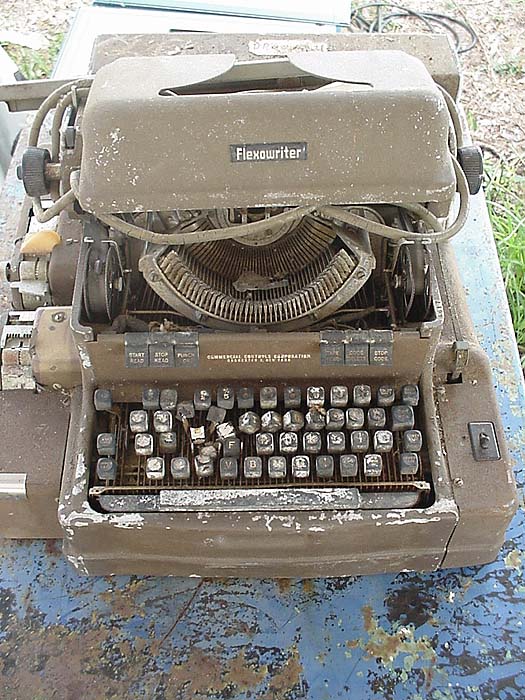
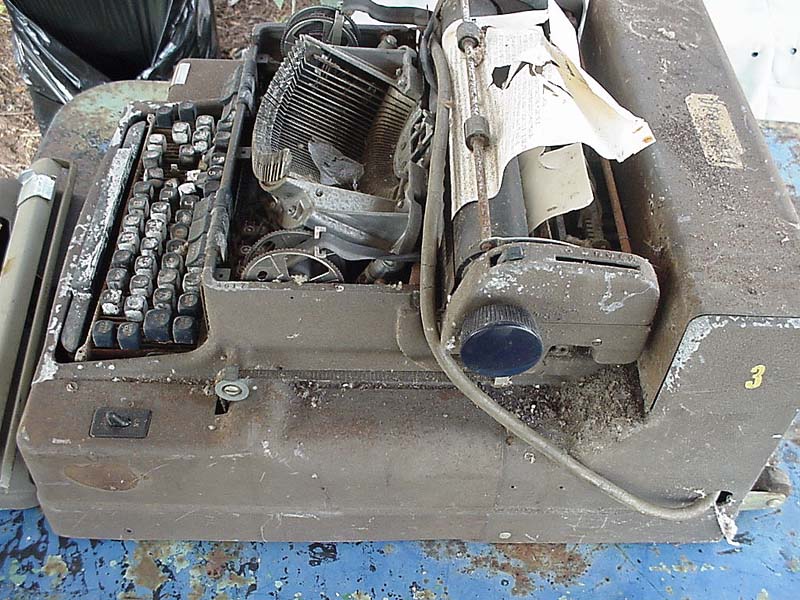
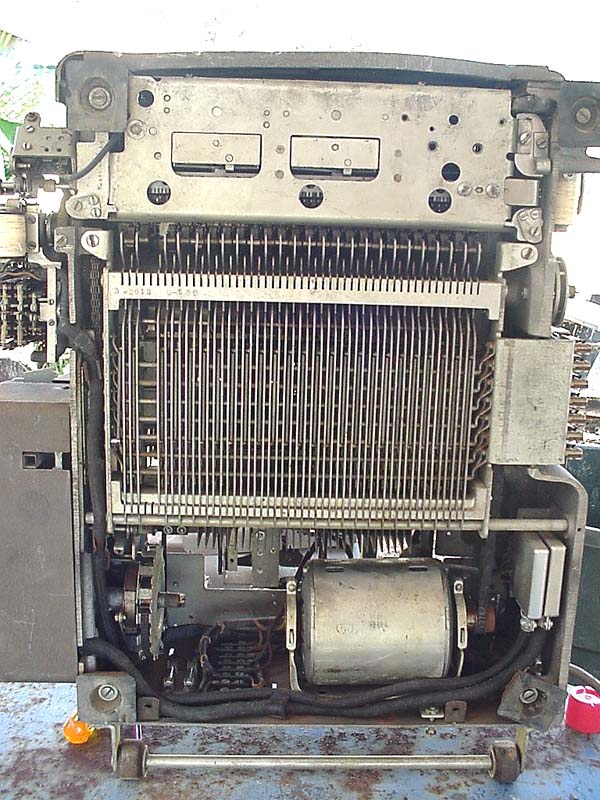
Today I started working on the 2nd Flexowriter. First I should point
out that this is a newer machine than the first one. This one has an
~13,500 serial number and the first one has an ~4,000 serial number. This
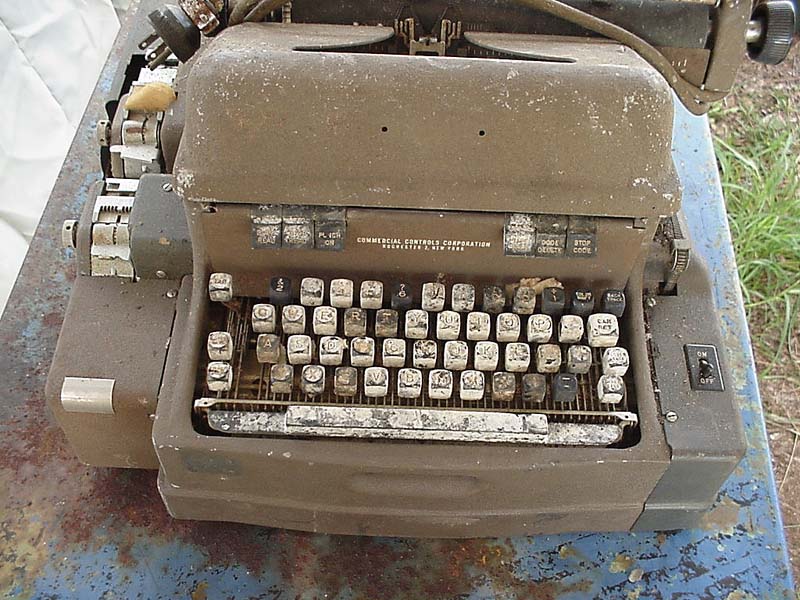
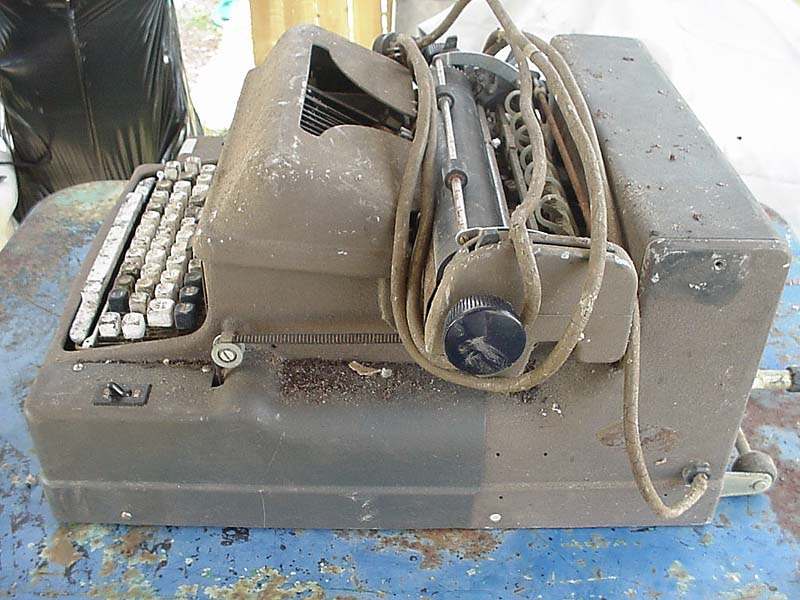
is what it looked like to begin with; front
<http://www.classiccmp.org/hp/flexo2/2front.jpg> and back
<http://www.classiccmp.org/hp/flexo2/2back.jp.g> and right hand side
<http://www.classiccmp.org/hp/flexo2/2right.jpg>. At least the keyboard
hasn't been smashed in this one but you can tell that it hasn't been used
in a LONG time by the mildew on the keys. The keys are supposed to be black
and not white! The power cords of both machines had been wrapped around the
carriage for so long that they had taken a permanent set and they broke
when I tried to unwrap them! The first thing that you notice about this
machine is that all the removeable covers are dark blue instead of brown.
I've been told that sometime in the 60s they changed the machine color from
brown to blue. Perhaps this is a transistion model or maybe somebody just
mixed up the parts during a repair or modification. This is the same model
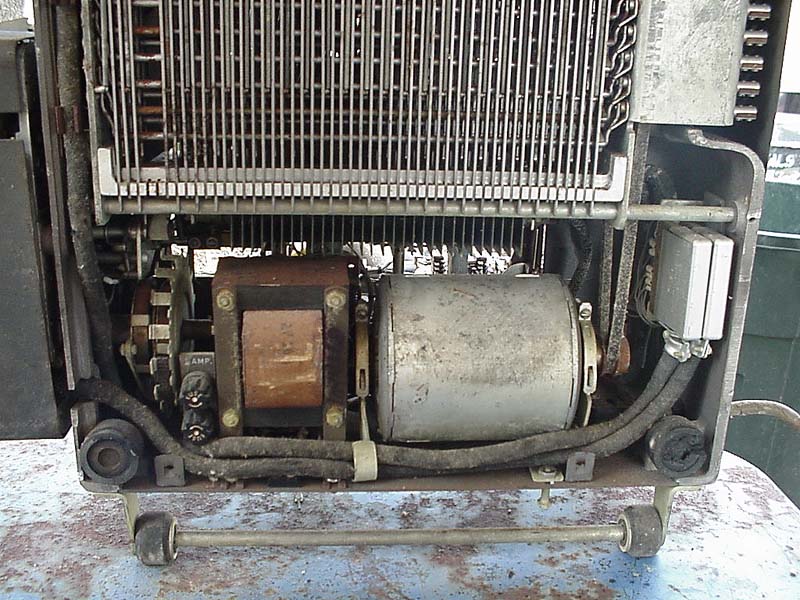
as the first one but it's very different. For one thing it has a
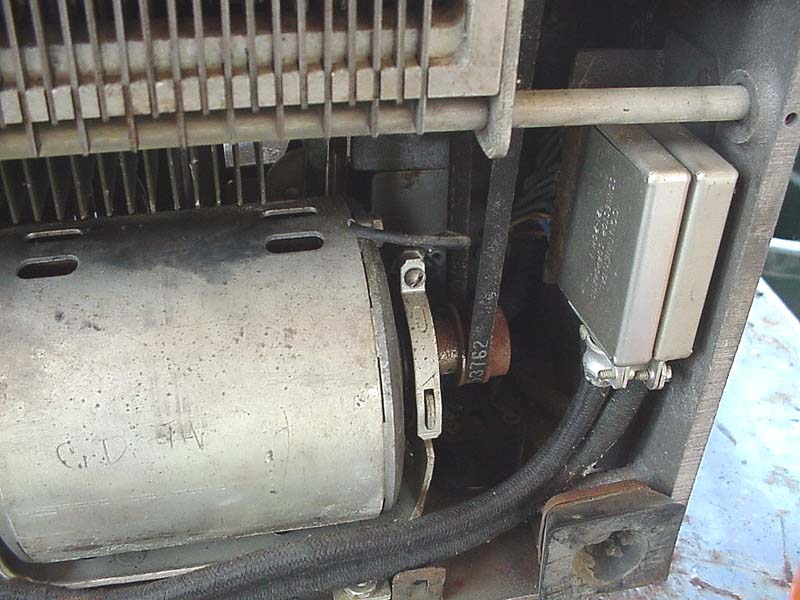
transformer in it <http://www.classiccmp.org/hp/flexo2/2motor.jpg>. It also
has a 2nd circuit board lurking behind the transformer and the fuse holders
are very different from the first machine. But in the back it's even more
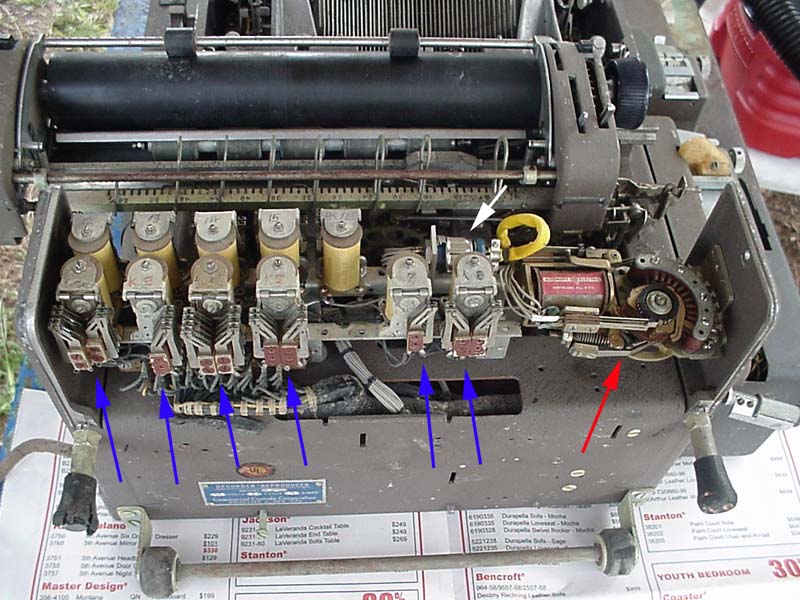
changed. There are a lot more relays in it and the relays have a lot more
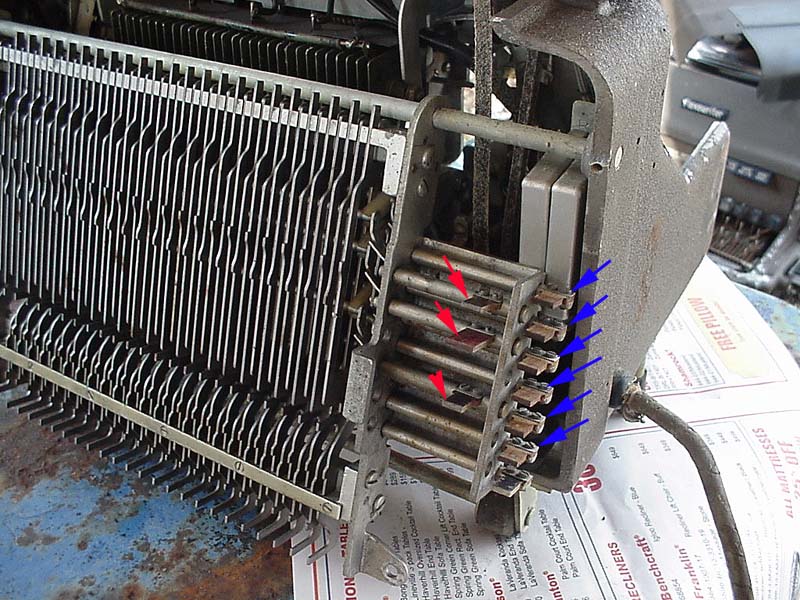
contacts. <http://www.classiccmp.org/hp/flexo2/2relays.jpg>. The blue
arrows show all the new relays and the red arrow shows a stepping relay
that has also been added to this machine. This appears to be a factory
modification since all the brackets, wiring, etc fit perfectly. However all
the added parts use wire with grey plastic insulation instead of the
various colored cloth covered wire used originaly so this appears to have
been done long after the machine was originally built. This mod also uses a
different type connector (white arrow). In addition to the added relays,
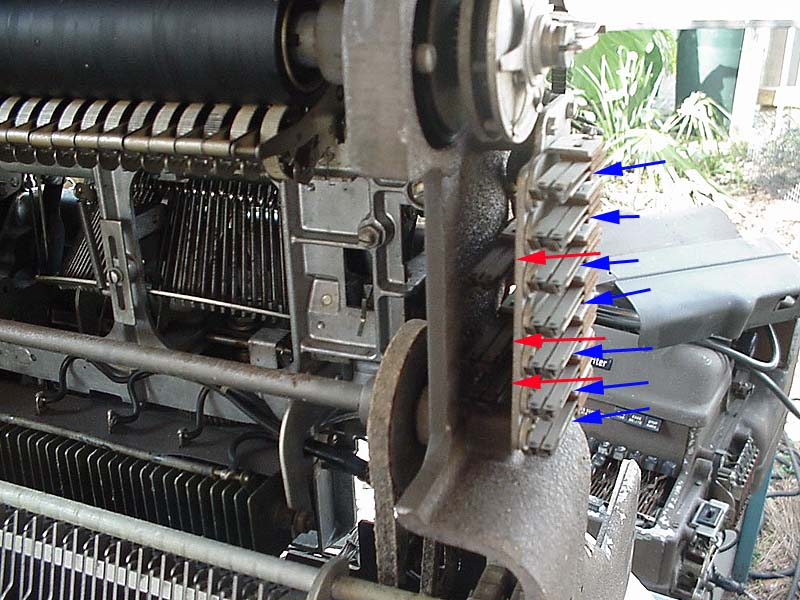
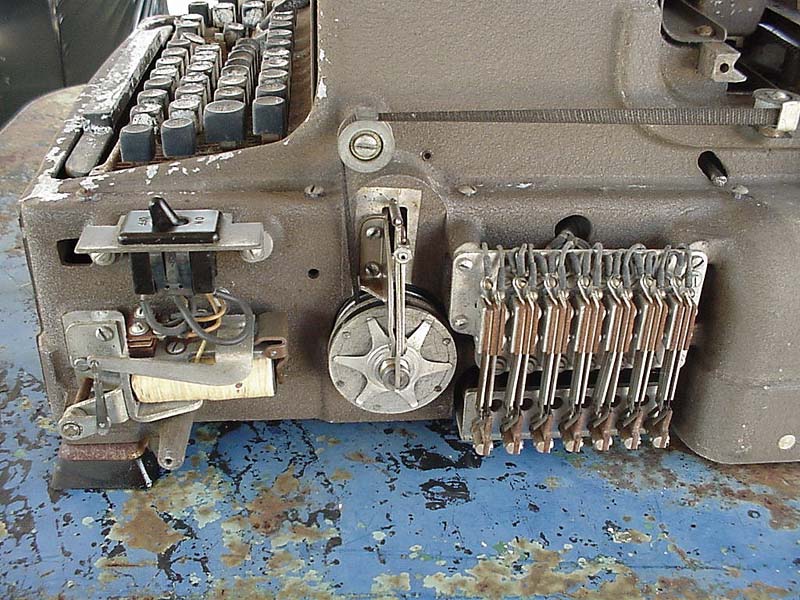
the encoder <http://www.classiccmp.org/hp/flexo2/2encoder.jpg> has three
more switch levers added (red arrows) to the original seven levers (blue
arrows. And of course there are three added sets of switch contacts (red
arrows) on the back of the plate that hold the original seven sets (blue
arrows) <http://www.classiccmp.org/hp/flexo2/2switches.jpg>. All of the
added electrical parts use the same grey plastic insulated wires. Another
change that I spotted was the use of round rubber feet with studs sticking
out of the top and bottom of it (the one in the picture is broken). The top
stud screws into the machine to mount the foot but I don't know for sure
what the bottom stud was supposed to screw into.* The first machine used
square rubber feet that were obviously make to sit on a flat surface such
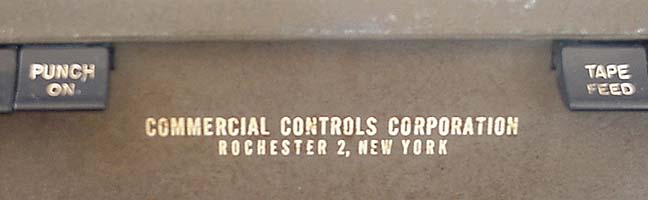
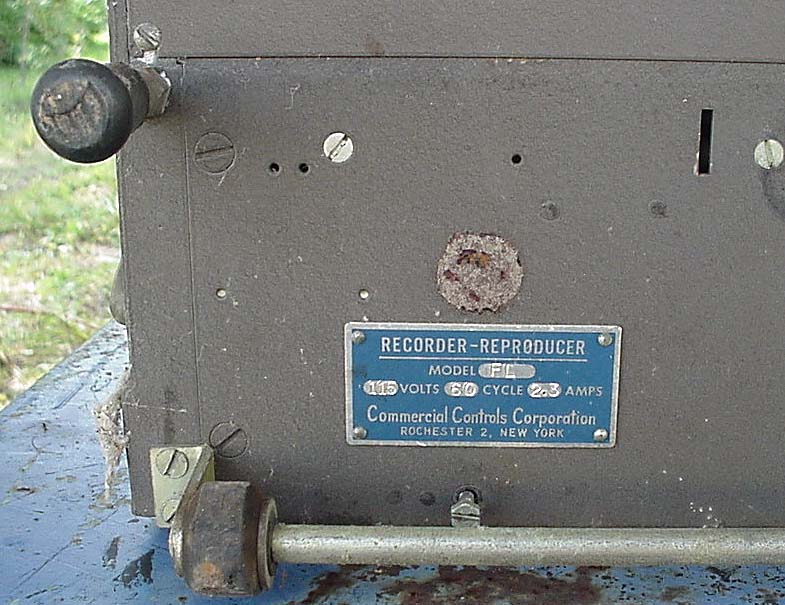
as a table top. Both of these machines were built by Commercial Controls
Corporation prior to it being taken over by Frieden in the early '60s.
<http://www.classiccmp.org/hp/flexo2/CC.jpg>. FWIW Here is also a picture
of the PT punch <http://www.classiccmp.org/hp/flexo2/2punch.jpg>. It's a
modular design and I had to take it off to remove the encoder.
*When I was a kid my dad had several teletype machines. A year of two
ago he told me about another machine that he used to have that printed form
letters from a paper tape. He said that it stopped printing at certain
points and you could manually type in people's names, addresses, etc. He
got rid of the machine many years ago and didn't remember the name on it.
Today I called him and asked him about it and asked if it was a Fleowriter
and he said that it was. He said that he still has a few accessories for it
including a bit bucket and a Frieden marked dust cover. He also said that
his Flexowriter sat on it's own stand. I suppose that that is what the
rubber feet with studs on this machine are intended for.
As I mentioned. I worked on the second machine today. I found that
there's something locking up the carriage and preventing it from going back
to the left. The release buttons have no effect even though all the linkage
is free and moves like it should. The problem seems to be in something
UNDER the carriage. I finally found a escapement behind the carriage and I
pryed over the lever that prevents it from turning backwards and I was able
to move the carriage to the left. I need to find out more about the
escapement and what how it's supposed to work. The shafts in the encoder
<http://www.classiccmp.org/hp/flexo2/2encoder.jpg> that rotate and move the
switch levers were also rusted up. I had to take the encover out and take
it apart and clean the pivots before it worked. Boy getting it all back
together was fun! NOT!
Joe
Any one know anything about a Xerox 6060. I've got a free one to pickup
tomorrow and I'm wondering what it is and is it worth the effort. It's
set up with a 10/10 Bernoulli box too. There doesn't seem to be much on
Google about it as Xerox also uses 6060 as the model number of a large
digital printing press.
James
--
www.blackcube.org The Texas State Home for Wayward and Orphaned Computers
>1) This machines has a large board on top of the mainboard - this board plugs
> into the Z80 socket (the Z80 moves to the top board), as well as a ROM
> socket and the monitor connector - there is also a bunch of "flying leads"
> which connect to various points on the mainboard and attach to a socket/header
> on the top board...
>
> Can anyone tell me what this board is? Is it "normal" on an Osborne-1?
> Neither of my 1A's have this board, and the mainboard appears to be the same...
> Is it perhaps an upgrade of some kind?
>
>2) Has anyone disassembled or otherwise obtained source code to the Osborne
> boot ROM - I would like to try and figure out how far the machine is getting,
> and what it is doing when it restarts.
>
>3) Has anyone seen this behaviour in an Osborne before?
Ok - I've figured just about everything out! ...
The board on top is an 80 column adapter.
The Boot rom listings are in the technical manual (duh!)
The problem with this Osborne is the keyboard! - It is apparently sending a
false key, which is causing the O1 to clear/redraw the screen.
Unfortunately, the keyboard does not look very servicable ... anyone successfully
fixed one of these things? (membrane matrix).
Regards,
Dave
--
dave04a (at) Dave Dunfield
dunfield (dot) Firmware development services & tools: www.dunfield.com
com Vintage computing equipment collector.
http://www.parse.com/~ddunfield/museum/index.html
After the 1A monitor started working, I turned my attention to another
Osborne in need of attention. This is an Osborne-1 - the older one in a
"tan" colored case - not a 1A.
This machine "sort of" works - it powers up, beeps, and displays the
"box" on the screen, along with the "Insert disk in drive A and press
RETURN" message.
At this point however, it seems to keep restarting - the screen continually
clears and redraws the box/message, which creates a flickering effect.
It does not beep as it restarts - experimentation shows that the beep is
enabled at power-up and gets turned OFF by the firmware as part of the init
sequence - it appears the the firmware does not actually turn the beeper ON
at startup, just OFF, so it only beeps after the first power-on (?)
Took it apart and checked all contacts/connections/sockets for corrosion,
reseated everything and still the same operation.
A couple of questions:
1) This machines has a large board on top of the mainboard - this board plugs
into the Z80 socket (the Z80 moves to the top board), as well as a ROM
socket and the monitor connector - there is also a bunch of "flying leads"
which connect to various points on the mainboard and attach to a socket/header
on the top board...
Can anyone tell me what this board is? Is it "normal" on an Osborne-1?
Neither of my 1A's have this board, and the mainboard appears to be the same...
Is it perhaps an upgrade of some kind?
2) Has anyone disassembled or otherwise obtained source code to the Osborne
boot ROM - I would like to try and figure out how far the machine is getting,
and what it is doing when it restarts.
3) Has anyone seen this behaviour in an Osborne before?
Regards,
Dave
--
dave04a (at) Dave Dunfield
dunfield (dot) Firmware development services & tools: www.dunfield.com
com Vintage computing equipment collector.
http://www.parse.com/~ddunfield/museum/index.html
Hi Tony,
>I would start by tracing the horizontal drive signal. My guess (without
>seeing it) is that the 555 is part of the vertical circuit and can be
>ignored for the moment. You may find the horizontal drive signal goes to
>the base of the drive transsitor, transformer coupled to the base of the
>horizontal output transistor, thence to the flyback.
Thats pretty much exactly the circuit --- This monitor is not designed to
be very easy to work on - there's a metal plate right under the circuit
board, and the other side of the board is right up against the neck of
the CRT - makes it pretty hard to take measurements in circuit.
This afternoon, I pulled it all apart, checked continuity through the
flyback, and pulled the horizontal drive transistor and checked it - it
appeared to still be a transistor (correct "diode" junctions from both
B-C and B-E).
So - I put it back together, planning to leave it for another day - on
a whim I tried it, and it worked! - And I used it for a couple of hours
as I checked out the rest of the machine with no further problems.
I still have no idea what the problem was - perhaps a bad contact in one
of the connectors, although I wiggled and jiggled everthing and was unable
to deter the monitor for working perfectly after I put it back together.
Regards,
Dave
--
dave04a (at) Dave Dunfield
dunfield (dot) Firmware development services & tools: www.dunfield.com
com Vintage computing equipment collector.
http://www.parse.com/~ddunfield/museum/index.html
Hi Guys,
I have an Osborne-1 with a bad monitor - I have the technical
manual, which gives schematics for the main logic board and
the disk board, but NOT the monitor.
The monitor is a: Zenith model DS5NF3
Symptoms are:
Its Powered through a single +12v line on the connector,
filiment lights, which suggests power is present.
Horizontal drive, vertical drive and video signals are all
present on the monitor connector.
No light at all, no "buzz" typical of flyback transformer.
Looks like horizontal/high-voltage circuit is dead.
Unfortunately I have no schematic - At least the only IC on
the board is a 555 - hopefully no unobtainium used in this
one (unless it's the flyback :-(
anyone got diagrams or other service information on a
"Zenith DS5NF3" monitor.
Suggestions/debug hints welcome - I'm guessing horizontal
output transistor or flyback ...
[and before anyone asks - yes, this is the one which was
missing it's monitor plug, however I have borrowed the plug
from a working machine and verified that the signals are
getting to the monitor]
Regards,
Dave
--
dave04a (at) Dave Dunfield
dunfield (dot) Firmware development services & tools: www.dunfield.com
com Vintage computing equipment collector.
http://www.parse.com/~ddunfield/museum/index.html
Greetings.
I have a PDP-11 H960 rack (empty BA23's) and some Fujitsu Eagles in
storage, which must be removed Monday. There are also some Pets, I
think, which are 2nd generation models, i.e. 8032's.
It is time for most of this gear to find new homes. I could use a
helping hand on Monday to load the truck. First on scene gets first
dibs on goodies, and I'll drive the truck reasonable distances from
LAX.
If you are interested, please contact me immediately with a phone
number.
Regards,
Eliot
----------------------------------------------
Mailblocks - A Better Way to Do Email
http://about.mailblocks.com/info
Anybody interested in a Gould Biomation model 1650-D logic recorder?
I comes with 11 probes, but no manual.
On top of the unit is a model 116 display AY control mounted.
Picture of this device at 'www.groenenberg.net/pic/MSC/biomation.jpg'
I prefer to swap it for some PDP related stuff btw.
Ed
--
edward(a)groenenberg.net | Collector of PDP-11's.
http://www.groenenberg.net | Politici zijn vieze oplichters.
Unix Lives! M$ Windows is crap.
'97 TL1000S
Recently picked up an Osborne-1 which is missing it's video jumper
plug - this is the small block to the right of the keyboard connector
which enables the internal monitor, and is removed to connect an
external monitor.
I know I can make one - but I thought I'd check here to see if anyone
has a "parts" or beyond-repair Osborne that might have a spare of the
original jumper block.
This is an Osborne-1A - the second edition, however I believe the jumper
block is the same on both versions.
Thanks,
Dave
--
dave04a (at) Dave Dunfield
dunfield (dot) Firmware development services & tools: www.dunfield.com
com Vintage computing equipment collector.
http://www.parse.com/~ddunfield/museum/index.html
Al pointed me to some information about the Flexowriter on Herb Johnson's
website. It seems that the Flexowriters have been around since at least WW
II and was orignally made by Commercial Controls. CC was bought out by
Frieden sometime doing the 1960s. The original Flexowriter only had a PT
reader and punch and no external I/O and was used for generating form
letters. Notable, It was used by the US government to write letters to
relatives who lost family members in WW-II. Later new models were created
by adding interfaces and a 2nd punch and 2nd reader. The two machines that
I have appear to be original Commercial Controls FL models without the
external I/O interfaces. Oh, I'll throw in a bit more history about these
two particular machines. These two originally came from the US Air Force
Missile Test Range. Anybody remember what that was? It was the original
name for what is now called Kennedy Space Center. Originally just called
Cape Canaveral after the geographical feature, it was used as a missile
test range starting in the late 1940s and was called US Air Force Missile
Test Range. The name was changed to the US Air Force Eastern Test Range
about 1959 when NASA choose it to be the site and their manned launches and
it was renamed to Cape Kennedy after the death of President Kennedy in
1963. Footnote: Not many people realize it but the Cape Kennedy name was
not officially recognized so the land is still Cape Canaveral but the
facility was officially named Cape Kennedy in 1963 and is currently named
the Kennedy Space Center. Another footnote: For many years I worked for
Martin Marietta in Orlando Florida. The Orlando facility was originaly
built in 1958. MMC chose Orlando due to it's location close to to the
Missile Test Range at Cape Canaveral since they originally planned to buid
the Pershing missiles here and test fire them from Cape Canaveral.
Herb has a short interview with an X-Flexowriter repair/salesman posted
on his site at <http://njcc.com/~hjohnson/s_flex.html>. For anyone that's
interested.
Joe
I just acquired an old (on-topic)(I think) HP 9195A
flatbed scanner... because it has an ADF (Automatic Document
Feed). Likely it's only 300dpi monochrome, but I want it only
for mass-scanning of (on-topic) crufty docs. (I have a nice,
newish flatbed 2**20 color, 2petapixel/inch scanner I paid
nearly $20 for, 15 minutes ago, but it requires a hairy meat
arm to feed it sheets.)
I found & downloaded the sj121en1.exe driver, which is the
most-recent version, for Win95. I don't have a Win95 machine
(I actually own zero win/dos computers) but bought a loaded
Dell P120 for such things.
My questions are all obvious:
* has anyone used this scanner on linux? (parallel interface, mind you)
* does it work under wine, vmware, dosemu?
* Will it work under WinXP? Win98? DOS?
I do have legit Win95 CDRs to install, as a desparate last
resort. Don't make me install it please!
Sorry, last one. This was the one I called up upon ($300)
http://www.technoland.com/tl_mb8000.htm
Ram
-----Original Message-----
From: Philip Pemberton [mailto:philpem@dsl.pipex.com]
Sent: Thursday, November 04, 2004 2:33 PM
To: cctalk(a)classiccmp.org
Subject: Re: GPIB Interface
In message <1ACBE318-2E8B-11D9-B151-003065B0DA30(a)comcast.net>
CRC <technobug(a)comcast.net> wrote:
> For those interested in hooking up GPIB equipment to your VAXen, I ran
> across on ePay an IEZ11 SCSI to GPIB interface that was designed for
> VMS.
> <http://cgi.ebay.com/ws/eBayISAPI.dll?
> ViewItem&category=39969&item=5136038770&rd=1>. Open VMS has a driver
> for the beast albeit retired...
Speaking of GPIB... Does anyone have a spare PCI or PCMCIA GPIB interface
lying around? I've been looking into upgrading the machine I use for
downloading IA files to my logic analyser, but no-one seems to sell PC
motherboards that have both an ISA slot and an AGP slot, and take a fairly
recent CPU. That and PCI GPIB cards seem to sell on ebay for stupidly high
prices - I saw one listed as "Untested, no warranty" go for nearly $300...
Later.
--
Phil. | Acorn Risc PC600 Mk3, SA202, 64MB, 6GB,
philpem(a)philpem.me.uk | ViewFinder, 10BaseT Ethernet, 2-slice,
http://www.philpem.me.uk/ | 48xCD, ARCINv6c IDE, SCSI
... Apple: "I know! Let's call it the Raincoat."
(c) 2004 OpenLink Financial
Copyright in this message and any attachments remains with us. It is
confidential and may be legally privileged. If this message is not
intended for you it must not be read, copied or used by you or
disclosed to anyone else. Please advise the sender immediately if
you have received this message in error.
Although this message and any attachments are believed to be free of
any virus or other defect that might affect any computer system into
which it is received and opened, it is the responsibility of the
recipient to ensure that it is virus free and no responsibility
is accepted by Open Link Financial, Inc. for any loss or damage in any
way arising from its use.
and another for less than $300...
http://www.baber.com/baber/411/soyo_sy-p4i-845pe-isa.htm
Cheers,
Ram
-----Original Message-----
From: Philip Pemberton [mailto:philpem@dsl.pipex.com]
Sent: Thursday, November 04, 2004 2:33 PM
To: cctalk(a)classiccmp.org
Subject: Re: GPIB Interface
In message <1ACBE318-2E8B-11D9-B151-003065B0DA30(a)comcast.net>
CRC <technobug(a)comcast.net> wrote:
> For those interested in hooking up GPIB equipment to your VAXen, I ran
> across on ePay an IEZ11 SCSI to GPIB interface that was designed for
> VMS.
> <http://cgi.ebay.com/ws/eBayISAPI.dll?
> ViewItem&category=39969&item=5136038770&rd=1>. Open VMS has a driver
> for the beast albeit retired...
Speaking of GPIB... Does anyone have a spare PCI or PCMCIA GPIB interface
lying around? I've been looking into upgrading the machine I use for
downloading IA files to my logic analyser, but no-one seems to sell PC
motherboards that have both an ISA slot and an AGP slot, and take a fairly
recent CPU. That and PCI GPIB cards seem to sell on ebay for stupidly high
prices - I saw one listed as "Untested, no warranty" go for nearly $300...
Later.
--
Phil. | Acorn Risc PC600 Mk3, SA202, 64MB, 6GB,
philpem(a)philpem.me.uk | ViewFinder, 10BaseT Ethernet, 2-slice,
http://www.philpem.me.uk/ | 48xCD, ARCINv6c IDE, SCSI
... Apple: "I know! Let's call it the Raincoat."
(c) 2004 OpenLink Financial
Copyright in this message and any attachments remains with us. It is
confidential and may be legally privileged. If this message is not
intended for you it must not be read, copied or used by you or
disclosed to anyone else. Please advise the sender immediately if
you have received this message in error.
Although this message and any attachments are believed to be free of
any virus or other defect that might affect any computer system into
which it is received and opened, it is the responsibility of the
recipient to ensure that it is virus free and no responsibility
is accepted by Open Link Financial, Inc. for any loss or damage in any
way arising from its use.
That is not true. There are several Pentium4-based AGP, ISA, PCI based
motherboards. I went a different route for my transputers which are
ISA-based for the most part (I use an SBC Pentium4 with 8 ISA, and 12 PCI
slots). The problem is that they are a bit expensive compared to a regular
Pentium4 motherboard. The necessity is due to the tremendous amount of
industrial equipment that needs to continue running on an ISA-based machine.
Here is one:
http://www.cyberresearch.com/store/product/776.2.htm (This one is on the
expensive side, but I saw one for about $300)...
Cheers,
ram
-----Original Message-----
From: Philip Pemberton [mailto:philpem@dsl.pipex.com]
Sent: Thursday, November 04, 2004 2:33 PM
To: cctalk(a)classiccmp.org
Subject: Re: GPIB Interface
In message <1ACBE318-2E8B-11D9-B151-003065B0DA30(a)comcast.net>
CRC <technobug(a)comcast.net> wrote:
> For those interested in hooking up GPIB equipment to your VAXen, I ran
> across on ePay an IEZ11 SCSI to GPIB interface that was designed for
> VMS.
> <http://cgi.ebay.com/ws/eBayISAPI.dll?
> ViewItem&category=39969&item=5136038770&rd=1>. Open VMS has a driver
> for the beast albeit retired...
Speaking of GPIB... Does anyone have a spare PCI or PCMCIA GPIB interface
lying around? I've been looking into upgrading the machine I use for
downloading IA files to my logic analyser, but no-one seems to sell PC
motherboards that have both an ISA slot and an AGP slot, and take a fairly
recent CPU. That and PCI GPIB cards seem to sell on ebay for stupidly high
prices - I saw one listed as "Untested, no warranty" go for nearly $300...
Later.
--
Phil. | Acorn Risc PC600 Mk3, SA202, 64MB, 6GB,
philpem(a)philpem.me.uk | ViewFinder, 10BaseT Ethernet, 2-slice,
http://www.philpem.me.uk/ | 48xCD, ARCINv6c IDE, SCSI
... Apple: "I know! Let's call it the Raincoat."
(c) 2004 OpenLink Financial
Copyright in this message and any attachments remains with us. It is
confidential and may be legally privileged. If this message is not
intended for you it must not be read, copied or used by you or
disclosed to anyone else. Please advise the sender immediately if
you have received this message in error.
Although this message and any attachments are believed to be free of
any virus or other defect that might affect any computer system into
which it is received and opened, it is the responsibility of the
recipient to ensure that it is virus free and no responsibility
is accepted by Open Link Financial, Inc. for any loss or damage in any
way arising from its use.
Longest of long shots, but I don't suppose anyone has any spare RML 380Z
keyboards that they don't want, do they? No, I didn't think so...
Anyone know if the same keyboard unit (repackaged into a different shell
or whatever) was ever used with any other machines / terminals of the
time? A quick dismantling of mine shows that they were made my
Alphameric, and that the PCB looks horribly familiar (as does the
name!).
cheers,
Jules
Can someone remind me of the URL for that data recovery place in NZ that
was mentioned on the list a while ago? Thought I'd bookmarked it, can't
find it now...
Someone on one of the local usenet groups that I read was asking about
data recovery from a dead drive; thought I'd mention the NZ place as I
recall them being far cheaper than UK companies...
ta
Jules
>From: "Roger Merchberger" <zmerch(a)30below.com>
>
>Rumor has it that Paul A. Pennington may have mentioned these words:
>> Roger said:
>>
>> > [[ I've been looking for a 'boxed' 6809 system for a long time, say a
>>>Chieftain, Gimix or SWTPC... ]]
>>
>> There's a SWTPC 6809 system on eBay right now:
>>
>>
>>http://cgi.ebay.com/ws/eBayISAPI.dll?ViewItem&category=4193&item=5135265112…
=1
>
>Holy... I guess I don't want one of those that bad anymore...
>
>... Well, OK, maybe I do, but not at that price! :-O I wonder what his
>reserve is...
>
>Thanks,
>Roger "Merch" Merchberger
Hi
I always love the term "Power Up". About all that means
is that some light will go on and there is little or no smoke.
Dwight
Someone (I believe a non-listmember) sent me this pic out of the blue...
DECies will want to see it. It was sent to me with the following quote....
"There are a few of us still out there"
Picture is at http://www.ezwind.net/jwest/RSX11M.jpg
:) Jay West
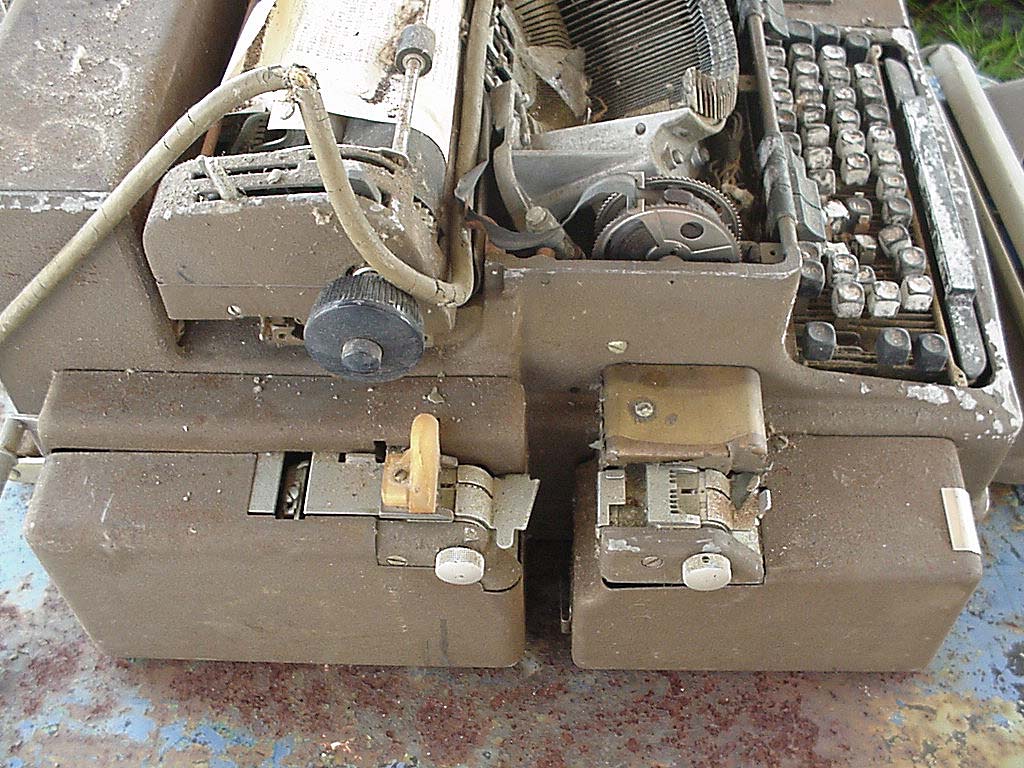
I've been cleaning and repairing the Flexowriter today. While I was
working on it I took some pictures. Here they are. The first ones show it
just the way that I got it. This
<http://www.classiccmp.org/hp/flexo/front.jpg> is what it looked like when
I got it. Here is a picture of the left side with the PT reader and punch
<http://www.classiccmp.org/hp/flexo/punch-reader.jpg>. Here is a picture of
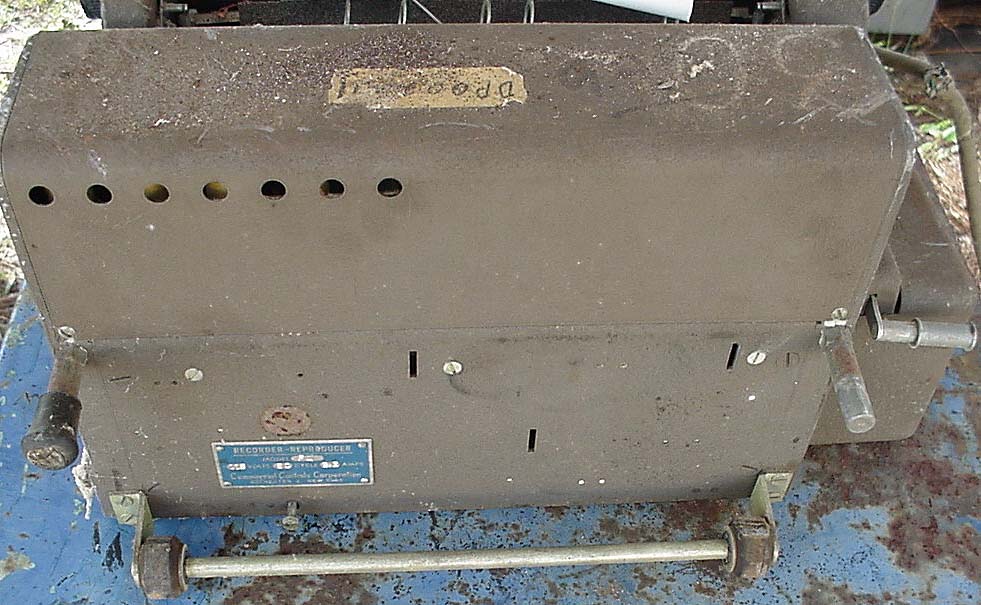
the back showing the label <http://www.classiccmp.org/hp/flexo/label.jpg>.
Right hand side <http://www.classiccmp.org/hp/flexo/right.jpg>. One of
neat things about it is that it has a stand built into the back of it so
that you can stand it up and work underneath it. Here is a picture of the
stand <http://www.classiccmp.org/hp/flexo/stand.jpg>. It has two shafts
that stick out of the back on the machine near the top and a shaft with two
wheels that runs across the bottom. The wheels on the shaft are wood!
OK enough of the "dirty" pictures. Here's some more after I cleaned it
up a bit. Here's what the bottom looks like. Note that it's sitting up on
the built-in stand. <http://www.classiccmp.org/hp/flexo/bottom.jpg>. Here
are closeups of the motor and the two connectors coming from the PT Reader
and Punch <http://www.classiccmp.org/hp/flexo/motor.jpg>. Here is a
closeup of the PT punch with the cover removed,
<http://www.classiccmp.org/hp/flexo/punch.jpg>. And here is a close up of
the PT Reader with the cover removed,
<http://www.classiccmp.org/hp/flexo/reader.jpg>. Another close up of the
bottom showing the self tensioner for the carriage drive belt and AC
terminal strip. The last picture shows the "stuff" on the RH side with the
cover removed. The switches at the RH are used to generate the six bit
character code. I believe the round deice in the center is the clutch for
the carriage drive belt. It seems to be stuck ON at the moment. The belt in
the picture is the one that drives the carriage left and right. I'm not
sure what the electromagnet on the bottom left is for. The power switch is
shown above the electromagnet.
<http://www.classiccmp.org/hp/flexo/carriage%20clutch.jpg>.
Joe
For those interested in hooking up GPIB equipment to your VAXen, I ran
across on ePay an IEZ11 SCSI to GPIB interface that was designed for
VMS.
<http://cgi.ebay.com/ws/eBayISAPI.dll?
ViewItem&category=39969&item=5136038770&rd=1>. Open VMS has a driver
for the beast albeit retired...
CRC
I went by my local recycler yesterday on the hunt for some items and came
away with a list of stuff that might interest folks here.
The main item was a DG Eclipse system in two racks with tape drives and
more. I didn't spend much time looking at it but can probably get more
information if anyone wants it. I also have no idea what the price would
be but I can guess that shipping would be the big consideration anyway.
The same place had a bunch of smaller items as well including a very clean
TRS-80 Mod 3 with a RS dustcover, a Kaypro II, a Franklin Ace 1000, a CoCo
that looked like it had seen better days, what looked like an IBM PC
Portable in its canvas bag, and a Compupro system with the main chassis
and a dual 8" chassis as well (this was wrapped in a pallet and those were
the items I could recognize. There's a few cubic yards of other stuff
mixed in that may or may not be related.)
There were also a good number of vintage terminals stacked about. Several
ADM3as in both blue and beige in various states of decay. Most looked
serviceable with a couple having a bit of screen rot. The couple I turned
on worked. None had the switch covers. There was also a Hazeltine 1500
in nice shape except for the fact that the video was bad and some
TeleVideo 925s and 950s that worked but needed TLC. Newer terminals (DEC
and Wyse, mostly) were all over the place. There was at least one VT100
that was marked as dead but that looked like it had all of the (yellow)
parts.
If anyone wants more info on any of this I'll be happy to get what I can
or to put you in touch with the shop.
Erik Klein
www.vintage-computer.comwww.vintage-computer.com/vcforum
The Vintage Computer Forum
I will be renting a UHAUL truck on Saturday (11/6) to pickup some items
about 20 miles outside of Austin and could use some muscle power. If anyone
on the list lives close to Austin and could meet me at the UHAUL place on
290 W. (in Austin) contact me off list. Thanks I will leaving Houston
around 7AM and be getting there no later than 10:30AM to pick up the truck
and drive on from there.
The transputer CPU was made by INMOS (which was later bought out by
SGS-Thompson which became ST-Microelectronics). However, there were several
manufacturers of transputer equipment. Some of the popular ones are INMOS,
Transtech, Niche, Parsytec, Sundance, and Parsys. See the specs page for a
list of vendors. This is not complete at all and only contains vendors I
have info on. What type of INMOS stuff do you have???
Thanks,
Ram
-----Original Message-----
From: Joe R. [mailto:rigdonj@cfl.rr.com]
Sent: Thursday, November 04, 2004 9:11 AM
To: General Discussion: On-Topic and Off-Topic Posts
Subject: RE: Surviving UK Transputer systems...
At 08:17 AM 11/4/04 -0500, Ram wrote:
>A transputer is just like any other processor with memory, etc, etc.
>Except that it has two unique attributes:
>
>1) Has communication links so that you can hook it up to other
>transputer nodes (or other peripherals). This allowed you to create a
>multiprocessor system with several nodes (seen transputer networks of
>1024 nodes at one time). It was like LEGO for parallel processing.
>The technology that was designed for the transputer is now slowing
>creaping into modern processors. Not bad for a mid 80's processor....
>
>2) Has micro-coded scheduler which allows you to create multi-processes
>inside a single CPU. It supported two priorities in high and low. You
>could do parallel processing in assembly with this baby! This is all
>embedded inside the CPU core. Designed around the mid 80's and had an
>EOL
>(End-of-life) around the late 90's. Quite a remarkable CPU and it was
quite
>fast too compared to the 386 of that era. See my website at
>http://www.classiccmp.org/transputer for more info/links...
I looked at the data sheets on your website so that I would know that the
parts and part numbers looked like. Does anyone other that INMOS and
Thompson make these? I find lots of parallel computing equipment so there
should be some transputer stuff in there too. I have found a lot of high
speed parallel stuff with INMOS parts but I think it's older (early 80s)
than the transputers. But the transputer stuff should show up one day.
Joe
(c) 2004 OpenLink Financial
Copyright in this message and any attachments remains with us. It is
confidential and may be legally privileged. If this message is not
intended for you it must not be read, copied or used by you or
disclosed to anyone else. Please advise the sender immediately if
you have received this message in error.
Although this message and any attachments are believed to be free of
any virus or other defect that might affect any computer system into
which it is received and opened, it is the responsibility of the
recipient to ensure that it is virus free and no responsibility
is accepted by Open Link Financial, Inc. for any loss or damage in any
way arising from its use.
Meiko was actually started by a bunch of former INMOS engineers. They made
their own hardware/software. They had several Computing Surfaces through
the years. The early ones were transputer based and then they switch to
Sparc processors.....
Ram
-----Original Message-----
From: Jules Richardson [mailto:julesrichardsonuk@yahoo.co.uk]
Sent: Thursday, November 04, 2004 9:31 AM
To: cctalk(a)classiccmp.org
Subject: RE: Surviving UK Transputer systems...
On Thu, 2004-11-04 at 09:10 -0500, Joe R. wrote:
> Does anyone other that INMOS and Thompson make these?
I remember using a Meiko computer surface way back when, but I suspect that
may have just been a bunch of Inmos boards behind the scenes (or something
else, and didn't even qualify as a strict transputer system)
Details on the web seem rather hazy unfortunately.
cheers
Jules
(c) 2004 OpenLink Financial
Copyright in this message and any attachments remains with us. It is
confidential and may be legally privileged. If this message is not
intended for you it must not be read, copied or used by you or
disclosed to anyone else. Please advise the sender immediately if
you have received this message in error.
Although this message and any attachments are believed to be free of
any virus or other defect that might affect any computer system into
which it is received and opened, it is the responsibility of the
recipient to ensure that it is virus free and no responsibility
is accepted by Open Link Financial, Inc. for any loss or damage in any
way arising from its use.
A transputer is just like any other processor with memory, etc, etc. Except
that it has two unique attributes:
1) Has communication links so that you can hook it up to other transputer
nodes (or other peripherals). This allowed you to create a multiprocessor
system with several nodes (seen transputer networks of 1024 nodes at one
time). It was like LEGO for parallel processing. The technology that was
designed for the transputer is now slowing creaping into modern processors.
Not bad for a mid 80's processor....
2) Has micro-coded scheduler which allows you to create multi-processes
inside a single CPU. It supported two priorities in high and low. You
could do parallel processing in assembly with this baby! This is all
embedded inside the CPU core. Designed around the mid 80's and had an EOL
(End-of-life) around the late 90's. Quite a remarkable CPU and it was quite
fast too compared to the 386 of that era. See my website at
http://www.classiccmp.org/transputer for more info/links...
Cheers,
Ram
-----Original Message-----
From: charlesb(a)otcgaming.net [mailto:charlesb@otcgaming.net]
Sent: Thursday, November 04, 2004 6:34 AM
To: General Discussion: On-Topic and Off-Topic Posts
Subject: Re: Surviving UK Transputer systems...
excuse the stupid question, but what's a transputer? is it just like a
cluster in a box ?
----- Original Message -----
From: "John Honniball" <coredump(a)gifford.co.uk>
To: <julesrichardsonuk(a)yahoo.co.uk>; "General Discussion: On-Topic and
Off-Topic Posts" <cctalk(a)classiccmp.org>
Sent: Wednesday, November 03, 2004 11:10 PM
Subject: Re: Surviving UK Transputer systems...
> Jules Richardson wrote:
>> Does anyone know of any complete Transputer systems (i.e. several
>> processors, cabinet, front-end control system etc.) from the '90's
>> that still survive within the UK?
---
Outgoing mail is certified Virus Free.
Checked by AVG anti-virus system (http://www.grisoft.com).
Version: 6.0.788 / Virus Database: 533 - Release Date: 01/11/2004
(c) 2004 OpenLink Financial
Copyright in this message and any attachments remains with us. It is
confidential and may be legally privileged. If this message is not
intended for you it must not be read, copied or used by you or
disclosed to anyone else. Please advise the sender immediately if
you have received this message in error.
Although this message and any attachments are believed to be free of
any virus or other defect that might affect any computer system into
which it is received and opened, it is the responsibility of the
recipient to ensure that it is virus free and no responsibility
is accepted by Open Link Financial, Inc. for any loss or damage in any
way arising from its use.
Just picked up an IMSB300-1 on ebay. This is cool as now I can connect my
transputer processors on the network and access them from any machine on the
net. Brings new life to an old friend. After opening it up, much to my
amusement, it is really an off-the-shelf package. It contains nothing but:
1 IMSB018 - standalone transputer board
1 IMSB019 - differential link convertor board
1 IMSB404 - T425-based Size-2 TRAM
1 IMSB431 - Ethernet TRAM
and it boots off of a firmware that is on the IMSB018. That's basically it.
Anyone know how to connect this to a B004/B008? It didn't come with any
cables etc. The links are differential, so I guess I can just connect this
to a differential tram, right??
Cheers,
Ram
(c) 2004 OpenLink Financial
Copyright in this message and any attachments remains with us. It is
confidential and may be legally privileged. If this message is not
intended for you it must not be read, copied or used by you or
disclosed to anyone else. Please advise the sender immediately if
you have received this message in error.
Although this message and any attachments are believed to be free of
any virus or other defect that might affect any computer system into
which it is received and opened, it is the responsibility of the
recipient to ensure that it is virus free and no responsibility
is accepted by Open Link Financial, Inc. for any loss or damage in any
way arising from its use.
Ram's message prompted me to post this, although it's been on my mind
for a while.
Does anyone know of any complete Transputer systems (i.e. several
processors, cabinet, front-end control system etc.) from the '90's that
still survive within the UK?
I'd like to get one for the museum sometime as we don't have any
transputer equipment at present, and it'd be nice to have one on display
and running. My old uni used to have a 140 CPU one that was capable of
doing some nice ray tracing, but I've been unable so far to find out if
they still have it. I imagine it's long gone and either dismantled or
scrapped.
Seems like individual bits turn up all the time (although probably with
a high price tag which doesn't exactly suit a museum!) but not any big
systems.
If anyone knows of any company that used to have anything that might
stand a chance of still being complete and just shelved in storage
anywhere, I could make some enquiries...
cheersy-bye
Jules
--
The most secure computer in the world is one not connected to the
internet. That's why I recommend NTL.
The board is a Niche Technologies NT1000 Advanced Computing Platform. Never
seen one, but that is what it is. Niche became absorbed somewhat by
Transtech later on. So, some of their products were later manufactured by
transtech. The NT1000 was re-named to something else by transtech, don't
remember the name. I get back to you on that. Niche made several sun
transputer boards. Martin Frank OAKES used to work there and when Niche got
bought out, they formed K-Par Systems which designed software and some
hardware as well. I talked to Martin a while back, very nice chap. Talk to
him if you need more details. His website is:
http://www.vine.co.uk/
Cheers.
Ram
-----Original Message-----
From: ard(a)p850ug1.demon.co.uk [mailto:ard@p850ug1.demon.co.uk]
Sent: Thursday, November 04, 2004 12:07 AM
To: cctalk(a)classiccmp.org
Subject: Re: Surviving UK Transputer systems...
>
> 9U. Do you got a picture of this? Never seen a 9U Eurocard
> transputer
No picture yet. I can take one sometime, but it will be on film (and I
have no scanner), as I will only buy a digitial camera when the quality
exceeds that of my existing medium and large format film cameras...
It looks like a normal Sun 3 board (with the metal pannel, carrying some
DC37 connectors, presumanly for external trasnputer links).
> board. Who made it? Whats wrong with that Museum???
It claims to be have been made by Niche Technologies Ltd. Never heard of
them.
As regards what's wrong with the museum, I'd rather my machines were used
by people who actually appreciate them. That's quita apart from the fact
that I've had experience of said museum and some of their policies (at
least 10 years ago) left a lot to be desired.
-tony
(c) 2004 OpenLink Financial
Copyright in this message and any attachments remains with us. It is
confidential and may be legally privileged. If this message is not
intended for you it must not be read, copied or used by you or
disclosed to anyone else. Please advise the sender immediately if
you have received this message in error.
Although this message and any attachments are believed to be free of
any virus or other defect that might affect any computer system into
which it is received and opened, it is the responsibility of the
recipient to ensure that it is virus free and no responsibility
is accepted by Open Link Financial, Inc. for any loss or damage in any
way arising from its use.
On Nov 3 2004, 23:37, Fred N. van Kempen wrote:
> On Wed, 3 Nov 2004, Christopher McNabb wrote:
>
> > Well, it looks like I won't be able to accept bids from the EU
anymore:
> >
> > http://www.theregister.co.uk/2004/11/03/ebay_catalogue/
> Correct, this has been a known law. It's a good law in general,
> but can be "wierd" when it comes to border-crossing situations
> such as ePay.
I'm not sure the regulations apply to most eBay transactions though.
In the UK, at least, I understand they only apply to *business* to
consumer transactions, not sales by private individuals. And I can't
see how they can be enforced against a seller outside the EU.
--
Pete Peter Turnbull
Network Manager
University of York
9U. Do you got a picture of this? Never seen a 9U Eurocard transputer
board. Who made it? Whats wrong with that Museum???
Cheers,
Ram
-----Original Message-----
From: ard(a)p850ug1.demon.co.uk [mailto:ard@p850ug1.demon.co.uk]
Sent: Wednesday, November 03, 2004 7:24 PM
To: cctalk(a)classiccmp.org
Subject: Re: Surviving UK Transputer systems...
>
>
> Ram's message prompted me to post this, although it's been on my mind
> for a while.
>
> Does anyone know of any complete Transputer systems (i.e. several
> processors, cabinet, front-end control system etc.) from the '90's
> that still survive within the UK?
I have here :
The boards I did for my Ph.D. (which are very non-standard, but which
have a couple of T425s on them)
A complete Inmos ITEM (3U rack version)
Quite a few ISA cards, both the B004 type (one transputer + RAM +
external link access) and the B008 (TRAM motherboard) type
A 9U SUN Eurocard with lots of TRAM sockets (and some TRAMs in them)
A small assrotmet of TRAMs.
> I'd like to get one for the museum sometime as we don't have any
Alas you know my views on giveing stuff to that museum :-(
-tony
(c) 2004 OpenLink Financial
Copyright in this message and any attachments remains with us. It is
confidential and may be legally privileged. If this message is not
intended for you it must not be read, copied or used by you or
disclosed to anyone else. Please advise the sender immediately if
you have received this message in error.
Although this message and any attachments are believed to be free of
any virus or other defect that might affect any computer system into
which it is received and opened, it is the responsibility of the
recipient to ensure that it is virus free and no responsibility
is accepted by Open Link Financial, Inc. for any loss or damage in any
way arising from its use.
That's what I thought. But wanted to make sure. The AUI port of the
IMSB300 is actually an IMSB431 which used a 5V transiever, so I am assuming
the transiver on the IMS300 needs to be 5V as well. Got to look for one as
most transievers are 12V....
Thanks,
Ram
-----Original Message-----
From: ard(a)p850ug1.demon.co.uk [mailto:ard@p850ug1.demon.co.uk]
Sent: Wednesday, November 03, 2004 7:18 PM
To: cctalk(a)classiccmp.org
Subject: Re: A new transputer toy....
> cables etc. The links are differential, so I guess I can just connect
> this to a differential tram, right??
I would guess so. The differential links are just the result of feeding
normal links through 'RS422' bufferes (26LS31 transmitter, 26LS32
receiver). If you don't hve the official Inmos converter TRAM (which is
not really a TRAM as it doesn't contain a transputer IIRC), you can
easily wire up said chips. I've done it several times.
-tony
(c) 2004 OpenLink Financial
Copyright in this message and any attachments remains with us. It is
confidential and may be legally privileged. If this message is not
intended for you it must not be read, copied or used by you or
disclosed to anyone else. Please advise the sender immediately if
you have received this message in error.
Although this message and any attachments are believed to be free of
any virus or other defect that might affect any computer system into
which it is received and opened, it is the responsibility of the
recipient to ensure that it is virus free and no responsibility
is accepted by Open Link Financial, Inc. for any loss or damage in any
way arising from its use.
Digging through what I thought was just another giant box 0' cables from the
UA auction, I got to the bottom and there were 2 NEC PC-8201A and 2 NEC
PC-8300 all in working order.
sometimes ya just gotta keep diggin'
Cheers
Tom
--
---
Please do not read this sig. If you have read this far, please unread back to
the beginning.
I have a Friden Flexowriter somewhere that I adapted for use with my Altair when I was a teenager.
Herbach&Rademan Surplus out of Philadelphia used to sell them.
They come with a huge box full of DTL electronics that provide some sort of telecomm interface.
We found instructions in one of the Hobbyist magazines (Byte?) on how to connect that box to the Altair serial port.
Later we found other instructions on how to eliminate the need for the box.
(It is huge -- I'd guess 12" x 24" x 36")
-Rob
-----Original Message-----
From: cctalk-bounces(a)classiccmp.org
[mailto:cctalk-bounces@classiccmp.org]On Behalf Of Joe R.
Sent: Wednesday, November 03, 2004 3:04 PM
To: cctalk(a)classiccmp.org
Subject: New finds: Some days you win, other days you WIN!
I got a call yesterday from one of my steady sources. He finally got in
the load of Intel Multibus manuals that I'd been waiting for. Went down
there this morning and spend about 4 hours digging thru a pallet load of
manuals. Found about 50 Multibus manuals. But only three different manuals.
Yeah. About 15 copies of each one! While I was there, they were sorting
out another load of OLD stuff that they'd just gotten. There was a lot of
'40s, 50s and '60s electronics in it as well as a lot of typrewriters,
checkwriters and mechanical adders. while I was there I went over and
looked in the scrap basket where they were tossing out stuff and in the
bottom I spotted something that said "Flexowriter". I really didn't want
to have to pull out all the junk that had been thrown in on top of it but
decided to find out more first. A quick call to Alex Knight (aren't cell
phones great?) and he confirmed that I SHOULD dig it out. So into the
basket I went. An hour later and I was the proud owner of not one but TWO
Frieden Flexowriters! Anyone have a manual or more information about these?
Also found some OLD modules that are marked Digital Logic Modules.
They're made of black plastic and about 1 1/8 square and 1/4" thick and
have ten pins on the bottom. The pins aren't round but are blade shaped
like those used on Jones plugs. There's no name on them but they have a
symbol of a capital R with the electrical symbol for a resistor
superimposed on it. I think I remember seeing that symbol a long time ago
but I can't remember who used it. Does anyone remember it.
Joe
All this talk of DNS makes me hungry.
The Dead Media site (http://www.deadmedia.org) is in need of
a new owner. I nominally ran it for a few years, cleaned it
up somewhat, then I passed it on to a new volunteer last year
who ultimately flaked on me. There is sits with no change for
probably two years.
If anyone is interested in reviving it, preferably on another
host, let me know. It's mainly a bunch of text. I have
low-quality perl scripts that actually generate the HTML,
the content is in a trivially simple flat "database" easily
converted to anything else.
There's a lot of room for work in categorization and such.
There is also a mailing list, somewhat cobwebby, that was on
old smartlist software, archives are around somewhere, plus the
last-used list of participants if you want to poke them all in
their virtual ribs.
> Anyone have a manual or more information about these?
Tom should for his LGP. I have some information as well that I'll get scanned and
on line.
Any IBM Executive model 'C' typewriters are worth digging out.
> So what OS's DID use the timesharing extension board?
Edusystem 50 (TSS/8)
> does anyone have a installable copy of Edusystem-50??
There is a bootable image in the SIMH distribution
The problem with all but the last versions of TSS/8 was
it assumes you have a DF32 or RF08 for swapping.
Hi all,
See... now I remember why I should not dive into yet another
restoration project (such as my AT). It only causes me to
need even MORE stuff :)
My system came with one of the last NEAT-based mainboard, which
did support both the 1Mbit DRAM chips, as well as those funky
"SIPP" modules. It had 2 banks of those chips installed, and,
at the time, I also had two banks of SIPPs in it, for a total
of 4MB. For some reason, the SIPPs have been pulled, so I am
now looking for a bunch of either SIPP modules, and/or about
18 of the 1Mbit chips to "fill the board." A 80286-12 copro
would be fun, too.
If anyone has something laying around they'd part with, pse
contact me off-list !
Thankee,
Fred
--
Fred N. van Kempen, DEC (Digital Equipment Corporation) Collector/Archivist
Visit the VAXlab Project at http://VAXlab.pdp11.nl/
Visit the Archives at http://www.pdp11.nl/
Email: waltje(a)pdp11.nl BUSSUM, THE NETHERLANDS / Mountain View, CA, USA
Charlie Root <root(a)huey.classiccmp.org> wrote:
|I would be very interested in running Edusystem-20 on my 8e. I also have
|a good paper tape reader/punch combo hooked up to my pc and would be
|happy to make copies of this tape.
|
|Are full installation and user guides for Edusystem-20 around?
I'm pretty sure I still have the Edusystem Handbook around somewhere. I
think that has all the necessary information because I was able to use it
to start from scratch (toggle in the initial loader, etc.) a couple of times
in high school. Didn't the Edusystem tapes modify the RIM loader to start
themselves or such? Once they started the interactive configuration dialog
really didn't need any extra documentation.
Dan Lanciani
ddl(a)danlan.*com