Anybody here interested in a bunch of Digital VAX Rdb/VMS books ?
Quite a few are still sealed. I prefer to sell them because I need the
space and could use any extra money but I am willing to swap them for
something else or perhaps even give them to someone for just the postage.
Cheers,
Stefan.
Replying to a bundle of posts:
> IBM used a twisted cable with their hard disks - in order to avoid having
> to explain "Drive Select" jumpers to their [Computerland level] dealers.
>
> The hard drive cable twist is NOT the same twist as for floppies!
Oops. See, I saw a mention of a twisted cable in the Miniscribe manual
which came from Hard Drives International, so I thought I was okay
there.
Anyway, I switched to a straight through connection. I tried the
Miniscribe drives with the 27X and the ST-238R with both the 27X and the
WD1002SV-SR2. With the 27X I get no POST/BIOS complaints, but the
system tries to go to ROM BASIC, so I guess it is ignoring the connected
drive. With the WD1002SV with BIOS disabled and 615/4/26 entered, then
I just get Drive C: error from the BIOS.
> If you are trying to recover files you are probably wasting your time, the
> XT controllers used unique formatting and you will never read the data off
> of the drives without using controllers indentical with ones used
> originally. It is not good enough to use the same brand or even chipset.
Is that true for MFM drives too? I know RLL setups were picky about
controller/drive compatibility but I didn't think MFM would be also.
> Another problem I had with early MFM hard drives was they needed to be
> read with the same model of controller that formatted them.
... I guess so.
> For the ST225 look for a DTC 5150 or a western digital 1002-WX1 HD
> controller. These were two of the most common HD controllers for XTs.
Thanks. I'll ask the owners if these models ring any bells.
> I doubt that you can read them with any of the 16 bit cards.
Are drives formatted with 16 bit cards generally compatible with each
other?
> When I put away any XT drives that I wanted the data off I kept the
> cables and controller card with the drive.
Yup. I certainly wish that were the case here.
> I have docs for the WD cards. The 27X sounds (without looking) like an RLL
> controller.
It is.
> Wrong 34-pin cable. Also check the markings on the controllers and the
> drives very carefully for the pin 1 identification. Perhaps all the solder
> pads are round, except for one which is deliberately square, (that's pin 1)
> or maybe it's silk screened on the board/drive.
It is actually silk screened on all these boards. No problems there.
--
Ryan Underwood, <nemesis at icequake.net>
This is on topic, since 9.1 will run on any Power Mac. Apple has now offered
OS 9.1 for free download. And no, it's not a joke.
http://docs.info.apple.com/article.html?artnum=75103
--
---------------------------------- personal: http://www.armory.com/~spectre/ --
Cameron Kaiser, Floodgap Systems Ltd * So. Calif., USA * ckaiser at floodgap.com
-- Never trust a computer you can't lift. -- Mac rollout, 24 January 1984 -----
I have two RX01 drives ...
the two boards *inside* an RX01 drive have an Mxxxx number too!
They are listed in the Field Guide: M7726 and M7727.
- Henk, PA8PDP.
-----Original Message-----
From: cctalk-bounces at classiccmp.org
To: General Discussion: On-Topic and Off-Topic Posts
Sent: 5-4-2005 20:50
Subject: Re: rx01 w/o controller board
Brad wrote:
I bid on an RX01 on ebay, hoping it had a controller card. Naturally
it's
> just the drive. [...] where can I get a controller card [...]
Naturally
> I have an unibus rx01 controller card, so all I need is a controller
card
> for this drive, right?
I'm completely confused. You have a controller card? Or you don't? If
you have one, surely you don't need one? Or are you saying that you
need
one for a different bus? Or is your drive missing the drive
electronics,
which is the real controller (vs. the Mxxxx "controllers", which are
really just host adapters)?
The "controllers" (host adapters) are:
Unibus Qbus Omnibus
----------- ----------- ----------
RX01 RX11 M7846 RXV11 M7946 RX8E M8357
RX02 RX211 M8256 RXV21 M8029 RX28 M8357
(Note that the RX8E and RX28 are exactly the same module.)
Eric
Appreciate a little bit of advice from the list please.
I started getting my shed full of gear in order on the weekend.
Following a renno of the kitchen the plan is to rebuild the kitchen
cupboards in the shed to provide additional storage.
I noted when moving stuff around on the weekend that some corrosion has
set into DB plugs and PS2 connectors etc. Fortunately its on a couple of
AT machines of which I have about a zillion so its not a big drama but
I'm more concerned about the longer term effects on my more precious
assets.
Storing stuff in the house would be great but that also equates to
divorce :-)
How do people store their computer stuff medium to long term.
++++++++++
Kevin Parker
Web Services Consultant
WorkCover Corporation
p: 08 8233 2548
m: 0418 806 166
e: kparker at workcover.com
w: www.workcover.com
++++++++++
************************************************************************
This e-mail is intended for the use of the addressee only. It may
contain information that is protected by legislated confidentiality
and/or is legally privileged. If you are not the intended recipient you
are prohibited from disseminating, distributing or copying this e-mail.
Any opinion expressed in this e-mail may not necessarily be that of the
WorkCover Corporation of South Australia. Although precautions have
been taken, the sender cannot warrant that this e-mail or any files
transmitted with it are free of viruses or any other defect.
If you have received this e-mail in error, please notify the sender
immediately by return e-mail and destroy the original e-mail and any
copies.
************************************************************************
Replying to a bundle of posts again:
> If you have an MFM drive used on an AT or better you have a good chance of
> reading it on any AT or better system with most any controller.
> RLL or 8 bit based systems have no such "standard".
I think this is the best summary of the situation I've seen yet.
> A terminator is also required at the last drive in the chain. Assuming
> you are using just one drive, not having the terminator installed would
> probably cause the drive not to work properly.
Yeah, both drives have terminators. One of the Miniscribe drives
doesn't have a terminator but I remembered to move it when I tried that
drive.
> If you are using a HD that originally had a twist, the jumper select
> will most likely be set to drive 1. Using a straight cable will cause
> the drive to appear as drive D instead of C ... I don't remember what
> problems that will cause. So if using a straight cable, make sure the
> drive select is at 0 (of 0-3) or 1 (of 1-4).
That's where it appears to be on both Seagate drives.
> If you are using an 8-bit card with the bios enabled, make sure in the
> 386 setup that there is NO HD installed (the bios will take care of it.)
Yup, did that.
> If you are trying to save files on the HD AND it was installed with an
> 8-bit controller, you don't have any choices but to use the 8-bit card
> bios to access the data AND an identical controller to the one that was
> used to low level format the drive. Fred can probably comment on whether
> it has to be the same type of controller, or the same controller for
> this to work. If you have any idea of what the original machine it came
> out of was, that would help :).
Here is the machine that the MFM drive came out of:
http://docs.van-diepen.com/th99/m/I-L/30739.htm
Intelligent Data Systems PC-88
> Finally, the clicking you hear on the drive is not a good sign. I would
> power up the drive with no cables connected (except of course the power
> cable) and if the clicking still continues, the drive is probably bad.
Clicking only happens when I've connected it to one of the 16-bit
controllers and the BIOS is attempting to find the disk. Otherwise the
drives sound fine.
> If it is important enough, you could also send the drive to a data
> recovery service and leave it to them to deal with it.
Not really important, but the drives used to be in BBS systems in the
early 90's and we are quite interested in the files and messages that
are on there for archival purposes.
> A few times I've seen different PC controllers from the same manufacturer
> (i.e. WD or whatever) work from one model to another but not be able to boot
> without a low-level formatting (booting from a floppy allows access).
Now *this* is interesting. I was assuming that if the drive was going
to work at all, it would be bootable too. Why is is that you wouldn't
be able to boot from the drive, yet you'd be able to read it if you
booted from some other media?
> As was pointed out if you know the drives were formatted on a 8 bit
> controller just set the BIOS to no hard drive and don't even try the 16 bit
> controllers, they would just be a waste of time. Your best bet would be to
> try different 8 bit cards and boot to a floppy then do a "dir c:", repeat
> until you've tried all cards.
Okay, will do.
> Does the controller require a real 8 bit machine, yes not all 8 bit
> controllers even worked in 16 bit computers.
Any examples of problem controllers in this area?
> Is the drive bad.
> Has the drive formatting been messed up.
Hoping not :(
> Is the drive terminated properly.
> Is the drive jumpered properly.
As far as I can tell, yes.
> On IDE all of the truly low level stuff is 100% hidden so the only
> compatibility problems with IDE tended to be drive geometry (early problems
> when the same drive could be addressed by different geometries) .
Yeah, I had a Fujitsu IDE drive die on me recently. I was able to get
the data by swapping the drive PCB with that of another drive which was
the same model, but not identical (6 months newer, different stuff on
the label). I was surprised that it actually worked.
--
Ryan Underwood, <nemesis at icequake.net>
> I've removed a few ISA and PCI slots using a hot-air gun.
> My success rate for ISA was quite good but PCI was less good:
I've found using the wide flat nozzle helps, it's easier to
heat the length of the connector evenly.
> I was doing this "just because I could" (I was scrounging
> other bits at the time) so I don't know whether the
> salvaged ISA or PCI slots would have worked again.
Likewise, I do know the ISA slots will work again though as
I use them for things like this ..
http://www.themotionstore.com/leeedavison/6502/vic20/isa/index.html
Cheers,
Lee.
.
Send instant messages to your online friends http://uk.messenger.yahoo.com
Two rolls, 4.25" x 400', of HP thermal paper for HP85
printer or similar.
Anyone want/need these?
Collect or postage from UK.
Lee.
.
Send instant messages to your online friends http://uk.messenger.yahoo.com
I was just looking through the reprint of the Radio-Electronic magazines
articles that describe the Simon computer. For those of you who haven't
seen them and have thought about building one, they are NOT a
construction or kit article per se, but rather they give a description
of how the computer works. As such, I don't consider it "light reading"
material to just read and build!
It doesn't look like it would be too difficult to build once the wiring
was laid out. The 120 or so relays used were war surplus, 24 VDC, 4PDT
according to the article. The only perhaps hard to find items would be
the stepper switch with make-before-break contacts, and a paper tape
reader.
One perverted thought I've had to make things a lot simpler to build is
to use a PLC :).
I started to gather the parts some time ago including 150 NOS DPDT 12
VDC relays and some NOS pilot light housings, but just don't have the
time for YAP (Yet Another Project.) So, the parts I've gathered along
with a CD containing scans of the Radio-Electronics Simon reprint have
been listed on VCM.
>Subject: Re: The SC/MP is finally alive!
> From: Wai-Sun Chia <waisun.chia at gmail.com>
>After having looked it up, the literature says that one of the unique
>feature of the SC/MP was/is the ability to share the system bus with
>other peers, therefore was designed for multiprocessing embedded
>system.
Yes. I used one of the later 8073 (SC/MP-II in Nmos) running Nibble
Basic and used a second SC/MP-I (oldest pmos part) in an arrangement
so the basic one did IO via the second using a shared bit of ram.
It was impressive then (1980).
>The site further acknowledged that this feature alone makes th SC/MP
>II one of the most advanced design of its time.
it was a little used but unique feature. However, it was also over
rated as it took trivial TTL logic to get the same functionality
when using 8085 or Z80s in multiples.
>So anybody is planning to build a cluster of these babies? :-)
Not likely. As micros go it was slow and if that much cpu was
needed to share/multiprocessor an application people move up to
Z80 or 8088.
>p.s. do you have pics of your SC/MP system? I would love to have a
>look at them...
Yes, slides really. I only just got a digital camera so I have to dig
stuff out and take pics, someday.
Allison
[keeper of old compuers, SBCs, S100, DEC PDP-8, PDP-11 and VAX]
I'm looking for input from the list as to things that should be in the
classiccmp list FAQ. I've got lots of ideas, but want to hit ideas I may not
have thought of (I'm old, I forget ;))
If you have any text you think should be included in the FAQ, or ideas you'd
like me to come up with text for, please email me offlist for review.
In addition, I think it's high time to spruce up the classiccmp website. I'm
not a web developer, so if anyone is good with HTML and would like to help
maintain the classiccmp website, email me, your services would be
appreciated! Along the same lines, I'm also looking for suggestions to
improve the classiccmp website as to content and features. Any thoughts are
appreciated!
Regards,
Jay West
I am looking for VAX COBOL media. TK50 would be
ideal, But any version would work, as would ISO
images or an actual CD. Anybody have any leads?
Thanks much
John
On Apr 5 2005, 14:32, Dan Williams wrote:
> I was wondering about that myself, when I read this bit ;)
>
> > then had lunch and flew back to Santa Monica, well over a hundred
> > pounds heavier...
How appropriate, then, that the very next message in my mailbox was:
From: TheGadgetStore.com <orders at thegadgetstore.com>
Date: Tue Apr 5, 14:52 +0100
Subject: (TGS) Walk To Weight Loss, Mr Turnbull
For ?7.95 plus shipping and handling* you can get your hands on the
Body Fat Meter and Pedometer - two essential tools in fighting the flab
--
Pete Peter Turnbull
Network Manager
University of York
>
>Subject: The SC/MP is finally alive!
> From: "river" <river at zip.com.au>
> Date: Tue, 05 Apr 2005 21:56:34 +1000
> To: <cctalk at classiccmp.org>
>For those that are interested, it's a SC/MP II (ISPA/600D) running at 2.048Mhz.
>It's got 2 x 4K (2732) EPROM, 2 x 2K (6116) RAM, 1 x 8251 USART and
>1 x 8255 PPI. I've got the comms and PPI working a treat and now I've got to
>embark on the fun task of creating a debug/monitor for it.
Sounds like one I"ve built.
Actually I have the original sc/mp isp8a/500 (the Pmos part) and the later
Nibble basic (8072) configured with ram and IO.
>Does anyone else here build old stuff like this? Or do you build your own debug
>and monitor software? Any experimenters/builders here?
I doubt your alone, theres at least two of us. ;)
Allison
Hi folks,
Really pushing the boundaries of on-topicness here, but I've just been
watching Die Hard (fairly good film as far as "omigod! he's got a gun! blast
him!" type films go) and spotted what appeared to be a CDC rack in the
background of the "computer room" scenes (well it certainly had "CONTROL
DATA" printed vertically up one side). Coloured grey with blue doors and
text. Anyone know what they are/were, just for curiosity's sake?
I'd check google, but for some reason my router is refusing to forward HTTP
(damn NAT keeps falling over).
Later,
--
Phil. | Acorn Risc PC600 Mk3, SA202, 64MB, 6GB,
philpem at philpem.me.uk | ViewFinder, 10BaseT Ethernet, 2-slice,
http://www.philpem.me.uk/ | 48xCD, ARCINv6c IDE, SCSI
... Censorship is something ?????? ???? I do ??? like!
> > If I'm not mistaken the whole reforming capacitors
> discussion was for
> > electrolitic capacitors (ie DC). The motor run
> capacitors are AC. I'm
> > not sure the reforming process would be the same
> (or if it is even
> > possible).
Are these capacitors electrolytics at all?
I thought that motor capacitors were generally
oil-filled, but not electrolytic.
--Bill
I need a ceramic 6502 for an upcoming project. Does anyone have one for
sale or trade? Contact directly, please ;)
--
Sellam Ismail Vintage Computer Festival
------------------------------------------------------------------------------
International Man of Intrigue and Danger http://www.vintage.org
[ Old computing resources for business || Buy/Sell/Trade Vintage Computers ]
[ and academia at www.VintageTech.com || at http://marketplace.vintage.org ]
Don't know whether this is now verbotten on the list, but I have put
up some old HP Journal on epay. http://tinyurl.com/3u7gn
I need bucks, so I might also be putting up my early Scientific
American computer issues as well.
LawrenceShould an e-mail be returned please resend to the
secondary address.
Primary - lgwalker at mts.net Secondary - bigwalk_ca at yahoo.ca
My Blogs
"Good News Clips" http://parklandclips.blogspot.com
"The View From Out Here" http://parkland_man.blogspot.com
At 09:27 PM 4/3/2005, Parker, Kevin wrote:
>I noted when moving stuff around on the weekend that some corrosion has
>set into DB plugs and PS2 connectors etc.
I was hunting for odd bits in my piles the other night and was
shocked at the decay of several plastic parts. The ends of a
set of GPIB cables for an old CBM disk drive were covered in a
white powder coating - not mold, but slow decay of the plastic.
Other plastic bits went from flexible to stiff to the point
of breakage. This is in a heated basement. The humidity
might be a bit higher than I want, but I do run a dehumidifier
in the maximum of summer. It's never damp enough to rust metal.
I wonder if ozone is a concern. I do have two Proliant
servers running down there.
My kids wanted to see a Commodore 64 in action. It took me a
while to find a combo to get from RCA to cable (F?), and sadly
it didn't work well on a TV with today's automatic tuning.
The sound was barely audible. Clearly I needed a cheaper TV.
I couldn't find (and didn't remember if I ever had) the Y/c /
audio cable for the C-64.
- John
Hi all
Looking for a QIC 02 drive for a Sun 3. This needs
to be either the
Archive 5945S
or
Wangtek 5099EG11
Actually I just need the bare tape drive as I
have the MT02 board, shoebox, etc.
Anything considered ...
Thanks
Ian.
__________________________________
Do you Yahoo!?
Make Yahoo! your home page
http://www.yahoo.com/r/hs
David Corbin wrote:
>>> On Behalf Of Billy Pettit
>
>
>>>He left most of his estate to his church. The fanzines were left to a
>>>University collection. He mentioned this is letters and conversations -
>>>but not in the will.
>
>>>But probate ruled that the church gets everything since it wasn't in the
>>>will. The church wass fighting to keep the stuff because they smell big
>>>money.
>
> If they smell money, they are unlikely to scrap it off the top. They should
> be contacted...
>
>>>So the collection now is lost to the group that would appreciate it
>>>most. I know of two major collections of science fiction lost the same
>>>way.
>
> See above...were they really lost???
>
>
>>>One of them was original art worth hundreds of thousands of dollars.
>
> Sounds like money to me..
>
>
> This does not changer the fact that you NEED to document your desires to
> make sure the person (o organization) YOU WANT gets your posessions...
>
> But it its CRITICAL to differentiate something which is lost/DESTROYED from
> something that merely goes to a different destination..
>
The difference is not as big as you think. These collections usually
are taken to auction houses. They sort out the few items that can sell
for big bucks. The rest are discarded. Once in a while they will be
sold by the pound. But ususally it goes in the dumpster.
Thus the best sf collection ever put together, that of Sam Moskowitz,
now is about 5% of its original size.
Worse, the desisions relative to what to keep, are made by appraisers
with limited information. They research but the info is not always
accurate, or subject to misunderstanding. For example, the recent
article on Business Week online could mislead an appraiser about the
value of PDP-8s. It mentions the different models, but doesn't include
all the info on how to tell rare from common.
That's what happened to the fanzine collection I mentioned. The lawyer
found a collection that had been donated with a huge assigned value. So
he concluded all fanzine collections were worth a few hundred thousand.
You see it all the time on eBay, all those "solid gold rare" Apple IIs
for hundreds of dollars.
The saddest of all is that those items that are not easy to research,
that don't have a lot info on the Internet or books. So their true
rarety and value is not appreciated. As an example, the recent April
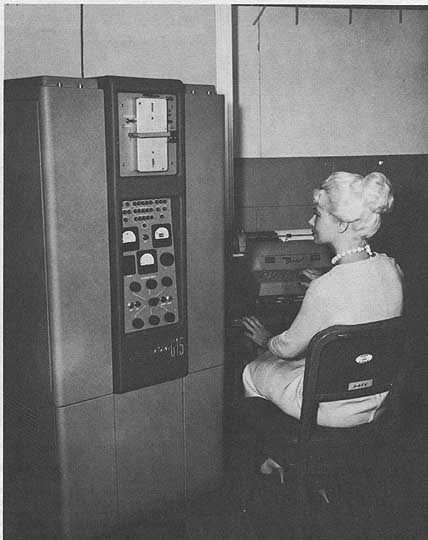
fool joke, what is the value of a G-15? How would a person know?
Billy
At 12:42 PM 4/4/2005, vrs wrote:
>> I have been seeing the same thing with my C= GPIB cables (as well as
>> certain tool handles from the same era). AFAIK, it's inevitable with
>> that sort of plastic.
>
>My RK05F has a white powdery junk all over the inside, and all the plastic
>bits have hardened (some have shattered). Is this the same problem? I
>figured something had caused all the plasticizer to boil out or something.
Could be. I thought it was either a mold from old finger-residue
or the plastic decaying. Any experts on plastic decay out there?
Is it an out-gassing of plasticizer or infiltration of ozone, or both?
- John
Can anyone point me to info on the MicroVax 3800? I may be able to
aquire one, but would like to know a little about it first. Also, I am
really looking for the dimensions/weight of the unit also?
Thank you
David Whittaker
musicman(at)sitcom.whit.org
--
No virus found in this outgoing message.
Checked by AVG Anti-Virus.
Version: 7.0.308 / Virus Database: 266.9.1 - Release Date: 4/1/2005
I have a 9133H connected to my IPC. I have the 9133H manual and the
only reason that I have not bothered to scan it is because it contains
no useful info AT ALL! It was written by brain dead people (whenever a
manual starts with "Don't let the terminology scare you", you know that
the manual is not worth the paper its printed on). Anyway it says zip
about the configuration switch other than "it changes disc formatting".
Thanks!
There are many different models in the 9133 family and they are VERY
different between each other. Early ones are amigo, while later ones
are CS-80.
Anyway the setting that works for me is Configuration switch in
position 1, address in position 0.
With these settings, I get:
/dev/A built-in floppy
/dev/D000 9133H hard drive
/dev/D001 9133H floppy
Connect the external HP-IB hard drive and look in /dev to see the
name(s) assigned to the hard drive. Then use the format_disc utility
(int he Utilities diskette) to format it.
A lot of software for the IPC is available at:
http://www.coho.org/~pete/IPC/integral.html
There is also an ongoing discussion at
http://www.hpmuseum.org/cgi-sys/cgiwrap/hpmuseum/forum.cgi?read=70969
Best Regards
**vp
If I was going to keep anything in an outside building I would first seal
it in a plastic trash bag to keep the varmits and bugs out of it. I would
probably help if you could put some kind of dissicant pack in the bag as
well. Then box it in a sturdy box to protect it and the bag and it should
keep fine. I have a friend that has books this way and stored them in an
outside shed and they've kept fine for over ten years. Considering the
heat, bugs and humidity here in Florida that's little short of a miracle!
Joe
At 11:57 AM 4/4/05 +0930, you wrote:
>
>Appreciate a little bit of advice from the list please.
>
>I started getting my shed full of gear in order on the weekend.
>Following a renno of the kitchen the plan is to rebuild the kitchen
>cupboards in the shed to provide additional storage.
>
>I noted when moving stuff around on the weekend that some corrosion has
>set into DB plugs and PS2 connectors etc. Fortunately its on a couple of
>AT machines of which I have about a zillion so its not a big drama but
>I'm more concerned about the longer term effects on my more precious
>assets.
>
>Storing stuff in the house would be great but that also equates to
>divorce :-)
>
>How do people store their computer stuff medium to long term.
>
>++++++++++
>Kevin Parker
>Web Services Consultant
>WorkCover Corporation
>
>p: 08 8233 2548
>m: 0418 806 166
>e: kparker at workcover.com
>w: www.workcover.com
>
>++++++++++
>
>************************************************************************
>This e-mail is intended for the use of the addressee only. It may
>contain information that is protected by legislated confidentiality
>and/or is legally privileged. If you are not the intended recipient you
>are prohibited from disseminating, distributing or copying this e-mail.
>
>Any opinion expressed in this e-mail may not necessarily be that of the
>WorkCover Corporation of South Australia. Although precautions have
>been taken, the sender cannot warrant that this e-mail or any files
>transmitted with it are free of viruses or any other defect.
>
>If you have received this e-mail in error, please notify the sender
>immediately by return e-mail and destroy the original e-mail and any
>copies.
>************************************************************************
>
>
>
> I was hunting for odd bits in my piles the other night and
> was shocked at the decay of several plastic parts. The ends
> of a set of GPIB cables for an old CBM disk drive were
> covered in a white powder coating - not mold, but slow decay
> of the plastic.
This might still be mold. There are thousands of types of mold, and they
all need to "eat" what they grow on. I'm battling mold now that I'm
sorting/cleaning my basement. Lots of surprises, as there seems to be a
mold type for just about any material.
Quick one:
Anybody has softcopy manual of BDV11? Or at least notes on jumper configs...
Looked at all the usual places, but didn't come up with anything...
/wai-sun
Right. It's *not* the 8530 SCC chip that's faulty, but it's *not* the
data bus either - there's plenty of bus activity so bit 6 isn't
permanently jammed high.
After checking the bus, I replaced the SCC chip with a socket and tried
my spare SCC chip from home (remarkably easy job as it turned out) -
gave exactly the same results on the console.
So, it looks like bit 6 of the bus is fine *except* when a serial port
access is in progress (i.e. other things sharing that bus are being
accessed fine)
Three possibilities at the moment:
1) The big LSI Logic L1A3626 IC which appears to control the serial port
bus is broken internally.
2) Something upstream of the LSI Logic chip is faulty.
3) Something else on the board is responsible for driving the bus during
SCC ops, and there's a break in the bit 6 track to it somewhere,
resulting in it always floating high during serial access.
I can't do much about 1 and 2 without knowing the pinouts of the LSI
chip or having full schematics of the board :-(
Point 3 I can test by tracing one of the other data bus lines and seeing
if it goes anywhere that line #6 doesn't.
I had a look at our Sparc 1 and 2 machines, but they don't use the same
chipset. They do however have a similar IC to the LSI chip in the 4/330
marked as "buffer" which of course increases suspicion that the LSI chip
in the 4/330 - or something upstream of it - has broken.
Chances are I'll be looking for a new board (yeah, right!) given the
lack of schematics. Other alternative would be to find a framebuffer
board for the machine and then use a graphical console - it might be
easier to find a compatible framebuffer versus a whole new 4/330
board...
Grumble!
cheers
Jules
Hi folks,
I've just stumbled on this - looks like someone's built a full CPU board
out of TTL. Wire-wrapped it too (I'm surprised it works - I never had much
luck with wire-wrap). I haven't had chance to take a good look at it, but
what I've seen is pretty interesting.
Link:
<http://www.homebuiltcpu.com/>
Later,
--
Phil. | Acorn Risc PC600 Mk3, SA202, 64MB, 6GB,
philpem at philpem.me.uk | ViewFinder, 10BaseT Ethernet, 2-slice,
http://www.philpem.me.uk/ | 48xCD, ARCINv6c IDE, SCSI
... All you folks do not exist. My sysop types all this stuff in.
Last week, in the middle of debugging Kermit (and making headway)
the 6070 disk dropped dead (I think the technical word for it is
'sh*t the bed').
I was operating it remotely (ssh to host machine w/minicom) so I
couldn't see that the power-OK led went out. Unloaded the heads,
powered off, checked for massive damage, etc, powered on, no POWER
OK or LOAD. Off for the night.
Next day, powered on OK, (power OK led on), LOAD, READY (headload
OK) but can't boot; the bootstrap always seems to get wiped out
whne the machine shutsdown badly. Can't write bootstrap (from
tape).
Diags failed; long story short, all of the disk logic seems good,
media is fine (whew!), seek and format, but no read-data at all --
can't read sector address headers post-format.
All four surfaces the same, so it's not heads or stuff up to the
input mux, diags seem to think it's likely in the disk drive.
I hope to put the 'scope on it tomorrow and begind debug. The
power-OK failure bugs me, though if some driver was able to drag a
power supply out of spec for many minutes you'd think there would
be evidence of, let's say, excessive power consumption (aka
smoke'n'flames). This ain't CMOS.
We'll see. Lost a bit of work, but everything was backup onto
tapes (multiple tape files each tape, plus multiple tapes).
Can't wait til Kermit is running!
Michael Sokolov wrote:
> I have previously heard of people connecting TK50 drives to TK70
> controllers. Supposedly it results in better performance. I don't know
> if you lose the ability to write TK50 tapes this way or not.
>
> This is the first time I hear about the opposite combination, but I have
> to assume it works - whoever put it together obviously had it working,
> otherwise the combo you have in your hands would not exist. MS
Er - couldn't it? It was junked, and nobody had bothered to make the cover
fit again. So it might just have been a try (say the original TK50 was dead)
to install a TK70, which didn't work and was subsequently abandoned. On the
other hand,
Fred N. van Kempen wrote:
> The TZK50 controller (which converts TKbus to SCSI) works with
> both units. The TK70 is smart enough to "fall back" to the
> slower TK50 data mode, so it'll just act like a faster (and
> somewhat more reliable) TK50 drive.
So it should work (and opinions differ whether the TK50 or the TK70 is more
reliable); the case front is the only issue. I see three possibilities:
-Running the thing without case (possibly bad idea, the resistor board in
the upper left seems to need constant directed air flow) or just without
front panel (ugly, things can get in)
-Widening the front panel cutout enough to accomodate the TK70 panel, or
trimming the transport's front bezel enough to fit in the hole (requires
irreversible modifications on original parts, so perhaps bad idea; however,
it looks doable without major damage)
-producing a new case front with a bigger opening (time for some
wood-carving?)
But, as I don't need it now, there is still the alternative of waiting for a
TK50 transport to fall from heaven. The TK70 could be removed from the
enclosure and used to (at least temporarily) substitute the TK50 which is
missing in our MicroVAX II (BA123 housing) in the university museum. Its
frontpanel has an opening which is big enough, curiously. (I had it home
over the weekend to repair the door hinge, st*p*d plastic pin had broken
off, hole was drilled in and a metal bolt inserted instead).
--
Arno Kletzander
Stud. Hilfskraft Informatik Sammlung Erlangen
www.iser.uni-erlangen.de
Handyrechnung zu hoch? Tipp: SMS und MMS mit GMX
Seien Sie so frei: Alle Infos unter http://www.gmx.net/de/go/freesms
I recently saw a poster for http://www.freecycle.org/ .
"It's a grassroots movement of people who are giving (& getting)
stuff for free in their own towns. Each local group is run by
a local volunteer moderator. Membership is free."
I signed up a few weeks ago. Today I got a carload of old Commodore,
Atari, Tandy and Mac IIci-era junk, free for the hauling ten minutes
away, but I had to "take it all".
It made me think there might be a business opportunity in a
"freeBay.com" style site - like eBay but without the cost.
And indeed, a little googling revealed other sites with the
same aim.
If anything, I think Freecycle suffers from a lack of centralized
interface. Not everyone is smart enough to sign up for a mailing list,
and a web interface would be easier to search. (Oops, didn't mean to
start that "list vs. web" thread again. I give up. You're right,
yes, absolutely, eBay should be a mailing list and not a web site.)
I might want to subscribe to my county's list, but I'd also drive three
hours for the right giveaway. It also made me think there could be
opportunity in aggregating and searching these giveaway mailing lists.
It would be great to filter the messages that contain the word "computer"
or "fish tank" or whatever you're hunting for. At a simple level,
you could do it with your mail-reader's filters.
"freeBay.com" is in some sort of registrar-lock. Like the "hot deal"
sites, an operator could make money on keywords and affiliate ads.
- John
While looking for something else in old magazines I ran across a
series of articles by Edmund C. Berkeley and Robert A. Jensen on the design
and construction of the Simon relay computer. (Oct 1950 to Sept 1951 Radio
Electronics) I can't find number 13 in Oct 1951, which is apparently a
description
of a different computer.
Would it be worthwhile trying to scan these and try to get someone
to post them?
Regards
Charlie Fox
Charles E. Fox Video Production
793 Argyle Rd.
Windsor Ontario Canada N8Y 3J8
519-254-4991 cfox1 at cogeco.ca
Check out The Camcorder Kindergarten
at www.chasfoxvideo.com
Dan wrote:
> Note that the name of the picture file is foo.jpeg
> but who knows.
Sure -- I realize that.
What I was referring to though was that:
http://www.geocities.com/heftyharry/foo.jpg
looks as if it is a photoshopped version of the 'real' picture at:
http://ed-thelen.org/comp-hist/BRL61-bendix-g15d.jpg.
Besides, heftyharry's G-15 doesn't look quite deep enough to actually hold
all the guts of the computer. Cropping it off towards the back end, and
placing some debris in back of it, is what gave it away.
I think I'll just take my medicine here, and admit to the fact that I've
been duped by an April 1st shenanigan. :-P
--- Heinz Wolter <h.wolter at sympatico.ca> wrote:
> that's a pdp1 front panel and tty, no? ;) april
> fools?
> h
Yes it is a PDP-1. But it is well-documented that
the major customer for the PDP-1 was ITT, who used it
for a teleprinter switching application. This
does look like an April Fool's joke, however.
That console typewriter looks too clean. Even
more suspicious is that the console typewriter is
sitting next to what appears to be the graphics
scope. There are several pictures on the net of
PDP-1s in museum exhibits that look like this, but
in all the old photos, it looks like the typewriter
was likely to be on a table attached to the CPU
cabinet. It is also dubious that the teletype
switch application would use a graphics scope at all.
Also, the picture of the internals shows a machine
in a non-standard white cabinet that strongly
resembles
the prototype PDP-1 at the CHM. The whole thing
smells fake, but I sent the guy a serious response
anyway indicating the value of the find.
--Bill
>From: "Marvin Johnston" <marvin at rain.org>
>
>
>In searching for radio gear, I ran across this URL and thought it might
>of some interest here. I don't recognize it, but it looks like it might
>be some older computer stuff.
>
>http://www.geocities.com/heftyharry/OLD_COMPUTER_SALE.html
>
Hi
It might be an analog computer but it looks more
like a power monitor for a large computer.
He didn't have an address?
Dwight
I have described my replacement of a burst TU56 motor-run capacitor at
http://so-much-stuff.com/pdp8/tu56repair.html
I am particularly interested in feedback about the mounting solution -- is
it ingeniously simple, or a horrible kludge :-)?
There is a new version of my web-site there for the browsing, too (though
most of the log entries are still stubbed out).
Vince
Arno Kletzander <Arno_1983 at gmx.de> wrote:
> and the board installed bears the number "5017683-01-B1-P2" on the solder
> side and the designation "TZK-50" on the component side. I suppose this has
> to match the transport in order to have a functional unit (unless the TK70
> is smart enough to say: "You think I'm a TK50, so I'm gonna act as if I was
> one!").
I have previously heard of people connecting TK50 drives to TK70 controllers.
Supposedly it results in better performance. I don't know if you lose the
ability to write TK50 tapes this way or not.
This is the first time I hear about the opposite combination, but I have
to assume it works - whoever put it together obviously had it working,
otherwise the combo you have in your hands would not exist. But I won't
venture a guess as to whether that combo can read/write TK70 tapes or just
read TK50s.
MS
Here are two articles from eWeek (formerly PC Week) today. No, they're not
April Fools jokes.
http://www.eweek.com/article2/0,1759,1780863,00.asp
Top Five Vintage Computers Turn Dust into Dollars
http://www.eweek.com/article2/0,1759,1780855,00.asp
Old Computers Find New Homes as Vintage Artifacts
Disclaimer: I used to work for eWeek and still have some biases...
-----------------------------------------
Evan Koblentz's personal homepage: www.snarc.net
*** Tell your friends about the (free!) Computer Collector Newsletter
- 700 readers and no spam / Publishes every Monday / Write for us!
- Mainframes to videogames, hardware and software, we cover it all
- W: http://news.computercollector.com E: news at computercollector.com
Hello everybody;
some time ago I found a strange construction in a bin at the campus, which
I'd like to put back together in a way that makes it usable, nice-looking,
and doesn't conflict with collector ethics.
What I'm talking about is a DEC TK50Z-G3 external enclosure from which the
original TK50 (CompacTape I) transport was removed and replaced with a TK70
(CompacTape II) - which made it impossible to re-fit the cover, because the
TK70's bezel is about 3 mm (2/16") wider than the cutout in the housing
front panel. The access door in the panel's cutout is also in the way but
could be removed rather easily.
What was obviously not replaced however is the interface board which resides
above the transport. The device, when connected to my SPARCclassic and
interrogated by "probe-scsi" from the OBP "ok" prompt, reports as follows:
Target 5
Unit 0 Removable Tape Qualifier 50.
and the board installed bears the number "5017683-01-B1-P2" on the solder
side and the designation "TZK-50" on the component side. I suppose this has
to match the transport in order to have a functional unit (unless the TK70
is smart enough to say: "You think I'm a TK50, so I'm gonna act as if I was
one!").
I'm not in a hurry to get this working (I got some distribution CompacTapes
some time ago, but no leads on a matching DEC computer yet), but I'd like to
get an idea of what to do with it - which largely depends on whether this is
a sensible combination at all.
Yours sincerely
--
Arno Kletzander
Stud. Hilfskraft Informatik Sammlung Erlangen
www.iser.uni-erlangen.de
Sparen beginnt mit GMX DSL: http://www.gmx.net/de/go/dsl
I don't have the Simon computer but I do have the a Samsonite card table
that look just like the one in this cover photo.
http://www.widomaker.com/~cswiger/simon/cover1.jpg
I got it from an elderly neighbor 30 years ago. If anyone builds the
electronic brain I will provide the table.
Michael Holley
www.swtpc.com/mholley
There are at least two types of Simon documents available. I *think* the
first articles were the Radio Electronics Magazine series, and that was
followed by the reprint. The primary difference that I could see was the
color diagrams in the Radio Electronics Magazine series as opposed to
B&W on the reprints. When the discussion took place the last time on
this listserver, ISTR that Doug Salot had the reprints but they were
slightly different from what I have.
While I have the scans of the reprint (and they are still around here
... someplace), it would be nice to have the color wiring diagrams (they
are MUCH easier to see the specific wiring being described in the
figure.)
Also, ISTR that someone else on the list got a copy of the articles from
the Charles Babbage Institute and there were still some copyright
restrictions.
> From: "Charles E. Fox" <cfox1 at cogeco.ca>
> While looking for something else in old magazines I ran across a
> series of articles by Edmund C. Berkeley and Robert A. Jensen on the design
> and construction of the Simon relay computer. (Oct 1950 to Sept 1951 Radio
> Electronics) I can't find number 13 in Oct 1951, which is apparently a
> description
> of a different computer.
> Would it be worthwhile trying to scan these and try to get someone
> to post them?
I know this could be the start of YET ANOTHER thread "Oh I think
it's older than that..." but to avoid that, let's raise the
standard from opinion/hearsay to printed word.
Man I wish I had a collection of pre-1980 DATAMATIONs!
From _ENCYCLOPEDIA OF COMPUTER SCIENCE_(Van Nostrand), 1976:
KLUDGE
The word "kludge" is a term coined by Jackson Granholm in an
article "How to design a kludge" in _DATAMATION_ (February 1962).
The definition is given as "an ill-sorted collection of poorly
matched parts, forming a distressing whole". The design of every
computer contains some anomalies that prove to be annoying to the
users and wghich the designer wishes he had done differently. If
there are enough of these, the machine is called a "kludge".
By extention, the term has come to be applied to programs,
documentation, and even computer centers, so that the definition
is not "an ill-conceiverd and hence unreliable system that has
accumulated through patchwork, expediancy, and poor planning".
The first kludge article triggered five others ("How to maintain a
kludge", etc) in subsequent issues of _DATAMATION_. Four of the
articles may be found in the book _FAITH, HOPE AND PARITY_ edited
by Josh Moshman, Thompson Book Company, 1966.
-- F. Gruenberger
[Said book found at abebooks...]
All:
I've been corresponding for months with this guy who is disposing of
his various systems as a result of moving to a smaller place. This weekend,
I finally started to see the fruits of my labor.
Today I received four copy boxes with the following: 300 (plus or
minus) 8" disks with tons of programs (uncataloged at this point) and 25 or
so "spare" S100 boards including (more than one of some) the Cromemco
Dazzler, SSM video, Matrox video, SIO and PIO cards, A/D and X10 cards, a
6800-based SBC, a 300-baud modem and some memory boards (small sizes).
Additionally, I have about 20 spare copies of various BYTE magazines (list
to follow).
This week I expect several more boxes consisting of the dual 8" disk
drives (plus spares), the drive enclosure (Synergistics), the IMSAI itself
(TDL Z80 I believe), scads of original documentation, the entire run of
Micro Cornucopia, some Interface Age and Kilobaud mags, and to top it off, a
Poly 88 system. There's also a *slim* chance that he's going to throw in a
Mark-8 system.
And the best part...all for the cost of shipping. Yeah! It's
Christmas in April!
Rich
Rich Cini
Collector of classic computers
Build Master for the Altair32 Emulation Project
Web site: http://highgate.comm.sfu.ca/~rcini/classiccmp/
/************************************************************/