I have what I believe is an unused RA60 head #4. At least the surface looks
very clean.
Someone has written "RA60 04" on the side of the box. On the top there is
handwritten 70-18661-04.
https://i.imgur.com/RNK0FOTl.jpg
I could use a RL02 or RL01 head as a trade if someone is interested.
/Mattis
> From: Mark Tapley
> I'm interested in one of the DECServers but Bill says it's big
> enough to be in the "pick up only" pile. ... drop it at a Pak/n/Ship or
> equivalent to get it headed my way.
PakMail will go pick stuff up.
If several people get together, they could make only one trip to Bill's,
which might reduce the cost.
Noel
Anybody interested in a pair of Tseng Labs ULTRARAM boards?
I assume they were expansions for the Tseng Labs Video Cards
but, if nothing else, they are loading with 4164's.
bill
Hi to all!
I'm looking for a good scan of the Heathkit H9 schematics.
A set of photos, if the document is to large for scanning,
would also work for me.
Regards
Rolf
I have some kind of IBM 3270 MCA board available for the cost of shipping
>from Sweden. IBM P/N 26F0191. Have no way of testing it, but it was pulled
>from an otherwise working machine.
https://i.imgur.com/jBBDrcnl.jpg
/Mattis
Anyone know more about this? So far I have only found references to Rayethon Computers in old trade mags.
http://v6y.net/IMG_20180912_170812.jpg
The rack is as stout as it gets.
BTW if anyone wants a nice RXO2 (auction ending in 6 hours), bidding starts at $1: https://www.ebay.com/itm/202440567768
Cheers!
-Justin
> Date: Mon, 24 Sep 2018 12:26:57 -0600
> From: Eric Smith <spacewar at gmail.com>
> To: "General Discussion: On-Topic and Off-Topic Posts"
> <cctalk at classiccmp.org>
> Subject: Re: SPACEWAR! Switch Boxes for a PDP-12
> Message-ID:
> <CAFrGgTS=XdctKw6G_FjddnLc6H=gpgf5JizV9zRXY4C0qhoYyg at mail.gmail.com>
> Content-Type: text/plain; charset="UTF-8"
>
> On Mon, Sep 24, 2018 at 11:23 AM, Robert Feldman via cctalk <
> cctalk at classiccmp.org> wrote:
>
>> >that is what the PDP-1 at CHM has been using for over 10 years
>>
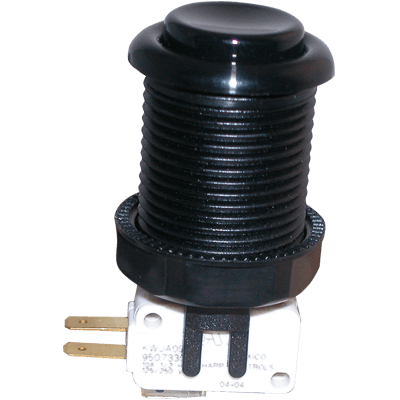
>> https://na.suzohapp.com/products/pushbuttons/58-9166-L
>
>
> Ken Sumrall built the Spacewar control boxes used at the museum, with some
> suggestions from me. We originally intended these to be temporary, and to
> build nicer control boxes later. Since they were intended to be used by
> restoration team members, and possibly museum guests, we wanted them to be
> reliable rather than authentic, and specifically did NOT want these
> temporary boxes to themselves become historical artifacts. We chose
> inexpensive but robust arcade pushbuttons. They can take a beating, and in
> the event that the microswitch does break or wear out, it can easily be
> replaced, though the complete button assembly with microswitch is not
> expensive. The boxes are particle board. We used DE-9 connectors. On the
> PDP-1, hyperspace is invoked by the CW and CCW rotate controls being
> activated simultaneously, so the hyperspace button is wired via series
> diodes to both rotate buttons.
>
> After we built them, Steve Russell pointed out to us that although these
> boxes don't look like at all like the originals, they actually are
> authentic, in the sense that like the originals, these boxes were quickly
> knocked together rather than carefully planned, and are functional rather
> than pretty.
>
> We positioned the individual buttons based on the layout used on one of
> the
> Atari coinop games, "Space Duel" IIRC, on the because Atari had done a
> good
> job of laying them out to be easy to use.
>
> I'm not trying to discourage anyone from trying to make replicas of the
> original Spacewar control boxes, but aside from some grainy photos and a
> brief description, not much detail about them is actually known.
>
> We do not know what controls were used when PDP-1 Spacewar was
> demonstrated
> at the Computer Museum in Boston. We don't think they had the original
> control boxes. Possibly they might have just used the PDP-1 console
> switches, which is quite inconvenient and increases wear on those
> switches. When we restored the PDP-1, we discovered that some of the
> console switches were flaky, and upon inspection, that they appeared to
> have been replaced multiple times, with suboptimal craftsmanship.
>
I like the ideas with the diodes for hyperspace, I'll steal that right away!
@ Chuck,
I know you know about the FST1 computer ( 24 bit ).
Do you know that there is ( now ?? ) a bit of documentation about it on Bytesavers ??
in .... PDF/Fairchild/Sentry ....
I have four 9-track tape drives, and a dirty DEC rack, that I need to
get rid of.
Two of the drives are HP 7970B's. One has the door unattached. Then
there's a Kennedy 9100 800/1600 bpi drive.
Very heavy.? As found, none tested by me. Just don't have time to play
with them.
Last is a CDC drive complete with an AST clone PC with an Overland Data
controller and software. This
was running a few years ago but has not been used since. Has Media
Master format conversion software also.
There's also a smallish DEC rack. Could use the top painted but
otherwise not too bad. Includes four sets of rack
slides.
All are located in Santa Cruz, CA and need to be gone soon, I need the
room in my hangar. Come get them!
Photos here: http://dvq.com/fall_cleaning/
--
Vintage computers and electronics
www.dvq.comwww.tekmuseum.comwww.decmuseum.org
>
> From: Bob Rosenbloom <bobalan at sbcglobal.net>
> Subject: Re: SPACEWAR! Switch Boxes for a PDP-12
>
> How about these? They look close, but are still a bit expensive.
>
>
> https://www.ebay.com/itm/VINTAGE-SWITCHCRAFT-60312DL-MOMENTARY-SWITCH/25358…
>
> Bob
>
I bought 5x of them. They are the locking style that we don't want, but I
think that we can bend the angled part to make them momentary.
Thanks for the help!
--
Michael Thompson
At VCF MW this past weekend, I was playing around with an FPP8/A stuffed
into a PDP-8/M with a fan removed. This hex-wide two-board set will happily
work in a quad-wide backplane, as it needs no signals that an 8/A would
otherwise provide.
I wanted to benchmark the FPP8/A with the software emulation that FORTRAN
IV supposedly does. Mind you, I also don't have an EAE in mine, so software
emulation for integer multiplication/division would also be used.
I tried running a simple program to print some natural logs and square
roots, which ran quite well with the FPP8/A in place.
Without the FPP8/A...all of the results were wrong. Significantly. Negative
numbers in many cases. No clear pattern as to what it's doing.
Would anyone be able to try my program on some other real hardware (or
another emulator) to verify? With and without EAE would also be desirable.
I'm not sure how to disable the EAE in SIMH, else I'd try that too.
Here's what SIMH looks like with my program:
PDP-8 simulator V4.0-0 Current git commit id: d35b8725
sim> at rk0 disk2.fortran.rk05
sim> b rk
.TYPE FLOAT.FT
DO 50 I=1,100
F = FLOAT(I)
G = SQRT(F)
H = ALOG(F)
WRITE(4,100) F,G,H
50 CONTINUE
100 FORMAT(' ',F12.6,F12.6,F12.6)
END
.R F4
*FLOAT/G$
1.000002 1.000002 0.000000
2.000002 1.414215 0.693147
3.000002 1.732053 1.098614
4.000002 2.000002 1.386296
5.000002 2.236070 1.609439
[snip]
98.000001 9.899495 4.584968
99.000000 9.949874 4.595121
100.000023 10.000008 4.605171
.
Much appreciated,
Kyle
> From: Brent Hilpert
> Your conceptualisation around the role of electrons is perhaps a
> little off.
Well, I'm not taking into effect things like the velocity of electrons
passing around the circuit (more current, with the same number of electrons,
effectively), etc, but I value the 'electron-based-view' since it led me to
understand the issue of EI conversion (something I don't recall having seen
called out explicitly - e.g. it's not in that DEC tech manual).
(Speaking of reducing the number of electrons: I recall a physicist - don't
recall who - who jokingly suggested the reason they are all identical is that
there is only _one_ - it travel forward in time an an electron, goes back as
a positron; rinse, repeat! :-)
> You don't need 'more' electrons to generate a higher current, you just
> need to 'expend them' more quickly, using words like 'more' and
> 'expend' loosely
Right, particularly since what's really happening (e.g. during the L
discharge phase) is that electrons are being 'borrowed' from the shells in
the atoms of the conductor, run around the circuit, and then returning from
whence they came.
> Capacitors very much play a role in supplying current to the load.
> Both the L & C play a role as energy reservoirs.
Right, but the C doesn't play a _direct_ role in the EI conversion, the way
the L does? (Or maybe it does - the voltage across the C could I guess play a
role in mobilizing electrons in the circuit?)
>>> The transformer is nonetheless much smaller than it would be in a
>>> straight linear regulator design because the secondary current it has
>>> to supply is several factors lower than for a comparable linear reg.
>> That's because of the higher efficiency of this circuit .. ?
> primarily it's because it's still a higher voltage by several multiples
> ... and thus the current that the transformer secondary has to deal
> with is the same factor lower .. meaning less copper for the secondary
> and less iron for the core.
Ah. Interesting tradeoff!
So it seems like they probably picked the intermediate voltage to be as high
as they could (to reduce the transformer cost), modulo the cost/availablility
of transistors for the switching...
> I haven't seen/read this TofOp.
Here:
http://www.bitsavers.org/pdf/dec/pdp11/1140/1140_SystemManual.pdf
if you're (still) interested; the H744 starts on pg 6-10 (pg 112 of the PDF).
Noel
Maybe you don't want to fix your program.
On September 19, 2018, at 5:46 PM, Michael Zahorik via cctalk <cctalk at classiccmp.org> wrote:
Kyle, I have not run my machine since March. Summer is car season. But I thought that maybe I could run this little program quickly. My PDP8E started up, loaded the RIM and SERIAL DISK then OS/8 ran. Everything looked good, BUT...... something is wrong with my FORTRAN 4. Programs seem to compile, but I can't even run a simple test program that prints out whatever I enter from the TTY. Something has gone south. Anyway, I'm not familiar with the command FLOAT(). Do I have to have floating point hardware to use this? Well.... either there is something wrong with my machine or more likely with my FORTRAN software or even more likely operator error (me). So many times after a long summer I have to re learn most of what I learned last winter. Kinda of like when I was in school after summer vacation. ?Mike Zahorik (414) 254-6768
From: Kyle Owen via cctalk <cctalk at classiccmp.org>
To: General Discussion: On-Topic and Off-Topic Posts <cctalk at classiccmp.org>
Sent: Wednesday, September 19, 2018 5:43 PM
Subject: Floating point math in FORTRAN IV on PDP-8
At VCF MW this past weekend, I was playing around with an FPP8/A stuffed
into a PDP-8/M with a fan removed. This hex-wide two-board set will happily
work in a quad-wide backplane, as it needs no signals that an 8/A would
otherwise provide.
I wanted to benchmark the FPP8/A with the software emulation that FORTRAN
IV supposedly does. Mind you, I also don't have an EAE in mine, so software
emulation for integer multiplication/division would also be used.
I tried running a simple program to print some natural logs and square
roots, which ran quite well with the FPP8/A in place.
Without the FPP8/A...all of the results were wrong. Significantly. Negative
numbers in many cases. No clear pattern as to what it's doing.
Would anyone be able to try my program on some other real hardware (or
another emulator) to verify? With and without EAE would also be desirable.
I'm not sure how to disable the EAE in SIMH, else I'd try that too.
Here's what SIMH looks like with my program:
PDP-8 simulator V4.0-0 Current? ? ? ? git commit id: d35b8725
sim> at rk0 disk2.fortran.rk05
sim> b rk
.TYPE FLOAT.FT
? ? ? DO 50 I=1,100
? ? ? F = FLOAT(I)
? ? ? G = SQRT(F)
? ? ? H = ALOG(F)
? ? ? WRITE(4,100) F,G,H
50? ? CONTINUE
100? FORMAT(' ',F12.6,F12.6,F12.6)
? ? ? END
.R F4
*FLOAT/G$
? ? 1.000002? ? 1.000002? ? 0.000000
? ? 2.000002? ? 1.414215? ? 0.693147
? ? 3.000002? ? 1.732053? ? 1.098614
? ? 4.000002? ? 2.000002? ? 1.386296
? ? 5.000002? ? 2.236070? ? 1.609439
[snip]
? 98.000001? ? 9.899495? ? 4.584968
? 99.000000? ? 9.949874? ? 4.595121
? 100.000023? 10.000008? ? 4.605171
.
Much appreciated,
Kyle
> From: Brent Hilpert
> In typical "down-converters" there are additional current paths in the
> supply, paralleling the input path, that can provide the 'additional'
> electron flow rate. ... the whole rationale of a switching supply is to
> use time (varying switching periods) and temporary energy storage to
> change that EI relationship from input to output without energy loss.
So, two more questions (if you have the time):
I can see that there's a nice synergy between the switching concept and the
buck converter (since the switch does exactly what the buck converter needs,
in terms of turning the input current off and on), _but_ - are there switching
supplies that operate the way I described (up-convert the frequency, then use
a transformer to get directly to more or less the right voltage)? I.e. without
needing to use a buck converter to do the conversion from low current at
higher voltage to higher current at lower voltage? (Although I guess the coil
for the buck might be cheaper than the transformer - even though the use of a
high frequency would reduce the size of the latter - making the buck approach
superior.)
To put it another way, there's no _necessary_ connection between the switching
concept, and the buck converter is there? Does that mean it is in theory
possible to stick a buck converter on the output of a linear supply to do the
V1I1-> V2I2 conversion? (Although I know it's probably a stupid design, because
you'd still need some sort of switcher for the buck converter, so the linear
supply would be basically pointless.)
> If the heatsinks seem huge compared to modern day supplies, that's more
> likely the result of technology improvements - faster devices, and
> moving from bipolar switching transistors to mosfets. Bipolar
> transistors have a near-fixed voltage drop which can't be reduced
Right, I knew bipolars had the fixed drop, but I hadn't made the connection
to that being the cause of the large amount of heat needing to be dumped.
Useful enlightenment!
> If you supply a link & location to a schematic I'll take a look
Here:
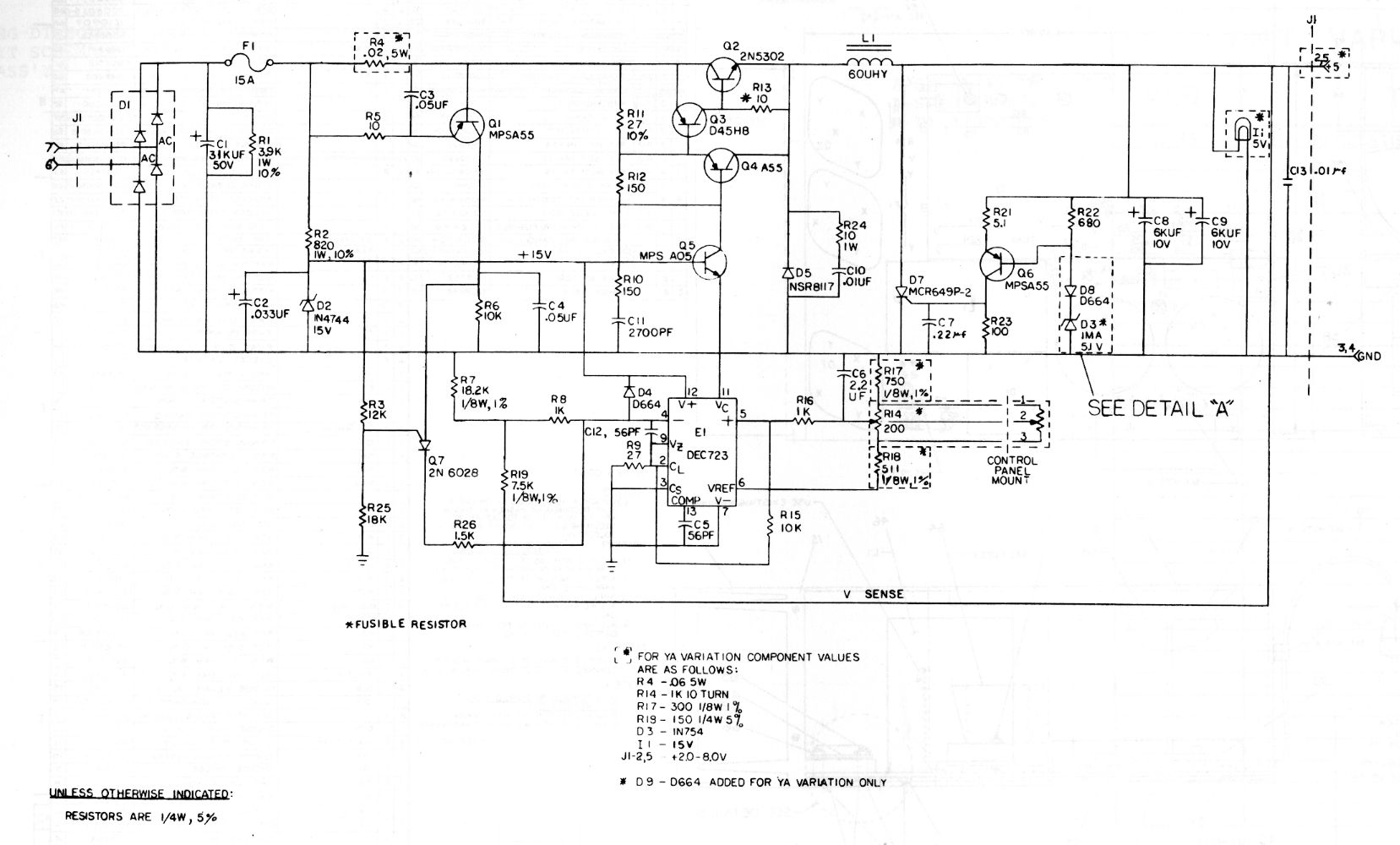
http://ana-3.lcs.mit.edu/~jnc/tech/pdp11/jpg/H744.tifhttp://ana-3.lcs.mit.edu/~jnc/tech/pdp11/jpg/H744.jpg
Thanks to everyone for taking the time and energy to reply!
Noel
Hi folks,
I am trying to find an out-of-print tech book for a research project I'm
doing. The book is called Porting Macintosh Applications to Windows 95 and
NT by Greg Stone, dated December 1996, ISBN 0471118516, published by Wiley.
It's listed on Amazon but not available; I've searched on
<http://usedbooksearch.net/> usedbooksearch.net and even WorldCat, with no
luck. Wondering if anyone has any ideas how I could find a copy?
Figure someone on this list could point me in the right direction. Would
love any help.
Thanks,
* Bill.
Bill Rosenblatt
GiantSteps Media Technology Strategies
157 Columbus Ave., Suite 409
New York, NY 10023
(212) 956-1045
Skype: billrosenblatt
Twitter: @copyrightandtec
Blog: https://copyrightandtechnology.com/
LinkedIn: https://www.linkedin.com/in/billrosenblatt/
Forbes: https://www.forbes.com/sites/billrosenblatt/
Visitors to the RICM like to play SPACEWAR! in the PDP-12. Unfortunately
using the console switches is uncomfortable, not intuitive, and is tough on
the switches. We would like to recreate the switch boxes used on the PDP-1
to make playing a better experience.
We modified the source
<http://www.ricomputermuseum.org/Home/equipment/dec-pdp-12/dec-pdp-12-source…>
>from D.E. WREGE
<http://www.pdp8.net/pdp8cgi/os8_html/SPCWR3.PA?act=file;fn=images/jby/jbyos…>
to use the LINC SXL instruction to read the PDP-12 GPIO signals, and
prototyped two switch boxes using recycled toggle switches. This works
great, so now we need to make better switch boxes.
This CHM article shows what we want to recreate.
<http://www.computerhistory.org/pdp-1/a87ddd9510aeebf6485c47a35f8a26aa/>
This article shows a sketch of the switch boxes.
<http://thedoteaters.com/?attachment_id=6416>
A generous donor made these boxes for us.
<https://scontent.fbos1-1.fna.fbcdn.net/v/t1.0-9/37971884_2342940525721951_2…>
The lever switches are turning our to be difficult to find at a reasonable
price. We found some NOS SwitchCraft lever switches that looked like the
sketch and the PDP-1 pictures and were a reasonable price, but our order
was rejected because they only had one in stock. eBay has Mossman and
SwitchCraft, but they are either very expensive (more than $50 each), or
they only have one available.
The switches that we are looking for need to be SPDT, three-position,
non-locking, center off. (If the switches have more than one pole we can
remove the extra poles to keep the operational force low.) Before we cave
in and buy some modern C&K toggle switches, does anyone have a source for
Mossman or SwitchCraft switches at a reasonable price?
--
Michael Thompson
> From: Brent Hilpert
> With the given 20-30VAC input (do I have that right?)
Yup.
> A glance at the schematic ... you might think it's just a linear
> regulator
And the writeup in the maint manual gives that impression too, which didn't
help! (Hence my assumtion that it was acting in the way a plain linear
regulator might, in terms energy efficiency.)
> Diode D5 provides the current path for L1 to supply energy to the load
> when the source is switched off.
Right. What is the role of the pair of big caps, C8/C9. Is that just to
filter ripple, or do they play a role in the provision of current when the
supply is switched off (by Q2)?
(My guess would be only the former, since unlike the energy stored in L1,
which can be used provide electrons when Q2 is off, capacitors only store
electrons, so they can't play much of a role in the conversion of V1I1 to
V2I2, which requires 'creation' of more electrons when I2>I1. Oh, reading the
maint manual, when Q2 is on, they store some of the current coming through
L1. So I guess they have a peripheral role in the overall operation.)
> The subtle thing about designs like this is where does the switching
> oscillation come from?, as there is no obvious oscillator present.
The maint manual does cover that. It more or less says that as the output
voltage rises through 5.05V, the voltage regulator turns off Q2, and as
it falls through 4.95, it turns it back on. (Presumably when the whole
works is first turned on, the output voltage is less than 4.95V, so Q2
stays on until it gets to the turn-off voltage.)
Q7 is part of the over-current sensing, it says.
> the switching is taking place after the transformer rather than
> straight off the mains, this allows the switcher design to be simpler
> and get away with using much lower voltage semiconductors.
Ah, I was wondering about why they did it that way.
> The transformer is nonetheless much smaller than it would be in a
> straight linear regulator design because the secondary current it has
> to supply is several factors lower than for a comparable linear reg.
That's because of the higher efficiency of this circuit, as opposed to a
straight linear regulator, which would need more mains power in to produce an
equivalent power out?
> Q5 is functioning as a common-base stage in the driver chain ...
> It is not part of the +15V supply to the 723, that is provided by
> R2, zener D2, C2.
I was confused by the maint manual, which says "D2 is used with Q5 and R2
to provide +15V to E1".
> There are a thousand configurations for power supplies possible
> depending on what needs to be accomplished ... It's useful to keep in
> mind that regulation and EI conversion are different objectives but
> they can be achieved either separately or in concert.
Got it.
> bipolars have a fixed MINIMUM drop, which can be used in a switching
> supply to as much advantage as possible with bipolars, but have a
> varying drop in a linear regulator
Right.
OK, I think I've got a decent grip on all this now - although I still
wouldn't want to try and _repair_ one... :-)
Noel
> Date: Sun, 23 Sep 2018 10:46:48 -0400
> From: Michael Thompson <michael.99.thompson at gmail.com>
> To: cctech <cctech at classiccmp.org>
> Subject: SPACEWAR! Switch Boxes for a PDP-12
> Message-ID:
> <CAH1BU=_4OVdEjGgMMcbyLZS9-aDCXp0sZxh1SiEJrtsuWu96Pw at mail.gmail.com>
> Content-Type: text/plain; charset="UTF-8"
>
> Visitors to the RICM like to play SPACEWAR! in the PDP-12. Unfortunately
> using the console switches is uncomfortable, not intuitive, and is tough
> on
> the switches. We would like to recreate the switch boxes used on the PDP-1
> to make playing a better experience.
>
> We modified the source
> <http://www.ricomputermuseum.org/Home/equipment/dec-pdp-12/dec-pdp-12-source…>
> from D.E. WREGE
> <http://www.pdp8.net/pdp8cgi/os8_html/SPCWR3.PA?act=file;fn=images/jby/jbyos…>
> to use the LINC SXL instruction to read the PDP-12 GPIO signals, and
> prototyped two switch boxes using recycled toggle switches. This works
> great, so now we need to make better switch boxes.
>
> This CHM article shows what we want to recreate.
> <http://www.computerhistory.org/pdp-1/a87ddd9510aeebf6485c47a35f8a26aa/>
> This article shows a sketch of the switch boxes.
> <http://thedoteaters.com/?attachment_id=6416>
> A generous donor made these boxes for us.
> <https://scontent.fbos1-1.fna.fbcdn.net/v/t1.0-9/37971884_2342940525721951_2…>
>
> The lever switches are turning our to be difficult to find at a reasonable
> price. We found some NOS SwitchCraft lever switches that looked like the
> sketch and the PDP-1 pictures and were a reasonable price, but our order
> was rejected because they only had one in stock. eBay has Mossman and
> SwitchCraft, but they are either very expensive (more than $50 each), or
> they only have one available.
>
> The switches that we are looking for need to be SPDT, three-position,
> non-locking, center off. (If the switches have more than one pole we can
> remove the extra poles to keep the operational force low.) Before we cave
> in and buy some modern C&K toggle switches, does anyone have a source for
> Mossman or SwitchCraft switches at a reasonable price?
>
> --
> Michael Thompson
Michel,
I did just what you did for being able to play Spacewar! on my PDP-8a (I
have KK8E with EAE, VC8E and the DK8E real time clock). But since the
frontpanel doesn't have proper switches for the switch register I had to
build game hand controls.
I built them just like those that can be spotted in the video from CHM:
https://www.youtube.com/watch?v=1EWQYAfuMYw but smaller.
I just used ordinary arcade style buttons and connected them to the
digital inputs on the DKC8A board and modified the source code for that.
Those hand controls have two switches for rotate left/right, one for fire
and one for acceleration. The last one is for hyper speed but that is
triggered by pressing left/right switches at the same time. I intended to
fix this so it should be triggered by the last button but never came to
it.
Unfortunately I haven't written on my page https://www.pdp-9.net/pdp-8a on
this yet...
/Anders
Hello everyone,
This is a longshot, but I was wondering if anybody has or knows someone
who might have a very specific HP part. It's the HP E3417A, a PQFP132
PGA interposer for some HP emulation/debug preprocessor stuff for CPU32
(among other 132 pin QFP).
Basically I came into an HP logic analyzer with a full preprocessor
setup for 160 pin QFP CPU32 procs. 16700A with emulator option, E2480A
preprocessor for CPU32, and a 160 pin QFP elastomeric socket with the
flex cable.
But, I've got one of these:
https://hackaday.io/project/6150-beckman-du600-reverse-engineering
That board has a 132 pin QFP, but with the right adapter, it should be
supported by the hardware I've got here.
Thanks,
Joe Zatarski
I have finally fixed the PSU of my TURBOchannel Extender
(https://robs-old-computers.com/2018/09/23/h7826-power-supply-repaired/).
Which means that now I would like to connect it to my DECstation 5000/240. I
need the relevant extender cable, which I believe to be a BC12N or a
17-03335-01. I asked on this list about a year ago if anyone has such a
cable and thought I would try asking again. I have found a 100-pin SCSI
cable that mechanically fits, but I don't know if that has the correct pin
assignments. I am aware of a site in the UK which lists this cable
(http://refurb.icc4it.co.uk/parts/legacy/dec/17-03335-01) but it looks like
one of those sites that speculatively lists things without necessarily
stocking them, and it is likely to charge business prices anyway.
So, two questions:
1. Could the 100-pin SCSI cable do the job?
2. Anyone have a genuine cable going spare (ideally in the UK).
Regards
Rob
Hi Mike,
At 10:18 PM 22/09/2018 -0400, you wrote:
> From outward appearences, it looks to be the same as the Wang 2244A, and
>the Wang Model 2200 Systems Mainteance Manual confirms that it is a TM200:
>
>http://www.wang2200.org/docs/system/2200_SystemsMaintenanceManual(redone).0…
What an excellent list this is. Who else would have spotted that?
> A reference manual and data sheet are available on the Wang 2200 site:
>
>http://www.wang2200.org/docs/peripheral/2234A_2244A_CardReaderRefManual.700…
>https://www.wang2200.org/docs/datasheet/2244A_CardReader_DataSheet.700-3524…
Lots of interesting information on card coding and usage, thanks.
Heh. Every single time I hear the name Wang, I'm reminded of the legendary time Wang showed
up at an Australian computer trade show, with their staff all wearing badges that said
"WANG CARES"
You have to say it with an Aussie accent and know the local idiom to understand why it's
side-splittingly funny.
>
> No schematics, though.
There's the rub.
Fingers crossed Al Kossow can find that original copy.
Regards,
Guy
> From: Alexandre Souza
> What about a nuclear bomb?
OK, if we're going to start being _really_ silly..... drop them into a
singularity! :-)
The best part is that you'll get to watch them being ripped apart and
destroyed by tidal forces _forever_ (since time dilation means that as they go
over the event horizon, their local time seems to stop compared to ours).
Noel
Once again. Silent700 put together an incredible show for the Midwest
computer festival in Elk Grove. Every room that was rented was almost
overflowing most of the show, so I suspect attendance was great. I heard a
lot of good feedback on the speakers and presentations, and I also noticed
that the auction pile was bigger than each previous year.
I'm not sure which exhibit was my favorite, could be Pat's AVLVAX or Mikes
HP3000 - but I also seem to have spent more time than usual at all the C64,
A2+, and TRS80 machines. Maybe I'll take a detour to the 8-bitters in my
collection for the near term, we'll see!
In addition to the show, there were multiple parties and some late nights
spent hanging out with the folks I mostly get to see once a year so
friendships were renewed and such! Midwest is definitely a really fun show,
I strongly encourage anyone who hasn't been to come out next year.
Silent700 and helpers (mike et. Al.). thank you so much for your untiring
devotion to making Midwest such a great show.
J
I spent some time this weekend documenting the hardware of these
and dumping some more MDOS floppies.
We had one copy of the MDOS manual which replaced the poor copy I
had in bitsavers.org/components/motorola/6800/exorciser.
It would be nice to find more/better docs, esp docs on the EXORterm 150
or 155. The terminal has a keytronics kb .ca 1978, of course all the
foam was crumbled.
I spotted a vintage multimeter in an antique shop in Startup WA for $24.
Didn't have a chance to test it, but it looks in good condition under the
cover.
https://photos.app.goo.gl/sTQF8g7jXx2TMKqCA
If someone wants it, I would be happy to acquire and ship it at cost.
-- Charles
Thanks for the link. So far I'd only tried google, assuming anything relevant on
bitsavers would show up. It didn't, which is interesting.
My search was only very brief though. I'd been doing an initial eval on the reader in
the evening, then read the post about Mr Hollerith's house. So hadn't yet done any
serious searching.
The unit was made in April 1977. Someone else mentions the TM200 is not the same
as the M200, so I have some reading to do.
Regards,
Guy
At 09:52 AM 22/09/2018 -0500, you wrote:
>On Sat, Sep 22, 2018 at 9:39 AM Guy Dunphy via cctalk <cctalk at classiccmp.org>
>wrote:
>
>> By coincidence, today I started evaluation of a punched/optical card
>> reader.
>> Model TM200, made by Documation Inc.
>>
>> Naturally I have zero information on it so far.
>> Does anyone know where I'd find a service manual or schematics?
>>
>
>Did you check Bitsavers already?
>
>http://bitsavers.org/pdf/documation/
>
>Thanks,
>
>Kyle
>
Does anyone within driving distance of central Illinois have a SMD drive I can borrow for awhile until I can get some kind of SMD emulator working? Anything 450 MB or bigger will do. I need one for the Lambda.
Too far? Road trip? I'm crying here (Sydney Australia.)
I have a couple of HP 7970B's (and the sevice manual) though not yet running.
But I have no 1600 bpi drives. Oh well...
Guy
At 01:43 PM 22/09/2018 +0000, you wrote:
>I could use a small rack but I think Santa Cruz, CA is a bit too far for
>a road trip from NEPA.?? :-)???? (I really regret giving all my racks but one away!!)
>
>
>bill
>
>
>On 09/21/2018 10:44 PM, Bob Rosenbloom via cctalk wrote:
>> I have four 9-track tape drives, and a dirty DEC rack, that I need to
>> get rid of.
>>
>> Two of the drives are HP 7970B's. One has the door unattached. Then
>> there's a Kennedy 9100 800/1600 bpi drive.
>> Very heavy.?? As found, none tested by me. Just don't have time to play
>> with them.
>>
>> Last is a CDC drive complete with an AST clone PC with an Overland
>> Data controller and software. This
>> was running a few years ago but has not been used since. Has Media
>> Master format conversion software also.
>>
>> There's also a smallish DEC rack. Could use the top painted but
>> otherwise not too bad. Includes four sets of rack
>> slides.
>>
>> All are located in Santa Cruz, CA and need to be gone soon, I need the
>> room in my hangar. Come get them!
>>
>> Photos here: http://dvq.com/fall_cleaning/
>>
>
>
> From: Mattis Lind
> The H744 is a buck converter. You can read about buck converters here:
> https://en.wikipedia.org/wiki/Buck_converter
Wow, that was incredibly hard to read; no clear and simple explanation of the
basic concept of how it works, before getting into the details!
If I understand it correctly, it stores part of the incoming energy of a block
of current in the field around the inductor; later, switches change state to
create a loop that includes the inductor, and it uses the stored energy to
cause electrons to flow around the new (temporary, because of the switch)
circuit. Is that about right?
The H744 manual doesn't really talk much about that aspect of the circuit's
operation (at least in terms of 'we use this trick to get all the energy out
of the incoming current flow'); it just describes the stuff around the coil as
"an LC filter". It says "This type circuit is basically only an averaging
device", which I wouldn't say is really on point - that would describe my
(incorrect) prior description as well as the correct one.
And just to make it even more confusing, it says "most of the input voltage is
absorbed across the emitter-collector of Q5", but I looked, and Q5 is tiny,
and I eventually figured out that that only applies to the +15V needed to run
the voltage regulator.
Noel
Anyone have advice on making thermite? Ingredients, sources, proportions?
The internet seems to think that just using aluminum powder with ferric
oxide is relatively hard to ignite, and that some manganese dioxide would
help with that.
Without spending too much time shopping, it looks like I can get:
* aluminum powder, 5 micron, 2 lb for $34
* ferric oxide, 10 lb for $27
* manganese dioxide, 1 lb for $39
Oh, one thing I forgot to include:
> a lot of the incoming power in that 30V AC has to be thrown away, in
> producing +5V.
So, if my understanding is correct, the 'switching' H744 really isn't much
better than a classic linear supply. It still wastes a very large amount of
the input power, and it still has a massively heavy transformer in it. Yes?
So I wonder what exactly the advantage was in going to the switching approach?
Yes, it keeps the output voltage steadier then a pure linear supply could -
but I'll bet there are analog approaches that can do the same. (They'd need
something that can produce a steady reference voltage, but the switching
approach needs, and has, the same thing.) Maybe the main output transistors
are happier being full-on or full-off, or something like that?
Noel
> From: Eric Smith
> That's way too good for these *&#$ing ST3000DM001 drives, and won't
> provide anywhere near enough sense of satisfaction.
https://www.youtube.com/watch?v=Gxm_qpKh7Jw
'Nuff said.
Noel
So there's something about the H744 I'm not sure I understand; hopefully those
with more analog-fu will set me straight if I'm confused.
This supply runs off 20-30V AC. It takes the input AC, rectifies it, and runs
it through a cap to filter out the ripple. What's next is that it's an early
switching supply; i.e. the electronics inside switches that newly-created main
DC off and on very quickly to keep the output voltage at around +5V.
However...
My understanding is that, without using a transformer (which creates an
independent circuit loop - more below), there's no way to increase the
_amperage_ out of circuit over what's fed into it: since amps are
electrons/second, the electrons/second out more or less have to equal
electrons/second in, since one can't easily 'create' electrons - at least, in
normal electonic gear! (Transformers, by creating a whole new circuit loop,
can 'create' more electrons/second in the new loop; since they tie the 'out'
of the new circuit back to its 'in', they can recirculate the 'extra'
electrons.)
And to the extent that the output is at lower voltage, the energy differential
has to be dumped; hence the huge heat sinks - a lot of the incoming power in
that 30V AC has to be thrown away, in producing +5V. Right?
My (possibly confused) understanding is that later switching supplies take the
incoming 60Hz wall AC, transform it to a higher frequency, run _that_ through
a transformer (which can be a lot smaller, since it's at a higher frequency,
and the higher the frequency, the smaller the transformer you can use - hence
the use of high frequency AC in airplanes, to allow use of smaller - and thus
lighter - transformers). That then turns out a massive amount of amps in the
output loop (since with a transformer, energy out is roughly energy in, modulo
resistive losses; and with constant power, if V goes down, I goes up).
So the losses are a lot lower - N amps at 110V in produce ~20N amps out at
+5V. (Well, depending on all the losses, ~20.) And the whole works is a lot
lighter, to boot.
Did this programmer get all that analog stuff correctly?
Thanks!
Noel
Hi all,
I've got an VME Bus sized CPU or GPU Board out of ebay a while before,
it is equipped with 4 pcs of AM29203 Slices and an AM2910A Sequencer.
It sems to be a german Product.
The Sticker on one of the DIN 96 Connectors states:
GE2149G206 WNr. 10488 Grund- Baugruppe
Does anyone know what it is or where is it coming from?
Kind Regards,
Holm
--
Technik Service u. Handel Tiffe, www.tsht.de, Holm Tiffe,
Freiberger Stra?e 42, 09600 Obersch?na, USt-Id: DE253710583
info at tsht.de Fax +49 3731 74200 Tel +49 3731 74222 Mobil: 0172 8790 741
I will soon have a teletype model 35 all cleaned up and running
Why like is some suggestions for something I can put in the base and
emulate an HP 2000 or even in modern 2100 my goal is nothing serious I'd
love to be able to do HP basic and find the version of Star Trek I think
that was the name of the game just show I can demonstrate the friends how
cool these machines were.
If I could have my dream come true the emulator would be on a little SBC
running Linux t
Or even a simple OS that upon being powered up it would display login or
was that log on on the teletype pretty much having the coat hard-coated but
still having an area for saving files.
Thanks and thanks for all the previous assistance members of this group of
this list have given me
On 20 September 2018 at 23:20, Eric Smith via cctalk
<cctalk at classiccmp.org> wrote:
> Anyone have advice on making thermite? Ingredients, sources, proportions?
>
NIST SP 800-88 Rev. 1? There is some milspec about sanding the
platters that actually specified what grit to use but I do not
remember the title.
N.
My SIMH resists anything but Adventure, I am working through a Fortran IV. I think you break from the loop and confuse the machine using i. That with some error checking:
.TYPE FLOAT.FT
????? DO 50 X=1,100
????? F = FLOAT(X)
????? G = SQRT(F)
IF (G) (11,11,90)
11 WRITE(4,75) G
75 FORMAT(H 5,ERROR)
90?? H = ALOG(F)
????? WRITE(4,99) F,G,H
99?? FORMAT(' ',E12.6,E12.6,E12.6)
50??? CONTINUE
WRITE(4,100) F,G,H
100?? FORMAT(' ',E12.6,E12.6,E12.6)
????? END
My for fortran IV book and I are the same age,LoL
Jonathan Engwall
engwalljonathanthereal at gmail.com
On September 19, 2018, at 11:10 PM, mark--- via cctalk <cctalk at classiccmp.org> wrote:
Hi Kyle
Just out of interest I ran this on VAX Fortran (Compaq Fortran 77 6.6-201) and I think got the results expected:
$ type for004.dat
1.000000 1.000000 0.000000
2.000000 1.414214 0.693147
3.000000 1.732051 1.098612
4.000000 2.000000 1.386294
5.000000 2.236068 1.609438
...
98.000000 9.899495 4.584968
99.000000 9.949874 4.595120
100.000000 10.000000 4.605170
However, I am no Fortran expert!
Regards, Mark.
-----Original Message-----
From: cctalk <cctalk-bounces at classiccmp.org> On Behalf Of Kyle Owen via cctalk
Sent: Wednesday, September 19, 2018 11:44 PM
To: General Discussion: On-Topic and Off-Topic Posts <cctalk at classiccmp.org>
Subject: Floating point math in FORTRAN IV on PDP-8
At VCF MW this past weekend, I was playing around with an FPP8/A stuffed into a PDP-8/M with a fan removed. This hex-wide two-board set will happily work in a quad-wide backplane, as it needs no signals that an 8/A would otherwise provide.
I wanted to benchmark the FPP8/A with the software emulation that FORTRAN IV supposedly does. Mind you, I also don't have an EAE in mine, so software emulation for integer multiplication/division would also be used.
I tried running a simple program to print some natural logs and square roots, which ran quite well with the FPP8/A in place.
Without the FPP8/A...all of the results were wrong. Significantly. Negative numbers in many cases. No clear pattern as to what it's doing.
Would anyone be able to try my program on some other real hardware (or another emulator) to verify? With and without EAE would also be desirable.
I'm not sure how to disable the EAE in SIMH, else I'd try that too.
Here's what SIMH looks like with my program:
PDP-8 simulator V4.0-0 Current git commit id: d35b8725
sim> at rk0 disk2.fortran.rk05
sim> b rk
.TYPE FLOAT.FT
DO 50 I=1,100
F = FLOAT(I)
G = SQRT(F)
H = ALOG(F)
WRITE(4,100) F,G,H
50 CONTINUE
100 FORMAT(' ',F12.6,F12.6,F12.6)
END
.R F4
*FLOAT/G$
1.000002 1.000002 0.000000
2.000002 1.414215 0.693147
3.000002 1.732053 1.098614
4.000002 2.000002 1.386296
5.000002 2.236070 1.609439
[snip]
98.000001 9.899495 4.584968
99.000000 9.949874 4.595121
100.000023 10.000008 4.605171
.
Much appreciated,
Kyle
> I've started to more aggressively archive material on old IBM and compatible coax and twinax
I'm not sure if this helps - they seem like they may be in the disposal chain though, might possibly be able to grab manuals if they come up?
http://www.a1usedcomputers.com.au/shop/prodList.asp?idCategory=256
> From: Pierre Gebhardt
> As I don't have core memory modules available, I thought of using MS11
> memory, which, according to my research, seems to be an option for
> 11/40 systems.
Err, which kind of MS11? There are lots of different ones:
http://gunkies.org/wiki/MS11
and they don't all work in every UNIBUS PDP-11!
Your options are the -E/-J group, and the -L, but the latter are a bit hard
to find, and expensive. (There may be non-DEC equivalents, but I don't know
about them.) They all need a MUD backplane such as the DD11-C or DD11-D.
(IIRC, the -M has a 'UNIBUS' jumper, but the card uses non-standard voltages
on the backplane; 12V instead of 15V, IIRC.)
> Does that mean that a single H745 regulator might be sufficient for my
> needs?
If you're not using a lot of MM11-L, you would definitely only need one H745,
no matter what configuration you have. (Note that if you have an old
machine/harness, there's a jumper you have to add if you have only a single
H745; see the second paragraph on page 6-18 of DEC-11-H40SA-B-D.)
Noel
With VCF: PNW six months away I want to try and get something together to
make a presence. I am not aware of anyone demonstrating an entire fleet of
Apple machines in a configuration as advertised as "The Macintosh Office" at
any recent point in history so I thought I should dedicate a table or two to
that. A quick inventory tells me I can totally get multiple compact macs, a
Macintosh XL, an IBM XT and a netbooting Apple IIe going with a set of
common office programs and networked together with a server running
Appleshare so that people can play with the software and try a few games
over the network.
The key component however is I need to get a LaserWriter working and
networked as well so people who play with MacPaint for example can print
their art out. I have access to four or five printers, of which one will
come up reliably and make a presentable attempt of dispensing toner and not
leafing roller sludge everywhere however while I can find cassette trays for
holding paper I cannot find the two brown paper trays that attached to
either side of the printer.
I see quite a few on google that are also missing the trays. Would calling
them uncommon be correct or might someone have a set they would be willing
to part with?
-John
Amazingly detailed 1hr talk about the Apollo Guidance Computer. It's
stunning how much they got into mid-1960s technology: 1 MHz hand-made
processor, 1 k of RAM, 4 k of ROM, and bank-switching, with a
fault-tolerant multitasking OS with an interpreted metalanguage.
Absolutely stunning.
https://media.ccc.de/v/34c3-9064-the_ultimate_apollo_guidance_computer_talk
--
Liam Proven - Profile: https://about.me/liamproven
Email: lproven at cix.co.uk - Google Mail/Hangouts/Plus: lproven at gmail.com
Twitter/Facebook/Flickr: lproven - Skype/LinkedIn: liamproven
UK: +44 7939-087884 - ?R (+ WhatsApp/Telegram/Signal): +420 702 829 053
I've started to more aggressively archive material on old IBM and compatible coax and twinax
terminals and was wondering if anyone has documentation scanned or squirreled away that I don't
already have on bitsavers. Most of these have been scrapped by now, and surviving keyboards for them
are going for the high hundreds of dollars now, even from companies like Telex or Memorex.
I started surveying what we have in the CHM collection and about half of them have no keyboards :-(
This is a drag.
Terminals from the PC era forward seem to be in a little better state since many appear to have adopted
some flavor of 5 pin DIN interface.
There are some new pictures of a few Telex coax terminals up now under
http://bitsavers.org/pdf/telex/terminal
and I started trying to restore a 276-12 with integrated establishment controller
that I'm going to have to find a keyboard for. Maybe Cindy knows of someone who
has some more old Telex Microswitch keyboards.
> From: Henk Gooijen
> As far as I know, the 11/40 uses only one H745.
Depends on what kind of memory it has. If MF11-L, it has two H745's; if
MM11-U, it has an H745 and an H754.
(The harness has two different connectors for the 5th 'brick', so it can
handle either kind. At least, that's the situation on the later machines
[serial numbers above 6000]; early production /40's only support the MF11-L,
and you have to use special add-on harnesses to support an MF11-U in them;
see DEC-11-H40SA-B-D, Chapter 6 for the details.)
Noel
> From: Cory Heisterkamp
> I can also highly recommend the book 'Digital Apollo'
Yes, it's quite good. Two other good books about the AGC are:
Eldon Hall, "Journey to the Moon"
which is by a guy who was one of the managers on the project. The book is
anything but a 'management history', though (unlike too many 'technical
histories', like the Smith/Redmond Whirlwind history, which I was just
looking at). The book is a _technical_ history - the engineering is front and
center, and management decisions are on the periphery, for background.
There's also:
Hugh Blair-Smith, "Left Brains for the Right Stuff"
which is by someone who was an engineer on the project - he did work on the
CPU architecture, and also some software. The book is a mix of personal
experiences, and an overall history of the moon race.
Noel
Two of them in fact, and a CADR - In my garage, no less!
The Lambdas are in bad shape, and the CADR is in very bad shape and missing its console and disk. It?s going to take awhile to get them cleaned up and see how viable they are.
On the plus side, I got a some spares and debugging equipment, and I have a working PDP-11 to debug the CADR with if it gets that far, so there?s a good chance I should be able to get at least one working.
I?ll post more as things develop.