> Liam Proven wrote:
> On Tue, 23 Oct 2018 at 18:59, Paul Berger via cctalk
> <cctalk at classiccmp.org> wrote:
>>
>> This is my issue with a lot of Linux distros they seem to try to hard to
>> look and work like mac or like windows while I would rather have them
>> look and work like the xwindows I knew and loved. One of my biggest
>> aggravations is cut and paste I would very much rather it worked more
>> like it used to on X.
>
> If you want it old-style, build it old-style.
>
> Install the minimal or server version of Debian, Ubuntu, Fedora,
> whatever you want, then install X.org and your window manager of
> choice.
>
> This is how I have been experimentally assembling GNUstep desktops for
> years now.
Have to concur with this. Even the "minimalist" (i.e. non-GNOME/KDE)
*nix "desktop environment" projects these days are getting so bloated
that I've given up bothering with them and set up an X environment one
component at a time. Currently running Window Maker with SpaceFM and
ROXTerm; getting it all properly set up and tweaked to my liking took
some doing, but the payoff was well worth it.
Now if I could only excise the GTK3 blight entirely, I'd really be set.
> From: Ben Bfranchuk
> I just can't find a clean simple design yet. ...
> The PDP 11 is nice machine, but I am looking for simpler designs
> where 16K words is a valid memory size for a OS and small single user
> software.
There was a recent discussion about code density (I forget whether here, or
on TUHS), and someone mentioned this paper:
http://web.eece.maine.edu/~vweaver/papers/iccd09/iccd09_density.pdf
which shows that for a combo of benchmarks, the PDP-11 had the densest code
out of all the ones they looked at. (They didn't look at the PDP-8, but I
suspect that since it's a single-address design, it's almost ceertainly not
as dense.)
The PDP-11 dates back to the days of core (it went through several generations
before DRAM arrived - e.g. the -11/70 originally shipped with core), and given
core prices, minimizing code size was pretty important - hence the results
above.
So if you want to get the most bang out of 16K buck...
Not the simplest machine to implement, mind - the -8 is a lot simpler. Which
axis is the most important to you?
Noel
> Grant Taylor wrote:
>> *Every* Unix desktop out there draws on Win95.
>
> Nope. That's simply not true.
>
> The following three vast families of window managers / desktops prove
> (to my satisfaction) that your statement is wrong.
>
> ? Common Desktop Environment (a.k.a. CDE) and it's ilk.
> ? The various *Box window managers / desktop environments.
> ? Motif window manager and it's ilk.
>
> They are all significantly different from each other and from Windows's
> Explorer interface, first publicly debuting with Windows 95.
There's also the Afterstep/Window Maker crowd, open-source
reimplementations of the NEXTSTEP desktop environment, which predates
even Windows 3.x. Win95 was certainly very influential in the design
and refinement of many other desktop environments going forward, but
it's not the be-all and end-all of anything.
>> Liam Proven wrote:
>
> How many graphical Unix desktops are sold or distributed in the world
> today that are not Linux? Excluding Mac OS X as I specifically address
> that point, I think.
>
> Now, I can point to 3 living (FSVO "living") descendants of those OSes:
>
> * CDE is now FOSS
> (It had a conceptual re-implementation, the XForms Common Environment,
> XFCE. Here's a screenshot:
> https://upload.wikimedia.org/wikipedia/commons/1/19/Xfce3.jpg
> Note, it has now moved to a Windows-like model)
>
> AFAIK no current or historical full-function general-purpose Linux
> offers CDE as a desktop choice.
>
> * NeXTstep inspired GNUstep
> http://www.gnustep.org/
> (and LiteStep but that's now dead)
>
> No current or historical full-function general-purpose Linux offers
> GNUstep as a desktop choice.
>
> * Risc OS inspired the ROX Desktop:
> http://rox.sourceforge.net/desktop/
>
> Again, no current or historical full-function general-purpose Linux
> offers ROX as a desktop choice.
But this is kind of a questionable standard to begin with, because the
whole point in the Freenix world is choice. No distributions offer
those as default options during the install process, but all of them
(aside from CDE, which only just went open-source a couple years ago
and is still in the process of being cleaned up and forward-ported to
modern *nixen) are available in the repositories for most major
distributions, and all of them are still actively updated.
> BeOS used the Windows model.
Kinda-sorta-not-really. BeOS (like just about everything post-1995)
takes cues from Win95, but its roots are in classic Mac OS and it
definitely hews closer to that in most respects, despite the absence
of a global menu bar.
> Outside of Apple, I think it is fair to say that no new OS or desktop
> environment since 1995 has used anything other than the Win95 model.
Haiku says hi. Or would, if they could spare the time from trying to
awkwardly kludge Linux development models into a BeOS world.
> The fact that there are a small handful of clones of the Apple Mac OS
> X GUI doesn't really invalidate this point.
This "aside from the things that don't match up with my argument, my
argument is flawless!" line of reasoning is novel.
> From: Paul Koning
> Some years ago I learned the architecture of the Dutch Electrologica X1
> and X8 machines. ... they gain a lot of efficiency by allowing almost
> all instructions to optionally set a condition flag, and almost all
> instructions to be executed conditionally on that flag. So a lot of
> code full of branches becomes much shorter. ... For example:
>
> if (x >= 0) { foo (); x += 2; }
> else x -= 3;
>
> translates to just 5 instructions:
Very clever!
What's the word length on that machine, BTW? I ask because it would be hard
to pull that trick on most short-word-length machines, there just isn't a
spare bit or two in the instruction to add that.
Noel
resent? with corrected subj. message
Catalog of Braegen? Compter systems FOUND! Anaheim CA. lsi 11 systems and unibuss add in stuff too printer and tape and disc subsystems... ANY ONE HAVE THE HARDWARE IN CAPTIVITY?.. the cdc discs look like that bold one someone posted from Craigs list the other day...? ed#?www.smecc.org
Sent from AOL Mobile Mail
At 04:40 PM 10/22/2018, Jim Manley via cctalk wrote:
>As for multitasking, even Windows 10 can easily get bogged down where the
>GUI becomes essentially unresponsive to user actions. MS has never grasped
>that it should never be possible to wind up in a situation where the user
>is stuck watching a rainbow-colored wheel spin, while some set of tasks
>consumes pretty much every clock cycle on every core, and the user can't
>even shift context away from whatever is hogging the system.
There are lots of reasons why that can happen in any OS with a GUI
You've discovered some computer that doesn't ever crash?
>The Woz was then challenged about Commodore 64 sales far exceeding those of
>Apple ][ and //e models, and he replied, "At Apple, we were always in it
>for the long haul. What has Commodore sold lately?" Commodore, of course,
>had long since gone bankrupt.
CBM didn't do that until 1994, right?
- John
Catalog of Braegen Compter systems FOUND! Anaheim CA. lsi 11 systems and unibuss add in stuff too printer and tape and disc subsystems... ANY ONE HAVE THE HARDWARE IN CAPTIVITY?.. the cdc discs look like that bold one someone posted from Craigs list the other day... ed# www.smecc.org
Sent from AOL Mobile Mail
On Mon, Oct 22, 2018, 02:36 Jim Manley <jim.manley at gmail.com> wrote:
Microsoft did offer a RAM expansion board specifically to allow the
Softcard to access 64K of RAM dedicated to CP/M,
Even that wasn't dedicated to CP/M. It was a 16K RAM card that was
equivalent to the Apple "Language Card", which allowed replacing the 12K of
ROM of the Apple II and II+ with 16K of RAM, of which 4K had two banks.
Although it was useful with the Softcard, it wasn't in any way specific to
it.
All models of the Softcard could output 80 x 24 text, not only through
third-party cards, but Apple's own 64K RAM and 80 x 24 video combo card,
Which was only available for the IIe. I stand by my assertion that the
Softcard did not in any way provide 80x24 text. It could use the capability
if it was separately provided.
On Tue, 10/23/18, Paul Berger via cctalk <cctalk at classiccmp.org> wrote:
> This is my issue with a lot of Linux distros they seem to try to hard to
> look and work like mac or like windows while I would rather have them
> look and work like the xwindows I knew and loved.? One of my biggest
> aggravations is cut and paste I would very much rather it worked more
> like it used to on X.
Amen Brother!
I mostly use rio (based on the same named windowing
system on Plan 9) for my window manager so at least
I get to avoid the dancing frogs. But back in the '80s
we were using a much nicer approach to cut-and-paste
on X than the commercial guys ever managed.
Time to take my cane back inside now that I've finished
yelling at the kiddies to get off my lawn.
BLS
I would be interested in any Rolm items you might have. (no promises.)
Thanks,
Peter VP
|| | | | | | | | |
Peter Van Peborgh
62 St Mary's Rise
Writhlington Radstock
Somerset BA3 3PD
UK
01761 439 234
|| | | | | | | | |
I just rescued? a? DG S-130 from a scrapper.?? The rack was being pulled out of a trailer with a
Excavator.? So the nice rack and the? hard drive where crushed.? The S-130 seems to be repairable, with? mostly sheet metal damage. The? front panels where both crushed. I would guess these are hard to come by? ??? but I thought I would at least ask if anyone had a spare they would part with.
I'm guessing its a S-130? by the blue and white front panel and switches. The upper front panel
which has the Model number is missing. Not sure? how to read the? Label on the back. It? has 8461 after the model.
Thanks, Jerry
[ Accidentally only sent to Eric originally ]
On Sat, Oct 20, 2018 at 3:41 PM Eric Smith <spacewar at gmail.com> wrote:
> On Sat, Oct 20, 2018, 01:46 Jim Manley via cctalk <cctalk at classiccmp.org>
> wrote:
>
>> The Softcard was a Z-80 based single-board
>> computer
>
>
> It wasn't. It was only a processor card.
>
Eric,
I'm going to stand by my assertion that the Softcard was a single-board
computer on the technicality that it did have its own RAM - you apparently
forget that registers are a form of RAM - HA! They're memory, they're
addressed over a bus (that just happens to be within the microprocessor),
and you can directly access any register at any time (random access). As
for I/O, that's what the Apple ][ bus was for, right? As Opus from Bloom
County, among other comic characters, was known to utter,
"PBBBBBBTTTTTT!!! ?
Microsoft did offer a RAM expansion board specifically to allow the
Softcard to access 64K of RAM dedicated to CP/M, and the Premium Softcard
//e provided on-board RAM to CP/M for the Apple //e, as you noted. All
models of the Softcard could output 80 x 24 text, not only through
third-party cards, but Apple's own 64K RAM and 80 x 24 video combo card,
which was often offered in packages, especially through dealers that
supported business customers (that's how my system came delivered). The
"etc." I mentioned was the functionality provided through the glueware
logic on the Softcard that enabled RAM and 80 x 24 text output, as well as
other I/O over the Apple ][ slots bus.
When I was in the Navy, our ship called at HMS Tamar in Hong Kong, and I
followed verbal directions (26 stops on the then-new subway under the
harbor into the New Territories) to the basement level of a shopping
center. There, I found clones of everything from Apple ][s and //es to
every expansion board and peripheral available in the early 1980s,
including both the original Softcard and the Premium Softcard //e.
Everything came complete with the floppy disks and every page of the
documentation, not just photocopied, but professionally typeset and
offset-printed.
In your missing-the-forest-for-the-trees response, you completely missed
the point of my post - that the Softcard was an extremely important early
product for Microsoft, the critical connection between the Softcard and the
QDOS prototype for x86 MS/PC-DOS, through Seattle Computer Products, and
that the number of CP/M licenses was much larger on Apple computers than
S-100 systems.
For those that cited the Amstrad systems, I was referring to the S-100 and
Softcard timeframe. CP/M was only provided with the Amstrad CPC664 and
6128 floppy-disk based models, and the DDI-1 disk expansion unit for the
464 (only CP/M 2.2 with the 664, and 2.2 and 3.1 with the 6128). The
Amstrads came along four years after the Softcard was introduced, and three
years after the release of the IBM PC. By that time, Digital Research's
influence had faded into insignificance, despite the full release of
CP/M-86 within six months of the IBM PC's debut (albeit at six times the
price of MS/PC-DOS). I do know that CP/M was used in European banking
systems well into the late 1990s, mostly because it wasn't broken and
didn't need to be "fixed". It probably would have remained in use well
past 1999 if it weren't for Y2K's impetus for massive upgrades to current
technology for 2000 and beyond.
All the Best,
Jim
On Sat, Oct 20, 2018 at 3:41 PM Eric Smith <spacewar at gmail.com> wrote:
> On Sat, Oct 20, 2018, 01:46 Jim Manley via cctalk <cctalk at classiccmp.org>
> wrote:
>
>> The Softcard was a Z-80 based single-board
>> computer
>
>
> It wasn't. It was only a processor card.
>
> that plugged into an Apple ][ slot, equipped with its own
>> 80x24 character x line black-and-white video output,
>
>
> No version of the Softcard had it's own video output. It used normal Apple
> video output. If you wanted 80x24, you had to use a separate third-party
> 80-column card, or (later) and Apple IIe, IIc, IIc+, or IIgs.
>
> RAM, etc.,
>>
>
> I'm not sure what you're referring to by "etc.", but the vast majority of
> Softcards and their clones did not have their own RAM, and used that of the
> Apple II.
>
> The PCPI Applicard and it's clones had their own RAM. Some very late
> models of the Softcard had their own RAM.
>
>
Hi Eric,
My name is Tom Hollowell. I took the US support of Rolm in 1998. PWA assumed the international. I noticed that you have some ROLM hardware. I may be interested in finding out what you have.
Let me know,
Thanks,
Tom
Sent from my iPhone
I received this message this morning, if someone in Germany would like a data book collection
"The computer club at the RWTH Aachen University has to move from a larger collection of semiconductor data books. These
are 2..3 steel cabinets full of data books of various manufacturers, for which there is no more space in the new
premises. I have seen your website and that you are dealing with the archiving / digitization of such books. Would you
be interested in taking over this data book inventory? You would otherwise have to go to the waste paper ..."
--
From: Alfred Arnold <alfred at ccac.rwth-aachen.de>
Guten Tag,
der Computerclub an der RWTH Aachen mu? sich im Zuge eines Umzugs von
einer gr??eren Sammlung an Halbleiter-Datenb?chern trennen. Dabei handelt
es sich um 2..3 Stahlschr?nke voll von Datenb?chern verschiedenster
Hersteller, f?r die in den neuen R?umlichkeiten kein Platz mehr ist.
Ich habe Ihre Webseite gesehen und da? Sie sich mit der
Archivierung/Digitalisierung solcher B?cher besch?ftigen. Best?nde
eventuell Interesse an der ?bernahme dieses Datenbuch-Bestandes? Sie
m??ten wohl ansonsten ins Altpapier gehen...
Viele Gr??e
Alfred Arnold
--
Alfred Arnold E-Mail: alfred at ccac.rwth-aachen.de
Computer Club at the http://john.ccac.rwth-aachen.de:8000/alf/
Technical University Phone: +49-241-406526
of Aachen
it's too bad that I am on the other side of the great pond . I would have been very interested in it :-(
Pierre
-------------------------------------------------------------------------------
Pierre's collection of classic computers moved to: http://www.digitalheritage.de
--------------------------------------------
Chuck Guzis via cctalk <cctalk at classiccmp.org> schrieb am Mo, 22.10.2018:
Betreff: Re: 1970s CDC disk drive (Craigslist, Washington DC)
An: "Ken Shirriff via cctalk" <cctalk at classiccmp.org>
Datum: Montag, 22. Oktober, 2018 08:16 Uhr
On 10/21/18 7:12 PM, Ken Shirriff
via cctalk wrote:
> Someone pointed out
this CDC disk drive on Craigslist in the Washington DC
> area:
> https://washingtondc.craigslist.org/mld/zip/d/early-computer-era-rolling/67…
>
> I have no connection
to this, and don't know anything about it, but
figured
> someone on cctalk might want to
pick it up, rather than it getting scrapped.
>
Looks
like a 9746.
--Chuck
Someone pointed out this CDC disk drive on Craigslist in the Washington DC
area:
https://washingtondc.craigslist.org/mld/zip/d/early-computer-era-rolling/67…
I have no connection to this, and don't know anything about it, but figured
someone on cctalk might want to pick it up, rather than it getting scrapped.
Ken
Hello alltogether,
i am restoring a PDP8A at the moment. The machine got a problem in the
Powersupply. I think one of the emergency ciruits trigger a shutdown of
PSU. In tracing this isue i hab two questions.
My 8A`s manufacturing year is 1977. It`s model is 8A620. On Bitsavers i
found a matching shematic for the BA8C Power distribution Board from
1976 (File: EK-8A002-MM-002_PDP-8A_Miniprocessor_Users_Manual_Dec76.pdf
page 597). The Board Number is 5412000-0-1.
My first question is if somone has the Board Layout with it's component
locations?
My second question is about the DEC4011 Chips. As i inspected the Board
i found the DEC4011 Chips. First i think they are the standard CMOS 4011
quad two-input NAND`s. In the shematic it look more like a four
Transistor array. Did anyone know somthing aput these Chips? Are there
any equivalent parts? Have anyone a Datasheet of it?
Marco
> From: Al Kossow
> The quality of modern keycaps is poor.
> These guys are after mechanical boards with double-shot keytops.
There's something I'm still not quite grasping.
I can see two reasons for people liking the old keyboards:
- i) Higher quality construction
- ii) Connection, through a historial artifact, to an earlier age
Am I missing any?
I can definitely see the first (I myself find many modern keyboards to be
complete crap), but if that's _all_ it is, I'd think there'd be a market for
modern production of quality keyboards - not a large market, true, but I'd
think it would be large enough to be worth servicing? (Unless the cost to
produce such would be so high that there wouldn't be any buyers - but that
seems at odd with some of the prices being mentioned.)
So maybe people _only_ want keyboards that have both i) and ii)?
Noel
> From: Doc Shipley
> You guys want people to stop scavenging those irreplaceable treasures?
> Ante up, pure and simple.
That works for keeping stuff out of the hands of scrappers (who are, after
all, business-people) - but not for fetishists who will pay totally
mind-blowing sums for them.
Sorry, I'm not paying $5K for _any_ keyboard. You can buy (for example) a
complete PDP-11/70 for that much money.
> In the end, that system is worth twice as much as desoldered parts as
> the best offer I got.
But will _all_ of the constituent parts sell, or just some of them - the rest
being destined to sit on a shelf, un-sold, until they are pitched?
There's a similar debate in other areas of collection - e.g. antique Japanese
woodblock-printed books. One can usually make more money by taking them
apart, and selling them a page at a time, as opposed to selling them as
complete books. (At least all the pages do tend to sell.) Some people
consider this vandalism - destroying a 200-year old artifact to maximize $$.
I can't say they're wrong...
Noel
> From: Lars Brinkhoff
> I have Alan Snyder's C compiler running
Way cool! Congrats!
Where did you find it? Do you have source too?
> there may also be machine descriptions for Honeywell 6000 series and
> PDP-11
There _was_ one for the H6000, not sure about the -11.
> At some point it seems like this compiler was tangled with Stephen
> Johnson's PCC.
It would be good to find out what, if any, the connection is.
Noel
FYI:
From: Lars Brinkhoff
Date: Fri, 19 Oct 2018 11:08:29 +0000
I have Alan Snyder's C compiler running in case anyone would like to
play with it. It's from around 1975, so the syntax is yummily archaic.
The primary host is a PDP-10 running ITS, but there may also be machine
descriptions for Honeywell 6000 series and PDP-11.
At some point it seems like this compiler was tangled with Stephen
Johnson's PCC.
Probably preaching to the choir, but if you are going to be mounting an
old tape, there are some issues to be aware of.
Tape is really stable over time and your data is likely still there.
As tapes age, the surface of the gluey oxide coating degrades. The
symptoms will be very discernable with a nine-track drive as you can
see the head/tape interface easily. The surface of the tape in contact
with the drive's head will ablate, leaving gunk on the head. The tape
will make a squeaking noise while running and may eventually stop
moving due to sticktion at the head.
Cleaning the head from time to time may get you through a read of a
tape for backup purposes, but there is a machine called a 'tape
cleaner' which is a drive which leads the tape through a path seeded
with knife-edges. As the tape travels through the machine, the knife
edges scrape a layer of oxide coating from the tape and smooths and
polishes the surface exposed. This will restore a tape to full
usability and should not affect data stored on the tape.
Pinch rollers can also collect oxide and need cleaning. Pinch rollers
on old drives may be so degraded as to make the drive unusable. I had
a Data General cart drive using Qic 300? tapes. The drive roller was
wrecked. I found in my junkpile a roller from an Epson Actionprinter
3250, removed it from the printer's output roller and after cleaning
the drive axle in the qic drive, used some windex to lubricate a
ballpoint pen barrel, stretched the roller onto the pen body, held the
body to the face of the drive axel and pushed the roller on. It worked
beautifully from then on. Stone knives and bearskins.
You can carefully make a set of knife edges on a board, thread the tape
through the edges, and use the drive you have to move the tape through
your homemade cleaner.
Best,
Jeff
Here's a list of? my next batch of stuff that can be
mailed.? Make an offer. Plan on USPS "if it fits it
ships" postage.
Data Translation DT2769/EP057???????????????????????????????? QTY 2
Data Translation DT15150/EP075 Dual D/A Converter Module
ADAC 1616/32HCO
ADAC 1632TTL????????????????????????????????????????????????? QTY 3
ADAC 1412DA? CONVERTER ANALOG TO DIGITAL 4CHANNEL
ADAC 1012??? DATA AQUISITION
Plessey Peripherals? 703185-100C & 701877-100? with Cable
BC13B-25? monitor cable
bill
Hey all --
Got an HP 2382A terminal I'm attempting to resurrect. I get no video, no
heater, no high voltage. What I believe to be the horizontal output
transistor appears to be bad, but I'm not sure if this thing contains
internal diodes that might be throwing off my testing attempts. It's
labeled "1854-0900." Anyone know what this actually is? (Anyone have a
service manual for this terminal?)
Thanks,
Josh
Free for cost of postage
- Digital microcomputer interfaces handbook (dated 1980)
"Hamilton Avnet" sticker on cover
- Intel iAPX 286 Programmer's Refernce Manual
- Motorola RF Data Manual (1980)
- Atmel Data Manual (1989)
- Intel ISIS-II USER'S GUIDE Copyright 1976, 1977, 1978
As you can imagine I doubt there is interest in all of the above,
but still I had to ask.
Diane
--
- db at FreeBSD.org db at db.nethttp://artemis.db.net/~db
> the unavilable on-line -11/44 Tech Manual, EK-KD11Z-TM-001
Ooops:
https://vt100.net/manx/details/1,3126
Not sure how that one didn't make it into my PDF collection....
Noel
So, I recently acquired a copy of the unavilable on-line -11/44 Tech Manual,
EK-KD11Z-TM-001; alas, it's bound, and I don't wish to debind it to scan it.
If anyone has one of those gizmos that can scan bound books, and wants to scan
this, please let me know, and I can lend it to you.
Noel
All, I received this request from Matthew who isn't subscribed to either
the TUHS or cctalk lists. He knows how to read the lists archives. Many
thanks for any help you can provide.
Cheers, Warren
----- Forwarded message from Matthew Whitehead -----
Date: Mon, 15 Oct 2018 08:25:39 -0400
From: Matthew Whitehead
Subject: Ultrix Tape Blocks
Warren,
I wonder if you can give me a referral. I want to install Ultrix-32
on my MicroVAX II using the ancient TK-50 tape drive. I know the tape
files are on your archive, but I need to know the block size for each
of the many files; it can vary a lot.
Who might be able to help me with this?
Matthew Whitehead
----- End forwarded message -----
> From: Bill Gunshannon
>> From: Jerry Weiss
>> Note: Apparently the RY emulation won't load if more than 256K memory
>> is specified ... I'm entirely not sure why SIMH has to enforce this
>> as its possible to work around .. Anyone know how to override and load
>> in SIMH?
> If it didn't it wouldn't be emulating real PDP-11 hardware. ...
> RX02 systems and they do not work with more than 256K.
Right, the hardware only has 18 bits of 'buffer address' (in both UNIBUS and
QBUS versions). But one can still plug one into a QBUS system with more than
256KB, and use it - you just can't use memory above 256KB for transfers
to/from the RX02, since it cannot physically create those addresses.
If sounds from Jerry's description as if SIMH refuses to emulate an RX02 if
the emulated system is configured with more than 256KB - which would be a
bug, if so.
Noel
Josh -
You may want to contact Denis Kohlhagen, at Butler Winding. IF this is for the preservation of an HP terminal in the museum, they may wish to assist in rebuild/rewinding that flyback. There are US firms that can perform this work, and publicity of preserving history is desired by some corporate marketing dept.
Butler Winding
7426A Tanner Parkway; Arcade, NY 14009 USA
http://www.butlerwinding.com/
Phone: 1-716-532-2234
Fax: 1-716-523-2702
==
?I poked around a bit more this morning and it's looking like part of the flyback is shorted out -- we have a 2382 at the museum and I popped it open just now and I verified that it measures differently (i.e "not shorted" :)) at the same points. So that's likely my problem. Drat.
- Josh?
Sent from iPad Air
I know some of our members are into phones...
I am tossing the following in a skip to go to a recycler. I'd rather not
ship the units, but am willing to pull any boards if someone needs them.
Toshiba Strata DX
Toshiba CIX200
Toshiba CIX40
The will be sent off to recycler Monday or Tuesday.
J
> From: Guy Dunphy
> The mechanics has no adjustment or spring tension on the pinch roller
> positions. ... all the spring is in the rubber of the rollers.
> But how much squish?
> ...
> I'm hoping someone might have some knowledge of how much punch card
> reader pinch rollers should press against capstans. Does 0.2mm squish
> seem right
To produce a given force on the card, the dimensional amount of squish needed
would depend on the rigidity of the material, no? A stiff material would
need/want less than something soft, I would think.
Noel
Does anyone have the user, technical and/or service manual for the original
10MB Iomega Bernoulli drives? Bitsavers has the manuals for the later
half-height 10.0/10.5 MB "Alpha-10H", but I'm looking for docs for the
original model, which was full-height with a SASI (pre-SCSI) interface.
I have the drives, about 20 cartridges that I want to image, and some
additional scratch cartridges.
I've never used Bernoulli drives before. These drives and cartridges were
last used around 1986. I'll disconnect and test the power supply before
powering up the actual drives, but is there anything else I should be
concerned with?
Does anyone have known-working 8-inch Bernoulli drives?
On 10/15/18 1:00 PM, cctech-request at classiccmp.org wrote:
> From: Michael Brutman <mbbrutman at brutman.com>
>
> Hi Eric,
>
> I have working 10MB and 20MB units here being driven by a PC XT with the
> Iomega specific card for them.
>
> I've had to puts lots of effort into cleaning the heads on them. I'm not
> sure if there is an oxide shedding problem or just 30 years of dust that
> I'm fighting, but they do seem to be very finicky at this stage. It also
> could be a media formatting problem; I think they have servo tracks that
> were laid down at manufacturing time, so if you have a read error on the
> servo track there is no way to fix it.
>
>
> Mike
I've got a collection of 1/2 height 8" drives, and one among them (a 20
MB unit) is able to come online with a cartridge inserted. Maybe head
cleaning is what is troubling the others - but I have no idea how I'd
jam a cotton swab in there and find the heads to attempt a cleaning.
I have a Bernoulli card in a PC that will lift the bits from
DOS-formatted cartridges, and I hook the drive up to an old Mac with a
SCSI card in it to image other arbitrary types (I've seen them used as
audio recording devices as well as external storage for HP equipment).
- David
Folks,
Yay, I was wrong! The IC seems to be OK, the issue was a stuck-on kb
switch. A quirk of the Apple design causes the last-pressed key to repeat
continuously if any key is being held 'on'.
That leaves me needing two kb switches and possibly one 'tilde' key. This
is the beige IIe kb with small black print.
Thanks for the space,
Bill
After VCFMW this year, I've been looking at old projects I have and
was wondering if anyone has any leads on TeleVideo systems.
I'm looking for TS-800 terminals/systems, and interested in probably
any 1980s Televideo terminals, depending on price, especially the 950,
and 965s... and keyboards for them.
I'd also like to find a TPC-II (the 8088-based portable computer). I
used to have one growing up, and there's a bit of nostalgia there.
It seems like there's more Televideo stuff lately than I remember
being on eBay before, but it's all fairly expensive, especially the
computers. I have picked up a few affordable things (970 & 965
terminals missing some keyboards and a TS-803 that I'm still waiting
on). I have a couple of TS-801's, TS-806C and a TS-816 that are in
various states of repair, that I've been poking at.
I also have various Qbus era DEC stuff that I could probably trade for it.
Any leads would be appreciated!
Thanks,
Pat
Folks,
A neglected Apple IIe showed up in my life, and now I find myself needing a
few parts. Specifically:
- AY-5-3600 keyboard encoder IC
- Several key studs, maybe a couple of keys
Anyone have a donor machine?
Bill
The short story: we need exhibitors, speakers and volunteers to have an
event. We are off to a good start but we all know time flies when you are
having fun, and March isn't that far away.
When: Saturday and Sunday, March 23rd-24th 2019
Where: Seattle, WA at Living Computers:museum+labs
Event page: http://vcfed.org/vcf-pnw
Pictures from 2018: https://photos.app.goo.gl/QPfZ4WXPdIdUo5gn2
Exhibitor registration: http://vcfed.org/wp/vcf-pnw-exhibitor-registration/
Have a question? Nervous about being a first time exhibitor? Want to help
but don't know how? Send me an email ... I'd be happy to talk to you.
-Mike
mbbrutman at brutman.com or michael at vcfed.org
Hi:
I'm looking for maintenance manuals for old Univac tape and printers. I've
already mined Bitsavers and done some fairly extensive Google searches but
would like manuals on:
Tapes: Uniservo IIA, IIIA or IIIC, VIC, VIIIC, 12, 16 or 20
Printers: 0751, 0755 (used on 1108), 0758 (used on 1108 and 494), 0768 (used
on 92/9300) or 0770 series (used on 1100)
Pointers to on line versions would be appreciated. If you have hardcopies
I'll be happy to buy them and give back a scan, or pay for the scan.
Tom
Long shot, but you never know...
I recently obtained an Altos 386/1000 system (80386 + 4GB RAM in a tower
case with tape drive and floppy)
After a quick clean and check it powered up, gave a whinge about a flat
battery (which I'm told is to be expected), and then booted SysV r3 Unix
OK.
After an hour or so poking about, I shut it down then powered it up again
a short time later...
Now, it starts up, does the power on checks (including the battery
whinge), loads Unix, prints some information about memory and a 16 user
license then stops. No more messages, no keyboard input, nothing.
So I'm a bit stuck. I've found some manuals online but they're not really
helping - I'll take it to bits later and see if I can read the internal
SCSI drive on another system but I'm not convinced there is an issue with
the drive though.
So wondering if anyone knows of any installation (or diagnostic) images
for these machines? It has a SCSI tape drive and I have some tapes for it,
so with some SCSI shenanigans I'm fairly sure I can write a boot tape on a
Linux system, or maybe even the floppy - but I need the images... Any
clues?
Thanks,
Gordon
Does anyone know of any more downloadable VT320 fonts and glyphs? This is
about all I could find at the moment.
https://vt100.net/dec/vt320/fonts
Trying to find some Cyrillic fonts so that Tetris looks right. I suppose I
can try to write my own, but that would take a good bit of effort to get it
looking right.
Also, is there a way to dump the existing font on a VT320 in the DRCS
format?
Thanks,
Kyle
On Wed, 10 Oct 2018, it was written
> Did you contact the guy with the drawings?
Yes but I haven't heard back from him, yet. At least the mail hasn't
bounced. Does anyone know the person who runs vintage-icl-computers.com ?
There is no name, address or anything there, and I wonder if the site is
still alive.
Christian
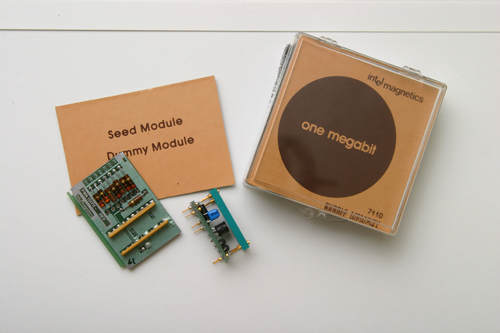
Currently working on restoring some bubble memories and I'm looking for
some modules originally included in Intel's BPK-72 development kit,
specifically the Dummy Load module and the Seed module.
http://archive.computerhistory.org/resources/still-image/Intel/intel.dummy_…
These are used for testing a bubble memory system as well as repairing
bubble modules which have had some sort of failure which requires manually
re-seeding them.
I have all the parts I need to work with the modules, I'm just missing
these parts. The manual shows the schematics, component values, and layouts
of both of these modules, so I can fabricate them myself if need be, but
wanted to see if anyone had them handy first.
Thank you again!
Josh
Hi, All,
I asked a version of this question earlier this year. I have not been
able to find any vintage machines that used these 16Kx1 55ns SRAMs.
Anyone recognize them? Lots of them for sale on eBay. Probably few
buyers. One would want to know which systems used them, thus my
question.
They probably would have been excellent in a DEC MOS memory board but
I have no evidence they were used thusly. Contemporary DRAMs were
cheap and 64Kx1 so that's what was in consumer gear.
Anyone? Fast SRAM? Anywhere?
There's little point in wiring 8 of them up into a byte vs using a
62256 except for speed. 55ns is faster than any 8MHz machine really
needs (100ns-150ns was typical for those depending on bus
architecture). I could see these being cache RAM for a minicomputer
vs primary RAM.
-ethan
The core memory could still have data in it....
Rod
Sent from Mail for Windows 10
From: Rod G8DGR via cctalk
Sent: 10 October 2018 09:28
To: Christian Corti; General Discussion: On-Topic and Off-Topic Posts
Subject: RE: Digico computer
That looks similar to the Logo of the company I worked for ICS (Instrumental Colour Systems)
The machine is identical down to the colour and the tape reader.
Did you contact the guy with the drawings?
Rod
Sent from Mail for Windows 10
From: Christian Corti via cctalk
Sent: 08 October 2018 15:25
To: General Discussion: On-Topic and Off-Topic Posts
Subject: RE: Digico computer
On Sat, 6 Oct 2018, Christian Corti wrote:
> I can make some pictures these days.
So, here they are:
http://computermuseum.informatik.uni-stuttgart.de/pics/digico
Some notes from my part:
There were two systems, there is only the front panel and board set left
>from the second one. One front panel says "LOS", the other "micro 16v".
Also pictures from the Pertec drive wreck that I hope can be restored to a
fixed platter only drive. (PCBs not shown, but I have them)
I have three memory boards in total, and the two CPU boards are different
revisions. The one shown is MK2, the other is MK1 with a lot of green
wires. All boards seem to be soldered by hand!
Christian