I have a pro-83 with the power supply. You can have it for postage. The
only thing wrong with it is one of the capacitors came off the board.
Bob Melville
250 941-4651
After 4 pacific
>
> Date: Tue, 13 Apr 2010 09:05:41 -0300
> From: "Alexandre Souza - Listas" <pu1bzz.listas at gmail.com>
>
> Next time, use kicad, diptrace or something useful. Eagle sux.
For Macintosh users Osmond PCB is very nice. I mention it only because
Macintosh based PCB layout software is thin on the ground so Mac users
might think there's nothing for their platform.
The fellow who developed Osmond seems to be quite a guy. At least, during
the years long (free) beta period he answered emailed questions about the
software quickly, clearly and friendly, and fixed bugs.
Jeff Walther
>
> From: "Chuck Guzis" <cclist at sydex.com>
>
>> I wonder if "chad" had origins with teletypes and paper tape, an
>> industry (telephone) separate from the punched card / data processing
>> industry way back when, and in which different terminology developed.
>
> Dunno, but either was fun to hide in a friend's drawer or light
> fixture. Paper tape punches were far nastier than the ones from
> punched cards.
Why nastier? The card ones are thicker (7 thou) and have sharp square corners. I think the first time I heard about them (in the UK) the card ones were called chads. It in a warning from our lecturer not to use them as confetti as he knew of a case of them getting into the bride's eye and she spent the next few hours in hospital because of them.
I think the holes were oblong so that the sideways on (row at a time) brushes of old IBM equipment could get through them easier. I don't think brushes would be able to read them a column at a time.
By the way, I have some 80 column cards punched with round holes, two holes for each oblong one, and they were described as 160 column cards.
Roger Holmes
> ------------------------------
>
> Message: 18
> Date: Sun, 11 Apr 2010 14:25:09 -0400 (EDT)
> From: Steven Hirsch <snhirsch at gmail.com>
> Subject: Memorex 102 20MB Hard disk
> To: Classic Computers Mailing List <cctech at classiccmp.org>
> Message-ID: <alpine.DEB.2.00.1004111405140.3802 at duo>
> Content-Type: TEXT/PLAIN; format=flowed; charset=US-ASCII
>
> Has anyone on the list seen or work with one of these? I received a
> Morrow M-20 8-inch hard disk along with my N* Horizon and found the
> Memorex 102 disk mechanism inside (what a beast!).
>
<snip>
I worked on the 101/102
See
http://www.bitsavers.org/pdf/memorex/disc/112-114.60-00_Memorex112_Fujitsu23
01_jan83.pdf for the Memorex 112 Technical Manual; the 112 is a later
version of the 102 and they probably have a lot in common. Paragraph 1.2.2
shows the typically current wave forms which should be the same.
According to the spec the start up current is 6A peak and 1.6A running. So
when running yr 10 ohm is only 1/4 watt and should be cool. The peak power
of less than 3.6 watts should only last a very short time as the motor comes
up to speed and it's back EMF lowers the current to the running current of
well under 1.6A (the running current supplies both the spindle motor and the
stepper motor). Again the figure shows a spindle motor start up current of
about 4.5A and the peak 6A occurs during stepping.
Good luck.
BTW, if you have an 102 documents I would really like a copy, personally or
at bitsavers.
Tom
I just discovered that Western Union's old telegram service isn't really
dead -- just sold to an outfit called "iTelegram". Never having really
looked at telegram services until now, I was wondering if anyone had any
information on what a same-day telegram cost way back when. Nowadays,
iTelegram does it for $45 + 88 cents a word.
--
David Griffith
dgriffi at cs.csubak.edu
A: Because it fouls the order in which people normally read text.
Q: Why is top-posting such a bad thing?
A: Top-posting.
Q: What is the most annoying thing in e-mail?
Anyone have a manual for these beasties? I'm looking for the print
codes for it. I've found some demo programs and a few of the print
codes on the web, but nothing complete.
On 4/11/10 6:37 AM, Rob Jarratt wrote:
> I have a faulty power supply in one of my VAXstation 4000 VLCs (clicks on
> and off more than once a second).
This failure mode of switching power supplies has been discussed here
before. What was the common cause of this, Tony? The startup resistor
or something, right?
-Dave
--
Dave McGuire
Port Charlotte, FL
-----------------Original Message:
Date: Sun, 11 Apr 2010 17:33:57 -0700
From: "Chuck Guzis" <cclist at sydex.com>
Subject: Re: Use mini CDR for equipment info?
On 11 Apr 2010 at 14:40, Dave McGuire wrote:
> I can't speak to the reliability of mini CDRs, but I can say that
> it seems like a whole lot less trouble to have a directory structure
> on a file server that's navigable by manufacturer and model number.
> I maintain about 26GB of documentation that way. I don't keep
> drivers or control software in there, but I could. Doing it the CDR
> way seems to me like it'd be more trouble than it's worth.
>
> Just a thought, no offense intended of course.
None taken. I find myself repeating things I've done 20 or more years
ago, forgetting that I've even done them--so locating the information
on a file server or in a paper file doesn't even occur to me. Then
there's the awful feeling you get when you find out that you've
already done something. But a CD-R stuck inside a cabinet might give
me a clue.
It's sort of like the situation a friend describes to me. He says
"Old age is great--I keep making new friends that I've known for 50
years..."
--Chuck
-----------------------Reply:
Oh, how I can identify with that... the other advantage is that you
can watch the same movies over and over and they're always new.
Re your docs: why not the best of both worlds, a label/postit/paper
inside the equipment with a reminder that you've been there before
and a pointer to where the machine-readable stuff can be found on
your server?
m
From: Joachim Thiemann
> Bummer. I'm not good at desoldering chips without potential damage
> to the board. Joe.
The easiest way to not damage the board is to cut the leads to the chip,
and then use a solder sucker to remove the solder in the hole along with
the remnants of the chip leads. Hopefully if one or more of the leads is
soldered to the ground plane, those pads used thermal isolation to
separate them from the ground plane.
Hi all,
I'm looking for details on a 4MByte QBus memory module made my
National Semiconductor. It doesn't have an NSxxx model number anywhere
on it, but is simply labeled 980110014-211. I've managed to work out
what many of the jumpers do, but a lot of them go straight into a
couple of PALs which I'd rather not need to reverse engineer. A manual
of some description would be nice although, failing that, even a
summary of the jumpers' functions would be great. Even a photo of a
similar module with a description of how it's set up would help at
this stage.
The main thing I need right now is how to configure the range of
addresses the module will respond to. It works fine on one machine
which has some memory on the CPU board, but another won't boot saying
that there's no memory at address zero.
Cheers,
--
Steve Maddison
http://www.cosam.org/
> From: ard at p850ug1.demon.co.uk (Tony Duell)
> I haev found it's impossible to predict the prices that things will
sell...
As a seller I look at the number of watchers:
- 0-9 likely to go for the starting price
- 10-15 likely to be one serious bidder, price tends to dribble up from
the starting price.
- 15+ war likely to be declared between multiple serious bidders and the
price can go ballistic.
A complete, untested PDP-11/10 system (eventually found my variac but too
late to fire up the system) sold for ~$100 from a $0.99 starting price. In
Australia just some of the parts and PCBs for a 1974 Electronics Australia
EDUC-8 microcomputer (contemporary of the MARK-8) has attracted a bid at the
$100 starting price while another auction for PCBs and some parts for a
reproduction MARK-8 has not attracted a bid. All can be explained by the
size and composition of the market. In Australia there are only a very
limited number of people in my city who have an interest in a PDP-11, the
MARK-8 is obscure and relatively unknown as Radio-Electronics magazine had
limited market penetration, while Electronics Australia's EDUC-8
project would have been seen by Australian professionals and enthusiasts
>from that era. So these auction prices are currently related to demand.
I'm in Australia and there can be category mismatches between the eBay.au
site and the rest of the world. So that what you an auction you think
should list into an equivalent category on eBay.com appears to just
disappear and searches will fail unless your buyers are searching only at
the top eBay level. Most eBay.com buyers appear to be unaware of this
limitation on searches.
Then there is the opposite of an eBay disaster where the object is just to
find homes for stuff. On eBay you don't have to wait for the end of a 7
day auction to sell something. When trying to find a home for something
oddball like a core memory system from a PDP-11/20 I'd be happy to accept a
$0.99 starting price bid from anybody who expresses the least interest. End
result is a happy buyer and you get the cost of the eBay listing fee
covered. Does surprise people who don't know this option of eBay,
plus this can upset people who expect to snipe an auction.
I have a faulty power supply in one of my VAXstation 4000 VLCs (clicks on
and off more than once a second). My worry is that I might have damaged it
by overloading it because I know it is not that powerful. I suspect I could
have overloaded it by putting in a disk that draws too much power (could
that do this kind of permanent damage?). Does anyone have any guidance on
what limit I should apply to the power a hard disk uses when considering
what disks to put in these machines?
Regards
Rob
All --
Does anyone have the source to the CompuPro Disk 1 format and copy
utilities? If they?re buried in a manual somewhere, I can?t find it. Any
pointers appreciated.
Thanks!
Rich
--
Rich Cini
Collector of Classic Computers
Build Master and lead engineer, Altair32 Emulator
http://www.altair32.comhttp://www.classiccmp.org/cini
One of the diskettes given to me has what looks to be support for running
the Morrow DJ controller under N*DOS.
Here's the equivalent of a README:
10!"LIST THIS PROGRAM"
20STOP
30 THIS SOFTWARE HAS A TIMING CONSTANT SET FOR
40 A Z80 N* HORIZON.
50 IF YOU HAVE A DIFFERENT SYSTEM THEN YOU
60 WILL NEED TO CALIBRATE THE TIMING CONSTANT.
70 PROCEED AS FOLLOWS\
80 1.COPY THE DOSCHG DISKETTE
90 2.POWER DOWN AND HOOKUP 8 INCH DRIVES AND CONTROLLER
100 3.BOOTUP YOUR OLD N* DOS
110 4.PUT COPY OF DOSCHG IN DRIVE 1
120 5.PUT AN 8INCH DISKETTE IN DRIVE 4
130 6. LF BASIC 2D00
140 7. JP 6519
150 8. SF BASIC 2D00
160 9. NOW BOOT THE DOSCHG
170 THE ABOVE PROCEDURE TIMES THE 8 INCH INDEX HOLE
180 IN THE DISKETTE FOR 1 REVOLUTION OF THE DISK
190 AND PLACES THE COUNT INTO THE SOFTWARE.
200THE NEW TIME CONSTANT IS AT 64E5 64E6
210FOR REL 5 8DIGIT BASIC.
220 DOSCHG IS NOT DESIGNED TO RUN UNDER THE TIMESHARE PROGRAMS
230THE TIMESHARE PROGRAMS INCLUDE THE 8 INCH DRIVERS.
240 AT THE END OF BASIC. THESE ROUTINES ARE USED
250 YOU MAY REPLACE THE DOS
260 ON THE DISK WITH ONE OF YOUR OWN BUT REMEMBER
270 TO USE RELEASE 5 DOS ONLY.
280 THE FILE BASIC IS 58 BLOCKS LONG BUT
290 AFTER BOOTUP BASIC ENDS AT 65CAH AND IS 56.7 BLOCKS LONG
300 THE OLD VERSION OF THIS SOFTWARE USED 3 BLOCKS IN
310 MORROW'S CONTROLLER RAM. REV 4 OF HIS BOARD WILL
320 NOT ALWAYS WORK WITH A PROGRAM IN THE CONTROLLER RAM
330 THE SOLUTION WAS TO MOVE THAT SOFTWARE TO THE END OF BASIC
340 YOU CAN USE THE MONITOR TO TEST THE CONTROLLER RAM
350 BY TM E400-E7FF 0
360 THE PROGRAM GCOPY COPIES 8 INCH TO 8 INCH DISKS COMPLETELY
370 THE DISK MUST HAVE THE SAME DENSITY AND NUMBER OF SIDES.
380 THE DENSITY IS SET BY THE PROGRAM 8INT. 8INT IS USED
390 TO INITIALIZE 8 INCH DISKS.
400 THE PROGRAM COPY IS USED TO COPY BY FILE FROM/TO ANY DISK.
410 LOAD AND RUN BASIC AS A PREREQUISITE TO RUNNING 8INT,COPY OR,
420 GCOPY. YOU MUST THEN GO BASIC, BYE, GO 8INT,COPY OR,GCOPY AND THEN
430 GOBASIC.
440 PGM1 IS USED ANYTIME YOU MAKE CHANGES TO BASIC AND
450 WANT TO SAVE BASIC ON THE DISK. THERE IS A JMP AT 2D00
460 WHICH MUST BE REWRITTEN BEFORE SAVING DOSCHG BASIC.
470 THE BASIC IS SET FOR 32K STARTING AT 2000.
Here's a directory listing:
DOS 4 12 D 0
BASIC 10 58 D 1 2D00
CF 39 6 D 1 2D00
CD 42 4 D 1 2D00
8INT 44 4 D 1 2D00
GCOPY 46 2 D 1 2D00
COPY 47 6 D 1 2D00
PGM1 50 8 D 2
INFO 54 8 D 2
CONTROL 58 4 D 2
TEST 60 4 D 2
TEST1 62 4 D 2
Does this ring any bells?
Steve
--
Thanks to Dave Dunfield's fine work, I have my Horizon system up and
running!
One thing still puzzles, me though: Is it possible to create and boot SD
diskettes on a DD system? When I boot at DD and bring up NST, it
cheerfully writes a SD diskette from an image. However, that image will
not boot. Should this work?
Next hurdle is getting the Morrow Disk Jockey 8" controller hooked in.
Some of the diskettes I received with the unit (none of which boot) have
Basic and ASM programs that look like they're intended as support for the
DJ controller. Without documentation, this is going to take a bit of
experimentation, I think.
Steve
--
>>> Next hurdle is getting the Morrow Disk Jockey 8" controller hooked
>>> in. Some of the diskettes I received with the unit (none of which
>>> boot) have Basic and ASM programs that look like they're intended as
>>> support for the DJ controller. Without documentation, this is going
>>> to take a bit of experimentation, I think.
>>>
>> Get docs as that will save a huge amount of time. They are likely on
>> Bitsavers or other archives.
>
> I have the Morrow Design docs, but the software discussed is all for
> CP/M. This box came with a bunch of BASIC and ASM programs that look
> like they are intended to patch N*DOS for the 8" controller. Cannot
> find anything out about them, though, thus the comment about trial and
> error.
>
> Steve
>
>
Memory says Morrow never bothered with NS*dos only CP/M but it tould be
iteretesting to see
otherwise.
Allison
********************************************
The COMPUPRO.ZIP file at Retroarchive (that Allison referenced in her next
msg) also includes some Morrow items. There is a formatdj.asm file for the
DJ/DMA controller that includes a NorthStar option. At least it's a start. I
didn't dig much deeper but there is definitely some more Morrow stuff there.
Jack
Philipp wrote:
...
And I got some RPR schematics from someone in the Netherlands last Sunday -
thanks again :-)
Would be cool if the schematics fit my RP02 and RP03 drives - at least a
little bit. I'll keep the stuff anyway. Perhaps there is some interest to
put that to Al?
Regards,
Philipp
http://www.hachti.de
------------------------------
The RP03 is an ISS drive and there will be little commonality in its
schematics with that of the RP02/RPR02. For example, the former servos on a
glass scale while the latter detents on a rack.
As I recall the 660-1 (RP02) was a relatively short run product since DEC
switched to the RP03. The Memorex 3660 (the IBM compatible version) was a
much longer lived product so it got the benefit of many design improvements
that were never in the 660-1. When Memorex refurbished a 3660 into a
660-1(refurb) I bet it got the benefit of all those improvements so it is
likely the schematics are similar but different in detail.
There is a 660-1 Maintenance Manual at bitsavers, no schematics. But the
maintenance manual has a list of all the signals in the back panel so if you
have the schematics that should be very helpful. Signals may have been
added or deleted but the signal names rarely changed as the design was
improved.
You ought to consider posting those RPR02 schematics at bitsavers.
Tom
> It's probably a laughable idea but... Is it possible to read LINCtapes
> with a TU56 and a TD8E
> DECTape controller? I could imagine that it's possible due to the simple
> design of the TD8E controller - most work is done in software...
>
Sort of. You will need to put an inverter in the timing track path (I
put it in the cable). Discussion from when I originally worked on this.
http://groups.google.com/group/alt.sys.pdp8/browse_thread/thread/64889d6346…
I was able to read some tapes but on the todo list is to build a better
reader since many of the tapes had too many errors.
http://www.pdp8online.com/images/
I can dig up the code I wrote if your interested but it will need some work
since it depended on the special interface board I made for the pdp-8 I have
online. Much of the work I did on the PC.
I can also give you the code the web site uses to display the tape contents.
I am trying to get rid of around 300 old magazines and journals for someone
I know. Included are about 200 "Proceedings of the IRE/IEEE" journals
varying in age from 1949 to 1970, as well as bound full-year journals from
1953, 1955, 1961, 1962 & 1963. Additionally, there are about 70 "R.F.
Design" Ranging from the late 1970s to the early 1990s, as well as 25
"Hewlett Packard Journal" from the early 1990s. Because the person who has
them does not want to give them away, I am trying to get $0.50 per 25
journals. They are located in Wall Township, New Jersey, and are for pickup
only.
Thanks
Joe
----------------Original Message:
Date: Mon, 5 Apr 2010 02:13:20 -0400
From: Ethan Dicks <ethan.dicks at gmail.com>
Subject: Anyone have an image of a Japanese PET chrgen ROM 901447-12?
Hi, All,
This has all been discussed over on the cbm-hackers list over the past
several months, but I've been fixing a couple of Static PET boards for
someone in Japan. The only thing that appears to be unique to one of
the boards is a 2316B in a Commodore-built 6540 adapter board (P/N
320076) and the 901447-12 ROM that's in it. There is no corresponding
ROM image on Zimmers.net (where the old funet archive lives), and this
ROM reads all zeros.
I have a photo of the keyboard layout for a Japanese chicklet PET, and
it doesn't happen to match the map of the Japanese C-64. One
interesting feature is a few Kanji characters mixed in with the
Katana, specifically, "4" maps to the Kanji for "year", "5" has
"month", and "6" has "day" - obviously for rendering dates easily.
There looks to be 51 Japanese glyphs total (all the Katakana
characters, the three Kanji, and a couple of other characters needed
to write sentences in Japanese). Given that the editor ROM is
identical to a standard European/US BASIC 1.0 PET, it seems likely
that the character drawn on the key would be the replacement in
"upper/lower case mode" for that particular symbol.
It seems likely I could reproduce the general contents of the ROM
following the keyboard map, but it would be great it someone out there
happened to have the real thing. I already know that nobody on the
cbm-hackers list has come forward with a copy, but I'm pretty sure
there are PET owners on this list who are not on cbm-hackers.
If anyone happens to have this ROM or ROM image, please share it with
the great repository at Zimmers.net.
Thank you,
-ethan
--------------------------------Reply: ----------------------------------------------------------
It would certainly be nice to find the 'official' ROM, but I thought that
the ROM that Philip (the owner of that PET on your bench) created
was pretty well complete and correct; it seems to match my Japanese
keyboard perfectly except for one character, and I suspect it's the key
that's wrong and not the CG.
Did you try that image and match it up to your Japanese chiclet
keyboard?
I've been playing with the idea of having all three (four?) character sets
available on screen at the same time, using the reverse video signal.
mike
I can say that Corvus PCs did indeed exist. I used one, and sold lots of them while working for Lawrence S. Epstein Associates in the 1980's.
There were other things Corvus that never got produced, this wasn't one of them.
Al
On Thu, 8 Apr 2010, Steven Hirsch wrote:
>
> On Thu, 8 Apr 2010, Curt @ Atari Museum wrote:
>
> >
> > Let me know if anyone has one of these or has seen one, I'm told these may
> > have been done by Tandon as they bought Corvus around 1987-1988 or so.
>
> Heh. You'll have to beat me to it...
>
> Seriously, though, are you sure this was ever actually manufactured? I
> have a bunch of glossy sales stuff from the early 90s that shows a number
> of Corvus items made of pure smoke and mirrors.
>
> Steve
TLC - tender loving care
The RP02 is a Memorex 660-1 OEM'ed to DEC who resold it as an RR02.
The RPR02 is made from a Memorex 3660 originally rented into the IBM
peripherals market, refurbished by Memorex into a Memorex 660-1 and then
OEM'ed to DEC who resold it as an RPR02 - the second R for refurbished
I'm probably going to bid for it.
Tom
------------------------------
Message: 11
Date: Fri, 09 Apr 2010 20:56:48 +0200
From: Philipp Hachtmann <hachti at hachti.de>
Subject: Re: DEC RPR02 on eBay
To: General Discussion: On-Topic and Off-Topic Posts
<cctalk at classiccmp.org>
Hu!
E. Groenenberg wrote:
> Indeed it is rare. A bit of TLC and it would definitely be a nice
> piece for any collection.
Ed....!
What is "TLC"?
And what is the difference between RP02 and RPR02? They look quite similar -
except the paint. And I
got some RPR schematics from someone in the Netherlands last Sunday - thanks
again :-)
Would be cool if the schematics fit my RP02 and RP03 drives - at least a
little bit. I'll keep the
stuff anyway. Perhaps there is some interest to put that to Al?
Regards,
Philipp
--
http://www.hachti.de
> http://www.merry-xmas.net/9track/
That is a CDC Keystone series drive. Can't really tell the model but I'd guess a 92181?
The DEC TU80 is a very close cousin.
It is natively "Formatted Pertec" interface, and I see the two 50 pin edge connectors for this on the back, but SCSI <-> Formatted Pertec converters do exist and there may be one bolted on the back somewhere.
Tim.
DEC RPR02 drive on eBay...This one really IS "RARE L@@K" etc. Two
days left as of the time of this writing, no bids, $100 opening bid,
in New Hampshire. Item #200457840777.
Beautiful device...wish I had a way to grab it. I hope someone
here gives it a good home.
(no association with seller, etc)
-Dave
--
Dave McGuire
Port Charlotte, FL
-------------Original Message:
Date: Wed, 31 Mar 2010 22:27:26 -0700
From: "Chuck Guzis" <cclist at sydex.com>
Subject: Re: Reading ancient paper digital media (was Re: Hamurabi
Focal source)
<snip>
>Watching the thing read at 1200 cards per minute is pretty impressive.
<snip>
--Chuck
------------Reply:
Watching one *jam* at 1200 cards per minute is even more impressive,
especially if the sensors are dirty or misadjusted (and *especially* if you
have to recreate the damaged cards manually)...
mike
I rescued this thing from a computer store in the area a couple years
ago, and I think it's time to pass it on. From what I was told and what
I can tell, this is a CDC 9-track SCSI tape drive that was removed from
it's original rack/chassis. At the time, this computer store used it to
do some data recovery on some 1980 census tapes from Chicago, and they
had rigged this to a more modern SCSI based PC to do so. So I don't
know what condition it is currently in, and no idea if it works still,
but it did before it was stashed away into storage from what I understand.
If you want it, I can ship it at your expense or more than happy to pass
it along any other means possible, it is located in the Chicagoland area.
Temporarily posted pictures at:
http://www.merry-xmas.net/9track/
Mike
Noticed eBay auction /#/380220354709 - some collection of HSJ50 bits and
what look suspiciously like some CI ports. Does an HSJ even have the
capability to support CI? I never really dealt with HSCs back in the
day, or the intelligent storage controllers from the BA35x era.
Anyway if it does support a CI interface, I thought it might be a
cheaper way for somebody with a larger VAX to get closer-to-modern
storage and much lower electric bills than using SDI or HSC options.
Doesn't do me much good for my 11/730, so go for it.
No connection to the seller, and no comment regarding the asking price...
Share and enjoy!
--Steve.
Hello,
I'm repairing my A1010 Amiga external floppy drive - the actual drive
works (tested by plugging it into the internal A500 floppy connector),
so the fault should be on the latch board inside; there are two chips,
a 74LS74 D Flip-Flop and one chip (also 14 pin) with number M53238P
preceded by the Mitsubishi logo. Given the required function, and
connections on the adapter board, I am 99% sure that it's a 74LS38
Quad NAND open-collector equivalent - but googling doesn't turn up a
datasheet, just a gazillion chinese parts vendors. Can someone just
confirm this in a cross-reference? Or a A1010 schematic? Or their own
drive?
Thanks,
Joe.
PS. Symptom is that the drive clicks but never spins. I've already
taken out the chips and replaced them - this time in sockets. So if
I'm wrong it's a simple matter of undoing the 20-odd screws yet again
(Verdammte Post mit deren entstoerregelungen von damals...) and
replacing the chip. I just want to double-check before plugging it
into the A500 again tonight.
--
Joachim Thiemann :: http://www.tsp.ece.mcgill.ca/~jthiem
Martin Goldberg <wgungfu at gmail.com> wrote:
> Someone from the IGDA-Preservation group is in the process of
> transferring old DEC game code printouts in to text files, and was
> wondering if any one from the list knew if there was a PDP5 emulator
> (as a bunch of this is PDP5 in origin)?
>
> He may also require assistance in checking some of the assembly, as
> the printouts and copies are not always clear enough to read
> accurately.
>
> Any help would be appreciated, and I'll pass the info on.
Depending on the code, it might be runnable on a PDP8.
The main differences between the PDP5 and PDP8, as far as I can
remember, is that the PDP5 keeps the PC at address 0, and stores the old
PC at address 1 when an interrupt happens, while the PDP8 have the PC as
a separate CPU registers, and stores the old PC at address 0 when an
interrupt occurs.
And some (combinations of) OPR instructions don't work on the PDP5. But
that should not be a problem if you just take the program to a PDP8.
So, unless the program in question needs interrupts, or play directly
with the PC, I believe it might run on a PDP8.
Johnny
Philipp Hachtmann <hachti at hachti.de> wrote:
> Hi folks,
>
> it's probably a laughable idea but... Is it possible to read LINCtapes with a TU56 and a TD8E
> DECTape controller? I could imagine that it's possible due to the simple design of the TD8E
> controller - most work is done in software...
Nothing laughable about it.
As far as I know, it should work just fine.
> I just stumbled across a few of those tapes with unknown content. I first thought that I got a
> DECTape which was wound to the wrong side. I just tried it out. The DECTape system seemed to
> recognize just something on the tape - as it "rewound" the tape just up to the "beginning". And
> then it was not able to read something, of course.
> Oh, it would be fine if LINCtape reading on TD8E was possible - and readily implemented...
>
> Best wishes,
>
> Philipp
>
>
> P.S.: I probably won't be able to give those tapes away without cleaning them... So offers to look
> at them for me are quite useless :-(
> If I do not find means to read the tapes, I'll degauss them. Or simply reformat them. Or both for a
> clean tape start. Most of it seems to be working data. And some obscure software I don't know (yet).
When you need to understand is that you can't use any "normal" software
to read them, and that include any device drivers.
The tapes are written in the other direction. And that's something the
device driver is involved in.
As far as I know, you can actually use any DECtape controller to
read/write the tapes, not just the TD8E. But the same problem applies to
all of them. You need a special device driver.
But apart from that, it should be pretty straight forward. You basically
do eveything the same way you would do with DECtapes, except you set the
transport direction inverted to what a DECtape would do for all operations.
DECtape and LINCtape are clever in the way they identify blocks though,
so that the block markers can be detected the same no matter which way
the transport is moving, which is why you seem to recognize the tapes
somehow.
(The tape markers were designed so that the fluxes would become the same
no matter which direction you read them.)
One last thing. It *might* be that you'll have to do some bitfiddling
after reading the tapes. A DECtape (and LINCtape) records only three
bits at a time. When reading forward, you read 4 rows to get all 12
bits. And of course, they get stuffed in a certain order. Reading in
reverse means you get groups of 3 bits possibly shuffled around, as well
as being inverted. Depending on the LINCtape format, and how the TD8E
reacts, things might end up just right, or might require the bit
fiddling. You'll have to experiment...
Johnny
Hi folks,
it's probably a laughable idea but... Is it possible to read LINCtapes with a TU56 and a TD8E
DECTape controller? I could imagine that it's possible due to the simple design of the TD8E
controller - most work is done in software...
I just stumbled across a few of those tapes with unknown content. I first thought that I got a
DECTape which was wound to the wrong side. I just tried it out. The DECTape system seemed to
recognize just something on the tape - as it "rewound" the tape just up to the "beginning". And
then it was not able to read something, of course.
Oh, it would be fine if LINCtape reading on TD8E was possible - and readily implemented...
Best wishes,
Philipp
P.S.: I probably won't be able to give those tapes away without cleaning them... So offers to look
at them for me are quite useless :-(
If I do not find means to read the tapes, I'll degauss them. Or simply reformat them. Or both for a
clean tape start. Most of it seems to be working data. And some obscure software I don't know (yet).
--
http://www.hachti.de
-----------------Original Message:
Date: Mon, 05 Apr 2010 16:28:58 -0700
From: Brent Hilpert <hilpert at cs.ubc.ca>
Subject: PET 4032 keyboard scanning problem / was Re: Anyone have an
image of a Japanese PET chrgen ROM 901447-12?
Speaking of early Commodore PETs, I have here a 4032 on which some of the keys
do not work. Some time ago I took a brief look at it and, as I recall,
concluded the problem was not the keyboard but rather something was messed up
with the scanning, something like not all columns/rows being scanned. I think
it was a 6821 or 6822 or some such doing the I/O, but the diagnosis was perhaps
more suggestive of something like a PROM bit failure causing the firmware
program to foreshorten the scan sequence.
Anyone have knowledge of a known failure mode of this sort with these machines?
--------------------Reply:
The most common problem is just oxidation and/or wear of the rubber 'contacts'
and the PCB grid; if you're lucky a good cleaning will clear it up, in case of bad
wear of the conductive pads you may have to recoat them with conductive paint
ot glue little pads of aluminum foil or aluminized mylar on to them.
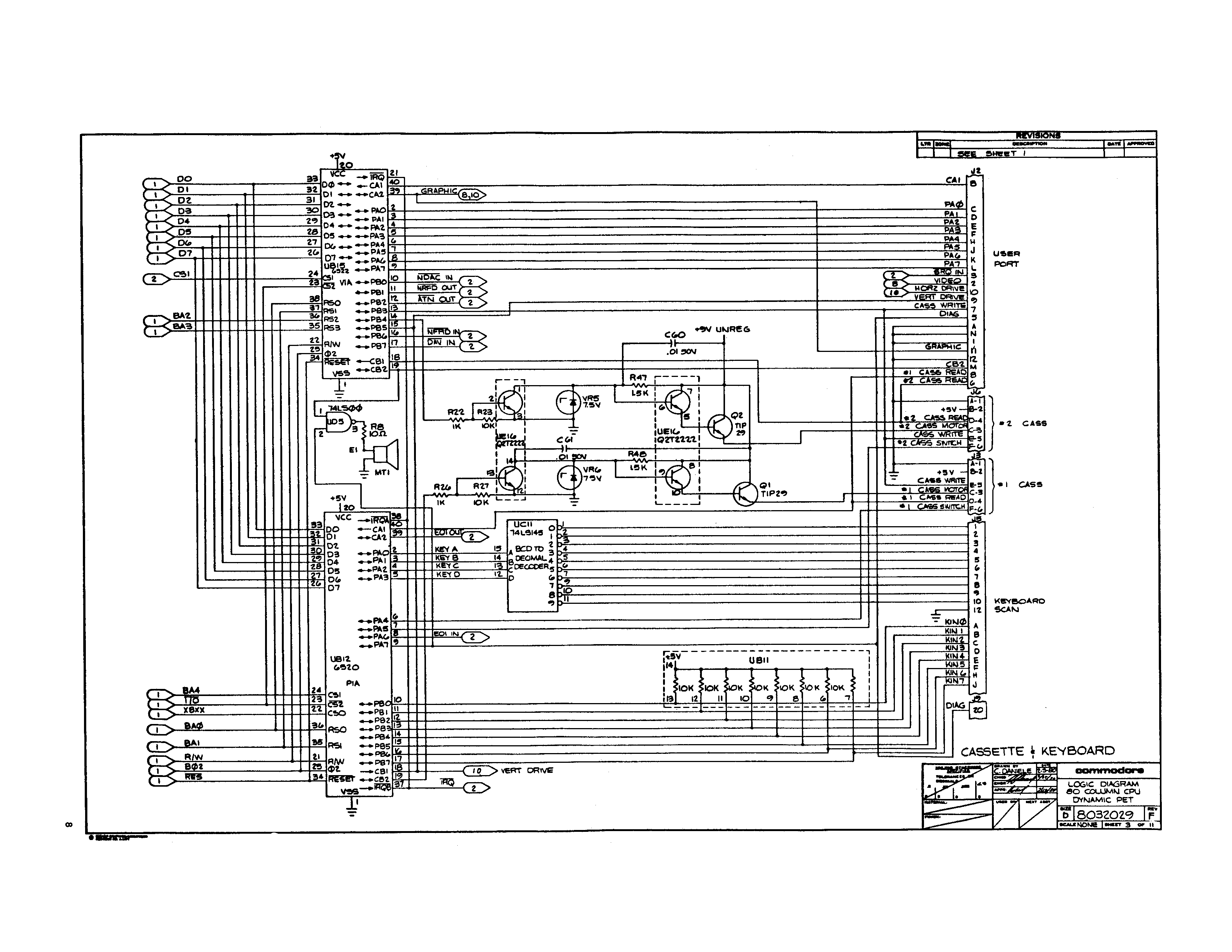
Electronically they are a normal scanned matrix, driven by a 6520 PIA (UB12?)
and a muliplexer; if there is a problem there then it would most likely be with all
the keys in a certain row or column. I suppose it's possible, but I'd be very
surprised if it were a bad ROM.
Check the schematic and you should be able to jumper across the appropriate
keyboard lines to test all the rows and columns.
http://www.zimmers.net/anonftp/pub/cbm/schematics/computers/pet/8032/803202…
Someone from the IGDA-Preservation group is in the process of
transferring old DEC game code printouts in to text files, and was
wondering if any one from the list knew if there was a PDP5 emulator
(as a bunch of this is PDP5 in origin)?
He may also require assistance in checking some of the assembly, as
the printouts and copies are not always clear enough to read
accurately.
Any help would be appreciated, and I'll pass the info on.
Thanks!
Marty
As it is getting close to the date for the Dayton Hamvention, is anyone
on the list going to be at Dayton? My plan is to be there with two
selling spots (one to park in) and see what kind of "stuff" I can get
rid of. If we have a few people there, it might be fun to have a
Saturday night dinner at one of the local restaurants.
Hi, All,
I was cleaning out a pile of stuff left behind when one of my brothers
moved to California and ran across what looks like an IBM Aptiva 2142
Media Console - a pop-top CD-ROM and floppy box with a 50-pin cable
back to the main box...
http://www.systemsalchemy.org/howto/aptiva/intro.html
Formerly, there appears to have been a lot of Aptiva information at
http://wymette.home.att.net/aptiva.htm but the site is gone (I think
AT&T just stopped serving "home pages" recently) and archive.org isn't
pulling up anything on that old site at the moment.
Another referenced site was http://members.rogers.com/airchan/ (which
is available at
http://web.archive.org/web/20021213012640/http://members.rogers.com/airchan/)
happens to have had a pointer to the original IBM hardware manual -
http://web.archive.org/web/20021201092020/http://members.rogers.com/airchan…
which at least mentions how to dismantle the Media Console.
>From what I have been able to find, the CD-ROM drive in the media
console is an IDE unit not SCSI, so I _think_ that while the connector
may resemble a SCSI-1 cable (50-pin "Blue Ribbon" connector) it may
not carry SCSI signals. There was at least one reference I found to a
"host card" in the Aptiva that was not being described as a SCSI card,
but I couldn't find anything that states it definitely is or is not
SCSI.
I don't happen to have an Aptiva, but if someone out there does, I'd
rather it go to someone than get broken down for recycling at Free
Geek Columbus (which is where it will end up if it's unloved). I
would want 1.2X actual shipping cost from 43202 (box, packaging,
incidentals, etc). I see a number of places selling them for about
$30 plus S&H, but I doubt they are flying off the shelves at that
price.
Cheers,
-ethan
Nigel Williams <nigel.d.williams at gmail.com> wrote:
> More details and pictures here:
>
> www.retrocomputingtasmania.com/members/nw-retrocomputingtasmania-com/pdp-11…
>
> If anyone knows the part numbers for the KDJ11 CABKIT or front/rear
> plastic panels for the BA23 that would help me contact suppliers.
You know, Google is really simple to use...
A quick search on "pdp-11/93 cabkit" gave me CK-KDJ1E-KA.
Found, for instance, on
http://www.pacificgeek.com/productdetail.asp?ID=1932313.
(in turn from http://www.pacificgeek.com/showallitems_bb_list.asp?Code=CK)
You can probably find information on all other stuff you are looking for
by using Google as well. However, finding the actual items might be
another story.
I wish you luck, though.
> My aim is to run RSTS/E v10 on this machine so I am open to
> suggestions for the simplest path to this goal.
>
> I have a SBOX CQD223A/TM SCSI card which I would be willing to swap or
> sell for the QBUS variant or some other manageable RSTS/E compatible
> storage device.
That is a Qbus controller, I assume you know this?
The Sbox is just a question of handles, which can be removed.
Johnny
Another thing that works (but you have to be careful) is to use an xacto
knife to cut the leads using the uncut leads as a "stop". At the point
most of the leads are cut, you can use a standard cutter to clip the
last lead on each side.
(Still trying to figure out how this is related to chip equivalence.)
> If I slip, that would be no good... nevertheless, that's probably
> what I'll end up doing (the cutting, not the slipping part!)
>
> Joe.
I sent the DEC ROM info to the VT220 Font author, and he responded with
thanks and also wanted to know if anyone had PDP-11 CPU tests.
I noted he might want to join here, but I thought I'd start the ball
rolling on his request.
Jim
--
Jim Brain, Brain Innovations (X)
brain at jbrain.com
Dabbling in WWW, Embedded Systems, Old CBM computers, and Good Times!
Home: http://www.jbrain.com
>
> Date: Tue, 6 Apr 2010 19:54:27 +0100 (BST)
> From: ard at p850ug1.demon.co.uk (Tony Duell)
> I haev found it's impossible to predict the prices that things will sell
> for on E-bay. Several times I've seen things with an opening bid of
> perhaps $5. I've thoguht that it was a rare an interesting item and put
> in a bid of $100 for it (and ecpected it to go for a lot more), only to
> find I end up winning it for the opening bid. Conversely there have been
> times when I've thought 'nobody will want that' and put in a sensible (if
> somewhat low) bid, only to find it sells for much more.
Time also plays a part, as in, who happens to be looking for that type of
item and how many. What sells for very little one month may go for
hundreds a month later.
I designed and ran off some circuit boards for 16 MB Macintosh IIfx SIMMs
and offered sets of four (64 MB RAM total) on Ebay. The first set sold
for over $270. As one would expect, the price declined from there until
it went under $50 which was about what I felt was my minimum considering
the effort to assemble them. The second to last set sold for about $50
and the set that made me quit went for about $25.
Then I waited a month or two, offered them again with exactly the same
auction listing and the price was back up over $120.
It's like there's a customer-base refresh function at work or at least a
time variant demand function.
Jeff Walther
Hi folks,
could someone please explain me THIS?
http://cgi.ebay.de/ws/eBayISAPI.dll?ViewItem&item=190385486840
I don't sell on eBay very often. And from time to time I see people paying astronomical sums for
more or less junk. But this time it was me offering stuff - and what did I get? I have no clue who
would sell me a used RK05 disk pack in unknown condition for that price. But this was a new in a box
one....!
What did I do wrong?
Was it the winner of the auction who has 0 eBay points? There was absolutely no trace of fraud on my
side. I did neither bid with another account nor did I even ask someone to bid on my auctions to
drive up the price. That's what I got from it. I hope that the lucky 0 points high bidder on my pack
is someone who really exists...
Regards,
Philipp
--
http://www.hachti.de
A few weeks back I purchased a Tandberg TDC 4120 drive at a recycler.For
some reason I like collecting different tape drives and removable media,
maybe just incase I find media with data I want to restore.
Browsing ebay I found 6 new QIC 1000 tapes for it starting at $1 with $5
shipping "IMATION MAGNUS 46165 QIC 1000- 1.2 GB-B NEW" and put in a bid
thinking nobody uses this stuff anymore. With 30 minutes currently left it
has hit $117.50 and all the bids are users with 2000+ feedback. So are these
things that rare, or do people snag it up to keep the prices expensive for
corporate users who need tapes? I can't really see a company needing new
tapes (1.2GB) these days, drives maybe to restore files but not new tapes.
Philipp Hachtmann wrote:
> What did I do wrong?
When offered in an open market with asymmetrical information and indeterminatedesire, if an item sells for more than certain people on this list think itshould, the people who spent more are idiots/clueless/scum/damaging the vintagemarket.
When offered in an open market with asymmetrical information and indeterminatedesire, if an item sells for less than certain people on this list think itshould, the people who spent less are parasites/snipers/scum/damaging thevintage market.
This is a once a month or more thread. Seriously, do we really need to rehash it?
KJ
I may be asked to handle some Terak 8500-series "variable density"
floppies. The documentation isn't very specific about these and
since I don't have them in hand, I'm guessing that they're really
just FM+MFM and not actually zoned bit density floppies.
Do I assume correctly?
Thanks all,
Chuck