On 11/9/10, Tony Duell <ard at p850ug1.demon.co.uk> wrote:
> The cables are differnet betwene the RLs and the RK06/07 (the latter has
> all pins bet one (termintor power) connected
That rings a bell (term power).
> the former has rather fewer
> wired), but AFAIK the terminator is the same (it terminates all signal
> pins. I think at least one RL controller printset shows the exploded view
> of the terminators with 'First used on Option/Model : RK06' specified.
OK. That's a good detail to remember when setting up drives of either kind.
One handy bit of trivia if you happen to have spare Unit plugs from
the high numbers of an RK06/RK07 set is that they work in an RL01/RL02
if you mentally mask off 2^2 (i.e., an RK06/RK06 plug labelled "4" is
"0" on an RL01/RL02). It's the same sort of switch/bulb housing, but
one less bit going back to the electronics. We didn't do it often,
but sometimes we were short some of the numbers and we did have a
couple of RK07s and a drawer of random unit plugs.
-ethan
De writes:
>> I am looking for info on a Gandalf LDS120 modem, specifically the
>> serial port pinout.
> In the division of irrelevant to the original question, I thought these
> things were line drivers, not modems.
I always thought they got lumped into "short haul 4-wire modems".
They do have "DCD" lights on the front. I seem to recall that it's just
a light and doesn't actually assert any RS-232 pins. But they could just
be differential line drivers probably with isolation.
20+ years ago I'm sure I looked inside to see what's in there but I
can't recall. I always thought they did some simplistic and almost certainly
not Bell-standard FSK or PSK but
that was just my impression, no actual evidence to back that up.
Did the 4-wire screws on the back have labels of "+" and "-"?
That would be a point in favor of them being line drivers and not modems
(although some simple modems were in fact phase-sensitive).
We used them between serial concentrators on different floors or
between serial concentrators between nearby buildings.
I note that there's no Gandalf directory at bitsavers. Gandalf
certainly has a unique heritage not really being a "computer"
company in the usual sense but for so many of us it was the
gateway from terminal to the computer or between computers. I
get the impression they were far more common at large academic
institutions than at any commercial site.
Tim.
On 11/09/10 10:44, Roger Holmes<roger.holmes at microspot.co.uk> wrote:
>> > From: Johnny Billquist<bqt at softjar.se>
>> >
>> > Gah. I have no idea what PPU mean, nor PP.
> You're probably just not old enough.
That is definitely true here. :-)
> In the 50s the main processor was called the CPU (Central Processing Unit) to differentiate it from the various PPUs, (Peripheral Processing Units). The first machine I programmed, the IBM 7094 had a CPU and two PPUs, one to read cards and write the images to tape transports, which would then be switched over to the CPU to read, compile and execute the job and write the results back to another tape transport which then got switched to the other PPU which then transferred the tape image to a line printer.
Thanks. That explains it.
> Somehow now (when most peripherals have embedded processors which could be called PPUs) we seem to have stopped using the term.
Yeah. It might have gotten lost in the inbetween years when computers
were trying to get rid of, at the time, expensive peripherials (they
were expensive enough without being their own computer).
I only started playing with computers in those inbetween years. :-)
Johnny
Hi! Over the last couple of years several of us at N8VEM,
S100computers.com, and others have been building S-100 boards. This summer
we did a major update/respin cycle to the boards and made manufactured PCBs
for many builders. For a while it seemed to satisfy the demand for DIY
hobbyist S-100 PCBs but now the interest is starting to pick up again so I
thought I would send an update to any S-100 enthusiasts on CCTALK.
I will reorder/respin S-100 PCBs once the interest level gets to an
economically viable level for a group purchase. Normally that is around
25-30 PCBs I know builders want which makes a cost at $20 plus shipping per
PCB affordable for most builders. This compromise balance seems to work
well and we've produced several S-100 boards this way. Here are the boards
we've made so far:
S-100 regular prototyping board (some remaining)
S-100 buffered prototyping board (some remaining)
S-100 backplane (8 slot plus utility circuitry - one left)
S-100 IDE (hard drive, CD-ROM, CF, ATAPI, etc)
S-100 parallel ASCII keyboard (just received a new batch of respin
PCBs)
S-100 4MB SRAM (Flash, etc)
S-100 system monitor (similar to Jade Bus Probe but two PCB set -
one or two remain)
S-100 bus extender (with logic probe, indicator LEDs, etc)
S-100 EPROM (SRAM, EEPROM, Flash, etc)
S-100 IO (dual serial, USB, voice synthesis, etc)
S-100 PIC/RTC
All of these have gone through at least one or two internal prototype
iterations plus one or more manufactured PCB orders. Since we respin the
boards based on builder feedback obviously the later generations of boards
tend to be "cleaner" than the earlier ones. This is an all volunteer
amateur project so the builders *are* the developers, QA, testers, etc in
addition to using the boards.
There are four boards in active development and/or approaching manufactured
PCB stage
S-100 Z80 CPU (just ordered first batch of manufactured PCBs after
two rounds of prototype build and test)
S-100 Console IO (dual Propeller VGA, PS/2 keyboard, microSD,
Ethernet, etc - first iteration prototype boards ordered)
S-100 ZFDC intelligent floppy drive controller (Z80/WD2793 second
iteration prototype board imminent)
S-100 68K CPU (first iteration prototype boards ordered)
Please note the above boards no longer *planned* they are actual boards in
some form or another. There are several more in the planning stages but I
won't waste your time with those since those plans change often. All of the
schematics, PCB layouts, bill of materials, etc are available on either the
N8VEM wiki or S100Computers.com website including build instructions for the
most part.
These are noncommercial Do It Yourself (DIY) hobbyist PCBs. They are not
perfect nor is this a business. John's apt description from comp.os.cpm
captures it well "Andrew Lynch (at N8VEM) see
(http://n8vem-sbc.pbworks.com/) and I, are in the process of having a few
commercial quality S-100 cards made for ourselves. If others are interested
in obtaining a bare card, let Andrew or I know. Please note these would be
bare cards, a schematic and that's it. Building the board and implementing
CPM etc., you are on your own. This is not a project for first timers."
In other words, if you want to play along that's great but this is purely
"CAVEAT EMPTOR" and there are no assurances, guarantees, or warrantees on
any aspect of the boards.
Please this is offered as an information post to interested vintage/classic
computer hobbyists not an invitation for flames and pointless criticisms.
Please be courteous and keep those to yourself. As always, questions,
comments and *constructive* criticism welcome.
Thanks and have a nice day!
Andrew Lynch
I was recently given an Advin Systems PILOT-142 device programmer... but
of course no software with it.
I downloaded Advin's Captain v1.34 software for XP from their website,
where they claim support for the model -142 but after installing and
launching the software, it reports that it does not work with the
"revision" of my programmer.
There are no revision or series marks on the unit other than the PILOT-142
sticker above the power switch... so I don't know what makes it different.
Email to Advin says they have NO software that supports the -142 even
if their website says otherwise.
In any case, I'm looking for anyone that might have DOS or Win software
for this older beast. It would be a nice unit for burning 2716, 2732
and a number of old PALs that I would like to do.
Chris
--
Chris Elmquist
The leftover P112 parts have arrived in Portland. We're now working out
what more needs to be bought to make kits. There will be ten kits. This
means that if all the preorderers take one, the last one who put down for
a preorder will not get a kit. I think I've already refunded your money
anyhow. If one of the ten declines to take a kit, the will be offered to
you (you know who you are). I'll keep the list informed on further
developments.
--
David Griffith
dgriffi at cs.csubak.edu
A: Because it fouls the order in which people normally read text.
Q: Why is top-posting such a bad thing?
A: Top-posting.
Q: What is the most annoying thing in e-mail?
I am the new keeper of the PDP-11/34A that Jack Rubin rescued a while
ago and wrote about here,
http://decpicted.blogspot.com/2010/01/pdp-1134a-data-systems-design-dsd-880…
I took it on a road trip from Chicago back to St. Paul after VCFMW
in September.
I've been doing a lot of cleanup on it and finally got to the point
where I could power it on (just the CPU box) this weekend.
I think now I need to learn about Grant Continuity ;-)
There is a M9302 terminator installed in the last slot (left most when
looking from the front of the machine) and also an M9312 in slot 4
(amoungst the CPU and cache cards).
Two of the original boards are removed from the backplane... the DSD
808830 controller and the DILOG DU130 tape controller. They were in
slots 12 and 13.
I then also have an RL11 on hand but it is not currently installed in
the machine.
When I power up the machine, it immediately lights the RUN light on the
KY11-B programmer's console. No matter what I do from that console, I
cannot get it to exit RUN or print anything to the serial terminal.
However, if I remove the M9302 terminator (a trick I found on some web
page), then sure enough, I can HALT it, the RUN light goes out and I can
do CTRL+BOOT and the serial terminal will spring to life with a register
dump and the '@' prompt.
I'm pretty sure that my problem is the empty slots 12 and 13 where boards
used to be and should now have Grant Continuity cards installed instead...
but I am curious why pulling the M9302 makes it "work". What is the
mechanism at play there?
I also suspect that I may have to look at the backplane wiring for slots
12 and 13 to put back whatever DMA jumpering might have been modified for
the two cards that used to be there-- or, at least for one of them as
I can probably put the RL11 into one of those slots and it requires DMA.
Chris
--
Chris Elmquist
Just noticed a number of items like this one
http://cgi.ebay.co.uk/ws/eBayISAPI.dll?ViewItem&item=260689944041 appear on
eBay. These are strange listings. First I would be very surprised if Dell
refurbished vintage DEC stuff. Second it is listed as refurbished but is
also described as being in New condition. Has anyone ever dealt with this
seller? They seem to have good feedback. I wouldn't buy at that price in any
case, but just curious I suppose.
Regards
Rob
Hi all,
I recently acquired a SPARCengine 440, which is a CompactPCI form
factor SBC. I don't currently have a cPCI chassis in which to test
this thing. Normally I would just hang onto this and wait for a
chassis to present itself, but I would like to know if the card works
before spending resources on the chassis. Is there someone that would
be able to help me out with some testing? I think I could make it
worth your while.
Thanks,
-Jon
OK, this is seriously weird.
I have two Amstrad 3-inch disc drives: an EME-156, and an EME-231.
Both drives will spin up, select and generally "work". For varying
values of "work". On both, the "activity" (selected, whatever) LED is
stuck on at half-brightness, but switches to full brightness when the
drive is selected.
For reference: both drives are showing the exact same symptoms.
I can select the drive, spin the motor, and seek around the disc.
Writing seems to work (more or less) -- when WR GATE goes low, the coils
of the head are driven to ~10V with smaller positive and negative pulses
(sort of like an exponential curve, synchronised with the falling edge
of WRDATA). When WR GATE goes high again, the head voltage falls back to
about 2V.
When I try and read anything, the head shows no response whatsoever. No
pulses on either side of the head at any amplitude (measured with a 1:10
probe on a Tek TDS2024B). Similarly, RD DATA shows no pulses either,
except for a brief glitch (2.8us or so) when the drive is selected.
The drive controller ASIC also gets rather hot.. like, too hot to touch.
I've confirmed that the power is correct -- 12V and 5V have been applied
to the correct pins.
I'm using "new old stock" Amsoft discs which I bought from an ebay
seller. No idea if they're good or bad, but they arrived in
shrink-wrapped side-opening plastic boxes and were apparently "Made in
Japan."
My current suspects are:
- Discs. The discs aren't actually magnetically coated in any way, or
the coating has failed in some way. Catch is, I don't have a known-good
disc to test with.
- Heads. Dirty, out of alignment or otherwise completely pooched.
Can anyone suggest some things I could check, or are these drives likely
to be toast?
Thanks,
--
Phil.
classiccmp at philpem.me.uk
http://www.philpem.me.uk/
On 7 Nov 2010, at 18:00, cctalk-request at classiccmp.org wrote:
>
> Message: 7
> Date: Sat, 6 Nov 2010 21:15:55 +0000 (GMT)
> From: ard at p850ug1.demon.co.uk (Tony Duell)
> Subject: Re: Fragility in the floppy world (was Re: TRS-80 Model II
> Manuals)
> To: cctalk at classiccmp.org
> Message-ID: <m1PEq7C-000J48C at p850ug1>
> Content-Type: text/plain
>
>>>> Oh, go ahead... But I beleive that cucifixion has never been used as a
>>>>> suicide method.
>>>> No. I've tried it dozens of times; there's just no way you can hammer in
>>>> the last nail.
>> On Fri, 5 Nov 2010, Tony Duell wrote:
>>> I have this image of 4 of those butane-powered nailers used by builders
>>> suitably arranged nad with a remote triggger facility. You get your arms
>>> and legs in the right places, somehow press the switch and bang...
>>
>> You might be able to get away with one of the Sears "Nextec" cordless
>> electric hammers.
>
> Except that I am in the wrong country for this.
>
>>
>>> No I am NOT thinking of trying this.
>> So, the technique remains untested.
>
> Do you _really_ want me to try it?
Definitely not, for one thing you would not be able to report back the result of the test if successful, only if it failed.
A bit like testing the I/O instruction that a torpedo's processor issues to explode its charge, and the code it executes afterwards. The Q.A. department of course would insist that the absence of a detonator and charge might affect the result of the test so must be connected up.
We do get into some weird discussions don't we, like guns. What's next? Using classic computers for "sex and drugs and rock and roll"? World domination? Extermination of parasites? Building of DNA molecules to breed a super intelligent organism which will then decide to eliminate what it regards as parasites, the human race?
If you must go off at tangents, please at least change the subject line!
Roger Holmes
On 11/06/10 02:03, Brent Hilpert<hilpert at cs.ubc.ca> wrote:
> Flogging a dead horse perhaps, as I believe the discussion is simply a
> matter of differing definitions of the phrase "virtual memory", but
> let's try a different approach:
Nothing like flogging dead horses... :-)
> Suppose we have a machine which at the instruction level provides
> 32-bit addresses, that is, it presents a 32-bit address space (4GB) to
> the user. However, there is only 1 MB of physical RAM memory in the
> machine.
That is one scenario, but definitely not the only one. Part of the
problem is that people seems to want to limit them self to this
scenario, and of course, if you start at that end, then you will more or
less always end up in the same place you just do here. :-)
> Without trying to go through the whole history of OS development
> (leaving out things such as overlays, shared libs, etc.), and without
> accounting for memory required by the kernel/OS for simplicity,
> consider several scenarios:
>
> - 1. User addresses map directly to physical addresses.
> User address 0 is physical address 0. The user address space is
> obviously
> limited to 1MB or less of memory and the user will be aware of such
> if an
> attempt to address beyond that is made.
Yes. And if you have several processes, they are all aware of each
others memory space, and care must be taken that they do not wander
outside their own confinements and clobber things in the system
(including the OS). Programs must be written to be memory aware, and
either PIC, or else linked to run at a specific address, since there is
no virtual memory.
> - 2. We add an MMU to map addresses.
> Multiple user address spaces may exist and can be mapped to different
> areas in physical memory. User address 0 may or may not ref physical
> address 0.
> A user is still aware of a limited address space dictated by the 1MB
> of
> physical memory. The total of the user address spaces cannot exceed
> 1MB.
Indeed. And it can be an arbitrary lower limit than 1 MB as well. And at
this point, programs can be written to not be memory aware. All programs
can be written without consideration to what addresses they use. All can
be linked to start at the same address, and run in parallel. They are
not aware of, nor do they see other programs memory space. They can be
PIC, or position dependent. They can clobber all their memory, and the
system itself is not affected.
> - 3. We add swapping-to-disk.
> The system as a whole is no longer limited to 1MB of memory, there
> may be
> multiple user address spaces totalling more than 1MB of memory. Each
> user
> however, is still limited to a max of 1MB of address space, i.e.
> each user
> is still aware of the limited physical memory.
Right. Adding swap does nothing more than grow the capacity of the
system total. For a single process, it is invisible.
> - 4. We add address-faulting, demand-paging - whatever one wants to
> call it.
> The user address space is no longer limited by physical memory. The
> user can
> hit any address in their 32-bit space and (magically) find a valid
> memory
> location there. More physical memory can be added (or removed)
> 'underneath'
> the user(s) without their awareness.
Except, or course, the OS can still limit you to use less than 1 MB.
Adding paging does nothing for the individual program as such. It is
totally invisible. You might argue that it gives you the possibility to
use more memory than physically available, and that is true, but that is
at the discretion of the OS. To get more memory, you will need to call
the OS to request more memory, and the OS can allow or deny this
request. Same as in #2 above.
> By the nomenclature I grew up with or suffer under, the term "virtual
> memory" only applies in scenario 4, although "virtual addresses" could
> be said to have been introduced in scenario 2.
The difference between 2 and 4 is only that the OS *can* allow you to
use more memory in scenario 4, not that it necessarily will allow it.
> Or, scenario 4 was my understanding of the *commonly-agreed-upon
> application* of the phrase "virtual memory", although I would not argue
> that in a very general sense it may be applied to scenario 2 or 3.
The difference between 2, 3 and 4 is actually extremely vague. The only
actual difference is that the OS *can* allow you to use more memory. But
let's say that the OS will not. Does that suddenly mean that you don't
have virtual memory, even though it is indeed using page demand loading
and all that fancy stuff?
And this also totally ignores the scenario that exists under the PDP-11,
and which started this thread. What if you have more physical memory
than can be addressed by virtual memory?
That's a whole different ballgame, and is not covered by any of your
scenarios...
All in good spirit. :-)
Johnny
I spend some more time on the severely defective 8/L core stack I have.
First I repeated the diode checks and wielded out all diodes that were more than 40mV away from the .55 V forward voltage that seems to be standard. Total number of defective diodes : 29 . Still cannot figure out why so many diodes were dead/shorted.
Also repeated the inhibit / sense wire checks :
1 sense wire open.
1 sense wire high ohmic. ( 200 ohms )
1 inhibit wire high ohmic ( 250 ohms )
Normal value for sense / inhibit wires would be around 15 ohms.
I then opened the stack by cutting through 128 X/Y wires and removing 256 wire halves...
There were several old repairs, covered with some ceramic substance, luckily all on the edges of the core mats.
The high ohmic wires were due to this old repairs, after scrubbing off the ceramic stuff and resoldering the connection the high ohmic sense wire was restored to its nominal 15 ohm value.
I still have to fix the other wires, ( i.e. 512 wire halves to remove...) and reassemble the stack, but it looks like core memory repairs are possible by amateurs.
Material needed :
- high powered, but comfortable, microscope.
- SMD pencil soldering iron. The smallest I could find, and it was still too big.
- the smallest solder I could find, still way too big.
The other core stack, with the one single bit error, is still closed, but by swapping sense wire I was able to confirm that the error is indeed in the stack.
Jos Dreesen
While browsing on ebay lately I noticed CPU scrap going for quite a bit of money, for example:
http://cgi.ebay.com/1-lb-Lot-high-yield-CPU-gold-scrap-recovery-486-/220690…
Seems like 486 era chips (ceramic) are getting melted down for gold, and those poor PPros are going to be rare as dodo birds in a decade. Kind of makes me wonder if anything is going to be around from the 90's computer era in a dozen years.
How much of the earlier stuff was saved from melting because gold was only worth $350 an ounce in the booming 90's compared to $1390 in the current depression?
TZ
Hi all --
I've made a small bit of progress with my new Terak. The power supply
seems to be working fine, and after going over everything and cleaning
the old crumbly foam out, cleaning edge connectors, and reseating
everything it now gives the impression that it's trying to boot. (And
Al's been kind enough to send me a few images from the CHM, so I have
something to try and boot!)
However, I've never actually seen one of these in action before, so I
have no idea what the expected behavior actually is. I currently get
nothing on the display (the CRT is lighting up and if I turn the
brightness up I can see a raster, so I know it's at least minimally
functional) and I get no sounds from the speaker. The drive seeks back
to track 0, pauses for 1-2 seconds and then and seems to briefly access
the disk for another second. Then, nothing.
Can anyone who has used one of these before tell me if this is anywhere
close to expected behavior? Is it possible to get a serial console on
these (and is there anything like a PDP-11 ODT prompt?)
Thanks,
Josh
I am attempting to enhance a program which runs under RSTS/E, RTEM-11,
RT-11 and TSX-Plus. Thus far, I have managed to support these enhancements
for all but RTEM-11 due to the lack of documentation on RTEM-11. When
I requested help with supporting such programs under RSTS/E, John Dundas
provided a reference document which cleared up many questions.
Does anyone know of a document (and its link if it is on the internet,
especially
at bitsavers) which describes the support provided by RTEM-11 for programs
which also run under RT-11? From the comments that I have seen, the RT-11
operating system is run under RTEM-11 with special "hooks" to interface to
RTEM-11. If my understanding is correct, then all of the RT-11 EMT requests
supported by an RT11SJ monitor will also be available when running under
RTEM-11.
There are also two other specific questions that I suspect have a simple
answer:
(a) How much memory does a user program have which runs under RTEM-11?
My assumption is that a user program has approximately the same
size of
memory available when running under RTEM-11 as it would when running
under the RT11SJ monitor on a PDP-11 with 64 KBytes of physical
memory
which usually (when no additional device drivers are present)
ends up being
approximately 48 KBytes or an address range from 0 to about
120000 octal.
(b) Whereas RT-11 actively supports the ability of device drivers to be
LOADed
and UNLOADed at any time based on which devices are in active
use, RSTS/E
and TSX-Plus require the device drivers of any device that is
active to be
LOADed at all times. It would be an assumption on my part, but I
tend to
assume that under RTEM-11, any available devices are already LOADed
by the actual operating system that controls the CPU.
Specifically, if a user
program performs the .DStatus RT-11 EMT request for an available
device,
the 3rd word of the device driver information will always be
non-zero which
specifies that the device driver in question is always in memory
and that a
.Fetch RT-11 EMT request would be redundant.
Can anyone provide any documentation sources? If anyone knows the answer
to the approximate size of memory available to a user program running under
RTEM-11 and / or the answer concerning the LOADed status of a device driver,
it would be greatly appreciated.
Jerome Fine
On 11/06/10 02:03, ard at p850ug1.demon.co.uk (Tony Duell) wrote:
>
>>>>>> > >>> > > The Philips P800 series has the PC as a general register (register 0).
>>>>> > >> >
>>>>> > >> > Could you use it like any other register?
>>> > > There were some restrictions. I don't think you could shift it (at least
>>> > > ont on the P850). But for many instructions it was just another register.
>> >
>> > Cool. So you could add to it, index by it, and so on?
> I think so. I can't find my programemrs pocekt guide fo the machine at
> the momnet. But I am pretty sure that register 0 could often be used like
> any other register.
Ok. Nice.
> There is at least one oddity. There are no autoicrement/autodecrement
> adressing modes on the P800s. However, in some cases, if you use the PC
> in some instructions it is autoincrements. For example the 'immediate'
> addrtessign mode isessentialy a (PC) operation (i.e. take the word
> pointed to by register 0) and has that bit pattern. But for obvious
> reaosns the PC is autoincrements then.
The PDP-11 actually pulls that trick on a few addressing modes as well.
Addressing mode 6 and 7 autoincrement the register if it is the PC, but
not for other registers.
(So a thing like MOV FOO,R0 is encoded as
MOV x(PC),R0
.WORD .-FOO
and the PC should obviously be incremented again here, but x(Rn) does
not exist as a variant with autoincrement of the register.)
>>> > > I guess the P800 wasn't totally ortogonal but it was a lot more
>>> > > orthogonal than many other machines.
>> >
>> > Indeed sounds nice. When did the machine appear?
> My P850 CPU service manual is copyright 1972, which alas puts it after
> the PDP11, but I thoguht the series was around a bit before that.
Hmm. Maybe still a first for the PDP-11 then...? :-)
>>>>>> > >>> > > What do you mean by condition codes here?
>>>>> > >> >
>>>>> > >> > The four low bits of PSW.
>>> > > Err... I don;t think that's helpful. Quite a lot of machines with a
>>> > > status register have a 'low 4 bits' of it:-). But that doens't make them
>>> > > condition codes. Similarly uf you hapopen to implement the same
>>> > > functionality using other bits of a status registers, doesn't that make
>>> > > them condition codes?
>>> > >
>>> > > What I was asking was what fucntionality do you require of these
>>> > > condtiion codes other than there being conditional jumps on carry, zero, etc?
>> >
>> > Sorry. I was just being lazy, and trying to explain condition codes by
>> > referring to what they are on the PDP-11.
>> >
>> > To try and be more specific then: condition codes are bits that are
>> > set/reset as a result of operations performed by the processed, and upon
>> > which you can the make conditional branches/jumps on.
> Now the P800 has a very odd way of doing this. There is a 2 bit status
> registers. It is set differnet ways according to the results of some
> instructiuos (for example, an arithmetic instruciton will set it one way
> if the result is 0, a differnet way if there's a carry out, etc). I/O
> operations set it one way for device ready, another for certain errors, etc.
>
> The condtional branches have a 3-bit condition field. You can branch on
> the status beits being any particualr value (00, 01, 10, 11), them not
> being one of 3 values 9I forget which one is omitted) or 'always'
Sounds slightly different than the condition codes of the PDP-11 then,
but not really like the immediate test and do instructions like the
PDP-10. Closer to the PDP-11, it would seem.
Johnny
On 11/06/10 02:03, "Chuck Guzis"<cclist at sydex.com> wrote:
> On 5 Nov 2010 at 15:09, Brent Hilpert wrote:
>
>> > By the nomenclature I grew up with or suffer under, the term "virtual
>> > memory" only applies in scenario 4, although "virtual addresses" could
>> > be said to have been introduced in scenario 2.
> My original definition was that "virtual memory" was the ability of a
> system (hardware, software, whatever) to fool a program into thinking
> that there was more memory present than was physically the case.
>
> Johnny (and please forgive me if I got this wrong) tied it into the
> ability to present each user with a address space, such that two
> users could use the same address space, but have different data. Key
> was the claim that a system with more physical memory than the user
> could directly address still qualified as virtual memory.
>
> I don't tie virtual memory into paging or even to multi-tasking or
> multi-user, although I'll concede that paging is a way (albeit
> rather simple-minded) to implement it. The Burroughs B5000 didn't
> employ paging and yet I think few would argue that it did not
> implement virtual memory (and quite possibly the earliest commercial
> use of it).
Yeah, you got more more or less right. Virtual memory according to me
(well, I got the definition from DEC) is the appearance of memory that
is your "own" although you in fact are running on a system with many
processes running concurrently. You can do anything with your memory,
and it will not affect anyone else. It's like your own sandbox. You can
do anything in there.
Obviously, this is not really tied into paging, nor multi-tasking (you
can have this with just one process, still protecting the OS from you).
Obviously, I do not tie memory sizes on either end to what virtual
memory is. You know, things like overlays are actually a form of paging
as well, and is a solution to allow you to have more memory used than
physically exist in the computer, and yet it don't require virtual
memory to implement this. (Heck, I just came up with an example of
paging and memory sizes that is totally disconnected to virtual memory,
or page tables, or anything close to that.)
Johnny
http://classiccmp.org/pipermail/cctalk/2010-November/293791.html
>Hi Andrew.
> I am restoring a Northstar Horizion. Would any of your boards be
suitable
>substitutes for the original NS ones?
>
>
>Regards
>?
>Rod Smallwood
Hi Rod! Thanks!
The boards would likely work in a NorthStar Horizon as it is a fairly normal
S-100 system. The boards are designed to be strictly IEEE-696 compatible so
either they would work as is or require some minor adjustment.
They are not strict NorthStar replacement parts though. They would
compliment a NorthStar system nicely I think but it would depend on the
board and how you use it. It is hard to say without knowing your specific
application though.
Allison covered the topic pretty well in her commentary. My recommendation
is to check out S100computers.com and see the documentation on the boards
and see if this would interest you. There are a lot of photos,
explanations, and videos of the various boards in action.
http://classiccmp.org/pipermail/cctalk/2010-November/293798.html
[Alexandre Souza]
> Andrew, I'm **VERY** interesting in knowing more about S-100 boards.
How
>much would it cost?
>
The S100computers.com and N8VEM S-100 boards are an all volunteer amateur
run project. They are roughly at cost for the PCB manufacturing. They are
$20 per PCB with $3 shipping in the US and $6 shipping elsewhere. These are
group purchases of boards for hobbyists by other hobbyists.
I am not soliciting sales for the boards. What I am asking is if hobbyists
are interested in getting these boards to contact me and tell which ones
they want. I will order/reorder boards when the "waiting list" for any
given board gets large enough to warrant an order.
This is not a business as I am trying to organize a group buy of the boards.
John and I are ordering boards for ourselves anyway so I thought to offer to
the community if there were other interested hobbyists. There are about
50-60 S-100 builders on the private distribution list now.
All of the boards are documented at S100computers.com and the N8VEM wiki.
The design information for hardware, software, schematics, PCB layout, parts
list, build instructions, etc are freely available and posted online. If
you can't find it please ask and hopefully I'll update the website.
I hope this helps. Thanks and have a nice day!
Andrew Lynch
From: rdawson16 at hotmail.com
To: innfoclassics at gmail.com
Subject: RE: FFS Sun monitor
Date: Mon, 8 Nov 2010 16:50:16 -0600
Paxton's got the scopes too.
Its good to see stuff go to a good home.
Fellow packrats unite!
Randy
From: rdawson16 at hotmail.com
To: innfoclassics at gmail.com
Subject: RE: FFS Sun monitor
Date: Mon, 8 Nov 2010 16:24:07 -0600
Hi Paxton,
Its yours. Call me and we will arrange things. I need to leave here by 5PM tomorrow for a ham meeting...
I also have a couple of oscilloscopes, low end, probably 5 MHz bandwidth a Sencore and a Heathkit, 5 inch CRTs if anybody wants them.
Randy
503-352-4612
> Date: Mon, 8 Nov 2010 13:46:42 -0800
> Subject: Re: FFS Sun monitor
> From: innfoclassics at gmail.com
> To: rdawson16 at hotmail.com
>
> On Mon, Nov 8, 2010 at 1:54 AM, Randy Dawson <rdawson16 at hotmail.com> wrote:
> >
> > Its large and heavy 19" ...
> >
> > Works fine with vga at hi res,and has attached cables for the sun.
> >
> > Its going to the recycle unless you guys want it.
> >
> > Randy
> >
>
>
> Hi Randy,
>
> I am interested in the monitor. I have a couple of Sun boxes that do
> not have a monitor.
>
> I am in Eugene at the moment but going back to Astoria tomorrow, Tuesday.
>
> I could stop by tomorrow afternoon on my way through if it is still available.
>
> Paxton
>
>
>
> --
> Paxton Hoag
> Astoria, OR
> USA
On 11/05/10 19:13, "Chuck Guzis"<cclist at sydex.com> wrote:
> On 3 Nov 2010 at 20:47, Johnny Billquist wrote:
>
>> > Ok. So, a program would think it addressed a memory space, which was
>> > it's own, and the addresses it used would in no way related to the
>> > actual physical memory it ended up referring to. I'd call that virtual
>> > memory. Although, having to map the whole virtual memory as one chunk
>> > to physical memory makes it a little more work, end less flexible than
>> > having pages. And it pretty much prevents you from ever being able to
>> > share memory in a reasonable way between processes.
> Well, not really. I refer you to the CDC 7000 SCOPE 2 operating
> system. There's a users' manual on bitsavers, but I suspect the
> design notebooks have long vanished from the face of the earth--so
> there's no documentation on the innards.
I tried to find any manuals on bitsavers, but I can't see anything about
a CDC 7000 there...
But while I can see that doing shared memory would be possible even with
a single mapping between virtual and physical address space, it would
mean you need to copy data between different locations between each
context switch, which would be rather heavy.
> At any rate, the CDC 7600 OS people had a peculiar problem. On the
> 6000 series of machines, PPUs are free-range; they have access to all
> of memory and at the time (say, 1968), comprised most of the
> operating system--there was almost no CPU code involved. You'd stick
> a request into your own location 1 and PP 0 would see it and detail
> off the work to the rest of the PPs. Very cool--you never gave up
> control of the CPU unless it was to yield to the job scheduler.
Gah. I have no idea what PPU mean, nor PP.
But it sounds like what you describe now would not be virtual memory. If
each process have access to all of the memory, then you'd not have your
own address space. Instead you'd have to make sure you kept within your
bondaries. Hopefully the hardware can assist with that, but maybe not.
But that is still something else. It's basically just talking about
physical memory. But I might very well totally be misunderstanding
things here, since (as I said) I don't know what these acronyms really mean.
> But this wasn't possible on the 7600, as each PP was assigned its own
> hard-wired slot in CPU memory and was unable to access anything but
> that. So the 7600 PPs were detalled off to I/O only. (Now, I'd call
> that memory-mapped I/O--you want to to talk to a certain I/O
> processor, you communicate with it through a hardware-fixed location
> in memory.) Which left the CPU to handle OS tasks such as job
> scheduling and file management. A whole new can of worms, as SCM
> (the memory that a program could execute from was very fast, but
> somewhat limited).
To me, the difference between shared memory I/O and memory mapped I/O is
about how the notification comes across between the subsystems. Is the
slave triggered by a write to the memory, or does the slave poll the
memory location. If the slave polls the memory location, then I'd called
it a shared memory design. If the slave gets triggered by a write to the
memory, then I'd call it memory mapped I/O. And what you describe here
could further be called I/O channels, I think, in IBM speak. Basically,
separate processors running their own code, which can do limited kind of
stuff, mostly related to I/O functions for the main processor. Some of
these designs even allowed you to place the "program" to be run in
shared memory, and then kick off the I/O processor to do the work, and
it signalled back when it was done.
But I digress... :-)
> A small permanently-resident "kernel" to handle PP commination and
> task swapping was written, but job processing, file management, etc.
> was performed for each job with a sort of matryoushka doll setup of
> overlapping field lengths. In other words, a user program was
> completely enclosed within the record manager which was completely
> enclosed within a buffer manager which was completely enclosed within
> the job supervisor for that job. So all user memory was shared with
> successively higher privilege level tasks, differing only at what
> location their respective location 0s were assigned to physical
> memory.
Ah, yes. That is also shared memory between different processes, but in
a somewhat limited hierarchical way. You could for all OSes say that any
process is always sharing it's memory with the operating system. :-)
> The 7600 also had a bulk core "LCM" which couldn't be executed from,
> but served for swapping and data storage.
>
> As far as piecemeal swapping, I'll leave that for another time when I
> discuss the CDC Zodiac operating system (1970), something for which I
> suspect no documentation survives.
Sounds like fun...
Johnny
> I am looking for info on a Gandalf LDS120 modem, specifically the serial port pinout.
I recall it's just 2, 3, and 7, i.e. no hardware flow control, and
probably not even DTR/DSR. Now whether 2 and 3 have to be
swapped...well I always just tried it both ways until it worked :-)
And it's 4-wire leased line on the analog side, right? So no ring detect etc. either.
Tim.
The device [1] that's currently all over my bench has an empty 28 pin DIL
socket on one of the PCBs. It's alongside a 27C256 EPROM and 43256 RAM, and
has a similar pinout.
In fact the pinout is the standard JEDEC one for 28 pin memory devices
(with
A13 on pin 26, WE on pin 27, OE on pin 22, etc) with one exception. Pin 1
is
not A14, it appears to be an output, linked to an interrupt pin on the
80C85
that links to the aforementioned memory devices and this socket). Oh, and
to
an input port pin.
Any ideas? My first thoughts were an E2PROM or simular, with a ready output
on
pin 1, or a RTC/memory device with an interrupt output on pin 1, but I
can't
find any obviuos candidates.
[1] A telephone network simulator. OK, it's not a classic computer, but I
will
be using it to test and demonstrate classic computer modems, it's well over
10
years old, and contains 6 microprocessors...
-tony
--------------------------------------------------------------------
myhosting.com - Premium Microsoft? Windows? and Linux web and application
hosting - http://link.myhosting.com/myhosting
Date: Mon, 8 Nov 2010 08:28:03 -0800 (PST)
From: Cameron Kaiser <spectre at floodgap.com>
Subject: Re: Weird discussions, was Crucifixion (was Re: Fragility in
the floppy world (was Re: TRS-80 Model II Manuals))
> > I once dated a girl who was a DEC geek (she grew up
> > around PDPs), and she wanted to have, erm, "physical
> > relations" atop my VAX 8700.
>
> Now we know the "real" reason the Cray-1 was C-shaped.
>
> A whole new classification of computers!
>
> - if you can have physical relations inside it, it's
> a mainframe
> - if you can have physical relations on top of it,
> it's a mini-computer
>
> - if you can get involved with someone who would
> like to test those characteristics you're amazingly
> lucky
Dr Pepper -> keyboard
+++++++++++++++++++++++++++++++++++
Not to brag, but in my experience the Cray-1 would be much harder to find
(and maybe more desirable in the long run...)
> From: Dave McGuire <mcguire at neurotica.com>
>
>>> I'm not familiar with the B5000 implementation (did I miss it in the
>>> thread already?), but I did try to avoid restricting the def to that
>>> of paging.
>>
>> The B5000, circa 1961 was an amazing bit of equipment. Read about it
>> here, then compare with later systems.
>>
>> http://www.ajwm.net/amayer/papers/B5000.html
The above says the first delivery was in 1963. I believe that is the date which matters. Ideas and plans for computers are around for a long time before they come to fruition and can maybe be traced back for many years but the one date you can rely on is when a customer accepted a machine as working to its specification and paid for it.
According to:
http://www.chilton-computing.org.uk/acl/literature/news/1962.htm
the Ferranti Atlas was working at Manchester University in 1962. I understand it had virtual memory. I wouldn't have wanted to pay for the quarter megawatt electricity bill !
Tony Duell wrote:
> The classic case of that is a demountable hard disk with headcrash
> problem. It will damage any disk inserted into it, and those damaged disks
> will then casue headcrashes on any other drive they're tried im.
> Some indiots end up damaging every head and disk in the building..
That actually happened to a friend of mine years ago. He is/was far from
an idiot, just unlucky. The first headcrash was silent, so he did not
realize there had been one, put the pack in another drive, went on to
copy another pack and moved that one to a third drive. By that time, the
first pack had started to destroy the second drive, as witnessed by
nasty sounds coming from it. But by then it was too late, the other
drives started making nasty noises as well, and 60 heads and three packs
had been destroyed. DECs entire stock of replacement heads was exhausted
at once and they had to wait for a week while more heads were shipped in
and the techs worked repairing the drives. A whole department of
programmers was idle for a week.
And as I said, the damage wasn't noticeable until after a little while
when it was too late.
/Jonas
On Mon, Nov 08, 2010 at 11:38:56AM +0000, Peter Coghlan wrote:
> If it is not possible to save them all intact, I would be interested in some
> CPU and I/O boards and possibly the backplane and memory boards if someone near
> the machines is willing to extract boards and ship them to me in Ireland. I
> would of course pay for shipping plus a small bonus to you and to the person
> shipping them, whatever you think is appropriate.
I can ask, it seems to be a nice enough guy.
> As a matter of interest, do you have a ballpark price for shipping the
> machines intact?
A lowball estimate for _one_ machine to me in Uppsala from Lule? is 1300
SEK, but I suspect it will be closer to 2000 SEK. I'll leave conversion
as an exercise for the reader.
Regards,
Pontus
Hi
I'm guessing the chance is pretty slim, but if anyone in Lule? or close
by wants an AlphaServer 2100 pedistal there are three available for
free. They are on the way to the scrapper.
I would love to pick these up but they are to far away. If anyone near
Uppsala would like to share the shipping costs that would be a
possibility.
Regards,
Pontus.
Hi all -
Just got myself a Terak 8510/c workstation, in pretty decent shape. I'm
going over it, and preparing to power it up (after testing the power
supply). Anyone know any details about this particular model? (And
what technical differences there are between the /a and the /c?) There
appears to be a good amount of information about the 8510/a, but I can't
find a thing about the /c variant. The /c appears to be considerably
newer (mine dates from around 1982 and is branded Calcomp on the front),
seems to have replaced the single internal 8" drive with two half height
8" drives, and the keyboard and monitor are completely different.
A service manual would be extremely helpful -- a few of the
double-height QBus cards came loose during shipping and were banging
around and I'm not sure yet what the order is supposed to be (I guess
I'll have to figure out whether the backplane is serpentine or not...
shouldn't be too hard) and it'd be useful to know what the power supply
pinouts are so I can test the voltages.
And while I'm at it -- has anyone archived any Terak floppies? There's
nothing on Bitsavers and I can't find anything anywhere else. Be nice
to have some software to run on this thing after I get it running again :).
Thanks as always,
Josh
As seen on the CoCo list (hosted by MaltedMedia):
http://five.pairlist.net/pipermail/coco/2010-November/052008.html
In short: 2 each Gimix 6809 multiuser systems, SS-50 based.
These are quite rare critters, it would be a shame to see them go.
I put a reply on that list & will echo the sentiment here:
The systems are in Winnipeg, Manitoba, Canada. The owner says that
shipping might be possible to the US *if* they arrange their own Customs
brokerage. I'd be happy to help if I can, so even though I live in the
US, I'm in a border town (I can see Canada from my bedroom window) so
instead of dealing with Customs, if "the lucky rescuer" can arrange
shipping to (or near, lets say 50km) Sault Ste. Marie, Ontario, Canada,
I'll drive across the border, get the units, bring them into the US [1],
and then reship them from the local UPS depot to their destination. [2]
[1] As I'm fairly sure the units were made in the US, there *shouldn't*
be any duty -- If there's any sticker or documentation that states the
fact, that would be much easier to prove.
[2] I reserve the right to look at the units for a few minutes -- I
remember wanting one of these ever since I saw the ads in Rainbow &
HotCoCo... I'll be sure to wear a bib, just in case I drool... ;-)
It's much easier to deal with Customs in person, instead of "Hopefully
the correct documentation (but probably not) taped to a box (but
probably not) and waiting 2-3 weeks for Customs to actually find it (but
probably not)." ;-)
Winnipeg is about 13-14 hour drive (one way) from where I live, and my
pocketbook won't stop hemorrhaging until next February (and something
tells me Winnipeg in February ain't the most fun to drive...) so if this
were next June, I could prolly find the time (and the $300 in
gasoline/petrol) but he's indicated that his timeframe won't allow that.
Just tryin' to spread the word,
Roger "Merch" Merchberger
Well, this is more than a child?s dream. This THE child?s dream :D
Got today an Ozone with 1 proc, 768MB RAM and no hard disks
:))))))))))))))))))))))))))))))))))))))))))))))))))
It is working, I already downloaded the Irix install media and found some
36GB HDs that seems to fit :D
Just want to share it with you :D :D :D I?m so happy!!! It may be a toy, but
I ALWAYS wanted to have a SGI computer :D
I even got the original granite SGI keyboard. So bad I wasn?t able to find
the matching mouse :(
Now I just need to find a proper sled (at least one) for the hard disks. I
think I can order one from ebay.
W00T!!! I?ll play DOOM on that!!! :D :D :D
Uhuuuu! :D
Alexandre
(happy as a child on xmas with a brand new toy :D)
(photos soon, as soon as I have some free time)
Well, incluiding the HUGE pack of hardware I got today (and the SGI =D) I
got an A3311A SCSI hard drive enclosure from HP. How hard is it to find
drive sleds? It has three, a pair of 9,1GB drive and a 18GB drive. I want to
find at least four drive sleds (ideally 5) so I can put my 4 36GB drives on
it, and make it avaiable for the SGI, Ultra 60 or HP9000
BTW, is there such a thing like a SCSI selector, so I can direct the scsi
array for one computer or another?
Thanks
Alexandre
It was sold by Montgomery Ward, and I believe it is a repackaged RCA system
(uses the 1802). I have scans of literature if you want more info.
----- Original Message -----
From: "Bill Sudbrink" <wh.sudbrink at verizon.net>
To: <cctalk at classiccmp.org>
Sent: Saturday, November 06, 2010 6:03 PM
Subject: CyberVision 2000
> Hi,
>
>
>
> Anyone know anything about this computer? Google reveals almost nothing.
>
> According to an email I just received, it was sold in the mid 1970's in
> department
>
> stores around Washington, DC. Email claims before the TRS-80 and Apple
> II.
>
>
>
> Thanks,
>
> Bill
>
>
Hi,
Anyone know anything about this computer? Google reveals almost nothing.
According to an email I just received, it was sold in the mid 1970's in
department
stores around Washington, DC. Email claims before the TRS-80 and Apple II.
Thanks,
Bill
Hi guys,
I have -- just this second -- got the standalone, single-board
DiscFerret hardware ("0I06") to image a disc. First, the proof:
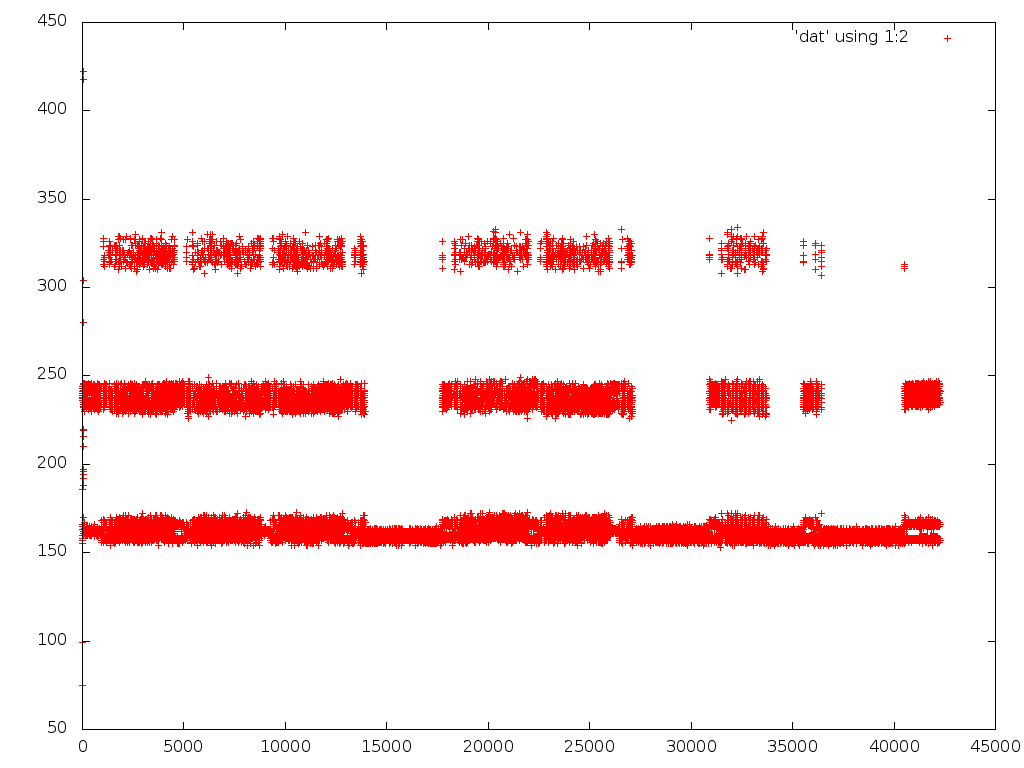
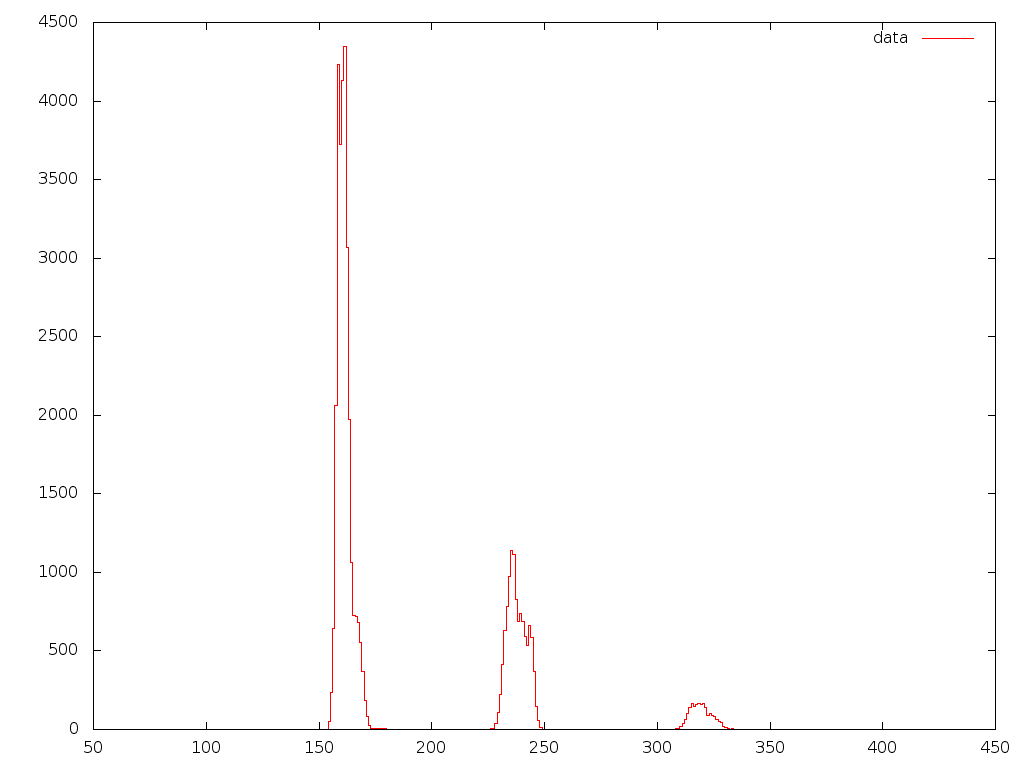
Scatter plot:
http://www.discferret.com/temp/dat.scatter.png
Histogram:
http://www.discferret.com/temp/dat.histogram.png
Raw transition data, gzipped space-separated format. First column is
array index, second column is the timing value:
http://www.discferret.com/temp/dat.gz
Rawbinary track dump, gzipped. Most significant bit of each byte is the
status of the INDEX sensor (1=index detected). If (x&0x7f) = 0, then a
counter carry occurred -- the next byte should have 128 added to it.
Repeated counter-carries are allowed.:
http://www.discferret.com/temp/dat.bin.gz
MagScan analyser output for dat.bin:
http://www.discferret.com/temp/dat.magscan.txt
For those of you who have a copy of the sources to my Magdecode decoder
engine (I know I sent it to at least one person on-list...), the
Rawbinary dump should load straight into Magdecode. The space-separated
data can be loaded straight into Gnuplot (which is what I used to
produce the plots), and I suspect MATLAB and Octave can probably load it
too.
The image file was created from an old coverdisc from "PC Zone"
magazine, and is completely undated on the label. The volume label is
"PCZ_OCT_3" which suggests it's from October, with last-modified dates
in February and August 1993. It only covers Track Zero, which (if memory
serves) is the MBR, FAT and Root Directory. The disc is 720K DOS format,
sampled at 40MHz.
Other things to note:
- The hardware works fine at 80MHz, and possibly faster than that. It
should be possible to sample with enough resolution to image a 5Mbps MFM
hard disc.
- There are plenty of spare registers. The new PIC uses 8-bit
multiplexed addressing, which gives 256 register addresses. Only 16 are
in use at the moment (!)
- Write support isn't enabled yet. I need to port this across from
DiscRW and test it (and no doubt rewrite parts of it, as I did with the
reader engine).
Surprisingly, there are only a few minor issues on the 0I06 PCBs:
- C6 is missing a polarity marker. This is a non-issue, as one end
connects to the ground plane and the other quite obviously connects to
+5V.
- Some of the component pads are rather small (notably the inductors
and Schottky diodes in the power supply). This makes it hard to heat
both the pad and the component pin at the same time, and thus makes the
parts a bit of a pig to solder. I worked around this with a hot-air gun,
preheater and solder paste... later boards will have bigger pads.
- The power supply chip is a QFN with pads under the chip. The only
way to solder it down is to use a hot-air gun... unfortunately TI don't
make this chip in a more accessible package, and the only viable
alternative would have nearly doubled the size of the power supply.
Despite these issues, it's perfectly possible to assemble a 0I06 and
have it work perfectly, without any "green-wire" fixes. I'm impressed:
usually a first-spin board needs at least one track-cut and a couple of
green-wires :)
Now here's where you guys come in.
I really don't want to have boxes and boxes of unused boards and parts
hanging around, so I need to know how many people would like to buy a
DiscFerret. These would be available as:
- PCB only
- PCB with the power supply section assembled and tested
- Fully assembled and tested PCB
- Some other form -- feel free to make suggestions!
I'd appreciate it if anyone interested in buying a DiscFerret could
email me at philpem at philpem.me.uk, with one of the following in the
subject line (start, end, on its own, uppercase, lowercase -- anything
will do, my procmail rule is pretty lenient):
- "I want a PCB on its own" -- DISCFERRETBARE
- "I want a PCB with the PSU built and tested" -- DISCFERRETPSU
- "I want the whole thing ready-built" -- DISCFERRETBUILT
- "I want a DiscFerret in some other form" -- DISCFERRETOTHER
Thanks to everyone who has supported the project thus far -- your
thoughts, ideas, comments and criticisms have been very useful!
Now to get my reflow oven working and build some prototypes... :)
Thanks!
--
Phil.
classiccmp at philpem.me.uk
http://www.philpem.me.uk/
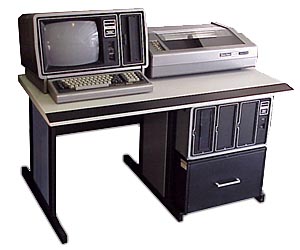
Thanks to the ever-useful JP Hindin, I've obtained a set of TRS-DOS
disks and other application disks for my TRS-80 Model II system, which
is the entire setup pictured here, plus a bit more:
http://oldcomputers.net/pics/TRS-80-II_table.JPG
It's been sitting, covered, pretty much since I obtained it, but now I
can try reviving it and actually seeing what it can do. I'm going to
tear into it and clean the drives and so forth, document what it has,
etc. and then boot 'er up and see what we can see.
I'm looking for a copy of the Technical Ref manual for it; despite
finding scans of the covers and so forth online, I'm unable to actually
locate one. In addition to that, if someone has a Shugart 8" Service
Manual, that might come in damned handy for making sure those are up to
speed as well.
Many thanks,
Nathan
--
-=-=-=-=-=-=-=-=-=-=-=-=-=-=-=-=-=-=-=-=-
Nathan Pralle, Computer Geek
Email: nathan at nathanpralle.com
Web: http://www.nathanpralle.com
Blog: http://www.philosyphia.com
Twitter: http://twitter.com/NathanPralle
-=-=-=-=-=-=-=-=-=-=-=-=-=-=-=-=-=-=-=-=-
Anyone interested in two MaxSpeed MaxStations? One is a SVGA MaxStation
and the other a VGA MaxStation. The SVGA version uses a PS2 kb connector,
the VGA version an AT kb connector. Sorry, no power supplies. These are
free, I'd prefer not to ship, but if I have no local takers then the buyer
to pay shipping costs. I'm in Austin TX. These will go to Goodwill if no
one is interested.
I'm in the very very early stages of shedding the majority of my
collection and this is just the start.
On 2010-11-01 00:02, "Chuck Guzis"<cclist at sydex.com> wrote:
> On 31 Oct 2010 at 11:37, Johnny Billquist wrote:
>
>> > The important question here - are the programs aware of the RA
>> > register, and can they change it? And can they address the full range
>> > of memory addresses as perceived by the program.
> No they aren't. Their memory exists from 0 to whatever the field
> length is, physically and continously. If they need more, a system
> request can expand their field length provided the system has
> sufficient physical memory to accommodate them. There is no way
> (absent perhaps a system request to get that information) for a
> program to know its real physical base address.
Ok. So, a program would think it addressed a memory space, which was
it's own, and the addresses it used would in no way related to the
actual physical memory it ended up referring to.
I'd call that virtual memory.
Although, having to map the whole virtual memory as one chunk to
physical memory makes it a little more work, end less flexible than
having pages. And it pretty much prevents you from ever being able to
share memory in a reasonable way between processes.
>> > Another word for swapping in and out?
> But much older and specific to the architecture and not done in
> pieces as a tranditional VM swap file would be.
Hmm. I don't think swapping is considered to be done in pieces today
either, although swapping is also a term that seems to be defined
differently depending on which OS we're talking about. Unix systems can
both page and swap. Swapping is throwing everything out to disk,
including some kernel structures for the process. Don't happen that
often nowadays... Paging is normally enough.
> I'll take the coward's way out and use the dictionary here:
>
> "1. Existing or resulting in essence or effect though not in actual
> fact, form, or name"
>
> So my definiton of "fooling the user into thinking he has more
> physical memory than he actually has" is certainly valid.
>
> And the VAX sense is also true, but only if one takes along with it
> the ability to over-commit memory space such that the amount of
> addressable memory (i.e. the sum of all users' memory) is greater
> than the physical memory present.
>
> A single task running on a VAX with at least as much physical memory
> as addressing space would not be using the virtual memory facility--
> every bit is reflected in the presence of real memory.
>
> But then, we fall on marshy ground again, when we consider the old
> "roll/swap" multiuser situation. I can run 8 jobs, each requiring
> 65K of memory on a system with 128K physical memory, simply by
> selecting when I give each a time slice and swapping/rolling them out
> as needed. So is that virtual?
Indeed. I remember (not so fondly) running on a PDP-11/70 back in the
80s. The machine was running RSTS/E V7, and the system allows max 63
jobs. We were at times actually 63 users running on that machine, and it
only have 1.5M of memory. It was swapping a lot, and things sometimes
went slow, but it worked perfectly fine. Seeing a machine today with
over 60 users is not common, and I'm not sure it would feel a single bit
more pleasant than the RSTS/E system I used back then...
And I'd still claim that the memory used by each process was definitely
virtual. And I'm willing to continue to fight for that view. Besides,
for the PDP-11, that is what DEC called it. :-)
Johnny
--
Johnny Billquist || "I'm on a bus
|| on a psychedelic trip
email: bqt at softjar.se || Reading murder books
pdp is alive! || tryin' to stay hip" - B. Idol
2010-11-05 23:42, Tom Gardner skrev:
>
> Good eyes!
>
> When I look more closely, it seems that the X and Y lines are under
> the center sections but no cores, ergo, 16 core mats. I'd like to see
> a real one to confirm.
>
> Tom
>
The reason I noticed is that I looked at a core memory board for a
PDP-10 just the other day, it had one half section with missing core. I
could take a picture if you like.
/P
The TEK 4051 is a Graphics Terminal with BASIC in ROM, It used the Motorola 6800 microprocessor. I did a Wikipedia article on the MC6800 and illustrated it with several old advertisements including the first M6800 ad and a Tektronix 4051 ad.
Here is the article
http://en.wikipedia.org/wiki/Motorola_6800
And here is the TEK 4051 ad.
http://commons.wikimedia.org/wiki/File:Tektronix_4051_ad_April_1976.jpg
Michael Holley
-----Original Message-----
From: cctalk-bounces at classiccmp.org [mailto:cctalk-bounces at classiccmp.org] On Behalf Of steve shumaker
Sent: Friday, November 05, 2010 2:37 PM
To: On-Topic and Off-Topic Posts
Subject: Tek 4051 in Austin
Tektronix 4051 functioning system??? Austin C/L #2043597225
looks in fair shape.? supposedly working...?? wants $150 cash and? pick up only
steve
No one seemed to notice this, but I thought I'd post it for Tony's
edification. It's a story in the October 7 EDN from the "Tales from
the Cube" back section and deals with solving a problem with the I/O
board of the HP9845:
http://bit.ly/cNwokC (it's a PDF)
Enjoy,
Chuck
On 11/5/10, Jules Richardson <jules.richardson99 at gmail.com> wrote:
> Dave McGuire wrote:
>> On 11/5/10 2:00 PM, Jules Richardson wrote:
>>> It's a bit more murky than that (albeit a related issue) because a lot
>>> of the bridge boards expect a vendor-specific command to tell them the
>>> drive geometry of the attached drive...
>>
>> MFM- or ESDI-to-SCSI bridge boards (Adaptec ACB-4000, Emulex MD21 if
>> memory serves) are weird to begin with...
>
> I think the Adaptec was one of the most sane boards out there
I do have some experience with a couple of them, primarily the ACB-4000
> IIRC it stores
> the drive geometry on block zero of the drive at format time, then at
> power-on fetches that block back and initialises itself with the loaded geometry.
That sounds somewhat familiar to me, but I wouldn't have been able to
have said that's what it did without looking it up first.
> I can't remember if it just hides the first block from the user, or hides the
> whole track.
I really can't remember that detail - been way too long, but if I had
to guess, I'd guess "block" since I have a fuzzy memory about some
detail about moving, say, an ST225 on and off an ACB-4000 and a
different kind of controller (an XT MFM card most likely, possibly a
WD WX-1 or Everex clone).
> I think the board responds to Inquiry, too (although it just returns "ACB
> 4000" rather than anything to do with the geometry of the attached drives)
That also sounds familiar (having played at the low-level back in my
early Amiga days).
> I've not played with the Emulex boards - I think the only ones I have are
> tape bridges rather than disk.
I have a couple of the Emulex bridging boards from the Sun-3/early
Sun-4 days, but I never had to set them up - they were black (beige,
really ;-) boxes to me. I just stuck them on a Sun box and don't
remember any special fiddling.
> The Xebec and Omti boards seemed reliable, but their SCSI implementations
> were
> a little lacking (one of them I think had the option of a user-supplied ROM
> with the expected disk geometry encoded into it, but it still wasn't "SCSI
> enough" to work with a modern system)
I think I tried to fiddle with an Omti board once but didn't achieve
enough success to use it. One reason I tried was it was a combo
hard-drive/floppy drive model. It would have been handy, but alas no.
It's likely I was running into one of those "almost-SCSI" problems
and lacked sufficient documentation.
Since I moved from PETs and C-64s and small DEC machines first to
Amigas and Macs, then much later to PCs, I was very happy when
embedded SCSI drives displaced all the Adaptec and Emulex and Xebec
and Omti boards - much easier to set up and move from environment to
environment.
-ethan