n 12/20/2010 4:38 PM, Chuck Guzis wrote:
> Something you don't see every day:
>
> http://www.ioffer.com/i/intel-paragon-super-computer-180057571
>
> --Chuck
The Paragon (and Delta before it - I was much more familiar with the
Delta) represented the pinnacle in ultra-GFlop multiprocessing of the
early 90's especially for "embarassingly parallelizable" code.
If the compiler could make your code run and your problem fit into
the memory space of a node, wow, the Delta was astonishingly kick-ass
compared to anything else out there at the time.
That said, it does not strike me as an especially "something to be
run at home" machine. Those who want to do this at home are already doing
BOINC with machines 2 decades newer or they have their own Beowulf cluster.
This is the fickle world of parallel supercomputing.
I think CHM has/had a nice Paragon on display and I recall seeing the
cabinets and prominent nameplate of the Touchstone Delta.
Tim.
Hi guys,
I'm trying to track down a copy of the schematics (if any still exist)
for the DMA Data LSI used in the AT&T Unix PC (aka the AT&T 3B1 or AT&T
7300).
The Technical Reference Manual scans which were posted here earlier
include the DMA Address LSI, but not the DMA Data LSI. Unfortunately
about 80% of the DMA logic is in.... *drumroll*... the Data LSI. The
Address LSI is basically a glorified presettable up-counter.
These should be in the AT&T UNIX PC Technical Reference Manual, if
anyone has a copy kicking around. I already have the DMA Address LSI,
Video LSI, 512k Motherboard, 1MB Motherboard and 2MB Motherboard
schematics.
Thanks,
--
Phil.
classiccmp at philpem.me.uk
http://www.philpem.me.uk/
Hi everyone,
we've had a look inside our IME 122 calculator and discovered that it is
full of SN14xx logic ICs. They are mainly from TI, but there are also some
>from Motorola and others. It seems that they have the same function and
pinout as the SN74xx parts but there must be a difference since the
machine has quite a lot of SN1401 (the SN7401 is a quad open-collector
NAND), but there are no pullup resistors anywhere!
Some of the types are SN1400, SN1401, SN1474, SN1490; the ALU is made up
of SN1482 and SN1483.
Anyone knows this series? BTW the supply voltage is 5V.
Christian
The Northstar mother board uses 8251s which require CTS to be active in order for the usart to transmit. There are jumper headers on the motherboard that allow you to strap them so they are active by default so you can use just a three wire RS232 connection.
regards, Steve Thatcher
-----Original Message-----
>From: "Robert J. Stevens" <trebor77 at execpc.com>
>Sent: Dec 18, 2010 11:13 AM
>To: cctalk at classiccmp.org
>Subject: RE: Need help with Project Northstar/Data I/O System-19/ADM, Terminals (dwight elvey)
>
>Message: 15
>Date: Sat, 18 Dec 2010 06:46:57 -0800
>From: dwight elvey <dkelvey at hotmail.com>RE: Need help with Project Northstar/Data I/O System-19/ADM Terminals (dwight elvey)
>Hi
> It is unlikely that there is a problem with the 2708s If the programmer said they
>were good, I'd expect them to be fine.
> The places I'd look are first the RS232 connection. The fact that the canon
>book works on one machine doesn't mean it will work on another. As well
>as the data lines, there are handshake wires that need to have the right
>levels.
> He said that he'd single stepped the code, what were the results of
>that? what did it do or not do right??
>Dwight
>
>It just goes crazy as the Prom was not burnt correctly
>Bob
>
>Turns out that the Problem is that the Data I/O System-19 I am using doesn't want to load the Hex file as INTEL. It will only load a File if it is flagged as BINARY and that doesn't give a proper code Image. I am trying to get a fellow to see if his System-19 will load the file and burn the 2708 Properly then I can get mine Fixed I HOPE.
>I also have been Re-Erasing the EPROMs as I go along.
>Bob
>
The Diode Tester unit for a Bendix G-15 very recently sold on Ebay. I
would like to know who won it. Did anyone here? You can reply off list
(I can be very discrete) - I have some questions to ask.
--
Will
> I've always wondered what the Scandanavians do to differentiate 0
> from O from ?.
They don't differentiate 0 from O- Although when I learnt Morse Code (at
a Swedish Army facility) together with a group of radio amateurs in the
70s, we were taught to slash the zeroes (contrary to the IBM mainframe
people) and write the Es as reversed 3s. And Swedes always cross the 7s.
About the letter '?' in Danish and Norwegian, which is written '?' in
Swedish (with the r?ck d?ts) and pronounced 'er', it is obviously
differentiated from Oh and zero in everyday writing by the slash or
dots. What the Danish or Norwegian radio amateurs or mainframe people do
to resolve the conflict they might have there, I have no idea.
/Jonas
All --
I?m working on a side project to another thing I?m working on and I?m
trying to compare code from DOS 1.0 and 1.1. I have the PC-DOS 1.1 files
(all including IBMBIO and IBMDOS) but only disk images (Teledisk) for PC-DOS
1.0. Is there an easy way to extract these files from the disk image? Does
anyone have these files already extracted that they can send me?
I think I can convert the TD0 image to IMD, but the IMD tools seem to
work at the track level on the image and not the file level, but any help
would be appreciated.
Thanks!
Rich
--
Rich Cini
Collector of Classic Computers
Build Master and lead engineer, Altair32 Emulator
http://www.altair32.comhttp://www.classiccmp.org/cini
> And I have a model 33 teletype here, with some provenance claiming an
> IBM lineage, that has a slashed-oh between the I and the P keys and an
> unslashed-zero next to the 9 key.
>
> Pressing the slashed-oh, sends 0x4F and pressing the unslashed-zero
> sends 0x30... and conversely, it prints an unslashed-zero when 0x30 is
> sent to it and it prints a slashed-oh when 0x4F is sent to it...
I just borrowed a book from 1974 about JCL by a person who had worked as
a systems programmer at IBM. In his coding examples, he consistently
puts a slash through the Ohs and leaves the zeroes unslashed. I would
assume therefore that that was standard practice for IBM mainframe work
at that time.
/Jonas
> They are interesting, but no more than weird numbers on semicustom
> devices. Motorola does the same thing, with their SC series of parts
> (not MC or XC)..
I tend to come in on this side too, these funny series are
Effectively TI-supplied "house numbers".
They may be different than stock SN7400 TTL or whatever DTL in minor or
Major ways but that was an agreement between the customer and TI.
I've seen the innards of DTL and TTL based calculators, and to think that
They would work with rejects or floor sweepings is unreasonable. If
Anything I would think that the house-numbered part would have some specs tightened
And others loosened to produce something most manufacturable. And isn't
That the reason for house numbers to begin with? (e.g. not purely obfuscation)
Tim.
> but the speed, temperature range, etc. requirements for a desktop calculator are not that high.
I think you (or maybe someone else) may have hit it earlier with the suggestion of fan-out/fan-in requirements and maybe some specializations such as open-collector wired-or with built-in pullups at the receiving end.
Later 7400 series chips for specialized functions (e.g. verge of SSI and MSI) had not-really-TTL-compliant inputs and outputs for specialized daisy-chain or low-fanin-load purposes. Look at the BI/RBO pin of a 7447 etc. (It's an input AND an output! Wow!) It's easy to see how this could be applied to some of the "stock" standard logic functions to greatly cut pin counts for a desktop calculator, and I suspect that's what the unique numbers are for.
Tim.
Is anyone here interested in buying a Symbolics MacIvory 2 with 16mw of RAM? I bought this directly from David Schmidt of Symbolics a few years ago and haven't had much time to do anything with it. It came with a Macintosh Quadra 650 and a keyboard with a Symbolics overlay as well as documentation. It is all in working order. I'd like to find a good home for this. If you're interested, please contact me and make an offer. David says that the MacIvory 2 with RAM (maybe only 8mw) costs $999 from him right now so I don't expect to get that much. If you already have a Macintosh that will accept these boards (only the Quadra 650 or 900 I think) we can discuss buying just the boards and not the Quadra 650. That would make shipping much easier and less expensive.
Thanks,
David
I need money. Selling 53 books. These are all books about the history
and impact of sci-tech.
It's massively time-consuming and tedious to put a value on all of
them. So instead I want to sell them as one giant lot. Most of these
books are only a few years old and most are in excellent condition.
Most of them I bought new. Some of them I bought used, and some have a
few notes in them. I could probably make more by selling them
individually, but as I said, I need $$ now (and I'm way too lazy to ship
all these one at a time!)
If anyone wants an instant library of history-of-technology books, this
is a great starting point.
Asking price: $350. (That's an average of just $6.60 per book. Some of
these are worth a LOT more.)
- 1491 - ISBN 1400032059
- Best of 2600 - ISBN 0470294191
- AC/DC: The savage tale of the first standards war - ISBN 0787982679
- Age of reconnaissance: Discovery, exploration, and settlement,
1450-1650 - ISBN 0520042352
- American telegraphy and encyclopedia of the telegraph - ISBN 1559181931
- Ancient inventions - ISBN 0345401026
- Blood: An epic history of medicine and commerce - ISBN 067941875X
- Clean tech revolution - ISBN 006089623X
- Miller's Collecting science & technology - ISBN 1840008490
- Crypto - ISBN 0140244328
- Does technology drive history? - ISBN 0262691671
- Edison: A life of invention - ISBN 0471362700
- Electrifying America - ISBN 0262640309
- German Enigma cipher machine - ISBN 1580539963
- Greatest inventions of the past 2,000 years - ISBN 068485998X
- Ham radio's technical culture - ISBN 0262582767
- History of mechanical inventions - ISBN 048625593X
- Information appliances and beyond - ISBN 1558606009
- Lincoln the inventor - ISBN 0809328976
- Longitude - ISBN 080271529X
- Maps & civilization - ISBN 0226799743
- Map that changed the world - ISBN 0061767905
- Marconi's magic box - ISBN 0306813785
- Meaning in technology - ISBN 0262661209
- Measuring America - ISBN 0452284597
- Nothing like it in the world - ISBN 0684846098
- One good turn - ISBN 0684867303
- Pencil - ISBN 0679734155
- Power to the people - ISBN 0374236755
- Readings in cyberethics - ISBN 0763724106
- Riddle of the compass - ISBN 0151005060
- Science and the founding fathers - ISBN 039331510X
- Science of measurement - ISBN 0486258394
- Science in nineteenth-century America - ISBN 0313331618
- Science of Star Wars - ISBN 0312263872
- Scientific instruments - ISBN 0520217284
- Scientific renaissance: 1450-1630 - ISBN 0486281159
- Social history of American technology - ISBN 0195046056
- Steam - ISBN 1422364402
- Structure of scientific revolutions - ISBN 0226458083
- Telephone gambit - ISBN 039333368X
- Thread across the ocean - ISBN 0060524464
- Victorian Internet - ISBN 0802716040
- Voodoo science - ISBN 0195135156
- Visions of technology - ISBN 0684863111
- What Einstein didn't know - ISBN 0440508568
- What Einstein told his barber - ISBN 0440508797
- When old technologies were new - ISBN 0195063414
- Why people believe weird things - ISBN 0805070893
- Why things bite back - ISBN 0679747567
- Wilbur and Orville - ISBN 0486402975
- Wireless - ISBN 0262082985
- Writing implements and accessories - ISBN 0810320177
Obviously it would be expensive to ship these, so I prefer a seller in
the northeast US.
Message: 15
Date: Sat, 18 Dec 2010 06:46:57 -0800
From: dwight elvey <dkelvey at hotmail.com>RE: Need help with Project Northstar/Data I/O System-19/ADM Terminals (dwight elvey)
Hi
It is unlikely that there is a problem with the 2708s If the programmer said they
were good, I'd expect them to be fine.
The places I'd look are first the RS232 connection. The fact that the canon
book works on one machine doesn't mean it will work on another. As well
as the data lines, there are handshake wires that need to have the right
levels.
He said that he'd single stepped the code, what were the results of
that? what did it do or not do right??
Dwight
It just goes crazy as the Prom was not burnt correctly
Bob
Turns out that the Problem is that the Data I/O System-19 I am using doesn't want to load the Hex file as INTEL. It will only load a File if it is flagged as BINARY and that doesn't give a proper code Image. I am trying to get a fellow to see if his System-19 will load the file and burn the 2708 Properly then I can get mine Fixed I HOPE.
I also have been Re-Erasing the EPROMs as I go along.
Bob
I am trying to restore a N* Horizon,. So far I have got the ZPB-A2 CPU
card working. I added the Prom Option and am using a 2708 EPROM with
Monitor Code by Dave Dunfield. A Friend burnt the Prom for me but I has
a problem and doesn't get the Keyboard Input. I have tried several times
to Burn a new Prom with my D/I Sys-19 but they don't behave as they
should. I have a SOL20 System/Bus Probe Card that single steps from the
get go and I can step through the Code and see how it behaves in
relation to the .lst listing. I have been using my Canon Book 10 running
"TERM" to talk to the N*. It talks OK to the Sys-19 as well as other
machines. I lost both of my Televideo 920/25's. I had three ADM LSI's in
the Shed/Barn but the Field mice made their nests in two. The one that
was untouched I brought in the Other day and It lights up the
Mini-Tracker showing that the ADM is setup as DTE. But I get no response
>from the Keyboard. Tried looping back 2-3 but no display. Don't see any
Raster but the tube POPs up a spot when turned off. I am going to try to
pull the Mother board out of the Other Micey ADM. Maybe I can swap the
M/B's and see if that CRT is working. Same for the One still in the Barn.
What would my chances be of soaking it and getting all the CRAP off it
and having it WORK????? probably ZILCH.
The third one is still in the Barn but Maybe it can be cleaned up. These
terminals haven't been run since 1992.
I also have a IBM 3101 a but so far all I found was the Base and CRT.
The Keyboard must be in the Barn.
Has anyone a spare Terminal. I'm thinking that maybe the Monitor code
will work when attached to a REAL Terminal
I bought about 5 2708's and If I can find someone who might load the New
Code for me I could send them a 2708 and E-Mail the .HEX file.
Bob in Wisconsin
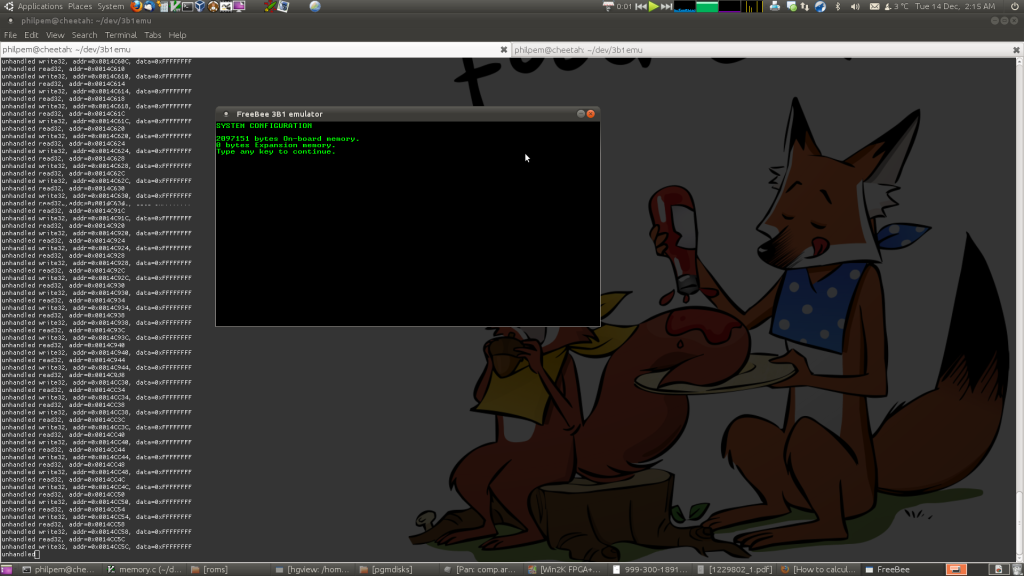
They say "A picture says a thousand words"... well, here's a screenshot
of the current version of FreeBee booting the System Loader and
Diagnostics disc for the 3B1:
http://i162.photobucket.com/albums/t242/philpem/Screenshot.png
And for those who don't believe anything unless they see it moving:
http://www.youtube.com/watch?v=Y0sRkJty6wo
:)
To make this work...
* Install the LibSDL (Simple DirectMedia Layer) development libraries,
and a C compiler. On Debian/Ubuntu, you want to 'apt-get install'
build-essential and libsdl*-dev. You'll also want make, sed, awk and
grep, which should auto-install when build-essential installs. On
Windows, you're on your own (though a homebuilt SDL and mingw32 should
work... in theory).
* Grab the FreeBee source code:
http://hg.philpem.me.uk/3b1emu/archive/tip.tar.bz2
And the ROM images:
http://philpem.me.uk/code/3b1emu/3b1_roms.zip
* Grab ImageDisk from Dave Dunfield's website, and the Version 3.51
Diagnostics Disk (.IMD file) from Bitsavers
* Use Dosemu, DOSBox, or a conveniently located DOS or Windows box to
convert the .IMD into a .BIN file:
IMDU 01_DIAGS.IMD 01_DIAGS.BIN /B
Copy the BIN file onto the Linux box.
* Untar the tarball, and cd into the directory it creates.
* make
* Copy the disc image in here, and rename it to 'discim'.
* Create a directory called 'roms', and unpack the 14C and 15C binaries
(.bin files) into there. Rename them to '14c.bin' and '15c.bin'
respectively.
* Run:
./freebee
* Watch the fun.
No, the keyboard isn't emulated (yet), no the hard drive isn't emulated
yet, and no, it doesn't boot past the RAM test screen... Keyboard is
next on the hitlist, followed by interrupts, masking and the
MMU/pagefault traps.
I'm looking for other folks to help out with this -- a reasonably
experienced 68K coder would be useful, or folks who know how the WD 1010
and 2797 Winchester and FDD controllers behave in 'real life'
(unfortunately I don't have a 2797 to breadboard with).
Enjoy!
--
Phil.
classiccmp at philpem.me.uk
http://www.philpem.me.uk/
I'm thinning down my collection and have a PDP 11/24 and
a VAX 3500 available - free but collecton only (UK).
The 11/24 could do with a clean, but it looks to be complete
and has the often missing power key as well. Internally there
are several cards.
The VAX 3500 is in a desk side pedestal style case. It has
wheels so can be moved. In nice condition cosmetically. No
idea what cards etc are installed.
Both units have never been powered up by me, and would need
to be carefully checked, etc before powering up. Given away as
is - for spares or repair.
Collection only. Contact me by email if interested.
Hi,
I just received some PCBs for a 6809, 6502, or 6802 computer. The ECB host
processor can either be a stand alone computer with the IO mezzanine board
Alternatively it be connected to the N8VEM backplane and rely on the N8VEM
SBC for IO or do both simultaneously.
The computer board supports 6809, 6802, or 6502 CPUs depending on builder
preference. You set configuration jumpers for the CPU you select.
The 6809 CPU configuration supports the CUBIX, the 6502 CPU supports DOS65,
and for 6802 and/or the 6809 there is a FLEX port in the works.
More information is available on the N8VEM mailing list and N8VEM wiki.
Please contact me if you have questions or comments.
Thanks and have a nice day!
Andrew Lynch
Hi Gang,
While surfing, I found a repository of NASA FORTRAN code from the NASA-COSMIC library.
Lots
of graphics in here as you could imagine, supporting Tektronix, PLOT10
and VT100 graphics terminals. As I know there are lots of geeks here, like me
still interested in this sort of stuff. I have attached a abstract
list of the code.
Let me know if you are interested in any of
this - it certainly has application or useful as learning material; for
example the calculation of satellite trajectories for us AMSAT ham guys.
You
can certainly Google yourself, but the download for me was a bit tricky
- requiring a linux box and the Subversion version control system.
How can I push it up to Bitsavers?
Randy
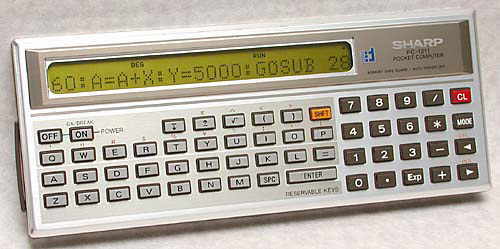
Interestingly enough, the Sharp PC-1211 (early basic programmable calculator) displays 'O' in a manner similar to what you describe. Zeros have no slash or other markings, but the 'O' has a notch in the upper right corner.
See http://www.vintagecalculators.com/assets/images/SharpPC1211_1.jpg for an example.
Josh
-----Original Message-----
From: Al Kossow
Sent: Thursday, December 16, 2010 2:52 PM
To: cctalk at classiccmp.org
Subject: Slashing the letter O (Was: Re: Service bureaus (Was: Tek 4051 firmware listing))
There was an attempt at establishing what can roughly be described as an upside down Q
for a slashed O. The only example I know of where someone used this are in line printer listings
>from SDS in the late 60's. I would have to do some serious digging in magazines to find who was
pushing this as a standard. They end up looking like misformed 8's.
It does terrible things to OCR.
Hi everybody,
I have two Sun UltraSPARC machined to be picked up: a Ultra 1 (512 M
RAM, with extra memory modules) and an Ultra 5 (also 512 M RAM). The
5 works for sure, runs NetBSD. These are for pick-up at McGill
University in Montreal, contact me off-list if you want them. There
might be a SS4 kicking around here as well to be gotten rid of.
Contact me off-list.
Joe.
--
Joachim Thiemann :: http://www.tsp.ece.mcgill.ca/~jthiem
Date: Tue, 14 Dec 2010 00:05:05 -0200
From: "Alexandre Souza - Listas" <pu1bzz.listas at gmail.com>
Subject: Re: apple Lisa2. One working!! - one to go?
> An example to ilustrate the talk: http://tabalabs.com.br/c64/sx
> +++++++++++++++++++++++++++++++++++++++++++++++
>
> Definitely interesting and somewhat relevant, but not quite the same
> thing; that deals with the common problem of replacing 24pin 8K 23xx type
> ROMs (or 68764/66 EPROMs) with a 27xx equivalent EPROM (with multiple
> images in this example), whereas Tony was talking about replacing a 2716
> with a larger 27xx EPROM, not quite the same thing or adapter.
Thanks Mike, but please, read again:
> An example to ILUSTRATE the talk: http://tabalabs.com.br/c64/sx
+++++++++++++++++++++++++++++++++++++++++++++++++
I've read it again, and I'd still say that although it's somewhat relevant
it's not what Tony was talking about.
Although the pictures and schematic illustrate the general idea of (badly)
making this *kind of* adapter (try reprogramming that EPROM ;-), I think it
would have been more useful to link to an illustration and schematic of what
Tony was actually talking about, i.e. adapting a 2716 (instead of a 2364).
You can buy those adapters for $5.00, by the way.
Am I missing something?
Brent wrote:
> On 2010 Dec 10, at 2:36 AM, Christian Corti wrote:
> >
> > we've had a look inside our IME 122 calculator and discovered that it
> > is full of SN14xx logic ICs. They are mainly from TI, but there are
> > also some from Motorola and others. It seems that they have the same
> > function and pinout as the SN74xx parts but there must be a difference
> > since the machine has quite a lot of SN1401 (the SN7401 is a quad
> > open-collector NAND), but there are no pullup resistors anywhere!
> > Some of the types are SN1400, SN1401, SN1474, SN1490; the ALU is made
> > up
> > of SN1482 and SN1483.
> > Anyone knows this series? BTW the supply voltage is 5V.
> I can't find a reference for those numbers, and I haven't seen them
> before, however I have seen TI inexplicably producing series identical
> or similar to more-common series, but numbered differently. For
> example, the SN3900 and SN4500 series are very similar to more-common
> DTL series such as the 700/800/900 series, but I have never seen a
> reference for the 3900 or 4500 series in TI databooks. One suggestion
> might be they were a 'consumer-grade' series, a step below the standard
> commercial-grade stuff.
Remember this was the late 60's or early 70's, and the thought of 7400 as the
"super series" with variants like 74L00, 74H00, 74S00 actually being inside the
family had not quite taken over in the same sense that it did later,
even inside TI. I don't think it's so much that the SN1400's/SN3900's/SN4500's
were a step below commercial grade, but they probably had product-specific
fanin/fanout/noise/current constraints and maybe even custom pinouts
or built-in pullup variants in their specs.
The 7400 "super series" of pin compatible parts in different speed/current/fanout
levels organized by 74L00, 74H00, 74S00, 74LS00 with often identical pinouts
was truly genius from a marketing-meets-technology point of view.
Not too different than say the 9-pin dual triode with similar to
identical pinouts but different gain variants (e.g. 12AU7/12AT7/12AX7) and a zillion
commercial/aerospace/computer variants (e.g. 5814A, 5963, etc.)
With regards to pinouts not everyone even inside a company had the same thoughts
regarding pin locations for Vcc and gnd. TI did a pretty good job most of the time putting
them at 7 and 14 or 8 and 16 for TTL which did simplify layout, but there are lots of exceptions
even inside the TTL product space. And sometimes there were good reasons for the
exceptions, other times I think it was just internal squabbling :-)
You can see some of this playing out in TI's competitors logic families too, e.g. Signetics
Utilogic with different subfamilies inside the Utilogic superfamily.
Tim.
Date: Sun, 12 Dec 2010 20:32:00 -0200
From: "Alexandre Souza - Listas" <pu1bzz.listas at gmail.com>
Subject: Re: apple Lisa2. One working!! - one to go?
> However, it's also quite easy to use a 2764 in place of a 2716 in the
> actual machine. What I normally do is make an adapter that will plug into
> the oriignal EPPROM socket and will tkae the 2764. Most pins just
> connect across, you need to connect the higher address lines on the EPROM
> to ground (do this on the adapter, of course). Then program the ROM image
> into the first section of the larger EPROM, and it should work fine.
An example to ilustrate the talk: http://tabalabs.com.br/c64/sx
+++++++++++++++++++++++++++++++++++++++++++++++
Definitely interesting and somewhat relevant, but not quite the same thing;
that deals with the common problem of replacing 24pin 8K 23xx type ROMs (or
68764/66 EPROMs) with a 27xx equivalent EPROM (with multiple images in this
example), whereas Tony was talking about replacing a 2716 with a larger 27xx
EPROM, not quite the same thing or adapter.
mike
Andrew,
The douglasgoodall website required a log in before viewing.
Status posted anywhere else?
Thanks
Rob
-----REPLY-----
Hi You can check the N8VEM wiki for schematics, PCB layout, and parts list.
http://n8vem-sbc.pbworks.com/w/browse/#view=ViewFolder
<http://n8vem-sbc.pbworks.com/w/browse/#view=ViewFolder¶m=S-100%2068K%20
CPU> ¶m=S-100%2068K%20CPU
Otherwise the status of the S-100 68K CPU board is
we've got a team of builders
schematic captured & reviewed
PCB layout done and verified
5 PCB prototypes ordered
prototype PCBs sent to builders
lead builder is currently doing build and test
project wiki set up
various pieces of TUTOR 1.3 software gathered
We are not done with build and test. No ETA. There are some minor changes
and items found so far but nothing of consequence. No cuts and jumpers
identified for the board.
After prototype build and test is done, we are going to focus on the
software. Probably custom test/debug/monitor EPROMs first, then TUTOR 1.3
with a goal of CP/M 68K (maybe)
The plan is the PCBs will be available for $20 each plus shipping. They are
for educational purposes only. No kits or pre-built boards. There is no
ETA for the manufactured PCBs.
That's about it. Thanks and have a nice day!
Andrew Lynch
This weekend we had a holiday party for MARCH (Mid-Atlantic Retro
Computing Hobbyists). At one point last night, several of us walked
through our club's storage warehouse. Ian Primus discovered that we
have a mostly complete Prime 6550 minicomputer. Apparently its racks
have been sitting in our warehouse for five years, but they weren't
arranged in the correct order, and I never realized they all go together
to make one full system! So, check your collections .... one never
knows what one might find among one's own collection after drinking a
lot of beer and bourbon.
I read the recent things about removing epoxy or other stuff gunked on components.
I have two questions,
I have an item with this stuff on it and I want to get it off,
however, some of it is covering some of the chips, and I need to be able to identify the components.
another worse problem is that one part of the circuit has a SIM card,
which is also covered in white epoxy which I want to remove without damaging the SIM card.
now the SIM card being encased in plastic means this is a whole lot of "fun"
any suggestions?
Decent Motorola 68000 / 68010 book?
Keith Monahan keithvz at verizon.net
<mailto:cctalk%40classiccmp.org?Subject=Re%3A%20Decent%20Motorola%2068000%20
/%2068010%20book%3F&In-Reply-To=%3C4D059E20.3050300%40verizon.net%3E>
Sun Dec 12 22:16:32 CST 2010
* Previous message: Decent Motorola 68000 / 68010 book?
* Next message: mysterious 30 pin SIMMs
* Messages sorted by: [ date ] [ thread ] [ subject ] [ author ]
________________________________
On 12/12/2010 11:15 AM, Philip Pemberton wrote:
> Hi guys,
>
> Does anyone have any recommendations for a good book on the 68000/68010
> CPUs (covering assembly language, the programming architecture and the
> interrupt system as a minimum)?
-----REPLY-----
I like
68000 Microcomputer Systems: Designing and Troubleshooting
By Alan D. Wilcox
http://www.amazon.com/68000-Microcomputer-Systems-Designing-Troubleshooting/
dp/0138113998
I contacted the author and received permission to make a PCB based on the
68K CPU board in the book.
We are making an S-100 68K CPU board PCB based on the board described in the
book.
It is currently in build and test and the status is on the Douglas Goodall
wiki.
http://douglasgoodall.pbworks.com
There is more information on the N8VEM 68K CPU board on the N8VEM wiki.
Thanks and have a nice day!
Andrew Lynch
Mark the 18th of this month - next Saturday - for an Open House at the
Retrocomputing Society of Rhode Island* at our millspace in
Providence, RI. Last month we fired up an EAI TR-10 analog computer,
and I suspect we will be doing the same this month, as well as
possibly some work on a PDP-11/45 and a DEC Lab-K. Lots of super nerd
geek talk as well. And possibly a fun dog.
Generally, hours are 3 to 8 PM, with a dinner break around 6. The mill
is located in the neighborhood of Olneyville, just a few miles from
central Providence. For directions go to:
http://rcsri.org/directions.html
Ask if you need more information!
*Not the Rhode Island Computer Museum aka RICM!
--
Will
On Sun, 12 Dec 2010 16:15:27 +0000, Philip Pemberton <classiccmp at philpem.me.uk> wrote:
> Hi guys,
>
> Does anyone have any recommendations for a good book on the 68000/68010
> CPUs (covering assembly language, the programming architecture and the
> interrupt system as a minimum)?
>
>
[...]
> --
> Phil.
"Microprocessor Systems Design - 68000 Hardware, Software, and Interfacing" Alan Clements, PWS-Kent Publishing Company
It appears that copies are available as PDF downloads from multiple sources...
CRC
Hi guys,
Does anyone have any recommendations for a good book on the 68000/68010
CPUs (covering assembly language, the programming architecture and the
interrupt system as a minimum)?
I'm trying to disassemble the AT&T UNIX PC Boot PROM and Loader, and
figure out why the Loader doesn't seem to think my WD2797 emulation is
providing valid data... As I said before, it's probing the FDC, reading either two or four sectors, then giving up and trying the HDD instead....
--
Phil.
classiccmp at philpem.me.uk
http://www.philpem.me.uk/
Hi guys,
I've got my 3B1 emulator "mostly working" in that it runs the Boot PROM,
sees the floppy disc in the drive, and proceeds to boot from it, getting
as far as the Loader.
When it gets to the Loader, I get the following display:
AT&T UNIX(tm) pc
Loader version 3.51
Copyright (c) 1985, 1986
AT&T
All Rights Reserved
Searching floppy disk...
####
Searching hard disk...
... and it stops there. I can tell from the emulator log that it's
trying to get the hard drive controller to read CHS 0:0:0 and DMA the
data into RAM at 0x77830, but because the HDC isn't implemented, it
locks.
What I expected was for the Loader to pick up the boot files on the
Diags disk, boot from that, and ignore the HDD. Does anyone know what
"typical boot behaviour" is for a 3B1, 7300 or UNIX PC, when booted from
the Diagnostics floppy (Foundation Set, disk 1) ?
This is a bit of a head-scratcher -- I'm trying to figure out if there's
a problem with my FDC driver (wouldn't be the first one) or the
DMA/interrupt controller, or if the Loader really needs a hard drive
controller (or a really good fake) to boot the system.
I'd also really like to know why the DMA controller has two separate
direction control bits -- DMAR/W- and IDMAR/W-... this seems downright
silly, though in keeping with the rest of the TechRef. My "annotated
edition" corrects about a dozen minor and major errors in the register
set descriptions, and adds a bunch of informational sticky-notes and
scribbly comments to reinforce certain points. Ewwww...
If anyone's interested in playing with my emulator -- go to
<http://www.philpem.me.uk/code/3b1emu/>. Hit the link under "Mercurial
repository", then ".tar.bz2" to get a Tarball of the sources. Untar it.
Grab the boot PROMs, and put them in a directory called 'roms' as
'14c.rom' and '15c.rom'. Use IMDU (Imagedisk utility) on a DOS PC (or
inside Dosbox) to convert the Foundation Set disks from IMDs to binary
files, then copy the first Foundation disk (Diagnostics) as 'discim'.
Compile (you'll need libsdl, aka the Simple DirectMedia Layer) and run.
I know the code is a mess, patches to rectify this (or any of the other
millions of bugs) would be almost certainly be accepted :)
There's also no keyboard or mouse emulation yet, just the CPU, video,
RAM, ROM and a basic memory mapper and DMA emulation. As for Ethernet
emulation... that's on the "maybe later" list, right after "learn how to
send and receive Raw Ethernet frames on Linux".
Thanks,
--
Phil.
classiccmp at philpem.me.uk
http://www.philpem.me.uk/
Hello Everyone!
I would like to identify some mysterious old SIMMs:
- module P/N appears to be "PS 91/344J"
- 30 pin, single sided, 9 chips "SIEMENS HYB514100BJ-60"
- "MADE IN U.S.A." probably manufactured in 1994
I have failed to find explicit information about these chips,
but I'd guess they are 1Mx4 so 9 of them would make a nice
4MB module with ECC/parity.
What kind of machine could these have been made for?
Thanks,
Sab
Hi, All,
I have had no luck googling any pictures of the short rack for the
PDP-11V03 system (CPU + RX01 in a formica-topped office-friendly rack)
that I *think* is called an H9610. For that matter, I was largely
unsuccessful in finding pics of most DEC racks by rack part number
(i.e., finding an 11/70 picture is easy - finding an H960 picture is
not).
Textual material for various rack configurations abound, but not
pictures accessible by Google image search. If anyone knows of a
gallery of rack pictures, I'd be grateful if you'd share the URL.
Thanks,
-ethan
> Subject: Re: 1970s TTL specs and prices
> To: cctalk at classiccmp.org
> Message-ID: <4D006B2A.5090407 at bitsavers.org>
> Content-Type: text/plain; charset=ISO-8859-1; format=flowed
>
> On 8/20/10 11:23 AM, Tom Gardner wrote:
> > For some Computer History Museum work I need information on 7400 series
> Flip
> > Flops (S and Normal, DIPs) circa 1973 (anything 1970-75). Anyone have
> any
> > maximum clock speed and OEM volume pricing information on parts such as
> 7473
> > thru 79 or 74106-116?
> >
>
> At introduction (May 1966) The 7474 (25Mhz toggle freq) was $11.40, $9.10,
> $7.70
> quantity 1/25/100, respectively
>
> The most expensive TI TTL part at that time was the 7491 9 bit shift
> register at
> $31.25, $24.85, $21.25
>
> Their most expensive IC was the linear SN354A Demodulator/Chopper at
> $145, $116, $99
> ------------------------------
There is a fairly complete set of IC Masters at the UC's Northern Reference
Library Facility, Richmond CA, http://www.lib.berkeley.edu/NRLF/. They have
a public reading room and will pre-pull material per an email request,
nrlfreq at library.berkeley.edu.
As it turns out I will be there next week doing some research on DRAM using
all the IC Masters and can see what is in the 1973 version about various
TTL.
FWIW, I frequently use a learning (pricing) curve off a per 100 price to get
a reasonable estimate of the high volume OEM price. You will have to
justify the learning percentage (2% to 10%) and the OEM volume (multiple of
annual volume of a high volume system?) to come up with a price. For
example using the 1966 7474 at $7.70 with a 5% learning curve and a 100,000
OEM volume has an estimated OEM price of $4.60. You will have to do some
research and thinking to come up with the values u use.
Tom
Date: Mon, 06 Dec 2010 17:33:50 -0500
From: "Curt @ Atari Museum" <curt at atarimuseum.com>
Subject: Re: Drive Type International Memories, Inc. (IMI) 5012H
> Weren't IMI's used in much of the earlier Corvus drives too?
Yes, in fact Corvus later acquired IMI AFAIK.
Cromemco also exclusively used IMI drives with their WDI and WDI-II IMI
controllers before they finally went to an ST-506 controller, both the large
7000 series and then the smaller 5000 series; note that the 5000s were
available with either the 40-pin IMI interface or a standard ST-506
interface and the model numbers are not necessarily unique.
mike
>Message: 26
>Date: Fri, 10 Dec 2010 00:27:09 -0600
>From: Doc Shipley < doc at vaxen.net >
>Subject: Re: Wow! Lego Antikythera device -- and it works
>Evan Koblentz wrote:
>> http://therawfeed.com/apple-engineer-re-creates-2000-year-old-greek
>
>?? I thought the Antikythera Research Project decided a few years ago
>that the original did NOT use differential gearing.
>
>?? To be perfectly honest, the fact that the Antikythera incorporates
>the first known User Guide impresses me as much as the technology....
>
>????????Doc
>
The report in The Register ( http://www.theregister.co.uk/2010/12/10/lego_computer/ ) includes some additional links, including one to an interesting article in Nature News from Nov. 24th at http://www.nature.com/news/2010/101124/full/468496a.html .
Bob