Chuck writes:
On 18 Jan 2011 at 14:18, Shoppa, Tim wrote:
>> Isn't it wonderful the way the pendulum swings? First parallel
>> cylinder select (e.g. SMD and other bus and tag type address
>> interfaces), then step in/out cylinder select (e.g.
>> SA4000/SA1000/ST-506) and serial cylinder select (e.g. ESDI), then
>> parallel cylinder select (e.g. IDE/ATA/SCSI), then serial cylinder
>> select (e.g. SATA).
> It would seem to be more a matter of "smarts on the disk drive" than
> anything. IDE/SCSI and SATA all have controllers on the drive and so
> have no dedicated signal lines for positioning. In particular
> IDE/SATA LBA and SCSI don't require any knowledge of the drive
> geometry, other than the sector size and the total number of sectors.
>
> with ST506/412 and ESDI, the "smarts" were still external to the
> drive.
There's a difference between what the interface doesn't require a drive
To do, and what the most common drive implementations actually do.
(I do agree that IDE LBA and SCSI, allowing a disk to be addressed as a
"big bunch of blocks", are substantially more sophisticated than purely
Physical interfaces.)
You might be surprised at how smart many drives were even though they were
Using the "not so smart" ST1000, ST-506 or floppy interfaces.
e.g. the cabling may only have "Step in" and "Step out" but on the drive
the drive itself is counting which cylinder its in to apply appropriate
precompensation. E.g. LSI Shugart floppy drives.
Any ST-506 non-stepper-motor drive knew what cylinder it was on thanks
To internal logic.
The SA1000 explicitly defined "buffered step mode" whereby the step
Commands on the interface could come in way faster than the physical stepper
Could move, and a counter on the drive played out the steps later. So on
The very first implementation, the drive was already smarter than the interface
Would imply.
Tim.
> Date: Tue, 18 Jan 2011 09:13:08 -0600
> From: Jules Richardson <jules.richardson99 at gmail.com>
> Subject: Re: SA4000 [was: Disc drive READY output -- any standards?]
> To: General Discussion: On-Topic and Off-Topic Posts
> <cctalk at classiccmp.org>
> Message-ID: <4D35AE04.7070905 at gmail.com>
> Content-Type: text/plain; charset=ISO-8859-15; format=flowed
>
> Tom Gardner wrote:
> > I believe it was the first HDD of any sort to use a floppy disk type of
> > interface. It was followed by the SA1000 interface, which in turn
> > became the ubiquitous industry standard ST506 interface. Since it was
> > first, it is not surprising that it had problems,
> > many of which it inherited from the Shugart floppy interfaces
> > it was trying to resemble so as to reduce design in times.
>
> Was it really done that way because it was supposed to look just like a
> big floppy at the interface level?
That is my understanding from the folks at Shugart who did it.
>Is that actually documented somewhere?
Possibly, how important is it to find it on paper? It was explicitly stated
as an objective of the next generation, SA1000, "Command signals for the
SA1000 use the same pin configuration as its floppy counterpart. Data
signals are handled through a different data separator because of the higher
transfer rates" ED 9/13/1979
> What would be needed to add a parallel address interface?
<snip>
Probably could make it look like an SMD interface with a microcontroller.
Tom
Jules asks:
> What would be needed to add a parallel address interface?
I believe that could be called the WD1003 :-)
In terms of cabling economy parallel cylinder select has some big disadvantages. Not that step-in-step-out cylinder select is awful efficient after you get to having multiple drive systems either (thus ESDI which used similar cabling but much more efficiently).
Isn't it wonderful the way the pendulum swings? First parallel cylinder select (e.g. SMD and other bus and tag type address interfaces), then step in/out cylinder select (e.g. SA4000/SA1000/ST-506) and serial cylinder select (e.g. ESDI), then parallel cylinder select (e.g. IDE/ATA/SCSI), then serial cylinder select (e.g. SATA).
Tim.
> Date: Sat, 15 Jan 2011 17:21:34 +0000 (GMT)
> From: ard at p850ug1.demon.co.uk (Tony Duell)
> Subject: Re: Disc drive READY output -- any standards?
> To: cctalk at classiccmp.org
> Message-ID: <m1Pe9or-000J43C at p850ug1>
> Content-Type: text/plain
>
> > > For pure bad deisgn, nothing beats the Shugart SA4000 hard disk.
> >
> > I have one of those. It has all the warts of an early design.
>
> Except it wasn't an early design. OK, it was an early-ish wincheaster,
> but stepper motor controllers are much the same whatever you sue them
> for. The problems were known about and could have been avoided.
>
> -tony
I believe it was the first HDD of any sort to use a floppy disk type of
interface. It was followed by the SA1000 interface, which in turn became
the ubiquitous industry standard ST506 interface. Since it was first, it is
not surprising that it had problems, many of which it inherited from the
Shugart floppy interfaces it was trying to resemble so as to reduce design
in times.
Tom
At 09:53 AM 1/18/2011, Shoppa, Tim wrote:
>Now posting it to a binary warez newsgroup, I don't see much harm in that. Worst case, somebody might complain that what you're posting is not illegal or a copyright violation and therefore you shouldn't do it.
Thank you for starting my day with a good belly-laugh.
- John
Clint writes:
> For a while now I have been pondering Usenet as a long term, offsite,
> distributed backup facility. Most of the premium servers are over two
> years of archive, with pretty decent reliability. Spot checks of
> files posted over two years ago still indicate 100% article availability.
> Basically, I propose we select a low-traffic group which is available on
> most premium servers, and start posting software/documentation to it in a
> standard rar/par2 format. And somewhat standardized naming conventions.
> If a file was posted two or three times over the span of a month, then
> reposted every year we can be almost assured the files would be available
> to enthusiasts for many years to come.
Seems to me, not that different than Cantor and Siegel's Usenet Spam. As in, it's technically possible to do something, so it's OK to do it.
Misusing Usenet, not a good idea.
Now posting it to a binary warez newsgroup, I don't see much harm in that. Worst case, somebody might complain that what you're posting is not illegal or a copyright violation and therefore you shouldn't do it.
Tim.
Figured this might be of interest...
paul
Begin forwarded message:
> Date: January 17, 2011 9:23:22 PM EST
> To: pkoning at equallogic.com
> Subject: Fwd: [rescue] PDP flip chips and memory boards, many lbs. worth
>
> Forwarded in case you know anyone who collects real PDP iron out there...
>
> john
>
>
> Begin forwarded message:
>
>> Date: 17 January 2011 20:21:26 EST
>> To: The Rescue List <rescue at sunhelp.org>
>> Subject: [rescue] PDP flip chips and memory boards, many lbs. worth
>> Reply-To: The Rescue List <rescue at sunhelp.org>
>>
>> Some of you here know that I recycle old PC motherboards, etc. though
>> whenever possible I try to divert anything valuable/historical out of
>> the melt-it-down pile.
>>
>> I have many pounds, well over 100lbs., of DEC PDP "flip chip" modules.
>>
>> I have to charge for them, but would like to sell all of them, all at
>> once, to 1 person if possible, at a per-lb price ($8 per lb). Given
>> that these flip chip modules are not very heavy this works out to well
>> under $2 each, I think.
>>
>> Some are in original plastic shrink wrap, but most are not, and have
>> been exposed to moisture but are otherwise complete; some have had the
>> resistors or capacitors on them "weep" which means they would have to be
>> replaced by someone competent with a soldering iron.
>>
>> A random listing of the few that I pulled out:
>>
>> A123
>> A206
>> A207
>> G728
>> K012
>> K026
>> K028
>> K123
>> K124
>> K134
>> K161
>> K202
>> K210
>> K303
>> K683
>> M113
>> M1502
>> M155
>> M207
>> M230
>> M502
>> M652
>> M7264
>> M783
>> M7941
>> M920
>> M974
>>
>> There are many more.
>>
>> Are there any PDP collectors on this list - I know there used to be but
>> perhaps this stuff is just too old these days.
>>
>> Cordially
>>
>> Patrick Giagnocavo
>> patrick at zill.net
>> _______________________________________________
>> rescue list - http://www.sunhelp.org/mailman/listinfo/rescue
>
I acquired a HP 8018A serial data generator, a very nice piece of equipment.
But after a little time the power supply heath sink is getting hot about 70
degrees Celsius (158F).
I'm not sure if that is normal, anyone who can help me with this ?
-Rik
Title says it all; I'm basically looking for a VME-based Sun workstation
with 5 or 6 slots -- something that's a nice middle ground between the
cramped 3-slot machines and the huge 12 and 16-slot ones. It doesn't
have to be complete or running, but a working power supply would be
helpful...
I'm trying to find a suitable host for my Symbolics UX400 (a VME-based
lisp coprocessor for old Sun machines), and the Sun 3/140 I have doesn't
seem to be able to keep the UX400 cool enough (it crashes quite frequently).
Anyone (preferably local to Seattle) have something that fits the bill
going spare? I can trade a bunch of Sun3 hardware :).
- Josh
I'm still trying to locate the "Optional Lower Cassette" for my HP
LaserJet IIp+ (that holds 250 sheets of paper and fits underneath the
printer (instead of feeding them 20-30 at a time through the front
door).
Anyone have a "parts" IIp from which I can buy the cassette &
paper tray?
thanks
Charles
Anyone on the list have experience installing A/UX on a 68k Mac? I'm
running into some very odd issue trying to bring up my Centris 610. The
Centris shipped with a 68LC040 processor and I've upgraded to a "full"
RC68040 CPU, since that's a requirement for A/UX. The CD-ROM drive is one
of the units known to be compatible with A/UX.
The FAQ claims that the installer understands third-party hard disks
(unlike the MacOS installer) so I'm trying to use (variously) an older IBM
Deskstar 850MB and/or Fujitsu 500MB SCSI drive for the install target.
Here's the odd part: With the original Apple-branded OEM Quantum drive
(which I do not want to overwrite) on the SCSI bus the installer
recognizes the CD-ROM and is willing to begin the process. However, with
any of the third-party hard drives in the system it is unable to recognize
_anything_ on the SCSI bus - doesn't see the hard disk or the CD-ROM.
I've checked and double-checked the jumpering on the hard disk and it's
not conflicting with the CD-ROM. Both the IBM and Fujitsu are fairly
run-of-the-mill 50-pin SCSI units.
I've never had issues in the past with non-Apple drives hanging the bus or
preventing access to other devices, so this one's really a head-scratcher.
Any ideas what might be throwing the SCSI subsystem for a loop?
Steve
--
>
>> seems that instead of requiring a particular time between step pulses,
>> these drives allow the controller to step as fast as it likes and they
>
>What happens with one of these drives is you slow the steppign rate (at
>the cotnroller) right down, say to 20ms steps? Does it still sometimes
>kil the index pulse?
>
I tested at the slowest stepping rate available on an unmodified BBC
model B (which I think is 24ms) and it still failed occasionally. I
suspect that it can fail no matter how slow the stepping rate is.
>
>Is this behavious properly documented anywhere? I guess that the days of
>getting OEM and service manuals for such drives are long gone :-(
>
Pete Turnbull tells me that the TEAC data sheet for the FD-235HF series
mentions it. He also has a write-up on the issue here:
http://www.dunnington.u-net.com/public/BBC/index_and_READY.html
Regards,
Peter Coghlan.
Hi! I am preparing to order some additional S-100 board PCBs. At the
moment, the most requested boards on the waiting list are below
S-100 buffered prototyping board (12 waiting)
S-100 4MB SRAM (11 waiting)
S-100 EPROM (9 waiting)
There needs about 20-25 firm builders on the waiting list to make a PCB
manufacturing order feasible. I cannot afford a lot of leftover PCBs so it
is important that most of these boards have a home before I will place an
order.
If you would like to get some S-100 PCBs based on the projects we have done
already please contact me at LYNCHAJ at YAHOO.COM
<mailto:LYNCHAJ at YAHOO.COM?subject=S-100> and I will add you to the waiting
list.
Please do not sign up if you are uncertain or unwilling to follow through
with getting a PCB. Your word of honor is sufficient to me that you will
follow through for PCBs on the waiting list.
I still have a small number of S-100 parallel ASCII keyboard boards and
S-100 PIC/RTC boards. In particular the S-100 PIC/RTC boards will be very
important for the upcoming S-100 8086 CPU board John and I are working on.
Thanks and have a nice day!
Andrew Lynch
PS a complete list of completed S-100 boards below. If you are interested
in any of these boards please let me know however the number of builders on
the waiting list probably means another board order is some time away.
Regular Prototyping board
Buffered Prototyping board
8 Slot Backplane
IDE
Parallel ASCII Keyboard converter
4MB SRAM
System Monitor Board
Bus Extender
EPROM
IO
PIC/RTC
Z80 CPU
these are in work but not complete yet:
Console IO
ZFDC
68K CPU
8086 CPU
Anyone here know anything about the .WAD file format in the context of
HP-UX 9.0x, or more specifically in the context of an HP 16505A which
is logic analyzer application running on top of HP-UX 9.0x on an HP
712/60?
I have a set of MS-DOS FAT12 floppy disk images which each contain an
UPDATE.WAD and an INFO.WAD file pair. I believe these must be
compressed file archives. From looking at hex dumps of the files
there are no obvious plain text strings.
I would like to be able to view the archive contents and extract
whatever files they might contain.
Sample hex dumps below. These sample file pairs start with a common
15-byte file header:
UPDATE.WAD (file size 320-bytes)
0000:0000 1f9d 9030 6e04 1c08-a320 8c18 060b ca80 ...0n...? ....?.
0000:0010 4123 e08d 1a0c 0fde-40d8 30c6 c484 3016 A#?....?(a)?0??.0.
0000:0020 6284 61a3 c68d 1920-1bda c038 03e2 c684 b.a??.. .??8.??.
0000:0030 75e6 c879 3107 8e9c-3763 d694 a133 e745 u??y1...7c?.?3?E
0000:0040 1937 765e 9849 c3a6-cc99 9775 e0cc 0130 .7v^.I???..u??.0
0000:0050 50a0 c084 0813 ce88-78e3 e149 a524 4f76 P??...?.x??I?$Ov
0000:0060 fc18 9223 4619 1a9f-c248 b9b2 e5cb 9833 ?..#F...?H????.3
0000:0070 6bde b443 d428 4183-490d 366c d8d4 a4d6 k??C?(A.I.6l????
INFO.WAD (file size 12043 bytes)
0000:0000 1f9d 9030 6e04 1c08-a320 8c18 060b ca40 ...0n...? ....?@
0000:0010 18f0 8640 1a07 6f20-8418 4362 c283 170b .?. at ..o ..Cb?...
0000:0020 daa8 7163 8647 8836-6624 9401 31a3 8d18 ??qc.G.6f$..1?..
0000:0030 366c 2081 82b2 068c-1a5f c690 f912 e30b 6l ..?..._?.?.?.
0000:0040 4417 65e4 c801 3022-c40b 3169 dcbc 5833 D.e??.0"?.1i??X3
0000:0050 078d 8211 0a8e 8250-0a62 65cb 9731 67c6 .......P.be?.1g?
0000:0060 8008 22e8 1c3a 61d8-b001 9153 ce1b 3920 .."?.:a??..S?.9
0000:0070 e68c 9193 060e 9da3-4947 a85d cbb6 ad5a ?......?IG?]???Z
? There are no Teletypes that use Baudot code. They use a US variant of
? the ITA2 five-level code.
? Baudot code was only used until about 1901. Murray code was used until
? the 1930s. Everything after that used ITA2.
That's a little like saying nobody actually uses ASCII since 1968, we're all really
Using ANSI_X3.4-1968 or later. Technically true but not common usage.
Everyone in the past half century has called a Model 28 TTY a Baudot Teletype when
They had to distinguish it from any other type. (Baudot is still the default for
Several applications so you don't even have to say it's Baudot.)
I suppose classiccmp naturally attracts folks who care about such things (witness
The thread I started over a few years ago when I noted that bitsavers had surpassed
100 GBytes and everyone informed me that no, a Gbyte was 1073741824 bytes so
I was wrong.)
Tim.
Hi guys,
Is there a defined standard as to when the READY output on a
Shugart-type disc drive should go active?
I'm (slowly!) working through the rebuild of one of the Amstrad drives
(an EME231 I know to have working mechanical components, potentially
good heads, and a fried control board), and I'm stuck on deciding how to
deal with the READY output.
My initial thought was to hold it inactive until a few INDEX pulses have
passed, and the motor speed was within 5% of 'ideal' speed. The plan was
to use a 32kHz oscillator and a 4040 counter to get a several-Hz signal,
then rig up some logic to check that the disc speed was OK, and after a
few valid index cycles enable the drive.
Then I started wondering... am I over-engineering this? Would waiting
for a couple of full disc rotations be enough to reliably generate a
READY signal?
Irony is that the read-amp will probably be the easiest part of the
whole system... I've got a Motorola appnote which basically says "if
you're using a data rate of X and a rotation speed of Y, these
parameters will work" -- X and Y being the two parameters the Amstrad
drive uses... That just leaves the write amp and erase logic to design
(and maybe a 'write lockout' jumper).
Thanks,
--
Phil.
classiccmp at philpem.me.uk
http://www.philpem.me.uk/
Eric wrote:
>>> There are no Teletypes that use Baudot code. They use a US variant of
>>> the ITA2 five-level code.
>>> Baudot code was only used until about 1901. Murray code was used until
>>> the 1930s. Everything after that used ITA2.
Tim wrote:
>> That's a little like saying nobody actually uses ASCII since 1968,
we're all really
>> Using ANSI_X3.4-1968 or later. Technically true but not common usage.
Eric wrote:
> No, it's not much like that at all. Baudot code used significantly
> different character encodings than ITA2, such that a Baudot device and
> an ITA2 device will not interoperate in any meaningful fashion.
> ASCII-63, ASCII-67, ASCII-68, and ANSI X3.4 have only minor variations
> and will generally interoperate reasonably well.
I'm not disagreeing that the academically correct term is ITA #2. (Interestingly
most web page hits today call it "ITA 2" or "ITA2" but the 70's and earlier
books call it "ITA #2" when they are being pedantic.)
I'm just saying that in its Heyday, if you had to distinguish a 5-level
TTY from a 7-level TTY, the working terms were Baudot and ASCII. Although
technically incorrect.
Sort of like when I know the people who used and maintained what they
called a 11/74, and then I see folks here telling me that no, it's really
A 11/70MP :-). Yeah, in a certain aspect that may be what the paperwork called
it. But really everybody called it the 11/74. When I'm told that the
academically correct word for something, is different than what everyone
actually called it at the time, and I see Wikipedia etc. going for academically
correct rather than "actual working term", it sometimes feels like history
that I lived is being redefined underneath me by some sort of pedantic streak.
Another recent example of a different character set being redefined underneath
Me: On Wikipedia, the morse code for -...- is defined as "double dash" with a
Possible keyboard equivalent of "equals sign", something I never heard
till recently. I called it "BT" with a bar
Over top for most of half a century now. I don't doubt that some CCITT standard
Called it double dash in the past, just that me and the guys I know who use
Morse every day, never called it that.
This isn't new to me. I remember getting involved in altmode vs escape key arguments
In the distant past. I always called it altmode, what right does anyone else
Have to call it escape? :-))))). Big smileys, because I discovered that three
Different ASCII codes (0174, 0175 and 033) were being used and I didn't know until
Much much later.
Tim.
>
>My initial thought was to hold it inactive until a few INDEX pulses have
>passed, and the motor speed was within 5% of 'ideal' speed. The plan was
>to use a 32kHz oscillator and a 4040 counter to get a several-Hz signal,
>then rig up some logic to check that the disc speed was OK, and after a
>few valid index cycles enable the drive.
>
The BBC Micro internally generates the ready signal for the 8271 controller
>from index, drive select and the 8MHz clock using a 74LS393, 4020 and 4013.
I figured out how the circuit works once and my head still hurts. As far as
I remember, it works like your description above and if an index pulse is
a few percent later than expected, it deasserts ready.
This was designed for 5.25in floppies and worked fine with early 3.5in
drives. However a problem arose with more recent 3.5in drives. It
seems that instead of requiring a particular time between step pulses,
these drives allow the controller to step as fast as it likes and they
signal the controller that the heads have not yet reached the required
location by suppressing index until they do. The circuitry in the BBC
notices the lack of index and drops the ready signal to the 8271 resulting
in a "drive not ready" error when stepping by more than a couple of tracks
(er, I mean cylinders) when using one of these drives.
It seems the lessons are firstly that the designers of the BBC micro did
not reckon they could rely on getting a good ready signal from the drive
and secondly, no matter how you try to be clever, something will later
come along to mess up your cunning plan.
Regards,
Peter Coghlan.
Actually, the Rayovac 840 is rated at 4.5v 800 mAh, so putting in
3*AAA is a reasonable (and "cost effective") thing to do. But the
footprint is a tad larger. There's room...
The NetBSD pages specifically mention a FCT623 as the cause of
problems but I didn't want to get into that mess unless I had to... A
Linux FAQ claimed that changing the video or serial cables could also
cause problems.
> The big minor thing is the back panel to the stand. It's missing
Bill, we have several *SR-33 "parts" machines; I'll mail you a back
panel for the stand. Send me your address in a private message.
Brent wrote:
> Some minor changes were made to the Murray encodings and it became the
> ITA #2, but referring to it as Baudot code continued for general
> reference. In other words (like so many other things), both terms would
> seem reasonable or 'correct' depending on the perspective one is coming
> from.
I will note that from an academic/historic standpoint that MacKenzie's _Coded Character Sets: History and Development_ calls it CCITT #2 and I don't think he uses the word Baudot at all.
But I also feel that MacKenzie's book is written almost entirely from a standards-committee mindset. There's occasional mention of "real world usage after the character set was standardized" but it's brief.
Tim.
> I remember my first computer experiences were in terminal rooms full of
> teletypes. You realised just how noisy they were when the machine (a
> DECSYSTEM-20) went down and all the terminals stopped at once. I would love
> to get hold of an ASR33 but they seem pretty rare these days.
Don't forget THE SMELL of a room of working model 33's. I'm not sure
exactly what the smell was - probably a mix of ozone from the motors,
warm oil on the mechanical parts, and some of the smell of oiled
paper tape - but that was part of the experience too :-)
Oiled paper tape could actually go rancid under some conditions
(that I'm unclear about today!). I wonder if that's one of the smells
I remember. In particular the smell from the hoppers that
Caught the holes punched from the tape as being not the typical
Teletype smell but something stronger and more offensive. The hoppers
Were not necessarily emptied daily :-)
Tim.
>
>> The datacenter was always at 62 degree's, after working 4-5 hours in
>> there, your knuckles started to stiffen up and you'd feel the cold from
>> the floor come up into your shins... ah.... good times, good times :-) I
>> loved the quietness, all you heard was the sounds of fans whirling away,
>> it was a deafening kind of quiet background noise, I miss that.
>
> It really is a good feeling. Only true geeks seem to appreciate it,
>though.
>
My last boss, who was from the sales end of the organisation occasionally
had to help me move stuff in our data centre. He didn't mind the heavy
lifting but he really hated being in the place. It didn't bother me at all,
especially if the office was hot and sticky.
What I miss is from 20 years ago, in a different place, the 400Hz drone of
power supplies in equipment connected to a motor-generator set. Never mind
the video - does anyone have a sound recording of that?
Regards,
Peter Coghlan.
Technology news of two days ago spoke of the Computer History Museum(a
past visitor) in Mountainview, CA(Silicon Valley) having a 2000 year
timeline and display. I hadn't realized computers have been around for
2000 years! Nevertheless, computer/electronic newsletters such as this
should relish in how people/orgaization(s)/institution(s) are
attempting to preserve computings past for all, technophiles and
technophobes. Maybe this will give encouragement to others who are
working diligently, albeit on a smaller scale, on attempts to preserve
one little aspect of computing, for example the Computer Museum of
Nova Scotia - the Kenbek machine.
Compute on!
Murray--
Regarding the charming wood/metal scale model of a "1401 Data Center" on eBay,
in addition to the 3 1401 Central Processing Units, many of the models are actually
for an IBM 7070: main frame cabinets, console (7150), and card reader (7500).
As a 1401 system, two of the 1401 CPUs are missing their mainspring! ;-)
The IBM 1402, in addition to reading and punching cards,
also delivers AC and DC power to the 1401 CPU, 1403 printer,
and 729 tape string. Technically, the model system is missing two 1402s.
Any large 1401 system would also likely have 1406 extended memory units
(12,000 characters). I suspect many 7070s also had RAMAC/disk
storage units (7300), as did some 1401 systems (1405, 20 MB).
For info and pictures about our two operational tape-based 1401 systems at the
Computer History Museum(CHM), restored by a grand team of retired IBM CE's,
checkout: http://ibm-1401.info/
- Robert
p.s. The CHM just opened to the public its new marvelous Revolution exhibit!
p.p.s. For mounting SMS logic boards, the 7000-series main frame cabinets used large
"Rolygon" sliding gates, while the 1401 used smaller pivoting gate "Cube" packaging.
On Jan 13, 2011, at 10:00 AM, cctech-request at classiccmp.org wrote:
> ------------------------------
>
> Message: 11
> Date: Wed, 12 Jan 2011 20:05:08 -0800
> From: Brent Hilpert <hilpert at cs.ubc.ca>
> Subject: Re: IBM 1401 Data Center
> To: "General Discussion: On-Topic and Off-Topic Posts"
> <cctalk at classiccmp.org>
> Message-ID: <35e182fb8e08dd69eadb310d14d7a288 at cs.ubc.ca>
> Content-Type: text/plain; charset=US-ASCII; format=flowed
>
> On 2011 Jan 12, at 7:35 PM, Curt @ Atari Museum wrote:
>
>> Okay, somebody needs to pick that up, either Al for the CHM or Sellam
>> or Evan.... put that on display, that is just too damned cool !!!
>>
> There have been links for sales of sets like this mentioned on the list
> previously but I think they were folded cardboard, not the detailed
> wood and metal of this set.
>
> The ebay page linked to this:
> http://ibmcollectables.com/360holocaust.html
> Great story, Bob. (.. now we know who to blame)
>
> And speaking therein of 360 front panels:
> ebay 150541712482
> IBM 360/50 front panel goes for $5600.
>
> ------------------------------
>
> Message: 12
> Date: Wed, 12 Jan 2011 22:54:12 -0600
> From: Jason T <silent700 at gmail.com>
> Subject: Re: IBM 1401 Data Center
> To: "General Discussion: On-Topic and Off-Topic Posts"
> <cctalk at classiccmp.org>
> Message-ID:
> <AANLkTikwnRof5-KaoJKDER6+NKnC-ugV84OE703Ny+1_ at mail.gmail.com>
> Content-Type: text/plain; charset=ISO-8859-1
>
>> On 1/12/11 7:10 PM, Glen Slick wrote:
>>>
>>> Short on space, power, and cooling? ?Not a problem with this IBM 1401
>>> Data Center:
>>>
>>> http://cgi.ebay.com/ws/eBayISAPI.dll?ViewItem&item=190490102075
>>>
>>> (I have no connection with this seller or listing)
>
> Awesome - I saw a set like this many years ago (let's say mid-90s) in
> the window of an "antiques" (junk) store in St. Charles, IL. I think
> they wanted around $250 for it, and those were the days I was scraping
> together $5 for meals, so it wasn't going to happen for me. I always
> assumed it was a salesman's kit, for helping to lay our datacenters
> (maybe it came with a big sheet of scaled grid paper to represent
> floor tiles?)
>
> Well, I'll be bidding...
>
> -j
> ------------------------------
So, I thought it would nice to use a Multia as a wireless machine,
after all, it does have PCMCIA ports...
My first challenge was that it wouldn't boot. It would startup and
get to the cursor and then hang. A new battery was suggested. Rather
than use the Rayovac 840, I elected to get a 3 AAA cell holder from
Digikey. I replaced it and watched. Sure enough, it started to boot
and then put characters on the screen and hung. I powered it off and
on and it got further and then hung. Now it won't get that far at all
and complains (via 14 LED flashes) that the DRAM is bad. I removed 2
and that didn't work so swapped them and that didn't work.
It would make a nice doorstop, but otherwise what are the suggestions?
Couldn't find original sender:
> Except for a few very odd ones (e.g. hard drives which record analagoue
> singals such as analogue video [1]) every hard disk I've worked on has
> used both sides of all platters for something. Maybe not user data
> storage (for excample, it may contain servo information only), but there
> will be a head on it.
Because of the enormous pressure to reduce cost, single headed drives are very common. And have been for as long as I've been in the HDD industry. For example, current technology is 667 or 750 GB per platter with 1TB/platter due in next 12 months. Yet there is a demand for 250, 300 or 500 GB drives for ultra low cost drives. Especially in the consumer electronics market - for example, DVRs and security systems.
Taking out the cost of one head can save $2.50 to $5.00 of manufacturing cost. That is a big chunk of the $25 manufacturing cost typical of the very low end drives.
Servo data has been embedded in the data surface for many many years. Most current drives generate their own servo information. Current drives even have a different tpi for the servo versus the data track, even though they are on the same surface.
Billy Pettit
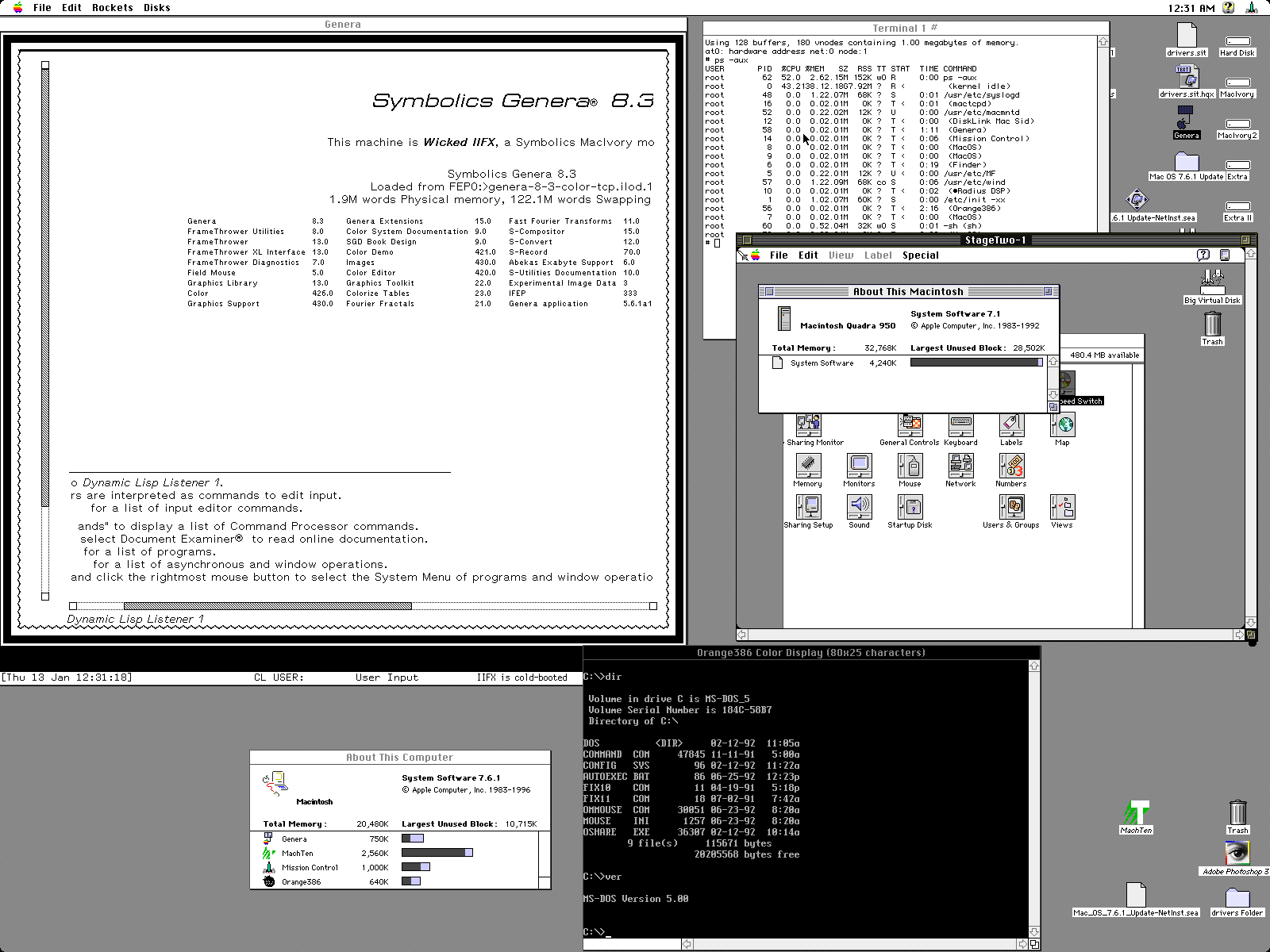
At 5:24 -0600 1/13/11, Josh wrote:
>Could I run these all at the same time in my trusty Macintosh IIfx?
>
>The answer: Yes. (warning, 1600x1200 image):
>http://yahozna.dyndns.org/scratch/random/5OS.png
>
That is so far beyond cool cool can't even see it any more! I'm
totally awe-struck! What a machine! What an idea!
How could you *possibly* have anything better to do than that?
--
- Mark 210-379-4635
-----------------------------------------------------------------------
Large Asteroids headed toward planets
inhabited by beings that don't have
technology adequate to stop them:
Think of it as Evolution in Fast-Forward.
>
>Anyway, some doofus managed to string fiber through the cabinet (one
>of the 9309 style cabinets, common with older big AS/400s and
>RS/6000s). For some reason, the decommissioned machine had to be
>removed during the day, but we were forbidden to touch the FDDI
>outside a 3 AM maintenance window. Several blades later...
>
>I'll tell you - IBM uses good steel.
>
Where did the dust end up?
On one memorable occasion, when we requested cable access between two of our
adjacent cabs, the data centre tech (without telling anyone) took an angle
grinder to the cab walls and showered our running equipment with fine steel
dust. Any mystery failures after that were blamed on dust getting sucked in
by fans and deposited on pcbs.
Regards,
Peter Coghlan.
> > Date: Thu, 13 Jan 2011 01:34:00 +0000
> > From: classiccmp at philpem.me.uk
> > To: cctalk at classiccmp.org
> > Subject: Disc drive READY output -- any standards?
> >
> > Hi guys,
> >
> > Is there a defined standard as to when the READY output on a
> > Shugart-type disc drive should go active?
<snip>
> > Thanks,
> > Phil.
> > classiccmp at philpem.me.uk
> > http://www.philpem.me.uk/
Having worked on a number of those HDDs and FDDs my recollection is the
"standard" for asserting READY was, at a minimum, that a disk was loaded and
the drive was "at speed." In some higher end HDDs I seem to recall that it
was not asserted until the heads were at TRACK 00 but I could be wrong.
Speed tolerance was pretty poor with ac motors and I think we just clocked a
retrigerable singleshot with index and required two (or more) indexes faster
than the timeout before we then asserted READY. There was probably a pot on
the singleshot and I suspect it was set to about 90% of nominal RPM for ac
motor drives and probably about 2% for dc motor drives.
The only real issues with motor speed not in range are writing out of
sector/track boundary (high speed) and read data recovery. With today's good
channels read data recover should not a problem over a wide speed range but
with the early primitive channels (e.g. "two time constant") this could be a
problem.
Tom
Hi! There is a community project at vintage-computer.com forums to convert
IDE drives to SCSI interface to support legacy computers like Amiga, Mac,
Atari, etc.
http://www.vintage-computer.com/vcforum/showthread.php?22906-SCSI-1-to-from-
IDE-drive-converter
The initial batch of prototype PCBs have arrived. Please contact me if
interested in working on the SCSI2IDE project.
Thanks and have a nice day!
Andrew Lynch
On 1/12/11 12:38 AM, Bill Sudbrink wrote:
...
> I hope you have enjoyed reading this,
> Bill Sudbrink, January 2011
I finally got a few minutes to sit down and read this. I VERY MUCH
enjoyed reading it, thank you for sharing this story!
-Dave
--
Dave McGuire
Port Charlotte, FL
I'm surprised that nobody has mentioned the most critical part of designing a data center: security.
The amount of money involved dictates that all details on a data center be closely guarded. Think about the income from ads for Google or selling music on iTunes. Or retailers like eBay or Amazon.
Thus information on data centers are the crown jewels for these companies. No way are they going to share this information. The secrecy has reached a point that they will not even acknowledge what country that many of these centers are in, let alone what building.
Most have reached the point the military took years ago: no hardware is ever returned to a vendor for repair. It is destroyed on site, never returned for warrenty.
Setting up a large data warehouse is a dark arcane science limited to a select few engineers. And the world of the cloud computing will take this secret keeping to another level of paranoia.
Billy Pettit
OK... today I discovered the real-time-clock on my 11/23+ was dead, so
TSX-Plus wouldn't run properly. I tracked it down to a bad LM339
comparator (inside the chassis power supply, of all places).
Miraculously, my local Radio Shack actually had one in stock and it is
now working again :)
The RL02 pack has RT-11 V4.00 and *two* versions of TSX-Plus on it.
The files with the expected .SAV suffix are version 5.0, but there
were also several .NEW files (including TSXMOD.NEW even though there
was no TSXMOD.SAV). When I run the new TSX-Plus it's version 6.16.
Unfortunately both versions are expecting a DL serial line card, not a
DH, and they are not interchangeable as far as drivers. And (of
course) LINDEF and DHVDEF are two of the short list of parameters that
cannot be patched via TSXMOD, but require regenerating the system :(
I was hoping to find the distribution files on the pack (such as
TSGEN.MAC) but no such luck. So it sounds like I need a new copy of
the TSX-Plus distro files... like the hobby-licensed 6.5 :)
Jerome H. Fine, would you please contact me offlist if you can help?
I've also emailed Lyle Bickley but I haven't seen him on the list in
quite a while.
thanks for any and all assistance.
-Charles
LinkedIn
------------
General,
I'd like to add you to my professional network on LinkedIn.
- Wai Sun
Wai Sun Chia
Owner at Squid Consulting & Integration
Malaysia
Confirm that you know Wai Sun Chia
https://www.linkedin.com/e/-silvj6-giuxf1pl-2b/isd/2134541550/lg02LGEk/
--
(c) 2010, LinkedIn Corporation
LinkedIn
------------
General,
I'd like to add you to my professional network on LinkedIn.
- Wai Sun
Wai Sun Chia
Owner at Squid Consulting & Integration
Malaysia
Confirm that you know Wai Sun Chia
https://www.linkedin.com/e/djnwms-giuxf0hz-71/isd/2134541438/V55UmQ-z/
--
(c) 2010, LinkedIn Corporation
LinkedIn
------------
I'd like to add you to my professional network on LinkedIn.
- Wai Sun
Wai Sun Chia
Owner at Squid Consulting & Integration
Malaysia
Confirm that you know Wai Sun Chia
https://www.linkedin.com/e/rs1ho6-giuxeoqh-2m/isd/2134540464/iiwlQPzs/
--
(c) 2010, LinkedIn Corporation
Hi
I have an ASR33 that is similar. I've just not had time
to tinker with it.
When I got it, it seemed to be missing the power board
for the reader. I finally made one with a piece of
vector board.
I had the machine and stand shipped in two packages.
I'd not opened the stand because I had't finished
fiddling with the unit.
I needed to make a little more space and guess
what I found in the box for the stand. you guessed
it, the supply board for the tape reader.
The H plate is easy to do, jammed on the end of
a screw driver blade.
Dwight
> I still didn't have the guts to try and disassemble the typing unit
> or the keyboard, but with access to their undersides, I was able to
Puty, becaue it really isn't that hard. If i could do it without the
manuals and without this list while still at school, then you can do it
now :-)
> problems remained, no line feed and no bell. I took the typing unit
> back out and looked carefully at the area of the line feed mechanism.
> It was substantially different from the illustrations in the documents.
Do you have the partsbook? I find it to be one of the most useful manuals
for the Model 33 becuase of all the exploded diagrams. Anyway, the
partsbook I have shows 2 different versions of the friction-feed platten
mechanism. The older one has ratchet teeth at both ends of the platten,
the later one only at the left side.
[..]
> The punch seemed like it would be almost trivial. It was, _almost_. The
> punch essentially just bolts onto the side of the typing unit. There are
> eight small levers that control which holes are punched and there is a
> large lever that provides the "power". The small levers simply drop into
> place, connecting with push rods in the typing unit. The large lever
> connects to a rotating shaft in the typing unit. Here's where the trick is.
> The lever connects to the shaft via a sleeve. The shaft has holes all the
> way through it, the sleeve has holes on both sides and screws go all the
> way through the sleeve and the shaft. There is almost no play in the
> connection... almost. I took out the KSR typing unit and transferred the
> punch mechanism to it.
>
> I put the KSR typing unit back in, threaded in some tape and tried it.
> Shredded
> tape. What??? Everything sure looked OK. The "bit" levers looked like
> they were all moving correctly, the large lever seemed to be going through
> its motions. I spent a long time watching it. Finally, I tried putting it
> back on the ASR typing unit. Shredded tape. WHAT!!! What could possibly
> have changed? Maybe I attached the sleeve for the large lever to the wrong
> holes? No, those are the only holes in the shaft. That's when I noticed
> that little bit of play. Just three or four degrees. That couldn't
> possibly make any difference, could it? I held the play all the way
> clockwise
> and tightened the sleeve screws. Shredded tape. I loosened up the sleeve,
> held the play all the way counter-clockwise and retightened. Perfect! I
> moved the punch back to the KSR typing unit and, with my new knowledge, got
> it attached and working.
That link is actually in 2 parts -- the sleeve that clamps to the shaft
and the crank plate that carries the link to the punch. They re held
together by a screw. Loosening that gives you quite a bit of adjustment
(10's of degrees)(, and that's waht you should be using.
>
> After the punch experience, I spent a very long taking exact measurements of
> the reader control mechanism that needed to be moved to the KSR typing unit.
> It is a complicated little assembly, consisting of a cam controlled lever
> that moves based on whether a solenoid is energized and in turn opens and
> closes a switch as the cam rotates. It looked like the location tolerances
> of the whole thing would be about a sixteenth of an inch. There is a spring
> that attaches to the lever and keeps it pressed tight against the cam. I
> transferred the mechanism. Attaching the spring turned out to be the
> hardest
> part of the whole job. The lever end of the spring is "permanently"
It's a lot easier if you remove the transmitter shaft first. Take the
distributoir unit apart, then unto the clamps over the bearings and
essentailly the shaft justlifts out.
> attached,
> but the other end has to thread through a tight space and hook over a small
> pin that is part of the typing unit frame. I fooled with it for more than
> an
> hour. What finally worked was to tie some plastic fishing line to the end
> of
> the spring, guide the line to the pin and use the line to stretch the spring
> over to the pin. I used a piece of "coat hanger" wire to coax the loop at
> the
> end of the spring over the pin and then finally reached in with a long thin
> scalpel to cut the line and pull it out.
Many years ago I bought a set of speing hooks spedifically for doing
things like this. They weren't cheap, but they've saved a lot of bad
lanugage over the years :-)
>
> "There's the easy part done," I said to myself. I figured I would spend the
> rest of the day getting the lever, solenoid and switch lined up correctly.
> I put the KSR... well, now it was really the ASR, typing unit back in and
> fired it up. The bit gods, or maybe Rube Goldberg himself, smiled upon me.
> It worked the first time.
Actually, I've never hand any problems getting that part to work first
time...
-tony
> I should point out here that, while I'm not bothered by the complexity
> of electronic circuits, I find mechanical complexity (lots of levers,
> gears, cogs and the like) a bit intimidating.
I guess I had a mis-spent childhood. I grew up taking mechanicla things
apart, and more importantly putting them together again. When I got my
first ASR33 (back in 1985 I think), I didn't have the maniuals, there
were no mailing lists like this (at least not in the UK), but I still,
very carefully, took it apart, right down to the last nut and bolt. And
then put it together again.
I would like to say it worked first time, but that would be a lie. No,
I'd mis-assembled the feed-supression linkage so that it moved the
carriage on control codes. But it didn't take me too long to figure htat
out too.
-tony
Thanks to Pete Turnbull's FindCSR (entering it once by hand was
enough) :) and reading another manufacturer's DHV11/16 documentation
dug up on Bitsavers, I now know my CSR.
Actually, two of them, 160140 and 160160, since I have learned that a
DHV11/16 appears to the 11/23+ as two DHV11 8-line cards with
consecutive address spaces modulo 20 octal.
Then I could run the various DHV11 diagnostics from my XXDP pack, and
the first time through on VDHAE0, it found the card but stopped on an
ILL INT 430 error. So I took the hint and entered 430 instead of the
default 300 for the vector interrupt address. Then Unit 1 passed the
tests, but Unit 2 had an ILL INT 440 error. Another clue :) With 440
for the 2nd vector it passed all tests.
Now to make sure it's not conflicting with my RLV12 controller, make a
cable for the user terminal, and start fumbling with TSGEN.MAC and
other TSX-Plus files!
All I need is a few VT100's and this will be 100% identical to the
system I used at my first EE job (in 1981) :)
-Charles
dwight elvey wrote:
> I needed to make a little more space and guess
> what I found in the box for the stand. you guessed
> it, the supply board for the tape reader.
That is the same way mine is configured. I think it
is using the whole stand as a heat sink.
> The H plate is easy to do, jammed on the end of
> a screw driver blade.
Like I said, "once you get the knack".
Bill