> > > > The reason is quite simple--tungsten-filament lamps (not that I
> > > > expect anyone to have any carbon-filament ones) have a very
> steep
> > > > resistance-temperature curve (higher "hot" resistance).
> >
> > HP remembered this.
> Indeed they did. In the Mdoel 200 Audio Oscillator for one thing ;-)
>
> I am sure it's mentioned in one of Fred Terman's books too, not
> suprisingly...
>
> -tony
IIRC using a light bulb is a/the classic way of stabilising the
amplitude of an audio oscillator. I have seen it in several designs.
/Jonas
All,
I also have a 90s air cooled mainframe. Sadly I have all the hardware but
no Bus and Tag cabling to go with it. I'd like to fire it up, but without
the ability to cable it that's a remote pipe dream. I warn anyone taking
one of these on to make sure they save the cabling from the copper
scrappers as well. ESCON is still easy enough to get. Bus and tag has so
far eluded me so I believe it must be getting thin on the ground. If
anyone does know of a UK/Western Europe source, please let me know about
it!
Thanks,
Colin Eby
On Tue Apr 26 14:17:26 CDT 2011, Tony Duell wrote:
> If you are really crazy, use containers of salt water with suitable
> electrodes in them :-). Just don't knock them over and spill the liquid
> into the machine under test.
Hmm. A home brew dummy load with variable resistance. (Add salt to taste.)
Martha Stewart meets Forrest Mims. ;-)
T
Dang! Missed the obvious!
Indeed, looks like the monitor was SYSGENed since there is an ANSwer file on the disk labelled SJFB.ANS I don't have the system running at the moment but will boot it again this weekend at latest and check the config but I'm sure that's it.
I suspect the RT-11 copy either has FPU support enabled (which my 11/34 lacks) or one of the many timers (I have one on the DL-11W but that is it). The LSI system is an 11/73A so it is "loaded".
I suppose it is time to SYSGEN a new copy - The SYSGEN.COM and a load of assorted files are already on an MFM drive (as a bootable MSCP device) . I have the SYSGEN manual from bitsavers so I guess it's time to play "seventy questions".
Anything about the 11/34 I need to be aware-of in terms of options? I want SJ, but probably don't need SJ timer support. I'm running it from a dual RX-01 drive so I'll have to keep things to a minimum on this particular system. If I get ambitious later I can try a new "Qniverter" I picked-up to allow the 11/34 to use the LSI-11 disk controllers.
Thanks!
Mark
> Why don't you just create a new "virgin" RT11 boot disk on your LSI?
> E.g.:
> .INIT DX0:
> .COPY DL0:SWAP.SYS DX0:
> .COPY DL0:RT11SJ.SYS DX0:
> .COPY DL0:DX.SYS DX0:
> .COPY DL0:DL.SYS DX0:
> .COPY/BOOT:DX DL0:RT11SJ.SYS DX0:
>
> and then try booting the disk on the other system.
> Or did I miss the posting where you've already mentioned that procedure?
> What happens if you try another monitor, e.g. RT11FB or RT11BL? It may be
> possible that your version of RT11SJ has been SYSGENed for some options in
> your LSI machine. Type SHOW CONF on your LSI and what for the version
> string like "RT-11FB (S) V05.03"; the (S) indicates a SYSGENed monitor.
Professor Mark Csele, P.Eng.
Niagara College, Canada
300 Woodlawn Rd., L-23
Welland, ON, L3C 7L3
(905) 735-2211 x.7629
E-Mail: mcsele at niagarac.on.ca
URL: http://technology.niagarac.on.ca/people/mcsele
Author of "Fundamentals of Light Sources and Lasers", Wiley, 2004
Hi,
does anyone have the manuals (or even scans of them) for the IBM 3287
printer? I'm looking for information regarding setup, configuration and
error codes.
Christian
This news has been all over the Apple II boards and blogosphere today,
so I figured someone should post it here on cctalk. Ryan Suenaga, a
very active and veteran member of the Apple II community, died yesterday
in a hiking accident. He was only in his mid-40s.
Dear Mr. Allain
I read your post on the cctech mailing list at
http://www.classiccmp.org/pipermail/cctech/2003-June/016522.html
I was wondering if you still have the Omron Scy-P5r PLC with you? If yes, I
would like to purchase it from you.
--
Regards
Syed Nauman Shah
>> Any alignment must be totally lost by now. But if I do get it
>> working I
>> can format a disk on it and see if that works. Reading and writing
>> files
>> might be more of a problem, I can't remember if there is any way to
>> create directories and files in the bare OS, or if one needs
>> programs
>> from another disk, in which case I would be out of luck if it is so
>> badly misaligned that it can't read other disks.
>
> Could you connect it up as a second drive? I seem to rememebr there's
> a
> socket for that on the ST (a strange 14 pin DIN socket?). Or test it
> on
> some other machine that uses a standard-ish floppy drive?
I could connect it as a second drive in a PC. I think it is actually a
bog-standard drive.
Connecting a new drive to the ST was dead easy, however most of the old
diskettes that came with the machine seem to be bad. Now I shall have to
try to get the old drive working again.
I thought the head assembly on the old drive might have had bushes for
the guide rod. Not so, they were just holes punched through the sheet
metal...
/Jonas
I am accepting reasonable offers for the following entire IBM Series 1 system:
http://vintagecomputer.net/ibm/Series1/
If no one is interested I will donate it to MARCH's museum
instead. Contact me directly by email
When cabled together this system would I believe function as a
document storage system and communications for a medical
facility. Anyone who knows a thing or two about the Series 1 is
welcome to have access, it's set up and power is available until at
least July. After that I have to move it.
I wish I had more time for it myself. So far I have un-parked the
4962 hard drive, wired the component cables, and tried to access the
control panel. I have a limited knowledge of IBM minicomputers, just
enough to know that these kinds of minicomputers don't just power up
and say READY when you attach a monitor to them. In short the
operational condition is unknown. The individual components power up.
Anyway, here is a list of the components.
qty) Description
2) 6' IBM 4997 Rack Units with shelves to house the processor and peripherals.
1) IBM 4956 Processor
1) Cambex Corp Model 80810 2-tape drive storage device (no tapes)
1) IBM 4962 8" disk drive / Hard Drive (w/ 3 boxes of maint. software)
1) IBM 4967 Hard drive (69kg)
1) IBM 4963 Hard drive (55kg)
1) IBM 4963A Hard drive (55kg)
1) IBM 4978 display station and keyboard (display is bad?)
12) Series I system software/hardware manuals "standard 3-ring binder sized"
20) Series I system software/hardware manuals (tall, blue, with IBM
written on them)
There is documentation for all components, plus service logs,
software documentation, installation instructions, etc. Pretty complete.
Misc. papers and other documentation and receipts.
3 boxes of IBM software on 8" disks, including diagnostics for hardware.
1 box of cables and jacks for additional display stations/terminals
1 box of printer ribbons (no printer)
probably some product literature and period IBM sales circulars, etc.
I believe I also have the modem for this system.
The items are in Wilmington, Delaware minutes from rt 95, about an
hour north of Baltimore, 25 minutes south of Phila Airport. Please
contact me directly, reasonable offers accepted. I will avoid
selling individual components. Pick up preferred, items are near loading area.
Bill
Yes, one can get lucky that way - and I have machines in my personal collection where I have not replaced the filter caps (yet). Component tolerances can allow continued functioning even with significantly degraded components. But if I turn one of those machines on and it doesn't start up, that's my problem. If I turn the key on one of our machines at work, in front of a crowd of people, and it doesn't start up, that's a different story.
Industry studies (work by Cornell Dublier) show that aluminum electrolytic capacitors have a limited life span. (The most common failure mode is not drying out, it is elevated ESR.) Then there have been the various scandals about substandard components. I think it bears consideration that electrolytic capacitors are not one of the most reliable components in our information systems. --- Ian
________________________________________
From: cctalk-bounces at classiccmp.org [cctalk-bounces at classiccmp.org] On Behalf Of Tony Duell [ard at p850ug1.demon.co.uk]
Sent: Sunday, April 24, 2011 11:10 AM
To: cctalk at classiccmp.org
Subject: Re: new here
> cautious sort, disconnect the filter caps and perform a leak-down test, rep=
> lacing parts that fail. If you're really cautious, just replace them - tha=
> t's what we do with power caps if they're over twenty years old. There's a=
> date code on the part. =20
If I did that, I'd have replaced every capactior in every machine I own,
including the machine I am currently typing this on. I haven't. In fact
many of my machines, including ones that are 40 years old, are still
runnign with all their original capacitors.
Yes, capacitors fo fail. I've replaced a number over the years. And they
can fial from just old age if the electrolyte dries up. But in m
experience it's not the problem that some people claim it is.
-tony
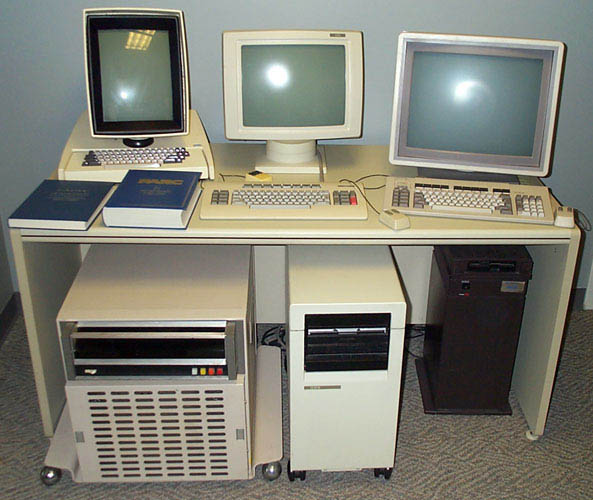
I am looking for confirmation that this is a Xerox 8010 / Xerox Star:
http://vintagecomputer.net/xerox/8010/
It's missing the front cover and one of the side panels. I don't have the
monitor or mouse, just what's pictured. Anyone have one of these?
Thanks
Bill Degnan
I recently received a PCjr add-on which is so unusual, it felt like
Christmas. But as always, it needs a little TLC.
This is an expansion chassis made by an outfit called "Legacy
Technology" in Nebraska in the mid to late 80s. The interesting part of
the chassis is a hard drive controller card and hard drive. PCjrs only
had hard drives if you bought a 3rd party controller, and they were all
pretty hackish.
The drive is a 20MB Teac SD-520U and it is very flakey - I am getting
data corruption almost all of the time. The corruption seems random;
this drive might just be tired.
I've low level formatted the drive twice. The controller BIOS supports
INT 13, Function 7 (Low Level Format). It's not helping.
Since the drive is probably not usable, I'm trying to figure out how to
substitute in another drive. Examination of the BIOS extension shows
that the controller supports 3 types of 20MB drives and 1 type of 10MB
drive. I have 10MB drives that I can use, but not another 20MB drive.
This is an XT class controller so I'm expecting to find some jumpers to
set the drive type, but they are eluding me.
The controller is actually a two part affair - A small amount of logic
with the system BIOS extension on it, and then a WD1002-HDD board. The
WD1002-HDD board mounts to the underside of the hard drive and then
connects to the hard drive using the familiar 34+20 wire ribbon cables.
It looks like it is capable of controlling three separate drives; it
only has one 34 pin connector, but it has three 20 pin headers, one of
which is in use.
Does anybody have docs for the WD1002-HDD? If so, where do I find the
drive type jumpers on the board?
If I can't figure the controllers out I'm going to be looking for a
similar drive. I suspect the trusty ST-225 works - the geometry is the
same.
Regards,
Mike
We in MARCH are selling the following IMSAI 8080:
http://cgi.ebay.com/ws/eBayISAPI.dll?ViewItem&item=270739896050
Proceeds for this system are NOT going to our club, but rather to the widow of a local computer reseller who died in an industrial accident recently. Our club was asked to fix up the computer and sell it on her behalf.
- Evan Koblentz and Bill Degnan
I have encountered an old 14" disk drive - it looks like it is
probably a clone of an IBM 2314. It does not look like a 2314 at all
(it is plain blue box with, that sort of looks like a 2311, but with
more heads), and no tag at all. The drive interface uses that goofy
connector that the late 60s IBM drives standardized on, for talking to
the control units. The boards all have "CMS" stamped on them. Any
ideas? Was CMS, whoever they were, one of the early clone companies?
--
Will
On Thu, Apr 21, 2011 at 2:47 PM, Fred Cisin <cisin at xenosoft.com> wrote:
> On Thu, 21 Apr 2011, Brian Lanning wrote:
>> My mom was a secretary. ?She had an IBM selectric. ?World's loudest
>> typewriter. ?She could type 90wpm on that thing. ?Oh man, what a
>> sound. It sat on a foam mat to try to absorb some of the vibration. ?I
>> used that for my papers until I got an original IBM 5150 and my school
>> got a much of Apple 2Es.
>
> Rated top speed for the mechanism was 14.8 characters per second (about
> 150 WPM). ?But a 150 WPM typist (yes, I've met some!) would have bursts
> substantially higher, and selectrics would come apart.
I do not know precisely how fast my mother could type, but her
Selectric sounded like a machine gun when she got going. She never
had one "fly apart", but she did wear out more than one unit from
8-10-hour-days of multi-page-carbon-set production work (final copies
of court transcripts). She was paid by the page, so long stretches of
error-free typing was the only way to make a decent wage.
At one point in the early 1980s, her machine broke and she took it to
a new repair shop in town. The tech was puzzled at the wear he
observed during the triage until he watched her type to test out the
freshly-repaired unit. As she banged away at a high rate of speed for
a full page, the tech nodded and said to her, "you and I are going to
become good friends". He was right.
(Our 32K PET shared the home office with the Selectric. One afternoon
when I was noodling around on the PET and she was deep in production
mode, during a pause in the clatter, I remarked that someday soon,
she'd be doing all of that "on one of these" (meaning a computer, not
specifically a PET). She laughed. Less than five years later, she
switched to 512K Macs and an Apple LaserWriter I).
> At work, somebody succeeded in running one at 300 baud. ?Briefly.
> That was discontinued when the "golfball" went flying into a sheetrock wall.
Wow. Who knew full-face-shields were needed in an office environment.
-ethan
So I attended Notacon, and some people may be interested to know that
there was a Lisa there brought by the CMU Computer Club. They hacked
together a demo on it, which was pretty decent given the clock speed,
etc. They claim "first lisa demo ever." --- you know how that goes
around here! :) The demo concluded with the apple logo in COLOR, which
they did by translating the brightness-level information into color on
the FPGA board.
They used an fpga development board to bring digital video signals in
off the chips, and frame buffer it and output to an HDMI output port.
They didn't actually scan convert it, but left it at its native
resolution, which was something weird. Like 700 x 300 or something?
(quick google says 720 x 364)
When pushing them for more answers on details of their hacked together
video solution, and ideas for scan converting --- they clammed up, and
said that since they will be offering a commercial product at some point
in the future, they couldn't talk about it. Weren't going to document
it publicly, post it online, etc.
I suppose it's not too surprising that college kids don't understand the
difference between raw ideas & prototyping vs executing and marketing an
actual product. I just found it disappointing that it happened at a
place where the fundamental point of getting together is to share
information. I guess they consider sharing a one-way street.
Keith
Eric writes:
>Fred Cisin wrote:
>> "trusty ST-225"??
> Well, as compared to some brands, yes. JTS comes to mind, though it
> wasn't contemporary with the ST-225.
Most of my suffering with MFM drives happened at the upper end of
the cost/complexity spectrum.
Looking back 20 years I in fact have good respect for the simpler of
the MFM drives and the ST-225 is an example.
Maybe my expectations were just lower for a drive that didn't cost
$4000 (list price of a XT-2190). But it's also quite true that ST-225's
didn't crap out at the rate as the much more expensive MFM drives
and for that I have to really give them some credit.
Tim.
Can someone here please explain to me, in ** simple English **, the
difference (in usage, not in how they work) between a "control grid
tube" and a "barrier grid tube" ... ?
I tried Googling but that led to me being more confused, not less. :)
Hi! There are bunch of S-100 Serial IO boards left so if anyone would like
one or more please let me know.
John has a nice description of the board here:
http://s100computers.com/My%20System%20Pages/Serial%20IO%20Board/Serial%20IO
%20Board.htm
These are respin PCBs which resolve all the minor issues from the original
release and the board is 100% without any modifications.
These are generic IEEE-696/S-100 serial IO boards with dual serial ports,
optional USB, and optional voice synthesizer support. There are also some
parallel pins available.
They are available for $20 each plus $3 shipping in the US and $6 elsewhere.
If you have questions you can contact me or ask on the mailing list
http://groups.google.com/group/n8vem-s100
Thanks and have a nice day!
Andrew Lynch
PS, although these are home brew PCBs you can use them in either building
your own S-100 from scratch, restoring/repairing a vintage system, just
adding them to an already working system for more IO.
MARCH is selling the following IMSAI 8080
http://cgi.ebay.com/ws/eBayISAPI.dll?ViewItem&item=270739896050
Proceeds for this sale will go to the widow of a veteran Trenton
Computer Festival exhibitor whose husband died in an accident. She
donated her husband's collection to the Mid-Atlantic Retro Computing
Hobbyists, and asked that we sell one nice system from that lot to
help her financially.
Bill
>> Armstrong was the more impressive in actually putting the tube to
>> work.
>
> DeForest is painted rather blatantly as nothing less than a slimeball
> by the T.H. Lee chapter cited by the previous web site:
>
> http://www-smirc.stanford.edu/papers/chapter1.pdf
>
> In legal proceedings attempting to claim credit for the superhet,
> DeForest made a perfect idiot of himself. He didn't have a clue.
It's tough for a techie to go into court and come out looking smart.
You can be the world's best expert on some important area of
technology and come out completely skewered every which way
>from Sunday if you try to look like a smarty-pants. Just being the
expert who was in the thick of things puts you at a real
disadvantage in almost every legal situation, no matter how
humble you try to be.
And even if your side wins it doesn't mean you're gonna be a
happy guy. Look what happened to Armstrong.
All these legal tribulations from the early 1900's seem just as relevant
(as business and/or moral lessons) today in the 21st century.
Tim.
One item I've needed on several occasions was an ASCII keyboard (TTL or RS-323 levels) for a vintage system. While I do have a few Keytronic serial keyboards with TTL output - they are old and can be "flaky".
I found a pair of products that convert a standard PS/2 keyboard to RS-232 ASCII output (and can be modified for TTL). In addition, the vendor was very cooperative about modifying his product to meet the needs of those of us in the vintage computer community.
To be specific, the standard products support baud rates from 2400bps to 115Kbs.
I contacted the owner of the company ("John Ursoleo" <jursoleo at att.net>) saying that for the vintage systems I was working with, I needed lower baud rates. John asked me to send my units back - and reprogrammed them to support the following baud rates: 110, 300, 600, 1200, 2400, 4800, 9600 and 19,200. He sent them back to me, and I tested them again with the low speed option and they worked great.
The "low baud rate" version of these products can be ordered with the /LB option.
Here's where to get the products, manuals, etc.:
PS2ADPT http://www.versalent.biz/seradpt.htm
PS2PRO http://www.versalent.biz/ps2pro.htm
Note: The standard output of this product is RS-232 voltage levels - but it is easy to modify them for TTL levels. Doing so voids the warranty - so you are on your own with this mod.
I have NO financial interest in this recommendation - it's just a good product I've found useful...
Cheers,
Lyle
--
Lyle Bickley, AF6WS
Bickley Consulting West Inc.
http://bickleywest.com
"Black holes are where God is dividing by zero"
A friend desires to leave the hot desert this summer and move to the cool mountain and yet maintain contact with his PDP11 with which he still runs his business. He has a rotten phone connection, but good internet. He runs a highly modified version of RTST 5x and cannot reasonably move his stable 30 y/o applications to later/other OS's. I would appreciate knowing what the listers use to accomplish same.
-> CRC
>From: Gary Buda <gbuda at cyberwright.net>
>To: greenkeys at mailman.qth.net
>Date: Sat, 23 Apr 2011 12:37:21 -0500
>Subject: [GreenKeys] Free RTTY machines in central Iowa
>
>Des Moines had a swap fest today. One of the sellers had a sign for a FREE
>model 33 and a FREE model 18. What they really have, I believe is a FREE
>model 33 and a FREE model 15. They're relocating to Florida and don't want to
>haul this stuff with them nor do they want to throw it in the garbage. They
>didn't bring the units to the swap fest, so I have not seen them. And, I
>don't have an interest in them either. They just sold their computer and
>therefore no longer have email. But, you can contact them here:
>Rich Acopy
>515-243-9567
>
>Good luck!
>Gary WA0NDN
>NNNN
>
>______________________________________________________________
>GreenKeys mailing list
>Home: http://mailman.qth.net/mailman/listinfo/greenkeys
>Help: http://mailman.qth.net/mmfaq.htm
>Post: mailto:GreenKeys at mailman.qth.net
>
>This list hosted by: http://www.qsl.net
>Please help support this email list: http://www.qsl.net/donate.html
I know this is from an old post but I am looking for a 130 in one manual
28-259 and was wondering if you ever got this one? If you did can you e-mail
me a copy? Thank You Don
http://www.mhtest.com/ has done it before, maybe you won't even have to send them your boards :)
For many purposes I think I'd be happy with a good 600 DPI color scan of both sides (including silkscreen). I don't think that modern PCB processes will by default produce a board that "looks like" an Altair era board (I remember the silkscreen actually covering tinned solder pads.)
On Fri, 22 Apr 2011 22:52:22 -0500, you wrote:
>And they don't think there's something wrong (and unprofessional)
>about this practice? It looks (to the layperson) that it's so deeply
>ingrained in the culture that it has become acceptable and expected. Do
>the people involved just view it as an acceptable risk, or do they think
>there just isn't any risk?
>
> -Dave
There are probably a few other MD's (and DO's) on this list, including
me ;)
I went through it in my late 20's and now, 20 years later, would not
have the stamina to do it at all, let alone safely. From personal
experience I'm inclined to believe the practice of 36 hour shifts is
no more or less than institutionalized hazing, as has already been
addressed by other posters. Any complaints were always met with
derision of the "you think YOU have it tough, when *I* was an intern I
had to walk uphill both ways barefoot in the snow 36 hours a day",
etc. Especially among surgeons, who usually won the macho-asshole
award hands down.
-Charles
--- snip ---
>>
>>Has anyone used any of the serial port ethernet servers (aka port
>>directors) and how well did they work?
> Now that we have more details I'd say that the best solution is
> either this, or else a dedicated low-end x86 PC running OpenBSD. In
> either case the 'fun' part could very well be wiring the two
> together. Honestly I'd recommend a PC with OpenBSD over a Serial
> Port ethernet server.
--- snip ---
A VPN router and a 4 or 8-port terminal server should be adequate.
Xyplex terminal servers, while a PITA to configure, seem pretty darned stable.
An MX1600-04 is a 1U rack size, and can support 16 concurrent sessions.
It's best to use them with a multiplexor that supports modem control though,
so that if your Telnet session drops, your interactive session becomes detached.
Otherwise, the next person connecting will pick up your session.
I've successfully interfaced Xyplex series routers with Emulex CS02's, and DHV11's.
It's been some time since I've messed with them, though, so I can't readily
spout the exact terminal server settings & cable pin-outs, so I'd have to
dig them out of my storage unit for examination.
Lantronix terminal servers will also work; they're alot smaller, but not my favorite.
(I couldn't get rid of the pesky "Welcome to the Lantronix Terminal Server" message.)
T
On Sat, Apr 23, 2011 at 3:24 AM, Zane H. Healy <healyzh at aracnet.com> wrote:
> Now that we have more details I'd say that the best solution is either this,
> or else a dedicated low-end x86 PC running OpenBSD. ?In either case the
> 'fun' part could very well be wiring the two together. ?Honestly I'd
> recommend a PC with OpenBSD over a Serial Port ethernet server.
Yeah, and running conserver: http://www.conserver.com/ or something like it.
Depending on how many serial ports you have, you can have a real
multi-user setup with this.
HTH
--
Regards,
Torfinn Ingolfsen
On hu, 21 Apr 2011 21:33:22 -0700: "Zane H. Healy" <healyzh at aracnet.com> wrote:
> At 9:13 PM -0700 4/21/11, CRC wrote:
>> A friend desires to leave the hot desert this summer and move to the
>> cool mountain and yet maintain contact with his PDP11 with which he
>> still runs his business. He has a rotten phone connection, but good
>> internet. He runs a highly modified version of RTST 5x and cannot
>> reasonably move his stable 30 y/o applications to later/other OS's.
>> I would appreciate knowing what the listers use to accomplish same.
>>
>> -> CRC
>
> I would recommend running the E11 PDP-11 emulator on a laptop.
> Though based on what you describe, I think SIMH could work just as
> well. Honestly I'd recommend moving it over to an emulator anyway if
> he's running his business off of it. It's one thing for those of us
> here to run PDP-11 hardware of that vintage as a hobby, it's another
> thing to depend on it for your livelihood. What type of drives is he
> using?
>
> The following webpage desperately needs updated, but should point you
> in the right direction.
> http://www.aracnet.com/~healyzh/pdp11emu.html
E11 has been seriously looked at in the past, but the required additions and money constraints nixed going in that direction. Whenever time permits he has been looking at alternates to the current hardware. However, this system which has a rack of Fuji Eagles and a number of tape decks, has been running without much repair maintenance for the last several decades. We recently had to work on one of the Fujis and now are in the process of shot-gunning all the caps. We were totally amazed when one of the drives became flakey and found that nearly all the caps were bad - luckily Earl W. Muntz didn't work for Fuji...
However, the current problem is not transporting the applications, but contacting the current system. Remember that RSTS is multiuser and he has no intention of also transporting his drones that also access the computer to the cool mountains with him :) There are also a number of customers that dial in to get access to data.
Has anyone used any of the serial port ethernet servers (aka port directors) and how well did they work?
-> CRC
Hey folks. Who is handling new subscriptions here nowadays? An
acquaintance from another list is interested in joining but has been
having trouble.
-Dave
--
Dave McGuire
Port Charlotte, FL
At 12:00 -0500 4/22/11, Chuck wrote:
>Would you fly as a passenger on a jet whose pilots pulled 30 hour
>shifts routinely? I wouldn't--hell, I wouldn't ride on a bus whose
>driver was pulling a 3-day no-sleep shift.
...
Chuck, you are right on the money. Cameron, you know I like
you, but the way interns are abused is pure simple insanity. Heck,
pick almost any "operator error" disaster you care to name -
Chernobyl, Exxon Valdez, whatever - and odds are >> 80% that you will
find someone either operating outside normal work hours or who had
been recently doing so. On the last full mission I participated in,
we made 4 critical errors during integration and test, any one of
which could have damaged the spacecraft or terminated the mission -
and *every one* of which was made outside normal working hours.
Your own post that started this thread contained the phrase
"Hope my overnight admission orders didn't kill anyone." Would you
say that about any other part of your work? Would you want your loved
ones admitted or treated by someone under those conditions?
I admit there are conditions where doctors have to work long
hours; I watched M*A*S*H just like everyone else. But *training*
doctors to do that at the expense of patients' safety during normal
times is dangerously bad policy, particularly considering the tiny
percentage of doctors who will ever consent to work that way anytime
during their professional lives. It's also educationally
counterproductive, as anyone who has ever crammed overnight knows.
Why and how the medical community, who has the best knowledge
available of what physiological effects result from long-term sleep
deprivation, ever allowed this practice, to say nothing of
institutionalizing it, is beyond mystery and into mysterious evil as
far as I'm concerned.
I don't guess hospitals should be shut down but I think it
would be a really good idea to take a few administrators and
schedulers each month, ceremonially break legs or induce other
disorders, and then admit them on the 36th hour of a new intern's
first overnight shift.
--
- Mark 210-379-4635
-----------------------------------------------------------------------
Large Asteroids headed toward planets
inhabited by beings that don't have
technology adequate to stop them:
Think of it as Evolution in Fast-Forward.
>> A friend desires to leave the hot desert this summer and move to the
>> cool mountain and yet maintain contact with his PDP11 with which he
>> still runs his business. He has a rotten phone connection, but good
>> internet. He runs a highly modified version of RTST 5x and cannot
>> reasonably move his stable 30 y/o applications to later/other OS's. I
>> would appreciate knowing what the listers use to accomplish same.
> A relatively lightweight PC at his business, with internet access and a
> serial port, running linux and kermit, should get him access. For
> certain values of soldering in the missing serial port, even one of the
> linux-based linksys routers could probably be made to work.
> SSH from the mountain to the PC/linksys, kermit to PDP.
I use a hardware TELNET <> LAT gateway, so I don't have to deal with
power hungry multiplexors, serial cables, and baud rate limitations.
Of course, since he's probably running V5A, he couldn't get that fancy.
However, a plain ol' terminal server would be much easier to implement.
Set the router to direct TELNET traffic to the terminal server, and voila !
T
The workshop will have persons of all skill levels, including
individuals with 40+ years experience in attendance. The "Teletype
101" is expanding into a workshop for all experience
levels. Whatever your skill level there should be someone who can
help you. I will be bringing an SWTPc 6800 or a PDP 11 as a demo
unit, depends on space, etc. If you buy a teletype, you can work on
it/get help on the spot - a good deal!
Here is the official email about the teletypes. Please read this
over carefully.
PLEASE SEND INQUIRIES TO ME DIRECTLY (if the below does not answer
your questions).
Bill Degnan
billdeg-at-aol.com
A Vice Pres. M.A.R.C.H.
--------------------------------------------------------------
THERE IS NO SHIPPING - PICKUP ONLY
1. If you have not done so already pick a teletype from the photos here
<http://www.midatlanticretro.org/teletypes/>http://www.midatlanticretro.org/teletypes/
2. The prices are labeled on the photos:
Selling prices:
$100 TTY (best cond. has stand, chad paper catch, sheet holder, rare )
$75 TTY (complete/good cond no stand)
$75 TTY (fair condition but has stand)
$50 TTY (poor cond. / incomplete / parts)
3. There are two ways to get your choice of teletype
a. Register for the workshop/Pick up at VCF
<http://www.vintage.org/2011/east/workshop.php?action=select&id=149>http://www.vintage.org/2011/east/workshop.php?action=select&id=149
In addition to the workshop itself, your $40 also gets you:
- Entry into the drawing to win a free "serviceable" teletype.
- $40 applied to the purchase of a teletype, "dibs" in the order of
registration (first to register = first to pick from what's
available, second, etc.).
- If you do not show up for the workshop you lose your place in line
but the $40 can be applied to a purchase from what's available.
- The $40 deposit is non-refundable.
NOTE: You have to make the remaining balance due payment in order to
take possession of your teletype.
b. Purchase outright/Pick up any time
- If you don't want to wait until the workshop, you can buy a
teletype outright by paying full price in advance of the VCF. First
come first served.
- I will mark the photos with the names of the purchaser after
payment has been received.
- Visit the link below and click on the "donate" button to enter the
Mid-Atlantic Retro web site PayPal account to make payment.
<http://marchclub.org/>http://marchclub.org/
4. How to take posession of your TTY:
The teletypes are located in the Mid Atlantic Retro Computing
Hobbyists' Computer Museum which is located in the InfoAge Science
Center of Wall, NJ. For directions see
<http://infoage.org/html/visit.html#directions>http://infoage.org/html/visit.html#directions
Payment (see 3 above)
Pickup Before VCF Weekend
InfoAge Sundays when MARCH has someone there at the museum pick
teletype assuming they have paid the full price (paypal).
Pickup on VCF Weekend:
Persons can pay $40 in advance to reserve a TTY, and it's their
choice whether they attend the workshop. The $40 goes towards the
purchase price of a TTY. One must pay the balance due to take
possession of their TTY.
Pickup After VCF Weekend
Persons can visit InfoAge Sundays when MARCH has someone there at the
museum to buy and take home a teletype assuming they have paid the
full price (paypal).
There is no shipping available.
-end-
----- Original Message -----
Message: 13
Date: Thu, 21 Apr 2011 15:49:52 -0400
From: Ethan Dicks <ethan.dicks at gmail.com>
Subject: Re: F&*#ing chicklet keyboards (was Re: Retro Atari 400
looking Keyboard)
To: "General Discussion: On-Topic and Off-Topic Posts"
<cctalk at classiccmp.org>
Message-ID: <BANLkTi=-0VR2fJMZKd-xyO66CLDr2ScRCw at mail.gmail.com>
Content-Type: text/plain; charset=ISO-8859-1
Some folks didn't even wait. Some paid over $100 for an external
"full-sized" keyboard. I bought a blue-bezel chiclet PET with the
internal cable from Skyles Electric Works for the external keyboard
(probably long since separated).
<snip>
Now (largely because issues of practicality are irrelevant), the price of a
1977/1978 chiclet-keyboard PET is several times that of a 1978 Graphic or
Business-keyboard PET.
-ethan
----- Reply -----
There was an upgrade kit available from Commodore, consisting of a
replacement upper case half with the new Graphic keyboard, a new black decal
and matching black monitor bezel, and an optional new external cassette deck
to replace the internal missing-the-corner unit.
I upgraded mine and also replaced the white screen with a green tube; glad
now I kept the original parts for the day I sell it...
m
A few years ago I came to poses an original unassembled Altair 8800 kit. I have since decided to donate it to the Computer History Museum in Mountain View, California. But before I send it off, I would like to capture the printed circuit board artwork and make available to others wishing to reproduce bare boards. Can anyone recommend a service bureau, preferably somewhere on the east coast (US), that can do the work?
-Mardy
The IBM channel cables were separately a Bus Cable and a Tag Cable and I
believe the high data rate version had two of one of them, probably the Bus
Cable. They used an IBM proprietary hermaphroditic pin and shell which
initially we had to buy from IBM at extraordinary prices but after a while
someone, I forgot whom, came out with a plug compatible pin that avoided
IBMs patents.
The Signal Cable in the OEM HDD interface from RP01 -> SMD interface had
three tags (set head, set cylinder and control) and a bus of varying width
starting with 8 bits and growing about 1 bit/generation.
The DC cable in the same interface had separate read and write cables and a
few signals.
The names go back to the 2311 era or perhaps the 1311 era when I seem to
recall at least the DC Cable carried some DC into the drive. They had a 4th
tag, set difference which the OEMs didn't use.
Tom
> Message: 20
> Date: Thu, 21 Apr 2011 13:44:17 -0700
> From: Al Kossow <aek at bitsavers.org>
> Subject: Re: CMS disk drive?
> To: cctalk at classiccmp.org
> Message-ID: <4DB09721.8030200 at bitsavers.org>
> Content-Type: text/plain; charset=ISO-8859-1; format=flowed
>
> On 4/21/11 1:20 PM, William Donzelli wrote:
> > These connectors are smaller than b&t, and are a weird mix of pins,
> blades,
> > and coax.
> >
>
> OK, the connectors I was thinking of were like page 1-2 of
> TM114-1072-J-1M_Model_114_Tech_Oct73
>
> The 114 calls the two cables DC (radial) and SIGNAL (BUSED). SIGNAL has
> bus and tag lines and
> the DC cable has the coax. They are similar to the Memorex cables with AMP
> connectiors Tom
> mentioned.
>
> Weren't the cables from the CPU to Controllers "Channel" cables?
Free for a little gas money - a new? in box with manual 6940B general
purpose IO box, can be used with quite a few HP systems with the right
interface card, which we do not have. Located in Boulder, CO, and can
deliver to SLC, Seattle, or the Bay Area. It is not too huge, about ten
inches of rack space. Let me know now!
--
Will
Can up describe it in more detail or better yet post some photos? For
example does it have 20 heads? Is the funny connector the AMP M series, are
there 3 (control in, out and data in/out)? Does the spindle look like the
nose cone of a rocket with a hole in the center? Etc.
CMS might be Caelus Memory Systems but I don't think they ever did a 2314
class machine
I seem to recall a Computer Memory Systems but I think they were much later
Could be some variant on CalComp or Century Data Systems
Tom
> Message: 5
> Date: Thu, 21 Apr 2011 12:55:56 -0400
> From: William Donzelli <wdonzelli at gmail.com>
> Subject: CMS disk drive?
> To: "General Discussion: On-Topic and Off-Topic Posts"
> <cctalk at classiccmp.org>
> Message-ID: <BANLkTimw66t7NP9+HVxPEyGQ21NmK2ZQMQ at mail.gmail.com>
> Content-Type: text/plain; charset=ISO-8859-1
>
> I have encountered an old 14" disk drive - it looks like it is
> probably a clone of an IBM 2314. It does not look like a 2314 at all
> (it is plain blue box with, that sort of looks like a 2311, but with
> more heads), and no tag at all. The drive interface uses that goofy
> connector that the late 60s IBM drives standardized on, for talking to
> the control units. The boards all have "CMS" stamped on them. Any
> ideas? Was CMS, whoever they were, one of the early clone companies?
>
> --
> Will
The original RAM configuration is outlined below. It was used this way, and booted just fine from RK-05's in days gone by.
An M7847 with 16KW
A Motorola board with 6 rows of 9 4116 chips (for a total of 48KW)
A Mostek board with eight rows of 9 4116 chips (for a total of 64KW)
The Motorola board was originally set to the lowest 48K, the M7847 after that, and the Mostek for the highest 64KW addresses ... I reconfigured when I checked these out (I lack the actual docs on the Motorola and Mostek boards but there are only eight DIP switches so it was easy enough to guess and just verify the range via the front panel ... bus error when a non-existent address is deposited).
I think I goofed on the original size of the Mostek board ... it sports two banks of 4 rows by 9 of 4116 chips (64KBytes each bank).
As for the RX11 interface (M7846), I could not find config info except for a photo of a board on the web (checked bitsavers but can't find that board). My jumpers are as follows: V2 V4 V5 V7 N1 A7 A8. All other jumpers are snipped off.
Power Supply: after the long-term storage in the garage that was the first thing I checked. Once had a 5V supply put out 7V so I'm paranoid about that now! The 5V and +/- 15V supplies are all good.
Cheers .... Mark
Professor Mark Csele, P.Eng.
Niagara College, Canada
300 Woodlawn Rd., L-23
Welland, ON, L3C 7L3
(905) 735-2211 x.7629
E-Mail: mcsele at niagarac.on.ca
URL: http://technology.niagarac.on.ca/people/mcsele
Author of "Fundamentals of Light Sources and Lasers", Wiley, 2004
>>> Tony Duell <ard at p850ug1.demon.co.uk> 04/19/11 5:47 PM >>>
>
> Well, a few more bizarre things to report:
>
> I tried to disable interrupt sources as suggested. The only one, =
> apparently, was the DL11-W SLU/LTC card which was set for both functions. =
> The card was reconfigured to be "SLU Only". No change in behaviour. The =
> DL11-W console is set for address 177560, vector 60.
The console will geneate 2 iterrupt vectors (60 and 64 I think) for
transmit and receive. They cannont be set separately, so if the DL11-W is
working properly, that's OK.
The RX11 will also generate interrupts. What's it set to?
>
> Next, there are three memory cards: one M7847-DJ (16K*18 MOS, MS11-JP), =
> one "Motorola memory systems" card with 48K words, and one "MOSTEK memory =
> systems" card with 96K words. Both the two later cards use 4116 DRAM =
> chips.
Hang on a second. You've got 16Kw + 48Kw + 96kw there. That's 160Kw
total. The PDP11/34 (it is an 11/34 IRIC) has 18 bit addressing and can
access a total of 128kw. 4Kw are used for the I/O space, so you have have
a maximum of 124kw of memory (practically, most memory boards wil
lautomatically disable themselves in the I/O space, so you could fit a
pair of 64Kw boards, say,m without problems). But with your configuration
you must have some locations addressing 2 boards, which is not a good thing.
>
> Tried to use the M7847-DJ card alone (after all, RT-11SJ should run on =
> 16KW of memory). Reconfigured the card address to start at 0 and verified =
> that it occupies addresses 000000 to 077777 via the front panel. When the =
> machine it turned on, the display reads "054207" (this was not expected). =
> Tried booting using the bootstrap on the M9301-YB card: the heads don't =
> engage at all and the program halts rapidly displaying "173764" ... =
> BIZARRE since that is a non-existent address.
Is it? Remeebr the address show is the 16 bit program counter address. If
the MMU is disabled (which it will be on power-up, and nothing is going
to enable it), addresses starting 16 or 17 are mapped to the I/O space at
76 or 77. So that address is 773764. Which I think is in the bootstrap
ROM.
>
> Next, tried the Motorola memory card which was already configured to start =
> at 0. When the CPU is powered-on, displays "000002" on the display. =
> Tried to boot the disk, heads engage, a few steps of the disk heads, and =
> halts again at "005134".
>
> Finally, tried the MOSTEK memory card. Reconfigured to start at 0, and =
> verified that addresses 000000 through 377777 are occupied by RAM. Powers =
> up with a display of 000002 and halts at 005134 when a boot is attempted.
>
> The system is now stripped during testing, consisting of the following:
> Slot 1/2 =3D CPU, Slot 3=3DM7859 Panel interface and M9301-YB bootstrap/ter=
> minator, Slot 4=3Dmemory, slot 5&6&7 empty (with a grant continuity card =
> in D), slot 8=3DM7856 SLU/LTC, slot 9=3DM9302 at the unibus end and M7846 =
> RX-01 interface.
That sounds OK.
> As I was typing this, had a thought about slots: I recall reading =
> something about not putting memory into slot 9. So, I moved the RX-01 =
Yes, The reason is that memroy boards are MUD (Modified Unibus Device)
boards and take their signals from connectors A,B (this matters on
machines like the 11/44 which have a 22 bit address bus, and where the
addres lines on A,B are not the same as those on E). Device controllers
(SPCs -- Small Peripheral Controller) take their signals from C-F. On
slot 9, the A/B conenctors are the Unibus output to the next backplane
(or for a terminaotr) and are not qurie the same signals as the ones on
an MUD slot. In fact I think on some machines you can short out a power
rail by putting an MUD card in the Unibus Out slot or a termintor in an
MUD slot.
> controller to slot 6 (and moved the grant card in slot 9D). Now, when =
> powered-up with the Motorola or Mostek memory cards, displays "000000" but =
> otherwise no changes in booting behaviour. When the MS11-JP RAM was =
> installed instead, displays "177777" once, "163776" the next time (when =
> powered up), and still absolutely nothing when boot is attempted (i.e. no =
> heads engaging at all).
>
> Is there something about RT-11 5.04 that I am not aware-of? An it was =
> suggested that there is a difference between the Unibus and Q-Bus boot ... =
> any thoughts on that one? =20
I've never heard of that being a problem...
>
> I can't see memory being the issue anyway: sure, 16KW might be an issue =
> (and that card might even be 'flaky'), but the other two cards are large =
> enough.
Silly question... Whenever I hear of a PDP11 wit flaky memeory I think of
the time I was led a merry dance by my 11/45. It turns out the problem
ther was power supply related (one ofthe 5V lines was sitting at 4.4V).
Have tyoy checked all the power supply voltages with the machine in
operation?
-tony
First a question for other Lisa owners:
Could an error 10707 result from attempting to startup Lisa Office from a
ProFile that was configured while attached to a different machine? I
believe there's some sort of node-locking that occurs during installation,
but I'm not sure what the symptoms of a mismatch might be.
Otherwise, here's the status of my restoration:
- Intermittant recognition of keyboard originally blamed on bad 1/4" jack
was finally traced down to missing screws on the bottom of the case.
With these missing, the front bezel springs out far enough to prevent the
keyboard plug from making reliable contact. Never noticed they were gone
until I turned it upside down.
- Dead keys addressed by cannabilizing a Sun 4 keyboard ($18 eBay
purchase). All foam disks replaced, all keys now working. Cleaned up
nicely to boot!
- Spent some quality time cleaning out the 9-pin mouse connector with Caig
cleaner and bent spring contacts in very slightly with jeweler's
screwdriver. Now making reliable connection, saving a big hassle trying
to get it off the board without damaging anything.
- Snarfed diskette drive from the second Lisa, cleaned up mechanism,
degreased with PCB flux remover (alcohol, I believe) and performed final
lub with a tiny amount of spray silicone.
It now passes LisaTest 100% and can boot into MacWorks / Finder 5.0 from
one of the ProFiles. The other ProFile has Lisa Office installed, but as
noted above it throws an error 10707 after chugging away for a bit.
When I use LisaTest to examine the ProFile the ready LED extinguishes,
followed by zero apparent activity before the test fails.
Steve
--
I'm wondering how many here have put any real effort or thought into
thinning out thier collection, and the question of spares.
Last night I started. So far I've been trying to identify dead equipment,
and have gotten as far as testing some terminals, and a couple compact Mac's
(I've identified a dead Mac Colour Classic).
One of the questions that comes to mind is this. How many spares is too
many?
Also is anyone in the Portland, Oregon area interested in junk I'll be
dumping? Local pickup only. I don't know if someone might be interested in
things like the dead Mac Colour Classic for parts.
I do have a list of a few items I'll be keeping an eye out for that have
been promised to a couple list members.
Zane
Hello Ethan,
Search ebay for Hannspree LCD. They made a bunch of fancy tvs with different shapes like baseballs, Cinderella's carriage, Winnie the Pooh etc. Look for a 9.6 inch one. These are the specs for all of them. These are NTSC.
9.6 LCD Monitor
800 x 600 Resolution
Brightness: 350 cd/m?
Contrast Ratio: 450:1
Digital Comb Filter
2 Watt + 2 Watt Audio System
Connections: 1 S-Video Inputs- 2 Composite Video Inputs- Headphone Jack- 2 Audio Inputs (for Composite/S-Video)- 4-in-1 Connection
I took apart a baseball shaped one for a project and the screen has nice brackets around the edges and the video is pretty good. I shopped for a long time until I found one that went for about $30. The prices are usually a litte too high but you may get lucky. They also made some 15 inch models but they didn't have s-video.
You can find manuals and info here: http://www.hannspree.com/global/category.aspx?c=288
Ralph