Thanks everybody for the heartwarming responses,,,and the corresponding
requests for "first dibs" on much of the collectibles I will be parting
with. :-)
I really did not fathom, just how much stuff I have. When you get around to
trying to inventory it, a project I started and abandoned several times over
the lat few years. It seems a bit overwhelming. Add to the fact that much of
the stuff that I thought was "here" or "there" was not in the spot I
remember it being. This was no doubt to my dad moving stuff around,
forgetting he did, and not telling anybody where he put it. Fortunately, I
do not think he threw any hardware away, but I'm afraid some documentation
may be lost, or put in an area where it was exposed and damaged by the
elements, but It will take a lot more "digging" through literally piles of
equipment to find stuff. Something I am not looking forward to in the HOT
arizona summers.
I have decided to tackle this effort by dealing with Items by brand name and
since I have a lot of DEC stuff, it will go first, then move on to HP, then
IBM, then the odd stuff.
So far I have counted close to 200-250 various DEC qbus boards, some VAX,
some PDP. More importantly I have about a dozen BA11/BA22 chassis, a few
BA123 , a few other BA4xx chassis.
Some stuff I will be selling on Ebay, but I would prefer to sell some of my
pdp stuff through the list, and to cut down the amount of shipping I would
have to do, I would like to sell a few "complete" pdps in the smaller
chassis, I have more than a few lsi-11/2, 11/23 and 11/73 with enough
peripheral boards and memory for at least 4-5 units, maybe more. On some of
the chasis, like a BA11-M they would be sans any actual disk, others would
have a rd OR rx50 drive. If no drive they would at least have the qbus
board. Whatever boards and odd things I would have left over would go to
anyone who will throw a few dollars my way. Almost all the pdp's can be
shipped via UPS, except the BA123. My UniBUS machine, the 11/04 is mounted
in the standard dec pdp full-height rack with a 3rd party RX02 floppy and a
unique TS07 upright reel-to-reel. The 11/04 works, the RX02 gave a lot of
read errors (dirt or dust most likely) and the TV07 is a "project" ,not
working, but is complete, the whole system, I'm afraid it would need to be
freighted, as I would like, if possible, sell it in one piece.
I will also be selling a ISI PDP-MAC, that's a M68K processor on a Qbus quad
height board. I think this one has the 10Mhz and about 1MB of memory on
board (although I'm not real sure as the cards contained between 128k to 1MB
on board) expandable to 4mb) with on board MACSBUG 1.0 firmware, two serial
ports and a parallel port, I will use most any qbus peripheral card made for
the pdp/vax. I was trying to find a Unix prom that would allow it to run 4.2
BSD and maybe even Netbsd (looking through the M68k source code, the qbus
hooks are there!) I do not know what OS will run using the MACSBUG firmware.
So would there be interest in doing this? I am not going to set a firm price
but more of a "make offer" type of deal (be generous as it goes to the widow
and orphan fun...mom) but may set a reserve on some things. For someone who
doesn't have a pdp, but was looking for one, or wants to get started with a
small one, here's your chance. Be prepared to make your own cables, though,
as I cannot find the boxes of DEC cables I once had, and you will need to
configure it yourself. Some cards may require you to move a few dip switches
or set a few jumpers.
I know more than a few have asked for certain things and I'm on it, but it
may take time to dig through and find stuff.
Cheers
Tom P
>On Mon May 9 14:57:10 2011 bob at jfcl.com wrote
>> Jerome Fine (jhfinedp3k at compsys.to) wrote:
>>How would device drivers designed for a Qbus or Unibus do disk I/O?
>> How would serial ports to a terminal operate?
> You could, if you had the right bits and knew enough about RT11, just
> write new device drivers for RT11 and port it to S100 hardware. I'm sure
> there are people with enough knowledge to do that, but RT11 is _not free_.
> What hobbyists do in their garage is one thing, but any commercial
> endeavor would have to be careful about putting their name on that.
Wouldn't it be possible to sell a kit containing the complete board and
enclosure, power supply etc. and device drivers, but *not* the OS? I think
most hobbyists wouldn't have a problem getting RT11/RSX whatever on their
own using the hobbyist license and installing it themselves. The hardware
part (and the device drivers) is what most people can't do.
I think a complete kit less the OS is viable and fair to all parties. I
would like to see more (any!) choices in that area, new retro hardware
ready for vintage but readily available OS.
I need to desolder a chopper transistor from a PCB in the PSU of my PDP11 so
that I can test it and if necessary replace it. The trouble is that I am not
experienced with soldering and desoldering and I am having a lot of trouble
desoldering it. I have made several attempts, damaging one of the PCB tracks
in the process (should be repairable by adding a wire). I have a cheap
Weller 40W soldering iron and I have been using some narrow tips. I have one
of those pumps for sucking out the molten solder. I also have 2mm solder
wick (braid?).
I seem to have removed most of the solder from two of the pins, mostly with
the pump, the solder wick just does not seem to pick up any solder not
matter what I do. One of the pins, however, goes onto a track that is more
like a large area of metal and the iron does not even seem to melt the
solder there.
The thing I really don't understand is how you desolder more than one pin at
the same time. There is always bound to be just a little solder left holding
each pin in place no matter how much you remove with the pump or wick. So
it seems to me that you would need to have the solder in all 3 pin holes
molten, all at the same time, to be able to lift the component.
What is the trick? Or is it just that my soldering iron is not good
(powerful) enough?
Thanks
Rob
I saw this online and figure it's ok to cross-post here since it's public
information. I have no knowledge or involvement in this but thought it
might be relevant for the group.
If this kind of post is unwelcome, please let me know.
----------------
WHO: You!
WHAT: VCF East 7.0
WHERE: InfoAge Science Center, Wall Township, New Jersey
WHEN: May 14-15
WHY: Vintage computers!
The Vintage Computer Festival East returns on May 14-15 at the InfoAge
Science Center, 2201 Marconi Rd., Wall Township, New Jersey, 07719. ?
This year's event, VCF East 7.0, is expected to be our largest ever on
the east coast.
There will be more than 20 hands-on exhibits, six lectures, and two
hands-on classes. ?Also planned are a book sale, consignment sale, food,
live restoration of an IBM mainframe from 1965, museum tours, prizes,
and even a reading of epic technology poetry.
The hours are Saturday 10am-7pm and Sunday 10am-5pm. ?Lectures and
classes are scheduled for the mornings and the exhibit hall is scheduled
for the afternoons. ?Tickets are just $10/day, $15/weekend, and free for
ages 17 and younger. ?Parking is free.
Our classes are limited to just 10 people each. ?A few spots are still
available for a $40 pre-registration.
Full details are posted at http://www.vintage.org/2011/east and
http://www.facebook.com/vcfeast7 or contact VCF East producer Evan
Koblentz at evan at snarc.net or (646) 546-9999.
Tickets are sold at the gate. ?Class registration is at
http://www.vintage.org/2011/east/workshop.php.
VCF East 7.0 is sponsored by:
- MARCH (Mid-Atlantic Retro Computing Hobbyists) --
http://www.midatlanticretro.org
- VintageTech -- http://www.vintagetech.com
- InfoAge Science Center -- http://www.infoage.org
Desoldering a component is a learned skill. I have been
in component level repair since the early to mid 1960's.
I was trained for depot repair level by the USN.
On normal track devices, DIPs, transistors, diodes, etc
I rarely go above 650*. If the component has a large
back plane of tracking on either side of the board, I will
dial up to 750*.
As Phil mentioned, a first attack to remove what oxidation
and junk is present, is appropriate. Then I will apply some
new solder, and watch closely for the "drop" of the new solder
which means it has heated thru the hole to the far side. Both
the internal plating of the through hole and the pin help
convey the heat. Very inexpensive boards with no thru plating
will be your enemy. I would not expect to find that in a PDP.
An immediate application of a good vacuum to remove the solder
is then warranted. If your vacuum device will not pull a vacuum
against the area of skin on the outside of your hand between
your thumb and forefinger, get another, it is NOT good enough.
Follow that with a dental probe to manipulate the desoldered
pin if possible, examining both sides of the board. You may
hear or feel a "click" as the last solder whisker lets go.
I have never used "braid", I have never liked it, you must heat
both the braid and the track/pin to melt temperature, difficult
at best. A product called, I believe "Solda-Quik", used in surface
mount work, can be used as a catalyst to lower the melt temperature
of some solders to around 350* and aid in the more rapid removal
of the existing solder. I have done surface mount repair with
this product.
A lifted track can be repaired with some 30 gauge wire wrap wire
stripped clean, bridging gaps, or thru holes to solid track on both
sides. I have also socketed any DIP I have ever removed, if at all
possible, with a good 2 side wipe socket suck as AMP.
Kevin Andres
Senior Technician
Engineered Protection Systems Inc
Nicet # 90660
Fire Alarm Systems Level II
616 459 0281
kandres at epssecurity.comepssecurity.com
-----Original Message-----
From: cctech-bounces at classiccmp.org [mailto:cctech-bounces at classiccmp.org] On Behalf Of cctech-request at classiccmp.org
Sent: Saturday, May 07, 2011 1:00 PM
To: cctech at classiccmp.org
Subject: cctech Digest, Vol 93, Issue 8
Send cctech mailing list submissions to
cctech at classiccmp.org
To subscribe or unsubscribe via the World Wide Web, visit
http://www.classiccmp.org/mailman/listinfo/cctech
or, via email, send a message with subject or body 'help' to
cctech-request at classiccmp.org
You can reach the person managing the list at
cctech-owner at classiccmp.org
When replying, please edit your Subject line so it is more specific
than "Re: Contents of cctech digest..."
Today's Topics:
1. Re: ebay: VAXstations (Salt Lake City; I can pick up for you)
(Zane H. Healy)
2. Re: ebay: VAXstations (Salt Lake City; I can pick up for you)
(Fran Smith)
3. Re: rack mounting vintage gear (Jonas Otter)
4. Re: ebay: VAXstations (Salt Lake City; I can pick up for you)
(Pontus)
5. Desoldering a chopper transistor (Rob Jarratt)
6. Re: Desoldering a chopper transistor (Pete Turnbull)
----------------------------------------------------------------------
Message: 1
Date: Fri, 6 May 2011 12:38:59 -0700
From: "Zane H. Healy" <healyzh at aracnet.com>
Subject: Re: ebay: VAXstations (Salt Lake City; I can pick up for you)
To: "General Discussion: On-Topic and Off-Topic Posts"
<cctalk at classiccmp.org>, General Discussion:
Message-ID: <p0624085bc9e9fe44266a(a)[192.168.1.157]>
Content-Type: text/plain; charset="us-ascii" ; format="flowed"
At 12:24 PM -0400 5/6/11, Dave McGuire wrote:
>On 5/6/11 12:16 PM, Richard wrote:
>>See item # 170637016956
>>
>>Described as a "VAXstation 3", but I don't think that's the proper
>>designation.
>
> That could very well be a VAXstation-3. If it was sold as a
>VAXstation-II and upgraded with a KA650 CPU and MS650 memory
>module(s), that'd be an appropriate designation.
>
> In any event, that one (he says he has two) is in the BA123 "World
>Box", which have dried up significantly on the market in the past
>couple of years and are becoming much harder to find than they had
>been.
I have a MicroVAX III, nice system. What might be interesting to
know is what it has for a disk subsystem. If they upgraded the CPU's
and RAM, did the also upgrade the hard drives to something other than
MFM?
In any case I'd say $250 for a KA650 system in a BA123 is well worth
the cost, at least it is if you're local. I wouldn't want to have to
pay shipping on it!
Zane
--
| Zane H. Healy | UNIX Systems Administrator |
| healyzh at aracnet.com | OpenVMS Enthusiast |
| | Photographer |
+----------------------------------+----------------------------+
| My flickr Photostream |
| http://www.flickr.com/photos/33848088 at N03/ |
------------------------------
Message: 2
Date: Fri, 06 May 2011 13:11:26 -0400
From: Fran Smith <fsmith at ladylinux.com>
Subject: Re: ebay: VAXstations (Salt Lake City; I can pick up for you)
To: cctalk at classiccmp.org
Message-ID: <4DC42BBE.8080003 at ladylinux.com>
Content-Type: text/plain; charset=ISO-8859-1; format=flowed
Hiya,
> That could very well be a VAXstation-3. If it was sold as a
> VAXstation-II and upgraded with a KA650 CPU and MS650 memory module(s),
> that'd be an appropriate designation.
I had one just like this back in the day with full graphics , mouse etc
that I used as a workstation. I upgraded it from MV-11 to MV-III in box
with the above kit.
Nice versatile units and I hope they go somewhere they can be used.
Fran
------------------------------
Message: 3
Date: Fri, 06 May 2011 20:09:02 +0200
From: Jonas Otter <jonas at otter.se>
Subject: Re: rack mounting vintage gear
To: cctalk at classiccmp.org
Message-ID: <4DC4393E.3010304 at otter.se>
Content-Type: text/plain; charset=ISO-8859-1; format=flowed
> > What exaclty is an "anti-tip feature"?
> Most racks have a pull out stabilizer of some kind, or even jutting out little "feet" to prevent them> from tipping over forwards while you pull heavy things out on the rails. So, in order to pull out a
> device, first you pull out the anti-tip bar at the bottom, then pull out the device. The DEC H960
> racks don't have that pull-out bar, instead they have two feet that stick out the front of the
> cabinet a foot or so, and serve to trip people walking too close to the computer...
>
> -Ian
You can see an anti-tip bar here:http://www.flickr.com/photos/textfiles/3789164168/
If you look at the bottom of the rightmost TU80 you can see a silvery T-shaped thing with a foot on it. That is the anti-tip bar.
/Jonas
------------------------------
Message: 4
Date: Fri, 06 May 2011 22:34:20 +0200
From: Pontus <pontus at update.uu.se>
Subject: Re: ebay: VAXstations (Salt Lake City; I can pick up for you)
To: General Discussion: On-Topic and Off-Topic Posts
<cctalk at classiccmp.org>
Message-ID: <4DC45B4C.6070803 at update.uu.se>
Content-Type: text/plain; charset=ISO-8859-1; format=flowed
2011-05-06 18:24, Dave McGuire skrev:
>
> In any event, that one (he says he has two) is in the BA123 "World
> Box", which have dried up significantly on the market in the past
> couple of years and are becoming much harder to find than they had been.
>
It is definitely on the want list :) If anyone local to me (sweden that
is) has anything in a BA123 I wouldn't mind driving a bit and pay a bit
for it.
I've seen two in Sweden, on with GPX
Regards,
Pontus.
------------------------------
Message: 5
Date: Sat, 7 May 2011 10:04:40 +0100
From: "Rob Jarratt" <robert.jarratt at ntlworld.com>
Subject: Desoldering a chopper transistor
To: "General Discussion: On-Topic and Off-Topic Posts"
<cctalk at classiccmp.org>
Message-ID: <037a01cc0c95$ce2121c0$6a636540$(a)ntlworld.com>
Content-Type: text/plain; charset="US-ASCII"
I need to desolder a chopper transistor from a PCB in the PSU of my PDP11 so
that I can test it and if necessary replace it. The trouble is that I am not
experienced with soldering and desoldering and I am having a lot of trouble
desoldering it. I have made several attempts, damaging one of the PCB tracks
in the process (should be repairable by adding a wire). I have a cheap
Weller 40W soldering iron and I have been using some narrow tips. I have one
of those pumps for sucking out the molten solder. I also have 2mm solder
wick (braid?).
I seem to have removed most of the solder from two of the pins, mostly with
the pump, the solder wick just does not seem to pick up any solder not
matter what I do. One of the pins, however, goes onto a track that is more
like a large area of metal and the iron does not even seem to melt the
solder there.
The thing I really don't understand is how you desolder more than one pin at
the same time. There is always bound to be just a little solder left holding
each pin in place no matter how much you remove with the pump or wick. So
it seems to me that you would need to have the solder in all 3 pin holes
molten, all at the same time, to be able to lift the component.
What is the trick? Or is it just that my soldering iron is not good
(powerful) enough?
Thanks
Rob
------------------------------
Message: 6
Date: Sat, 07 May 2011 10:40:55 +0100
From: Pete Turnbull <pete at dunnington.plus.com>
Subject: Re: Desoldering a chopper transistor
To: General Discussion: On-Topic and Off-Topic Posts
<cctalk at classiccmp.org>
Message-ID: <4DC513A7.3000405 at dunnington.plus.com>
Content-Type: text/plain; charset=ISO-8859-1; format=flowed
On 07/05/2011 10:04, Rob Jarratt wrote:
> I need to desolder a chopper transistor from a PCB in the PSU of my PDP11 so
> that I can test it and if necessary replace it. The trouble is that I am not
> experienced with soldering and desoldering and I am having a lot of trouble
> desoldering it. I have made several attempts, damaging one of the PCB tracks
> in the process (should be repairable by adding a wire). I have a cheap
> Weller 40W soldering iron and I have been using some narrow tips. I have one
> of those pumps for sucking out the molten solder. I also have 2mm solder
> wick (braid?).
You don't normally desolder more than one pin at a time but you do need
a good iron and a good pump. On DEC PSUs particularly, I've found the
holes are, um, less than generous -- the component pins tend to be a
close fit and there's not much room around the pin even when you get all
the solder out.
I normally use a 100W Weller soldering gun for things like those
trannies (I have a 50W Weller temperature-controlled iron for anything
else). The trick is to get the solder hot enough to flow, and to do so
quickly. If you can't do that, you're unlike to succeed, and the longer
you leave the heat on the pad, the more likely you are to damage
something. Then use a large pump to suck it off. Sometimes adding
fresh solder and trying a second time helps -- the first attempt removes
most of the oxidised stuff and the flux from the fresh solder helps
remove the last of it. Then push the pin from side to side to break the
last whisker of solder that bridges from the pad across the gap to the
pin -- if you can!
I'd suggest getting a bigger iron if you can, and don't use a narrow tip
for large components. I wouldn't waste any time on solder braid, either
-- fine for small stuff but probably not for this.
--
Pete Peter Turnbull
Network Manager
University of York
End of cctech Digest, Vol 93, Issue 8
*************************************
> Date: Sat, 7 May 2011 19:43:10 +0100 (BST)
> From: ard at p850ug1.demon.co.uk (Tony Duell)
>> of those pumps for sucking out the molten solder. I also have 2mm solder
>> wick (braid?).
>>
>> I seem to have removed most of the solder from two of the pins, mostly
>> with the pump, the solder wick just does not seem to pick up any
>> solder not
>
> Thats what I tend to find too. I much prefer the solder sucker (pump).
I have had similar experiences with several brands of desolder braid/wick
but I have also found that the Chemtronics brand always works well for me.
Unfortunately, I have not been able to find it anywhere local and always
must order it from Digi-Key.
I suspect it is simply a matter of being impregnated with flux, but I'm
not certain.
Jeff Walther
> I have had similar experiences with several brands of desolder braid/wick
> but I have also found that the Chemtronics brand always works well for me.
> Unfortunately, I have not been able to find it anywhere local and always
> must order it from Digi-Key.
> I suspect it is simply a matter of being impregnated with flux, but I'm
> not certain.
ChemWick (which is indeed better than the other brands but this applies to the
Other brands too) will "dry out" and become much less useful
If not stored properly.
I suspect Digikey etc. move it a lot faster and store it more consistently
than the local shops or many lesser mail order houses.
If it does get dried out, dipping it in one of the fancy-pants fluxes will
Pep it up considerably :-)
Many of the higher-tech solder pastes and fluxes have to be stored at
Even more tightly controlled temperature/humidity.
http://telehack.com/telehack.html
Documentation plus history about what it is and what it can do. Fun
stuff!
g.
--
Proud owner of F-15C 80-0007
http://www.f15sim.com - The only one of its kind.
http://www.simpits.org/geneb - The Me-109F/X Project
ScarletDME - The red hot Data Management Environment
A Multi-Value database for the masses, not the classes.
http://www.scarletdme.org - Get it _today_!
Political correctness is a doctrine, fostered by a delusional, illogical
minority, and rabidly promoted by an unscrupulous mainstream media, which
holds forth the proposition that it is entirely possible to pick up a turd
by the clean end.
Closest I have personal experience with, is the Alpha Micro AM100 S-100 processor that used the WD-16 aka MCP1600 chipset (LSI-11 chipset but different microcode).
It is not a PDP-11 but lemme tell you, every time I see the WD chips on an AM100 CPU board it screams out "coulda been a LSI-11" to me.
Working at the problem the other way: I remember a very early IMSAI product, was some sort of Unibus-to-S-100-interface. Never saw one in the flesh but it was in the IMSAI price lists. I think it was some sort of shared memory but maybe it was more than that (DMA? Doubt it but it would be nice.)
Are the early IMSAI marketing docs up on the net anywhere? I think a lot of the mini-oriented stuff they listed early on (e.g. 14" SMD drive systems, 9-track systems) were vaporware but I could be proven wrong. Right now I can't even find the price lists on the net.
Tim.
See item # 170637016956
Described as a "VAXstation 3", but I don't think that's the proper
designation.
Asking ~$250
I am in Salt Lake City and can pick these up for you if you want.
I have no affiliation with the seller.
--
"The Direct3D Graphics Pipeline" -- DirectX 9 draft available for download
<http://legalizeadulthood.wordpress.com/the-direct3d-graphics-pipeline/>
Legalize Adulthood! <http://legalizeadulthood.wordpress.com>
pdp11 CPU on S100 board?
Given that old Soviet knockoffs of pdp11 cpus can be found on ebay, I was
wondering if anyone else has thought of making S100 boards containing said
processors.
--
David Griffith
dgriffi at cs.csubak.edu <http://www.classiccmp.org/mailman/listinfo/cctalk>
A: Because it fouls the order in which people normally read text.
Q: Why is top-posting such a bad thing?
A: Top-posting.
Q: What is the most annoying thing in e-mail?
-----reply-----
Hi Dave,
In theory, I don't see anything preventing an S-100 PDP11 CPU board. The
only practical concern is there would not be enough demand for the boards to
make even small batches of manufactured PCBs economical. This has proven to
be the limiting factor the hobbyist projects I've seen.
At N8VEM and S100computers.com, we already have about 15 or so boards
including an S-100 Z80 CPU board, with a second prototype board of an S-100
68K CPU board on the way, a third prototype board of an S-100 8086 CPU board
imminent, and a first prototype board for an S-100 6502 CPU board soon. So
certainly there are many CPUs which can be implemented on S-100 boards as
bus masters. However, these are all fairly popular mainstream CPUs and are
likely to have enough hobbyist interest to warrant at least a small run of
manufactured PCBs.
I doubt anyone knows for certain how much demand there would be for an
exotic S-100 PDP11 CPU board however I'd be willing to support a community
project along the lines of the vintage-computers.com XT-IDE, AT2XTKBD, SCSI
to IDE/CF, and FM Synth efforts. My role is mostly the schematic capture,
PCB layout, and getting the prototype boards made. I am assuming you or
someone else would have the knowledge to make the schematic and perform the
initial build and test debugging. I don't know much about PDP11 since it is
outside my interest area.
Using the S-100 bus has some advantages in that we already have a fairly
complete suite of peripheral boards already such as RAM, ROM, floppy disk,
hard disk, video, serial IO, RTC/PIC, etc. The project could focus solely
on making the S-100 PDP11 CPU board a bus master much like the S-100 68K CPU
board already in development and just reuse the rest of the boards "as is".
This has made initial build and test of our S-100 8086 CPU board
*dramatically* easier. By using the S-100 EPROM board, S-100 4MB SRAM
board, S-100 Serial IO board, etc the S-100 8086 CPU board booted CP/M-86
almost right away. Very nice!
A community project would start with a schematic and PCB layout which should
be fairly straight forward to do. Next would be getting some prototype
boards which would be typically $30 each if we went the www.33each.com route
$150 for 5 PCBs. If a lot of builders wanted to participate we could get a
batch of 10 from PCBcart.com for probably around $250 for 10 PCBs.
However, as you probably know already the track record for community
projects, especially at CCTALK, is pretty poor. Probably the best bet would
be to take it elsewhere to improve the "signal to noise" ratio.
I am aware of another S-100 hobbyist project that is working to make a
multiple board custom 32 bit RISC CPU system. It is quite impressive in
scope but well beyond my skill set.
Thanks and have a nice day!
Andrew Lynch
Hi! The S-100 EPROM PCBs have arrived! These are updated respins of the
S-100 EPROM board from last summer with minor corrections and improvements.
The S-100 EPROM board supports a wide variety of EPROMs, EEPROMs, FLASH
memories, and Static RAMs in 8 or 16 bit modes. It supports many common 28
pin and 32 pin chips.
More information is available at John's S100computers.com website here:
http://s100computers.com/My%20System%20Pages/PROM%20Board/PROM%20Board.htm
The board is $20 plus $3 shipping in the US and $6 elsewhere. Please send a
PayPal to LYNCHAJ at YAHOO.COM and I will send your boards right away!
There are plenty of PCBs so even if you weren't on the waiting list there
should be plenty to go around. Thanks and have a nice day!
Andrew Lynch
PS, I have some S-100 4MB SRAM boards, S-100 parallel ASCII keyboard
interface boards, and S-100 Serial IO boards left too in case you'd like to
get some of those and save on shipping.
Hello to the cctalk list after a long absence!
My wife and I own a small business specializing in vintage computers and
electronics, especially 1980s microcomputers and game consoles. We?re in
the process of moving from Bloomington, Indiana, out to California, and as
part of that move, all of our inventory has to go!
Because we are anxious to complete our move quickly, we need to sell
everything as a single bulk lot. If you?re a fan of the technology or
looking to start your own related business, this is a chance to acquire a
mother lode of great old stuff. There are some real treasures included --
we hope that you?ll be able to give these computers a good home. Included
are almost 100 systems (Apple, Atari, Commodore, TI, Sinclair, and more);
thousands of disks, tapes, and cartridges; over a thousand books and
magazines; electronics test equipment; and more.
The complete list of stuff is available at http://bit.ly/izaYpw (
https://docs.google.com/document/pub?id=1JS2fRLSfeOoI27Otf-Zhkl1f84WNZQHwM-…
)
I can be contacted by email at squunkin at gmail.com, or leave a message on our
Google Voice number at (408)
676-6467<https://www.google.com/voice/b/2?pli=1#phones>and I?ll get
back to you. (Serious offers only, please -- and feel free to
pass the word along to any interested friends!)
The sale will go to the best offer from the most reasonable person as
quickly as we can manage it.
Here are the basic terms and conditions:
- We must sell as a single lot and cannot split off individual items.
This is not negotiable -- I?m in California, and the inventory is stored in
Indiana. (Obviously, we can?t handle returns either.)
- This is a LOT of stuff; you will certainly need a U-Haul track or the
like. (I?m not a pro at this, but I?d estimate a 20? truck.)
- Once the sale has been arranged, I?ll make a trip back to Indiana to
help you load up your truck: you?re not on your own. This makes it very
important to me to establish a firm pick-up date. I can be flexible about
the day of the week.
- We cannot guarantee the condition of individual items and must sell
as-is: most of this stuff is at least 20 years old. We have always tried to
test new equipment as it arrives, and most of the media have been kept in a
controlled environment.
- Southern Indiana is humid and subject to flooding, and there is a
chance that some items may have some moisture damage. If we discover in the
process of loading that any items of particular interest to you are damaged,
we can adjust the final sale price accordingly. Please let us know about
those items in advance!
- The list of items we?ve compiled is not exhaustive, but represents a
large sample from our inventory database. There?s more.
- We currently have around 3-4 dozen WYSE and Falco terminals available,
most of which power on. Please let us know ASAP if you want them included
-- otherwise, they?ll be heading to recycling on May 14th.
- If you have any questions, please ask! I will try to respond to every
enquiry with 24 hours.
I'm attempting to figure out an error code on my IBM 3480-B22 drive, and
was wondering if anyone had access to a manual listing error codes for
the drives. I seem to have a "logic" manual, but that's not
particularly helpful yet.
The code the drive displays, immediately after start-up is "CHK 38".
Pat
--
Patrick Finnegan
> I'm attempting to figure out an error code on my IBM 3480-B22 drive, and
> was wondering if anyone had access to a manual listing error codes for
> the drives. I seem to have a "logic" manual, but that's not particularly
> helpful yet.
>
> The code the drive displays, immediately after start-up is "CHK 38".
>
> Pat
That's out of my area but a quick check of the 3490 manuals I could find
(couldn't find any relevant 3480 doc) does not look good. It says this is
a "call your service rep" type of error- the CHK XX codes are apparently
undocumented, at least for 3490s. If you can't find a 3480 guide on
bitsavers (I just checked and couldn't find one) then this may or may not
be worthwhile:
http://www.fujitsu.com/downloads/COMP/fcpa/tapes/m2488ce_prod-guide.pdf
The only reason I suggest it is Fujitsu has some history of ripping off IBM
(they did it with several OS versions and paid over 800 million USD in a
settlement) and compatible-hardware manufacturers often try to keep the
same error codes to make pubs easier (also by ripping off IBM), so maybe
just maybe they are using the same codes as the 3480/90 tape subsystem. See
appendix E. for the code listings.
Nice piece of hardware btw. IBM's marketing materials say "The A22 control
unit is priced at $65,430, and the B22 tape unit, which contains two tape
drives, sells for $43,120."
Good luck and post back if you find anything. If you don't get any answers
>from the list or elsewhere (some good places to ask are on IBM-MAIN (you
will need to subscribe or nobody will see your posts) and the yahoo
hercules groups) email me offline and I'll see if I can find anything.
--
+------------------------------------------------------------------------+
| Vintage Coder America Online Com ivagntrpbqre at nby.pbz <ROT13> |
| |
| Collecting: DOS assemblers, compilers, books, and related doc, |
| software and doc for IBM S/360 through OS/390. |
| |
| Wanted: Ada 95 compilers for MVS/ESA and Solaris (Sparc). |
| |
|---------------------------------------+--------------------------------|
| Powered by Slackware 64 & Solaris 10 | Powered by Hercules |
|=======================================+================================|
| PGP Key 4096R 0x1CB84BEFC73ACB32 Encrypted email preferred |
| PGP Fingerprint 5C1C 3AEB A7B2 E6F7 34A0 2870 1CB8 4BEF C73A CB32 |
+------------------------------------------------------------------------+
OK, so someone gave me a nice 40U equipment rack. I was planning on
using it for my Nuclear Data ND812, which has rackmount plates for
everything. I first experimented with the empty dual 8" floppy rack
unit and a couple things came up.
For reference take a look at these photos to see the ND812 rack units:
<http://picasaweb.google.com/legalize.slc/NuclearDataND812#>
First, I'd like to minimize the potential for scratching the paint on
the rack mount plates. Should I use a plastic or teflon washer between
the plate and the mounting screw? Like most rackmount equipment, the
only support is from that front panel, so it has to be mounted pretty
tight to support the weight.
The maintenance manual doesn't say anything specific about mounting the
equipment in a rack. Is it typical for things to be supported only by
that front mounting panel, or do people add some kind of additional
support in the rear?
--
"The Direct3D Graphics Pipeline" -- DirectX 9 draft available for download
<http://legalizeadulthood.wordpress.com/the-direct3d-graphics-pipeline/>
Legalize Adulthood! <http://legalizeadulthood.wordpress.com>
> > What exaclty is an "anti-tip feature"?
> Most racks have a pull out stabilizer of some kind, or even jutting out little "feet" to prevent them> from tipping over forwards while you pull heavy things out on the rails. So, in order to pull out a
> device, first you pull out the anti-tip bar at the bottom, then pull out the device. The DEC H960
> racks don't have that pull-out bar, instead they have two feet that stick out the front of the
> cabinet a foot or so, and serve to trip people walking too close to the computer...
>
> -Ian
You can see an anti-tip bar here:http://www.flickr.com/photos/textfiles/3789164168/
If you look at the bottom of the rightmost TU80 you can see a silvery T-shaped thing with a foot on it. That is the anti-tip bar.
/Jonas
Hiya,
> That could very well be a VAXstation-3. If it was sold as a
> VAXstation-II and upgraded with a KA650 CPU and MS650 memory module(s),
> that'd be an appropriate designation.
I had one just like this back in the day with full graphics , mouse etc
that I used as a workstation. I upgraded it from MV-11 to MV-III in box
with the above kit.
Nice versatile units and I hope they go somewhere they can be used.
Fran
I can't help you specifically but I note that that tape would've held some posts from mid-1990 and want to wonder out loud:
Wonder if the same posts were on the "Usenet CD-ROM's" that were sold (or maybe just discussed) in the early 90's.
"Sterling Software" is one name associated with that but I also remember a Vancouver BC based company doing similarly.
Likely I just replaced an unreadable tape with an unfindable CD. I have no idea if the "sell-usenet-on-CD's" ever actually sold any.
Tim.
With the addition of two more Tektronix 4015-1 terminals, I've
rearranged my Tektronix storage tube terminals in the warehouse and
uploaded some updated pictures of "Tektronix storage tube row". (The
4015-1 is essentially a 4014 with APL and printer interface options.)
Neither of the 4015's are reported to be in working condition from the
seller, but at least all the keycaps with APL glyphs are present. The
4010 and 4014 are relatively simple terminals, so I should be able to
restore them to working order. They have no microprocessor, firmware
code or custom ASICs, so repairing them should be a matter of
replacing capacitors or replacing TTL or analog parts.
<https://picasaweb.google.com/legalize.slc/Tektronix#>
--
"The Direct3D Graphics Pipeline" -- DirectX 9 draft available for download
<http://legalizeadulthood.wordpress.com/the-direct3d-graphics-pipeline/>
Legalize Adulthood! <http://legalizeadulthood.wordpress.com>
Hunter S. Thompson once said; ".... but once you get into a serious drug
collection, the tendency is to push it as far as you can..."
My drug, of course was classic computers. I shared this "hobby" with my
father, whom was retired USAF and retired TWA aircraft mechanic. We would
tinker with all sorts of stuff we collected and finally when we had no more
room, built a small storage shed.Then a few more, until we had about 2-3.
When I had to downsize because of the economy and moved, I stored my
collection inside the various sheds we built on his large parcel of land in
the Sonoran dessert, Putting them away when we finished or stored them to
await further restoration. I don't know how many pdp's or HP we restored or
fix to working condition, then gave away to students in the area. I was the
bigger collector though. I was most interested in all the DEC stuff we got
at auction for next to nothing; alphas, vax;s the occasional pdp's. But I
also collected anything that was "pre-80's'
Well, my father passed away last month. We had already stopped working on
stuff when he was diagnosed with Alzheimers. I would always be back at the
shed picking through stuff for my projects. Unfortunately, much of the stuff
that was well-ordered and nicely on racks, etc was taken doen when my dad
would be searching for stuff and couldn't remember what he was looking for.A
lot of the stuff was "reordered" and some "lost" or stored in one of the
sheds that lost it's roof in a fierce storm and was all waterlogged. But a
lot is still OK.
It took me only a few days recently, to realize, that I should be thinning
this heard down.
My mother may decide to move as she gets older and I cannot move all this
stuff to storage.
Much of it is commodity stuff. By that I mean it was part of the "lots" we
would buy at the university auctions. For one item we wanted, we had to but
the whole lot. Much was discarded, but some of it still remains. Sun and SGI
stuff, older HP stuff.
The stuff I valued, DEc stuff and my pre-80's stuff too need to be taken
care of. I have decided to "sell" a bunch of the stuff. Those that will
still fetch a decent price on Ebay. Most of the money will go to my mom as
her income has been greatly diminished by my fathers death. And besides, she
put up with us for all those years. Other stuff, I'll sell to anyone
interested in throwing a few buck my way. A lot of stuff is just to be given
away.
So I"ll be doing triage at first. It is getting "warm" here in SE arizona,
on it way to HOT and I'll be doing triage slowly, in the morning and it will
take months.
There is a lot of stuff I'll give away to anybody that wants it, some is in
great condition, some terrible, I'll let you know which.
I have lots of odd cabling and lots of odd stuff.
If you are looking for something. let me know.
I also have lots of documentation and some of it I know Al Kossow was
interested in.
I soon as I find a cheap/fee web space. I'll start posting what is
available, rather than cluttering this mailing list.
But here are a few things:
A complete IBM RT system (romp processor) with most/all the software and
documentation. A couple of AT&T systems, a "lot" of qbus pdp and vax stuff.
An 11/04 unibus system with third part floppy's and an TV07 tape drive (
tape drive complete but not functioning) along with the "PDP" rack it's in.
A Tektronix 4051 computer, a OSI superboard, a few HP 9000/300 systems. Lots
of tabletop vaxes and alphas. a lot of vt 520 terminals, as well as some
ADM-3A, VT100's, Vt 220. Vt 320''s and other odd terminals.
A few of the Qbus Mac cards.
If you are near Tucson Arizona or are coming to the area this summer, you
may be able to pick it up in person, or maybe pick through all the stuff.
This is not a fire sale! I have decided to let it go slowly as the day may
come where I would have to get rid of it fast, but not now. But I'm ready to
deal and while most of this stuff isn't really rare and expensive, it;s
still worth a few sheckles to collectors. and the money's going to a good
cause.
Cheers
Tom P.
Hi guys,
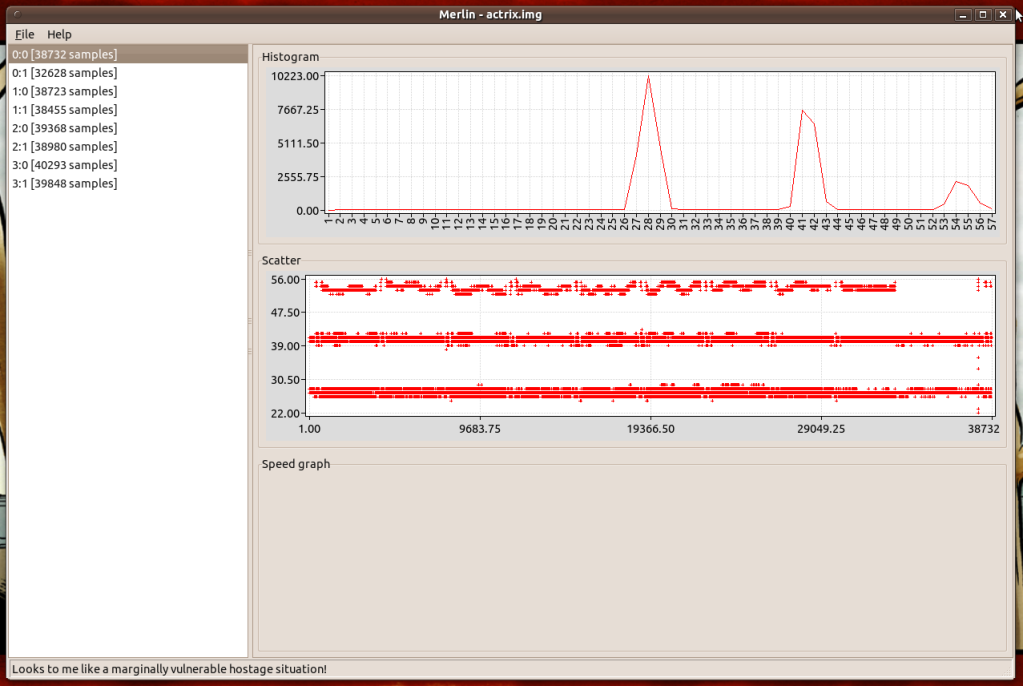
Here's a screenshot of the analysis side of the current DiscFerret
software build:
http://i162.photobucket.com/albums/t242/philpem/Screenshot-1.png
At the moment, I've got it reading IMG files (the format of some disc
images Chuck Guzis sent me a while back). CWI files are next on the hit
list (another one of Chuck's file formats) and then DFI files (the
DiscFerret native raw image format).
The GUI was built with wxWidgets, and in theory the code is completely
cross-platform compatible. I'm aware of wxWidgets backends for GTK, Mac
Cocoa/Carbon and Windows, so that covers all the major *nixes, OS X and
Windows. As long as you have a half-way decent C++ compiler, that is
(*cough* GCC). However: I will openly admit that the code has only been
tested on Linux.
It slows down to an absolute crawl (~60 seconds refresh time) if you
turn anti-aliasing on... though I suppose that's to be expected when you
ask it to plot 30-odd thousand data points on a scatter chart...
The raw-reader app is working too -- I can specify the various
parameters of a disc drive, and do a full track-by-track read of an
entire disc, and dump the data into a file. Next on the 'add list' is
DFI support (so the analyser can read it, of course!) then disc-format
script support.
Effectively, I want a tool which can be told what type of drive is in
use, what disc format, and will automatically figure out whether
double-stepping is needed, and what read parameters to use. Even to the
point where it'll warn you if you specify a 100tpi format and a 96 or
48tpi drive... Built in sanity checking :)
Which now brings us onto naming -- the reader app currently calls itself
"discferret-read", and the analyser "Merlin". Can anyone think of better
names for these, or should I be lazy leave them as-is?
(Suggestions on an email to the usual address please!)
At this point the reader app is close to releasable (involving maybe a
few more weeks of work assuming I find a ready supply of Round Tuits),
but the analyser needs a lot more work. Mainly because I seem to be
spending a lot of time chasing mismatched-free bugs in the algorithms.
Thank $DEITY for Valgrind (and a great big sarcastic "gee, *thanks
guys*" to the GTK developers who have obviously never heard of it, much
less used it on their own code...)
Cheers,
--
Phil.
classiccmp at philpem.me.uk
http://www.philpem.me.uk/
> On 4/24/11 10:04 AM, Tony Duell wrote:
>>
>> There are quite a few PDP8 owners/enthiasts here. I've got an 8/e with
>> 32K words of core, ?RX01, TU56 and PC04 on my desk. I've also got an 8/a
>> upstairs somewhere, but it's got the 8/e CPU board set in it, not the
>> hex-height 8/a CPU board. I am told that was a stnadard variant.
We (RICM) have an 8/I with 5x TU55 drives, a pair of bare 8/L, and a
very functional 8/S that now runs FOCAL.
I can give plenty of advice on ferroresonant power supply capacitors.
Advice is easy to supply.
--
Michael Thompson
Tom, I'm very sorry to hear your dad passed away. That's a hard lesson for
us all that the real classics are people, and they can't be replaced.
I would love to see all the machines and parts you have collected over the
years but I am a million miles away and had a recent personal "economic
downturn" that leaves me happy to have a roof and a piece of bread.
Good luck to you and your mom and I hope whatever else you have to part
with won't hurt nearly as much.
--
+---------------------------------------+--------------------------------+
| Vintage Coder America Online Com | Collecting software and doc |
| ivagntrpbqre at nby.pbz <ROT13> | for S/360 through OS/390 |
|---------------------------------------+--------------------------------|
| Powered by Slackware 64 & Solaris 10 | Powered by Hercules |
|=======================================+================================|
| PGP Key 4096R 0x1CB84BEFC73ACB32 Encrypted email preferred |
| PGP Fingerprint 5C1C 3AEB A7B2 E6F7 34A0 2870 1CB8 4BEF C73A CB32 |
+------------------------------------------------------------------------+
> Date: Wed, 4 May 2011 21:36:32 EDT
> From: JHMcCarthy at aol.com
> Subject: Re: Drive Type International Memories, Inc. (IMI) 5012H
> To: cctech at classiccmp.org
> Message-ID: <c892a.3319ecda.3af35920 at aol.com>
> Content-Type: text/plain; charset="US-ASCII"
>
> Just a historical question. I have a 10 MB IMI drive that was going to
> be
> used in the IBM PC-XT back in 1983. Is IMI still in existence? Was it
> located in Oregon in 1983? --- Jud
>
> Justin (Jud) McCarthy
> 251 SW 9th Ave
> Boca Raton, FL 33486
> Home (561)391-1422 Cell: (561)504-7048
> jhmccarthy at aol.com
The IMI 10 MB was never used in the IBM PC/XT; IBM's suppliers were Seagate,
MiniScribe and CMI. The IMI drive was likely used in clones.
CMI is most famous for its exclusive contract to supply the PC/AT drives
which then almost sunk the AT due to their high apparent failure rate. If
anyone has a copy of the Core International advertisement offering to build
a breakwater at Boca with trade-ins I'd love a copy.
Only Seagate survived.
Tom
Just a historical question. I have a 10 MB IMI drive that was going to be
used in the IBM PC-XT back in 1983. Is IMI still in existence? Was it
located in Oregon in 1983? --- Jud
Justin (Jud) McCarthy
251 SW 9th Ave
Boca Raton, FL 33486
Home (561)391-1422 Cell: (561)504-7048
jhmccarthy at aol.com
Having been given, some time ago, 2 8/L core memory stacks to test and then sell, I set about and fired up my 8/L. This 8/L was bought some years ago for around 500 USD, in known working condition. Try this today....
The memory tests revelead that one stack was nearly OK, the other was seriously sick.
The nearly OK one was 99.9% OK, but bit 0 @ address 0 was stuck. I intended to live with that, until it was pointed out on classiccmp that address 0 is very essential indeed....
I decided to take the plunge and tried to repair the memories.
The sick module was checked out first. Result : around 20 of the select diodes were either shorted, or open ciruit. Further tests show that the coremats themselves were also sick : resistence of sense and inhibit wires varied widely ( normal values are around 19 ohms vor inhibit, 24 ohms for sense wires ). Select wires were all OK.
So the stack, made by Dataram, was opened by cutting through 128 wires and separating the upper diode board from the stack. Then the microscope was fired up and I produced some pictures :
An overview of the coremat :
ftp://jdreesen.dyndns.org/ftp/Cores/coremat.jpg
Strange to find was a whole bunch of very small cupper wire remains, which where below some lacquer, which means they must have been there since the beginning :
ftp://jdreesen.dyndns.org/ftp/Cores/wire_remains.jpg
A whole bunch of repairs, covered by some gunk was found. These also were made during production. They were present only on the sense and inhibit wires :
ftp://jdreesen.dyndns.org/ftp/Cores/old_repair.jpg
Wait a minute : only on the sense and inhibit wires? which where also the wires with the variables resistance ?
So I took out the smallest tip SMD iron I could find and started resoldering these old repairs. See
ftp://jdreesen.dyndns.org/ftp/Cores/new_repair.jpgftp://jdreesen.dyndns.org/ftp/Cores/new_repair2.jpgftp://jdreesen.dyndns.org/ftp/Cores/new_repair_3.jpg
And yes, with each repair one more sense or inhibit wire was OK. Yes ! Good !
Until, with one of the last repairs, the inhibit wire broke, some few mm inside the coremat...
ftp://jdreesen.dyndns.org/ftp/Cores/broken_inhibit.jpg
In this picture you can seen the green select wire in the middle, which no longer has an accompaning inhibit wire.
The other core lines still have the inhibit wire, in parallel with the select line.
Major bugger, since the inhibit line is the lowest of the four wires in each core....
I attempted repair by trying to pull out the whole inihibit wire from that line of cores, only to have it break in several more places....
Endgame for this particular stack.....
... and some weeks later i did open the other stack, made by Fabritek.
First impression was much better than the Dataram stack, no loose copper wire segments, the pic shows it all :
ftp://jdreesen.dyndns.org/ftp/Cores/coremat_ft.jpg
Also far fewer repairs on this one, and much better organized : instead of just soldering the wire-ends together, the wires are soldered together in some spare PCB holes that are sprinkled about the area for that purpose.
ftp://jdreesen.dyndns.org/ftp/Cores/wire_hole.jpgftp://jdreesen.dyndns.org/ftp/Cores/wire_hole2.jpg
The reason of the stack failure was soon apparant, see :
ftp://jdreesen.dyndns.org/ftp/Cores/core_broken_ov_ft.jpg
In even greater detail the broken core can be seen here :
ftp://jdreesen.dyndns.org/ftp/Cores/core_broken_ft.jpgftp://jdreesen.dyndns.org/ftp/Cores/core_broken2_ft.jpg
I strongly suspect mechanical stresses are biggest in the corner, which I assume is why this particulare core was broken. But since this core is situated in the coremat corner, surely a repair must be possible ?
I started with cleaning out the remains of the wires that connect the coremat-pcb with the diodeboard.
And yes it had to happen : a small shift of the soldering iron, and one select line was broken...
ftp://jdreesen.dyndns.org/ftp/Cores/omg.jpgftp://jdreesen.dyndns.org/ftp/Cores/omg2.jpg
Luckily it was outside the stack, so the wire could be repaired
ftp://jdreesen.dyndns.org/ftp/Cores/omg_repaired.jpg
Then I took some individual cores from the Dataram mat, here they are, with a small piece of flatcable for size comparison :
ftp://jdreesen.dyndns.org/ftp/Cores/cores.jpgftp://jdreesen.dyndns.org/ftp/Cores/cores2.jpgftp://jdreesen.dyndns.org/ftp/Cores/cores3.jpg
This is the overal location of the broken core repair, the mat edge, with x/y select and sense/inhibit wires.
ftp://jdreesen.dyndns.org/ftp/Cores/pcb_edge.jpgftp://jdreesen.dyndns.org/ftp/Cores/pcb_edge_2.jpgftp://jdreesen.dyndns.org/ftp/Cores/pcb_edge_3_ft.jpg
So first the X select line was opened, a core was inserted, and the select line soldered in again. See :
ftp://jdreesen.dyndns.org/ftp/Cores/inhibit2.jpg
Next line was the inhibit line, the picture also clearly shows the old, broken, core
ftp://jdreesen.dyndns.org/ftp/Cores/inhinit_mounted.jpg
And the sense and Y select wires were routed through :
ftp://jdreesen.dyndns.org/ftp/Cores/repair_full.jpgftp://jdreesen.dyndns.org/ftp/Cores/repair_full_close.jpg
Select, sense and inhibit wires where then measured and found to be OK. I was astonished to find that the Cu-wires on this stack were considerably less brittle than the ones of the Dataram stack, although visually they are the same.
Pending a company move, the whole setup was now set away for a few weeks.
In the new lab I set about reassembling the stack.
Which is when disaster struck ... The new magnifying glass setup was unstable and landed where it could cause maximal damage : the coremat itself, with around 40 cores broken........
Major major bummer, and really only myself to blame. Not only was the stack now lost, but I also now cannot produce evidence that the core repair worked.
So in conclusion : can core memory stacks be repaired ?
Potentially yes, but it is every bit as difficult as you would expect, and only certains failure modes are repairable. In the 8L stack an additional difficulty is the way the stack is build up with 128 wires to be snipped, 128 holes to be cleaned and to be rewired, all without damaging the cores.
So i now have 2 stacks, one Fabritek, one Dataram, both opened. Mechanical differences prevent building one good stack from the two damaged ones.
The Fabritek has two known good coremat-pcb's, the Dataram has two potentially good coremat PCB's.
I have spent rather too much time on this, and am open to offers on these stacks, in the condition described above.
If someone wants to sell their known-defective 8L / 8I Dataram/Fabritek corestacks, I would also be interested.
Jos Dreesen
Sorry if this system is still off topic...
I have a full set of guts for the 2-CPU version of the Digital AlphaServer
4100. No CPUs, no memory, no expansion boards, no fans, no PSUs, no disks,
but all the other parts that could be removed, down to the little metal
clips that make an electrical connection between the case and the cover.
http://alexeyt.freeshell.org/AS4100_parts.jpg
Here's what happened: I got 2 of incomplete systems in the early 2000s,
and put them away to play with 'later'. Then I had to move, so I decided I
could keep just one. I took out everything in the less complete system
that could be removed, and boxed it up. The more complete one went in the
basement of the new house. Fast forward 2 years or so: there's a flood in
the basement, and the 'good' AS4100 dies under a foot of water :-( By the
time the basement dried out enough to get to it, it was so rusted I was
unable to open the case. It did, however, save the lives of a half-dozen
other machines that were stacked on top of it.
For some reason I kept hanging on to the box of spare parts... I have no
way of using these, so I figure I sould give them to someone who can.
They're yours for the cost of shipping from 27606; it's about 5-6 pounds
all told (I'm guessing, I don't have a scale).
Alexey
>From Myles Swift:
"Please do post it on the Classic list. I have some other items to
sell as well - 8 inch external floppy drive, 2 Kaypro 10s, one is #49
>from the first run that I pre-ordered. I also have an original IBM PC
with a Tall Trees card and a 5 MB CDC hard drive with the lock bar. I
have an ATR-8000. That ATR was the first unit with a programmable
floppy controller so you could burn floppies for different systems. I
think it was designed as an Atari add-on device. That business died
when Kaypro included Uniform to perform that function. I also have a
Compaq 386, the one that really put Compaq into high gear.
I figured I would try offering the heavy stuff locally first before
going to ebay. You can forward this list of items to see if anyone on
the Classic list is interested. "
He also has a Cipher F880 1/2" drive with Cipher S100 controller
card. He also says that he's looking for a Pertec Interface Q-bus
card.
Contact Myles at mswift "at" computerassistance.com.
Cheers,
Chuck
On Tue, Apr 26, 2011 at 7:34 PM, Michael Thompson
<michael.99.thompson at gmail.com> wrote:
> We (RICM) have an 8/I with 5x TU55 drives, a pair of bare 8/L, and a
> very functional 8/S that now runs FOCAL.
Did you have to do any work on that -8/S? I have one that needs a lot
of replacement bulbs and some sleuthing in the "lock" circuit (the
switch is fine, but the machine behaves as if it's always in "lock"
mode). I've done lots of work on M-series machines like the -8/L and
-8/i (it's where I got my start with 12 bits), but virtually no
debugging of the older logic. I built a simple M-series FLIP-CHIP
tester with a DEC backplane socket and an 6821 PIA, but it was
straightforward to abstract different arrangements of inputs and
outputs for different modules. I haven't done the homework to see how
many types of R/S-series modules are used in a Straight-8 or -8/S, so
I'm not even sure how difficult it would be to make a comparable logic
tester. I'd like to automate the testing to the point where I could
at least plug in a suspect module and either flip some switches or
type some commands to exercise the inputs and monitor the outputs -
yes, one can debug pre-TTL machines with a lot of clip leads and an
oscilloscope, but I'd like to abstract that one level to see what
boards need detailed attention.
Has anyone ever considered building an automated or semi-automated
R/S-Series module tester? Did it get further than musings and
drawings?
-ethan
>
> If I am not mistaken, the chopper transistor you are referring to is Q1
> (p88). I checked the resistance with the component still soldered onto the
Correct.
> board. Looking at it from the front (with a plate behind connected to what
> looks like a diode), the resistance between the middle and the left pin
was
> 170Kohm (or 1Mohm, the multimeter scaling confuses me somewhat, I get
> different numbers depending on whether I put the dial on 200K or 2M,
either
Well, it's not totally shorted, then, which is the common failure mode of
chopper transistors.
Does your meter have a 'diode check' range? If so, use that, and check the
base-emitter and base-collector junctions with the probes both ways round.
This will at least tell you if the junctions are good. You really need to
remove the transistor from the PCB to test it, though.
But perhaps before that we should check a few more things. The chopper
circuit
is driven by E2 (p88), a good ol' 555 timer wired as an astable. For this to
work, it needs to be gettign power. This power comes from one of two places
:
When the supply is running, it comes from T1 on the PSU motherboard, via
pins
7 and H of the connector and diode D7 (p88).
At start-up it comes from the mid-point of the mains smoothing capacitors
via
pins 2 and B and Q6 (p88). The base of Q6 is driven from the network R2
and D2
(p82). You should check the power resistors on the motherboard, actually,
R1, R2 and R3 (p82).
Now obviously the first can't be doing anything since the supply is not
running. But the second source should be there. You should measure the
supply voltage at pin 8 of E2 _with respect to pin 1 of E2_. That is, the
black meter probe is connected to pin 1 of E2, the red one to pin 8 of the
same IC. Be warned that this circuitry is directly connected to the mains,
and will have _lethal_ voltages on it with repect to ground. So connect the
wires, make sure they can't touch anything, then plug the machine in and
see
what voltage you get. Unplug the mains and wait for things to discharge
before
touching anything.
-tony
--------------------------------------------------------------------
mail2web - Check your email from the web at
http://link.mail2web.com/mail2web
I've seen several mentions on here of folks using LJ5 printers... I recently
acquired as part of a govt auction, a C3768A Lj5 SI paper handler board and a
Token Ring Jetdirect card with Lj5SI drivers for several O/Ss. Status is
unknown although they *look* unused in original boxes. Anyone interested can
have them for postage from 95006 (I suspect they would fit a medium flat rate
box).
Steve
>> Is it really the knowledge that's fading away or the technique?
>>
>> I mean, seriously, there is nothing complicated about core planes.
>> Its a bunch of toroids with wires strung through them.
>
> Tricks of the trade that make the job easier.
>
> One of the better known tricks it to pull apart a wire to be strung
> though a line of cores, rather than cutting it normally, so you get a
> little bit of a needle like tapered end on the wire.
One odd thing about these attitudes we have, is that we're almost all male and the folks
who did and understood the work and improved the techniques were almost exclusively female.
It's sort of like the boatanchor radio groups where we have men lecturing other men
as to how to lace cables or properly wrap a wire around a lug before soldering.
The women who actually did the work would laugh at all of us :-). I know they laughed
at me and other male techies (anywhere from undergrads to professional machinists to
full professors!) who sometimes attempted these sorts of tasks!
Tim.
A friend of mine (who's been trying to join this list!) needs help
rescuing something from the Berkeley California area. Contact him
privately at ark72axow at msn.com.
I hate to keep posting sad news .... but there is more .... Rick Hanson,
the owner of Club100.org, died of of cancer this weekend. Rick was an
incredible asset and friend to the Model 100/102/200 community.
----- Original Message -----
> Date: Mon, 02 May 2011 21:31:01 +0200
> From: Jos Dreesen <jdr_use at bluewin.ch>
> Subject: 8/L core memories ( long, with pic's, hopefully of interest )
> To: General Discussion: On-Topic and Off-Topic Posts
> <cctalk at classiccmp.org>
> Message-ID: <4DBF0675.9000301 at bluewin.ch>
> Content-Type: text/plain; charset=ISO-8859-1; format=flowed
>
<snip>
> Pending a company move, the whole setup was now set away for a few weeks.
> In the new lab I set about reassembling the stack.
>
> Which is when disaster struck ... The new magnifying glass setup was
> unstable and landed where it could cause maximal damage : the coremat
> itself, with around 40 cores broken........
>
> Major major bummer, and really only myself to blame. Not only was the
> stack now lost, but I also now cannot produce evidence that the core
> repair worked.
>
I feel your pain; all that tedious work and then... (a few similar T-shirts
in my wardrobe ;-) )
> The Fabritek has two known good coremat-pcb's, the Dataram has two
> potentially good coremat PCB's.
> I have spent rather too much time on this, and am open to offers on these
> stacks, in the condition described above.
>
> If someone wants to sell their known-defective 8L / 8I Dataram/Fabritek
> corestacks, I would also be interested.
>
>
> Jos Dreesen
No idea if they're useful or compatible, but I have a damaged MDS core board
and a jar of new loose cores in two sizes somewhere, in case you or anyone
else is insane enough to consider repairing those boards.
mike
> Dies tguis just miove the head up and down, or does it also move it from
> side to side. I am wondering if it's there to adjust the depth of
> engagement between the rack and pinion.
It moves the heads in an arc around the rack and pinion as a pivot point. The engagement of the pinion does not seem to be adjustable. The motor can be rotated but not shifted radially as far as I can see. Also the track 0 sensor is adjustable.
/Jonas
CC folks, I have a friend who is looking for a copy of Processor
Technology's DISKT, their program for exercising the Helios disk
drive, anyone have that out there?
bruce damer
At 12:00 -0500 5/3/11, Jos wrote:
>Major major bummer, and really only myself to blame. Not only was
>the stack now lost, but I also now cannot produce evidence that the
>core repair worked.
Jos,
you must have felt terrible. I'm really sorry that happened,
but I'm awe-struck at the work you put in investigating and repairing
that far, to say nothing of photo-documenting the whole way as you
went. That was a great job, and I very much appreciate the post.
Thank you most kindly! You deserved a much better outcome.
On the broken cores, hm ... do the same places that glue logic also glue cores?
:-)
--
- Mark 210-379-4635
-----------------------------------------------------------------------
Large Asteroids headed toward planets
inhabited by beings that don't have
technology adequate to stop them:
Think of it as Evolution in Fast-Forward.
This message has been forwarded from Usenet. To reply to the
original author, use the email address from the forwarded message.
Date: Sun, 17 Apr 2011 11:35:24 +0200
Groups: alt.folklore.computers,de.alt.folklore.computer,alt.sys.pdp11
From: =?ISO-8859-15?Q?J=F6rg_Hoppe?= <j_hoppe at t-online.de>
Org: albasani.net
Subject: PDP11GUI: Home page has moved
Id: <ioec8s$gro$1 at news.albasani.net>
========
Home page and online doc of PDP11GUI have moved to
www.retrocmp.com/tools/pdp11gui
The download is an attachement now.
The old page is still alive, but will disappear without further notice.
Enjoy!
Joerg Hoppe
Hi guys,
Does anyone happen to have a working version of news124f1.tgz from the
UTZOO Usenet / NetNews archive set?
Part of it is currently available from
<http://www.skrenta.com/rt/utzoo-usenet/>, but the above file is
damaged, and all the .toc files are missing... here's what you get if
you try and decompress the file:
tar: Unexpected EOF in archive
tar: Error is not recoverable: exiting now
'Nuff said really... if anyone knows of an alternative source for these
files (ideally one which has the complete 124F1 file), please let me know!
Thanks,
--
Phil.
classiccmp at philpem.me.uk
http://www.philpem.me.uk/
Hi guys,
I'm going to stick my neck out a bit, and assume you all saw the
screenshots I posted this week. If you didn't, well... you missed a treat :)
I've just committed the current "development alpha" of the DiscFerret
software to the DiscFerret Mercurial repository. You can access the
files at the following address:
http://hg.discferret.com/software/merlin/
Hit the "zip," "gz" or "bz2" link on the top toolbar and you can
download a ZIP, tar-gzip or tar-bzip2 file containing all the current
source files.
At the moment, I've only tested Merlin on Linux (specifically, Ubuntu
10.10 "Maverick Meerkat"), although *in theory* it should also build on
the various BSDs and Mac OS X, as long as you have a working copy of the
GCC C++ compiler, and the wxWidgets libraries for your system (note that
'wx-config' must be on the PATH).
At the moment, it'll only read "Catweasel IMG" files. These are
basically dumps of the Catweasel data buffer, sampled at 28MHz, in the
following format:
File := 1 or more "Track" blocks
Track :=
uchar cylinder // physical cylinder (track)
uchar head // physical head (side)
uint32le payload_length
uchar[] payload // length specified by payload_length
uchar = unsigned char, an 8 bit unsigned value
uint32le = unsigned integer, 32 bit, little endian.
Data is exactly as extracted from the Catweasel memory; 28MHz clock
rate, index in the MSbit, bits 6..0 contain the timing value.
Please feel free to post your comments on-list, or email me in private
if you prefer.
Thanks,
--
Phil.
classiccmp at philpem.me.uk
http://www.philpem.me.uk/
At 19:06 -0500 4/29/11, cctalk-request at classiccmp.org wrote:
>...The other side to this is that unless you show kids how do fun things,
>they will have a go on their own. Possibly with things that are a lot
>more dangereous than a car battery and lead.
Oh yes! My kids have done archery, rock climbing, sailing (with
*lots* of wind), bicycling (on public roads), snorkeling in the
ocean, model rocketry, etc. etc. etc. with my encouragement and
supervision. Lots of warnings, but (hopefully) lots of fun, too.
At 19:06 -0500 4/29/11, ard wrote:
>...I think I've expressed this view before... Everything has some risks
>associated with it, even getting out of bed in the morning. So I could
>either spend my life lying in bed and die of boredom or I can get on with
>what I enjoy, even though there are some dangers in doing so. I'll take
>sensible precaustions (not drinking the electrolyte as it may contain
>heavy metal ions, not eating solder, making sure high voltage devices are
>isolated and discharged before I work on them, etc). My life will
>probably be shorter doing that, but it will be a lot more enjoyable which
>would seem to be the important thing.
I agree almost completely with this. My one provisio is that I'm much
more likely to take risks when I (think I) understand them and know
how to minimize or control them. There's a lot of chemistry and
biochemistry that's not in that category for me, so I'm more cowardly
there.
At 5:03 -0500 4/29/11, Grumpy Ol' Fred wrote:
>It has a radio that can be used while working,
While my '68 Plymouth 12V bench supply appreciates the compliment,
it's not warranted. The AM radio came out in the '80s, and was
replaced by an AM-FM-Cassette which subsequently failed. Wish I'd
kept the AM radio...
But Fred left off one of the most important auxiliary functions! It
can also function as a dolly for moving computer cabinets around the
workshop at speeds up to ~100 mph (well, OSHA-type regulations
notwithstanding...)!
--
- Mark 210-379-4635
-----------------------------------------------------------------------
Large Asteroids headed toward planets
inhabited by beings that don't have
technology adequate to stop them:
Think of it as Evolution in Fast-Forward.
Hello everyone,
Looks like Canadian Government Surplus has a large pile of old radar items
including a DG Eclipse S/230 system and some version of a Nova. In the
picture you can see these items along with a number of large disks and a lot
of documentation.
Auction closes a couple of days from now and I'm in Canada but 3000 miles
away from it.
The pile is in Ucluelet BC.
Heres a link:
If you can't get right to the item, just use the search term "radar".
http://crownassets.pwgsc.gc.ca/mn-eng.cfm?snc=wfsav&sc=enc-bid&scn=69424&lcn
=213328&lct=L&srchtype=&so=ASC&sf=ferm-clos&lci=&str=1<nf=1&test=1
Hi,
I'm restoring an IBM 3340-A2 winchester disk drive that is part of our
new IBM 4331 system[1]; so far so good. It still needs some cleaning and
visual inspection; it was incredibly dirty (I've even found a mouse trap
inside on top of the air filter housing!) but looks fine otherwise. We
also have almost all manuals for the system, except one for the 3340: the
first of six volumes, i.e. volume R01 that contains the sections INDEX,
MLX, LGND, START, FSI, MSG, SENSE, OLT and OPER. All other manuals will be
scanned bit by bit and put on our FTP server.
Question: does anybody have that manual? I'd be interested in a scan; i
can then put it online if desired.
Christian
[1] The system consists of a 4331-2, four 3278 terminals including
console, a 3287 matrix printer, a 3262 steel band printer, a 8809 tape
drive, and a string of one 3340-A2 and one 3344-B2 drive. There were also
several 3370 drives that went to the nearby IBM museum.
>
>By necessity: any retelling of 80's era networking will have so much
>source information available from UUCP mapping projects and Usenet
>and mailing lists, than any other more closed sections of the network.
>(BITNET and later NSFNet are also up there in terms of preserved
>message/map volume but by no means as huge).
>
Where are the preserved BITNET maps to be found? I went looking for BITNET
topography related material a few months ago and found only a few examples.
One of the people I contacted recently came back to me with a stash of files
previously thought to be lost but I would be pleasantly surprised to know if
there is more material out there.
Regards,
Peter Coghlan.
>
>What OS is it supposed to be
>running (the starting host seems to be a sort of hybrid of TOPS-10,
>Unix and VM/CMS)?
>
What bit is like VM/CMS? - I've never come across anything else that
reminds me of VM/CMS to any degree :-)
Regards,
Peter Coghlan.
> BTW, anyone looking for a good sunday talk?
>
> Incredible I have no one from this list on MSN. If you're looking for
> some chatting, add webmaster at pinball-taito.com.br to your MSN and lets
> have a bit of talking :D
>
> Boring day...
>
> Greetings from Brazil
> Alexandre Souza, PU1BZZ
Maybe somebody should set up an irc channel on freenode if there isn't one
already...that sounds like a good idea to me!
>
> I will add some diagnostic wires to the board as you suggest, I don't
> remember a lot about TTL chips, is there a convention about which are the
> power pins?
>
> In the meantime someone else told me that the click I would hear when
> connecting to the mains (before switching it on with the key) was some
kind
> of relay. I don't hear that anymore, would that help to isolate the
problem
> at all?
OK, I am looking at the schemaitcs... I will take the referenes from this
manual on bitsavers, since I guess we all have access to it.
http://www.bitsavers.org/pdf/dec/pdp11/1124/MP01018_1124schem_Aug80.pdf
This is a complex PSU, and it is not obvious at first sight what is going
on,
but I will try... I will put page references (to that PDF) in brackets.
The relay is K1 (p70). It shorts out a soft-start resistor in series with
the
input to the mains bridge rectifier. This produces 350V across C1/C2 in
series.
Now much of the PSU circuitry runs off a little SMPSU. The chopper
transformer is T1 (p82). It provides about 12V across C3 (p82).
Now we need to look at the 'Bias and Interface Board'. The relay is driven
by
E4 (p86). It's essentially a 'mains OK' circuit, the relay is energised when
the votlage across the mains smoothing capacitors is high enough to trigger
E3a. E3a is on the mains side of the isolation barrier, of course. But the
relay driver (E4) is powered from a signal called '+5V'. This is not the +5V
that you're expecting. It comes from the 7805 regulator E1 (p87). The input
to that comes from that little SMPSU I've been talking about. This is
isolated
>from the mains.
The control circuitry for that is on page 88. Be warned that this circuitry
is
NOT isolated from the mains. It's a relatively conventional SMPSU with the
control circuitry powered straight from the mains. Q1 (p88) is the chopper
transistor.
So, if everything's working right, this SMPSU starts up when you apply
mains
to the machine, the 'mains OK' circuit triggers and the relay pulls in.
I would start by checking that '5V' supply, remember it's not the one to
the
backplane. Check it at the output of E1, for example. If it's missing, as I
think it will be, you need to sort out the SMPSU I've been talking about.
But
let's find out if you need to do that.
-tony
Regards
Rob
--------------------------------------------------------------------
mail2web.com ? What can On Demand Business Solutions do for you?
http://link.mail2web.com/Business/SharePoint