Content-Description: Notification
This is the mail system at host bmail.freibergnet.de.
I'm sorry to have to inform you that your message could not
be delivered to one or more recipients. It's attached below.
For further assistance, please send mail to postmaster.
If you do so, please include this problem report. You can
delete your own text from the attached returned message.
The mail system
<cctlak at classiccmp.org>: host mx1.ezwind.net[199.188.211.138] said: 550 5.7.1
<cctlak at classiccmp.org>... server [172.20.1.51] for <cctlak at classiccmp.org>
rejected address saying "<cctlak at classiccmp.org>... User unknown" (in reply
to RCPT TO command)
Content-Description: Delivery report
Reporting-MTA: dns; bmail.freibergnet.de
X-Postfix-Queue-ID: 8BFB4929B02C
X-Postfix-Sender: rfc822; holm at freibergnet.de
Arrival-Date: Wed, 15 Jan 2014 20:24:06 +0100 (CET)
Final-Recipient: rfc822; cctlak at classiccmp.org
Original-Recipient: rfc822;cctlak at classiccmp.org
Action: failed
Status: 5.7.1
Remote-MTA: dns; mx1.ezwind.net
Diagnostic-Code: smtp; 550 5.7.1 <cctlak at classiccmp.org>... server
[172.20.1.51] for <cctlak at classiccmp.org> rejected address saying
"<cctlak at classiccmp.org>... User unknown"
Content-Description: Undelivered Message
X-Virus-Scanned: amavisd-new at freibergnet.de
Date: Wed, 15 Jan 2014 20:24:00 +0100
From: Holm Tiffe <holm at freibergnet.de>
To: cctlak at classiccmp.org
Subject: Longshine LCS-6610F REV C FDC, Jumpersettings needed
Reply-To: holm at freibergnet.de
User-Agent: Mutt/1.4.2.3i
Organization: FreibergNet Internet Services, TSHT
Priority: normal
X-Phone: +49-3731-74222
X-Mobile: +49-172-8790741
X-Fax: +49-3731-74200
Hi all,
the Suject already tells what Im looking for.
I have an XT Floppy Controller for an 8 Bit Slot that his it's own Bios
Chip.
There is a description on TH99, but this is a different Version, the
Jumpers are located totally different.
The Label on the PCB of my Controller is "LCS-6610F REV:C".
Has someone a Manual with the correct Jumper settings?
Kind Regards,
Holm
--
Technik Service u. Handel Tiffe, www.tsht.de, Holm Tiffe,
Freiberger Stra?e 42, 09600 Obersch?na, USt-Id: DE253710583
www.tsht.de, info at tsht.de, Fax +49 3731 74200, Mobil: 0172 8790 741
> Message: 21
> Date: Wed, 15 Jan 2014 06:37:59 -0500
> From: Bob Vines <bobvines00 at gmail.com>
> To: cctech at classiccmp.org
> Subject: Re: Restoration of a PDP-8a
> Message-ID:
> <CAPDUT-=Vd2iYTC=u97rjnr5O=Hk1wv+Ltpf9uKphABWNzdOi7g at mail.gmail.com>
> Content-Type: text/plain; charset=ISO-8859-1
>
> ------------------------------
>>
>> Message: 12
>> Date: Tue, 14 Jan 2014 10:24:57 +0000
>> From: anders at abc80.net
>> To: "General Discussion\: On-Topic Posts Only" <cctech at classiccmp.org>
>> Subject: Re: Restoration of a PDP-8a
>> Message-ID:
>> <20140114102457.Horde.jcUVy0nXMOJSjET97Z2yBA7 at blue.abc80.net>
>> Content-Type: text/plain; charset=UTF-8; format=flowed; DelSp=Yes
>>
>> Hi,
>>
>> Slowly my restoration project continues. I have repaired the power
>> supply and I actually found and bought a programmers console. I also
>> got a DKC8-A in etch revision D. I have now all the boards needed for
>> getting this machine running.
>>
>> Is the two cables between KC8 and DKC8 just two strait 40 pin cables?
>>
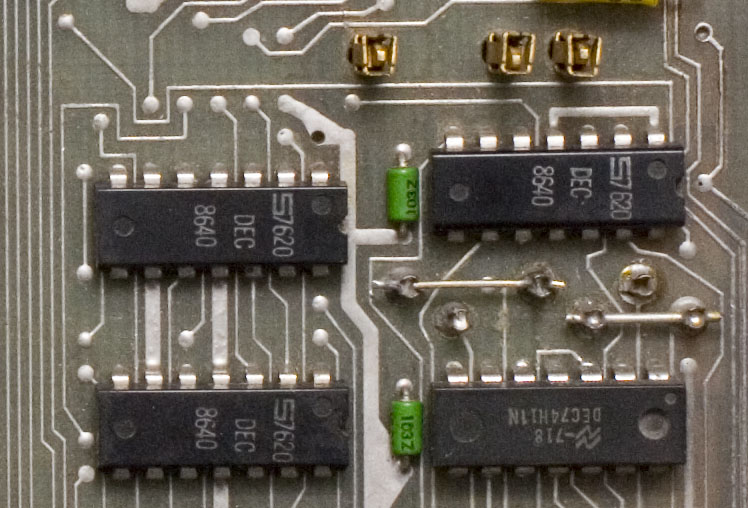
>> I have a question about memory configuration. I have two core stacks
>> from different suppliers. One from DEC and one from Dataram corp. The
>> later one is impossible to find any information on. The DEC stack is a
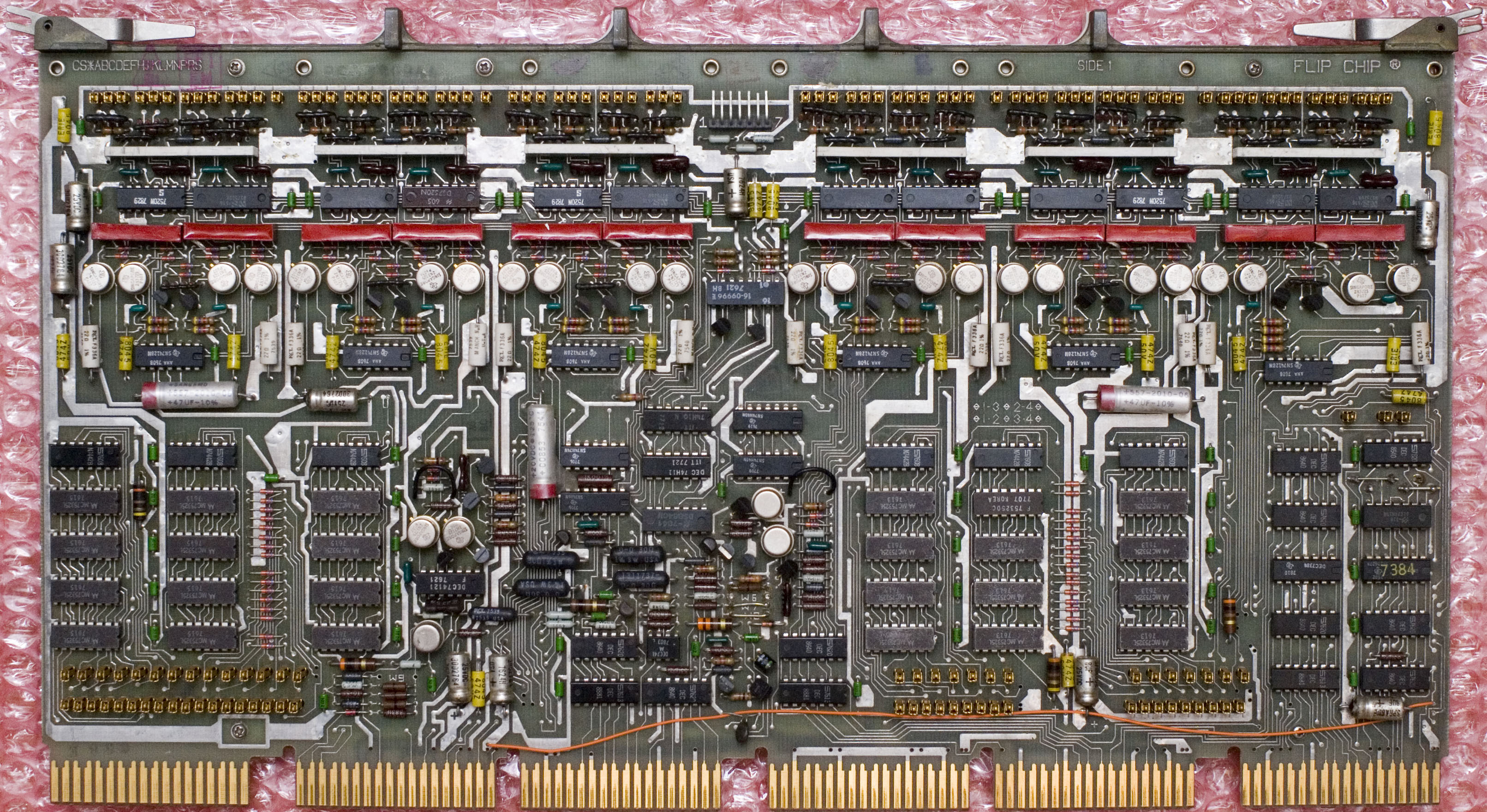
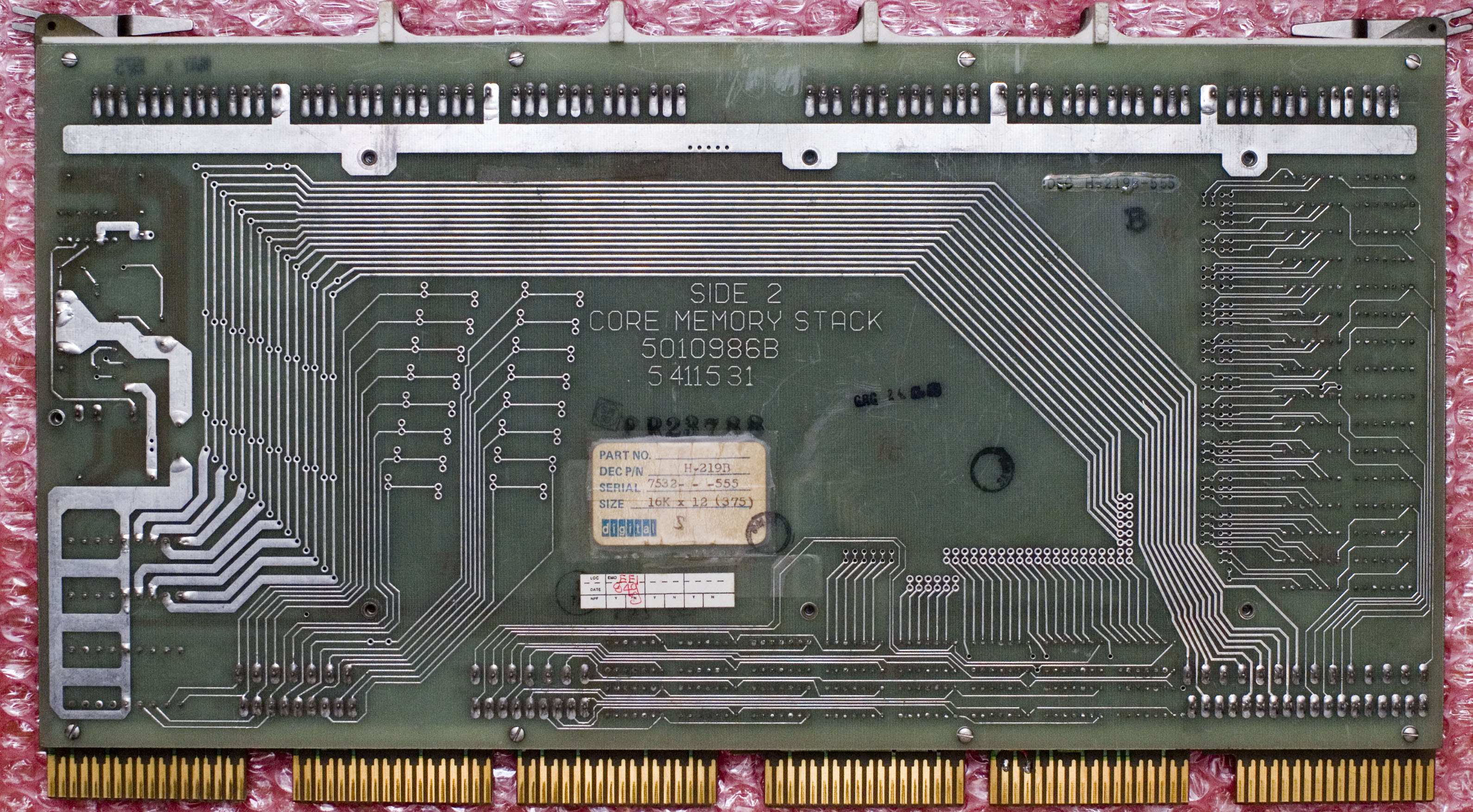
>> MM8-AB 16k module but the address field configuration looks strange.
>> If I interpreted the manual correct it's configured as a 8k module
>> using field 4-5.
>>
>> Picture of the jumpers on the actual board:
>> http://www.abc80.net/docs/pdp8/pdp8a/DSC_2258.JPG
>>
>> Pictures on the complete board on both sides.
>> http://www.abc80.net/docs/pdp8/pdp8a/DSC_2252.JPG
>> http://www.abc80.net/docs/pdp8/pdp8a/DSC_2253.JPG
>>
>> The board is known good and does not origin from this particular machine.
>>
>> Does anybody know why this looks like this?
>>
>> /Anders
>>
>
> The PDP-8/A Operator's handbook at
> http://bitsavers.informatik.uni-stuttgart.de/pdf/dec/pdp8/pdp8a/EK-8A001-OP…,
> page 3-30 states that two BC08R cables are used. The Digital Cables
> Handbook at http://www.pdp8online.com/bklatt/cables.html describe the
> BC08R on pages 30 & 31. Page 31 shows the pinout.
Great, I have missed that one.
>
> About the Dataram module: Does any of the info at
> http://bitsavers.informatik.uni-stuttgart.de/pdf/dataram/ help? Also,
> there is a Dataram company (http://www.dataram.com/) still in business
> providing computer memory products (since 1967). Have you tried to
> contact them? You might get lucky, especially if they like the idea
> of one of their "early" products still in operation after 30+ years.
>
I'll try to contact them. I have already tried bitsavers.org
> The MM8-AA & MM8-AB Engineering Specification at
> http://www.pdp8online.com/pdp8cgi/query_docs/tifftopdf.pl/pdp8prints/mm8aa.…
> shows that your jumpers are in locations 1-3 & 3-4. It then states
> that those two jumpers, in combination, will configure the module for
> memory locations 32K-48K, which it then states are "presently not
> available." But it was written in 1975. However, the 1978 KT8-A
> Memory Management Control (EK-KT08A-UG-001 at
> http://bitsavers.informatik.uni-stuttgart.de/pdf/dec/pdp8/pdp8a/EK-KT08A-UG…)
> allows an -8/A to use up to 128K of any -8/A memory type. Perhaps the
> previous user of the MM8-AB module had the KT8-A module to allow the
> use of more than 32K?
Ok. Thanks. That explains it I think.
/Anders
This is a walk down memory lane!
http://www.jcmit.com/memoryprice.htm
Cindy Croxton
Electronics Plus
1613 Water Street
Kerrville, TX 78028
(830)792-3400 phone (830)792-3404 fax
AOL IM elcpls
_____
No virus found in this message.
Checked by AVG - www.avg.com
Version: 2014.0.4259 / Virus Database: 3658/7002 - Release Date: 01/14/14
The LA120 Decwriter III manual calls for Nye type 622-00 oil for the print head support rails. I know nothing about lubricants -- I'm a programmer, after all.
Can anyone recommend a modern replacement?
From: Jules Richardson <jules.richardson99 at gmail.com>
> I've got a couple of 68008 systems. One is on a STE-bus board
I have a STD-bus 68008 card somewhere around here, which makes a certain
amount of sense. I believe it was also an OS-9 target.
KJ
Just following up one last time to say that these systems are in fact still
available, if anyone wants them. I've had a couple of inquiries on them but
neither panned out, so they're still sitting in my garage. I need the space
for a classic car that can't sit in the rain, so they won't be there
forever. I've pushed a few pictures here: http://500px.com/theodric
> Free to a good home:
>
> 2 Tandem Himalaya K200 mainframes (circa 1993, according to the date
> stamps inside), a disk array, some spare disks, two terminals, assorted
> system cabling, spare internal cards and spare internal disks.
>
> The fellow I got them from worked for NYSE Euronext, and said that they
> were used there before he acquired them through official channels after
> they were decommissioned. I have a printout of an e-mail to that effect,
> which also includes instructions for bringing them up-- something I've
> never tried to do. They take a couple C19 power cords (provided) on an 8A
> circuit [edit: standard 230V single-phase residential power], and are
> reportedly working.
> They are large (76x102x53cm) and heavy (two strong people can lift one,
> just) [edit: 205kg each; much less with all modules removed]. Location is
> Noord-Holland, Netherlands. If you're interested in collecting them or you
> are willing to arrange your own pallet collection by courier, please
> contact me off list.
>
Jeremy
>
> From: Christian Gauger-Cosgrove <captainkirk359 at gmail.com>
> Date: Tue, 14 Jan 2014 09:15:54 -0500
> Subject: DEC 18-bit Operating Systems
> So, I've been plinking around a bit with some of the operating systems
> for DEC's 18-bit machines. Specifically with DECsys-7 for the PDP-7,
> and XVM/DOS for the PDP-15.
>
> I've heard that DECsys-7 can run on the PDP-4, and in fact it
> "kind-of/sort-of" does. I'm wondering if anyone here knows how to get
> DECsys-7 working on the '4 to the point of being usable. The problem
> is that the PDP-4's console teleprinter was the 5-bit
> (ITA-2/USTTY/"Baudot") Model 28 KSR Teletype, the '7 used an ASCII
> machine (33 KSR, or 35 KSR). So the one key which is used in DECsys to
> terminate input to the text editor the delete/RUBOUT key is not
> present on the 28. So, you can't create any programs in DECsys on the
> PDP-4. There has to be something I'm missing that'll get it to work
> (surprisingly, the other key vital for using the editor in DECsys --
> the tab key -- will work by inputting the teletype's bell code).
>
>
> My next question has to do with XVM/DOS; I cannot seem to get FOCAL to
> run. The system was built to the simulator's configuration (no UC15
> UNICHANNEL, FP15, floating point, RP15, RF15, LP15, no VT15 or VP15,
> support for API), using SGEN I then tailored the system properly
> (start up with XVM and API turned on, and memory size of 128KW). I
> assigned the DAT slots needed for FOCAL:
> (-1 and -4 are already assigned by the monitor to SYA <SYS>.)
> ASSIGN SYA <CMG> 3,5,7,10
> Trying to execute FOCAL with "E FOCAL" I get an IOPS13 error ("FILE
> NOT FOUND - CAL ADDR **"), and trying it with LOAD and GLOAD I get a
> .LOAD 3 error ("SUBR NOT FOUND"). Anyone here know the magic of how to
> get FOCAL to run on XVM/DOS?
>
>
> Thanks to any who respond.
>
> Regards,
> Christian
>
> I won't be any help in the PDP-15, but I an very interested in any
software that you have that would run on a real, not simulated, mag-tape
only PDP-9.
--
Michael Thompson
On Mon, 13 Jan 2014 15:04:54 -0800, Chuck Guzis <cclist at sydex.com> wrote:
> "Apotekets fl?ckborttagningsmedel = cloth cleaning petrol, made for
> and sold by Apoteksbolaget, the swedish governments drug dealing
> entity of old"
> All petroleum fractions of varying weight. Ultra-pure (triple filtered)
> lamp oil should do as well.
>
> --Chuck
A closer equivalent/essentially the same stuff would be lighter fluid,
e.g. the Zippo stuff. Lamp oil is more like kerosene I think, longer HC
chains.
/Jonas
On 7 January 2014 21:14, Tony Duell <ard at p850ug1.demon.co.uk> wrote:
>> [ Mark Tapley ]
> > 2) I quibble with Tony?s recommendation to reject a machine that says
> > Sin(Pi) = 0. I?m pretty sure the TI says that; the quicker but
> > essentially equivalent test I always used to taunt my HP-41-equipped
> > friend was (Sqrt(2))^2. The TI said 2, the HP said 1.99999? I claim
>
> Actualyl, that is soemthing rather different.
>
> If you take a decimaly approxiamtion of SCRT(2), rount it after, say, 13
> digits, then square it and roudn the reult to 10 digits (or whatever),
> you will get 2. But if you take any finite numbero dgiits of pi,
> calculate the sin, the answer is not zeor. It's of the order of
> 10^-(numbero of digits). So even if you take 13 digits of pi, the SIN
> should not display asn zero. I suppose you could argue that if you took
> over 100 digits, the result would be zero (since a number of the order of
> 10^-100 will underflow to 0), but I doubt that the TI uses 100 digits
> anywhere.
I was thinking numerical precision the other day and recalled this
conversation; while I'm firmly in the "pry my HP(s) from my cold, dead
fingers" kind of person, I have come to the conclusion that I have to
side with Mark here.
Let me pretend I have a calculator with 2 significant digits after the
comma, so pressing \pi gives 3.14. I hit "sin". What should I get?
1.59e-3? Or 0 (0.00)?
I believe both are correct.
In this case 3.14 is a quite valid representation of \pi, since to the
calculator, 3.14 is its representation for the entire range (say)
3.135=<x<3.145. Hence, it is _allowed_ to return anything from
6.59e-3 to -3.41e-3; 0 is therefore a perfectly acceptable result (*).
What it will return is then simply a matter of the algorithm used
internally. This argument scales to any finite precision.
It's been a while that I have carefully read David Goldberg's "What
Every Computer Scientist Should Know About Floating-Point Arithmetic",
nor can I claim to have fully understood it even then. So if you can
point out the flaw in my argument, I'm happy to be shown the error of
my thinking.
Cheers,
Joachim
(*) One can argue though that one result is more educational than the
other. But I'm looking at calculators being a working tool, not an
educational tool.
...for brevity, all values computed using my Hp48 :-) ...
--
Joachim Thiemann :: http://jthiem.bitbucket.org ::
http://signalsprocessed.blogspot.com
I just dug up a shrinkwrapped set of Mac System Software, but it has
no version number.
There's a wire-bound manual and I can see by the outlines under the
cover that the software is on 3.5" floppies. The lower back cover says
"914-0520-A", which I assume is an Apple part number.
The Internet says it's System 6.0.5 for an SE/30. Can anybody verify
that, or correct it?
Pics: http://www.docsbox.net/Mac_SW/
Thanks!
Doc
Afternoon,
I have the PSU operational again.
2 +12, 1 -12, and -5V are all present.
These voltages could be wrong: (pin-wise) on J2.
Pin 6: 4.97VDC
Pin 5: GND
Pin 4: GND
Pin 3: -12.28VDC
Pin 2: about 12VDC
Pin 1: about 12VDC
+/-24VDC are both present on J4 where they should be.
The motors do not run and there is no voltage present at fuse F2 (the fuse
OTHER than the line feed one. There is +24VDC present at the line feed
one.) There is continuity between the -24V pin and the non-line-feed
motor fuse. No fuses blow.
With J2 disconnected, power draw drops from ~65W to ~42W. Several random
resistors checked (in-circuit) that should measure 540Ohms measure about
588Ohms. No LEDs light up and there is no bell. No components are
particularly warm to the touch with power removed.
Anything with this taste wrong to you? I'm completely stumped.
--
Cory Smelosky
http://gewt.net Personal stuff
http://gimme-sympathy.org Projects
It's time they went, I'm afraid.
Vintage 68020-powered Apple Macintosh LC - for spares or repair
http://www.ebay.co.uk/itm/271372079309
Vintage 68030 Apple Macintosh IIsi - for spares or repair
http://www.ebay.co.uk/itm/271372063205
Opening price 1p. In other words, as close to free as eBay will let me.
--
Liam Proven ? Profile: http://lproven.livejournal.com/profile
Email: lproven at cix.co.uk ? GMail/G+/Twitter/Flickr/Facebook: lproven
MSN: lproven at hotmail.com ? Skype/AIM/Yahoo/LinkedIn: liamproven
Tel: +44 20-8685-0498 ? Cell: +44 7939-087884
Toby,
I'm away for the holidays, but I'd love an original XT for a console to run my 5364. I might also be able to contribute a few systems your sale if it's for a good cause. I have a couple RS/6000s I could stand to offload.
--Colin
Tobias Russell <toby at pdp11.co.uk> wrote:
>Hi,
>
>I've decided to have a clear out to raise some funds for the school club I
>run teaching 7-11 year olds computer programming, electrics and engineering.
>
>So here is what I have looking for a new home:
>
>- Lots of micro-vaxes (pizza box style)
>- Lots of microVax chassis (mostly unpopulated with cards)
>- Various Apple IIs and Apple II peripherals
>- Various terminals
>- SMD drives
>- BBC micros, Spectrums and ZX81s
>- Atari 2600's (woodies, darth vaders and jr's)
>- IBM PC/XTs
>- Misc PDP-11 parts (a few QBUS chassis, RX50s, TU58s, TK50s, QBUS cards,
>UNIBUS cards, PDP-11/44, RD,RF,RZ series hard drives)
>- Lots of other assorted items
>
>If anyone is interested in anything or would like to visit and dig through
>the stash get in contact.
>
>All the best,
>Toby
>
I'm currently pulling the CIS-local code out of DECWAR in aid of installing
it on the DECsystem-1070 (KI-10 #587) running at the museum. It would be
very helpful to (1) talk to someone who programmed in Macro-10 on the CIS
systems, or (2) at least find someone with UUO and programming environment
manuals. (I don't see either CIS or CompuServe on Bitsavers, but I may be
missing something.)
Does anyone reading CCtech/CCtalk want to confess to having experience in
these matters? Privately or publicly?
Thanks,
Rich
Rich Alderson
Vintage Computing Sr. Systems Engineer
Living Computer Museum
2245 1st Avenue S
Seattle, WA 98134
mailto:RichA at LivingComputerMuseum.orghttp://www.LivingComputerMuseum.org/
>
>The ST's floppy controller is the COTS WD-1772, and that series of controllers
>was extremely popular in a lot of 8 bit machines. The 1770 is a familiar number
>to me as being the one they had to bodge into the BBC Micro because supplies of
>the controller it was designed to use had dried up.
>
Indeed. The BBC Micro originally used the 8271 which was replaced by the 1770.
>
>Its sound was basically the Yamaha AY-3, a chip that as pretty impressive for
>its time and again appeard on many eight bit machines such as the BBC Micro
>(again) and newer ZX Spectrums.
>
The BBC Micro used the 76489 for sound.
Regards,
Peter Coghlan.
I bought a cheap USB to ATA/ATAPI bridge a while back and have had a good
bit of luck connecting various IDE drives to my laptop for imaging
purposes. However, I have a few drives that simply won't mount under
Windows or OS X, despite being detected by the Device Manager in the case
of Windows. It seems to be narrowed down to the smaller drives, like under
2 GB or so. For instance, I have a Maxtor 7213AT 210 MB drive that won't
mount, although an 80 GB Seagate has no trouble at all. The Maxtor is a
known-good, bootable MS-DOS 6.22 drive. Has anyone encountered this?
Besides connecting it to a motherboard with built-in IDE, are there
workarounds?
Thanks,
Kyle
I'm sure many of you reuse medicine bottles for keeping small things like
fasteners, passive electronic components, etc. I'm sure you also will
throw away lots of bottles rather than peeling off the labels because the
process can be slow and leave messy partially-delaminated paper, and
stickum all over. Here's something I learned recently from my pharmacist:
A prescription label will come off cleanly if you try to take it off
within a couple days after being stuck on the bottle. So when you get
your meds home, take the label off, stick it on your forehead, then put it
back on the bottle. When the bottle is empty, the label will peel off
cleanly and easily. Skin oils do the magic.
This is also helpful for more secure destruction of the label.
--
David Griffith
dgriffi at cs.csubak.edu
On Jan 10, 2014, at 7:32 AM, ARD wrote:
> But you could not add a card reader to
> a TI58 to make it into a TI59 (and I always thought it was a pity there
> was no TI59-C).
Agreed on the TI59-C!
A friend of mine who owned a TI-58 ordered a TI-59, decided it was not suitable, and returned it. Somehow his TI-58 was subsequently able to read magnetic strips. I assume somewhere down the line, someone came to be in the possession of a TI-59-shaped mag card piggy bank?
Right, there was no official way to add a card reader? :-).
> Of coure the HP41 could _later_ be expanded with the extended memory
> modules, but those were not avaialble when the machine first came out. So
> you would probably not have considered those.
Had I paid much attention to the four ports on top of the machine, I might have. But you are right.
> Incidentalyl, never try to
> print non-normalised numbers on an HP97. The print routine gets confused
> ans leaves the pritnhead turend on for too long. The result is a
> burnt-out head.
!! Good to know. Thank you! Pretty sure my Dad had use of an HP-97 at one point, but I think it has long since gone back to the university.
> Every non-HP machine I've tried (TI, Sharp, Casio,...) gives 0.
I?ll find out when I can, but I have at least one (years-old) project I need to finish first.
> The TI59 uses a BP1A battery pack which is 3 AA NiCd's in a plastic
> housing. No other internal electronics.
The pack I have, so I can probably get the plastic housing open. Are they plain AA ni-cads, or do I need to order cells with solder tabs? Never mind, I?ll find out when I get there.
> If you have a PC100 printer cradle, it will run from that without a good
> NiCd pack anywhere.
Sigh. I did, two moves ago. I have not seen it for decades, though. I fear it?s gone.
> Or you can runn it from a 3.75V bench supply. There
> is a TI59 service manual on the web (Google foudn it for me this morning)
> which gives the polarity, etc.
Thank you! That?s on my hard drive now. I did not find it the last time I looked!
- Mark
Someone pointed this out to me
http://www.ebay.com/itm/281238835798
a nice collection of 9000 parts, incl an extender card and NOS 9 track head
Don't have any 9000's myself, though.
Hello everybody,
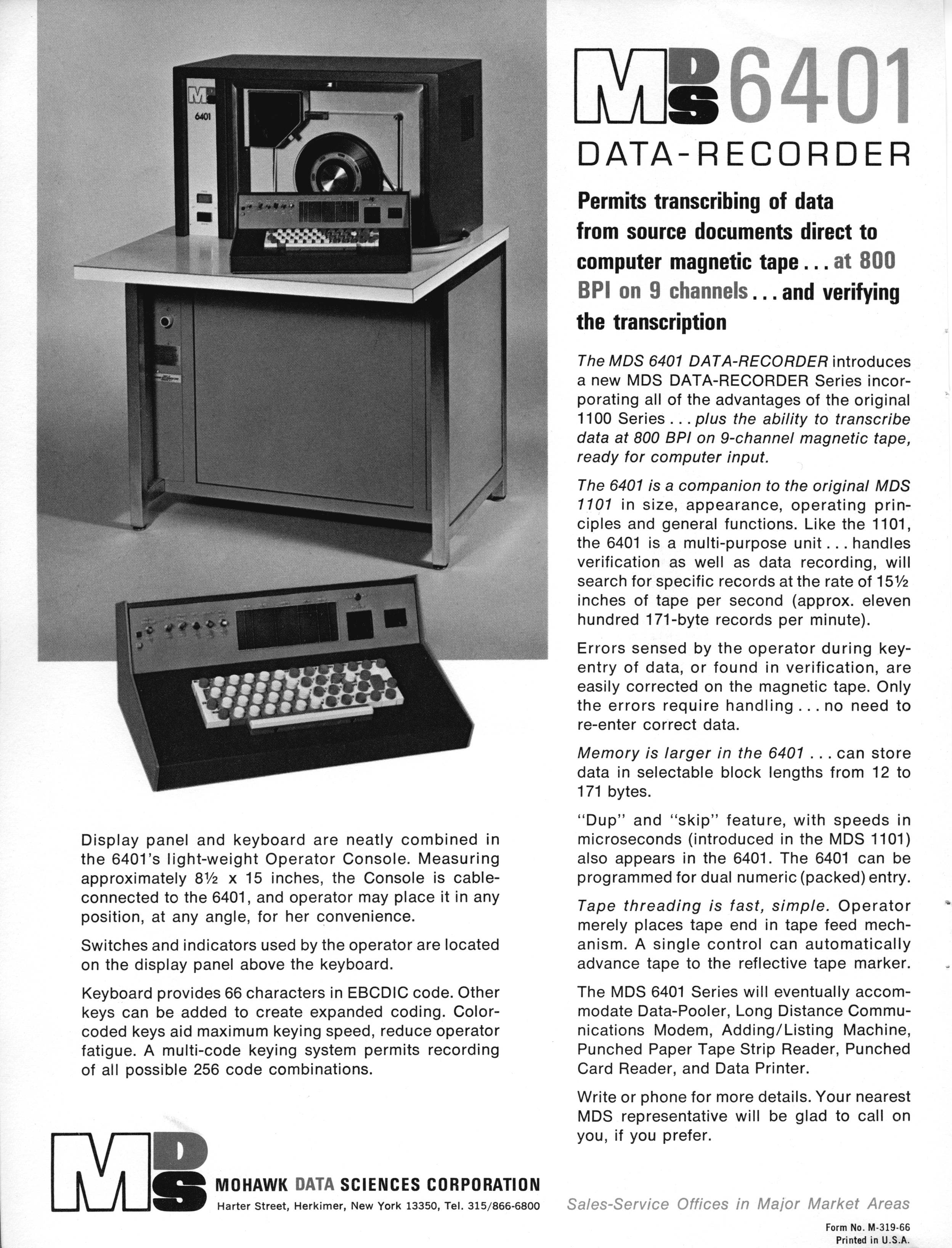
a friend of mine asked me to drop a note to the list, if anybody is interested in a so-called Data-Recorder from Mohawk Data Sciences Corp (MDS) available for pick-up in the region of Dortmund, Germany. He needs the space and wants it to find a new good home. System condition is unkown but complete according to my knowledge.
Model type should be MDS-6401. Information can be found on bitsavers:
http://bitsavers.trailing-edge.com/pdf/mohawk/M-319-66_MDS-6401_Brochure.jpg
Please contact me off-list and I will get you in touch with him for those interested.
Kind regards,
Pierre
?
-------------------------------------------------------------------------------
Pierre's collection of classic computers : http://classic-computing.dyndns.org/
I have a SCSI to Pertec Formatted interface that came off the
back of a Cipher 990 drive. The drive was a horrible piece
of junk, and we chucked it, but I kept the SCSI adapter.
I tried it last year on a CDC Keystone (92185) drive, and
was surprised it seemed to work. I was just trying to
get some tape mapping software running when it
died. The adapter was powered from the reel motor
supply of the drive, so it needs something like 60 V DC,
and has a switching supply built into the board.
Anyway, it now gets a power on self test error and won't
go any further. I do have full schematics for the adapter.
If anyone wants it, it is yours for the shipping.
Jon
From the Digibarn site, feel free to answer...
>Your Name: Dave Tumey
>Your Email address: davetumey at yahoo.com
>
>1. Include comment in Site
>2. Include name with comment
>3. Include email address
>
>Comment was:
>-----------
>I am rebuilding the RTTY station I had as a teenager and I am trying
>to get my hands on an ASR-33 Teletype. Even though they built some
>600,000+ machines, I am finding it quite difficult to track one
>down. I am looking for a machine with EXCELLENT cosmetics - it does
>not need to work - that can be fixed. For a machine in excellent
>condition, I would be willing to pay a king's ransom. So...if you
>know anyone who might have a machine that is in need of being
>utilized, please let me know, it would be greatly appreicated. --dave
I have third party memory cards in my 11/750. The installation guide
indicates that they also work in an 11/730. They are from National
Semiconductor, NS753.
alan
On 1/5/14, 8:28 AM, Ken Seefried wrote:
>
>
> I've seen a couple of vague references to 3rd party memory cards for the
> VAX 11/730, equivalent to the M8750, that used denser DRAM chips in order
> to use less power. Unfortunately, my google-fu has turned up nothing.
> Does anyone know who made these cards and what part number they would be
> (assuming they exist at all)?
> > They'd written an AI program in LISP to help with the querying and
> > matching engines with designs.
> > After it was up and running, it was translated into Forth in order to
> > fit into a computer that could be rolled around on a cart.
> > Of course now days it would just need a cloud.
> > Dwight
> "Translated into Forth"? Now that's interesting! -- Ian
A good programmer can write FORTRAN in any language!!!
Tim.
A few years back a restored a PDP-8/L that was in very bad shape. To
make my life easier I putted a module location chart together.
Somebody here might find it useful.
http://www.abc80.net/docs/pdp8/modules/index.html
/Anders
Hello list,
more than a year ago, I offered a large lot of documentation originating from an Unisys system-80 computer which is a descendant of UNIVAC computer systems. Some binders are from UNIVAC, newer docs are from Unisys.
http://classic-computing.dyndns.org/unisys/p1130068.jpghttp://classic-computing.dyndns.org/unisys/p1130069.jpghttp://classic-computing.dyndns.org/unisys/p1130070.jpg
The Houston Computer Museum was/is interested but financing the shipping seems problematic due to missing donations.
Unfortunately, I need to clear out a room this year and the four large packages with these docs have been standing in my way for very long now. Therefore, I'd like to offer again this documents to anybody who is interested has long as he pays shipping or grabs them at my place. Location is Germany near Cologne.
If you are intersted, I can send you a list (not entirely complete, though) of the documents.
I'd love see them go in good hands. I don't have the machine and thus have no use for the 110 kilograms of paper.
A subset of the docs can also be sent to whoever is intersted.
Please contact me off-list.
Kind regards,
Pierre
?
PS: Picture of a system-80: http://museo.freaknet.org/wp-content/uploads/2013/12/800px-Cea1.jpg
-------------------------------------------------------------------------------
Pierre's collection of classic computers : http://classic-computing.dyndns.org/
On Jan 8, 2014, at 12:00 PM, ARD wrote:
> THe HP41 was a much mroe expandable ssytem than the TI59. Or at least,
> IU've never seen an TI59 controlling a benchtop of HPIB instruments,
> savign the readiungs to floppy disk or tape and then trasnmittign the
> logged data over an RS232 link. I do that with my HP41 all the time.
>
> I don;t think the TI ever had a realtime clock, did it?
>
> And of course the HP had an alphanumeric dispaly.
All true to the best of my knowledge; expandability and extensibility (sic?) was one area where the HP was leaps and bounds ahead of the TI. I was insufficiently precise; I was looking at total storage capacity and program execution speed as my main ?performance? criteria at the time.
FWIW, the TI would print alpha characters on its PC-100 printer/cradle, if you had one of those. But it was pretty kludgey, and I don?t think there?s any way to get alpha out of the handheld part of the system. Well, OK, get the result 07734 and hold the calculator upside down. :-)
>> 2) I quibble with Tony?s recommendation to reject a machine that says
>> Sin(Pi) = 0. I?m pretty sure the TI says that; the quicker but
>> essentially equivalent test I always used to taunt my HP-41-equipped
>> friend was (Sqrt(2))^2. The TI said 2, the HP said 1.99999? I claim
>
> Actually, that is something rather different.
>
> If you take a decimal approximation of SQRT(2), round it after, say, 13
> digits, then square it and round the reult to 10 digits (or whatever),
> you will get 2. But if you take any finite number of dgits of pi,
> calculate the sin, the answer is not zero. It's of the order of
> 10^-(number of digits). So even if you take 13 digits of pi, the SIN
> should not display as zero. I suppose you could argue that if you took
> over 100 digits, the result would be zero (since a number of the order of
> 10^-100 will underflow to 0), but I doubt that the TI uses 100 digits
> anywhere.
(Quote slightly modified)
Point taken; the TI gets very close to 2.00 for my test and should show 2.00, but for the near-zero result, it should show the scientific-notation value it gets, not 0.00. Now I?m curious; I?ll have to try to get my TI running long enough to try this. Hopefully Pi and Sin are two of the keys with fewer bounce problems than the others?.and I really don?t know what I?ll do for a battery pack. Sigh. At least the cells look like standard Ni-Cads.
And no, although I did think about trying to write an arbitrary-precision set of subroutines for the TI using multiple registers to represent a single number, I never did it and 100 digits of Pi, or 100 digits of Sin(x) function, would have been beyond my math/programming skills anyway.
- Mark
Again, don't ask me - I am just passing this on...
- LP
---------- Forwarded message ----------
From: Pam Tcath <ptcath at gmail.com>
Date: 9 January 2014 18:06
Subject: FS: Apple Lisa 2
To: lemswap at googlegroups.com
For sale is an Apple Lisa 2 updated (in-board hard drive and 3.5"
Floppy Drive). It has been in an attic for 20+ years. It powers on,
but since I have never had a Lisa before, I did not want to screw
anything up and didn't test it further. The Keyboard and Mouse are in
their original boxes inside the original Accessories box. Pictures
available on request. Once cleaned and restored it could be museum
quality as there is no structural cosmetic damage. I checked eBay this
AM and the only Lisa 2 is $ 2500.00. My friend who runs an Apple
Museum values a working Lisa 2 at $ 1500.00. I am asking $ 1200.00
postpaid CONUS. PayPal ONLY.
Pam Tcath
Cranston, RI 02910
--
You received this message because you are a member of the LEM Swap group.
To post to this group, send email to lemswap at googlegroups.com
To unsubscribe, send an email *from your subscribed address* to
lemswap+unsubscribe at googlegroups.com
LEM-Swap is not a discussion list; it is for buying & selling Mac
stuff. Reply directly to the person who posted, never to the list.
Software piracy is illegal and not allowed on LEM Swap. Except for
freeware and software originally provided with computers, no software
is to be left on hard drives unless the original installer (not a
burned copy) is included, along with any required registration number,
password, etc.
Shipments valued at US$100 or more should be insured, and shipments
valued at US$25 or more should be shipped so they can be tracked.
See the list FAQ http://lowendmac.com/lists/swap.html for guidelines
on postings, feedback, and dispute resolution. Seller feedback at
http://groups.google.com/group/swap-feedback
---
You received this message because you are subscribed to the Google
Groups "LEM Swap" group.
To unsubscribe from this group and stop receiving emails from it, send
an email to lemswap+unsubscribe at googlegroups.com.
For more options, visit https://groups.google.com/groups/opt_out.
--
Liam Proven ? Profile: http://lproven.livejournal.com/profile
Email: lproven at cix.co.uk ? GMail/G+/Twitter/Flickr/Facebook: lproven
MSN: lproven at hotmail.com ? Skype/AIM/Yahoo/LinkedIn: liamproven
Tel: +44 20-8685-0498 ? Cell: +44 7939-087884
On Jan 9, 2014, at 1:40 AM, cctalk-request at classiccmp.org wrote:
> A program loadaed from magnetic card use the top row of keys (A-E) to
> run it,
Generally true. It?s also possible to label other keys as ?subroutine headers? and execute the subroutine from the keyboard (by for example hitting SBR Sin, if somewhere in the magnetic-card-loaded code is a PGM Sin (I think, been a while) followed by <code> followed by RTN. So it does help to have documentation with the magnetic stripe card.
But for most cards, Tony is right, the 5 function keys were what called the pieces of code on the card.
Also agreed with the other users, the ROM packs came with plain plastic label strips, which were totally superfluous if you had the documentation and could remember which key did what.
- Mark
>> It's the same kind of superior smugness you get from Lisp zealots, who
>> also use
>> ten-dollar words like "homoiconcity" and claim that it's the only tool
>> that can
>> bring us artificial intelligence, despite the fact that it has yet to
>> actually
>> produce any AI of note despite having been around for 56 years. It
>> does however
>> make sense once you realise that Lisp source code is also Polish
>> Notation.
>
> It's not. Lisp does NOT use RPN.
> ----------------------
My friendly Lisp expert (Quadrescence) clarifies me that Lisp does use
Polish Notation per se (but not, of course, REVERSE Polish Notation). So
this post is dedicated those people who occasionally wrongly claim that
Lisp is RPN (though Peter Corlett does not appear to be making this
claim). Sorry, Peter.
I would dispute that Lisp has not delivered any meaningful AI, however.
It was the substrate for decades of symbolic AI research, the
fundamentals of which are neatly summarised in books like Norvig's
Paradigms of AI Programming.
--Toby
>
> Lisp uses prefix ordering ...
>
> There are languages that use RPN (I won't bother listing them) but Lisp
> is not among them.
>
> --Toby
All,
I?m siding with the peacemakers - if you find you think better in stack, use a stack-based machine like an HP. If you find you think better in parentheses, TI/Casio is clearly the way to go. I?m truly glad both exist.
I have a couple of observations, though.
1) TI-59 and HP-41 were both powerful enough to program to emulate the other style. I had a relatively easy job programming my TI-59 to run RPN, using the A..E keys for the operations; my high-school friend with the HP-41 had a tougher time programming his machine to do parentheses, using function keys for ( and ).
I picked the TI because at the time (~1979), it had nearly the same performance for a considerably lower price. However I now have awful keybounce issues on my -59 and my Dad?s HP-41CV is still going strong. My personal preference both for ease of use and (particularly) for programming is that the RPN machine is easier, but I do concur it takes a while more to get used to. However the difference was less important to me than the cost difference at the time.
2) I quibble with Tony?s recommendation to reject a machine that says Sin(Pi) = 0. I?m pretty sure the TI says that; the quicker but essentially equivalent test I always used to taunt my HP-41-equipped friend was (Sqrt(2))^2. The TI said 2, the HP said 1.99999? I claim both answers are correct. The HP is correct because the rounding error did appear, and the calculator correctly reflected its effect in the final result. However the TI answer is *also* correct because the TI does arithmetic to 13 digits, and displays only the high-order 10 digits. The rounding process from the truncated result to the displayed digits results in the 2.00.. answer which is displayed.
I?ll freely admit that the 13-digit-calculation to 10-digit-display rounding process is concealing the truncation problem from me, and if I don?t know to look carefully for it (which can be done, by calculating (Sqrt(2))^2 -2, resulting in 1E-12 or so) I could be bitten badly by it when it finally *does* accumulate up into the displayable digits, or when I do an X=Y test that ?looks? like it should succeed, etc. But, I claim knowing this is part of being familiar with the tools you use, and incumbent on the user.
Different tools, different characteristics; both powerful and effective, in my opinion.
- Mark
Hey folks,
It's a long shot, but does anybody have a manual for an Execuport 4000 printing terminal? It was made by Computer Transceiver Systems, Inc.
I haven't found it on Bitsavers, and Google isn't being very helpful.
Thanks,
-Seth
If anyone has original (or copies of original) disk that shipped with the
Kaypro 16 (the hard drive model, not the 16-2), I would love to get ahold of
a set of floppies or images. I've probably posted this request more than
once over the years, but I have yet to find a set of this software. If
anyone can help me out, please drop me a line.
Thanks!
James
I picked up this set of Televideo PM and InfoShare Supervisor's Manual and
Media last month. I don't see it on Bitsavers, unless I am missing it...
Does anyone know if this is archived anywhere already? If not, I'll add
it to my "to scan" and "to image" piles.
?https://www.dropbox.com/sh/yvvpgdth1o6ch26/-7_V9yLMOh#/?
?Thanks,?
Garrett Meiers
Founder, BitHistory.org &
President, ConsulNIX, LLC
www.BitHistory.orgwww.linkedin.com/in/theunixguy
The local craigslist equivalent yielded a tiny advert "Imsai 8080 computer from 1977".
price : 110 USD, negotiable....
The picture was a tiny B/W jpg lifted from the internet, and did not look too promising.
The actual hardware ?
An absolutely mint, as-new, IMSAI 8080...
>from the orignal owner....
with full documtation, including original invoice...
in the original IMSAI cardbox !
Also MPU-A and MIO cards..
24 Kbytes of 2102 SRAM..
all ICs socketed..
with papertape software....
handpulled papertape reader...
Needless to say no further price negotiations took place.
About the only minus is the MDC-A4 floppy controller, which requires more difficult to find hardsectored disks.
( Original diskdrive and disks were scrapped a long time ago )
I will also need to find some extra s100 connectors to complete the backplane.
it seems the '2014 project is defined !
Jos
I'm looking for a service disc for the 3.5" (IBM-XT/AT vintage) drives
(not 5-14") - does anyone have one for sale? Ideally this is the
original as they came with ondisc faults for part of the testing
procedure AIR.
Thanks!
John :-#)#
--
John's Jukes Ltd. 2343 Main St., Vancouver, BC, Canada V5T 3C9
Call (604)872-5757 or Fax 872-2010 (Pinballs, Jukes, VideoGames)
www.flippers.com
"Old pinballers never die, they just flip out"
After deliberating it for several months, I have decided to
let go of most of my PDP-11 stuff.
It consists roughly of a 11/70, 2 RK07's, 3 RK05's, 2 RL02's,
TU-80 (upright one), RM03 drive and a PC04, + many parts etc.
A more complete list can be found at www.groenenberg.net/download/1170
as well as a few pics.
Offers are entertained, and questions will be answered.
Response to offers will be not immediate, I'll wait at least a week
before a decision is made on that.
The stuff is located in the Netherlands, about 20 Km west of Arnhem.
Ed
--
Dit is een HTML vrije email / This is an HTML free email.
Zeg NEE tegen de 'slimme' meter.
Not much chance, but I thought I'd ask. It is a capstan driven desktop 8 channel
optical paper tape reader, circa 1980. AC motor, built like a tank, and the capstan still
feels OK.
It shouldn't be too difficult to trace out if not, there are only 11 signals
coming out to a 25 pin connector. Obviously parallel given the logic on the circuit board.
I'll take some pictures of it and scan the circuit board today.
On 1/6/14 6:52 PM, Al Kossow wrote:
> That reminds me I need to take some pictures of a Dysan test box that
> I picked up at the flea market. It uses a normal drive, so it won't
> write off track but it has a lot more circuitry than would be
> required for just an ordinary read/write circuit.
Al, Bitsavers does not have manuals for either the Dysan Model 450 (5
1/4" drives" or Model 850 (8" drives) online. I do have an original
Model 450 manual if you need scans. (I know, I still owe you VG
schematic scans.)
I did put a Dysan PAT-1 Model 850 (8" drives) up on eBay yesterday in
case anyone cares. No manual or accessories :(.
FWIW, I have both the Accurite HRD and Dysan DDD 5 1/4" Digital
Diagnostic Disks, and they don't seem to be compatible. I use QAFloppy
(Diagsoft QAFE/Plus) with the Accurite HRD and it works fine. However
the Dysan disk is not recognized by the software.
Second, I see the PAT-1 Schematic on Bitsavers is for the PAT-1 Model
850 for 8" disks.
Third, the PAT-1 box isn't directly compatible with PC floppies as the
interface signals are slightly different. Works fine with the early
Shugart/Tandon drives, but won't recongnize PC drives.
Finally, I have maybe six or so of the Dysan DDD disks marked bad, bad
side 0, or bad side 1. If someone wants to see if they can use them, let
me know.
Hi,
I've decided to have a clear out to raise some funds for the school club I
run teaching 7-11 year olds computer programming, electrics and engineering.
So here is what I have looking for a new home:
- Lots of micro-vaxes (pizza box style)
- Lots of microVax chassis (mostly unpopulated with cards)
- Various Apple IIs and Apple II peripherals
- Various terminals
- SMD drives
- BBC micros, Spectrums and ZX81s
- Atari 2600's (woodies, darth vaders and jr's)
- IBM PC/XTs
- Misc PDP-11 parts (a few QBUS chassis, RX50s, TU58s, TK50s, QBUS cards,
UNIBUS cards, PDP-11/44, RD,RF,RZ series hard drives)
- Lots of other assorted items
If anyone is interested in anything or would like to visit and dig through
the stash get in contact.
All the best,
Toby
On Monday, January 6th, 2014, Jerome Fine wrote:
>I assume that drive 0 was DS3 and drive 1 was DS4? Please confirm.
>I managed to make up the required circuits and LEDs for a BA23
>box with 2 hard drives and an RX50 (placed outside of the BA23,
>but connected with long cables to the normal connectors) connected
>to an RQDX2 via the standard distribution board adjacent to the
>hard drive bays. I remember that lines 3 and line 4 on the 10 pin
>cable supported the second hard drive. My first attempt jumpered
>line 1 and line 3 along with line 2 and line 4 to allow the 4 button
>panel to support both hard drives as long as they were BOTH in
>WRITE PROTECT at the same time. The circuit I developed
>much later needed two switches, two resistors and 4 LEDs.
>On occasion when I need two hard drives in an BA23, I disconnect
>the 10 pin cable to the normal 4 button panel and connect that 10 pin
>cable to my contraption.
>I am curious, do you have the circuit needed to support the second hard
>drive? And did you have to cut any traces on the 4 button panel?
>What I don't understand is why DEC did not make the information
>easily available if you found it so easy to make supporting a second
>hard drive possible. But back then, I guess DEC was DEC. It was
>much more profitable selling an expansion BA23 box or better yet
>a BA123 box.
>Jerome Fine
I typically took the easy way out, and soldered two 1/4 watt resistors onto the 4-button circuit board,
which ultimately strapped the 2nd hard drive as "Always ready" and "Write Enabled".
T
>
> From: Glen Slick <glen.slick at gmail.com>
> Date: Sat, 4 Jan 2014 12:02:32 -0800
> Subject: Re: MFM Control Signals and RD disk size
> On Sat, Jan 4, 2014 at 11:16 AM, emanuel stiebler <emu at e-bbes.com> wrote:
> > On 2014-01-04 11:59, Robert Jarratt wrote:
> >
> >> So how does it do this when the disk is yet to be formatted? In other
> >> words,
> >> when it formats the disk how does it know what size the disk is?
> >
> >
> > DEC drives have this information in a special area of the drive.
> > If for exmaple, the MV2000 finds this blocks, it formats to exactly this
> > specs. You see this, if you go into the MV2000 diagnostics.
> >
> > All other drives, you have to enter the specs manually ...
> >
>
> How does that match with this information, if it is correct, that the
> MicroVAX 2000 disk recognizer works for the set of known disk drives
> even if the disk came from a different system and has no DEC specific
> information or formatting on it currently?
>
> http://home.iae.nl/users/pb0aia/vax/fmtbob.html
>
> "The standard DEC drives that are supported in the VS2000 and their
> industry equivalents are:
>
> RD54 - Maxtor XT-2190
> RD53 - Micropolis 1325 or 1335
> RD31 - Seagate ST-225
> RD32 - Seagate ST-251-1
>
> If you have any of these standard drives you can simply plug it into
> your 2000 and the ROM formatter will automatically recognize the drive
> types. I've never seen this fail, even if the drive has never seen a
> DEC machine before, or even if the drive was previously formatted in
> a PC."
>
This was posted years ago for the RD53 - Micropolis 1325 or 1335:
Unscrew the two screws holding the circuit board to the bottom of the drive
and carefully lift it up. Along one edge of the circuit board you will find
a place where it would appear that a resistor should be -- this place is
marked
R7. Solder a jumper into that spot to make this drive into an RD53. Set
the
drive select jumper to DS2 and you should be in business.
--
Michael Thompson
Hi! Thanks to the great response on the pre-orders for S-100 Z80 CPU V2
PCBs! I have placed a PCB manufacturing order and they should arrive about
the 22 Jan 2014. I will send out the pre-ordered boards first and then
offer the remainder to the builders. Thank you very much and have a nice
day!
Andrew Lynch
>>
>> A working, complete, 1975-6 SWTPc with top and bezel, original backplane,
>> original CPU and RAM with an MP-S card is worth $1000+. That would be
the
>> bare minimum system. $700 is too low for a working system. The newer
6809
>> SWTPc's would be worth less, maybe you can get one of these for $700.
>
>Although note that the earliest SWTPC 6800 used the MP-C card as the
>console interface along with Motorola's MIKBUG ROM monitor. This was
>all pretty much from the MEK6800-D1 eval kit reference design.
>
>If you have an MP-S card for the console interface then you will also
>have SWTBUG, which SWTPC developed and came later in the evolution of
>those systems.
Oops. Yes the MP-C, not the MP-S. A working system from the first year or
two would be worth a lot more than $700, MP-C / MIKIBUG. Forgot that I
upgraded mine. I use the MP-S but I still have the MP-C.
Bill