From: Richard <legalize at xmission.com>
>In particular, I've been trying to figure out the synchronous
>communications schemes that were used in the airline industry in order
>to get some airline reservation terminals in my collection talking.
Ug...you're looking for Airline Control Protocol (ALC) aka SITA P1024B.
The terminals speak a multidrop bisync serial protocol with 6-bit
characters and next to no error detection or correction. To do anything
useful, you'll need a terminal controller (PAD) and something that pretends
to be IBM TPF (airline industry specific mainframe OS) running an IPARS
reservation system. X.25 was usually used to connect the terminal PADs to
the hosts.
The good news is that all of this is very well documented and there's a
whole ecosystem of companies that still support this mess. Even Cisco
supports ALC in their IBM feature set for IOS, so theoretically you could
use that as a PAD (I've never tried). 20+ years ago I was involved with a
project to build an ALC TPAD emulator on top of SVR4 that would let us
replace those clunky terminals with PCs and translate IP messages to ALC
for the back end, among other things.
looking to find windows ce. mostly what i come up with are devices that
have windows ce on them or i find the software that was installed along
side windows ce. i would like to find windows ce 6.0 if possible. i
would like to play around with it. maybe someone even has a windows ce
6.0 palmtop or something even
An author friend has just put up one of his occasional
retro-futuristic photoblogs. But this time, he has a selection of '60s
mainframes which might amuse. They're the bottom section of tyhe
post...
--
Liam Proven ? Profile: http://lproven.livejournal.com/profile
Email: lproven at cix.co.uk ? GMail/G+/Twitter/Flickr/Facebook: lproven
MSN: lproven at hotmail.com ? Skype/AIM/Yahoo/LinkedIn: liamproven
Tel: +44 20-8685-0498 ? Cell: +44 7939-087884
Since others are running ?DEC things available? I?ll add a few of mine. Free; I?ll mail them inside the USA. Outside the USA, please ask.
a. Three Unibus jumpers, M9202 ? the kind with 3 feet of Unibus cable folded between the two circuit boards.
b. One DEFPA-DA dual attached FDDI NIC, PCI interface. No software for it, but it should be ok though I?ve never used it myself.
c. Two DEC Pro hard drive controllers (device code 401). One is labelled ?bad? though it looks physically intact; the other is not so labelled and also appears ok. Not tested.
paul
I have a stack of maybe ten 10MB Bernoulli box packs.
I'm not sure what's on them; I think they came from a clean-out of a
business I did in the 90s. If there's anything interesting on them,
I'd like it to get archived someplace.
Would anyone with a working drive be interested in reading them
in exchange for keeping the packs? I'll pay shipping in the U.S.
--akb
Hello,
I have the following items to get rid of:
1 KA650 with two M7621 memory boards and cabinet kit
(without battery).
1 KA630-AA, cabinet kit, but no memory.
1 KA630-AA, M7608 and M7609 memory boards, cabinet
kit.
1 VCB-02 with keyboard, mouse and VR290DA monitor.
The monitor would be really difficult to pack for safe shipping,
however.
1 DHV11 serial multiplexer.
1 CQD-223/M SCSI disk controller (made by CMD).
1 Dilog DQ153 G. (Pertek tape controller??)
1 AVIV mag tape control, might have been for Storage Tech
tape drives.
1 M3106 4-line serial mux with dirty cabinet kit
1 Dilog ESDI disk controller (I think)
1 M7607 memory
1 Andromeda MFM disk and floppy controller
1 MSC Q-bus memory board
1 MSC double-widw Q-bus memory board
1 M7264 LSI-11
1 M7950 parallel interface board
1 Dilog DQ132
2 M7941 parallel interface
1 M8027 LP interface
I can send photos or do other research to try to confirm the
identity of some of these boards, if interested.
I have some Q-22 and maybe Q-18 backplanes, too.
Jon
From: allison <ajp166 at verizon.net>
> It was my understanding that a smaller machine managed it and fed it and
accepted
> fire hose rate data from it and there was likely no OS but a framework
that the specific
> application was supported by. It was from all I read not used as a
general purpose
> machine like a VAX or CDC 6000. So rather than OS you likely looking for
something
> like VAX ELN, PDP-11 IOX, or some other library of "stuff".
The original Cray OS (COS) was basically a batch OS. More than just a
framework, but less of an OS than, say, OS/370. They were indeed
front-ended by a host machine (the one at Pittsburgh had 2 (I think)
VAX/VMS hosts) where you'd write and compile your Fortran, stage your data,
and write a script to get everything submitted to the Cray run queue and
collect the results. Later (mid 80s) they came out with UniCOS, which was
a SVR2-ish Unix port which let you eliminate the front ends. I recall
some vi-v-emacs level internecine warfare between the "UniCOS is awesome"
and "all that Unix overhead is a waste of a perfectly good Cray" camps.
Internally, Cray was committed to UniCOS, so that's who "won".
From: Zane Healy <healyzh at aracnet.com>
> As for array processor software, it sounds like we may need to talk. I
believe I still
> have a FPS array processor tape. I've never really considered that it
might be rare.
> I suppose I should have also grabbed all the spares at the time I got
tape.
Yup. I know more than one FPS that ended up getting tossed because no one
kept the software (and in one case, because the software was for a host
that no one had any more). Unfortunate...they're really interesting
devices.
It has been at least a year and a half that I sent my IOB6120 board to
Dave McGuire for assembly. I haven't heard from him in a while. Does
anyone know what's up with him?
--
David Griffith
dgriffi at cs.csubak.edu
Does anybody have a spare external drive for a Tandy 1000EX XT clone? If
not, is there a way to make a 'generic' 5-1/4" drive work with it? IIRC the
1000EX connector is a basic card-edge deal, probably 34pin.
When I found the machine, the ext. drive wasn't sitting that far away from
it, but not realizing they were a pair, I just walked away from it. Been
bugging me for years, what a PITA with one drive, lol.
Gotta gotta get it working. Thanks for any & all assistance!
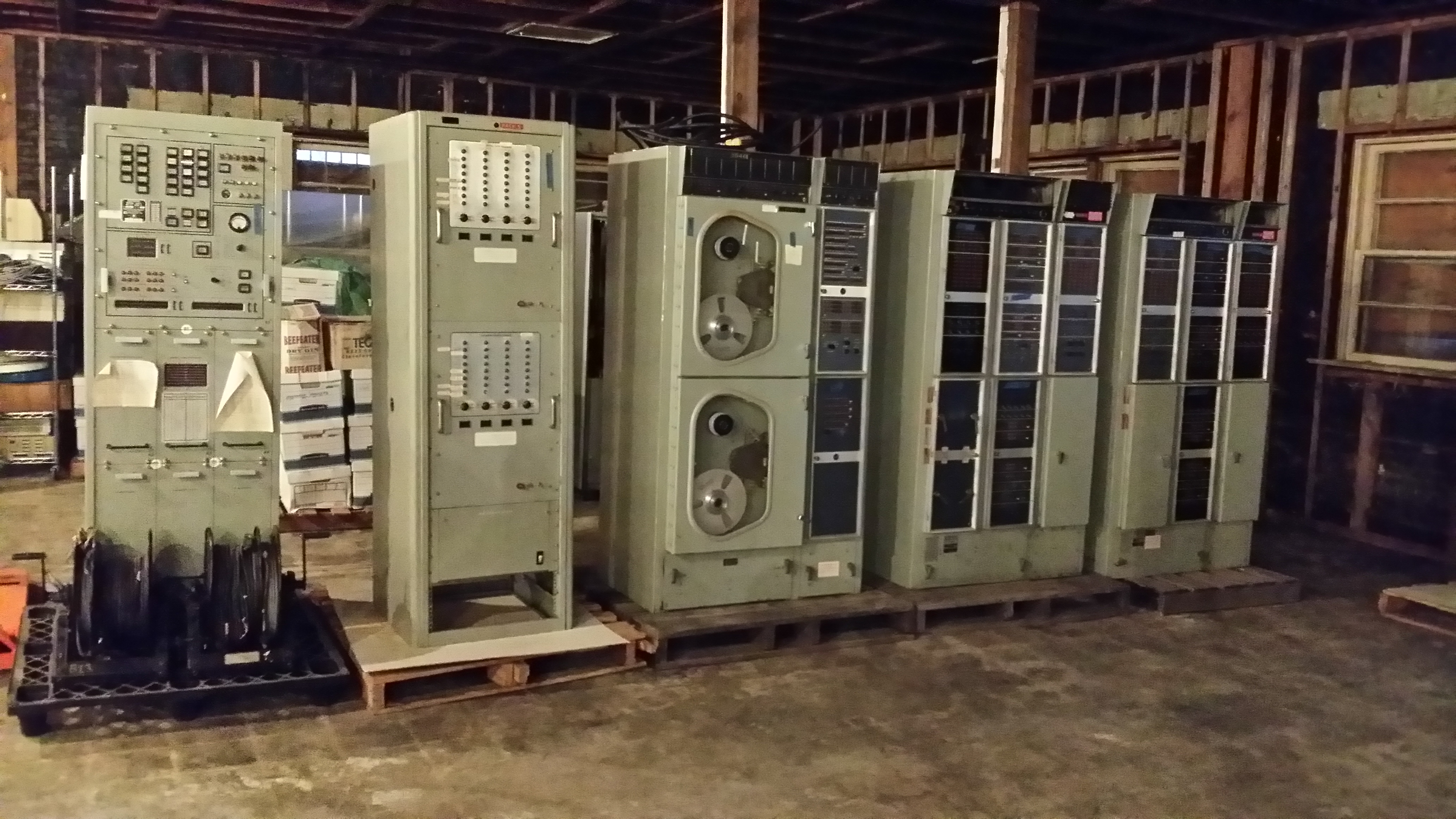
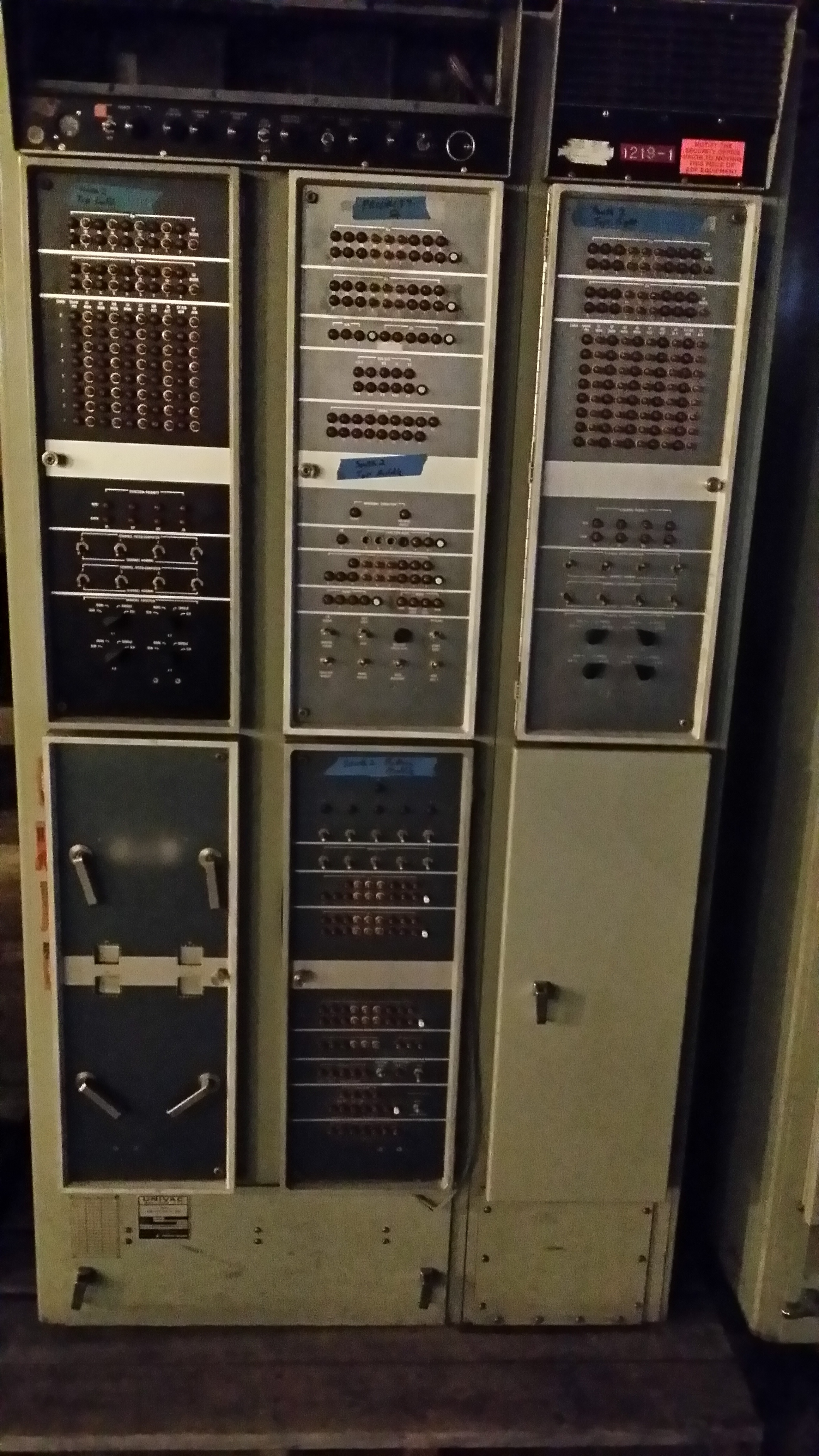
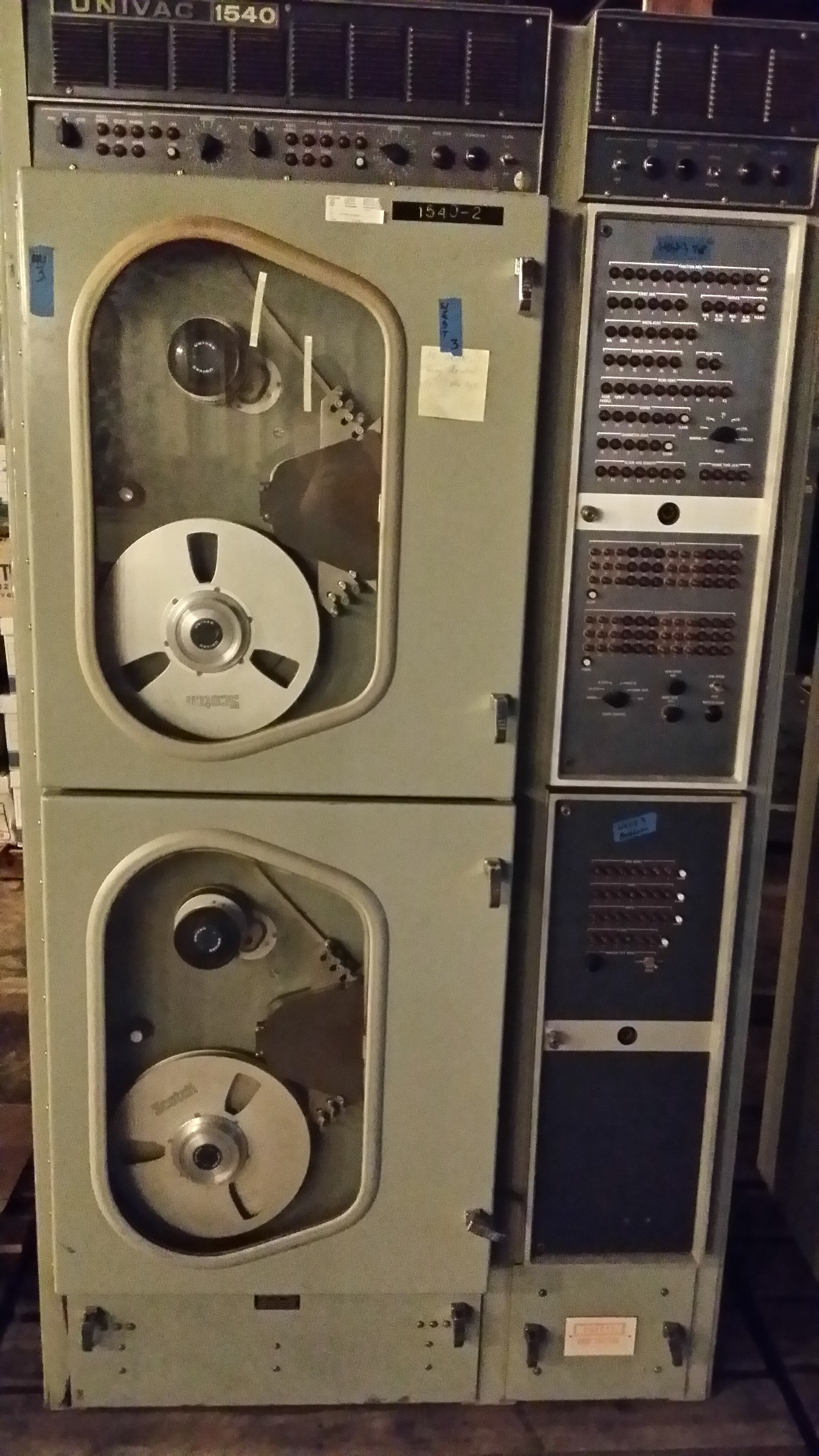
For the past couple of years we in MARCH have been teasing people with
the knowledge that we have a UNIVAC mainframe. :) It's a model 1219-B
(1965 transistor system) used on Navy ships for things like radar and
weapons system control.
This weekend we finally got around to taking some good pictures of it in
our storage warehouse. The computer was a gift to us from the Johns
Hopkins University Applied Physics Laboratory.
Here are the five main racks: http://snarc.net/1219b/all_comp.jpg. Left
to right: A/D converter (ignore the cable spools on its pallet), data
recorder / IO hub, one of two identical tape drives, both CPUs. Here are
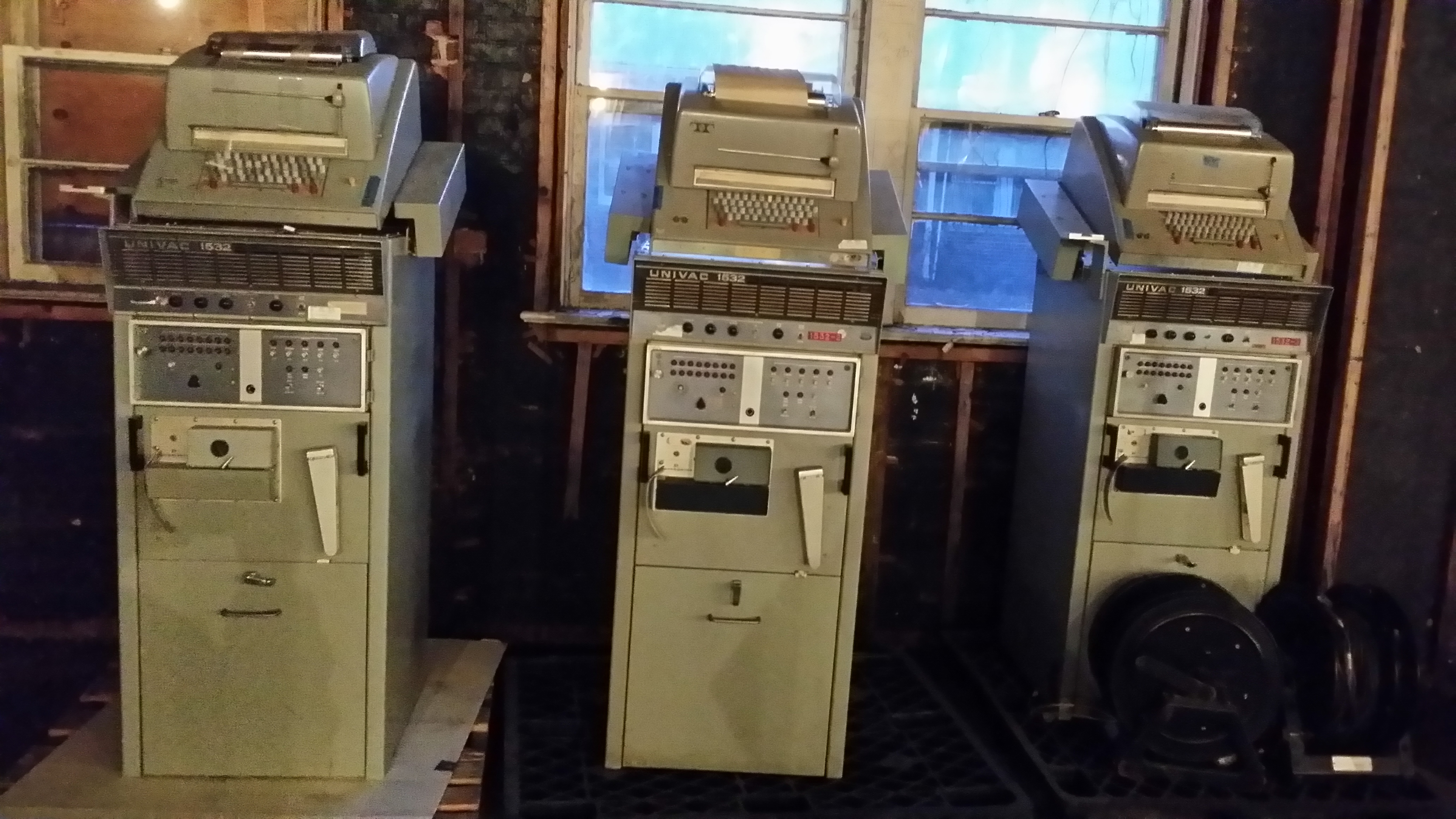
three of the four IO consoles (paper tape below, TTY above):
http://snarc.net/1219b/all_io.jpg. All are identical. The second tape
drive and the fourth paper tape/TTY console are on on display in our museum.
Now for some close-up pictures.
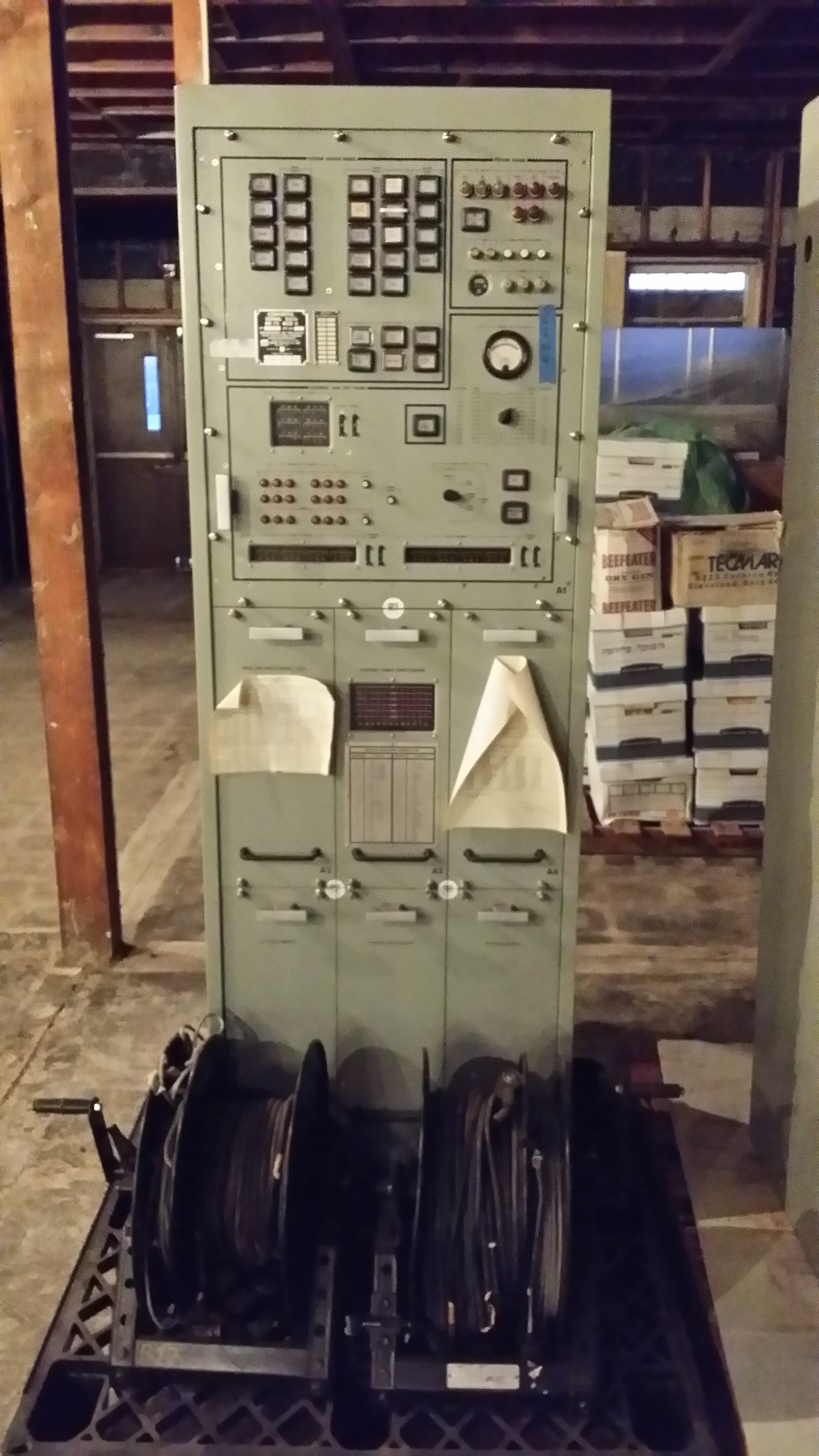
1. A/D control panel: http://snarc.net/1219b/close_control.jpg.
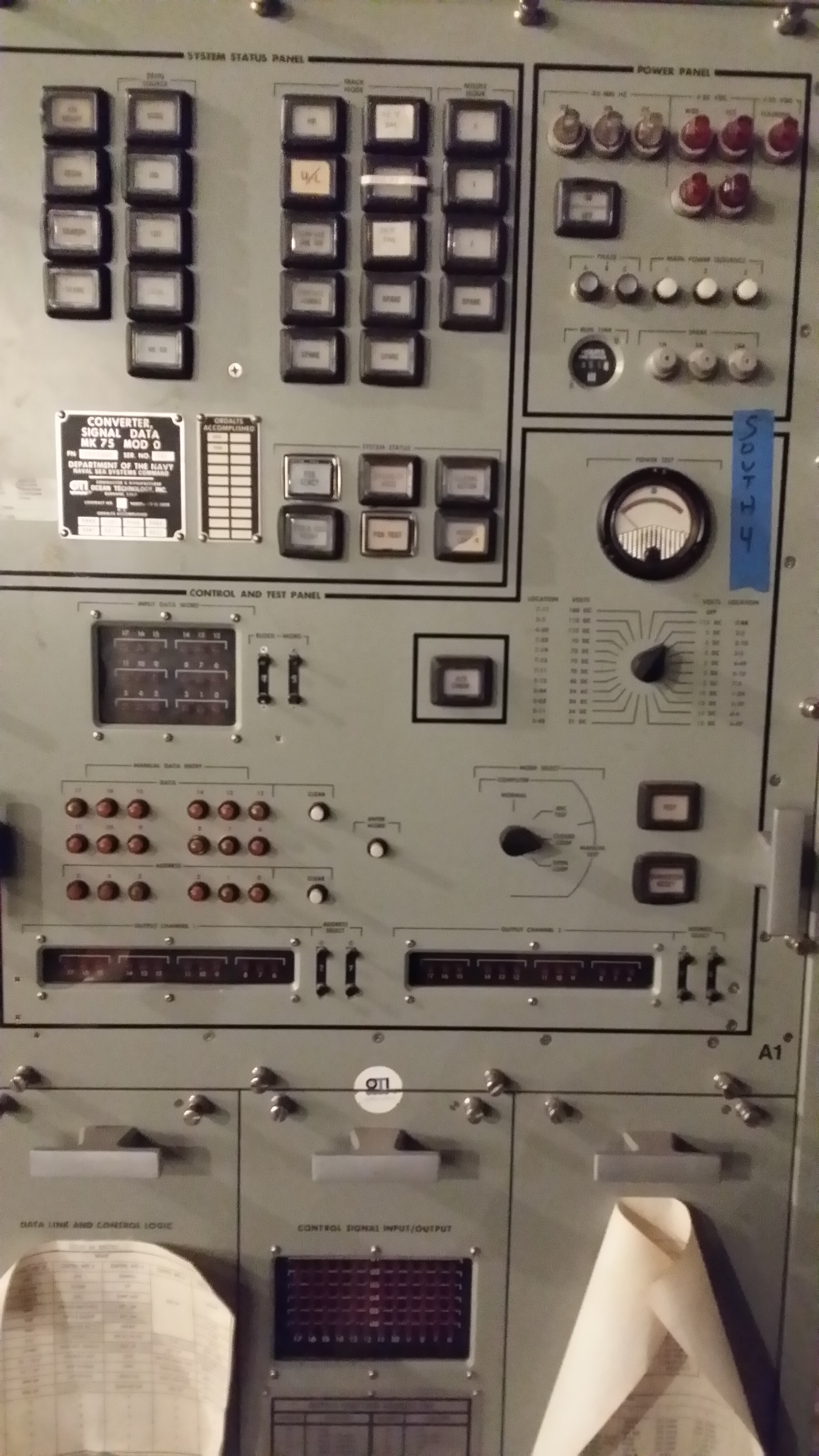
1a. Details: http://snarc.net/1219b/close_control_detail.jpg
2. CPU: http://snarc.net/1219b/close_cpu.jpg (unfortunately both CPUs
are missing the top UNIVAC nameplates.)
3. Tape drive: http://snarc.net/1219b/close_tape.jpg
4. Data recorder and I/O hub:
http://snarc.net/1219b/close_datarecorder_io.jpg
5. Paper tape / TTY console: http://snarc.net/1219b/close_io.jpg
No, we haven't tried to power it up ... it might be another few years
before we get there, plus, we're missing the core memory, software,
various important cables, and most of the manuals. We also don't have
the electronic terminal or the line printer.
Still, it's one damn impressive-looking computer, and we're very proud
to own it!
For context: each CPU weighs about 1,500 pounds. Each tape drive cabinet
weighs about 1,000 pounds (you can see it has two drives inside the
cabinet; each is a 7MB, 7-track tape.)
We hope to be able to take this out of storage and put it on static
display at VCF East but that depends on a bunch of other factors, like
whether our forklift is working, etc.....
anyone looking for a bunch to use in a display i got a pile from making h11
tapes copies and curious befor i tossed it if anyone wanted it that bluish
white colour of dec tape
adrian
On 01/17/2014 12:06 PM, allison wrote:
<snip>
>
>Another Lucas company, Droids Inc,? had one on order.? Whatever happened to them anyway?
Are you think "Droids works" makers of EditDroid and SoundDroid?
>
Nope. There was a Lucas company called Droids Inc. In San Rafael. I only visited them, but know they were still around a year later.
Billy
>From: "Daniel V. Mackey" <n2dvm at arrl.net>
Subject: 1541 Alignment disk.
>Does anyone have a Dysan Alignment disk for the 1541 or know where a disk
can
be found/purchased?
>Thanks.
-----
Have you tried the 1541-1571 drive alignment program by Free Spirit
Software?
PM me if you need assistance.
Bill
Vintagecomputer.net/contact.cfm
Does anyone have documentation (printed or PDF) for any of the
following MAINDEC diagnostic tapes for the PDP-8/A?:
MAINDEC-08-DJKKA-B-D, PDP-8/A CPU TEST, dated Feb. 15, 1975
MAINDEC-08-DJDKA-C-PB1, DKC8-AA OPTION, TEST #1, dated 04/04/77
MAINDEC-08-DJKMA-B-PB1, KM8-A OPTION TEST #2, dated 11/08/76
(Or any others?)
If you've got printed copies, could you either scan them or copy them
for me? I'm more than willing to cover your copying & mailing costs.
Or email the PDF copies (or URLs)?
I'll send copies of everything to Al and David Gesswein for posting online.
Thanks,
Bob
--On January 19, 2014 10:54:55 AM +0000 Dave <dave.g4ugm at gmail.com>
wrote:
> The folks where I worked at the Proudman Oceanographic Laboratory
> (POL)
>
> http://www.pol.ac.uk/
>
> which was based at Bidston Observatory
>
> http://www.bidstonhill.org.uk/heritage/trail08/
>
> had access to the Cray at Daresbury via an Remote Job Entry system.
>
> http://tardis.dl.ac.uk/computing_history/cray-1s.html
>
> They used it for Oceanographic modelling. I seem to remember we had
> an allocation of one hour of CPU time per week and we struggled to
> use it.
> (Is this the same Cray we are talking about here?)
No, I don't think so. The Cray I'm talking about was housed in a
building on Guilford Street in London. My job at the time was to hook
it up to an HP machine running Ultrix so people could submit work to it
interactively.
In the process I may have been the first person to put IP protocol
packets onto the ULCC network. At that time people in the UK were
suspicious of TCP/IP. I think they became less suspicious when the
found that the work I was doing didn't cause problems.
Mike
On 01/17/2014 12:06 PM, allison wrote:
> One has to remember what the machines were used for. It was designed
> to solve very large problems that create huge arrays. Oil mapping is
> one thing that does that, the others explode.
Two local machines that I remember was Apple, using Cray in their Esthetics Design Lab and another at Industrial Light and Magic to control the models in many of the scenes from Star Wars.
Another Lucas company, Droids Inc, had one on order. Whatever happened to them anyway?
The US Navy had at least one in Monterrey at the Fleet Weather Station.
I can't find my notes, but I'm certain that GM had one or more in their design department in detroit.
Billy
>I can't know for sure, but here is a lower bound: 11
>
>Clubs:
>1 - Update Computer Club, Uppsala
>2 - Retro-Computing Society of Rhode Island.
>
>Museums:
>1 - Living Computer Museum, Seattle
>3 - Computer History Museum, Mountain view (the may have more, but at least
3)
>
>Private collections:
>3 - Undisclosed :)
> Pontus.
The Corestore has two PDP-12's as well.
-John
Hi all,
Recently, my PDP-8/E has been acting funny. I finally had some time tonight
to run a memory test and found that all addresses matching the pattern
XX5XX read back all zeros. Everything else tests fine. I swapped the XY
driver board (G233) and found that the problem went away.
I can't seem to locate a schematic online. My PDP-8/E preliminary
maintenance manual only describes the G227, for the 4k core board. Can
anyone help with a schematic, or judging from the symptom, point me to a
particular area on the board? I've got a 'scope and should be able to
diagnose it if I know where to start looking.
Thanks,
Kyle
Finally, I have a bidirectional 20 ma current loop between my old
desktop PC and the 8/A :) There was another "gotcha"... although the
power for both transmit and receive current loops comes from the M8316
in the 8/A, the line driver on the PCL-740 card is *not* isolated from
ground even when set to passive mode! The 20 ma was there on mark all
right, and no current on space, but the design of the M8316 card
interface is such that isolation is required for both the + and -
terminals. So I had to whip up a quick optoisolator-based board
(although a small fast relay would work for 110 baud, I didn't have
one handy and I may want to download large files at a faster rate).
Anyway. Now I have a set of files (AJRL**.BN) and need to download
them to the 8/A. First I have to toggle in the RIM loader, of course.
But are these binary files in RIM or BIN mode? If the latter, can I
use the PC to send the BIN loader over to the 8/A?
thanks
Charles
Hi all,
anybody out here has the parameters for the TEST70 on a microVAX to
format a Maxtor xt1140 disk?
Actually just trying to test a disk for a friend, and all i have is the
VAX ...
Cheers
On Sat, 18 Jan 2014 12:00:01 -0600, you wrote:
>>From: Jonathan Katz <jon at jonworld.com>
>>
>>On Sat, Jan 18, 2014 at 10:22 AM, Charles
>><charlesmorris800 at centurytel.net> wrote:
>>> I have an ancient (AMD K6, 300 MHz, Win XP) desktop PC that I am
>>> trying to use to download RL02 diagnostics to my PDP-8/A via the TTY
>>> console port (20 ma current loop).
>>
>>Not familiar with this at all, but two things.
>>
>>1) I remember being able to set IRQs on PCI slots in this era of
>>systems. Maybe you need to play with that?
>>
>>2) Have you tried a protocol other than current loop on this ISA card
>>(like RS-232) to another system to see if it works?
>
>I suspect you are right - that the card is somehow not signaling the PC that it is ready to accept data. But there are no IRQ conflicts (card is jumpered to 12 and Windows is unaware of anything else using 12, or address 0210-7). The existing serial ports are on 03F8, IRQ5 and so forth. Although the PCI slots do have a "plug & play/Auto" setting, I removed every card except this one and the problem is still there!
>
>Yes, I have tried RS-232. The problem is not the line drivers/receivers... no data is appearing at the UART's TxD pin regardless of which set of buffers it then goes to. And as I noted, I did hard-wire the RTS, CTS, DTR lines and they are being sensed, and do not appear to be telling the port to hold off.
>
>This card has a controller chip by Lattice and the UART (and a small amount of glue logic). No schematic information of course.
>
>Will keep trying. Thanks for the help.
>>From: Jonathan Katz <jon at jonworld.com>
>>
>>On Sat, Jan 18, 2014 at 10:22 AM, Charles
>><charlesmorris800 at centurytel.net> wrote:
>>> I have an ancient (AMD K6, 300 MHz, Win XP) desktop PC that I am
>>> trying to use to download RL02 diagnostics to my PDP-8/A via the TTY
>>> console port (20 ma current loop).
>>
>>Not familiar with this at all, but two things.
>>
>>1) I remember being able to set IRQs on PCI slots in this era of
>>systems. Maybe you need to play with that?
>>
>>2) Have you tried a protocol other than current loop on this ISA card
>>(like RS-232) to another system to see if it works?
>
>I suspect you are right - that the card is somehow not signaling the PC that it is ready to accept data. But there are no IRQ conflicts (card is jumpered to 12 and Windows is unaware of anything else using 12, or address 0210-7). The existing serial ports are on 03F8, IRQ5 and so forth. Although the PCI slots do have a "plug & play/Auto" setting, I removed every card except this one and the problem is still there!
>
>Yes, I have tried RS-232. The problem is not the line drivers/receivers... no data is appearing at the UART's TxD pin regardless of which set of buffers it then goes to. And as I noted, I did hard-wire the RTS, CTS, DTR lines and they are being sensed, and do not appear to be telling the port to hold off.
>
>This card has a controller chip by Lattice and the UART (and a small amount of glue logic). No schematic information of course.
>
>Will keep trying. Thanks for the help.
I got it working at last! Changed the card (and COM3 port) settings to
IRQ5 and it sends and receives through a loopback test of the current
loop interface. Tx and Rx lights are flickering, and my trusty Tek
scope shows a nice 110 baud data stream in the current loop :)
Yet another multi-hour casualty of Microsoft legacy software. No idea
why it wouldn't work on IRQ12 with all other cards removed and the
onboard hardware not using that interrupt. Sigh.
Now to figure out how to download the RL diagnostics, which are binary
files! Hopefully it will be as simple as COPY AJRLxx.BN/B COM3: but we
shall see.
... and of course I need the BIN loader running on the 8/A (unless
those files are in RIM format?) Anyone know?
-Charles
On Jan 18, 2014, Jos Dreesen wrote:
> The ETH also had a Cray, here it is sitting lonely in the groundfloor : http://www.flickr.com/photos/orrc/2434182074/
> Don't know the exact type though.
It looks to be a Cray-1, though I can't tell if it is an A, S or M variant. It is displayed in a similar fashion to how the Cray-1A, serial 3 is displayed in the first basement at NCAR near the rear entrances to the Mesa Lab computer room. We even have a display adjacent to it comparing it to an iPhone 3 from a computing capacity point of view. I'm really kicking myself now that I didn't think to stash away the COS software and documentation years ago when our last COS Cray was decommissioned, but I wasn't in the group that was responsible for administering the Crays. I did spelunk through some storage areas and offices when people retired, but did not find anything that isn't already on bitsavers.
On Sat, 18 Jan 2014 12:00:01 -0600, you wrote:
>From: Jonathan Katz <jon at jonworld.com>
>
>On Sat, Jan 18, 2014 at 10:22 AM, Charles
><charlesmorris800 at centurytel.net> wrote:
>> I have an ancient (AMD K6, 300 MHz, Win XP) desktop PC that I am
>> trying to use to download RL02 diagnostics to my PDP-8/A via the TTY
>> console port (20 ma current loop).
>
>Not familiar with this at all, but two things.
>
>1) I remember being able to set IRQs on PCI slots in this era of
>systems. Maybe you need to play with that?
>
>2) Have you tried a protocol other than current loop on this ISA card
>(like RS-232) to another system to see if it works?
I suspect you are right - that the card is somehow not signaling the
PC that it is ready to accept data. But there are no IRQ conflicts
(card is jumpered to 12 and Windows is unaware of anything else using
12, or address 0210-7). The existing serial ports are on 03F8, IRQ5
and so forth. Although the PCI slots do have a "plug & play/Auto"
setting, I removed every card except this one and the problem is still
there!
Yes, I have tried RS-232. The problem is not the line
drivers/receivers... no data is appearing at the UART's TxD pin
regardless of which set of buffers it then goes to. And as I noted, I
did hard-wire the RTS, CTS, DTR lines and they are being sensed, and
do not appear to be telling the port to hold off.
This card has a controller chip by Lattice and the UART (and a small
amount of glue logic). No schematic information of course.
Will keep trying. Thanks for the help.
I have an ancient (AMD K6, 300 MHz, Win XP) desktop PC that I am
trying to use to download RL02 diagnostics to my PDP-8/A via the TTY
console port (20 ma current loop).
I bought an Advantech PCL-740 card (ISA slot) which has one port that
can be configured for RS-232, 422, 485 or current loop. But I cannot
get it to transmit any data no matter what, and I'm pulling my hair
out!
I downloaded the drivers on Advantech's website and they do show I can
change the status of the RTS, CTS, etc. control lines. On transmit
test, the status box keeps displaying "Tx Pending" once a second, but
nothing comes out on the line. I scoped directly on the 16550 UART
chip and I can see the various interrupt and chip select lines moving,
and the baud rate clock, but the transmit data pin never changes
state.The seller shipped me another card, and it behaves identically.
The software requires the user to install the COM3: port under Win XP,
then separately configure the board to that port with the Advantech
program. At the command prompt or in Device Manager, MODE COM3: shows
that the port is getting set up with the appropriate parameters. While
in the DOS box, attempting to copy a file directly to COM3: results in
a "The handle is invalid. No files were copied" message. Don't know
the significance of that?
Is there some BIOS-level problem wiith the motherboard I should be
looking for? I have used this PC with vtserver to send data via the
onboard COM1: port and it does work. There are no IRQ or port address
conflicts.
thanks
Charles
> Date: Fri, 17 Jan 2014 00:38:44 -0600
> From: Kyle Owen <kylevowen at gmail.com>
> Subject: PDP-8/E MM8EJ G233 Troubles
>
> Hi all,
>
> Recently, my PDP-8/E has been acting funny. I finally had some time tonight
> to run a memory test and found that all addresses matching the pattern
> XX5XX read back all zeros. Everything else tests fine. I swapped the XY
> driver board (G233) and found that the problem went away.
>
> I can't seem to locate a schematic online. My PDP-8/E preliminary
> maintenance manual only describes the G227, for the 4k core board. Can
> anyone help with a schematic, or judging from the symptom, point me to a
> particular area on the board? I've got a 'scope and should be able to
> diagnose it if I know where to start looking.
>
> Thanks,
>
> Kyle
http://bitsavers.trailing-edge.com/pdf/dec/pdp8/pdp8e/ has the -8/E
maintenance manual set (that is not the preliminary version).
Schematics for your MM8EJ are also there, look at
http://bitsavers.trailing-edge.com/pdf/dec/pdp8/pdp8e/MM8-EJ_Engineering_Dr…
- it gives schematics along with some waveforms and some acceptance
tests in the Engineering Specs.
Bob
Relative to the offer for old computer books, a source to look is the local library.
I do volunteer work for the Friends of the Pleasanton Library. We get book donations every day, sometimes huge ones. We gather these up and have a sale every six months. Berkeley has a full time store to sell donations. Sunnyvale has a sale every month.
And often there are computer books and the occassional computer magazines. But because it is impossible to sell anything older than a couple of years old, the rest are sent elsewhere. If the book is interesting, I save it for Al. But he gets so many from others like me, that he can't accept more than a tiny fraction of what is available.
Sometimes the quantity is overwhelming. We had a pickup load about 3 months ago. A Programmer cleaned out his house.
This week, I got a couple of 6502 assembly language books, some CP/M books, a nice RS-232 book that did go to Al.
Point is work with your local library, and you might have access to hundreds of donated old computer books. And software and games. That they have no home for.
Billy
Title says it. Anybody have a spare logic pulser I can buy or barter?
Something like an RSR LP620 or any of the numerous re-badged versions such
as B&K DP31A, etc. would be fine. Just need a basic unit to do some
anticipated t-shooting as I reassemble the Altair.
Contact me on or off-list if you like. Thanks!
Evening...
This is stumping me. What exactly is the 555 being used for? If I can
figure out what it's doing, I can debug it further and solve my problems.
--
Cory Smelosky
http://gewt.net Personal stuff
http://gimme-sympathy.org Projects
I pulled out my DEC RD53 for testing the archiver and surprise the heads
were stuck. I opened it and freed them but wasn't able to find the bumper
that is the cause of the problem. I put pictures here.
http://www.pdp8online.com/rd53/rd53.shtml
Does anyone on the list know where the bumper is and can say in relation
to my pictures? The first drive hasn't restuck so far but I have another to do.
Also does anyone know the data format for the stuff the RQDX3 puts on the first
few tracks? I think its the sparing information and other disk organization
information. If it wasn't too hard I was going to see if I can convert my
extracted data to an image usable under SIMH.
The low level format is strange. The first 3 sectors on track 0 are
in one format then 3 track worth of sectors with a different CRC code which
is where I suspect the controller is storing its stuff. Also some funny
stuff at the end of the disk.
Afternoon,
Until I can get a 'scope to fix up the H7110 I want to get the rest of the
LA120 up so I can look for any other faults.
However...I didn't realise the input to it was slightly different. ;) How
can I adapt the input to the H7150 from the input designed for the H7110?
(The power switch had broken anyway, I could use that replaced...I think
there are cutouts for the voltage selector, too.)
--
Cory Smelosky
http://gewt.net Personal stuff
http://gimme-sympathy.org Projects
My recycle buddy in Denver is currently shredding abt 140 pounds of this
stuff per week.
He is willing to give it to someone to archive, if they will pay the
postage/freight.
Owner's manuals, books, 3-ring binders, posters, memorabilia, leaflet of
jumpers, they all come in.
The only problem is, there is usually some paperwork left in it from the
original owners, which will need to be removed and shredded.
Age of the paperwork ranges from the 80s to current products.
Anybody want to accept this task?
Cindy Croxton
Electronics Plus
1613 Water Street
Kerrville, TX 78028
(830)792-3400 phone (830)792-3404 fax
AOL IM elcpls
_____
No virus found in this message.
Checked by AVG - www.avg.com
Version: 2014.0.4259 / Virus Database: 3681/7010 - Release Date: 01/17/14
From: Geoffrey Oltmans <oltmansg at gmail.com>
>I wonder if our local Alabama Supercomputer Authority office might have
>archives of software for the Cray X-MP and on. They are down the street
>from my work. Supposedly the X-MP24 was the first machine that they
>installed and put in operation back in the 80's.
Interesting idea. The last Cray I spent quality time on was an X/MP-48 at
the Pittsburgh Supercomputer Center in the mid- to late-80s. They're still
around. Wonder if anyone has checked in the closets there for old tapes.
KJ
So, I've been plinking around a bit with some of the operating systems
for DEC's 18-bit machines. Specifically with DECsys-7 for the PDP-7,
and XVM/DOS for the PDP-15.
I've heard that DECsys-7 can run on the PDP-4, and in fact it
"kind-of/sort-of" does. I'm wondering if anyone here knows how to get
DECsys-7 working on the '4 to the point of being usable. The problem
is that the PDP-4's console teleprinter was the 5-bit
(ITA-2/USTTY/"Baudot") Model 28 KSR Teletype, the '7 used an ASCII
machine (33 KSR, or 35 KSR). So the one key which is used in DECsys to
terminate input to the text editor the delete/RUBOUT key is not
present on the 28. So, you can't create any programs in DECsys on the
PDP-4. There has to be something I'm missing that'll get it to work
(surprisingly, the other key vital for using the editor in DECsys --
the tab key -- will work by inputting the teletype's bell code).
My next question has to do with XVM/DOS; I cannot seem to get FOCAL to
run. The system was built to the simulator's configuration (no UC15
UNICHANNEL, FP15, floating point, RP15, RF15, LP15, no VT15 or VP15,
support for API), using SGEN I then tailored the system properly
(start up with XVM and API turned on, and memory size of 128KW). I
assigned the DAT slots needed for FOCAL:
(-1 and -4 are already assigned by the monitor to SYA <SYS>.)
ASSIGN SYA <CMG> 3,5,7,10
Trying to execute FOCAL with "E FOCAL" I get an IOPS13 error ("FILE
NOT FOUND - CAL ADDR **"), and trying it with LOAD and GLOAD I get a
.LOAD 3 error ("SUBR NOT FOUND"). Anyone here know the magic of how to
get FOCAL to run on XVM/DOS?
Thanks to any who respond.
Regards,
Christian
--
Christian M. Gauger-Cosgrove
STCKON08DS0
Contact information available upon request.
http://hackaday.com/2014/01/10/a-diskvaccuum-for-obsolete-disk-formats/
"[Jim] has a box of disks for a very old Compucolor II computer, and
with bit rot slowly setting in he figured it might be time to dump all
those disks to a more permanent format. After reviewing the existing
tools to read these disks, he decided to build his own floppy disk
interface that he calls the DiskVaccuum.
"The DiskVaccuum is based on a Papilio Pro FPGA board and a few chips
worth of level conversion. The FPGA is able to read bits and move the
head of the disk with ease, saving everything to the drive of a much
more modern computer."
--
Liam Proven ? Profile: http://lproven.livejournal.com/profile
Email: lproven at cix.co.uk ? GMail/G+/Twitter/Flickr/Facebook: lproven
MSN: lproven at hotmail.com ? Skype/AIM/Yahoo/LinkedIn: liamproven
Tel: +44 20-8685-0498 ? Cell: +44 7939-087884
I love the oldskool feel and appearance of my Challenger Machines. At:
http://youtu.be/xQUhFoBDGT0 in HD this time if anyone wants to take a peek.
Terry (Tez)
>
> From: Rich Alderson <RichA at LivingComputerMuseum.org>
> To: "'General Discussion: On-Topic and Off-Topic Posts'" <
> cctalk at classiccmp.org>
> Cc:
> Date: Thu, 16 Jan 2014 21:45:45 +0000
> Subject: RE: eBay PDP-12
> From: John Ball
> Sent: Thursday, January 16, 2014 9:29 AM
>
> >> I can't know for sure, but here is a lower bound: 11
>
> >> Clubs:
> >> 1 - Update Computer Club, Uppsala
> >> 2 - Retro-Computing Society of Rhode Island.
>
> >> Museums:
> >> 1 - Living Computer Museum, Seattle
> >> 3 - Computer History Museum, Mountain view (the may have more, but at
> least
> >> 3)
>
> >> Private collections:
> >> 3 - Undisclosed :)
>
> > The Corestore has two PDP-12's as well.
>
> LCM has 2.
>
> That bumps the number up to 15, by my count (with the RI correction by
> Will).
>
> Rich
>
>
> Rich Alderson
> Vintage Computing Sr. Systems Engineer
> Vulcan, Inc.
> 505 5th Avenue S, Suite 900
> Seattle, WA 98104
>
> mailto:RichA at LivingComputerMuseum.org
>
> http://www.LivingComputerMuseum.org/<http://www.livingcomputermuseum.org/>
>
> The RICM is negotiating with a private collector for one, so you can add
that to the list.
> --
> Michael Thompson
Hi all,
the Suject already tells what Im looking for.
I have an XT Floppy Controller for an 8 Bit Slot that his it's own Bios
Chip. So far as I know should even 1.2 and 1.44MByte Disks possible with
that beast..if I could figure out how the jumpers are to set.
There is a description on TH99, but this is a different Version, the
Jumpers are located totally different.
The Label on the PCB of my Controller is "LCS-6610F REV:C".
Has someone a Manual with the correct Jumper settings?
Kind Regards,
Holm
--
Technik Service u. Handel Tiffe, www.tsht.de, Holm Tiffe,
Freiberger Stra?e 42, 09600 Obersch?na, USt-Id: DE253710583
www.tsht.de, info at tsht.de, Fax +49 3731 74200, Mobil: 0172 8790 741
On Sun, Jan 12, 2014 at 11:30 AM, Liam Proven <lproven at gmail.com> wrote:
> Good, in-depth article from the Register.
>
> 2 very long pages. This is the single-page less-cluttered print view:
> http://www.theregister.co.uk/Print/2014/01/12/archaeologic_sinclair_ql/
Very cool. One of my co-workers, who designed some of our 68000-based
COMBOARDs had a QL, the only one I've seen in the States (I bought an
Amiga the next year). The only other 68008 I've seen was in a
"COMBOARD-mini" design I came up with that never launched - it was
essentially a protocol emulator/async-sync converter to sit on a cable
between a host and an IBM Front End speaking HASP or 3780. We were
moving into the era where it was going to be easier to hook up to a
serial port than stick a card in a box, so we kicked around a
miniaturized version of our flagship product. Since the code was
already in 68000 assembler, in a dialect of our own, changing CPUs
wasn't feasible, but going from a 16-bit DMA host interface to an
async serial host interface was.
We made a run of boards, assembled a couple, but never had enough
market response to dedicate the labor to port the host transport layer
>from DMA buffers to async ports. We could build it, but they wouldn't
come. The era of bisync comms was over.
-ethan
On Thu, 16 Jan 2014 23:13:34 -0600, you wrote:
>From: Ethan Dicks <ethan.dicks at gmail.com>
>On Thu, Jan 16, 2014 at 12:40 PM, Charles
><charlesmorris800 at centurytel.net> wrote:
>> I attempted to order the BC80M from Pinnacle Micro... an email canceling
>> the order without explanation... they didn't have the cable in stock (and
>> they claim their inventory is only updated periodically)
>
>Or they tried calling around and couldn't find one to buy cheaply
>enough to sell to you.
Our suspicious minds seem to be working the same way :D
>> Meanwhile, I explained to Continental Computers that my need for the
>> BC80J-20 was hobby/"vintage" and that I couldn't afford $145. They
>> offered to sell it to me for $75, still steep but more reasonable.
>
>I have had good luck with Continental Computers in the pasts. ISTR
>buying a KT8A from them about 15 years ago.
>
>> Plugged it in, hooked up the RL02's... same failure is still there :(
>> (Fault lamp flashes when BOOT is toggled and the heads start to move,
>> then the drive goes back to Ready status). Time to start downloading
>> diagnostics via the console port!
>
>I have never had to debug drive electronics, so I have no idea. Do
>you happen to have a PDP-11 and an RL controller? If I were chasing a
>problem in my own hardware, I'd see how a different system/controller
>handled things (but I know not everyone has a matrix of DEC hardware
>to mix and match from).
>
>-ethan
Funny you should ask. In fact I do have an 11/23+ with two RL02's
(that works fine even with the homemade ribbon cable, although it's
shorter than the one in the 8/A).
Now that I have a long enough cable, I am planning to do just that
(plug it into the RLV11 or whatever the controller is called) and see
what's what.
I also have one of Philipp Hachtmann's USB-port console interface
cards that I haven't got around to playing with yet, and may use that
to download diagnostics too.
-Charles
Hi,
I have available for free:
- 23 C/C++ users journal, early this century (okay, not OS/2 related)
- 8 "Developer Connection for OS/2 News", I think mid 90s
- all 1996 issues of OS/2 magazine
- january 1997 issue of OS/2 magazine
- 2 OS/2 developer magazines: may/june and nov/dec
- february 1998 issue of "extended attributes"
I'll throw them in the paper recycling bin a week after today if no one
wants them.
Regards,
Bert
> Date: Wed, 15 Jan 2014 22:27:32 -0800 (PST)
> From: William Maddox <wmaddox at pacbell.net>
> To: "General Discussion: On-Topic and Off-Topic Posts"
> <cctalk at classiccmp.org>
> Subject: Re: Restoration of a PDP-8a
> Message-ID:
> <1389853652.25217.YahooMailNeo at web181601.mail.ne1.yahoo.com>
> Content-Type: text/plain; charset=iso-8859-1
>
>
>
>> I have a question about memory configuration. I have two core stacks?
>> from different suppliers. One from DEC and one from Dataram corp. The?
>> later one is impossible to find any information on.
>
> Is your Dataram board a DR118A?? I have the manual for that.
>
> --Bill
>
Yes it is. Can you scan it? Or at least check out how to configure it.
/Anders
>Ethan Dicks ethan.dicks at gmail.com
>Fri Jan 3 18:03:10 CST 2014
>On Fri, Jan 3, 2014 at 5:57 PM, Charles <charlesmorris800 at centurytel.net> wrote:
>> Anyway I was thinking of just bending over and paying the $57.50. Until I
>> got to "standard 9-13 day shipping $15.00" and it goes up from there.
>
>Postage rates really went up a year ago. I was shipping things 12-13
>months ago, then *bam* double-digit increases.
>
>> Perhaps I can locate some surplus multiple twisted pair cable and carefully
>> solder the ends to a header connector. There are 13(?) twisted pair
>> differential signals and the rest are no-connects or grounds. As Henk
>> pointed out, some of the trouble may be the 6' of unshielded ribbon cable
>> (which is also smaller gauge than the twisted pairs)...
>
>6 feet?!? I must have read 6 inches (or I had a dust spec on my
>screen ;-) That's a lot of unshielded cable to push those
>differential signals side-by-side through. My RL8A had 4 to 6
>*inches* of flat cable going into the RL8A, then the BC80J to the
>drive.
>
>Most folks who collect DEC equipment have a few of the 40-pin shielded
>cables. They were used with so many devices. If you don't have one
>spare, those shouldn't be expensive to find and try out.
>
>-ethan
I attempted to order the BC80M from Pinnacle Micro. After several days
of "your order has been received" I got an email canceling the order
without explanation. The online chat was never answered. Finally after
several emails I found out they didn't have the cable in stock (and
they claim their inventory is only updated periodically). So much for
Pinnacle, I don't plan to order from them again any time soon.
Meanwhile, I explained to Continental Computers that my need for the
BC80J-20 was hobby/"vintage" and that I couldn't afford $145. They
offered to sell it to me for $75, still steep but more reasonable. So
I bought it. Put the shipping on my Fedex account.
Plugged it in, hooked up the RL02's... same failure is still there :(
(Fault lamp flashes when BOOT is toggled and the heads start to move,
then the drive goes back to Ready status). Time to start downloading
diagnostics via the console port!
Hello all,
I'd like to reset the root password of hp/ux running a HP 9000/300 system.
I know the procedure for a pa-risc based system running 10.20 or 11, but not for a 68xxx based system.
Are there any hints?
Andreas
Gru?
Andreas Holz
I have a couple of Intel 8080A based MDS systems available. You can see them at:
http://fsironworks.com/images/MDS.jpghttp://fsironworks.com/images/MDS.1.jpghttp://fsironworks.com/images/MDS.2.jpg
One MDS (the open one) has an 8080A processor card, four memory cards,
a front panel controller, a floppy channel card and a floppy interface
card. The other MDS has no cards, and no panel either. There are two
dual 8 inch floppy units.
The front panel is pretty decent, but the paint on the cabinets shows
typical wear and such.
I have not tested these, and I have no floppies or docs for it.
Interested? Please send me an email - maybe make an offer.
--
Will, in 10512
>There's recent and current thread over on VCF from a guy who wants a PDP-12
(and unfortunately isn't >in a spot where it's practical to buy this one on
eBay)
>Hey, here's the thread in case anybody here has another PDP-12 to
sell/trade to him:
>
>http://www.vintage-computer.com/vcforum/showthread.php?40932-DEC-PDP-12-Min
icomputer
Yeah, that's me. Pardon the rant. I come from the world of generosity so I'm
a touch rough when people tell me this hobby revolves around mass wealth and
you can't do anything without it.
-John
> Message: 9
> Date: Wed, 4 Dec 2013 12:46:27 +0100
> From: anders at abc80.net
> To: cctech at classiccmp.org
> Subject: [Fwd: Restoration of a PDP-8a]
>
> Hi,
>
> I have started restoration of a PDP-8a model 8A420-CN. I doesn't have any
> schematics for this machine and I have searched internet for sources
> without any luck. The sets on
> http://bitsavers.trailing-edge.com/pdf/dec/pdp8/pdp8a does not include my
> version.
>
> My machine came with 16K*12bits core memory, 20 slot backplane and only
> the "Limited function board" frontpanel (don't now if this machine ever
> had the "Programmer's console").
>
> This is how my "Power distribution board" looks like:
> http://www.abc80.net/docs/pdp8/pdp8a/DSC_2118.JPG
>
> Some questions:
> 1. Is there anybody that could help me with schematics on this machine?
> Scans are preferred, but I can pay for paper prints. I'm especially
> looking for a diagram that matches the "power distribution board" that I
> got.
>
> 2. If I plug in the machine with only the regulator boards (2xG8018) and
> the limited function board in it, should the lights and fans come to life?
>
> 3. I suspect that my model shouldn't have "Power distribution board
> control", G8019 since my "Power distribution board" misses the connector
> for this board. Can that be correct?
>
> Any help is appreciated. PPD-8a is new to me, but I have some knowledge in
> the PDP-8 architecture since I restored a PDP-8/L that was in really bad
> shape.
>
> /Anders
>
What chassis is your -8A in -- is it the BA8-C as listed in
EK-0PDP8-SP-001 - PDP-8 Family Configuration Guide, April 1978 at
http://bitsavers.trailing-edge.com/pdf/dec/pdp8/omnibus/EK-0PDP8-SP-001_PDP…
The exploded view of the BA8-C is on page 41 of 217 of the MP00415 -
8A Family (Semi) Field Maintenance Print Set, April 1981 found at the
same source. Pages 50-56 show the "Power Distribution Board." The
Limited Function Board is page 57. The "Power Distribution Board
Control" is shown on pages 58-61. The 20-slot Omnibus is there too.
Can you list your modules/boards/etc. for us? You may have to pick
through the different drawing/schematic sets to find your individual
components.
The PDP-8 Family Configuration Guide will give much information about
your system and proper placement of modules. Page 2-10 (Worksheet,
8A420, 8A425) discusses your machine's layout. It says: "The BA8-C
power supply consists of two G8018 regulators; one provides 25 A at +
5 Vdc, 2 A at + 1 5 Vdc, and 2 A at -15 Vdc for the top 10 slots,
while the other provides the same current for the bottom 10 slots."
Figure 2-1 "PDP-8/A Computer Designations" breaks down the 8A420 as:
4 = CPU is the KK8-A
2 = CHASSIS is the 20 slot BA8-C
0 = CORE memory
The PDP-8 Family Configuration Guide doesn't explain the "CN" suffix,
but that looks similar to the suffixes listed in some of the
Engineering Drawings/Field Maintenance Print Sets for "Unit
Variations." There is a "CN" Variation of the 8A425 listed in the 8A
Family (Semi) Field Maintenance Print Set, but I haven't found a
description of it. ... I just found some of it. The 8A425 Parts
List on pages 24-25 lists the parts used in that version of the
semiconductor-memory 8A42x system. The parts that aren't obviously
semiconductor-memory-related may apply to your system too.
The pictures of your system show only the Limited Function Board, but
I _think_ that all -8As used the same Front Panels/Consoles, whether
they were the Limited or Programmer's versions. Perhaps you could
pick one up somewhere. I've got two or three Programmer's Consoles,
but all have one or more problems. The one on my 8A400 has a bad gate
on one of its quad-[I forget]-gate ICs, but I haven't replaced it yet.
Bob
On 2014-01-15 21:13, Al Kossow <aek at bitsavers.org> wrote:
> On 1/15/14 7:37 PM, Glen Slick wrote:
>> >Does this apply to the RQDX3 disk format?
>> >
>> >Disk format for secondary storage system
>> >US 4434487 A
>> >https://www.google.com/patents/US4434487
It sortof do. This is a description of how the disk logically appears in
an MSCP subsystem. RQDX controllers are MSCP. I can't see that it holds
enough low level detail to actually be used as a source to figure out
how each block on an RD53 will look like. (But I have only read through
it cursory.)
> Did the RQDX3 come out of Colorado Springs?
I don't think so.
> From the dates, it looks more like something for
> the RA8x/RA6x
This actually applies to MSCP, so it is used on both RQDX controllers,
as well as SDI and others.
> The stuff at the end would be BAD144 data, or did
> they stop using that when they switched to MSCP?
BAD144 predates MSCP, and MSCP do not use BAD144. With BAD144, the bad
blocks of a media are visible to the system, and needs to be dealt with
by the OS itself. With MSCP bad blocks do not exist. They are hidden
(replaced) by the disk controller in combination with the disk itself,
so that the OS never sees any bad blocks.
(But the actually operation of mapping out a bad block might require
handling by the OS, depending on the controller.)
Johnny
------------------------------
>
> Message: 12
> Date: Tue, 14 Jan 2014 10:24:57 +0000
> From: anders at abc80.net
> To: "General Discussion\: On-Topic Posts Only" <cctech at classiccmp.org>
> Subject: Re: Restoration of a PDP-8a
> Message-ID:
> <20140114102457.Horde.jcUVy0nXMOJSjET97Z2yBA7 at blue.abc80.net>
> Content-Type: text/plain; charset=UTF-8; format=flowed; DelSp=Yes
>
> Hi,
>
> Slowly my restoration project continues. I have repaired the power
> supply and I actually found and bought a programmers console. I also
> got a DKC8-A in etch revision D. I have now all the boards needed for
> getting this machine running.
>
> Is the two cables between KC8 and DKC8 just two strait 40 pin cables?
>
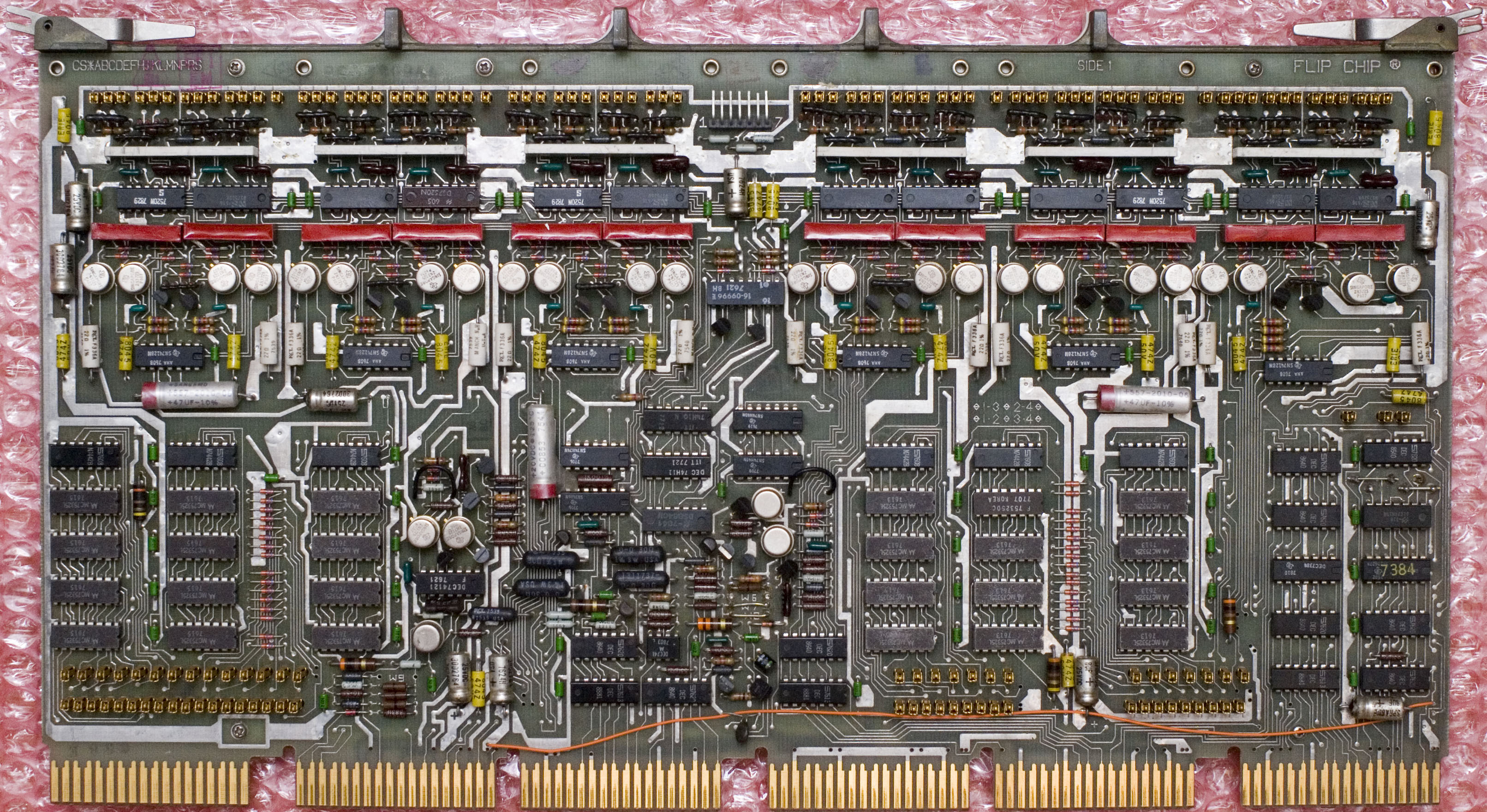
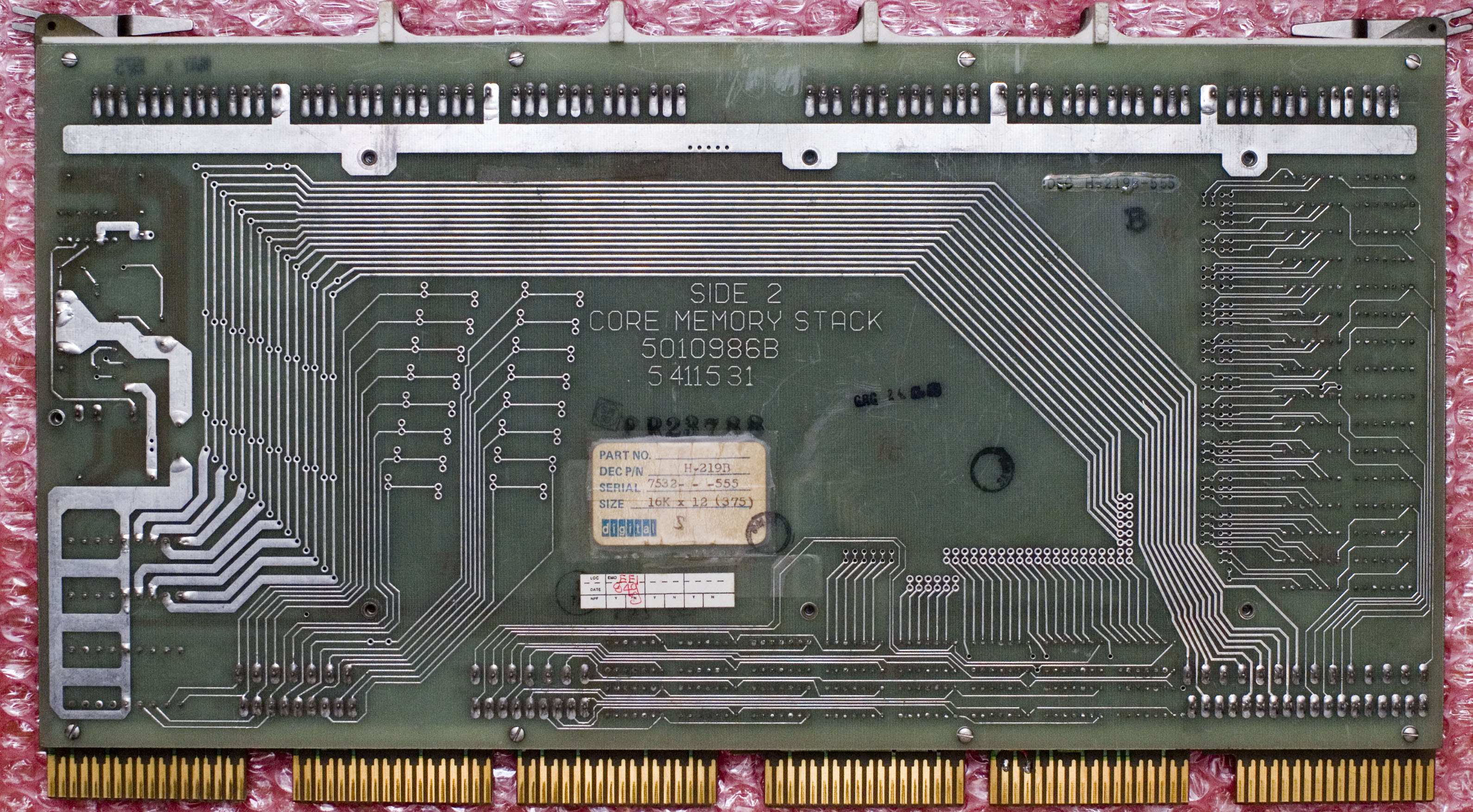
> I have a question about memory configuration. I have two core stacks
> from different suppliers. One from DEC and one from Dataram corp. The
> later one is impossible to find any information on. The DEC stack is a
> MM8-AB 16k module but the address field configuration looks strange.
> If I interpreted the manual correct it's configured as a 8k module
> using field 4-5.
>
> Picture of the jumpers on the actual board:
> http://www.abc80.net/docs/pdp8/pdp8a/DSC_2258.JPG
>
> Pictures on the complete board on both sides.
> http://www.abc80.net/docs/pdp8/pdp8a/DSC_2252.JPG
> http://www.abc80.net/docs/pdp8/pdp8a/DSC_2253.JPG
>
> The board is known good and does not origin from this particular machine.
>
> Does anybody know why this looks like this?
>
> /Anders
>
The PDP-8/A Operator's handbook at
http://bitsavers.informatik.uni-stuttgart.de/pdf/dec/pdp8/pdp8a/EK-8A001-OP…,
page 3-30 states that two BC08R cables are used. The Digital Cables
Handbook at http://www.pdp8online.com/bklatt/cables.html describe the
BC08R on pages 30 & 31. Page 31 shows the pinout.
About the Dataram module: Does any of the info at
http://bitsavers.informatik.uni-stuttgart.de/pdf/dataram/ help? Also,
there is a Dataram company (http://www.dataram.com/) still in business
providing computer memory products (since 1967). Have you tried to
contact them? You might get lucky, especially if they like the idea
of one of their "early" products still in operation after 30+ years.
The MM8-AA & MM8-AB Engineering Specification at
http://www.pdp8online.com/pdp8cgi/query_docs/tifftopdf.pl/pdp8prints/mm8aa.…
shows that your jumpers are in locations 1-3 & 3-4. It then states
that those two jumpers, in combination, will configure the module for
memory locations 32K-48K, which it then states are "presently not
available." But it was written in 1975. However, the 1978 KT8-A
Memory Management Control (EK-KT08A-UG-001 at
http://bitsavers.informatik.uni-stuttgart.de/pdf/dec/pdp8/pdp8a/EK-KT08A-UG…)
allows an -8/A to use up to 128K of any -8/A memory type. Perhaps the
previous user of the MM8-AB module had the KT8-A module to allow the
use of more than 32K?
Bob