Does anyone know if an ECO exists to convert a REV11 board (M9400) to 22-bit,
in the same way that an ECO exists to convert BDV11's to 22-bit? (On the
BDV11, there's a resistor pack with 4 unused pull-up/down pairs, making it a
really trivial ECO.)
Noel
> From: Ben Sinclair
> It halts back to ODT at 00104
Depending on how the vectors are set up, that could be an unhandled clock
interrupt. Common practise is to set the vectors at X to point to X-2, and
put a HALT instruction in X+2. 0100 is the line clock interrupt vector.
> there is a strange modification... On my original M8186, there is a
> capacitor on the left, after the first row of chips, when looking at it
> from the tab side.
You mean the component side?
> The "new" one has that capacitor replaced with a piece of perfboard
> with two smaller capacitors, and a two pin connector. I have no idea
> what that might be
Maybe the electrolytic failed, and the person couldn't find the right size
replacement, so used two smaller ones in parallel?
> When I run the program, it halts at 000014.
That means it trapped through location 010 (illegal instruction); the vector
there points to location 012; it executed the HALT instruction at 012, and
stopped with the PC containing 014 (the location of the next instruction -
see the description of the HALT instruction in most versions of the PDP-11
processor manual).
To find out the location of the illegal instruction, you need to look on the
stack: R6 (the SP) will point to to top of the stack, and the PC and PS at
the time the illegal instruction were seen will be the top two things on the
stack. (I forget whether they are in (SP) and (SP+2), or (SP+2) and (SP+4).
And I forget whether the saved PC is the address of the bad instruction, or
if the PC has already been incremented to point at the next instruction.)
But I'm not sure that's really going to tell you much. If it's a hardware
flaky, the fault may be happening on a perfectly good instuction.
> the error address should be in R1, which reads as 004330. I did try and
> write to that location, and it reads back fine.
But if you trapped through 10, that's not caused by that memory location
being a problem.
> I'm confused though, because it halts at 000014, but that program
> doesn't have an instruction at 000014. .. I would have thought it would
> halt on some location that actually had an instruction.
After a HALT instruction, the PC points to the _next_ instruction after
the HALT. So the HALT was at 012.
> What exactly does the aux switch on the front panel control? I assumed
> it was power to the AC plug on the back of the machine, but it must do
> something else.
Well, it depends on what model of box you have, and how it's configured, but
on standard DEC LSI11 boxes (the ones with three switches; Restart, Run/Halt,
and Aux), the Aux can be configured (and normally is) to turn the Line
Clock off and on; the Aux power thing is an optional behaviour.
That would definitely fit the symptoms and behaviour you describe.
> From the documentation, I don't see that it does anything other than
> control that AC plug.
There's documentation somewhere (don't recall off the top of my head - it
won't be in the processor card stuff, it will be in the box documentation)
about how to configure the Aux switch. Basically there are some jumpers
on the PCB in the front panel.
Noel
On 10/26/2014 8:09 PM, Josh Dersch wrote:
> On 10/25/2014 10:17 PM, Don North wrote:
>> On 10/25/2014 8:14 PM, Josh Dersch wrote:
>>> I picked up a Teletype DMD 5620 (aka BLIT) terminal a couple of
>>> weeks back and I finally got the keyboard working this week; in the
>>> meantime a problem with the display has cropped up.
>>>
>>> See here for a video:
>>> http://yahozna.dyndns.org/scratch/blit/WP_20141023_001.mp4
>>>
>>> (apologies for the quality and that it's rotated 90 degrees... you
>>> get the general idea).
>>>
>>> For those without video-playback capability, essentially after
>>> warming up for awhile (generally after a couple of minutes) the
>>> screen starts shaking horizontally; like the horizontal position is
>>> oscillating rapidly. This causes "fringes" on the horizontal edges
>>> of the picture, as this oscillation occurs multiple times during the
>>> course of a single rescan. Generally it gets worse and worse the
>>> longer it's been on, though sometimes it will stabilize for a little
>>> while.
>>>
>>> I thought it might be a bad solder joint and I started prodding
>>> around with a dowel when the set was "cold" but I was unable to make
>>> the screen jump at all while doing so. I also cleaned the
>>> horizontal position and horizontal oscillator pots with some contact
>>> cleaner to no real effect.
>>>
>>> I am not particularly good with CRTs, working on them is not my
>>> favorite thing, something about the high voltages I guess :). Anyone
>>> have any suggestions?
>>>
>>> Thanks,
>>> Josh
>>>
>>
>> It appears the the screen is jumping in some integral number of
>> pixels horizontally, like 32 or 64. I don't see any vertical scan
>> line displacement.
>>
>> I would check that the digital horizontal sync (and blanking if
>> available) are rock solid, and that the digital pixel stream is gives
>> a stable eye, and
>> it solidly locked to the horizontal sync signal.
>>
>> Based on the short little movie I would suspect more of a digital
>> issue than a monitor analog issue, at least for starters.
>>
>> Don
>>
>>
>
> Thanks (to both you and JWS) for the tips. I'll see if I can get a
> scope hooked up to the sync signals sometime this week, though the way
> the behavior progresses (it gets steadily worse and the amplitude of
> the oscillations gets greater) makes me think it's probably not a
> problem with the signal coming from the display logic -- a digital
> failure I'd expect to stay approximately the same, something that
> increases in magnitude over time seems more like an analog thing, but
> maybe I'm jumping to conclusions :).
>
> At any rate, it doesn't appear to be a thermal issue -- I powered it
> on this afternoon and it's now immediately showing the issue, much
> worse than before; to the extent that I can hear a not-very-pleasant
> whining from the flyback that makes me nervous to run it for any
> significant length of time as I'm afraid something (like the flyback)
> might get damaged.
>
> I may attempt a recap at some point (when I find time -- I don't know
> why I keep getting into new projects when I have no time for them...)
> since it's likely due anyway. There are a lot of capacitors to
> enumerate and stuffed into a relatively tight space. Did I mention
> that I hate working on CRTs? :)
>
> Thanks again,
> - Josh
>
>
Just a a quick follow-up here: I recapped the BLIT this weekend.
Recapping the monitor's power supply had no effect but after doing the
main PCB it seems to be humming along nicely. I also redid the logic
power supply while I was at it.
Now to fix the mouse...
- Josh
More stuff cleaning out from the move
Got the following in working condition. These are all zero footprint
and fit under the Compact mac machines. Also stacks nicely next to the
Mac II Series
Apple 20SC External SCSI Hard Drive- Commonly used with the Mac Plus and SE
Apple Tape Backup 40SC- Tape Backup drive Uses QIC Tape
Apple CDSC Single Speed CD-ROM Drive
Decided to take a good shot at putting my only S-100 serial board to use.
Figured the place to start was ID'ing the connector pin-outs so I could set
up a cable and begin the process.
Lacking any docs whatsoever, all I could do was trace out the PCB and try
to ascertain what was what. So here's what I've come up with - can +you+
figure out which pin is which?
Board has two outputs, J1 & J2. They are standard 10-pin DIP headers, using
the standard numbering scheme. We'll look at J1; J2 is essentially the
same, but routes to different pins / chips / transistors.
Pin 1 - Col. of 2N3906 (Base is driven by opt. 2 of 1458 - see Pin 7)
Pin 2 - Pin 28 (DB3) of both 1014 & 1015 UARTs
Pin 3 - 1K pull-up to Vcc (12V? Same Vcc as 1458s)
Pin 4 - 150R -> 47R -> Pin 6 w/ XNOR input 1A at 150/47 junction
Pin 5 - n/c
Pin 6 - 47R -> 150R -> Pin 4 w/ XNOR input 1A at 150/47 junction
Pin 7 - 1K2 -> opt. 2 of 1458 (see Pin 1)
Pin 8 - GND
Pin 9 - 1458 opt. 1
Pin 10 - GND
So we have what looks like three (3) each Inputs & Outputs, plus a Vcc and
GNDs:
Inputs - Pin 2, 4, 6
Outputs - Pin 1, 7, 9
Vcc - Pin 3
Gnd - Pin 8, 10
So.. what do +you+ make of it? =)
Just clearing out more stuff, got the following commodore 64 items that
need a home
Jim Brain's ZoomFloppy- Allows you to connect your 1541 to your PC to
make Floppy Disks- Works Great. First $20 shipped takes it
Comet64 Internet Modem- Serial to Ethernet Adapter for your C64, Also
allows you to use Virtual Disks over the internet.
First $25 shipped takes it.
User Port Relay Cartridge
Essentially a GPIO Cart for the C64, you can turn relays on and off
through basic
$20 shipped Takes it
I just moved into a new place, and after moving the amount of computer
stuff I have, Ive decided that I need to thin the collection.
I have the following
Nice original Mac 128k with carry bag, manuals, original ssw disks,
boxed external 1200 modem, external floppy disk drive And Imagewriter
I- Everything is there except the box, Has boxed Mac Software with it
too, MacTerminal, Mac Pascal. MacPaint/MacWrite. Even the original
audio cassette tour tape.
Mac 512k- Has Aldus Asset Tag on it #201- Former Pagemaker Dev
machine, with external hard to find Hard Disk 20, the one that
connects to the floppy port.
Macintosh Plus- Works but needs a keyboard & Mouse
Macintosh Classic- Works but needs a cap job.
Make a fair offer on anything. It needs to go
> From: Al Kossow
> It's pretty much just the odd manual from here and there that I'm
> adding now.
Speaking of which, is there by any chance a master list somewhere of stuff
you're looking for? Or if Manx says 'not available online', can I take that to
the bank? (Although identifying missing things that way's kind of tedious -
one has to type each document's ID into Google to see if it's available.)
Because I just bought a big stack of stuff, and perhaps some of it is stuff
that's not available online - if so, I'd be happy to scan any such.
Noel
> From: Johnny Billquist
>> (.. the page in the 11/94 User Guide .. pg. 1-4 - is missing from
>> all the online copies of that manual which I checked.)
>> ...
>> the pinout on the board is given in the KDJ11-E User's Guide
>> (EK-KDJ1E-UG-001, available online)
> PDP-11/9x manuals are not scarce at all. Where do you people search???
> 11/93:
> http://bitsavers.trailing-edge.com/pdf/dec/pdp11/1193/EK-KDJ1E-UG-001_KDJ11…
> 11/94:
> http://bitsavers.trailing-edge.com/pdf/dec/pdp11/1194/EK-PDP94-MG-001_Sep90…
If you actually read my message (the one you included in your reply), you
will see that I referenced _both_ of those (the 94 'MG' document is fully
titled the 'System User and Maintainence Guide' - I shorted that mouthful to
make it less work to type), and indicated they were available online.
And the '93' manual you list is not for the 93, but rather is for the KDJ11-E
CPU card, which is used in _both_ the 93 and 94. (That document is also
mostly duplicative of the 94-MG.) Needless to say, there's a lot more to
those systems than the CPU card, although some of it (e.g. the power
supplies) _may_ be documented separately; I haven't checked.
Typical DEC systems have a lot of other documents, none of which seem to be
available online for the 93/94, including (typically):
User Manual
Technical Manual
Maintainence Manual
Field Maintainence Print Set
Illustrated Parts Breakdown
For the KDJ11-E there does seem to be the "KDJ11-E CPU System Maintenance
Manual" (EK-403AA-MM-001), but that doesn't seem to be available online.
The one 11/94 document I know of (the System User and Maintainence Guide)
does reference the Field Maintainence Print Set for the 11/94 (MP-02637-01 -
but according to Manx, that's not available online), and the IPB. So probably
the other ones don't exist for the /94.
I don't know which of these documents even exist for the /93, since I can't
find a single 93-specific document - which might list what other /93
documents exist.
Noel
> From: Roe Peterson
> Can anyone point me at the pinouts for the KDJ11-E pdp11/93 DB9 rs232
> connectors for the extra 7 (simulated) DL11s?
Alas, documentation on the 11/93-94 seems to be very scarce on the ground.
(And, just for grins, the page in the 11/94 User Guide which has the section -
1.2.6 - which talks, however briefly, about that panel - pg. 1-4 - is missing
>from all the online copies of that manual which I checked.)
The only thing I can suggest is that if you actually have the cable, the
pinout on the board is given in the KDJ11-E User's Guide (EK-KDJ1E-UG-001,
available online), on pg. 88-91 (aka 2-13 to 2-16), and an ohm-meter and some
time will give you the pinout of one of the DB9's - presumably they are all
the same, from there.
Noel
Hi all,
I've got a 5160 here with the XT keyboard - however it's got the 64/256K
motherboard fitted (with the "early" Jan '86 EPROMs), and Wikipedia seems
to claim that by the time the 64/256K boards came out the machines were
shipped with 102-key keyboards (the XT flavor of the Model M, I assume).
Anyone know if that's true, and so my system should technically have a
"full size" keyboard, or was there a crossover period where systems with
the newer boards shipped with the 83-key XT keyboards?
Everything else about the machine suggests it was built sometime '86 (dates
on the PSU, IC date codes on the expansion boards etc.), although it has a
20MB F/H IBM hard drive (rather than the H/H Seagates that I think the
newer systems got). There's no ID info on the underside of the keyboard
like there is on my Model M; I'm not sure if there should be.
Also, I'm missing the silver keyboard decal - I believe these just said
"IBM personal computer" like they did for the 5150, even though the 5160
case decal mentions XT. Does anyone have one they could pull from an
otherwise-junk keyboard that they might be willing to part with?
cheers
Jules
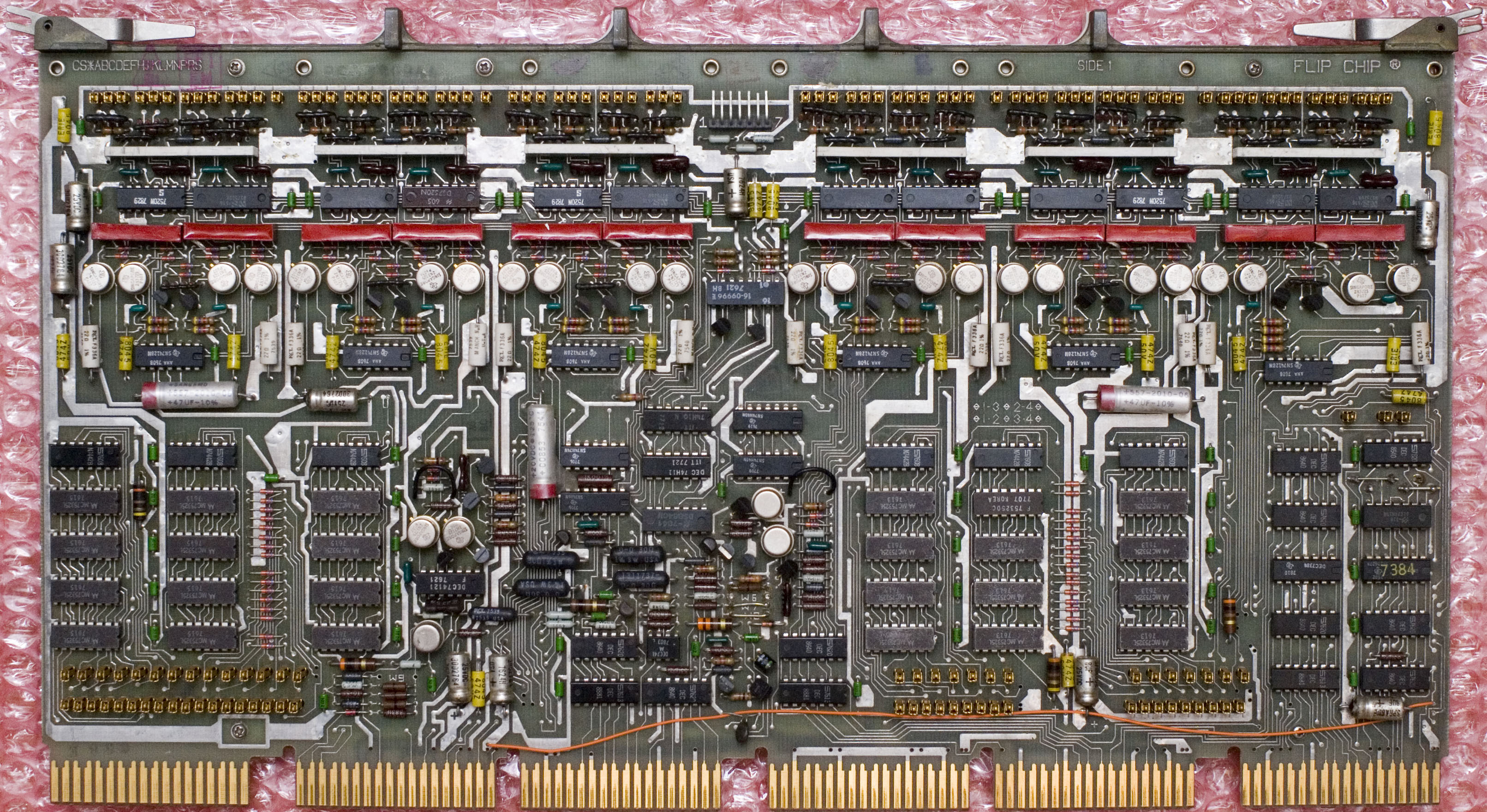
I can't tell for sure, but this auction may be for PDP8 core board.
KT-KEARNEY-TRECKER-ASSY-KT83-0933-KT84-020-SYSTEM-BOARD
http://www.ebay.com/itm/181565552717
board is 6 across in size.
From what I could find out K&T used PDP8 for NC controlled machines at
some time.
There is also this sort of board. The silkscreen shows a Microprocessor
section outlined with a 40 pin ceramic gold chip.
I am going to query the vendor to get a picture where you can read what
is on the can, or get the text on the can. Maybe the thing is a Harris
part, don't know.
Since the listing is for Giddings and Lewis, which is either a
subsidiary or competitor of K&T it may be another completely different
system. It looks like K&T, G&L and Cincinnati Millacron had a number of
legal runnins as there were several lawsuits in the google hits when
looking these boards up.
CM used an OEM Microdata 1600, and later 3 generations of their own 1600
derived designs before moving on to other newer microprocessor scale
parts. The CM 800, and 900 and one later are all 1600s, or near
relatives os such. The 900 uses 8K, 16K microdata manufactured core
boards, and also the Ampex / CDC 32k core board. I buy all those that
show up cheap on the usual auction site.
Here is the processor board:
GIDDINGS-LEWIS-KT-KEARNEY-TRECKER-871-20410-05-SYSTEM-BOARD
http://www.ebay.com/itm/181564464339
Jim
> From: Henk Gooijen
> I wanted to connect a VT510 to the console port. All connectors are
> DE-9
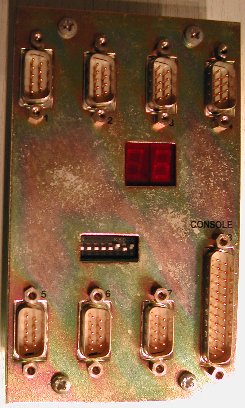
Really? The PDP-11/94-E User Guide (EK-PDP94-MG-001), available online in a
number of places, shows (pg 46, aka 2-18) the Console/SLU panel, and the
Console connector is much larger than the SLU connectors. (The illustration
shows a 23-pin D-type connector - presumably an error, it should have been
25.) And here:
http://www.pdp-11.nl/pdp11-93/rear-panel-small.jpg
is a picture of one, and it indeed has the 25-pin console connector.
Although I suppose it's possible they changed the actual hardware at some
point, and some real machines have a 9-pin D-type? Or maybe a VAX of some
sort uses a similar panel, but with all 9-pin D-types, and someone had
stuck on of those on that machine?
> What worked for me is the "VAX console cable", in other words: that
> DE-9 connectors is NOT "PC alike"! You can find the VAX console cable
> pinout on the web.
Good catch! It makes sense that the VAX and 11/93-94 use the same 9-pin
D-type pinout; that way they'd only have to have one kind of cable.
Noel
I have a pdp-11/70 front panel, but no bezel. Does anyone here have one?
I understand that the 11/40, 11/45, 11/50, 11/55, and 11/70 had identical
bezels.
--
David Griffith
dgriffi at cs.csubak.edu
Folks,
I have just bought one of these and it is behaving oddly. I think the PSU
regulation is faulty. Does any one have a schematic of the PSU, or even just
the regulator board. I think the US and UK actually have the same PSU as my
UK version has 2 x 110 Volt primaries strapped in series. .
Dave Wade
G4UGM
Yet another "oh, let's spend an evening doing a small project" that's
ballooned into a major undertaking:
I thought I'd try my hand at getting my old PET up and running again;
this is an original "chiclet" keyboard model (with 6550 RAMs and no CRT
Controller chip). There are a multitude of problems with it (the CPU
isn't resetting, I'm sure there's bad RAM and ROM) but I thought I'd
start with the most obvious fault -- the video generation.
Here's a picture of what it's currently doing (sorry it's not very
good...) : http://yahozna.dyndns.org/scratch/pet/oneline.jpg
It's only drawing a single line of characters (garbage with some noise
due to a very terrible socket holding the character ROM), centered
vertically. I initially thought this was a VRAM addressing issue (a
stuck counter or whatnot) but it turns out the VSync signal is much too
fast -- it's only about 1.2ms long (it's supposed to be about 16ms).
I'm actually surprised the monitor can deal with that without damage, so
I've been leaving the monitor disconnected while debugging. The HSync
period is correct (63.8us or so), and most of the addressing / character
display logic (which is driven by earlier portions of the video timing
chain) seems to be running correctly, it's just only getting a chance to
draw one line of characters before the next frame starts.
I'm not having much luck tracing down the fault; I have a schematic
(http://www.zimmers.net/anonftp/pub/cbm/schematics/computers/pet/2001/320008…)
but it's not making it easy to work out exactly how everything ties
together. I can't find anything resembling a service manual for this
model, but perhaps I haven't looked hard enough yet.
The initial clock (output of E2 pin 6) is correct at 8Mhz; this is
divided down to 2Mhz by the counter at C9 (pin 8, the divide by 4
output), which is passed to the 74LS107 at C7 and from here it gets
murky and I don't quite see how things fit. I did replace C7 to no
effect (ok, I jumped to conclusions...). The divided clock outputs (Q,
pins 3/2) from this have a period of about 256us; the LS107 at B6
divides this down to the final period of 1.2ms which is used for the
VSync signal.
Has anyone here any experience with this hardware? Any tips?
Thanks,
Josh
For those that remember "Bits & Bytes" and "The Academy on Computers"
that aired on TVOntario in 1983, I have some great news!
While sadly
Jim Butterfield passed away in 2007, co-host of the Academy, Jack
Livesley, is still around and will be coming to the Personal Computer
Museum (http://www.pcmuseum.ca) in Brantford, Ontario, Canada to do a
live Q&A Saturday November 15, 2014 at 1:00 PM EST.
For those that are
not aware, the Personal Computer Museum is a not-for-profit and the only
interactive personal computer museum in Canada. It is also home to
Canada's largest videogame collection (over 15,000 games and counting)
and also home to the largest known collection of CED video discs
too!
The visit is of significance to me personally because Jack was one
of the people that inspired me to choose computers as a career path. He
will be accompanied by Karl Hildon, who was the editor of "Transactor"
magazine which folks that loved Commodore computers will definitely
remember as well.
Directions and more information can be found on our
website. For a glimpse at Jack and more details on the event, please see
http://pcmuseum.ca/jacklivesley.asp
Admission is free although
donations of electronics and money are always appreciated!
Make Offer If Interested, Thanks
Sun Microsystems Server / 2 units
- Sunfire 6800
- Removed from working condition
Inter-Tel (100+ units / Cords and Headsets were disconnected)
- Model ? Standard Digital Terminal
- Part Number ? 550.4400
Inter-Tel (50+ units) / Cords and Headsets attached)
- Model ? 8520
- Part Number ? 550.7200
NEC (25+ units) / Cords and Headsets attached)
- Model ? DTH-8D-2(BK)TEL
- Part Number ? Dterm 80
T.O.W.E.R. Surplus
Steve Swindell
(412) 657-2800
[AIM: (Steve Swindell)
towersurplus at gmail.com]
The drop in list traffic yesterday was my fault. The problem was on a system
unrelated to the classiccmp server, but it only affected the classiccmp
server. I believe it would have impacted just over a day of traffic. Problem
resolved, and my apologies.
Details for the tech oriented:
Our hosting service has two front end mail processors (mx1/mx2) that do a
lot of quick/basic checks before passing mail onto the backend mailbox
servers. One of them had an issue and had to be restored from a backup that
was a couple weeks old. We don't normally think anything of that in this
particular case, because the config files on a front end mx basically never
change so any backup is good. Much to my chagrin, I didn't realize that the
backup for mx2 was taken BEFORE switching the mail stream for classiccmp.org
>from the old ccmp server to the new one. Since both front end mail servers
are equal preference, that means that about half the inbound mail for
classiccmp.org was being directed to the old server which has pretty much
been sliced up as things were migrated to the new server. Last night I
changed mx2 to deliver to the correct/new classiccmp server (mx1 was already
doing so), and that fixed the problem. Newbie mistake, my apologies.
Best,
J
Hrm?
-------- Forwarded Message --------
Subject: Undelivered Mail Returned to Sender
Date: Thu, 13 Nov 2014 18:39:13 -0600 (CST)
From: Mail Delivery System <MAILER-DAEMON at classiccmp.org>
To: woyciesjes at sbcglobal.net
This is the mail system at host huey.classiccmp.org.
I'm sorry to have to inform you that your message could not
be delivered to one or more recipients. It's attached below.
For further assistance, please send mail to postmaster.
If you do so, please include this problem report. You can
delete your own text from the attached returned message.
The mail system
<General at classiccmp.org>: unknown user: "general"
--
--- Dave Woyciesjes
--- CompTIA A+ Certified IT Tech - http://certification.comptia.org/
--- HDI Certified Support Center Analyst - http://www.ThinkHDI.com/
Registered Linux user number 464583
"Computers have lots of memory but no imagination."
"The problem with troubleshooting is that trouble shoots back."
- from some guy on the internet.
I have several untested spare boards for HP3000 9xx series systems
available for shipping from 94025.
1. 802.3 interface board (HP 27125-80201) - I have a mystery cable that may
go with this board, included.
2. HP-IB interface (HP 27110-60301) with couple cables
3. MUX card (HP 27140-60001) - this may be for a HP-UX 800 Series machines.
First come, first serve. Contact me off-list via lee_courtney at acm.org
--
Lee Courtney
Hello all,
we have two machines in our collection: a 8515 and a phoenix, both
rebranded to OCE, a dutch plotter manufacurer. Both machines are missing
their bootmedia. is someone able to copy those or image them?
The 8515 uses 8" media, the phoenix 3.5"
--
Met vriendelijke Groet,
Simon Claessen
drukknop.nl
I've got a bunch (maybe half a dozen) 600 ohm - to -600 ohm telco line
transformers. Nice units, maybe 5 inches tall by 2.5 inches wide, and
potted. Use 4 8/32 screws for mounting.
Is there any use for this stuff? Does anyone want them?
--Chuck
Just taking a stab.. I've run out of options trying to locate docs for the
lone S-100 serial board in my stash, so I think it's time to look for a new
unit. I don't own a logic analyzer, nor have I sufficient experience to
figure out how to put my current board to use in the absence of docs.. so
it goes.
Does anyone have an S-100 (for Altair, in specific) RS-232 / serial
communications board with available documentation? Just looking for
something that can be made to work with a common serial terminal (emulated)
so I can play around with BASIC and so forth. Plan is to use a basic 486 /
Pentium laptop running Linux + Minicom or similar to emulate a VT-whatever
on the Altair's comms port.
(As an aside.. a bit of a mea culpa - I +did+ once own a genuine ITT (I
think it was ITT) tele-tank with a paper tape machine. Picked it up for $15
at a local electronics surplus - AxMan - back in the early 1980s. It didn't
work right.. or at least I had no idea what to do with it. When powered-up,
it would begin to print blank lines over & over, line after line.. just sat
there, running away like crazy doing nothing.
I had not the slightest idea how to deal with it, so I removed the works
>from the top of the base, and THREW IT OUT OF MY SECOND-FLOOR BEDROOM
WINDOW. It was so heavy, I didn't want to have to carry it back down. The
base served as an excellent printer stand for several years, and the
not-so-obvious access panel did well to conceal various contraband during
the same period.)
Hello,
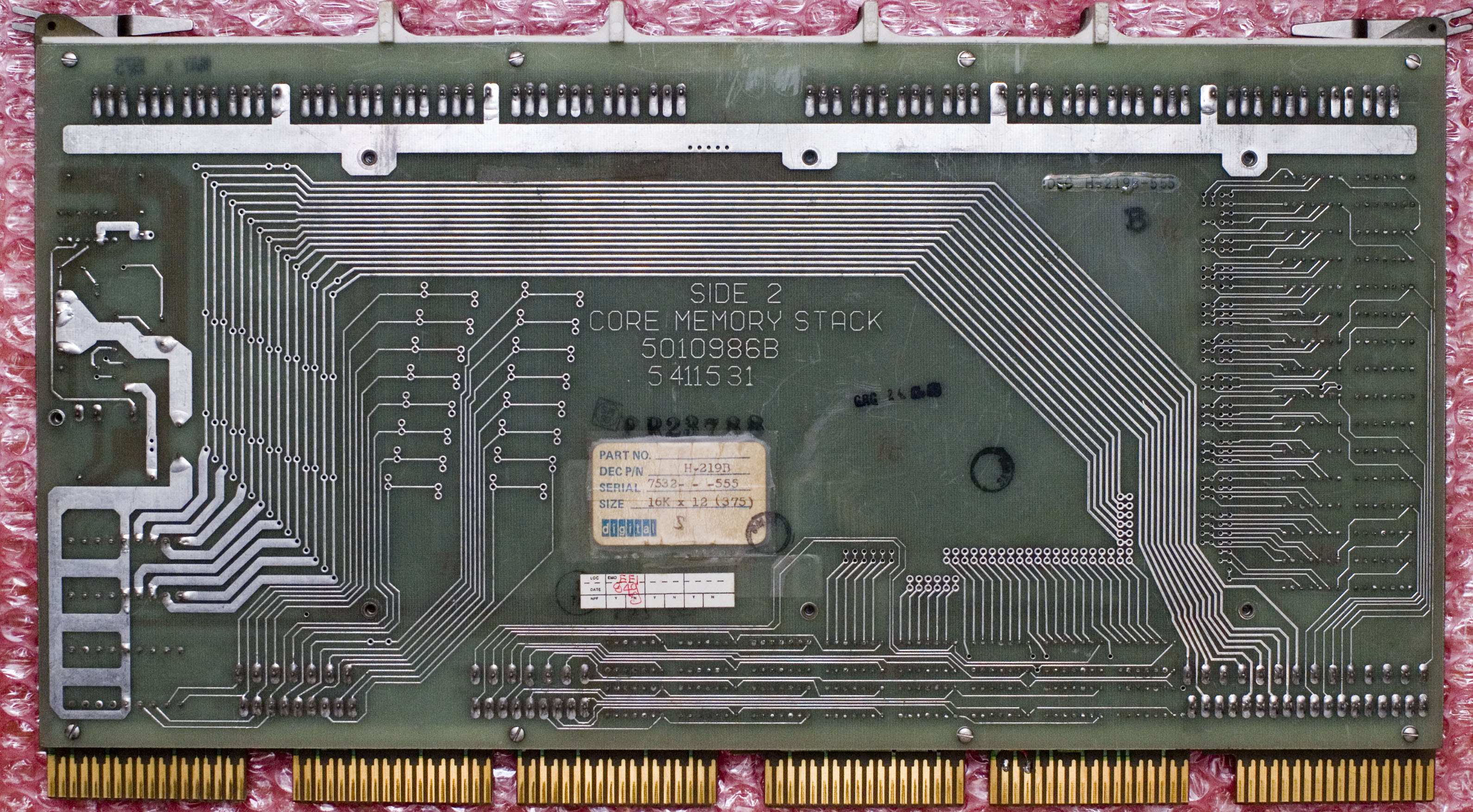
Here is some hi resolution pictures on front/back of a MM8-AB 16K core.
Fits perfectly in a PDP-8a that has the correct power supply (G8018).
http://www.abc80.net/docs/pdp8/pdp8a/DSC_2252.JPGhttp://www.abc80.net/docs/pdp8/pdp8a/DSC_2253.JPG
The picture on ebay is really bad, but you can see that it is the same.
/Anders
> Message: 5
> Date: Wed, 12 Nov 2014 08:47:37 +0100
> From: Mattis Lind <mattislind at gmail.com>
> To: "General Discussion: On-Topic and Off-Topic Posts"
> <cctalk at classiccmp.org>
> Subject: Re: Kearney & Trecker Core memory, may be PDP8
> Message-ID:
> <CABr82SLXMERy5JWVtoCvpC07EuLJydYLvcEuGEaTyU=QHB00Xw at mail.gmail.com>
> Content-Type: text/plain; charset=UTF-8
>
> This is another Ebay item which seems to be identical :
> http://www.ebay.com/itm/DEC-H219B-16K-x-12-Core-Memory-Stack-Board-Flip-Chi…
> .
>
> Also indicate PDP8/a system core mem, MM8-AB.
>
> 2014-11-12 8:41 GMT+01:00 Mattis Lind <mattislind at gmail.com>:
>
>> Looking at page 3-17 of
>> http://bitsavers.informatik.uni-stuttgart.de/pdf/dec/pdp8/pdp8a/EK-8A001-OP…
>> shows that it is as far as I can see identical to the 16 k MM8-AB.
>>
>> 2014-11-12 8:13 GMT+01:00 Paul Anderson <useddec at gmail.com>:
>>
>>> pic #4 shows a DEC core sticker on the back, but out of focus.
>>>
>>> On Wed, Nov 12, 2014 at 1:09 AM, jwsmobile <jws at jwsss.com> wrote:
>>>
>>> >
>>> > On 11/11/2014 9:12 PM, Jon Elson wrote:
>>> >
>>> >> On 11/11/2014 09:18 PM, Johnny Billquist wrote:
>>> >>
>>> >>> On 2014-11-12 04:00, Jon Elson wrote:
>>> >>>
>>> >>>> On 11/11/2014 07:33 PM, jwsmobile wrote:
>>> >>>>
>>> >>>>> I can't tell for sure, but this auction may be for PDP8 core
>>> board.
>>> >>>>>
>>> >>>>> KT-KEARNEY-TRECKER-ASSY-KT83-0933-KT84-020-SYSTEM-BOARD
>>> >>>>>
>>> >>>>> http://www.ebay.com/itm/181565552717
>>> >>>>>
>>> >>>>>
>>> >>>>
>>> >>> The fact that the board have four edge connectors and not six
>>> totally
>>> >>> excludes PDP-11.
>>> >>>
>>> >> The first and last picture of the ebay listing above clearly has SIX
>>> edge
>>> >> connectors.
>>> >> And, in fact, a number of PDP-11 peripheral boards had only 4
>>> connectors.
>>> >> CPU boards and memory did usually have 6.
>>> >>
>>> >> Jon
>>> >>
>>> >>
>>> >> I based my PDP8 on googling and looking for comments about the
>>> processor
>>> > type. There was a history page which said they used PDP8s in their
>>> > designs. I know that the 6 up is more common for PDP11, but wanted
>>> to
>>> > throw it out there. I figured a core board of the right variety for
>>> $195
>>> > might be a steal since the seller didn't list it to be on the DEC
>>> hardware
>>> > searches on Ebay.
>>> >
>>> > Thanks for Al's comment on the 6800 board. I see about half of all
>>> photos
>>> > being crap these days on ebay. I was crossing fingers it would be a
>>> design
>>> > that started out as an actual dec, and maybe had a small board built
>>> up
>>> > with a Harris pdp processor on it. I know that is a really long
>>> shot,
>>> but
>>> > not impossible.
>>> >
>>> > thanks for the comments.
>>> > Jim
>>> >
>>>
>>
>>
>
Hi all --
Got myself a nice looking DECwriter Correspondent (AKA the LA12). It's
having a bit of trouble moving the carriage assembly and I can't find a
service manual for this thing. (It's similar in some respects to the
DECwriter IV, but the mechanical parts appear to be fairly different.)
The carriage assembly (print head, ribbon) is carried from one end of
the platen to the other via a cable attached to a servo motor on one end
and a pulley on the other; in the middle of this cable is a small metal
ball -- this ball is (as far as I can tell) meant to sit in a small
"cup" on the underside of the carriage and when the cable moves, the
ball pulls the carriage along. I'm assuming this was done this way
since the Correspondent is meant to be portable, and allowing the
carriage to break free of the pulley mechanism would probably reduce
damage in the case of a sudden shock (like getting dropped.)
So far so good -- unfortunately the vast majority of the time, the ball
leaves the carriage behind (especially on carriage return) and I can't
quite figure out what's out of tolerance -- the carriage appears to move
smoothly, nothing is bent out of shape or broken as far as I can tell,
and there's plenty of tension in the cable. There's also not much to
adjust here so I'm kind of puzzled.
I've put up a few pictures (and a short video demonstrating the problem)
with the print head/ribbon removed here:
http://yahozna.dyndns.org/scratch/la12
Anyone ever worked on one of these before? Any ideas?
Thanks as always,
Josh
FTP has been re-activated on the new server, so those who have
websites/content on the machine can again get in via ftp to
add/remove/change content.
J
Greetings folks.
The additional drive was added to ccmp server last night. No problems
encountered other than for some oddball reason xenserver added it as drive 4
instead of drive 3. It thinks drive 3 slot is in use but it's not. I can
live with ada3p1 ;)
I've got my hands full with some work on bitsavers as well as ongoing client
workload, and some rough edges still remain on the mailman "two views of the
same list but joined at the hip" thing. That needs to be addressed quickly
before the current/new archives get incoherent but I'm short on available
time.
So, is there anyone that is *very* well versed in mailman "under the hood"
that can do a one-time assist with the following:
1) Get the "two views of the same list but joined at the hip" working
the way it previously was. I have some details/recollections on this, but
not complete "do this" instructions.
2) There has been an ongoing issue for years with the "forgot password"
emails and/or the new subscriber email verification not working right.
3) Please for the love of god figure out why every single post to the
list gets me a "bounce rejection" notice to my mailbox and stop it.
4) Integrate multiple fragments (I have several, if that's not complete
other listmembers have mentioned they can supply any missing fragments) of
the list archives into one archive that is complete.
FYI - when rebuilding the server a couple weeks ago, I switched from
sendmail to postfix, so a passing familiarity with postfix would be helpful
as well in your endeavors above. The OS is FreeBSD r10 p11.
If anyone is versed in the above and has a bit of time to spearhead the
above tasks, please email me off-list.
Also - once the archives are cleaned up, two other folks have volunteered to
get archive searches to be "much improved".
Thanks!!
J
Here's a collection of LINC material, produced in conjunction with the LINC reunion in St. Louis a few years back - http://tinyurl.com/LINC-StLouis .
Jack
> From: Paul Anderson
> The first board is definitely a DEC core board. If it will help anyone
> I can pull a MM8-A and MM11-D and compare them to the pic to see which.
That would be really useful.
If I had to bet, I'd go with the 8: DEC SPC/MUD memory boards often have CA1
jumpered to CB1 (NPG), and I don't see that here. And the way CC1 is ganged
to CF1 to CT1 is very odd - CC1 is Parity A in an SPC/MUD slot. (Yes, it
could be for a specially wired system unit - but those don't usually use hex
cards.) And then there are a number of different kinds of component (e.g. the
transistors in the cans, TO-18 I think?) which seem to be in multiples of 12.
Too bad there's no picture of the edge of the handles to give us an M-number!
Noel
So, my local bookstore guy has an IBM 5151 monitor for sale, which is
surprising because:
a) I haven't seen *any* vintage IBM PC kit locally in the last 8 years,
b) I picked up a 5160 with an MDA display adapter but non-IBM monitor from
John over in Duluth a few weeks ago, and I was thinking what a shame it was
that it didn't have the original IBM screen.
So, it's almost like it's meant to be, or something...
Of course working condition is unknown, so before I commit to it, are there
any common showstoppers with these displays (failed CRT, yoke windings,
LOPT etc.) - or are whatever faults that may be typical with them all in
components that are still available?
(I'm kicking myself a bit because he said I was welcome to bring it home
over the weekend to try it out and then bring it back if I decided I didn't
want it - I just couldn't remember at the time if the 5151 was the MDA
display or something else, but with hindsight I probably should have just
taken it regardless!)
cheers
Jules
I'm trying to install the Whitesmiths C compiler under RSX11M using
FLX (using the Whiteshmiths c compiler distribution tape V2.25 from
bitsavers).
Alas, 'FLX' says the tape has zero files and directories, while a dump
under Linux shows definitely some contents.
I tried both the simh & tpc format, no luck here yet.
Am I missing something?
The command I used is 'flx /rs=ms0:[*,*]/do'
Thanks,
Ed
--
Dit is een HTML vrije email / This is an HTML free email.
Zeg NEE tegen de 'slimme' meter.
There's about an 80% chance that I will reboot the classiccmp server tonight
to add another 300gb drive to it. Total expected downtime would be about 30
seconds.
If I do wind up doing it tonight, I'd expect it to occur vaguely around
8:30pm-ish CST.
J
Longest of long shots, but does anyone happen to know the keyboard
connector pinout on an ADDS 4000/260 terminal?
I have such a terminal here, and it has a 6-pin RJxx-type socket, but the
keyboard which came with it would appear to be for something else, and has
a 4-pin RJxx plug (I'm not sure of the actual RJ designations, but they're
physically different, albeit close - the keyboard one fits in the
terminal's 6-way socket, but is too loose to make contact on its 4 pins)
However, the manual for the terminal mentions supporting a PC keyboard, so
it's possible that a standard PS/2 keyboard with the PS/2 connector lopped
off and replaced with a suitable RJxx connector would work - i.e. the
clocking method and scancodes are identical - if I knew the pinout (it's
also possible that the same is true of the keyboard that came with it - the
physical layout's identical to a PC, but with the addition of a 'select' key)
cheers
Jules
I found this item on eBay: a Tektronix Microlab I with 8086
personality module, but can't seem to find much about what
capabilities it provided. It doesn't seem to be in the same league as
the Fluke 9000 series (9010A etc) so what could it do? Was it simply a
way of testing out different microprocessors (like a SBC with plugin
CPUs)?
http://www.ebay.com.au/itm/380885770121
> From: Ben Sinclair
> Then, in between trying a few things (but without touching the
> hardware), the machine seemed to get very flaky.
> ...
> I tried removing the RLV11 boards, returning the machine to it's former
> state, but I have the same issue.
This is a total _guess_, but... I've recently been working with some 11/23's I
just bought, and I too had similar flakies appear mysteriously with one of
them.
I'm not sure exactly which of the below finally cured them, but you can try
the following things (one of which finally did it for me - after sitting for
a long time, the connections can possibly be slightly flaky):
- re-seat all the cards in the backplane
- re-seat the chips on the CPU card (take them out _very_ carefully, slowly
levering from all 4 corners - they are brittle, and you can fracture
the carrier if you get too aggressive)
- re-seat all the jumpers on the CPU card
I also discovered and repaired at least two cold-solder joints (one was one of
the pins for W1, the master clock control - the pin was actually loose when I
wiggled it). Cold solder joints are pretty insidious - they can work fine for
a while, and then start to give problems.
Do you have more than one memory card that you can swap in/around? That
might be it, too.
Noel
Random find in my local book store's pile of scrap electronics heading for
recycling - a Netronics Phoneme speech synthesizer. IC dates all around
mid-1982.
I just have the board, no case or anything, but it appears to be reasonably
self-contained: there's a connector for PSU, a phono which I'm guessing is
speaker out, pots for volume and pitch, and a DB-25 connector. The DB-25
only has pins 1,2,3,7 & 20 in the socket, so I'm assuming it's RS-232.
Does anyone know anything about these? Assuming it still works (it looks
like it just expects 6-9VAC or thereabouts on the PSU connector), is the
control protocol documented anywhere? DIP switch settings? (there are 8 on
the board, labelled BSY, 3, 2, /C, /C, B, P, C)
Looking at the PCB traces, it appears to allow data input by either pin 2
or 3 (dictated by the '2' and '3' DIP switch settings), but there's no data
sent out down the serial line, so communication is write-only.
I suppose it's possible that I hook up a terminal and (assuming that I have
the line parameters right) start typing English, but it's probably not that
simple ;)
cheers
Jules
What about the PVC bands to replace the original in the cassette?
Unfortunately any reference here in cctech older archives has been lost...
Thanks
Andrea
David Griffith <dgriffi at cs.csubak.edu> wrote:
> He seems to come and go. I ordered a mini-altair from him in September
of 2013 and got it around a year later.
I've run into this too many times over the years with someone who is
running a side business. Demand greatly outstrips their work process and
the owner is just inclined to keep stringing along the customers with
excuses, if any communications at all.
Years ago I ordered a lot of equipment from "The TRS-80 Recycler." It took
over a year and dozens of really lame excuses before I received it all.
Then I saw similar things happen to people who prepaid for those next
generation IMSAIs, but they never got theirs. Same thing with a supplier
or two in my other hobby, reel-to-reel tape recorders.
If I was in that situation I'd probably just stop accepting new orders
(i.e. cash) but accept backorders. Tell the buyer honestly how long it
might take and charge the money only the day it ships. But often these
guys *need* the money and keep accepting it, which is just a wrong thing to
do.
Amardeep
> Message: 9
> Date: Mon, 10 Nov 2014 10:41:03 -0600
> From: Chris Elmquist <chrise at pobox.com>
> To: "General Discussion: On-Topic Posts" <cctech at classiccmp.org>
> Subject: Re: TU58
> Message-ID: <20141110164103.GL7672 at n0jcf.net>
> Content-Type: text/plain; charset=us-ascii
>
> On Monday (11/10/2014 at 06:25AM -0800), Al Kossow wrote:
>> On 11/9/14 11:44 PM, Simon Claessen wrote:
>>
>> >I have been thinking about making an Arduino sketch to generate the
>> blocks for a new tape
>>
>> Norprine tubing works great as a replacement
>> http://www.usplastic.com/catalog/item.aspx?itemid=104207&catid=664
>>
>> The tricky part is cutting it.
>>
>> Thanks to Brad Parker for telling me about it.
>
> What's the correct ID to choose?
>
> I assume you then slip it over the aluminum hub after cleaning all the
> old roller residue from it? Do you glue the new tubing to the hub?
>
> Maybe we could get someone to cut proper sized chunks of this tubing
> with a laser cutter of some sort so that we have accurate dimensions
> with a clean edge?
>
> Chris
> --
> Chris Elmquist
>
I'll guess: no 55134, 3/8" ID x 1/2" OD x 1/16" based on a tip in an
another forum.
I wander if it could be possible to cut in a lathe if its put on a
temporary hub and cooled down with cooling spray.
I'll try to find a seller of this tube on the European side of the ocean.
The one that is refereed to above doesn't seams to ship over seas.
/Anders
Hello,
> I haven't booted my machine up yet, because it hasn't been able to
read any of its console tapes.
I have too a lot of tapes, complete and uncomplete sets of software
installation tapes,
plus two/three console versions and some with unknown content.
The problem is, many of them suffer from sticky rubber on tape (if you
try to move the rubber leader,
it will create blank spots on tape, removing the magnetic oxide substrate).
Other have a broken band. I read somewhere around, it is possible to
detach the rubber band using hot air,
and replace it with some sort of PVC strings. I would need a lot of time
to try something... but the bigger problem is not this...
I don't have a TU58 to be used on the desk to try to read the tapes, and
even better to assembl?e a new firmware allowing to format
blank tapes.
I'm trying to buy some piece of hardware since a lot of time... no luck
so far.
If anybody has a TU58, or parts, please let me know.
Andrea
The classiccmp server and it's backups were on a temporary san that hit a
bug and rebooted itself. Needless to say, dropping iscsi to a hypervisor is
not a good thing. The classiccmp vm thus rebooted itself, ran fsck, and (as
best as I can tell) the only thing corrupted was the cctalk and cctech
config.pck files (which contain the list settings and membership). The only
backup had the same corruption on it, because it ran the backup before I
noticed the problem. Anyways.
Knowing the recovery wouldn't be quick/easy anyways, I took the opportunity
to just build a new classiccmp server VM from scratch. The latest OS,
patches, dependencies, libraries, and ports. This new VM is on the new
production san so there's a pretty fair amount of additional disk space
thrown at classiccmp (and thus bitsavers). It's always amazing when I
revisit this just how many packages/services are on that machine that a
reload from scratch requires. It's been a busy few days/nights.
Things you should know:
1> The membership list for each list was recovered thanks to the hard
work of DBoone. He processed the last few days of maillogs to get the
subscriber lists back. THANK YOU D.
2> Given how we had to do #1, it is possible that a few folks that had
subscriptions weren't automatically re-subscribed (someone who set their
membership on 'no email' could be one example). Those folks will notice and
just resubscribe.
3> Given the very bizarre way we had the cctalk and cctech lists "joined
at the hip", I do not recall the magic we did to get that working properly.
I am aware that posts from one probably aren't being redirected to the other
like it used to (if at all). I'm working on refiguring that out, and any
suggestions (offlist) would be most appreciated.
4> Given that I had to recreate the lists configurations from scratch,
I'm pretty certain that I have some settings different than used to be. If
you find anything different that matters, let me know.
5> The "new" classiccmp server is currently hosting the mailing lists,
the classiccmp.org website, plus all websites that are underneath
classiccmp.org (ex. www.classiccmp.org/hp , www.classiccmp.org/cpmarchives ,
etc.). Thus, you may notice a different ip address and hostname on the
server. The new name/IP will stick till any future rebuilds.
6> The "old" classiccmp server is still up, and is hosting all the
websites that have their own domain name. Time permitting, I'll be migrating
those one at a time to the new server. During that time period - however
long it takes - ftp and rsyncd will not be available to prevent loosing
changes when cutover occurs.
7> I do not recall who all the folks were that were helping review/gate
posts between cctalk/cctech. If you were one of those folks, please let me
know asap off-list so I can get you re-added.
8> For people who have websites hosted on the classiccmp server, be
aware the new server is running mysql56, php56, and apache24 (with mod_itk).
Before your website is moved, let me know if you're aware of any breakage
that using those new versions may cause. I'd also prefer to transform any
myisam databases to innodb unless you're aware of an issue that may cause.
9> Please do not post to the list or email me directly about "hey, the
archives are gone!". They have been preserved, and time permitting they will
get imported back into the "new" mailing list (along with the missing 199x
bits that were recently mentioned). Rumor has it that someone has
volunteered to improve the archive search mechanism in the not too distant
future.
10> Many people have asked me over the past year or so to host their
classiccmp-related website, and I pushed them off due to the lack of disk
space. That is no longer an issue so if you're one of the people wanting
that (and still do), now is the time to get back in touch with me. As
always, we'll host any classiccmp-related website free of charge.
11> Within the next 30 days (at most) we'll be adding the classiccmp server
to our CDN service. The advantage: I would expect to be able to remove
any/all bandwidth limits previously in place and folks will be able to
download files from the bitsavers master very quickly and your
classiccmp-hosted websites will be a lot more snappy. The downside is,
you'll have to either be ok with it taking a while for new/changed content
on your site to be visible world-wide, or you'll need to take a look at the
api (or via a CDN website login) to invalidate the cache when you change
something. In most cases, this can be easily automated.
12> During the mailing list outage, all websites and bitsavers were still
up. It was just the mailing lists that were affected.
I'm sure there's more that I've forgotten. But.. Enjoy!
Best,
J
Anyone have one of these sets (2 or 4 CDs) for the old IBM Thinkpad? I
have a nice old timer here that I want to use for some older
applications (ancient EPROM programmer) and this would work nicely if I
could find the drivers.
At the moment I can only find invalid torrents or what certainly looks
like malware 'drivers' to download.
IBM off-loaded everything to Lenovo and there is nothing on their site
that I could find for these legacy machines. Archive.org has the support
site archived, but not the download files...
eg:
https://web.archive.org/web/20060713020434/http://www-307.ibm.com/pc/suppor…
Seems a shame to recycle a perfectly good computer just because one
can't get it running on all cylinders!
Thanks!
John :-#)#