> From: Johnny Billquist
> But for people who actually wants to read several hundred K of
> MACRO-11... Here is your chance... :-)
Ah. Was going to ask what the TCP/IP itself was written in. Well, at least
it's an 8-bit machine - think about writing a TCP/IP in PDP-10 MACRO... :-)
Noel
It is David Tumey and he is on the Greenkeys list.
Regards
Rob
> -----Original Message-----
> From: cctalk [mailto:cctalk-bounces at classiccmp.org] On Behalf Of Bill
> Sudbrink
> Sent: 14 January 2015 22:24
> To: cctalk at classiccmp.org
> Subject: Dan Tumey
>
> Is he on this list? The University of Iowa's PDP-8 restoration site says
he is
> producing beautiful replacement Teletype hammer pads:
>
> http://homepage.cs.uiowa.edu/~jones/pdp8/UI-8/log.shtml
>
> I'd love to get a few for my tty.
>
> Bill S.
Jay, leds hasn't changed much from years ago. Electronicaly, i believe any
led of same size/format/color will fit. Of course i can dig deeper if you
want
enviado do meu telemovel
Em 14/01/2015 19:25, "Jay West" <jwest at classiccmp.org> escreveu:
Yep, I'm still working on "restoration" of the Microdata Reality.
I say "restoration", because due to another restoration project that
actually has a deadline, I only have time to clean up the microdata and
repair just obvious visual brokenness, not actually start testing/repairing
it electronically. That will come after the "deadline project" J
As most know, schematics and detailed documentation are nonexistent for this
machine.
I've done the rack, the disc drive, the tape drive, and the power supply. On
to the last item, the front panel.
Virtually all of the LED's on the front panel board had so much mouse pee
that the leads on the LEDS actually corroded through, so I need to replace
them all.
Without schematics, can anyone suggest how I might go about determining a
suitable replacement LED from an electrical perspective?
Pictures at www.ezwind.net/microdata/restoration
Best,
J
Cctalk'rs,
Very exciting news to share tonight.
Al Katz and Sol Libes, who co-founded the Trenton Computer Festival
based on Roger Amidon's idea, gave we "MARCHins" permission to publish
their video of ENIAC's John Mauchly keynoting the 1977 show. It was the
first TCF keynote: there wasn't one at the 1976 show.
Claude Kagan (a Western Electric engineer who also ran a 1960s/1970s
high school computer club here in central New Jersey) gave the
introduction. There are also remarks by Kay Mauchly, who was an ENIAC
programmer, followed by some audience Q&A.
A few minutes of the video are choppy due to the original source.
Please share this far and wide!
Video is in two parts so here's the playlist:
https://www.youtube.com/playlist?list=PL_e5fSxflvrxXO5Ddh9ZXX-cli94zF3Pc
I just noticed that NTP on classiccmp stopped, it has been restarted.
My apologies, but you?ll probably want to scroll back ? day to catch any
unread messages if you didn?t notice it!
J
Sean wrote....
------------
I have Comcast business grade cable Internet to my home and I'm already hosting my own personal site and sites for a few other folks; no data caps; plenty of static IPs; not terribly slow; everything's protected with a Liebert double-conversion UPS... not totally a commercial datacenter in terms of available bandwidth or backup power capacity but nevertheless my uptimes are decent.
------------
I have said many times in the past, but as new list members pop on they are probably not aware of this.
I host the classiccmp server (which is not just the classiccmp mailing list, but a growing truckload of user websites that are classiccmp related) gratis. I do not host it on a "Comcast business grade cable internet" connection (there's a contradiction in terms in and of itself...)
This is not something I "run out of my home". One of the companies that I own is a hosting provider. We have a rather large-ish datacenter and I have dedicated a set of resources to classiccmp.
Our bandwidth is many orders of magnitude greater than a "home or business connection". Not to mention, it's managed bandwidth with load balanced connections to multiple carriers. Our infrastructure is all xenserver based, so spinning up new VM's is a mouseclick. We have quite a few SAN's so storage is not a problem at all. Full HVAC monitoring & control, power backups (oh, and we have two separate powerstations from Ameren UE ON SITE). This infrastructure is professionally managed by my company 24x7. Long story short... it's not a "home" connection.
More to the point, since I own the company, rest assured that hosting your site here is not a "till the boss finds out" or "my wife accidentally turned off the computer" type of situation.
As a result - I'm happy to host any website, ftp site, wiki, etc. etc. that is classic computer related. As long as it meets that criteria, you can host your site with us for no charge.
Best,
J
> From: Robert Jarratt
>> I've replaced LEDs many times without thinking what I am fitting.
> "without thinking" is that an impostor pretending to be Tony? :-) :-)
Foolish novice! Please consult:
http://en.wikipedia.org/wiki/Hacker_koan#Enlightenment
for enlightenment. :-)
Noel
More discussion ensued than was expected for this question.
On a minimal 4k machine (no extended memory and no EAE) and no data break
devices operating the longest latency would be that of a memory reference
instruction with a defer (indirect address) cycle. On a Straight 8 this
would be 4.5 microseconds. A single cycle data break device could have
delayed the interrupt indefinitely although I know of no such devices. A
three cycle break could extend the delay by an additional three memory
cycles (4.5 microseconds) for a total of 9 microseconds.
If the machine was equipped with an EAE then the Division instruction would
have delayed entry of the interrupt service routine by up to 35
microseconds (on a straight 8). I believe this was a 9 microsecond
instruction on the 8/e EAE.
If the machine is equipped with extended memory then there is the CIF
induced delay. CIF is the Change Instruction Field instruction. This
instruction only schedules the change. The actual change does not take
place until the next JMP I or JMS I instruction. The interrupts are masked
by the CIF until the conclusion of the indirect branch. This is because
the interrupt handler would not be able to restore the instruction field
correctly in this instance. I have been unable to think of a reason why
you would ever want to delay the indirect branch although you certainly
could do so. That means the sequence CIF followed by a JMS I would only
see the additional delay from the JMS I which is the same as the delay from
a memory reference instruction with a defer. The JMP I variant would only
be 3 microseconds.
And the greatest source of interrupt latency on a straight 8 would have
been due to the Option 189 which is the low cost A/D converter. This
option added the ability to do 6 to 12 bit A/D conversions as a CPU
instruction (6004). It performed a typical successive approximation
conversion using the MB and AC registers. When 12 bit conversion were
selected this instruction would take 56.6 microseconds to execute according
to the manual. I don't have a 189 for my straight 8 but I am planning on
hunting down the cards I don't have.
And the answer Mr Stearns gave for this question was "No matter what it is
faster than Windows."
On Mon, Jan 12, 2015 at 9:10 AM, Doug Ingraham <dpi at dustyoldcomputers.com>
wrote:
> This weeks question comes from Warren Stearns. It is a little obscure and
> specific to the PDP-8 family of computers.
>
> What is the source of the greatest latency in the interrupt system on a
> PDP-8.
>
> I have three answers, two of the answers depends on the options fitted to
> an 8.
>
> Why would this have been an important question? Interrupt latency would
> be extremely important in the field of data collection which was one of the
> principal early uses of these machines. My particular 8 was used for
> exactly this purpose in the Summer when it was hauled to a radar site and
> collected weather research data for the Institute of Atmospheric Sciences.
> I believe it was used for this from 1969 through 1972. I have several
> hundred DECTapes with some of this data. The surprising thing is we don't
> see any problems reading DECTapes that haven't been out of their box since
> the early 70's.
>
> Doug Ingraham
> PDP-8 S/N 1175
>
Is he on this list? The University of Iowa's PDP-8 restoration site
says he is producing beautiful replacement Teletype hammer pads:
http://homepage.cs.uiowa.edu/~jones/pdp8/UI-8/log.shtml
I'd love to get a few for my tty.
Bill S.
So.. about this "knowledgebase" of restoration techniques.
Apparently new folks don't know and some older listmembers don't remember...
We did start a "wiki" for people to post restoration tips, repair tips, etc.
This was done about 8 years ago. When I first brought up the idea there was
a lot of discussion on the list as to if it was a good idea or not. Many
people had very good thoughts as to why it would be wonderful, and many
other people had equally good thoughts as to why it would not be wonderful.
In any case, I set it up. We found that there was an initial flurry of
posting, and then virtually nothing. Statistics showed it was not used very
much at all. There were a handful of issues as I recall (not my
implementation of it, but in the general idea of a
repair/troubleshooting/restoration "wiki"). I only remember one of them at
the moment... and that was that someone would post an article without really
having detailed expertise in that given area and then someone that DID have
expertise in that area would (for lack of a better term) contramand that
article or write a separate one with conflicting info which made it hard for
a novice to really sift through the information. In short, everyone has an
opinion and at times the articles directly conflicted with another and
someone seeking knowledge wouldn't know who to believe.
That being said, if people really want to give this another try, I would be
happy to turn on the old classiccmp knowledge base (I'm 99% sure it's stored
but just not turned on), or I could easily have one of my support staff dump
a wiki installation to a folder there (under classiccmp) and we could give
it a try again. I'm all for it, but for it to be successful - it has to be
due to contribution/acceptance by the membership at large. My proclivity at
this point would be to install a new wiki and then pull articles already
posted in the old "wiki" into it.
And yes, if it's to be in the classiccmp.org domain, I'd have to host it. I
have not yet seen a scenario where we'd be willing to point an a-record
off-site (but that's not to say some future situation might get a different
response).
Best,
J
> From: Robert Jarratt
> It wouldn't be hard to create a wiki where this kind of information is
> collected
> ...
> Isn't there someone on the list who has been offering lots of server
> capacity? It could be hosted there.
Umm, that might have been me - I have offered to host things on a number of
occasions, and do in fact host the older ClassicComputers archives (the newer
ones are^H^H^Hwere at www.classiccmp.org).
I'm not sure I can help in this case, though. I do have access to a lot of
space (so hosting the archives is not a big deal), _but_ i) I'm a guest on
this machine, and hosting active content like a wiki would be something I'd
have to get OK'd, and ii) technically, hosting a wiki is a whole different
ball of wax from hosting static content (which I can just put in place, and
forget), and I'm not sure I have the time/energy.
If someone did, that would be great, because I think a wiki about restoring
old computers would be a really powerful resource. Not for detailed technical
content (as someone already pointed out, we have the manuals), but for:
- Articles laying out how to start, where to get stuff, what you need to
know (with lists of recommended books/etc in fields such as digital
logic, etc, etc)
- Articles on what tools/etc it's useful to to have, and recommendations for
manufacturers, models etc (e.g. an oscilloscope is pretty much a
must), and where to find them cheap
- Lists of which systems are good targets (because they're easy to find,
have good documentation available, parts availability is good,
etc, etc)
- Articles on specific topics which aren't covered in literature (e.g. the
whole discussion about capacitor reforming; the heat soak for old
tapes/floppies, etc)
- Etc, etc, etc.
All stuff that's not really written down anywhere, but which a beginning
collector (especially one who didn't work on these things 'back in the day')
would find invaluable.
Noel
> From: Johnny Billquist
> And tcp/ip already exists. At least on TOPS-20.
There are at least two TCP/IP's for PDP-10's - the other, written by Ken
Harrenstien, is the one for ITS. I'm not sure how closely related the TWENEX
one is the TENEX one done at BBN - I vaguely seem to recall that DEC re-wrote
it extensively, but I don't know much about that code.
> From: Pontus Pihlgren
> Do you mean to say that bytes are 8-bit wide on PDP-11? Why would
> PDP-10 be so much harder?3
TCP/IP header fields are all multiples of 8 bits. So anytime you want to
read/write one on a PDP-10, you have to start LDB'ing and DPB'ing through
byte pointers/descriptors all over the place. Which I'm sure is no biggie for
most experienced PDP-10 coders, but it would drive me bonkers.
Noel
Does anyone here have a contrast knob from a Compaq Portable or
good-looking substitute?
--
David Griffith
dgriffi at cs.csubak.edu
A: Because it fouls the order in which people normally read text.
Q: Why is top-posting such a bad thing?
A: Top-posting.
Q: What is the most annoying thing in e-mail?
I talked to the owner maybe 6 months ago. It was a bizarre and difficult
interaction. He refused to let me see the units, and insisted I give him an
offer first. He would not even give me the list of the items he had. We went
into a circular discussion: that I couldn't give him an offer if I didn't
know nor see what the items were, to which he replied that if I were a
serious buyer I would make him an offer beforehand, therefore I was not
serious and he would not show me the items nor give me the list. So that was
not very helpful. Then later on he sent me 3 or 4 close up pictures of only
the name badges of some of the machines (one badge from HP, maybe two of
IBM). I got the distinct impression that either something was fishy or that
the guy had unreasonable expectations. Or maybe both. I just gave up. Looks
like you are faring much better than me, so that's positive. I am interested
in the IBM system, the tapes and tape controller units mainly, if you don't
want them.
Marc
On 1/9/15 6:38 PM, Lyle Bickley wrote:
> When Bob and I initially talked to the owner, he told us that what he
> had was a major find for a collector. He spoke in glowing terms as to
> the condition of the 4341 and the HP mini (de-installed from a running
> environment and then stored for many years). So as you would expect,
> Bob and I were very anxious to see both systems. What we found was a
> serious disappointment. As Bob said, the 4341 and the HP mini were
> crammed into a storage unit with lots of other junk. It was impossible
> to see/determine what system components were actually there. There was
> no way to know how complete or what features either system had.
> Repeating what Bob said, everything was water damaged, rusty and in
> poor condition - and I do mean everything. We told him that his asking
> price was too high - and that the condition of the systems was so bad
> we wouldn't even make him an offer. Lyle
Well that's a disappointment. I'm still going to take a look at it
tomorrow...but I'm going to be prepared to walk away from it.
TTFN - Guy
hello all
i just joined and am based in Carlsbad CA. I have several servers from the 1991 (yes they include fully functional CRTs and keyboard/mouse).
After several conversions with JJ owner and curator for the San Diego Museum in Australia he suggested i contact this forum. Is anybody interested in these? I can also be reached at 760703096
I have been given a tiny piece of core memory, about 1cmx1cm. It has
obviously been cut from a larger piece and is almost certainly unusable. I
would therefore like to frame it for display and to show to young people. Is
there a recommended good way to mount the core for framing with the smallest
amount of possible damage?
Thanks
Rob
Hello everyone (new to this list),
I have in a place I need to clear an IBM System/36 class mini-computer
collecting dust. Before it ends up in scrap, I would like to make sure
is not of any value for collector/hobbyist or a computer museum for
parts or as a whole.
Any lead will help.
Thanks.
IBM's System/36 page:
https://www-03.ibm.com/ibm/history/exhibits/rochester/rochester_4018.html
Hector
Good things, bad things.
I got in love with Hostinger, and uploaded my site (www.tabalabs.com.br)
there. But seems that in the time I needed them most (my site was advertised
into a famous brazilian site) they fell down...I have a (fairly) limitted
number of pageviews in the free plan.
Anyone that could (free!) host a retrocomputing site? Less than a GB.
Thanks!
---
Enviado do meu Apple IIGS (pq eu sou chique)
Meu site: http://www.tabalabs.com.br
Meu blog: http://tabajara-labs.blogspot.com
For people in the SF Bay area
Excess Solutions moved to 1555 7th, across from Spartan Stadium and I
went down to see the new place. Mike told me he's having a grand opening
BBQ tomorrow.
This weeks question comes from Warren Stearns. It is a little obscure and
specific to the PDP-8 family of computers.
What is the source of the greatest latency in the interrupt system on a
PDP-8.
I have three answers, two of the answers depends on the options fitted to
an 8.
Why would this have been an important question? Interrupt latency would be
extremely important in the field of data collection which was one of the
principal early uses of these machines. My particular 8 was used for
exactly this purpose in the Summer when it was hauled to a radar site and
collected weather research data for the Institute of Atmospheric Sciences.
I believe it was used for this from 1969 through 1972. I have several
hundred DECTapes with some of this data. The surprising thing is we don't
see any problems reading DECTapes that haven't been out of their box since
the early 70's.
Doug Ingraham
PDP-8 S/N 1175
While this post is specifically for Tim Shoppa (as the only
person that I can think of who can answer), if anyone else
has the background, please reply.
I believe that I have found a rather inconvenient bug in
SDHX.SYS from version Y01.16 (from V05.06 of
RT-11) that can cause RT-11 to crash. If I am not
mistaken, the same bug is also present in the previous
version V01.00 of SDHX.SYS from V05.05 of
RT-11. Unfortunately, the bug can cause RT-11
to crash
There also seems to be another bug which results in the
extended memory status being displayed incorrectly,
but otherwise does not cause an actual problem.
I realize that RT-11 is rarely used these days and that
SDHX.SYS is used even less frequently, but I suggest
that these errors really need to be fixed. I would
appreciate any suggestions as to how to proceed.
Jerome Fine
So it turns out the NatSemi NS23C QBUS memory card can really, really easily
be upgraded from 256KB to 1MB, as it has all the necessary traces, jumpers,
etc for this capability built into the card - even though the NS23C
documentation says nothing about this capability!
I found out about this capability when I bought a group of QBUS cards which
included two NS23C cards. Looking at the chips, trying to figure out how big
the cards were (I didn't at that point know the card model), I saw one had
64Kx1 chips, the other had 256Kx1 - one was 256KB, the other 1MB!
Later, looking at the prints, I noticed that the memory chips had all 9
address lines wired (unlike the very similar NS23M card), and there were a
couple of jumpers that appeared to adapt the card to 1MB operation.
So I tried upgrading the second card, and it worked!
The chips are all in sockets, so pulling the 64Kx1's and replacing them with
256Kx1's was easy. There are three jumpers one has to remove/move; alas, they
are in the PCB on the top surface, although there are jumper pins there -
there's a trace running between the two pins - so you have to cut the traces.
The first two jumpers one has to remove are W23 and W24 (right next to the
other memory size jumpers), which allow one to increase the maximum memory
size to 1MB.
The other jumper one has to move, is to move the 'jumper' from W40 to W41;
this moves the pickup point for the 'RS0' signal, which indicates which bank
of chips (there are 2x18 banks, i.e. 16 data, and separate byte parity) to
activate, from address line 17 to 19.
(Parenthetically, the way the address logic works on the card is slightly
odd; if the card is not on a 'natural' boundary [e.g. a 256KB boundary, if
it's a 256KB card], the memory contents are scrambled; the low memory, in bus
address terms, is at the top of the card, in chip terms, and the high memory,
in bus terms, is at the bottom of the card. I understand why they did it that
way, it's the most economical in logic/traces, etc but it's something one
would have to remember when looking for a bad memory chip, if the card is set
to an address which is not a multiple of its size.)
Not sure if anyone else out there has any of these cards, but if so, I'd be
interested to hear if anyone does this.
Noel
I have scanned and uploaded 12 issues of "Kugram," the official
newsletter of the Kaypro Users' Group:
https://archive.org/search.php?query=kugram&sort=-publicdate
It's really "K?gram," which I'd say as "K-microgram" but the limits of
character sets and convenience probably turned it into "koo-gram."
And they refer to themselves as "kuggers," not "K-microgrammers." :)
One odd thing about these: there's no date on the covers, just Volume
and Issue numbers. However, it looks like they started publishing in
January 1983.
Anyone got any more issues laying around that I can add to this
collection? I will pay for postage to get them to me. You can have
them back, but I will have chopped their spines for easy scanning.
Also, anyone want the physical copies of the ones I've scanned? Pay
the postage and I'll send them out (there are two copies of a few of
them.) They are chopped as well.
Enjoy!
-j
I have an RK05J drive that has been sitting around for a long time, and I want to prepare it for going back into service on my PDP 8/e system.
Here's what I've done so far:
- I have replaced the foam that isolates the blower motor from the housing, as it had started to deteriorate.
- I vacuumed out the entire drive very carefully
- I removed the head-lock that was put in when the drive was transported from its original location to my location
- I ran the drive without a cartridge (and not connected to a system) for about 6 hours with the old absolute filter in place
- I removed all of the circuit boards and cleaned the edge connectors and sockets
- I tested all of the front panel lamps, and found all to be good
- I replaced the absolute filter and ran the drive for another few hours to circulate air and get any last particles of stuff filtered out.
- I very carefully cleaned the heads... they were extremely clean. I used a lint-free swap, and a commercial solution that I have that I've used for floppy disk head cleaning that seems to work well. I used this solution on the first RK05's heads, and it worked with no problems. However, the first drive was in service on the PDP 8/e when I got it, and was running fine. This second drive came off a PDP 11 system, and has been sitting for a very long time (years).
I plan on running the drive without a pack in it for about 2 hours before I try loading a pack.
I'm wondering if there is anything else that I should do before add the drive to the chain (this would be the second drive on the system)?
I am also wondering, that since I have very few PDP8-sectored RK05 packs, and a ton of PDP-11 sectored packs, if , when I first power up the drive after it has been connected up to the RK8E , I can put one of my PDP 11 packs in there and spin it up, if the controller will be able to load the heads? I'd much rather sacrifice one of these packs if there are problems rather than risk one of my precious PDP-8 sectored packs.
Thanks in advance for any suggestions/answers.
Rick Bensene
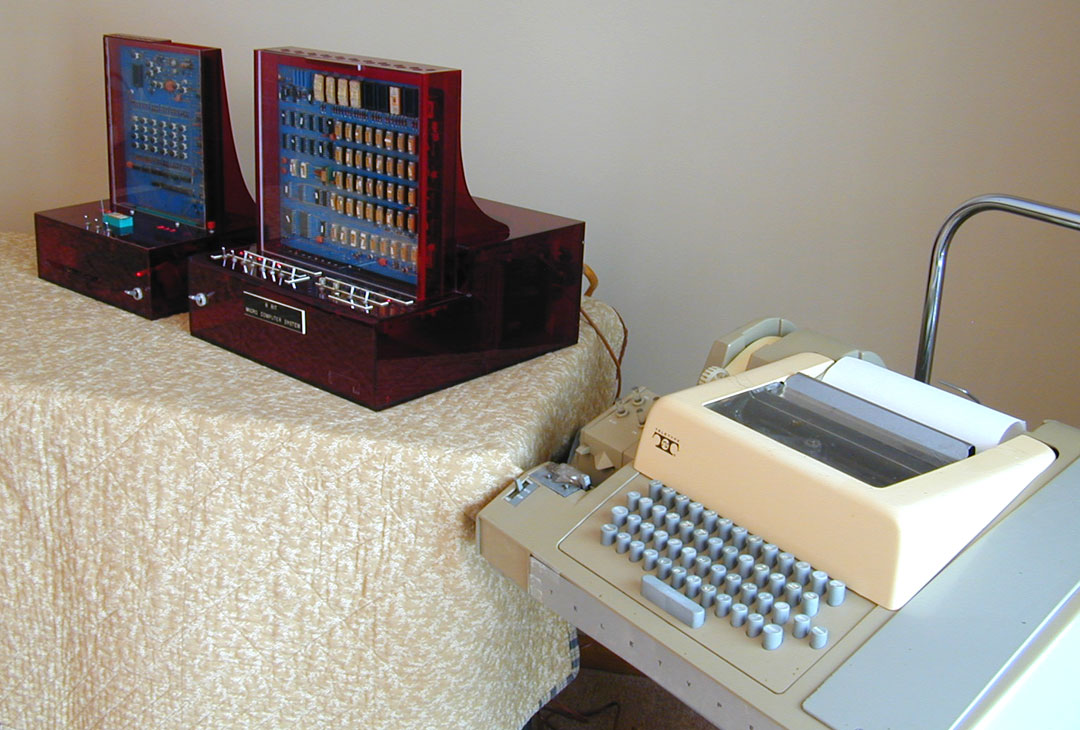
A few years ago I inquired about an early 8-bit micro in my collection that
I did not know the background on. Recently I found out the background of the
computer and thought I would share it with the history buffs here.
It was built by the Univac R&D Division in St. Paul, Minnesota in 1972. They
were carefully monitoring the developments at Intel with regard to their
4004 and 8008 microprocessors being developed. Part of their research was to
construct actual computer systems to research and then build an application
using the 8008. They started by building a 4-bit system similar to the one I
have using the SIM4-01 and MP7-01 boards. That unit was completed and being
demonstrated by March of 1972. They ordered the 8-bit system (SIM8-01 and
MP7-02) when it was announced in April of 1972 and construction took place
during the summer of 1972. Univac designed and built their own interfaces
for these systems and used a Teletype for I/O. The Univac 8008 "8-Bit Micro
Computer System" in my collection was complete and being demonstrated to
various Univac divisions and military organizations by early fall of 1972.
I visited with one of the Univac engineers that did some of the programming
and he said that only very simple programs were used in demonstrations--like
doing simple math operations or it asked for your name, you typed it in on
the teletype and it printed some phrase using your name.
Univac spared no expense in developing this system as seen in the
construction and fabrication of the cases which are thick, deep red
translucent plastic. Not only is it a very aesthetically designed, but it
has to be one of the very first 8-bit computers fully assembled and
operational.
Here is a photo of the system:
http://solomonson.net/computers/Univac.8008.TTY.jpg
I have also done a You Tube video telling more about the system:
https://www.youtube.com/watch?v=9KojS1ezQIY
Hi all,
anybody in Denver Area looking for some?
I have two I don't need anymore, and for a small fee, you can pick em up.
Sorry, no shipping, no accessories ...
Esteemed listmembers;
I have started working on restoring a 3B2/300, and right away I've discovered the probable cause for the machine's catatonic state. Three of the system board EPROMs are missing.
Anybody got a /300 they can dump the EPROMs on? For some reason the AATKL ROM (3/4) is still fitted, so technically speaking I only need images of the AATKJ (1/4), AATKK (2/4), and AATKM (4/4) EPROMs.
I may also be after a copy of the AARAM (2/2) ROM from the NI (ethernet) board. My EPROM programmer can't get a good connection on pin 1 of that device and reads it as all zeros. It may still be okay in the socket on the board.
ok
bear.
--
until further notice
We did more debugging on the PDP-8/I today. The individual CLA and CMA
instructions work OK, but the combined CLA CMA instruction does not set all
of the AC bits to 1s. Tracing with a 'scope found that the AC ENABLE signal
was not active during the combined CLA CMA instruction. Replacing the M160
in slot E30 fixed the missing AC ENABLE signals and fixed the combined CLA
CMA instruction. The Instruction Test 1 and Instruction Test 2 diagnostics
ran OK, so the processor is probably working fine. The TC01 DECtape diags
did not run as expected so we need to read the manual before we try it
again next week
--
Michael Thompson
I ordered a couple XT-CF-Lite boards as described in
http://www.malinov.com/Home/sergeys-projects/xt-cf-lite. Has anyone else
here built and used this? I have a problem with the BIOS. Either Sergey
specified the wrong size EEPROM or provided the wrong BIOS image. The
specified EEPROM holds 8192 bytes while the BIOS image is 32,768 bytes.
I sent an email to Sergey, but I thought I'd ask here too.
--
David Griffith
dgriffi at cs.csubak.edu
A: Because it fouls the order in which people normally read text.
Q: Why is top-posting such a bad thing?
A: Top-posting.
Q: What is the most annoying thing in e-mail?
I just thought I'd let everyone know, for the record, that I found an
inexpensive USB-interfaced EEPROM programmer that works with Linux. This
is the Model TL866CS which is often sold as "MiniPro Programmer". These
can be found on Ebay for around $50. It feels substantial and solidly
built.
The software I used to control it can be found at
https://github.com/vdudouyt/minipro. The software has some nits[1] but it
does work. There's a QT-based front-end at
https://github.com/wd5gnr/qtl866. That one has a potential showstopper
bug in that it does not surround the device name with quotes when calling
the minipro software.
So, for those of you (like me) who have posted from time to time looking
for a chipburner that works with Linux, here's a solution.
[1] udev rules aren't installed in the right place. No option to emit a
list of supported devices.
--
David Griffith
dgriffi at cs.csubak.edu
A: Because it fouls the order in which people normally read text.
Q: Why is top-posting such a bad thing?
A: Top-posting.
Q: What is the most annoying thing in e-mail?
> Anyone out there interested in a Motorola Envoy of the MagicCap era of personal devices, circa 1994?
Interested as in buying, or interested as in a valid cctalk discussion
subject?
No to the former. Yes to the latter.
OK, may be a bit late to chime in but I didn't have time to go through my
stuff and look it up earlier, so here goes:
A DECstation 5000/200 with PMAG-B Framebuffer is available in southern
Germany. I myself was given that machine several years ago and didn't get
to try it out yet.
Unfortunately I don't have the knowledge and resources available to put
the machine online so it would have to be physically relocated. I would
prefer putting it on an indefinite loan but might also be persuaded to
trade or outright donate to this worthwile cause.
Feel free to contact me if you think it might be of any help.
Yours sincerely,
Arno Kletzander
> On 29 December 2014 at 00:31, emanuel stiebler <emu at e-bbes.com> wrote:
> > > On 2014-12-28 14:56, David Brownlee wrote:
> > >>
> > >> Bj?rn Johannesson has been working on the VAX framebuffer and keyboard
> > >> code in NetBSD to get X running on the LCG equipped machines (like the
> > >> VAXstation 4000/VLC and 4000/60).
> > >>
> > >> He's expressed an interest in looking at some issues in the DECstation
> > >> X11 code, but doesn't have access to an appropriate machine.
> > >
> > > which DECstation, and which Graphic adapter?
> > > There where quite a few different ones on the TURBOChannel,
> > > from the very dumb frame buffer to the 3d ones ...
> >
> > My initial thoughts would be a nice little 3100 or possibly a 2100
> > with the simple framebuffer, but obviously the goal would be to
> > support whatever is available.
> >
>
> At least VS3100 M38 and M76 don't work with NetBSD, we realized this approx
> a year before. Martin got a machine from me to investigate further, but I
> think nothing has happened in this reagard since then.
>
> Regards,
>
> Holm
> --
> Technik Service u. Handel Tiffe, www.tsht.de, Holm Tiffe,
> Freiberger Stra?e 42, 09600 Obersch?na, USt-Id: DE253710583
> www.tsht.de, info at tsht.de, Fax +49 3731 74200, Mobil: 0172 8790 741
>
>
>
> ------------------------------
>
> Message: 6
> Date: Wed, 31 Dec 2014 11:47:55 +0100
> From: Johnny Billquist <bqt at update.uu.se>
> To: cctalk at classiccmp.org
> Subject: Re: Anyone have a spare DECstation in europe for a developer?
> Message-ID: <54A3D45B.4080307 at update.uu.se>
> Content-Type: text/plain; charset=utf-8; format=flowed
>
> On 2014-12-31 11:40, Holm Tiffe wrote:
> > David Brownlee wrote:
> >
> >> On 29 December 2014 at 00:31, emanuel stiebler <emu at e-bbes.com> wrote:
> >>> On 2014-12-28 14:56, David Brownlee wrote:
> >>>>
> >>>> Bj?rn Johannesson has been working on the VAX framebuffer and keyboard
> >>>> code in NetBSD to get X running on the LCG equipped machines (like the
> >>>> VAXstation 4000/VLC and 4000/60).
> >>>>
> >>>> He's expressed an interest in looking at some issues in the DECstation
> >>>> X11 code, but doesn't have access to an appropriate machine.
> >>>
> >>> which DECstation, and which Graphic adapter?
> >>> There where quite a few different ones on the TURBOChannel,
> >>> from the very dumb frame buffer to the 3d ones ...
> >>
> >> My initial thoughts would be a nice little 3100 or possibly a 2100
> >> with the simple framebuffer, but obviously the goal would be to
> >> support whatever is available.
> >>
> >
> > At least VS3100 M38 and M76 don't work with NetBSD, we realized this approx
> > a year before. Martin got a machine from me to investigate further, but I
> > think nothing has happened in this reagard since then.
>
> Uh... Holm... He was talking about a DECstation 2100 or 3100 here... Not
> a VAXstation. :-)
>
> Johnny
>
> --
> Johnny Billquist || "I'm on a bus
> || on a psychedelic trip
> email: bqt at softjar.se || Reading murder books
> pdp is alive! || tryin' to stay hip" - B. Idol
>
>
> End of cctalk Digest, Vol 2, Issue 31
> *************************************
>
> From: Lyle Bickley
> I got a letter a couple of weeks ago that "Manuals Plus" .. is going out
> of business. I verified that by phone yesterday.
> They are having a "make me an offer" sale ...
Interesting that nothing is on their Web site about it. Maybe they are
prioritizing their past customers?
Guess I'll have to call and see if I can make an offer on a few things...
Noel
On Fri, 9 Jan 2015 06:06:02 +0000, Tony Duell wrote:
> I mentioned using a good continuity tracer that is not fooled by diodes. This
> will handle any parasitic junctions in ICs, etc. If you get to know the instrument
> you will not have problems from false positives.
>
> -tony
Tony,
What continuity tracer do you use? Can you recommend a "good
continuity tracer that is not fooled by diodes" that can be
built/purchased for not a lot of money?
Thanks,
Bob
>
> From: Al Kossow <aek at bitsavers.org>
> To: cctech at classiccmp.org
> Subject: Re: Broken H724 power supply from PDP-8/e
>
> On 1/7/15 6:24 PM, Michael Thompson wrote:
> > The H724 power supply in my PDP-8/e works OK for about 5 seconds and then
> > the +5V output goes to about 3.0V. If I leave it on for a few more
> seconds
> > it will blow the 20A fuse for the +5V output.
> >
>
> sounds like something is firing the crowbar (Q207)
>
Thanks Al and Marco.
I saw Q207 when I inspected the power supply and wondered what that giant
diode was for. I also saw it in the schematic and was surprised to see that
the diode installed backwards. Now I see that it is an SCR, not a diode.
R29 is easy to get to, so I will try raising the crowbar voltage a just
little. It is also possible that the regulation of the +5V is not working
correctly and the crowbar should be firing.
--
Michael Thompson
I got this off of the auction site, listed as untested. It came in today, looks in beautiful condition, and powers up just fine, with the 86 1.1 message on the display. I have the 'Microcomputer Experiments With the SDK-86, Leventhal' book headed my way.
I have not been able to find much else - any suggestions for fun projects with this?
Randy
Just in case someone is curious, there is another brazilian computer
dissected, the CP200 (ZX81 clone) from Prologica
www.tabalabs.com.br
Greetings from Brazil!
Alexandre
I got a letter a couple of weeks ago that "Manuals Plus"
http://www.manualsplus.com/ is going out of business. I verified that
by phone yesterday.
They are having a "make me an offer" sale - and I understand they are
being swamped with orders. If you need/want original service/op manuals
for test equipment, etc., now is the time to buy.
I've bought a lot of manuals from Manuals Plus - and I'm really sorry to
see them go. Unfortunately, the owner of their building is raising
their rent next month - and they can't afford to stay - or move...
Lyle
--
Bickley Consulting West Inc.
http://bickleywest.com
"Black holes are where God is dividing by zero"
On Fri, 09 Jan 2015 17:25:26 -0800
jwsmobile <jws at jwsss.com> wrote:
>
> On 1/9/2015 10:43 AM, Bob Rosenbloom wrote:
> > I believe these are the same ones advertised a year or so ago.
> > Lyle and I went to see them and found a storage building piled
> > to the ceiling with stuff. It was impossible to see what was
> > actually there, though what could be seen had heavy water damage and
> > looked to be in bad shape. At the time he was asking $5000 for
> > it all so we just walked away. Might be a lot cheaper now.
> >
> > Bob
> >
> >
> > On Friday, January 9, 2015 10:27 AM, Jason T <silent700 at gmail.com>
> > wrote:
> >
> >>
> >> Not mine, not near me, not known to me:
> >>
> >> http://sfbay.craigslist.org/pen/sys/4837367667.html
> >>
> >>
> >>
> >
> I talked to the owner for quite a while tonight and got some
> information. He is very interested in moving it and is sending
> photos. He said someone is coming to take a look at it tomorrow in
> Freemont. I will post the photos he sends me tonight.
>
> I hope someone buys it for other than gold. I am not set up to
> address this sort of a deal myself, and am passing the info along to
> who may be able to.
>
> I told him about cctalk and ibm vintage lists, so if you are on that,
> that is the secret handshake as far as what I told him, vs. a scrap
> dealer.
When Bob and I initially talked to the owner, he told us that what he
had was a major find for a collector. He spoke in glowing terms as to
the condition of the 4341 and the HP mini (de-installed from a
running environment and then stored for many years). So as you would
expect, Bob and I were very anxious to see both systems.
What we found was a serious disappointment. As Bob said, the 4341 and
the HP mini were crammed into a storage unit with lots of other junk.
It was impossible to see/determine what system components were
actually there. There was no way to know how complete or what features
either system had.
Repeating what Bob said, everything was water damaged, rusty and in poor
condition - and I do mean everything.
We told him that his asking price was too high - and that the condition
of the systems was so bad we wouldn't even make him an offer.
Lyle
--
Bickley Consulting West Inc.
http://bickleywest.com
"Black holes are where God is dividing by zero"
> From: Alan Hightower <alan at alanlee.org>
>
> I appreciate all the input from folks. With 3600 though holes and at
> least 4 layers, I'm afraid I will make mistakes using any manual method
> like ohm tracing without a check or balance. With so many permutations
If it is indeed a four-layer board, there's a pretty good chance that the
inner two layers are power and ground; if so, your project just got a lot
easier. You can just hold it up to a strong light source - if it's
completely opaque, then the inner layers probably are power/ground planes.
If not, then at least you can see the traces (although without knowing which
layers they're on...).
~~
Mark Moulding
Does anyone have any past experience reverse engineering an existing
de-populated PCB into a scan, netlist, or similar? Any lessons learned
positive or negative?
I have a AT&T 3B2 310/400 main board that is beyond salvaging into a
working system. A previous owner has also removed the socketed parts
including the Western Electric chip set. I'm unable to find working
schematics of most of the 3B2 cards and main boards. So I'm considering
bulk de-populating the remainder of the board in an oven and trying to
derive a schematic from it. It's a fairly large board but appears to be
100% through hole. I roughly estimate it contains ~3500 through holes.
And guessing it is 6-10 layers. Thus running it through a single vector
x-ray machine would not be very useful.
I've brain-stormed several ways it can be done from de-laminating the
board, building a 2D bed of nails armature, mirroring the board holes on
a new mated PCB with 3 dozen FPGAs, etc, etc. But I'm seeking advice
>from those who've done it already.
Thanks,
-Alan
google "instant input assembler" and you may find more information.
the book was "16-bit microprocessor architecture" by Terry Dollhoff - written in 1979.
google "16 bit microprocessor architecture" and you may find links.
the book may be available on Amazon and other places.
possibly interesting reference to the computer it was installed on at
http://archive.org/stream/kilobaudmagazine-1979-07/Kilobaud_Microcomputing_…
- look for "instant input" - they talk about the computer it came on. that company (Technico) has been out of business since sometime in the early 1980s.
Was digging though storage this week and found a B&C Proteus. Did anyone save the contents
of their BBS? I see I scanned the manual for the 1409 at some point, but I don't seem to
have any other docs or software from them.
Hi Everyone!
Here is a reminder that the Glenside Color Computer Club is holding a BASIC Programming Contest using the Dartmouth Time Sharing System Simulator honoring the Creation of the BASIC Computer Programming Language at the 2015 CoCoFEST this April 25-26, 2015 in Lombard, IL at the Heron Point Building. See the link below for details of the Contest and click on ?CoCoFEST? on the left for further details of the CoCoFEST itself.
http://www.glensideccc.com/cocofest/events.shtml
I?m looking forward to seeing you at the CoCoFEST!
Kip Koon
computerdoc at sc.rr.comhttp://www.cocopedia.com/wiki/index.php/Kip_Koon
> Message: 16
>Date: Wed, 07 Jan 2015 15:21:07 -0800
>From: Chuck Guzis cclist at sydex.com
>On 01/07/2015 02:41 PM, Simon Claessen wrote:
<snip>
>> Guitar wires are out. They are way to flexible. I opted for fosfor
>> bronze wire, but could not find it in the shops in Amsterdam. Then I
>> stubled upon a shop selling beads and stuff to make bracelets and
>> earrings. They sell "memory wire", A very tough silver coated wire of
>> 0.6mm. I have no idea what the alloy is, but the mechanical
>> characteristics are not bad.
>
>Drop in to a good musical instrument repair shop. Flutes, for instance,
>use phosphor bronze wire springs; clarinets tend to use stainless steel
>springs; dulcimer wire is typically phosphor bronze. I've even used
>harpsichord bronze wire to fashion pins to convert a SIMM to a SIPP. It
>solders well.
>
>An instrument repair shop is also an excellent place to fine flat blue
>steel springs.
>
>--Chuck
A good model railroad hobby shop should also have phosphor bronze wire. It is used to model overhead wire for trolleys/trams.
Bob
As many of you noted it is a phrase that contains every letter in the
English language alphabet called a pangram. I first encountered this
phrase in high school typing class. For me it became computer related when
I was watching the Teletype repair man work on the KSR-35 attached to a
PDP-8 sometime in 1974 or 75. I am sure it was something like that for
many of you.
Doug Ingraham
PDP-8 S/N 1175
On Sun, Jan 4, 2015 at 9:04 AM, Doug Ingraham <dpi at dustyoldcomputers.com>
wrote:
> Time for another trivia question. We will start off the year with an easy
> one. This one is related to computers but not exclusive to computers.
>
> What is the significance of the phrase:
>
> The quick brown fox jumps over the lazy dog.
>
> No fair looking it up on the internet.
>
> Doug Ingraham
> PDP-8 S/N 1175
>