so, what is easier to read and write?
IF STRING1 = STRING2
or
if !(strncmp(string1,string2,10) {
I've rewritten cobol into C a few times when I was a big enthusiast of C
and the C code was longer and harder to maintain.
On 2/17/2015 1:29 PM, John Foust wrote:
> At 01:02 PM 2/17/2015, Ethan Dicks wrote:
>
>> What I read horrified me. How could anything be that mind-crushingly
>> verbose?
>>
> As compared to purposefully terse C one-liners? :-)
>
> - John
>
>
>
>
I reccived this message from Jose - they want to rent 1980s computers for a movie.?They are located near Montreal, I think.
Please respond below:
----------------------------------------------------------------------------------
I'm working on a feature film for Fox Entertainment, in Canada and we are looking for computers dating back to 1983.
Ii was wondering if renting some of them would interest you.
Thank you.
Best regards.
--
Jose Varela
jfvarela at me.com
514 756 5699
Fox Quebec Productions
1777, Carrie Derick, 3e etage, suite 311
Montreal, Quebec H3C 6G2
?514 613 5852?
I set up a poll to select a moderator to replace the inactive moderation
on the Catweasel group. I know the owner / creator is probably on here,
and I am doing this per Yahoo instructions to get rid of the spam.
I'm posting here briefly as I'm sure a lot have filtered out the group
due to the spam.
Here is the poll link:
https://groups.yahoo.com/neo/groups/catweasel/polls/poll/3206349?pollType=E…
The information about this is in a couple of messages on the Yahoo
groups site. This is partly an effort to salvage the Catweasel group
there, and partly an effort to see if Yahoo customer service follows
thru. So far they are communicating with me. I'll let you all know how
it goes.
I'll end the poll for a new moderator around the end of February, per
their suggestion.
Thanks
Jim
On Wed, Feb 18, 2015 at 08:06:14AM -0600, cctalk-request at classiccmp.org wrote:
> Your membership in the mailing list cctalk has been disabled due to excessive
> bounces The last bounce received from you was dated 18-Feb-2015. You will not
> get any more messages from this list until you re-enable your membership. You
> will receive 3 more reminders like this before your membership in the list is
> deleted.
These automatic unsubscriptions are getting tedious. I'm not bouncing cctalk
mail, but I *am* bouncing all mail from cctech since I never subscribed and the
list software has ignored all reasonable efforts to unsubscribe. Evidently
there's a misconfiguration somewhere that is linking the two lists like Siamese
twins.
I did drop Jay a line offering to look at and fix the configuration, but that
mail seems to have vanished into the void along with my cctech unsubscription
attempts.
So, is there any way to receve cctalk and not cctech?
I received this email from Mary - I myself have no personality LOL, perhaps you do?Please apply within:
From: Mary Abramson <Mary.abramson at nutopia.com>
My name is Mary Abramsonand I?m a Casting Producer at Nutopia.
Currently we?re looking for a couple of guys that areespecially passionate about vintage tech to host a new show. I?d love to speakwith you about this project if you?re interested.
Let?s set up a call, and thenpossibly a Skype interview. If not, please feel free to pass my contact info onto anyone you think might fit.?I?ve attached our companybio below, but please don?t hesitate to ask me any further questions. Lookingforward to hearing from you!?Sincerely,Mary
Mary Abramson
NY Casting Producermary.abramson at nutopia.com
Cell: (917) 969-1537?www.nutopia.com
On 14 February 2015 at 16:41, John Foust <jfoust at threedee.com> wrote:
> They consume about 18 watts and have claimed life expectancies
> in the 30,000 to 50,000 hour range.
But, is this the kind of life expectancy where they include the hours
when it's also powered off? Because that's what I have seen for some
early LED lights - 20,000 hours total lifetime if you used it only 2.5
hours a day.. the rest of the day was included in the life time claim.
Real life expectancy was thus only a bit more than 2000 hours, less
than three months, which turned out to be pretty accurate in practice.
In Sydney Australia. a PDP-11/03 (probably with an expansion chassis) and an
RX01 drive, all in a lowboy "desk" cabinet. All front panel covers present.
Cost details are not specific, but it appears to be "free to a good home".
Owner will not ship, so local pickup only.
If interested, please contact me off-list and I'll hook you up with the
owner.
Best,
J
I'm trying to upgrade my pdp11/23+. The new eeproms are 68766 24-pin 64kbit.
Like an idiot, I assumed my minipro 6 ltl USB programmer could handle these, but I was wrong.
Can anyone point me at a programmer that _can_ burn these?
Thanks!
Gary's pulling up a BBS pushed me onto a wave of nostalgia so I've been
digging through my old DOS archives of BBS software and the like that I
picked up years ago and I came to a question.
How did people set up multi-node BBS' back in the day?
I know you could run something like Desqview and run multiple copies on a
single system, and some BBS' (like TBBS) had built-in multitasking so it
handled multiple modems. And, of course, you could get fancy and run a
Novell network. Were there other ways of doing this?
I also saw a random mention of multi-node Commodore BBS'. Given Commodores
didn't network or multi-task, I'm curious if the author of the note was
mistaken, or if such things existed -- and then how did they work?
My thanks for helping with my flashback;
- JP
Indeed; given the choice I think I'd much rather
modify an old file-handling report-printing
business program written in COBOL than most other
languages...
I mean, what could be simpler and more
self-documenting:
http://www.google.com/doodles/grace-hoppers-107th-birthday
m
----- Original Message -----
From: "John Foust" <jfoust at threedee.com>
To: <cctalk at classiccmp.org>
Sent: Tuesday, February 17, 2015 4:29 PM
Subject: Re: Rich kids are into COBOL
> At 01:02 PM 2/17/2015, Ethan Dicks wrote:
>>What I read horrified me. How could anything be
>>that mind-crushingly
>>verbose?
>
> As compared to purposefully terse C one-liners?
> :-)
>
> - John
>
>
On Tue, Feb 17, 2015 at 4:29 PM, John Foust <jfoust at threedee.com> wrote:
> At 01:02 PM 2/17/2015, Ethan Dicks wrote:
>>What I read horrified me. How could anything be that mind-crushingly
>>verbose?
>
> As compared to purposefully terse C one-liners? :-)
Life is more than [0-9A-Z.,:;/#$%!*<>()_-+]
-ethan
At 01:02 PM 2/17/2015, Ethan Dicks wrote:
>What I read horrified me. How could anything be that mind-crushingly
>verbose?
As compared to purposefully terse C one-liners? :-)
- John
> From: Roe Peterson
> I've got a couple of kdf11s, but I have never been able to find the
> bulkhead panel for one.
Same here: that's why I posted that data; I figured people probably had
11/23+ boards that were 'unusable' because they didn't have the console
cabkit. "Not any more", in the immortal words of Inspector Clouseau! :-)
Noel
So the description of the SSR3 register in "Microcomputers and Memories"
(1982), on pg. 284, apparently has an error. It describes bit 5 as "enables
I/O mapping", but.... the QBUS 11's don't have any kind of I/O mapping that I
know of. Or am I confused?
Noel
All,
I have the SC-40 home safe and sound.
Before I go ANY further...I want to image the boot/microcode drives which
aren't 512-byte sectors. What's the best approach?
My options are a VAX netbooting VMS or netbooting NetBSD (install doable
for that one.)
Thanks!
--
Cory Smelosky
http://gewt.net Personal stuff
http://gimme-sympathy.org Projects
> From: Roe Peterson
> Really?
Really! :-)
I can see a crystal on the cabkit, and if you look at the interface spec
('Microcomputers and Memories', 1982, pg. 628), it's clear it must use the
External Clock for the baud rate to be switch selectable on the cabkit.
> I always assumed the rotary switches just replaced the 4 bits from the
> dipswitch.
That is the case for the KDJ11-B, which is why I assumed the same thing was
the situation with the 11/23+. But it's not...
> Where can I find a schematic?
Good question. I would assume in the 11/23+ print set, but I looked there, and
couldn't find it. Maybe that print set (MP01236) is just for the CPU board
itself, and there's some other print set for the larger system, including the
cables, but I can't immediately think what I should look for.
FWIW, the part number for the cabkit is 54-15422-01.
(I think the 54- prefix means 'assembly', but I'm not sure. I should collect
a list of all the DEC part prefixes - I looked, but there doesn't seem to be
one.)
Noel
Googleing for something else, I came across the museum of the Dutch
'Hoogovens' steel melting & manufacturing plant (now called Tata steel).
Apparently they have a PDP-5, a PDP-8s, a PDP-8e and a PDP-11/34 in their
collection & display. Pictures can be seen at
http://www.hoogovensmuseum.nl/collecties/computermuseum/
text is only in Dutch.
Apparently the PDP-5 was the first process-computer in the Netherlands
at that time (1965) and was used in the oxysteel division to analyse the
steel for quality & contamination using spectral analysis.
Ed
--
Dit is een HTML vrije email / This is an HTML free email.
Zeg NEE tegen de 'slimme' meter.
Kind of a long shot, but hey. I've had this trusty old Sparcbook 2 for
awhile now and I never did manage to track down any OS media for it.
It's currently running a variant of SunOS 4.1.2 and the old 2.5" SCSI
drives (plural) are still holding out, but I'd like to be able to revive
it when they finally do go to silicon heaven.
Anyone have anything for these machines? These are significantly
different from the later Sparcbooks (which are considerably more
Sun-compatible, hardware wise)...
Thanks!
Josh
MARCH's PERQ-1 is missing the keyboard and control tablet. Does anyone
have those that we could borrow, in order to bring up the system? We're
looking to work on it in June this year.
Hello,
As of late I've been looking for the following parts for the following SGI
systems:
- SGI Indigo?
o video-graphics flat/flexcables (very important, need it);
o IMPACT Video break-out cable;
o IMPACT Video stand-offs (10);
o IMPACT pull straps (3 sets, but 'just' 2 for HighIMPACT is
also
fine for me);
o IMPACT Video screws (10 also, but not as important);
o IMPACT "Digital Media CD" (... or if someone could tell me
what's on there).
- SGI O2
o blue optical (i.e. CD-ROM) drive bezel;
o black top lid;
o two or three disk sleds/brackets;
o analog A/V (AV1) module (not too important).
Interested to buy, but I have items to trade (compatible in/for SGI
O3000-series, for instance; like 10-Gbit Ethernet NICs).
Lastly, I'm located in the Netherlands. Thanks in advance.
Kind regards,
Marco
My HP 7970E mounting bracket is at the fabricator, so hopefully copies will
be ready soon. I'll keep the folks posted that asked for a bracket. That
means if anyone wanted a mounting bracket but didn't respond to my earlier
post, you need to let me know by end of day today. It is unlikely that
another run will be done in the future.
Separately - on the other side of the 7970E tape chassis are three metal
shims. They are normally attached with glue to the back lip of the chassis
edge where it mounts to the rack on the right side. I have noticed over time
that on some drives one or more of these shims have come off and been lost.
Another listmember (THANK YOU) fabricated a few of these shims. If you need
these, I have a few extra that are available for the cost of mailing (aka
$0.00). Once I run out of those few, perhaps the listmember that fabricated
them would be willing to make a few more if there is a need.
Best,
J
I don't understand the role of the M8162 "Port MUX A module" and M8163
"Port MUX B module" that the field-guide claims to be part of the MK11.
They aren't part of the MK11 as far as any documentation that I've read
regarding it. At least the M8162 has a pair of 20ma-style SLU connectors
on it, but no UARTs that I can see.
Do these modules really belong to the MKA11, rather than the MK11? Or to
something else entirely?
Is the MKA11 (which I can't find documented online) a revised MK11? The
field-guide seems to imply this given its entry for the M8164 which
basically reads like this:
M8158 MK11 U Address buffer module
M8159 MK11 U Data buffer module
M8160 MK11 U Control A module
M8161 MK11 U Control B module
M8162 MK11 U Port MUX A module
M8163 MK11 U Port MUX B module
M8164 MK11/MKA11 U Data buffer module (Replaces M8159)
It seems to me that something is incorrect in the field-guide, but none of
my researches have identified where the error is and what the right
answer(s) might be.
Anyone here have any experience/knowledge with/of the MKA11 and/or the
M8261/M8163?
Thank you,
paul
> From: Paul Birkel
> Note that 1170mP_Jul77_text.pdf also includes some additional MKA11
> information, and improved diagrams.
Umm, where is that? I just looked, couldn't find it online? (Clearly my
Google-fu is pretty weak... :-)
Noel
I have an older (dark grey) HP rack that has a front door on it. The top
2/3rds of the door is closed off metal (dark cream color). The bottom 1/3rd
is a dark brown/grey plastic vent. In the area that is vented, I'm missing
one of the vent/slotted panels to fully close it off. I used to have a 7900A
drive sticking through this opening, but no more (not in the current
configuration being built).
I'm building a machine to (hopefully) take to a VCF show, and would like to
obtain another one of those vent panels to properly fill up the opening.
Ideally, I'd like to buy/trade for one of those panels and keep it. But if
you have one that you don't want to let go of, I'd at least like to borrow
it for a few months for the show and then could return it.
Does anyone have one of these plastic vent panels?
Best,
J
I made an inventory of the defective TTL?s I have, other than I initially though there is a reasonable spread over types and brands.
Other than the NS DM7400 there are no types with an extensive failure rate.
The list talks for itself.
-Rik
Type
HP Number 1820-
Quantity
Brand
CER
Date
7495AN
1
Siemens
7417
8H08/74H08
1
??
PCF7427
93L00PC
1
7302
9N03/7403
1
Fairchild
7328
DM7400N
14
National Semiconductor
352,422,424,401,351,435,315,215
DM7403N
4
National Semiconductor
315
DM7404N
5
National Semiconductor
317,315
DM7408N
2
National Semiconductor
307
DM7410N
2
National Semiconductor
308,217
DM74121N
6
National Semiconductor
313,315,314
DM74195N
1
National Semiconductor
241
DM7420N
1
National Semiconductor
211
DM7432N
2
National Semiconductor
314,413
DM7474N
5
National Semiconductor
435,349
DM7493N
1
Texas Instruments
7252
DM7495N
2
National Semiconductor
242,241
DM74H00N
1
National Semiconductor
334
DM74H08N
1
National Semiconductor
229
DM74L00N
1
National Semiconductor
337
DM74L04N
3
National Semiconductor
313,351
DM74L10N
1
National Semiconductor
423
DM74L74N
1
National Semiconductor
316
DM74L86N
1
National Semiconductor
317
DM74LS373N
1
National Semiconductor
8005
N8885A
1
Signetics
7402
N8T20N
1048
1
Signetics
7915
SN7400J
1
Texas Instruments
7313
SN7400N
2
Texas Instruments
7405,7335
SN7402N
1
Texas Instruments
AS7419
SN7404N
3
Texas Instruments
7344,7402,AS7406
SN7406N
0471
1
Texas Instruments
8044S
SN7407N
0668
2
Texas Instruments
H7845,AS7414
SN74107N
2
Texas Instruments
7945B,7414
SN74121J
1
Texas Instruments
X
7326
SN74123N
0579
4
Texas Instruments
7406,8014
SN74155N
2
Texas Instruments
7222
SN7416N
1
Texas Instruments
AHA741
SN74191N
1
Texas Instruments
M7628
SN74193N
3
Texas Instruments
FF7606,FF7536
SN74193N
1
Texas Instruments
7516
SN7451N
1
Texas Instruments
7427
SN7474N
1
Texas Instruments
7339
SN7475N
1
Texas Instruments
7349
SN7493AN
1
Texas Instruments
7235
SN7493AN
1
Texas Instruments
AS7344
SN7495AN
4
Texas Instruments
BS7402,7227,7244
SN7495N
1
Texas Instruments
7401
SN7496N
1
Texas Instruments
M7331
SN74H00N
1
Texas Instruments
7135
SN74H01N
1
Texas Instruments
BS7423
SN74H01N
1
Texas Instruments
7252
SN74H04N
2
Texas Instruments
7527,AS7406
SN74H101N
2
Texas Instruments
7217,7336
SN74H108N
1
Texas Instruments
7205
SN74H40N
1
Texas Instruments
7510
SN74H74N
0512
1
Texas Instruments
7419
SN74L04N
2
National Semiconductor
218,313
SN74L42N
1
Texas Instruments
7312A
SN74LS00N
1
Texas Instruments
M7523
SN74LS03N
3
Texas Instruments
7945
SN74LS08N
1201
1
Texas Instruments
7801
SN74LS244N
1
Texas Instruments
8432B
SN74LS257AN
1438
1
Texas Instruments
7927B
SN74S04N
1
Texas Instruments
UK7949
SN74S374N
2
Texas Instruments
M7919X,F9022X
7400
0054
1
Motorola
7315
7410
0068
2
Motorola
7245,7443
7473
0075
1
National Semiconductor
217
7474
0077
2
National Semiconductor
212
74H08
0141
6
National Semiconductor
228,217,604,229,228
MC3001
0141
1
Motorola
7326
7404
0174
1
National Semiconductor
543
7405
0175
1
National Semiconductor
037M
7405
0175
1
National Semiconductor
947
MC3003 / 74H32
0205
1
Motorola
7513
74121
0261
1
Texas Instruments
7410
74121
0261
1
National Semiconductor
425
7403
0269
4
National Semiconductor
345,428
CA3028A
0306
1
National Semiconductor
413
7402
0328
2
National Semiconductor
527,532
7402
0328
1
Motorola
7248
74H00
0370
1
Motorola
7413
74H00
0370
1
Fairchild
7237
74H40
0376
1
Motorola
7334
74H04
0424
1
National Semiconductor
231
7408
0511
6
Fairchild
F7421,F7407,F7409,F7428
7413
0537
1
National Semiconductor
533
74L00
0583
1
National Semiconductor
521
74L02
0584
3
National Semiconductor
222,231
74L10
0587
1
National Semiconductor
514
74L30
0589
1
National Semiconductor
232
74L54
0591
1
National Semiconductor
521
74L74
0596
1
Fairchild
X
SL3459
74L86
0598
3
National Semiconductor
405
9322PC
0616
1
Fairchild
352
9322PC
0616
1
Fairchild
X
7221
9324PC
0706
1
Fairchild
7735
9328PC
0741
2
Fairchild
X
7240,7309
74C175
1562
2
Signetics
L147,B104
74C175
1562
1
National Semiconductor
011
-----Oorspronkelijk bericht-----
Van: "Kyle Owen" < <mailto:kylevowen at gmail.com> kylevowen at gmail.com>
Verzonden: ?11-?2-?2015 23:57
Aan: "General Discussion: On-Topic and Off-Topic Posts" <cctalk at classiccmp.org>
Onderwerp: Failed ICs and components
I am writing my master's thesis on accelerated life testing and would like
to get a collection of parts to decap and experiment on. What prompted my
study is a failed 7474 dual flip-flop in a PDP-8/E. As I later read (on
here, I believe) was that the 7474s seem to fail in higher number than
other 7400-series ICs. Is this because of a design flaw? I'm not sure
(yet), but would like to find out.
More recently, I saw a 680k 2W carbon resistor that read 1.3 meg out of
circuit. As it turns out, it was in a high voltage portion of the circuit,
and I suspect that electromigration caused its failure over time. Many of
you are probably already aware that carbon resistors tend to increase in
value as they age, though there are a few explanations too for that
behavior, as I understand it.
I would like to tie all of this together by researching older accelerated
life testing schemes, examine how those parts actually fared, and see how
current day models might be improved.
If anyone has a collection of dead ICs (preferably those that have died
inexplicably, and not by extreme overvoltage, for instance), I would like
to talk to you about getting a few. If they are 7474s from Texas
Instruments, ca. early 1970s, even better!
Thanks in advance,
Kyle
I have an LA12 that's mising the "DATA/TALK" key. Does anyone have or know of
a junked LA12 keyboard from which I can take that key? Failing that, would a
VT100 key physically fit? How about 3D-printing the key?
--
David Griffith
dave at 661.org
A: Because it fouls the order in which people normally read text.
Q: Why is top-posting such a bad thing?
A: Top-posting.
Q: What is the most annoying thing in e-mail?
I have an LA12 that's mising the "DATA/TALK" key. Does anyone have or
know of a junked LA12 keyboard from which I can take that key? Failing
that, would a VT100 key physically fit? How about 3D-printing the key?
--
David Griffith
dave at 661.org
A: Because it fouls the order in which people normally read text.
Q: Why is top-posting such a bad thing?
A: Top-posting.
Q: What is the most annoying thing in e-mail?
> From: Glen Slick
>> "jwsmobile" <jws at jwsss.com> wrote:
>> Mr. 544 feedback is being trolled by 0 and 1 feedback idiots.
> Ended at just under $23K USD
Interestingly, although the winning bidder was pushed up an extra 1K by one of
those feedback-1 trolls, there were a couple of real bidders right underneath
them. So that price is _basically_ real; three people all felt it was worth
roughly that.
It's so bizarre, the way some stuff is in such demand, and other stuff is
basically totally unwanted.
I told this guy:
http://www.ebay.com/itm/221685737714
there was no way he'd get that much for that set of cards, and he was like
'but some of this old computers stuff is going for a ton of money'. I was
like, 'For things which are in short supply, and in demand, yes; neither of
those is true of M8044/M8045's....' (Although for them, it's understandable;
there are plenty of higher-density QBUS memory cards going for not much.)
Noel
> Message: 27
> Date: Sun, 15 Feb 2015 15:24:13 +0000
> From: tony duell <ard at p850ug1.demon.co.uk>
> To: "General Discussion: On-Topic and Off-Topic Posts"
> <cctalk at classiccmp.org>
> Subject: RE: proper chemical / glue for 11/45 switch repair?
> Message-ID:
> <A8192EF71C5C4946A240D25EDC8F9448027B4533 at EXMBX16.thus.corp>
> Content-Type: text/plain; charset="us-ascii"
>
>
>> An -11 owner would be able to say for certain, but the old model
>> airplane solvent glue was methyl chloride. It's also in a lot paint
>> stripper as well. "Tenax" model glue is a name that comes to mind.
>
> In the UK, dichloromethane (same stuff) is sold under the brand name
> 'Plastic Weld', It is _by far_ the best way of mending plastics that it
> will
> disolve. And I think DEC front panel toggles fit into that category.
>
> That said, trying to glue the pivot pins back on to the toggle is going
> to be (IMHO) a waste of time. The area is just so small. Personally, I
> would
> drill through the toggle (make sure it's in the exact right direction) and
> put
> a metal pin through.
>
> -tony
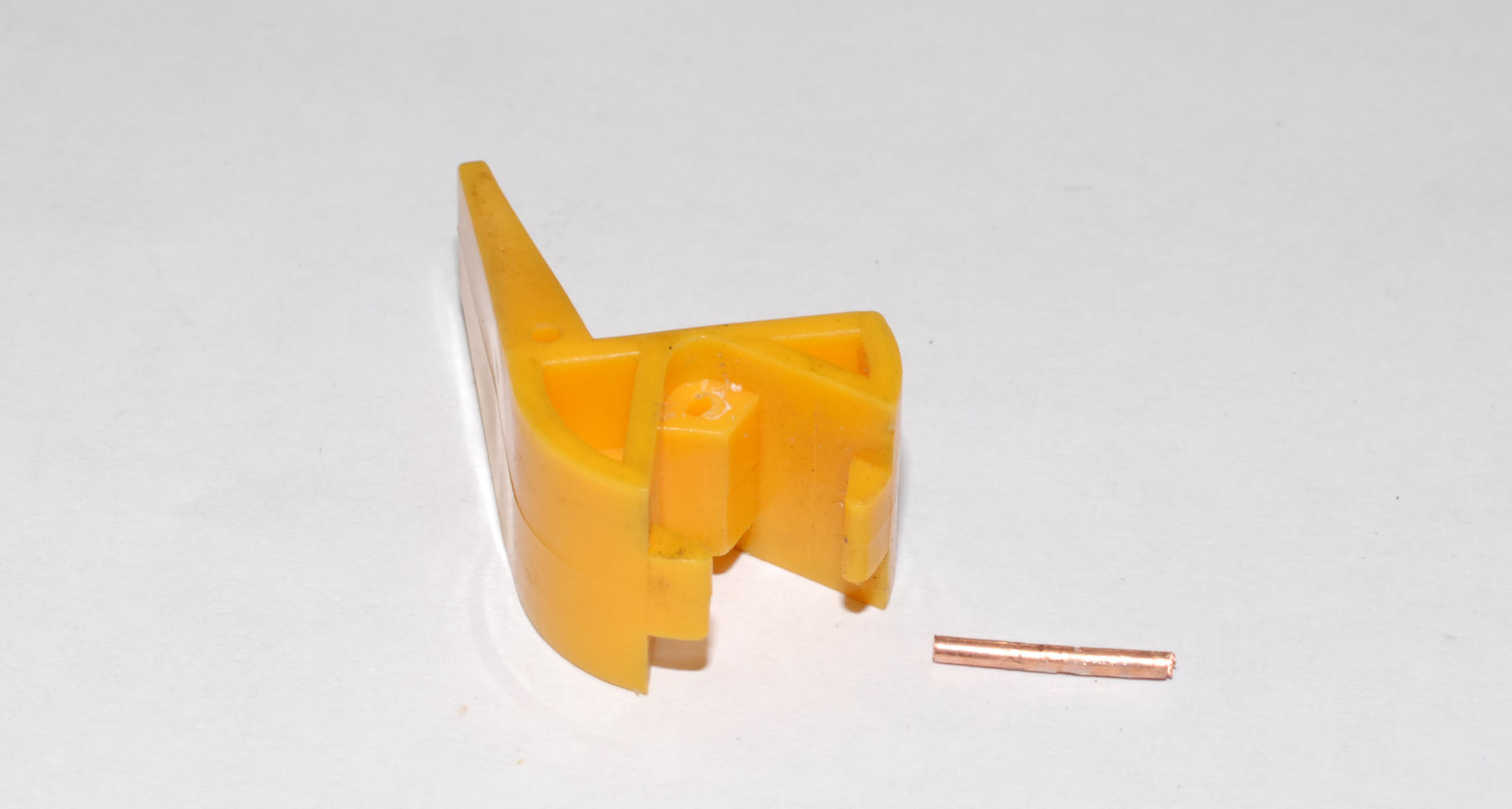
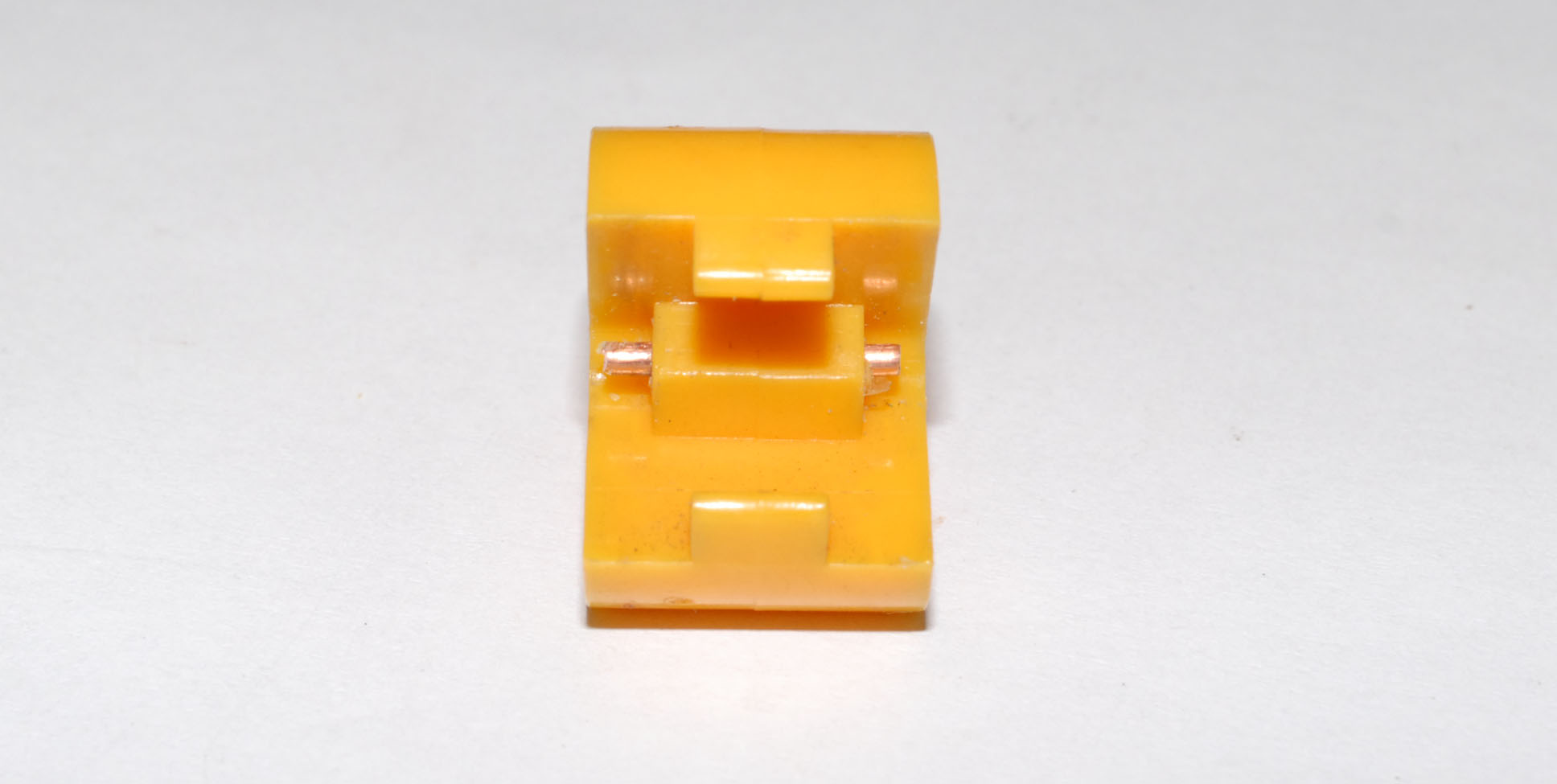
It has been done! I did it on my switches on the old 8/L.
http://www.abc80.net/zz/pdp8/DSC_9858.JPGhttp://www.abc80.net/zz/pdp8/DSC_9864.JPGhttp://www.abc80.net/zz/pdp8/DSC_9865.JPG
I used the core from a copper wire 1,5mm2 since the diameter turned out to
be perfect.
/Anders
On Feb 13, 2015 9:58 AM, "jwsmobile" <jws at jwsss.com> wrote:
>
>
> On 2/13/2015 8:01 AM, Geoffrey Oltmans wrote:
>>
>> I presume I can't be the only one watching this eBay auction in
disbelief.
>> I'm wondering if this is a museum or not. Presumably a private collector
>> would not have such deep pockets, but you never know!
>>
>> Over $13k USD and still a little less than 2 days to go!
>>
> Ultra-rare-Commodore-65-C65-DX64-prototype-working-serial-22
>
> http://www.ebay.com/itm//171673209321
>
> Mr. 544 feedback is being trolled by 0 and 1 feedback idiots. One has to
wonder.
>
> I wouldn't use this auction as a reference in an appraisal.
>
> Jim
Ended at just under $23K USD (?20,050)
Hi,
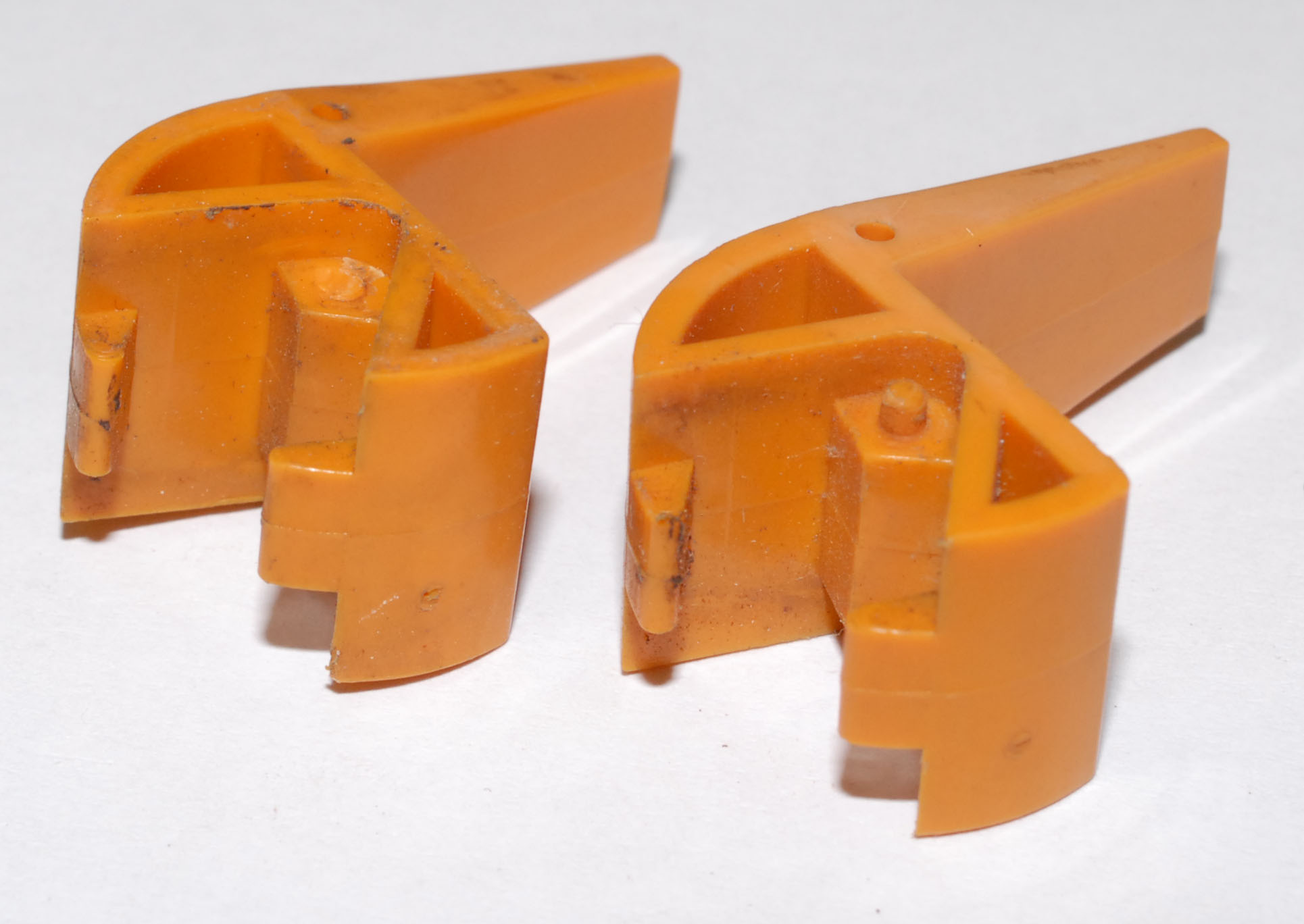
One of the bit flip switches on my 11/45 front panel is broken. It
snapped off cleanly at the pivot where the plastic meets the metal. The
remnants of the two little plastic switch handle leg tips are still there,
in the metal switch housing.
The fracture is clean and is such that they would fit perfectly back onto
the main hunk of the switch plastic, like new, if l could find the right
compound to get the pieces to re-meld into each other. I guess model
airplanes used to employ this sort of melding technique I'm describing in
their construction, right? But I have no idea of the chemistry involved --
whether pdp11 switch plastic is compatible with that sort of glue.
I don't think I want something that just adheres, non-porously to the
bits because that would interfere with the operation of the switch pivot
point and there's no room for inaccuracy / spurting glue gobs in there.
The fracture is essentially _at_ the pivot.
So my question: are these pdp11 switches the right sort of plastic for
this meld repair I'm describing? If so, what's the chemical that I'd need
to make this happen? Plain old model airplane glue?
thx
jake
Dear Friend,
I am writing this mail in confidence . I am looking for a trust worthy person and I decided to contact you because you and the deceased customer has the same surname.
My name Lee hao and I work in Private Banking Division of Bank of Communication Hong Kong and 9years ago I opened and managed account for an individual Ryan with a financial portfolio of USD$9,000,000.00(Nine Million United States Dollars)which he wished to invest and have spun around in the growing market in mainland China at that time.
we made various investment opportunities and this hide high return and with sometimes getting back return as high as %0.02 of funds total quarterly. This ran until last quarter in 2009 when he instructed me he had URGENT investments in Hong Kong which requires cash payment and that I liquidate funds principal(9M) and have monies available to him in Hong Kong which we did. We made contact with a reputable bank in Hong Kong at that time(Bank of China) and they agreed to receive the money for a fee and make cash available to our client. I went ahead with the transfer request and that was the end of it. However Bank of China send us memo end of 2010 informing us the money was not claim since that time and that they only inform us about this because after a certain amount of years and money not claim government confiscate money as unclaimed funds.
Further to this an enquiry was carried out and it was discovered that Ryan was involved in automobile accident in Chengdu, Sichuan Province Mainland China in 2010 and died as a result of his injuries sustained. on further enquiry we also discovered he died intestate without a known next of kin to the funds in Bank of China as his wife and only known relation had died some years earlier before making investment with my bank.
This is what I propose: Since you share the same last name as the late Ryan you stand in as next of kin and with my exclusive access to his file and the preparation of legal documents I make you the beneficiary to the funds in bank. I painstakingly work out all modality how this should work without no one get into trouble now or in the future when all concluded. I know this might be a bit heavy for you but trust me on this for you do not have to have known him for provided you have same last name and with the arrangement I have in place I assure you this would work. Nobody get hurt as this lifetime opportunity for me to secure a better future for my family as I retire soon and with all my years in the banking sector very little to show for.
Finally I do understand you may be skeptical about this considering the fact you do not know me and we not have previous dealing. Rest assure this is a known practice in the banking industry here in Hong Kong/mainland China as this happens every time the only other alternative is money revert back to the States enriching already wealthy corrupt government officers. I send you this letter not without a measure of fear as to the consequences of this if my actions are discovered and I beg you do not betray my confidence in this matter for I know nothing ventured is nothing gained. If you are able to render your genuine assistance please get back to me immediately via, email. I look forward to executing this business deal with you.
I ask that if you find no interest in this project that you should discard this mail. I ask that you do not be vindictive and destructive. If my offer is of no appeal to you, delete this message and forget I ever contacted you. Do not destroy my career because you do not approve of my proposal. You may not know this but people like me who have made tidy sums out of comparable situations run the whole private banking sector. I am not a criminal and what I do, I do not find against good conscience, this may be hard for you to understand, but the dynamics of my industry dictates that I make this move. Such opportunities only come ones' way once in a lifetime. I cannot let this chance pass me by, for once I find myself in total control of my destiny. These chances won?t pass me by. I ask that you do not destroy my chance, if you will not work with me let me know and let me move on with my life but do not destroy me. I am a family man and this is an opportunity to provide them with new opportunities. There is a reward for this project and it is a task well worth undertaking.
I await your response.
Best regards
Lee Hao
Email: leehao44 at hotmail.com <mailto:leehao44 at hotmail.com>
Forgive me if I missed earlier discussion, but has anybody
seen the
Imitation Game movie, ostensibly about Alan Turing?
There certainly were some real howlers in there, like the
bit where Turing
single handedly decides what info they would share with the
British
government, so as not to alert the Nazis that the Enigma
code was
broken!
Also, there is only one instance of the Bombe, while it is
pretty well
known they had a set of 350 of them at Ft. Meade running 24
hours
a day. And those were the NCR Bombes, running at 1800 RPM,
insted
of the one in the movie going clunk-clunk-clunk. Some other
papers
seem to indicate there were another 350 Bombes at Bletchley.
It only makes sense for there to be a big array of NCR
Bombes, not
the slow British-built ones, but
with all the ships being sunk, how could they be sure such a
shipment
could make it across the Atlantic? These things were
critical national
resources, so I just can't image the US shipped a batch of
them to
Britain. (Also, there is the security issue of how to keep
prying eyes
off the Bombes while being shipped.)
Also, they have Turing building the Bombe with his own
hands. Various
descriptions have hundreds of people at Bletchley wiring the
rotors and
doing much of the other work. The Bombe parts must have
been made
in machine shops across England.
At the end of the movie, they sort of imply by a confusing
flashback that
Turing tells the whole story of the code cracking work at
Bletchley to
the police officer. It is well documented that he never
revealed anything
to anybody about what he did there.
Any comments?
Jon
I've recently acquired a TC08 controller to interface a set of TU55 drives to my PDP-8/I. My 8/I has the earlier Negibus I/O configuration and the simplest (at least in terms of number of cards required) solution for interfacing is to convert the Posibus TC08 to a Negibus TC08N. This requires swapping out a few positive logic interface cards for the corresponding negative logic equivalents. I'm looking for the following cards and quantities:
M100 - qty 3
M102 - qty 2
M633 - qty 4
Please let me know off-list if you have any of these items available for sale or swap.
If you do have an M102 but don't want to get rid of it, I'd be very happy just to have clear photos of the card, front and back. Vince Slyngstad has already prepared Eagle layouts of the M100 and M633 but lacks adequate info to recreate the M102.
Thanks!
Jack
Being bitten by "vintage computer restoring" bug, I am long time looking for a reasonable condition PDP8, preferably a PDP8/L.?
Is there such a machine out there looking for a new home or can someone point me to a possible selling-place other than eBay? EBay has hardly any, and just a few weeks ago I unfortunately missed one.
Any help or hint is highly appreciated...
Hello all,
I'm looking for some good demonstration/fun software to run on my demo
RSX-11/M+ and RSTS/E systems.
I don't much mind what the software is so anything that can be
provided I'll probably find useful. In particular I'm looking for some
games. If it's of any consequence, I'm using RSX-11/M+ 4.6 BL87 and
RSTS/E 10.1-L.
Also, does anyone know if there's any other archives that have copies
of the RSTS/E and RSX-11 layered products than the Trailing Edge FTP?
(Particularly I'm interesting in getting DEC C on RSX-11/M+, but if I
recall correctly the tape image on the aforementioned archive is
corrupted. Also I'm looking for the WPS package for RSTS/E.)
Thank you to any who respond!
Regards,
Christian
--
Christian M. Gauger-Cosgrove
STCKON08DS0
Contact information available upon request.
I have often thought it would be cool to build a relay calculator, along the lines of Casio's relay calculators that they marketed for a time in the 1950's before it became clear that electronics were the way to go. They even made some scientific and programmable machines, but a basic four-function machine with an accumulating memory register would be enough.
Rick Bensene
The Old Calculator Museum
http://oldcalculator.com
Sent from my Android phone using TouchDown (www.nitrodesk.com)
I've been bouncing around the idea of building my own relay computer
* I have mostly inspired by the TIM project[1] and Harry Porter's Relay
Computer[2]
* I am looking at having a limited number registers like the 6502 or 6800
* the computer is going to be Harvard architecture based
I wondering have any of use done anything like this?
[1] http://www.northdownfarm.co.uk/rory/tim/
[2] http://web.cecs.pdx.edu/~harry/Relay/
> From: Jacob Ritorto
> My NASA EE buddy recommended working up an appropriate load from
> regular household lightbulbs. They won't light, naturally, but you can
> dial in your load by simply choosing certain wattages and doing the math.
Err, both tungsten and carbon filament incandescents have very different
resistance when hot (lit) and cold. To make it even more, they are of opposite
sign: with tungsten, the resistance increases as it heats up (a nice
stabilizing feedback), and with carbon, it goes the other way. So if you're
not running enough current to light the bulb, you can't use the printed watt
rating; you'll have to use an ohm-meter.
Noel
Mattis Lind from this forum sent me some failed National Semiconductor 74xx
series, plastic encapsulated. These were from an HP 98xx series calculator I
believe. He noticed than when they failed they failed open. I failed myself
to have the local National Semi people interested in looking at them, and I
just did some XRays to find out if something obvious had happened to the
wire bonds. Nothing we could see, but we didn't take enough close ups. I
want to take a look again, and if I don't find anything could send them on
to you if Mattis is OK with it.
Marc
> Darn! That sounded like a good collection. Alas, I know I haven't kept
> every bad IC either (except that one from the PDP-8/E...not really sure
why
> until now, I guess). But if you do find them, I could certainly use them.
On 14/02/15 11:02, Cory Heisterkamp wrote:
> Tom, any reason for choosing the Harvard architecture?
it may have some Modified Harvard architecture
the computer is NOT Stored-program based, it may have a small (128/256
byte) CPU styled cache
> I'm currently in the middle of a relay computer build so I'll toss in
my 2 cents.
> The most important thing I hit on early is to define the instruction set,
> work out a number of potential applications/uses on paper (or excel),
> and step through each instruction to make sure the machine is capable
enough.
> You'll probably discover a number of efficiency improvements you can
make to the hardware while doing so,
> and a few "hardware subroutines" worth adding.
> You can also baseline how long a program will take to run if you
settle on a clock rate, and determine if there's a better way to do it.
> Ultimately, relay computers are SLOW. Don't take 6 cycles to do what
could be accomplished with a couple extra relays and a single pulse.
> Well thought out HW and instructions will pay big dividends when the
soldering iron comes out. -Cory
good point, I am prototyping the computer design in software and
software in 6502 assembly
Sorry, this was accidentally sent before it was completed.
At 04:40 PM 2/13/2015, Tom Sparks wrote:
>I've been bouncing around the idea of building my own relay computer
I built a greatly scaled down version of Simon more than 50 years ago. See Chapter 3 in:
Edmund Callis Berkeley
Giant Brains, or Machines That Think
New York: John Wiley & Sons, Inc., 1949; Reprinted New York, Science Editions, Inc., 1961
Available in DejaVu format at:
https://ia600504.us.archive.org/17/items/GiantBrains/giant_brains.djvu
Dale H. Cook, GR / HP Collector, Roanoke/Lynchburg, VA
http://plymouthcolony.net/starcity/radios/index.html
On 14/02/15 09:52, Brent Hilpert wrote:
> On 2015-Feb-13, at 2:56 PM, Tom Sparks wrote:
>> On 14/02/15 08:20, Brent Hilpert wrote:
>>> On 2015-Feb-13, at 1:40 PM, Tom Sparks wrote:
<snipped>
> Just an opinion, but the Zusie / Z3 recreation ref'd by Pontus looks most interesting, if one wants to do an historical design vs. something novel.
my project is a what if?....
"1890 portable telegraph switching computer"
I am limiting myself to 1930's knowledge and ideas because they could
have be discovered early in time, but unpublished/lost/etc
I am welling to use modern versions to reduce the build time
> The Zusie site mentions the Z3 recreation in Germany.
> With a few recreations of the same machine there's the potential to benefit from community software development.
>
> The Zusie fellow sure was fortunate to obtain a large quantity of good relays at scrap prices.
> I've long been interested in building a relay computer but that's one of the stumbling blocks - relays new are so pricey today.
I noticed that with the relays
> Had in mind a physical implementation much like the Zusie, upright front-access 19" relay rack with an LED per relay to show state (and many blinkenlights).
>