>From: dwight <dkelvey at hotmail.com>
>If I were doing it.
>First you need to find out if it needs OC output.
>There are many flash parts in surface mount that can have the higher
speeds.
>Add some 74LVC245 to give bus drive needed, also surface mount.
>All on a little PC board. There would be a lot of wasted space in the flash
but what the heck.
>Put an edge connector on the board to deal with programming.
>All will fit in a smaller space than the original part.
>Dwight
That would be great engineering fun! But at less than $4 for the blanks,
using the old PROMs and the vintage programmer seems pretty straightforward,
vintage correct, and low risk solution. Miraculously, my best offer got
accepted on ebay, so semi-affordable vintage clunky Data I/O 29B Programmer
and plenty of blanks are being shipped to me :-). I count collecting vintage
tools for servicing your vintage machine as part of the fun too...
Marc
Anyone out there have a manual for the Emulex CS21/H (or possibly the /U variant)? This is a UNIBUS DH11 clone. (There are also /FA, /FB, /FC, and /FD variants which are DMF32 clones - and we have the manual for these but it's of no use for our CS21/H boards :)).
At the very least, if anyone has the dip switch settings for this, that would be an immense help.
Thanks,
Josh
Sr. Vintage Software Engineer
Living Computer Museum
www.livingcomputermuseum.org<http://www.livingcomputermuseum.org>
As something went wrong in posting this question, I try to repost it
here. please don't be offended by this.
-------------------------------------------------------------------------
Hi all.
is there a list of equivalents for DEC ic's?
I've made a mistake in attaching our BA-8 to the PDP8/f and plugged in
the ribbon cable connecting connector C and D the wrong way. some magic
smoke came loose and there are a few chips broken .
by comparing the signals on those connectors, I made a list of suspect
chips on which some pins got-15v or +15v...
The M8330 board got most of the blast, resulting in 4 burned chips, but
other boards could well be affected.
-----------------------------------------------------------------------
--
Met vriendelijke Groet,
Simon Claessen
drukknop.nl
for both serial ports I can configure a terminal session at my Wyse 370
ASCII terminal. But I don't have any idea how to switch between
sessions. Any idea or any hint where I can find a manual for this terminal?
for both serial ports I can configure a terminal session at my Wyse 370
ASCII terminal. But I don't have any idea how to switch between
sessions. Any idea or any hint where I can find a manual for this terminal?
Absolutely (assuming you count your engineering time as free), not to
mention it feels rewarding to use clever engineering tricks to solve a
problem instead of money. But I want to keep my machine original and vintage
if I reasonably can. My programmer ended up very reasonably priced, and it
is recognized as one of the better vintage programmers of that era. So it
fits perfectly in my collection of higher end, historically meaningful
engineering tools. Two birds with one stone, so it was a pretty easy
decision.
Marc
>Sean Caron <scaron at umich.edu>:
>The median listing price for them on eBay for a 29B with pack seems to be
around $3-400 which IMO is a little steep for a 30+ year >old PROM
programmer. Hopefully your best offer successfully accepted was much lower!
>I think the part cost on the PROMs pales in comparison. For the cost of the
29B, you could design a replacement for the original >PROM, have some boards
fabricated, stuff them and you'd still be ahead a few hundred bucks ...
>starts to make sense at those kind of prices, imo.
>Best,
>Sean
William Degan wrote:
Comparing the 160 and 160-A manuals with the 160 in the ebay auction
(252070822992)
Page 37 of the 160 manual from 1960 - smaller "160" marquee sign.
Page 3-1 of the 160-A marquee says "CONTROL DATA 160-A"
Ebay auction says "CONTROL DATA 160"
So, there were two variations of the 160 marquee/sign above the numeric
display.
----
Also, if a person is looking at the front of the computer, on the top left
side, there is a square cut-out / slot? in the original 160 table
(purpose?). This slot does not appear on the 160-A's table (from the 1963
programming manual), nor is it present on the Ebay auction.
I am thinking this was originally a "later" 160 that was probably serviced
well into the 160-A days.
--
Bill
vintagecomputer.net
Only a few 160s used the 3 small inserts in the marquee. There were used to make it easier for the NCR rebrand. The later solid sign became the CDC standard.
The cut out on the left was for the BPRE-11 punch. Only the early 160's and early 1604 machines had this. The punch table was spring loaded and could be raised up to the desk top to reload paper tape. Later on, the punch was mounted on a tray that slid out to the front.
Another change was the replacment of the original paper tape reader with the PED 350. PED (Peripheral Equipment Division) was a CDC created company. Their first product was the 350 reader. Later, they made the 60X series of tape units and the 405 card reader. This was all part of CDC's effort to move away from other companys' peripherals. The early CDC systems shipped with Ampex tape units, IBM card equipment.
The original paper tape reader was an inport from Ferranti in England. It was fascinating; used thyratrons as light sensors. I had one, but it disappeared in the last move. You can tell it from the 350 by the paper tape load arm. On the Ferranti, it is a steel rod. On the PED 350, it is a flattened V shaped plastic arm.
Another way to tell early 160s from later units is the side drops. On the early units, the top formica also went down the left and right side about 12 inches. This stopped mid-life. Old memoriy says at s/n 43 but after 55 years, that is not hard data.
The early 1604's also had this side drop of the desk top. You can see it in some early photographs. I did see one 161 typewriter stand with the side drop, but don't remember if it went into production.
NO 160s were ever converted to 160-As. Not one. There are physical differences in the logic chassis. More cards slots were needed. The extra 4K bank of memory takes up a lot card space. The front panel would have to be totally replaced. The 160-A requires a lot more cable ports for the Buffer channel and the external memory (169).
160-A manuals would be useless for a 160. The card types are the same and about half the commands are the same. But that is it.
By the way, bitsavers has an excellent description of the 160 in "System Programs For The 160 Computer". It includes a photograph showing the above differences. And pages 1 - 10 present good insight to Seymour Cray's thinking about his next machine, the 6600. It shows where the idea for the PPUs came from.
The obsolete 160s were in use for many years after their demise. Usually for testing peripherals, copying paper tapes, etc. I last worked on one in 1980, almost twenty years after it was built.
Billy Pettit
>Not sure what you mean by membrane keypad. My front panels certainly
>have real buttons, which makes a clicking noise and feeling when I press
>them. But maybe I'm confused and there is some membrane behind the keys
>or something?
>
>Johnny
That's my mistake. I've never actually seen or touched a DKC8-AA panel, just
pictures of them in the manual :)
Hoping to acquire one since I am trying to do other things with the 8/A than
keep debugging its hardware! (such as getting Dumprest working for RL02).
>The 74f parts may be too fast. Try adding damping resistors (10 to 30 ohms)
>in series with the outputs to slow things down or just switch to 74ls
>
>Joe
Thanks for the tip. That is what I was implying, not sure I said so
explicitly :)
But adding twelve resistors which may or may not fix the problem, and
hacking up my board is not an attractive thought... but neither is changing
three 20-pin unsocketed DIPs without proper desoldering equipment. Guess I
should have used sockets in a prototype!
Besides, the board really does need redoing with proper power and ground
plane management.
-Charles
..the Subject says all.. I'm looking for the Formater Utility
for an Emulx QD01 ..preferably for the PDP11/RT11.
The Manual
http://bitsavers.informatik.uni-stuttgart.de/pdf/emulex/QD0151001-C-QD01_Di…
lists the Part Numbers for the Software as PX995180x-0y where x is 1 or 2
and y is between 1-4, dependig of the distribution tapei media. A RX50 Floppy
with the PN VX9951804 should exist too..
Has someone images from that software handy?
Regards,
Holm
--
Technik Service u. Handel Tiffe, www.tsht.de, Holm Tiffe,
Freiberger Stra?e 42, 09600 Obersch?na, USt-Id: DE253710583
www.tsht.de, info at tsht.de, Fax +49 3731 74200, Mobil: 0172 8790 741
Chuck Guzis <cclist at sydex.com> wrote:
Subject: Re: Control Data 160 Ebay
I believe the eBay lister stated that it was a 160, not the -A. So no
return jump for you...
--Chuck
Which would make it even more scarce. There were only a little over a 100 of the 160 models made. And 40+ of them were rebranded as NCR machines.
There were 495 160-As made officially. (There were also a small number shipped without serial numbers to the good people at Langley.)
I know of at least 5x 160-As still in existence, besides my own. Which should be going to a museum this week if they can sort out shipping glitches. My system includes a 161-A Typewriter in lousy shape and a 167-2 Card Reader in perfect shape. Plus all manuals, software (with listings) and spare parts. Even the paper tape rewinder!
I did not know any 160 machines survived, so who ever bought it has a unique item.
I have looked for 15 years for an 8092 = the first true 8 bit computer. Haven't found even a hint or rumor of one.
I am working with Al Kossow, to see that this material is eventually in his archives.
Billy Pettit
The original proprietor of Zendex has put the firmware of the ZX-200A
in the public domain, so I've put my reverse-engineered source code on
Github:
https://github.com/brouhaha/zx200a-fw
The ZX-200A is a single-board Multibus floppy controller intended for
Intel MDS (including Series II and Series III) development systems,
replacing either or both the Intel dual-board SBC 201 single-density
and SBC 202 double-density floppy controllers. Since it can do both
densities, it can replace both Intel controllers simultaneously,
allowing the same floppy drives to be used for either density, by
using different logical drive numbers. We take it for granted that
"modern" floppy controllers often support selectable density, but with
those early Intel board-level floppy controllers that wasn't the case.
Also, the Intel SBC 202 double-density controller uses an
Intel-proprietary M2FM disk format, instead of IBM-compatible MFM. As
such, none of the single-chip FDCs are compatible with it, with the
possible exception of the Western Digital 1781 (with a huge pile of
external support logic), and (less likely) the TI TMS9909.
Unfortunately the original ZX-200A manual, which contained the
schematics and source code, is not available, hence my project to
reverse-engineer it. I'm working on tracing out the schematic, but as
the board has 82 chips it is slow going.
Several years ago, Vince Slyngstad and I "cloned" the rare DKC8-AA
Programmer's Panel for PDP-8 with some improvements (0.6 vs. 0.3" LED
displays, real "click" buttons instead of that membrane keypad, and fixed a
couple of bugs in the original design). Also, since 8235's were scarce even
then, we used 74F244 buffers instead to gate the input vs. output of the
switch register onto the bus back to the M8316 Option 1 board.
That may have caused a lurking problem, since occasionally the SR will
change bits when an address is loaded. Turns out an oscillation starts on
the ground lines at about 20 MHz with certain entries at the keypad to LSR
and LA (I can't see an obvious pattern). This parasitic is large enough (up
to 2V p-p with respect to the chassis/rack) that it's clocking the D-flops
used as the physical switch register! It can be seen in the 7-segment
displays as a "flicker" which will change when I touch the ground on the
board... attempts to add more grounds actually made the problem worse!
I'm thinking of redoing the board layout with better attention to ground
planes/power buses. There's a .01 uf decoupling cap at every IC and 12 out
of 40 pins on each of the two connecting ribbon cables are dedicated to
ground. 7 on one, 5 on the other are for +5 volts.
On the other hand, I am tired of tinkering and considering just buying a
real DKC8-AA if there's one out there. Anyone? ;)
-Charles
+1-410-734-6804
New hobby thing. ;)
Wildcat! 4 running on it, stock out of box config. If you don't see all the
menus except for help and send to sysop, wait till I validate users. When I
get back home i'll set it to give non-validated users more permissions,
though.
--
Gary G. Sparkes Jr.
KB3HAG
Can anyone help me to locate an old IBM 026 printing keypunch for a project on which I am working?I was an IBM Field Engineer many years ago and I used to service lots of Unit Record equipment at that time.Any help in locating a machine would be greatly appreciated.Thank you.
AlEx-IBM Field Engineer
> From: Holm Tiffe
> Anyway, thanks for the schematics
Eh, de nada.
> I have the board running again. The fix was simple, the xtal was bad.
You're lucky it was something so simple! (Although we've seen this kind
of thing before - I had that 11/23 with a bad crystal.)
I've got three dead 11/73 boards (from someone else), but none of them are
that easy. Different symptoms on all three, but I suspect the State Sequencer
gate array on all three. On one, at least, the ILOE latch control signal from
that gate array is sitting at 2V (which I seem to recall is characteristic of
a TTL input that's not being driven).
Maybe it's just some corrosion, and re-seating the gate array (if I can work
out how to unseat it - don't have the extraction tool) will fix it.
Otherwise, I'm SOL. At least the J11 there are spares for - that gate array
is surely umobtainium.
Noel
Bit of a tricky one to google this, so thought I'd consult the list -
does anyone know of a documented project that replaced the internals of
a BBC Model B with a Raspberry Pi (or MiniITX PC) interfacing with
keyboard etc. to bring modern internals with a traditional interface?
I don't even know if there is a word for these kind of projects?
Thanks, Mark.
So I've mentioned how I've seen this wierd behaviour where QBUS memory boards
that hadn't been used in a long time didn't work when first plugged in, but
started working later.
I just had something even weirder happen, and am curious if anyone has an
plausible explanations.
So I had a dead M8044 (MSV11-D), symptom was that you could write -1 to any
location, it read back as 0. Quite repeatable, I can power cycle the machine,
take the card in and out, etc, etc.
So I throw it on an extender, and start chasing. I have a two instruction
loop (write location 0, loop), and I'm watching the data going into the
memory chips on the card, and it all looks good. So I add a third instruction
(read location 0, after the write), and continue chasing.
Data looks good coming out of the chips; then it goes to an octal latch. So I
look at the latch enable, and that doesn't look so hot - just a tiny little
ugly spike. So I look at the source of that, and it's a D flop. So I look at
the D flop's clock input, and it's also a nasty little spike. So that comes
>from the output of a triple-AND, and so I start looking at the inputs of the
3-AND. And when I put my 'scope lead on the second input... the memory
suddenly starts working!
Well, I could see that - the added resistance or capacitance or whatever of
the probe might have had some effect on a circuit that was right on the edge.
But here's where the ghost enters the machine.
I pull the 'scope probe ..... and the memory keeps working!
I can power cycle the machine, leave it off for 15 minutes, power it back on
- and the memory still works fine!
Does anyone have _any_ idea WTF is going on here?!?!
I feel like I'm in some sort of AI koan...
Noel
Several people asked, here's the scoop:
The common proms for HP 21MX M/E/F are 1K, 4K, and 8K.
1K are used for either loader roms on the cpu board or microcode on the FAB
4K are used for microcode on the FAB or FEM
8K are used for microcode on the FEM
The manuals you'll want to print and keep handy:
HP 12992 Loader Roms Installation Manual, 12992-90001 (April '86)
HP 1000 M/E/F-series Firmware Installation and Reference Manual, 12791-90001
(September, '83)
I believe these are both on bitsavers. They are "must have" manuals.
These are all bipolar proms, and most modern prom programmers will not be
able to program them. I use a Data I/O 29B (with Unipak 2B), and it can
program all these parts. Those programmers appear on ebay from time to time
at around roughly $400.
The blank proms are not terribly easy to find these days. Ebay has them
occasionally, but your best bet is sites that cater to arcade machine
repair.
Here's a non-exhaustive but useful list of compatible parts for each:
1K parts
MMI 6301
Harris 7611
Signetics N82S129
National 74S287
TI 24S10
AMD 27S21
Fujitsu 7114 (possibly 7052 as well, need to verify that)
4K parts
Signetics N82S141
Harris 7641
MMI 6341
8K parts
Signetics N82S181
Harris 7681
MMI 6381
Anyone here get the Control Data 160 (Ebay 252070822992)? I must admit
time, money, and space aside I would love to have had this one! (I have
the manuals at least)
--
Bill
vintagecomputer.net
> There are a number of things like that (e.g. the H786 power supply for
> the BA11-N; [print sets] not available separately [online], but in the
> 11/23 FMPS [online], if you know to look there): we ought to produce
> some sort of registry, to collect such information in one place.
So I have started such a registry.
http://ana-3.lcs.mit.edu/~jnc/tech/FMPSOnline.html
The concept is that eventually search engines will index that page, so people
looking for, say, '"BA11-N" prints' will wind up there, and that page will
tell them where to go.
I went through a number of PDP-11 print sets which are online (11/05S, 11/23,
11/34, etc) to compile the initial list, but it's just a start. I will add
others as I come across them; and if any knows of, or finds, any others (i.e.
print sets which _are_ online, but do not show up when looked for in common
search engines such as Google), please let me know, and I will add them.
> I also found prints for the MF11-U, MF11-W, and MM11-Y; none of which
> appear to be on-line (although the MF11-U ones might be in the 11/05S print
> set, which ISTR is online).
On looking at the 11/05S print set online, I think it has most of the MM11-Y
prints, but some pages are apparently missing (it claims), so I think not
everything is there.
> I don't think the ME11-L prints are online either, but those I have in
> my 11/05 print set - I'll have to see if that print set is online
> somewhere, no point re-scanning them, if so.
So it turns out that these don't seem to be online (in any form), but I have
a set of hardcopy in my set "PDP-11/05 Engineering Drawings" (which is
different from the 05S set which _is_ online), so I will scan them in and
make them available at some point (especially since these seem to be the most
common PDP-11 core memory boards).
If anyone is desperately searching for them, please let me know, and I will
accelerate that process.
The situation with the ME11-L/MF11-L/MM11-L (which are all the same boards)
is slightly complicated. The board set is called an MM11-L (or -LP,
depending); G110+G231+H214 for non-parity, G109+G231+H215+M7529 for parity.
The MF11-L seems to be a backplane, plus an MM11-L board set; the ME11-L
seems to be an MF11-L in a box.
Some CPU backplanes (e.g. the older 11/05's) can also take an MM11-L board
set. (The _newer_ 11/05's have backplanes which take an MM11-Y - whether an
MM11-L would work in them, I have no idea.)
Noel
> On looking at the 11/05S print set online, I think it has most of the
> MM11-Y prints
Err, make that the 11/04 print set. (Sorry!) The 11/05S has the MF11-U (or
would that be MM11-U - I wonder if there's a system to the ME/MF/MM
designators).
Noel
List of blank for 21MX and microcode :
That would be very usefull. Thanks in advance
---
L'absence de virus dans ce courrier ?lectronique a ?t? v?rifi?e par le logiciel antivirus Avast.
https://www.avast.com/antivirus
I picked this up at Radio Shack about 25-30 years ago and have been
hauling it around ever since.
http://imgur.com/oNEcRFv,VacFqrY#0
(There should be two images...a link to the second.)
It was a surplus thing that RS was selling on the parts wall and I
grabbed on the off chance I'd need it someday. I lost the cardboard
top to the plastic bag it came in, so I know nothing about it.
Anyone have any idea?
Thanks...Win
Since the capacity of 2x RF31 and 1x RF71 disks is a little bit low
for VMS with some compilersi (~400MB every disk), I've looked for a bigger
disk, at least for the sytem itself. (I've already relocated the pagefile
to the 2nd disk).
Ok, there are RF73 available at ebay US for $100, but addiotional $50 and more
for shipping is to much, I have to pay additional 19% of customs VAT on top
of the sum from disk+shipping.. Maybe there are people that think that this
prices are ok, but not me, not for an old 2GB disk for an computer with
that power consumtion and that computing "power"..
In the case there is someone in europe that want to give away such a disk
for an acceptable price, please mail me..
Luckily an old friend of mine found 2 Disks in his stock, another RF31 (not
tried jet) and an RF73.
I've changed now the working but still almost empty RF71 in my VAX4000-300
against that RF73 disk and tried to integrate it to the system.
It starts with all LEDs on (as the other do), begins to rattle a little
with the head assembly (as the others do) but stops then and begins to
reposition somewhere in 0.5s cycles. It never finishes doing that, it is
not going to ready. The ready led is blinking for a short time after every
0,5s cycle. I've tried to talk with the disk using the KA670 Firmware
with set host/dup/dssi/bus:0 2, PARAMS is working and STATUS is responding,
the displayed last failure was 3304(X) and I don't know what that could be..
All other commands do work, but they are aborted since the disk is busy.
The available RF72DUG8 gives the hint that the error codes are listed in
the service manuals, but it seems that those manuals aren't available
somewhere.
What could the error be? Is the disk dead?
Regards,
Holm
--
Technik Service u. Handel Tiffe, www.tsht.de, Holm Tiffe,
Freiberger Stra?e 42, 09600 Obersch?na, USt-Id: DE253710583
www.tsht.de, info at tsht.de, Fax +49 3731 74200, Mobil: 0172 8790 741
Oops:
http://www.dailywell.com.tw/uploadpic/file/20130914143655f.pdf
----- Original Message -----
From: "Mike Stein" <mhs.stein at gmail.com>
To: "General Discussion: On-Topic and Off-Topic
Posts" <cctalk at classiccmp.org>
Sent: Monday, September 07, 2015 12:41 AM
Subject: Re: MITS Altair 8800b switches needed
> Anything here you like?
>
> Might have to hunt for a distributor/retailer
> though.
>
> m
>
> ----- Original Message -----
> From: "drlegendre ." <drlegendre at gmail.com>
> To: "General Discussion: On-Topic and Off-Topic
> Posts" <cctalk at classiccmp.org>
> Sent: Sunday, September 06, 2015 4:21 PM
> Subject: Re: MITS Altair 8800b switches needed
>
>
>> Since Erik brought it up..
>>
>> I could also use a couple switches, but in my
>> case they are for an 8800A
>> model. (Well, it's sort-of a 'B' now as it was
>> upgraded to the 'B' power
>> supply, but it still has the original 'A' type
>> D/C board).
>>
>> Like the 'B' it uses mostly Mom-Off-Mom
>> mini-toggles, with panel mount
>> bushing, and the long solder terminals that
>> solder directly to the PCB (not
>> the small eyelet type). But the handles are the
>> standard mini-toggle bat
>> handle - not the flatted paddles Erik
>> describes.
>>
>> Any leads, feel free to mail me off-list.
>> Thanks!
>>
>> -Bill
>>
>> On Sun, Sep 6, 2015 at 1:13 PM, Erik Klein
>> <classiccmp at vintage-computer.com>
>> wrote:
>>
>>> I am desperately seeking NOS, working pulls or
>>> accurate replacement
>>> switches for my MITS 8800b.
>>>
>>> These are flattened paddle switches, both
>>> ON-OFF and MOM-Off-MOM type.
>>> SPDT, Panel mount, solder post with a 15mm
>>> actuator. This last part is the
>>> pain as everything I've found is 10mm or less.
>>>
>>> I've checked every online source that I know
>>> of plus all of the local
>>> electronics and surplus shops with no luck.
>>>
>>> I'm sure someone here has a stash or knows
>>> someone who does. I need at
>>> least one of each type but would prefer a few
>>> more as I do have a few
>>> marginal switches to replace if I can.
>>>
>>> I'd even buy a complete 8800b D/C board if
>>> that's what it took.
>>>
>>> Please email me at my webmaster@
>>> "vintage-computer.c0m" address if you can
>>> help.
>>>
>>> Thank you!
>>>
>>>
>>> --
>>> Erik Klein
>>> www.vintage-computer.com
>>> www.vintage-computer.com/vcforum - The Vintage
>>> Computer Forums
>>> marketplace.vintage-computer.com - The Vintage
>>> Computer and Gaming
>>> Marketplace
>>>
>
I am desperately seeking NOS, working pulls or accurate replacement
switches for my MITS 8800b.
These are flattened paddle switches, both ON-OFF and MOM-Off-MOM type.
SPDT, Panel mount, solder post with a 15mm actuator. This last part is the
pain as everything I've found is 10mm or less.
I've checked every online source that I know of plus all of the local
electronics and surplus shops with no luck.
I'm sure someone here has a stash or knows someone who does. I need at
least one of each type but would prefer a few more as I do have a few
marginal switches to replace if I can.
I'd even buy a complete 8800b D/C board if that's what it took.
Please email me at my webmaster@ "vintage-computer.c0m" address if you can
help.
Thank you!
--
Erik Klein
www.vintage-computer.comwww.vintage-computer.com/vcforum - The Vintage Computer Forums
marketplace.vintage-computer.com - The Vintage Computer and Gaming
Marketplace
We would be glad to hear from anyone who might have new material
related to the Burroughs B6700.
We're on the hunt for any manuals or software related to the Burroughs
large systems so we can build an emulator for the B6700. This search
includes the B5000, B6000, B7000 families, since there is considerable
overlap across these families and collateral from one system family
can assist understanding another. Example models include B5500, B5700,
B6500, B7500, B6700, B7700, B6800, and B7800.
We were amazingly lucky with the B5500 to have so much of the critical
documentation (thanks Bitsavers!) and a complete suite of system
software, but even though the B6700 was more recent and produced in
larger numbers we're not having the same level of good fortune finding
artifacts.
What we have so far is documented here:
https://docs.google.com/spreadsheets/d/1JnMsyE8ssJi_-MUsK0rT9LPtNpeJCpTv1Qr…
If you're interested in this system then you likely remember that it
had a particularly impressive front-panel display, seen here:
http://www.retrocomputingtasmania.com/home/projects/burroughs-b6700-mainfra…
This was known as the MDL display: Maintenance Diagnostics Logic
display. Because the MDL had the 4 x top-of-stack registers down to
the bit-level particular bit-patterns allowed words to be displayed.
The early MCPs put IDLE into the display during IO waits, and
subsequent releases: B for Burroughs, but sites quickly started
putting their own company initials or the time.
The Danish museum is so far the only place I've found that kept the MDL:
http://datamuseum.dk/wiki/Genstand:11000045_Konsolpanel_Burroughs_B6700
Thanks to Finn Verner Nielsen for being so helpful and undertaking an
expedition into their warehouse to locate and photograph the item for
us. On that DDHF web-page you will see on the left of the picture the
B7800 MDL they have too.
My goal is to also construct a replica of the B6700 MDL.
Steps undertaken so far:
Posts to newsgroups
Posts on LinkedIn, wikipedia, Yahoo groups
Emails to a few dozen people who were involved with the system
Trawling the Internet
Johnny, I appreciate the thought, but there are over 1500 pins on this board
and soldering them all would be a major undertaking in itself... I don't
have a wave soldering machine ;)
The first error flagged today is on D1 CA 3, the Command Register A bit 3.
Scope loops definitely identify this bus as trouble and it's part of the
disk address register too.
The command register is two 'LS174 hex D-flops, and it drives the input of a
'165 shift register (disk address) and the input of an 8234 (2-1
multiplexer/driver) back onto the data bus, and that's it. Should be
simple... ha!
The voltage on that output pin will go up and down as set by the loop until
the board is flexed - then it will wander up to around 1-2 volts (measured
at the pin with a DIP clip).
However, I measured its ability to drive a 510 ohm load to 3.5 volts, and
sink at least 10 ma (measured directly) staying below 0.8 volts. And the
inputs to those two gates can be pulled to 0 with only a fraction of a
milliamp, and go high when the driving D-flop is disconnected! I couldn't
reproduce the problem while flexing the board either, but then I'd need
three or four hands.
So I changed the LS174 anyway. No luck - the card passes diagnostics until
the board is flexed. All three of those chips are in the same general area
of the board, too.
Close inspection of the driven '165 shows a lot of black oxidation on its
pins... don't those tend to grow crud inside the package and cause problems
too?
But... read on ;)
After perusing the schematic several more times this evening, I found one
more place I'd overlooked where D1 CA 3 (the "flaky" line) connects... to an
AND gate E96 in the center of the card, that has a solderable jumper for
RL01/02. I had moved that jumper to RL01 for testing by another member (as
that is the drive he has), and back to RL02 when I got the card back from
him.
Lo and behold, underneath that piece of wire was a tiny solder whisker, at
the moment shorting the CA 3 line to (something else?) but it was definitely
continuity to another trace.
Don't know how long that whisker might have been there, quite possibly from
before I changed it for the test!
Anyway I cleared it, and I've flexed the board numerous times while running
AJRLAC controller diagnostic, and made 8 passes without an error. So far so
good.
So I connected the drives, booted up SerialDisk and can read their
directories (only C & D, but that's a PIP version problem that I corrected
on my RL02 image).
Drives seem to be working :) ... of course R20A: (the SYS directory) is
clobbered, so I'll have to remake the pack with my known-good image, but I
was able to format the pack in Drive 1 without errors. Even wiggling the
board several times. Now I'm running read/write tests (AJRLIA.DG) on Drive
1. No errors so far after two ten-minute passes :)
THIS time maybe I really got it... CA 3 is the 4th bit of course where all
the problems were occurring. Will let it run for a while longer.
David Gesswein just sent me a version of dumprest for RL that he's just
written, modified for my Omni-USB port at 40/41.
If that works I'll be able to upload an entire RL02 in about 2 minutes
instead of 3 hours with vtserver...
-Charles
Jay, Mike, John,
Thanks for the helpful information. It just dawned onto me that these were
"write once" PROMs, not modern EEPROMs. Duh. So you get one shot at doing it
right...
The Data I/Os on ebay seem to be quite a bit more than $100 right now, I'll
keep looking. I guess none of the modern ebay Chinese ones would do? Also
where can you get the blanks? Any modern equivalents here too?
Marc
-------------------------
Jay West wrote:
The Data I/O 29B works perfectly for those old fusable link proms.
John Robertson wrote:
One can pick up a Data I/O 29B and Unipak II off eBay starting around
$100USD (ish). There is a very good support group on yahoo groups:
https://groups.yahoo.com/neo/groups/Data_IO_EPROM
Mike Loewen wrote:
I used a Data I/O 29B programmer to burn the PROMs, with a Unipak 2B.
The blank PROMs were variously Signetics N82S141, MMI 6341-1 and National
74S474. Along with the 12821A HP-IB board, you also need a Boot Loader
PROM, 12992H (12992-80004). The boot loader PROM is a Signetics N82S129 or
equivalent. For installation information about the firmware PROMs, see
manual 12791-90001 (HP 1000 M/E/F-Series Firmware Installation and
Reference Manual). For boot loader information, see manual 12792-90001 (HP
12992 Loader ROMs Installation Manual).
------------------------
I know this is a pretty long shot, but does anyone happen to have any service or maintenance manuals on the DG 6050 disk drive that have a procedure for adjusting the servo control circuit board? Or does anyone know anything about doing this? Thanks
> From: Johnny Billquist
> Early DMA controllers were all multiple cards, so having their own
> dedicated backplanes were a pretty sane idea.
Well, there was also that large intermediate generation which still had their
own backplanes, but they were 'system unit' (for lack of a defined term for
this form factor) backplanes (e.g. RK11-D, RH11, etc), which fit into e.g. a
BA11-K, along with other 'generic' UNIBUS backplanes (i.e. DD11-C, etc).
That first generation I spoke of (the one with backplanes that mounted
directly in H960's) are marked by the use of lots of small Flip Chip cards,
not the larger quad/hex boards that one finds in the 'second generation'
(above). I guess the larger board versions were cheaper to manufacture, which
is why they got rid of the first generation ones in favour of the second
generation (which were often functionally identical to the first-generation
ones they replaced, e.g. RK11-C and -D).
Those first-generation one used very similar construction technique to the
KA10 generation of machines, which also used that size Flip Chip (although a
different series, mostly with individual transistors), and heavier wire on the
bacplanes. What did KI10's use, does anyone know? I have this bit set that
they used roughly the same kind of Flip Chips as the 'first generation' PDP-11
DMA devices, but I've never seen a KI in person.
Noel
As a result of remodeling my house, I now have less space for the
collection and need to thin it out a bit. The following items are
free for pick-up in the Los Angeles area. Priority will be given to
the first person who will take everything. Almost all of these are
"portables" so it isn't that much volume. Some work; some don't and
are projects. The Seequa (dual DOS-CP/M unit) and Access Matrix
"Actrix" could be very cool pieces if brought into working condition.
1. Seequa Chameleon Plus: Powers up; no video - otherwise in
nice condition
2. Corona ATP: Works, boots off floppy to MS-DOS 2.11 disc
(included) - nice condition
3. Sanyo MBC-775: Powers up, no video; though external RCA video
works - shows boot error in ROM - nice condition
4. Sanyo MBC-675: Works - missing one floppy drive - boots off
floppy (not included) to MS-DOS 2.11, broken foot - rough condition
5. Access Matrix - Actrix: Powers up, video good, floppy drive B:
cycles and won't boot (comes with case, manual and software)
6. Sony SMC-70G Genlocker: Works (tested RCA out), asks for
system disk
7. NEC PowerMate Portable SX: powers up, no video, possible HDD
crash based on screeching noise
8. Kaypro II: Lights flash on floppy drives, no video, constant
beeping noise in sync with flashing floppy drive lights
9. Kaypro 2X: Works - boots to screen asking for disk (seem to
recall that one of the floppy drives may need realignment)
Please PM me if you are interested.
> From: Ethan Dicks
> That looks like a great haul.
We're talking about the guy on eBay whom I posted a pointer to a couple of
days back, the one with large lots of QBUS CPUs, memory, DLV11s, etc?
> I hope they are working cards.
All the ones I've gotten from the guy above which I was able to test (couldn't
test, e.g. the RK05 cards 'cause I don't have a working RK05 yet) were OK -
QBUS memory, 11/23's, etc.
Noel
was it a 160 or a 160A?
Ed#
In a message dated 9/6/2015 9:13:38 A.M. US Mountain Standard Time,
coryheisterkamp at gmail.com writes:
I'd be curious, too. I was *this close* to throwing in a bid seeing as
this turned up within driving distance...until I was politely reminded that I
have a few other projects around here. The coffee can of 'spare parts' also
gave me pause. -C
On Sep 5, 2015, at 9:08 PM, Jay Jaeger wrote:
> On 9/5/2015 7:10 PM, william degnan wrote:
>> Anyone here get the Control Data 160 (Ebay 252070822992)? I must admit
>> time, money, and space aside I would love to have had this one! (I have
>> the manuals at least)
>>
>
> I would not be terribly surprised if that auction result flushed out one
> or two more. Ya never know.
>
> JRJ
>
> From: Holm Tiffe
> Sorry, I couldn't find a mailing about Schematics for the KDJ11-AA,
http://www.classiccmp.org/pipermail/cctalk/2015-September/011849.html
> I've read that you got some documentation and want to scan it, 600dpi
> with some TIFF compression or so.. that's all.
Well, now I'm really confused, because AFAIK the message that talked about
the 600dpi and TIFF is the same one that thas the URL for the FMPS. So I
don't understand how you don't have them. Oh well.
> No, I'm not reading every singe mailing from that list.
I don't either - there's often too much. But I do read everything that looks
like it could be DEC-related, and most of the other stuff too (it's kind of
fun to read about the really old machines, etc).
Noel
> we now have the 11/73 prints, which I will be scanning Real Soon Now.
OK, done:
http://ana-3.lcs.mit.edu/~jnc/tech/pdp11/MP01890_KDJ11-A_Jan84.pdf
Can the appropriate people please download this to all the right places
(e.g. repositories)?
Don't be misled by the svelte 1.5MB size; they were scanned at 600dpi, and
there is a _ton_ of resolution in there (you can go way past the '100%'
setting on Adobe Reader without getting pixellation).
The originals were in really rough shape (torn, written on, etc), but I think
the results are fully legible. I looked quickly, and found a couple of issues,
where there was writing which obscured things on the scans, and fixed the
images manually to show what's on the original prints. However, I didn't have
the energy to look at every detail of every page, so if something comes up
un-readable, let me know, and I'll issue a fixed set.
(There are some places which aren't legible, e.g. lower right pins of E9 on
K3, but the original prints aren't legible there either, so there's nothing I
can do about that; it's possible to work out what the pin numbers are,
though.)
And a _HUGE_ 'Thank You' to Paul Anderson for lending me the print set so I
could scan them for everyone!
> That does leave us needing the 11/83/84 CPU prints, so if anyone has a
> set...
Can I repeat my appeal for these? They are for the KDJ11-B (M8190). With this
board being so recent, surely someone must have a set? I'd be happy to do the
work of scanning them, if someone has originals but isn't up to the scanning
part.
Noel
So I have one of these Mostek memory cards, and it was non-functional, and a
Google didn't reveal _anything_ online about them.
The fault was a couple of picked bits, so I started off tracing the signal
paths for those bits from the bus fingers, to the transceivers, to an octal
latch, etc - and then it dawned on me that this card has two banks (i.e. it
has a 9x4 array of xx64 64Kx1 chips; i.e. to provide 16 bits wide plus byte
parity, there are two groups of 18 chips), and one bank was picking, and the
other was not. So that meant that data paths were all OK, it was a simple
matter of finding some bad memory chips.
(It turns out that diagnostic heuristic is quite useful, since many PDP-11
semiconductor memory cards have two banks of xxKx1 chips; so if you have
dropped/picked bits, look to see if both banks have the same fault. If 'no',
it's pretty much guaranteed to be a memory chip, and it should be easy to
find. I just fixed for someone an M8044 with this failure mode, without doing
any hardware debugging at all; the symptoms, and the prints, were all I
needed.)
There was nothing to indicate which banks/bits were where on the MK8022, but
by pulling memory chips (luckily, they were socketed, so this was pretty
painless), I managed to work it out (unlike many memory cards, it's not
semi-random). For reference for others, here it is:
Low bank:
01 - H1
...
0200 - H8
0400 - E1
...
0100000 - E8
High bank:
01 - F1
...
0200 - F8
0400 - D1
...
0100000 - D8
D-H9 seem to be parity.
If anyone has one of these cards, and it's busted and they're not up to
dealing with it, let me know. Depending on the failure mode, I _may_ be
able to help (no documentation of any kind, after all...)
Noel
Reading docs on DEC TU10 for pdp 11 one makes a serial connection, right?
Not sure because I found little about baud, etc.
I did not see any definitive controller card for UNIBUS pdp 11. Maybe I am
missing something..can anyone share experiences?
Bill Degnan
twitter: billdeg
vintagecomputer.net
Looks like I spoke too soon. The dreaded RL8A failure has returned!
I made a new OS/8 RL02 pack on vtserver (took the expected three hours at
9600 baud console speed). Booted up the 8/A, so far so good.
But then Drive 0 faulted and OS/8 crashed... restarted and it crashed a few
seconds later again.
I flexed the middle of the RL8A upwards and the system worked. For a while.
Then it crashed and wouldn't reboot.
Back to where I was earlier in the week - won't even allow SerialDisk to
boot if the RL8A is in the backplane. OS/8 on the SerialDisk virtual RK05
works flawlessly if the card is removed.
Obviously there is still an intermittent which has come back. Maybe there's
a tiny thread of something conductive stuck under one of the IC's and I
managed to temporarily clear it as I described.
Anyhow I am resuming my search for a good RL8A. I have wasted enough
man-hours on this flaky board.
thanks
Charles
> From william degnan
> I was looking to see if references to the tm11 were "module/card" or
> backplane interface.
I think pretty much all that earliest generation of UNIBUS interfaces were
stand-alone backplanes (i.e. 19" wide things that went in an H960 in a fixed
location, and were filled with the small Flip Chip modules); the RK11-C,
RP11-C, RF11, and TC11 all are.
> I surprisingly found little commentary or threads about the TU10 /
> TM11, other than DEC docs. I guess these are not super common
Yeah, I think they were the first PDP-11 tape drives - not as rare as RF11's
now, but pretty rare.
Noel
> From: Jay Jaeger
> I would not be terribly surprised if that auction result flushed out
> one or two more.
Well, auctions like this are hopefully getting the word out that many of
these old computers are worth a lot more than scrap value.
Yes, it will cause some people to ask unrealistic amounts for them, but
better that than the other way: someone's who's asking too much can always
come down to reasonability, but someone who's scrapped a machine, well, it's
gone forever...
Noel
> From: Holm Tiffe
>> Not reading the list much, are we? :-)
> Huh? Have I missed something in the near past?
That would be the implication, yes... :-)
But yes, you're in luck. I'm scanning them as we speak.
Noel
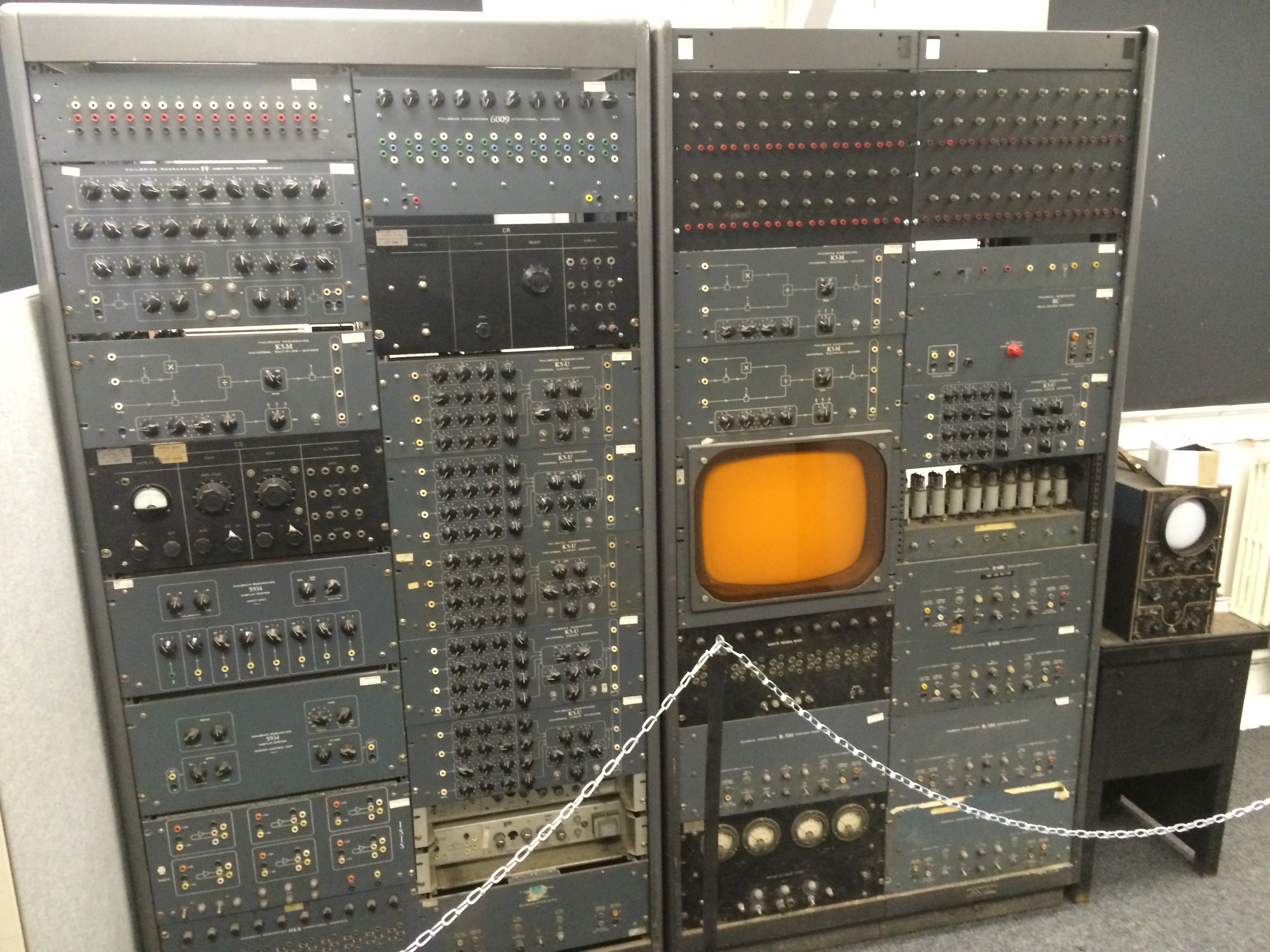
Here's a new picture of "George" -- aka the Philbrick analog computer
that MARCH rescued two months ago. It was used at M.I.T. from 1958-1970.
http://snarc.net/george.jpg
> From: David Gesswein
> I have a working one on an 8. It took a lot of work to get it to that
> state.
>
> http://www.pdp8online.com/tu10/tu10-repair.shtml
Wow. That is a really awesome repair job you did there. My hat is off...
Noel
I'm looking into a road trip from Champaign to Maine via Indy, Detroit,
Windsor, Niagra Falls, Buffalo or 1000 Islands, Syracuse to Boston area,
and up to Maine. Not sure about the return Route.
I'll be leaving late Sep or early Oct.
I have talked to a few list members about dropping off/picking up items. If
anyone wishes to buy/ sell/ trade along the route, please contact me off
list. I have a good size minivan and am trying to keep things down to a
BA11-K or FL02 size, but that can change.I do have a few 42 inch cabs with
q-bus boxes i could part with. I have a lot of 8A, 8E, qbus, unibus, VAX,
boxes and parts, and LAXX, VTxx and VR units and parts.
Thanks, Paul