I am sure a few of you have extra Apple 2's laying around and I have a
couple apple iPhone 5 in mint cond please let me know what ya have or a
commodore pet.
--
*Mike's ?Honda ATC 3wheeler? Shop? for LIFE!!!*
* Have a blessed day!*
Hi folks,
'Decaying battery' panic led me to unearthing my Lisa 2/5 to check the state
of the batteries on the I/O board since it hadn't been out of its box or
powered up since 2005. Fortunately the damage is very minimal and is only
restricted to track discolouration and external rotting of one particular
diode which I can't find mention of on my schematics.
Anyone with a 2/5 care to check their I/O board for me please? The diode is
D8, just above the battery location. It's in the board in such a way as to
make its markings pretty unreadable in the pictures I took before cleaning,
but it's the only white diode in the machine and I'm guessing it might be a
5.6V 1N4734A based on what I can see. Fortunately it still works for now,
0.7V voltage drop.
Pic of the board before cleaning is at
http://www.binarydinosaurs.co.uk/LisaIOBoard.jpg
Cheers!
--
Adrian/Witchy
Binary Dinosaurs creator/curator
Www.binarydinosaurs.co.uk - the UK's biggest private home computer
collection?
Rich and Jay this middle book in this url is the one we have here at
museum the thin one Jay is sending you we have never owned. Is it
uncommon or?? Yes by all means photo/scan the thing!
https://www.flickr.com/photos/131070638 at N02/25092973706/in/photostream/
the 11/40 series books seem to be the ones we run into the most
and I should round them all up from the various buildings and keep 2
sets and blow the others out for people to set next to their
processors.
Ed# _www.smecc.org_ (http://www.smecc.org)
In a message dated 2/19/2016 4:50:26 P.M. US Mountain Standard Time,
jwest at classiccmp.org writes:
Richard wrote...
--------------
All -- I've been searching for an online version of the LSI-11 Processor
Handbook from 1975 (which I think covers the 11/03) but I can't seem to
locate it anywhere.
Does anyone have a link to it or, alternatively, a real copy that maybe I
can scan?
---------------
I probably have several hundred of those dec handbooks, organized by year.
I
just pulled the one you want...
https://www.flickr.com/photos/131070638 at N02/25043539971/in/dateposted/
Richard - it's yours for "the cost of a beer if we ever meet". All I ask is
that if one isn't online anywhere, you make reasonable efforts at some
point
to get it scanned and available to the public.
Email me your shipping address off-list.
J
Richard wrote...
--------------
All -- I've been searching for an online version of the LSI-11 Processor
Handbook from 1975 (which I think covers the 11/03) but I can't seem to
locate it anywhere.
Does anyone have a link to it or, alternatively, a real copy that maybe I
can scan?
---------------
I probably have several hundred of those dec handbooks, organized by year. I
just pulled the one you want...
https://www.flickr.com/photos/131070638 at N02/25043539971/in/dateposted/
Richard - it's yours for "the cost of a beer if we ever meet". All I ask is
that if one isn't online anywhere, you make reasonable efforts at some point
to get it scanned and available to the public.
Email me your shipping address off-list.
J
I have some PA-RISC workstations in storage and an itanium server (that is a bit more accessible) that should both have 11i on them - it amy be a while before I can get to either of them - what would you need?
> ------------------------------
>
> Message: 28
> Date: Fri, 5 Feb 2016 18:23:31 -0500
> From: Bryan Everly <bryan at bceassociates.com>
> To: cctalk at classiccmp.org
> Subject: Looking for a file
> Message-ID: <6592215753613049498 at unknownmsgid>
> Content-Type: text/plain; charset=UTF-8
>
> Does anyone out there have access to an HP-UX 11.x system? I am
> looking for a ROM image file for the FX-e video card to help me write
> an OpenBSD frame buffer driver for this platform.
>
> Thanks,
> Bryan
>
Problem with scanning those handbooks - it is a destructive process
mashing them in a flat bed.
Maybe using one of the hold the book and photo the pages works
well? or.... find one that is blown apart already... Ed#
_www.smecc.org_ (http://www.smecc.org)
In a message dated 2/19/2016 9:37:50 A.M. US Mountain Standard Time,
rich.cini at verizon.net writes:
All -- I've been searching for an online version of the LSI-11 Processor
Handbook from 1975 (which I think covers the 11/03) but I can't seem to
locate it anywhere.
Does anyone have a link to it or, alternatively, a real copy that maybe I
can scan?
Thanks!
Rich
Sent from my iPhone=
well... the trick is to have book partially open not cracked
and to have 2 cameras for fast production copy and uniform size on the
size as cameras are fixed
clear material flattens pages
sure if just a page or so a camera even hand held works...
but if you are humping pages all day long..... you need this thing!
Ed Sharpe archivist for smecc _www.smecc.org_ (http://www.smecc.org)
In a message dated 2/19/2016 4:37:12 P.M. US Mountain Standard Time,
tdk.knight at gmail.com writes:
Why does someone just take a photo with their camera
On Feb 19, 2016 5:09 PM, "Fred Cisin" <cisin at xenosoft.com> wrote:
> On Fri, 19 Feb 2016, geneb wrote:
>
>> *sighs theatrically and shuffles off Fred's lawn*
>>
>
> well, if you had brought beer, . . .
>
>
>
>
...And when you look at the site you will see guy in dust mask.
when scanning fungus ridden or moldy material a must although I prefer a
class A respirator.
We have an offsite storage we call the tombs and it smells like
one... but it is for martial that is biohazzard challenged that we want to
scan someday. too awesome to toss but too ucccky to have in the archive,
museum area or library. If another copy shows up and/or someone scans a
copy then the ucccky held copy is discarded. If not at least a copy
is saved here and sometimes we suit up and scan some of it.
Ed Sharpe archivist for SMECC
In a message dated 2/19/2016 12:21:24 P.M. US Mountain Standard Time,
cisin at xenosoft.com writes:
>> http://www.diybookscanner.org/ :)
> Ooh, that's pretty cool.
Yes, but, . . .
I've participated in building a few similar devices.
Instead of the two sides MEETING in a V, there should be an open area
right at the spine to accomodate the greater thickness of the spine
itself. Having the two side panels able to slide up and down, with pegs,
a few inches would accomodate that and permit a varying amount of spine
clearance.
Lighting. Ideally, lighting for copy work should be at a 45 degree
(1/4PI) angle. That way specular reflection (glare) from glass cover
(still needed occasionally!) or even just glossy paper, is not going
towards the camera. If the trough faces north/south, then that can be
done with light(s) north and south of the unit. Using two lights makes it
much easier to get acceptably even illumination. Some people prefer
various forms of diffuse light, or coaxial lighting ("ring" light).
Having the camera at a fixed position relative to the work holder is great
IFF you are doing consistent size. Different sizes could be dealt with
through variable focal length ("zoom") lenses, but that is not always the
ideal solution. I like to use FLAT-FIELD lenses, which are generally
fixed focal length (sometimes called "primary lenses"). Enlarger lenses
are an extremely cheap source for those. Being able to move the
camera/work distance closer/farther requires a movable mount to change
distance, but keep the camera centered relative to the work. North/south
motion can be easily handled by moving the book along the trough,
preferably with a fence, or simple bench-dog stops. The other motion
generally requires the camera mount to be a pole at a 45 degree (1/4PI
radians) angle relative to the work. Since the work is at a 45 degree
angle from vertical, that means that the pole can be VERTICAL, with the
camera mount aimed at a 45 degree angle. The post should be offset
slightly from the north/south center, with the movable camera mounts
holding the cameras at 45 degree angle (preferably with the focal node
close to that central plane).
Positioning of the book would require placing it so that it is centered
north/south (calibration marks, as well as fence or bench-dogs, are very
helpful!) and moving the camera up and down and focussing for distance.
NOTE: use of other than 90 degree (1/2 PI radians) for the book holder
would require further changes!
--
Grumpy Ol' Fred cisin at xenosoft.com
All -- I've been searching for an online version of the LSI-11 Processor Handbook from 1975 (which I think covers the 11/03) but I can't seem to locate it anywhere.
Does anyone have a link to it or, alternatively, a real copy that maybe I can scan?
Thanks!
Rich
Sent from my iPhone
So I recently discovered that the LTC feature on the BDV11 bootstrap board
has a minor issue: the latch that stores the 'LTC enabled' bit is _not_
cleared by INIT (unlike every other PDP-11 device I've ever heard of), but
only by a direct store into the LTC CSR, _or_ power cycling (BDCOK, to be
exact).
This means that once you turn the LTC on using the BDV11, neither an INIT
instruction, nor a 'Start' command to ODT, will disable it! Needless to say,
it tends to scramble the booting process when an LTC interrupt shows up
before the software is ready for one...
I _was_ going to ECO the board, to connect BINIT to the clear input of the
latch, but... I now think I know why DEC did this. There is no bus receiver
on BINIT! (And there is, alas, no empty DIP space I could put one in.)
I'm seriously tempted to connect the 'reset' circuitry on the BDV11 to BINIT,
instead of BDCOK. That would mean that hitting the reset switch on the BDV11
wouldn't emulate a power cycle any more, but maybe I could live with that - I
never use that switch anyway.
And it would be _so_ nice to have 'Start' disable the LTC...
Noel
Might be shooting the messenger in this case though? He didn't create the torrent just sharing that he found one and is trying to download it but having trouble due to lack of full copies being shared so he doesn't have it all yet.
Unless you meant violation in tos of this mailing list?
Just trying to protect him from potential misunderstanding ;-)
<div>-------- Original message --------</div><div>From: Jay West <jwest at classiccmp.org> </div><div>Date:02/18/2016 1:24 PM (GMT-06:00) </div><div>To: "'General Discussion: On-Topic and Off-Topic Posts'" <cctalk at classiccmp.org> </div><div>Subject: RE: 928 gig classic computer manuals looking for seeders I am going
on vacation Ill see y'all Tuesday </div><div>
</div>The OP has blatantly violated what he expressly agreed to. Perhaps someone who is "bitter" has a good reason to be?
Jose,
What model is it and what are you asking about? Selling or seeking help to use it? It would also help folks if you mention where youre located. Members near you may speak up.
- John?
<div>-------- Original message --------</div><div>From: Jose Manuel <uribecosta123 at gmail.com> </div><div>Date:02/16/2016 10:05 PM (GMT-06:00) </div><div>To: cctalk at classiccmp.org </div><div>Subject: Kim 1 </div><div>
</div>I have a Kim 1 board.
Please contact.
Thanks.
Hello, all,
I was just gifted with an IBM 3101-12 ASCII terminal that happens to
be missing the fuse and fuse holder. Unlike a lot of 1960s and 1970s
gear, it's not round. It's square. Is this a standard IBM thing from
the 70s/80s? Anyone know where I could get one? It seems to snap in
and probably fell out at some point under its previous owner.
Also, I found only a little info on it from Googling. Later IBM ASCII
terminals emulated ANSI command or Wyse-50 or something. I couldn't
find anything on the 3101. Is it a glass TTY or does it respond to
any cursor positioning, etc. commands?
Thanks for any tips and info. Worst case, I can bodge in a fuse on
the inside, but if I can find a replacement holder, I'd like that
more.
Thanks,
-ethan
By the way I found a 900gig of old computer manuals 1955 - 1992 PDF
files just trying to find some seeders grrrrrrr I will let yall know
when they are done downloading!
--
*Mikes ATC Shop A how To Youtube Channel
https://www.youtube.com/channel/UC5OzVS_CmCOLjjztbRiPuKQ?view_as=public
405-481-4715 *
Does anyone have the DIBOL-11 software, which was packaged for RT-11
as CTS-300, and for RSTS as CTS-500?
My immediate interest is for RT-11, though I have a DECdatasystem-570
that I believe was originally sold with CTS-500, so it would be really
nice to get that as well.
It would also be nice to get scans of related documentation, if anyone
has it, including:
AA-5519A-TC Introduction to CTS-300 and DIBOL
AA-5697E-TC CTS-300 Release Notes and Installation Guide
AA-5495A-TC CTS-300 Concepts and Facilities
AA-1760F-TC DIBOL-11 Language Reference Manual
AA-5972D-TC DECFORM User's Guide
AA-5025B-TC CDS-500 DIBOL User's Guide
Hello Henk,
thanks for the link.
It talk about two boards (one hex and one quad). In effect mine are hex
and quad.
But the hex board has three IDC connectors, while the quad only two.
My suspect is that the third connector could go to some other module.
Do you have the VT30-H system too?
Could we compare the boards?
About documentation: I can't find the Option Bulletin cited on the text.
Thanks
Andrea
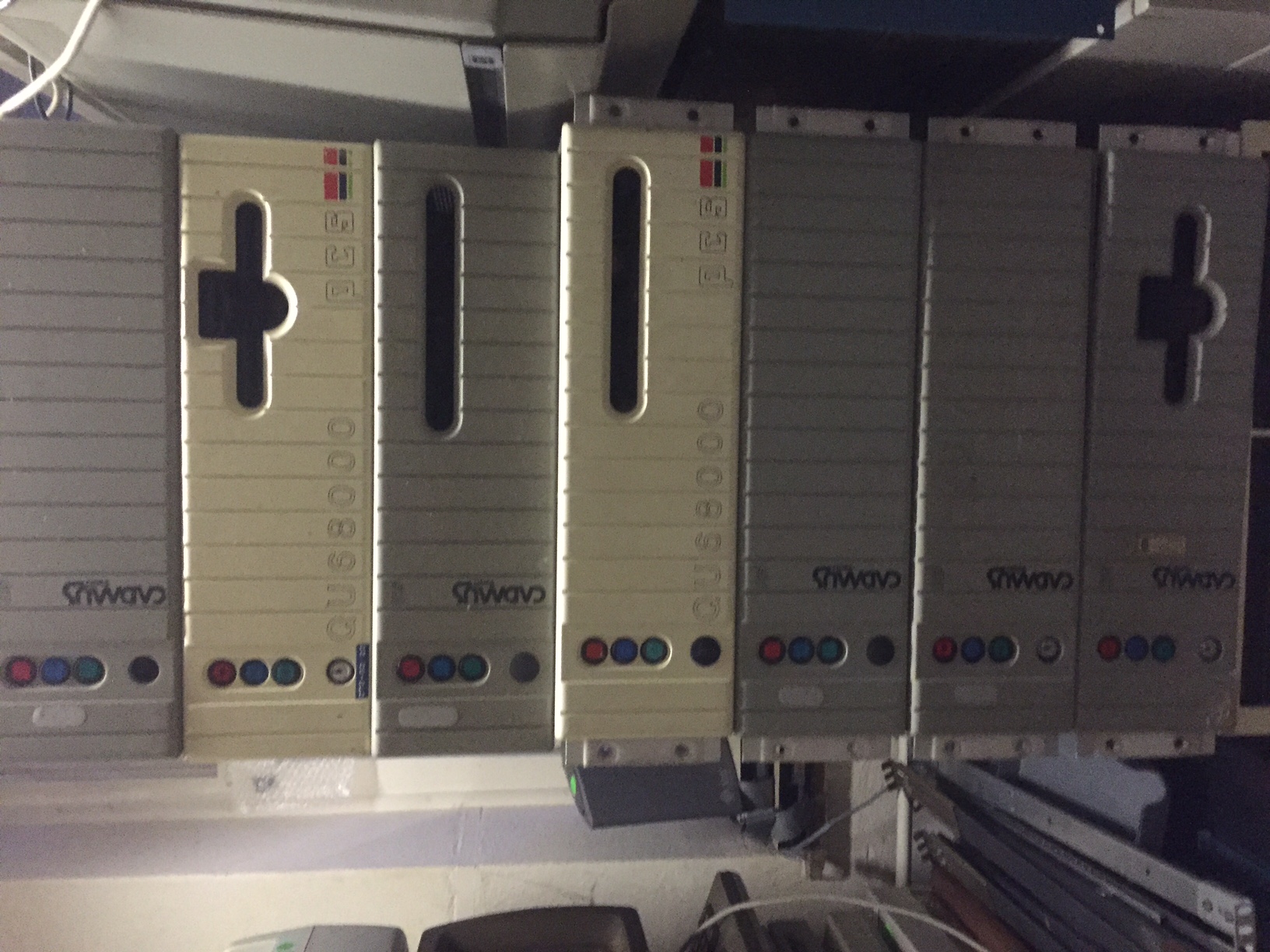
> Hi,
>
> Is anyone interested in PCS Cadmus/QU68000 systems? We at Hack42 have no
> idea what to do with them. We need to downsize and these take up a
> significant amount of our space.
>
> See http://dev.ramdyne.nl/IMG_2750.JPG for photograph of the stack.
>
> If you know other people who are interested in beasts like these, please
> pass this information on.
> --
> Andreas
Looks like interesting machinery from a German manufacturer!
There is a short blurb about them on de:wp (https://de.wikipedia.org/wiki/Cadmus_Workstations) saying the PCS QU68000 were based on (who'd have guessed...) a 68000 processor on a QBus (!) while the later models sold under the CADMUS trademark held 68020/030 and, from 1985 on, MIPS RISC processors. They ran MUNIX, a V7 UNIX derivate, with some quite sophisticated cluster integration (network boot, "Newcastle connection" common superroot namespace, networked block devices) enabled by a board called the Intelligent Communications Controller.
The outfit even still seems to stick around here (https://www.pcs.com/en/company/history/the-history-of-pcs/), albeit manufacturing access/time registration/industrial data terminals nowadays.
As usual, if somebody from Germany conducts an operation on those and doesn't know where to put all of them, I'm willing to help out with collecting and re-homing. (I may also have an opportunity to collect a couple of them in the Netherlands if there are any left by/can be held onto until end of May 2016. I'd wish for one of each significantly different type but this is not a reservation but a "last resort" deal if they'd go to trash otherwise. Basically, if anyone else comes along offering a good home for them, I'm happy to stand back.)
TIA,
Arno
Hi, all,
I have a question about old Mask-Programmed ROMs
The part in question is the National Semiconductor MM5231. This part is
a 2K-bit PMOS Mask-Programmed ROM, generally organized as 256x8, but
also can be organized (via a MODE pin)as 512x4 bits. In this particular
application, the parts are used as 256x8.
I'm wondering if anyone knows if these particular ROMs (from the '72
timeframe) have a tendency for bit rot over the years?
I know some of the early MOS ROMs had issues with metallization creep
that would cause data loss/corruption.
I have an old calculator that uses these ROMs as the micro and macrocode
stores.
The machine is catatonic, though the power supplies, master clock
oscillator and divider circuitry, and the other obvious stuff are OK.
I suspect it is probably stuck in some kind of microcode loop, just
cycling around doing nothing. I have not yet put logic analyzer on the
microcode latches yet, but that's probably my next experiment.
Sadly, if one or more of these ROMs (there are 18 of them!) has failed,
it likely means that the machine can't be restored to operation, as this
is quite a rare machine, and there just aren't many of them left around.
I have three different EPROM programmers, but sadly, none of them have
the capability to read these parts. I was I had a Data I/O programmer,
but alas, haven't come across one with all the Unipak modules I'd need
at a price I can afford.
Thanks,
-Rick
---
Rick Bensene
The Old Calculator Museum
http://oldcalculatormuseum.com
Hello,
I just acquired two DEC modules, M8295 and M7114.
These appear to be a video system for unibus, named VT30-H.
I don't find any info about these boards...
There's some documentation around?
Is the system complete or some other card is required?
Thanks
Andrea
On Wed, February 17, 2016 06:59, Arno Kletzander wrote:
>> Hi,
>>
>> Is anyone interested in PCS Cadmus/QU68000 systems? We at Hack42 have no
>> idea what to do with them. We need to downsize and these take up a
>> significant amount of our space.
>>
>> See http://dev.ramdyne.nl/IMG_2750.JPG for photograph of the stack.
>>
>> If you know other people who are interested in beasts like these, please
>> pass this information on.
>> --
>> Andreas
>
> Looks like interesting machinery from a German manufacturer!
>
> There is a short blurb about them on de:wp
> (https://de.wikipedia.org/wiki/Cadmus_Workstations) saying the PCS QU68000
> were based on (who'd have guessed...) a 68000 processor on a QBus (!)
> while the later models sold under the CADMUS trademark held 68020/030 and,
> from 1985 on, MIPS RISC processors. They ran MUNIX, a V7 UNIX derivate,
> with some quite sophisticated cluster integration (network boot,
> "Newcastle connection" common superroot namespace, networked block
> devices) enabled by a board called the Intelligent Communications
> Controller.
> The outfit even still seems to stick around here
> (https://www.pcs.com/en/company/history/the-history-of-pcs/), albeit
> manufacturing access/time registration/industrial data terminals nowadays.
>
> As usual, if somebody from Germany conducts an operation on those and
> doesn't know where to put all of them, I'm willing to help out with
> collecting and re-homing. (I may also have an opportunity to collect a
> couple of them in the Netherlands if there are any left by/can be held
> onto until end of May 2016. I'd wish for one of each significantly
> different type but this is not a reservation but a "last resort" deal if
> they'd go to trash otherwise. Basically, if anyone else comes along
> offering a good home for them, I'm happy to stand back.)
>
> TIA,
>
> Arno
>
Yes, those were nice machines. I worked with these systems in '84 - '87
and did visit their premises in Munich a few times. It was a small
office/factory building in the mids of a housing area.
Ed
--
Ik email, dus ik besta.
BTC : 1J5fajt8ptyZ2V1YURj3YJZhe5j3fJVSHN
LTC : LP2WuEmYPbpWUBqMFGJfdm7pdHEW7fKvDz
Hello,
For sale rare PDP 11/45 mini computer
Included:
- TU56 Tape transport
- Cardbuses
- Original DEC Schematics
Accepting offers. Please mail to jasper.wijnands at gmail.com. Located in The
Netherlands.
Kind regards,
Jasper Wijnands
pictures:
[image: undefined]
[image: undefined]
[image: undefined]
[image: undefined]
[image: undefined]
[image: undefined]
1. Anyone who has played with Xerox systems will have encountered the
dreaded 0937 code at boot time; it means "I have been configured for
network operations. I abjure the world and will wait until hell
freezes over before continuing the boot - unless I get the time from a
network time server!"
This is inconvenient and frustrating at times. Netware IPX/SPX is
basically Xerox XNS implemented pretty much unchanged; does anyone
happen to know if a Netware server can provide network time server
functions - and in a way that a Xerox workstation would grok?
2. I haven't powered up my 6085s in a long time - at least 5 years;
maybe 10 for some of them. The results have been most disappointing.
They won't even *start* POST - and/or they give a rolling screen with
no sync - and/or a blank screen - and/or they pass POST but won't boot
with an 0151 error. I've tracked these down in most cases to flaky IOB
boards. These boards hold the system PROMs. Anyone else seen similar
issues? Could it be bit rot in the PROMs? Is that a known thing with
6085s?
Thanks
Mike
Hi,
I'm looking for some old inkjet printers for a legal partner:
Epson Stylus Pro 9000
Epson 9500
Lexmark 7000 Z11
They're from about 1998 or 1999.
They probably have fixed nozzles across the page, no moving head.
Assuming they're of the correct vintage / acceptable, a bounty will be paid.
thanks!
Stan Sieler
sieler at allegro.com
Cupertino, CA
Hi,
We at Hack42 have an Apple Lisa 2/10 for sale at
http://www.ebay.nl/itm/121893065311.
When we powered it up for the last time 18 months ago, it appeared to be
working (no nasty smells etc) but we didn't test it very much. What has
happened since is anybody's guess.
Note: shipping to the US is *really* expensive, but within Europe is
only slightly less painful (with packaging it'll reach 25kg easily).
Pickup is an option.
--
Andreas
Hello all,
I have a bunch of VAX/VMS media that need a new home. I must move them
very soon and I have little time for shipping. Pickup from 53714
(Madison, Wi) preferred.
16MT9:
VMS V5.3 BIN 1/2 & 2/2 in shipping box with docs
VMS V5.3.1 BIN
8" floppy media:
VAX/VMS 3.4 5 disks
VAX/VMS 3.6
VAX/VMS 3.7
VAX/VMS 4.0 3 disks
VAX/VMS V4.1 UPD BIN 4 disks
VAX/VMS V4.2 BIN RX01 MANDATORY UPDATE
VAX FORTRAN 3.4
VAX PASCAL 2.3
Microfiche:
VAX/VMS 3.6 SRC LST
VAX/VMS 4.2 SRC LST
-Jon
Howdy.
I connected one of theese (i have two) to an PC last night.
Blemishes:
the text is blurry
wrong color tones (a little bit red)
so how much can i do with the display picture setting buttons ?
I'm thinking about connecting one of them to a Sun 10 (but i do have a
bunch of RS 6000 PPC machines.)
Hi,
Does anyone know of a tool which can convert between Motorola's FFP
(Fast Floating Point) float format and IEEE754?
I'm trying to reverse-engineer some ancient 68k code which uses the FFP
library, but a load of the floating point constants have been hard-coded
as hex constants, which is making things hard to interpret...
I've tried to convert the 68k assembler in FFPIEEE.SA to C, but I must
have missed something because it just isn't working...
Thanks,
--
Phil.
classiccmp at philpem.me.uk
http://www.philpem.me.uk/
> From: Jacob Ritorto
> I struggled for hours with inadequate eyesight, tools and materials,
> but I think I got this mod done!
That was quick! I had an 11/23 on my workbench that had had that backplane
mod, so I took it apart to take a picture, to help you, but I guess that's
OBE... :-)
> the machine's stuck in self-test at error 47, Memory CSR error.
It's not clear that that's really a hardware problem. DEC makes assumptions
about how many memory CSRs there will be, etc, and some third-party board
'fail' when they don't meet those expectations. I have a Clearpoint QED1 (I
think that's the one, didn't check) that does that.
> What I assume is the parity light on the third party "Clearpoint QRAM-2
> SPB-1 88B" lights during self test. I've found no documentation for this
> sucker as yet..
I have a PDF of the "User Information Manual" for the Clearpoint Q-RAM 88B.
(Oh, I see, later message says you found it.) No prints, alas. Anyone have any
we can scan and put online?
> I'll have to find my rl02 controller and build the system up some more
> so I can run xxdp and find out what exactly died.
I would tend to use diagnostics as 'help', not my main tool in diagnosing
faults. This is particular true as really bad issues can prevent the
diagnostics from loading/running, so if you get skilled at fault analysis
without depending on them, you're better situated to deal with the failures
that prevent using them.
> Can anyone offer hints as to how to identify which component is broken
> and how to go about repairing this?
As other have said, lacking the prints, pulling chips (if they are socketed)
ought to enable you to work out which chips goes where. (I'v worked out the
chip layout for a number of un-documented memory cards this way.)
I don't know about your 88B, but the one I have photos of, and my other
Clearpoint cards, the chips are in sockets. With luck yours will be too... If
not, ask if someone has one with sockets (alas, I don't have an 88B), who can
do the mapping for you.
Important: once you have worked it out, pass it along! I'm trying to upload
all the data I've collected about cards for which no documentation is
available to the Computer History wiki.
> It's the only memory board in this machine, so I guess the problem
> might actually be a bus or processor board, right?
Could be. I have an KDJ11-B which has stuck bits, and that's the CPU board,
so yours could be to.
> I have no other q-bus memory to test with, so can't do swapping /
> process of elimination to be sure.
It's definitely worth having another small QBUS memory card to use in fault
isolation when debugging. M8044's are readily available on eBay for about
$20. They are only Q18, so not usable in the same machine as Q22 memory, but
they are useful for debugging. I would definitely invest in one.
(If you luck out and get a bad one, send it to me, and I'll swap it for a
known good, tested, one. I've fixed a whole bunch of them, got to the point
where the last one I did for someone I didn't even have to pull out my
'scope! I could tell from the symptoms exactly which chip to replace! :-)
> From: Jay Jaeger
> Well clearly it is only affecting certain address bits - or the
> diagnostic would not run at all
Well, like I said, I do have a KDJ11-B which will run the on-board startup
diagnostic, but which has a bit stuck hard on the QBUS interface! So those
machines seem to be pretty resilient.
Although as you point out, if he can load and run the diagnostic, it's
probably not the CPU.
> note that it is starting at 010000000, so that points to the memory
Yup. If some locations work, and others don't, it's almost certainly the
memory. And since he's only dealing with a single memory card, it's probably
not the bus drivers/receivers on that card, either.
One can use ODT on the KDJ11-B to poke around, and find the envelope of the
problem. (See comments above about not relying on diagnostics! They are
better for saying something's busted, than for accurately telling what _is_
broken.)
With that, and a chip->memory map, it should be fairly easy to replace
the offending chips.
Noel
> From: Al Kossow
> Have you guys thought about a panel that would connect to the KM11
> connector slots of real rk11/tc11 controllers?
Umm, Guy sells KM11 clones? (I just bought a pair, they look really nice.) Or
did you mean something else?
Speaking of things Guy has, Dave is talking about adding a switch that would
turn a QSIC+indicator panel into a QAV-11... :-)
Noel
So here's a quick update on where Dave Bridgham and I are with the QSIC, since
I think we have reached a significant milestone.
We have the first of two wire-wrap prototype QBUS motherboards more or less
(see below) done, and working to do slave cycles on the QBUS. (I.e. we
implemented a simple register, and can write it, and read the contents back.)
A test program to write all 2^16 possible values, and read them back and check
them, ran several thousand complete passes with no errors.
To get there, we (Dave, really - he bore the brunt of the work on this
problem, and finally conquered it) had to tackle and fix some major noise
issues: the way the prototype is done (a wirewrap QBUS mother-board with bus
transceivers, level converters, etc, connected to an FPGA prototyping card
with flat cables), we think we had cross-talk problems in the cables (since
the connector pinout on the FPGA card, which we can't change, didn't alternate
ground and signal lines).
Anyway, it's working now; that means the hardware is 'mostly' working; most of
the work from here on out will be FPGA, etc, programming. There _are_ a few
additional QBUS lines used for bus master (DMA) and interrupts which we
haven't used yet, and one of the first things done now is to get those two
kind of bus cycles working; a) we have to get them done anyway, and b) that
will verify that the QBUS interface hardware is full working.
With that in hand, we can do the first controller (RK11), using memory in the
FPGA to simulate a small disk. We'll then try and get to the larger RAM on the
FPGA, to do full-size RAM disks. Next up after that is probably to hook up
some SD cards (we already have produced the small PCB daughter-cards, which
will mount on sockets on the wire-wrap mother-board, to hold the SD cards - we
still need to add those sockets and wire them up, hence the comment that the
wire-wrap mother-boards are "almost done"), at which point we'll have a
fully-functional prototype.
Dave has also produced prototype PCB's for the indicator panel, and one has
been stuffed, and Dave's about to try and hook that up, and get it running;
that will require yet a bit more work on the mother-board (install 3 sockets
to hold the driver chips for the signal lines in the interface to the
indicator panel). Blinkenlitz are a priority because, i) just because ;-), and
ii) being able to display data from inside the FPGA will be a big debugging
help.
Anyway, we think getting slave cycles working was a major milestone (for a
couple of software guys :-), And we think (_hope_ :-) that progress will now
be pretty rapid, so hopefully more soon.
Noel
From: Christian Corti
Sent: Wednesday, February 10, 2016 2:28 AM
> On Tue, 9 Feb 2016, Pete Lancashire wrote:
>> There are a few odd balls in 9-track as well, but the 556 was a typo.
> Really?
> I actually *do* have a 9 track tape drive (HP 7970) that has 200/556/800
> bpi densities:
> http://computermuseum.informatik.uni-stuttgart.de/pics/hp1000/hp7970_2.jpg
> And it is a *9* track tape, I know for sure.
Actually, what you have is a *dual-density* tape drive, an HP7970E. It
will write 9-track tapes at 800bpi, or 7-track tapes at 200, 556, or 800.
See the manual for the 7970 drive family at
http://bitsavers.informatik.uni-stuttgart.de/pdf/hp/tape/7970/07970-90885_7…
Rich
Rich Alderson
Vintage Computing Sr. Systems Engineer
Living Computer Museum
2245 1st Avenue S
Seattle, WA 98134
mailto:RichA at LivingComputerMuseum.orghttp://www.LivingComputerMuseum.org/
Hi
I had an email in from the screeners this morning. She is getting
there.
I suppose I should not expect automation speeds from a skilled hand
process.
Twenty boards not all the same with five passes per board, flush out
time and
drying time with the need for spot on registration aint gonna be that quick.
More news as I get it
Rod
In honor of Valentine's day and all the great ladies that I've worked with over the years, ?I for one had a small part in a romance by setting up a VMS account for the geologist in our department after listening to his complaints about how useless computers were for years. ?Come to find out he wanted to email with one of my best programmers. ?Love ensued with marriage in a little while. ?Please enjoy.
Big computers, big hair: the women of Bell Labs in the 1960s ? in pictures
| ? |
| ? | | ? | ? | ? | ? | ? |
| Big computers, big hair: the women of Bell Labs in the 1...In 1967, Lawrence ?Larry? Luckham was an operations manager at Bell Labs in Oakland, California. He brought a camera into work to capture a day in the life? |
| |
| View on www.theguardian.com | Preview by Yahoo |
| |
| ? |
Jim
Hi all,
I was stopping by a local recycler to pick up a few Cisco switches I bought
to add to my lab, and while I was there, I happened to spot a complete IBM
System z9 machine out of the U-M Health System.
http://www.ebay.com/itm/IBM-Type-2096-S07-System-z9-Enterprise-Server-TESTE…
The fellow that I was speaking with indicated that they might accept a
little bit less than the tagged price.
Perhaps this is a bit on the new side for the list but I figured these
don't come around too often and this might be a good place to find it a
home... I know there are lots of IBM enthusiasts here.
Best,
Sean
On ftp.dreesen.ch/PDP11 you can find some pics on how the rescued PDP11/04 fits right in next to its cousin, a PDP8/a
This 8a, BTW, has more memory (128K x 12) and more oomph ( a FPP8A ) than the PDP11/04....
Jos
I'm looking for an IBM 3290 to complement my z800 mainframe and third party
3174-22L establishment controller. I can't imagine these were particularly
rare, but am sure many of them have been destroyed in the waning years
since it takes special equipment/know how/desire to even use. Any leads on
on for a reasonable price?
Regards,
Kevin
On Mon, Feb 8, 2016 at 9:48 PM, Jon Elson <elson at pico-systems.com> wrote:
> On 02/08/2016 03:23 PM, Ethan Dicks wrote:
>>
>> I don't know if you could use the 256K boards (populated with 4116s) in
>> the 11/730 due to the tri-voltage 4116s, but even if they worked, you
>> wouldn't want to - 5 of them just isn't that much RAM.
>
> We ran our first 11/780 with 2 memory boards. I THINK we had a total of 256
> KB, and one Friday afternoon one of them died and we had to run over the
> weekend with only one board, so that would have been 128 KB. Yes, it was a
> bit tight on memory, but we got a LOT done on that machine.
As I mentioned our first 11/750 was delivered with 512KB (we upgraded
it pretty quickly to 8 boards for 2MB, where it ran for years). The
11/750 first shipped with IIRC VMS 2.0. My first encounters with VMS
was around mid-1984 and VMS 3.4. We had 8MB of memory in our second
11/750 but it was supporting 50+ users.
That 11/750 went off-lease, we sent it back. That's why I had to
upgrade the other one, so we'd still have an 8MB VAX in-house. It ran
VMS 4.7 at the end of its days 23 years ago (we had quite a bit of
software that wasn't available for/wasn't licensed for/wasn't under
paid-maintenance for 5.x). I haven't powered it up since we left that
building (I do occasionally power up the 8300 that we got for product
development).
So I'm fairly confident that 512MB is enough for VMS 2.0 but I _think_
by 3.0, you had to have a megabyte or two. 1.25MB would be the most
you could stuff in a 11/730 if you could use the boards populated with
16Kbit DRAMs. I don't think VMS 2.x runs on an 11/730 (but I could be
wrong there). We ran Ultrix 1.1 and VMS 5.0 on one of ours (with
5MB). VMS 5.0 barely fit - we mostly used that to link our product
binaries under 5.x for distribution to our customers.
I do know someone in Ohio who ran VMS 5.0 on a VAX-11/725, but they
did it by cutting a slot in the skin and running a BC11 cable out to a
BA11 box next to the 11/725 and stuffing a UDA50 in the BA11. With an
external disk, there's no practical difference between an 11/725 and
an 11/730... same CPU, same backplane, same memory... just a packaging
difference.
-ethan
Does anyone still have a copy of the "Emulex LSI/PDP MSCP Formatter Program
(SXMX8B) ? My QD32 emerged from storage in a foul mood and is giving me
errors I don't understand when I use the manual entry methods for inputting
geometry and issuing a format. From what I can tell, it's complaining that
its onboard RAM is bad. Comments / suggestions welcome.
thx
jake
On Thu, Feb 11, 2016 at 12:11 PM, William Donzelli <wdonzelli at gmail.com> wrote:
>> DEC VT100s
>> were around $1,800 in the early-1980s,
>
> VT100s (and terminals in general) often were used as bargaining chips
> to sweeten deals, so the price was quite "flexible".
I have no doubts that was true when selling systems, but I remember
seeing the paperwork from when we were growing, so 10 new employees
meant 10 new terminals (and sometimes one more CS21)...
Eventually, we stopped growing, then started shrinking, so it was
feasible to log into two systems at once by having two terminals on
your desk. We also had structured wiring from Nevada Western (DB25
modular adapters on each terminal, 6-pin silver satin cables to the
wall, and several 3U "switchboard" panels with blocks of jacks and
25-pair telco cables back to the VAXen) so it was also easy to employ
2-line switch blocks at our desks. Eventually, we had "modern"
terminals like the CiTOH 101e that supported a second session over the
"serial printer" line (we never used the second line for hardcopy).
Now, I use computers with bitmap screens to maintain multiple
simultaneous character-based sessions. Same workflow, less wire and
fewer large hunks of plastic and metal on my desk.
-ethan
> From: Jacob Ritorto
> Would you happen to have notes or references about how to do it?
It's not too hard; basically, one has to wire pins BC1, BD1, BE1 and BF1
(BDAL 18-BDAL21, respectively) on all _QBUS_ slots together into a bus. So
wire BC1 on slot 1 to BC1 on slot 2, slot 3, etc, etc.
A couple of notes: First, I said '_QBUS_' because if you have a Q/CD
backplane, clearly one doesn't run the extra BDAL lines to the CD slots, only
the QBUS slots (which run down the left-hand side, when facing the backplane).
Second, for optimal analog behaviour, the 'out' slot on the backplane should
be the last slot you wire to, so that there are no branches in the
transmission line for BDAL18-BDAL21 (which can produce reflections - aka
noise - on the transmission lines). How to do this efficiently (in terms of
the wiring) can be a bit tricky, depending on the backplane configuration.
E.g. if one has the standard 'serpentine' backplane, i.e. one with the slots
in the following kind of order (facing the backplane from the board side):
1-2
4-3
5-6
8-7
9-10
etc., one might naively think one has to run the extra bus lines back and
forth to match. However, only the _grant_ lines have to follow this pattern
(and they are already there); the added lines don't have to follow the same
pattern, as long as there are no branches.
So, for the example 5-slot backplane above, one could/would wire:
1-4-5-8-9--2-3-6-7-10
i.e. a single vertical run on the left hand side, a single diagonal from 9
back to 2 (shown with "--"), and then another vertical run on the right hand
side. Much simpler than wiring back and forth in slot order; there are no
branches; and the last slot is the 'out' slot.
For backplane with an _even_ number of layers, e.g.:
1-2
4-3
5-6
8-7
it's a little more complicated: a single vertical run on each side
cannot be connected in such a way as to have the 'out' slot (8) be the
last slot. One has to do something a little more complex:
1-4-5--2-3-6-7--8
with a vertical run on the left side, stopping short of the last slot; then
a vertical run on the right side, then a lateral back across on the last
layer.
Obviously one _could_ run the wires back and forth, in slot order, but that
will take a lot more wire, which at the very least is more work (especially
on backplanes which don't have full wire-wrap pins, just the little stubby
pins that have to have the wires soldered to); whether it also increases the
delay down those transmission lines enough to be noticeable is something I
don't know the answer to.
All the obvious caveats apply: make sure not to get confused by the mirror
pin and slot numbers on the front and back sides (you'll be wiring on the
back, whereas the diagrams above are on the front), etc.
Noel
Anyone know what this:
http://www.ebay.com/itm/251526917058
is? It has five chips, not six, so it's not the KEF11-BB CIS option. I've
tried Web searches on "57-27889-01", but not turned up anything useful.
Noel
Preferably one of the deskside SMP models.
Proving a point about under what circumstances X86 machines can be
considered cool... :^)
Located in Seattle.
--
Ian Finder
(206) 395-MIPS
ian.finder at gmail.com
>Richard Cini wrote:
>Jerome -- good point about the IOPAGE. Maybe I'll get an 8kw and 16kw board -- that gives me 28kw with the included 4kw. I have no specific software so I don't need to tinker with reducing IOPAGE.
>
>Rich
>
>>>On Feb 9, 2016, at 10:47 PM, Jerome H. Fine <jhfinedp3k at compsys.to> wrote:
>>
>>>Thanks guys. This is really helpful. I was getting confused between the M8044 and M7944 boards. Max memory for the LSI-11 is 32kw, right?
>>>
>>>
>>Correct, the maximum memory on a board is 32kw.
>>
>>For an LSI-11 (aka PDP-11/03) without any MMU hardware,
>>the actual maximum memory that can be accessed must also allow
>>for the IOPAGE registers. Usually, the IOPAGE address range
>>is 4 kw which leaves 28kw for everything else, including RT-11
>>(assuming that is what you are running). There is one option
>>available with some hardware to reduce the address range
>>set aside for the IOPAGE to just 2kw which then leaves
>>30kw for everything else. Unless you are running a specific
>>program which requires the extra 2kw, it is probably not
>>worth the extra effort.
>>
I hope that my version of arithmetic is for 8kw + 16kw = 24kw,
so somewhere I don't understand where the other 4kw comes
from.
Then, since you are missing only 4kw out of the maximum of
28kw (which is the normal maximum), you will not likely have
a problem unless you have really memory rich programs.
RT-11 runs fairly well in just 16kw (or 32 KB), so it should not be a
problem. For my own work in which I need to run MACRO.SAV
as fast as possible, I run the program in 64 KB of extended memory
under a Mapped Monitor - which a PDP-11/03 (or an LSI-11)
can't do since there is no MMU chip.
Of course, my actual CPU is a Pentium III which I use to run Ersatz-11
so that RT-11 is running 15 times as fast as a PDP-11/93. And the
disk I/O is also a bit faster. I can copy a 32 MB RT-11 partition to
a second 32 MB RT-11 partition in under 2 seconds. Even with two
ESDI hard drives on a PDP-11/93, that takes over 4 minutes.
Jerome Fine
I have not opened up ours yet but I always assumed they were all DEC
boards.
Ed# _www.smecc.org_ (http://www.smecc.org)
In a message dated 2/9/2016 7:36:05 P.M. US Mountain Standard Time,
glen.slick at gmail.com writes:
On Tue, Feb 9, 2016 at 6:08 PM, Richard Cini <rich.cini at verizon.net>
wrote:
> All ?
>
> I picked-up a Heath H-11 machine the other day and it has a single 4kw
memory board. From my prior experiences with DEC (an 11/34a many years ago;
now at the RI Computer Museum), I know my way around the field guide?but I?
m having trouble trying to identify the correct module number suitable for
the LSI-11 CPU. Even though it?s a Heath machine, I assume it?s module
compatible with DEC. Any help would be appreciated. Thanks!
>
> Rich
Maybe an M8044 MSV11-D (no parity) or M8045 MSV11-E (parity) would be
most appropriate. They came in 4KW, 8KW, 16KW, and 32KW flavors.
http://manx.classiccmp.org/collections/antonio/dec/msv1dop1.pdf
Fairly common on eBay.
>Good luck in finding media for AIX PS/2. As far as I know, it was never
released on
>CDROM and the last version I had was ~53 3.5? floppies (long gone now
unfortunately)
>and *only* worked on specific PS/2 hardware (no BIOS ? all drivers went
straight
>to the ?metal?).
>
>TTFN - Guy
Nope, AIX 1.3 is readily available. It's over on http://ps-2.kev009.com if
you know where to look along with a rather massive amount of documentation
and (VERY HANDY) installation instructions. I can confirm that it will work
on a stock IBM 8580 and you can get several different flavours of window
system if you wanna roll that way. I put a video on Youtube a few years ago
of a running machine when it was still rather badly configured. I briefly
had it working on the model 55SX as well but because I was not labling the
disks as I wrote them I went out-of-sequence somewhere and frustratingly
couldn't find Disk 15.
-John