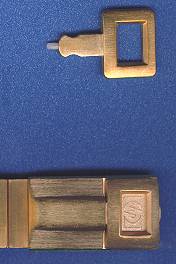
>Especially given how much money I had to pay for them; as HPs go, second
only
>to my HP-01 watch. I'm keeping them in a safe place!
What, you don't wear your HP-01? What's the point in having one, then?
- Joe
P.S. My HP-01 didn't come with the little key-presser stylus thingie. What's
the best hack replacement anyone has come up with?
>On Sun, 7 Feb 1999, Mark Gregory wrote:
>> Hi. I recently acquired a 1950's vintage Gibson GA-30 guitar amp. Never
>> having owned a tube-based amp before, I'm clueless about the proper way to
>> use this amp without abusing it (and it sounds great, so I want it to last
>> a long time! :v) .
Sam said:
>Wow, this is decidely off-topic. Way off topic. Don't you think this
>question would be better served on a more suitable newsgroup?
(This reply is Digest delayed)
This is not off topic! We don't talk enough about vacuum tubes!(..imho..)
First, amplifiers are the most basic element of any electronic analog
computer.
Second, where can anyone draw the OT line between vacuum tubes and LSI chips?
RTL,DTL,TTL, or transistors in general?
:)
Mark,
Check out Vacuum Tube Valley http://www.vacuumtube.com/
--Doug
=========================================
Doug Coward
Press Start Inc.
Sunnyvale,CA
=========================================
Questions on Intel 4004 chip:
-Am I correct in assuming that 4004 is no longer manufactured by Intel?
-How many were made?
-Is it true that this chip is used the Voyager spacecraft?
David
davidfreibrun(a)home.com
http://altaircomputers.org
-----Original Message-----
From: Sam Ismail <dastar(a)ncal.verio.com>
To: Discussion re-collecting of classic computers
<classiccmp(a)u.washington.edu>
Date: Wednesday, February 10, 1999 7:23 AM
Subject: Re: Intel 4004
>On Tue, 9 Feb 1999, David Freibrun wrote:
>
>> You have an Intel 4004? Where did you obtain this?
>
>The answer is right inside the message to which you are replying. Look...
>
>> >I would *love* some 4004 tools. I have a 4004 that I plan to build
>> >into a project someday. It came out of a non-UPC grocery store barcode
>> >scanner I bought at the Dayton Hamfest in 1983.
>
>Sellam Alternate e-mail:
dastar(a)siconic.com
>---------------------------------------------------------------------------
---
>Always hasslin' the man.
>
> Coming in 1999: Vintage Computer Festival 3.0
> See http://www.vintage.org/vcf for details!
> [Last web site update: 01/15/99]
>
You'll need to find someone local with a pickup truck, since you probably
won't find anyone willing to pay what it costs to ship it. I paid $385 to
ship mine from Pennsylvania to Denver. The "Draftmaster" 7596, I believe,
that we had at work weighed considerably more than mine, though it didn't
plot faster, or, in any detectable way, differently. It cost and weighed
more, and was more massive in its appearance. It was, however, an
excellent device.
one more thing . . . imbedded below.
Dick
----------
> From: Athanasios Kotsenos <a.kotsenos(a)rca.ac.uk>
> To: Discussion re-collecting of classic computers
<classiccmp(a)u.washington.edu>
> Subject: Re: HP plotters
> Date: Tuesday, February 09, 1999 11:56 AM
>
<snip>
>
> >I do have the manuals for the 758x series, by the way.
>
> I should have the manuals for both, but I've only definitely found one of
them.
> I actually found the info for printing the test page on their web site.
>
Well, I've had several people inquire about reproducing the two massive
manuals, nearly 1k pages each. I sent the manuals (user guide not
included) a Programming Manual and a Technical manual, the latter of which
has numerous 11"x33" foldout drawings, and they have sat at the printer's
for a couple of months waiting for an estimate on reproducing them to be
finalized. It won't be cheap because of those foldouts, which are
half-tones.
>
> So, if anybody wants them...
>
> Nasos.
>
Yes . . . that's how I remember it, too. Those irritating core dumps were
always recongnizable as they went through the line printer, since they
sounded like a chef chopping celery.
I never did get to where I could actually gain anything from a core dump.
I guess it hasn't changed much, though the dumps Windows95 gives you when a
process goes askew aren't as long.
Dick
----------
> From: Lawrence LeMay <lemay(a)cs.umn.edu>
> To: Discussion re-collecting of classic computers
<classiccmp(a)u.washington.edu>
> Subject: Re: Piece of classic FORTRAN code
> Date: Tuesday, February 09, 1999 9:47 AM
>
> > ::Those were the days . . . FORTRAN-II, SCOPE OS, COMPASS assembler . .
Golly! That does bring back the memories . . . but wasn't the CDC6xxx
family 64 bits? I cut my teeth on that one, back in the mid 1960's and it
seems that it (the 6600) was a dual-processor version of the 64-bit 6400.
Those were the days . . . FORTRAN-II, SCOPE OS, COMPASS assembler . . .
batch processing . . . (that meant you wrote your code on a 24-line
80-column "coding sheet" and, when finished, gave them to a woman behind a
door with a small window in it . . . and got your error listing a few days
later) . . . I'd have given a week's pay for an hour in that room behind
the door . . . mini-skirts . . . (you do remember keypunch operators and
Hollerith cards, don't you?)
Dick
----------
> From: Sergey Svishchev <svs(a)ropnet.ru>
> To: Discussion re-collecting of classic computers
<classiccmp(a)u.washington.edu>
> Subject: Piece of classic FORTRAN code
> Date: Tuesday, February 09, 1999 2:34 AM
>
> G'day,
>
> IF (COMPLF(-1).LE.2) IF (RSHIFT(COMPLF(0),32)-15) 360,1108,6600
> C IF (NOT(-1).LE.2) IF (ISHFT(NOT(0),-32)-15) 360,1108,6600
> 7094 PRINT *,'IBM 7094'
> STOP
> 360 PRINT *,'IBM 360 (32 BITS)'
> STOP
> 1108 PRINT *,'UNIVAC 1108 (48 BITS)'
> STOP
> 6600 PRINT *,'CDC 6600 (60 BITS)'
> STOP
>
> --
> Sergey Svishchev -- svs{at}ropnet{dot}ru
On Tuesday, February 09, 1999 3:25 PM, Michael A. Rivas Sr
[SMTP:mrivas@caribe.net] wrote:
> my brother got a hold of a tandy 1000. when booted up it asks for a boot
disk which he does not have. i have two questions
> 1) what can i do about the boot disk?
> 2) what does a tandy 1000 go for?
> << File: ATT00001.html >> << File: ATT00002.gif >>
Michael,
1.) I've had several different 1000s and each of them would boot from ROM
if a disk wasn't available. Since the ROM included a FORMAT command, you
could make your own bootable disk.
Some of the models might have worked a little differently. Exactly which
model do you have (1000TL / 1000HD / 1000RL ...)?
2.) There were about a trillion of these things made so, the value is
pretty low. I have seen them for as little as $10 at the flea market
without a monitor or hard drive. The monitor could cost another $10 to $15.
The hard drive with OS might add another $10.
So, the value of the complete working system would probably be in the $30 -
$50 range...
Regards,
Steve Robertson - <steverob(a)hotoffice.com>
>> ... my lovely 128DCR ...
>
>128 DCR ?
>Data Casette Recorder ?
>Detatched Cigartop Remover ?
>Did Commodore Retire ?
My TVC-15?
- Joe
P.S. I swear, one day I'll post something useful to this list.
Hi, I have a few OT questions. I hope no one minds.
1. I have a nasty hangnail that won't go away. Any suggestions how to get
rid of it?
2. Everyone know about Cuban cigars... but are Cuban cigarettes better than
American cigarettes? Are they also illegal?
3. I've heard rumors that Cabaret Voltaire and KISS are going on tour
together soon! Is it true? How can I get tickets?
- Joe
P.S. Consider this an experiment in the refusal to use emoticons.
These "names" aren't going to prove as helpful as the model numbers. I
have a 7585B which is, I believe, the precursor of the Draftmaster series,
the principal difference being the presence of a drive for the chart feed
and some different body panels. It's not at all certain that the behavior
you've described characterizes any malfunction at all. The fact that HP
people suggest it's broken doesn't mean much either, by the way. HP has a
habit of disposing of people once they've learned enough about anything to
be really useful, and their salesmen never get to that point.
I do have the manuals for the 758x series, by the way.
Dick
----------
> From: Athanasios Kotsenos <a.kotsenos(a)rca.ac.uk>
> To: Discussion re-collecting of classic computers
<classiccmp(a)u.washington.edu>
> Subject: HP plotters
> Date: Tuesday, February 09, 1999 5:14 AM
>
> Hi all.
>
> Anybody interested in any of the following?
>
> HP DraftMaster I
> HP DraftPro DXL
>
> Both are not really in working order.
> I'm guessing the DraftMaster has a problematic chip as it shows all this
> rubbish on the screen after you turn it on.
> The DraftPro DXL seems to have a mechanical problem. When I first turned
it
> on, it worked OK and I managed to get the test print out. After that it
> started behaving weirdly. It tries to move the 'head' unsuccessfully and
> never gets it to where it should go. Very slowly.
> Apparently HP people were in a couple of years ago (before I started to
> work here) and they said that repairs would be way too costly and buying
> something new would be a better option. Of course they would say that -
it
> is usually true anyway.
> I am hoping that someone could revive these on their own. It's a shame to
> see them go in the skip, but I do have to get rid of them soon as they
take
> up too much space. I'd take them home if I had enough space there.
> They _are_ big, so I guess you would have to live near London.
>
> I also have some HP 98785A screens (also big), which don't have to go as
> urgently as the plotters. I haven't tested them, though, but I will if
> anyone wants one.
>
> Nasos.
>
Richard Erlacher wrote::
<< Golly! That does bring back the memories . . . but wasn't the CDC6xxx
family 64 bits? I cut my teeth on that one, back in the mid 1960's and it
seems that it (the 6600) was a dual-processor version of the 64-bit 6400.
The CDC 6400, 6600, 7600 all were 60 bit, definitely.
The Cray-1 is the first 64-bit machine in the Seymour Cray line.
Those were the days . . . FORTRAN-II, SCOPE OS, COMPASS assembler . . .
batch processing . . . (that meant you wrote your code on a 24-line
80-column "coding sheet" and, when finished, gave them to a woman behind a
door with a small window in it . . . and got your error listing a few days
later) . . . I'd have given a week's pay for an hour in that room behind
the door . . . mini-skirts . . . (you do remember keypunch operators and
Hollerith cards, don't you?)
Dick >>
It does bring back memories !
John G. Zabolitzky
> 1) Install xtrs (Tim's TRS-80 emulator for linux/X). It can read .dsk
> files and write real disks.
>
> 2) Run my little program diskdmp that reads .dsk files and writes real
> TRS-80 disks. It does nothing else, but it's small. I don't know where
> you'd find it, but I've notionally GPL'ed it, so I can send the .tar.gz
> file to anyone who wants it (and you're welcome to stick on an ftp site,
> etc). However, as with all free software, it uses the author's OS of
> choice, in my case linux.
A long time ago, I wrote a small ASM program for formatting disks and
creating bootable images under DOS but, I don't really want to do that
right now.
I do have a Linux box here so, options 1 & 2 sound the most appealing. I'll
hang a 1.2MB floppy on it and grab Tim's app (since it's already in a FTP
directory). It could be a week or two before I get around to it. I'll let
you know if I have any more problems.
Thanks Again,
Steve Robertson - <steverob(a)hotoffice.com>
An important thing to keep in mind, however, is that not all drives adhere
to the latest, or even the more recent standard. Since this discussions
centers around old hardware, I'd be REALLY careful with ide interfaced
devices.
Case in point:
I once used a number of MAXTOR MXT540A drives, which were WONDERFUL . . .
they were fast, (6300 rpm at a time when most were 3600 rpm) beyond belief
at the time and very reliable. After a couple of years, Hitachi came out
with a nice CDROM drive, the 7730 (?) of which I bought a number.
Unfortunately, when I placed the HITACHI CDROM as a slave on the same cable
with the MAXTOR HDD as master, the servo on the HDD was overwritten, which
I only was able to verify after destroying (irreparably, because the
hardware with which to rewrite the servo didn't exist at MAXTOR any more
even though the drives were still within their two-year warranty) half a
dozen such hard disks. The CDROM certainly claimed to adhere to existing
convention, as did the HDD. MAXTOR was not able to explain the
malfunction, nor were they able to replace the drives with anything
comparable. --pity--
Dick
----------
> From: Eric Smith <eric(a)brouhaha.com>
> To: Discussion re-collecting of classic computers
<classiccmp(a)u.washington.edu>
> Subject: Re: no rom basic
> Date: Monday, February 08, 1999 10:58 PM
>
> jpero(a)cgocable.net wrote:
> > You done exactly right on everything except LLF which is big NO
> > No on modern drives, potientially losing it!
>
> I wish just for once that someone would actually cite a specific drive
> model for which this is true. I've LLF'd many of them with no ill
> effects.
>
> The ANSI X3.298-1997 standard, "Information Technology - AT Attachment-3
> Interface (ATA-3)" says that the FORMAT TRACK command is vendor-specific
> and recommends against systems using it, but nowhere does it suggest
> that an acceptable implementation would be to trash a drive.
>
> I have seen some drives that treat the command as a NOOP, simply
> returning success impediately without actually doing anything, but I've
> yet to see one which actually causes any harm to the drive.
>
> If anyone cares to present contrary evidence, please cite specifics.
> I'm not interested in FOAF anecdotes.
>
> I'm interested in a project for a 1999 Mark-8. Anyone else want a replica?
>
Perhaps... What would the scope of such a project be?
Steve Robertson - <steverob(a)hotoffice.com>
Hi,
After having moved to our new house I am gradually filling the garage with
stuff I have had in storage while the move happened. As part of this
process I am finding things I didn't even know that I had and things that
I don't have space for any more. Below is a list of things that I would
like to pass on to other collectors.
* Box of about 100 8" DEC floppy disks
* A number of old DC300 and TK50 tapes.
* Olivetti Logos 250 electromechanical calculator
* A hand cranked mechanical Olivetti calculator
* Communications Machinery Corp Multibus II Ethernet Node Processor ENP-70
* Prime EXL CPU board - I believe this goes with the above ethernet board.
* Digital engineering Inc. VT640 Retro Graphics board.
I am located in Cambridge UK. I don't really want anything for these items
but offers of something to trade would be looked on favourably.
--
Kevan
Collector of old computers: http://www.heydon.org/kevan/collection/
Richard Erlacher wrote on 23 January 1999 23:08
>This notion of cooking up or breathing new life into an old 8-bit model to
>run *NIX is probably a mite more than has been considered for one reason.
>*NIX tends to want to use virtual memory, without which many systems would
>quickly choke. The old CPM-capables don't support VM. A good reason for
>this is probably the lack of performance.
Many people have added VM support to applications running on non-MMU
hardware with little loss of performance. The Amiga has a few of these, most
notably Personal Paint by Cloanto. It can be done.
--
Gareth Knight
Amiga Interactive Guide | ICQ No. 24185856
http://welcome.to/aig | "Shine on your star"
Zane H. Healy wrote:
>As I understand it the Amiga software industry is in a bit of a crisis at
>the moment because 3.5" DD floppies are no longer being made. Well,
>they're also in a bit of a crisis thanks to the idiots running Amiga, Inc.
>killing the market last spring when it will be quite a while before the new
>Amiga is ready to ship.
You're right about the disk crisis. Amiga magazines are falling over
themselves to get a decent supply of DD disks. As for Amiga Inc killing the
market, quite probably but from what I have heard the new OS is closer to
release than everyone thinks (whatever that means) and as soon as I have
enough money I'll buy a Viper PPC with a G3 processor. The Amiga dead?
hardly?
--
Gareth Knight
Amiga Interactive Guide | ICQ No. 24185856
http://welcome.to/aig | "Shine on your star"
Hi,
I would like to get a Clipper CPU based workstation but know very little
about what models were made. Does anybody have any information on what
machines Intergraph made. I do know that some models were huge dual
display + tablet systems. I don't have the room for these but if they did
smaller deskside or even desktop systems then these would be of interest.
Many Thanks
--
Kevan
Collector of old computers: http://www.heydon.org/kevan/collection/
A similar subject came up in a local newsgroup here a few weeks ago. I have
attached one message below that might be of interest.
>> You done exactly right on everything except LLF which is big NO
>> No on modern drives, potientially losing it!
>
>I wish just for once that someone would actually cite a specific drive
>model for which this is true. I've LLF'd many of them with no ill
>effects.
>
Forwarded message:
-----Original Message-----
From: Rod Speed <rodspeed(a)ozemail.com.au>
Newsgroups: aus.computers.ibm-pc
Date: Saturday, 23 January 1999 19:58
Subject: Re: FDISK-Write protect error
>
>Joseph Henle <jhen(a)mailzone.com> wrote in message
>news:78bhko$s73$1@east42.supernews.com...
>
>> I am trying to fdisk a hard drive which indicated there is a non dos
>> partition. When I try to fdisk i get " write protect error writting
fixed
>> disk" I have also tried fdisk/mbr and i get same message. Any
suggestions?
>
>Probably best to completely clean out the first physical sector on the
>hard drive and the first few tracks and start again from scratch with
fdisk.
>Fdisk can get rather confused in some situations and thats the easy fix.
>
>The simplest way to do this is to use clearhdd from
>http://www.sec.samsung.co.kr/support/faqs/faq_view.cgi?no=99&kno=3
>
>Note that this claims its a low level format utility.
>It isnt, all it does is write zeros in the first few
>tracks. It just describes what it does rather poorly.
>
>
Hi, folks,
OK, got another one up for grabs. This one's a big Motorola 68000
'ExorMACS' manual. This thing is three inches thick, and weighs in at
nearly 9 pounds unpacked. I've not gone through it in detail, but I can
tell you that it is vintage 1980 or so.
Same deal as before; best offer takes it. If anyone would like me to look
through it for something specific prior to their buying it, that's fine.
Thanks in advance.
-=-=-=-=-=-=-=-=-=-=-=-=-=-=-=-=-=-=-=-=-=-=-=-=-=-=-=-=-=-=-=-=-=-=-=-
Bruce Lane, Owner and head honcho, Blue Feather Technologies
http://www.bluefeathertech.com
Amateur Radio:(WD6EOS) E-mail: kyrrin(a)bluefeathertech.com
SysOp: The Dragon's Cave (Fido 1:343/272, 253-639-9905)
"Our science can only describe an object, event, or living thing in our own
human terms. It cannot, in any way, define any of them..."
Just going from my experience. I recently installed Linux on a 1.2gb IDE drive. Then I fdisk-ed and removed all partitions. Then formatted and got same NO ROM BASIC. This is the drive I used the low level format on and it has been working great with no problems since.
-----Original Message-----
From: PG Manney [SMTP:manney@hmcltd.net]
Sent: Monday, February 08, 1999 6:33 PM
To: Discussion re-collecting of classic computers
Subject: Re: no rom basic
>Some hard drives will cause the above message if the 0 track has been
altered (written over) linux is >well know for this and the only way I know
to resolve this is to low level format the drive. A lot of 386 and >early
486 Award BIOS machines have an option of hard drive utility. If you do
you're all set. I chose a 3 >for the interleave value.
Not on an IDE, though! That's a LLF.
Recent finds and far more on topic!
Ti99/4a with a slew of carts and docs... I already have three!
Commadore 128, 1571 disk, some docs and software.
This puppy is one I've wanted to play with and plan to keep.
Allison
Greetings,
Attached is an archive posting regarding belts for the HP-85 calc.
Has anyone found a source for these belts with less than $50.00
minimum orders?
Thanks all.
Michael Grigoni
Cybertheque Museum
There was some discussion a few weeks ago about the Y2K problem as it
affected airlines. Someone said that no airlines would be flying due to lack
of insurance.
I just heard from TWA (took 'em a week. Suppose they've been getting lessons
>from HP?) They said they were not aware of it.
manney
>Some hard drives will cause the above message if the 0 track has been
altered (written over) linux is >well know for this and the only way I know
to resolve this is to low level format the drive. A lot of 386 and >early
486 Award BIOS machines have an option of hard drive utility. If you do
you're all set. I chose a 3 >for the interleave value.
Not on an IDE, though! That's a LLF.
In a message dated 99-02-08 08:45:25 EST, you write:
<< > Back on the three phase issue, many shops use another
> 3phase induction motor method to create needed three phases.
> Some don't even use a starting capacitor. They simple
> spin the motor with a pull rope and switch on the current.
>>
I've a small drill press with a (bad?) capacitor start motor that only seems
to start up once out of every 300 presses of the on switch. does spinning the
motor and then cycling the power really work??
G'day,
I've got a book
"Sistema Malykh Elektronnykh Vychislitel'nykh Mashin (SM EVM) -- Katalog
razrabotannykh i ispytannykh tekhnicheskikh i programmnykh sredstv", 1979.
("Small Computers Series: Catalog of designed and tested hardware and
software")
It covers machines of first "pass" -- SM-1, SM-2 (HP 2100s), SM-3 and SM-4
(Unibus PDP-11s).
I've attached its table of contents with my notes. The file is in koi8-r
charset; it is best viewed in Lynx 2.8.1, even if you don't have Cyrillic
fonts.
--
Sergey Svishchev -- svs{at}ropnet{dot}ru
> FWIW I've been told that the pen stylus was a stock Cross brand pen with
>a plastic insert.
Sorry, I wasn't clear. There's the pen-sized stylus -- which I have -- and
then there's a little stylus thing that's supposed to fit into a small space
on the flat closing part of the watch band. I don't have the latter.
- Joe
-----Original Message-----
From: Joseph S. Barrera III <joe(a)barrera.org>
To: Discussion re-collecting of classic computers
<classiccmp(a)u.washington.edu>
Date: Tuesday, 9 February 1999 5:10
Subject: OT: Nasty Hangnail; Cuban Cigarettes; Caberet Voltaire and
KISS?
>Hi, I have a few OT questions. I hope no one minds.
Not me. Well, not much.
>1. I have a nasty hangnail that won't go away. Any suggestions how to
get
>rid of it?
If you mean an overgrown finger/toe nail, sidecutters work well. On the
nail, that is. Amputation of the extremity is probably not justified in
this case.
>2. Everyone know about Cuban cigars... but are Cuban cigarettes better
than
>American cigarettes? Are they also illegal?
Nope. Not here. Neither are Cuban cigars for that matter. Just
expensive. Most tobacconists don't stock many. Smoking in many public
places is illegal these days however.
>3. I've heard rumors that Cabaret Voltaire and KISS are going on tour
>together soon! Is it true? How can I get tickets?
Can't help with this one.
P.S. It's not hard to type tounge in cheek, talking that way is much
more difficult.
Cheers
Geoff Roberts
Computer Systems Manager
Saint Marks College
Port Pirie South Australia.
My ICQ# is 1970476
Ph. 61-411-623-978 (Mobile)
61-8-8633-0619 (Home)
61-8-8633-8834 (Work-Direct)
61-8-8633-0104 (Fax)
Hi,
I'm thinking of putting together an FAQ-like document intended to combat
the stupid ideas people have about computers. So, does anyone have any ideas
for common misconceptions about computers that I should address? So far, I
have the places various things originated (i.e. IBM did _not_ invent the
PC, Apple did _not_ invent the GUI, etc.)
--Max Eskin (max82(a)surfree.com)
While the OS is off-topic, the machines it will run on aren't. Finally
people can get something other than System 7.0.1 for free. I just got this
>from the Apple Developer news:
----------------------------------------
[2] Mac OS 7.5.3 Posted for Free Downloading
Apple has posted the full North American English version of System
7.5.3 to its web site for free downloading.
http://swupdates.info.apple.com/cgi-bin/lister.pl?Apple_Support_Area/Apple_…
are_Updates/English-North_American/Macintosh/System/Older_System/System_7.5_Vers
ion_7.5.3/
The Mac OS System 7.5.5 update has also been posted.
http://download.info.apple.com/Apple_Support_Area/Apple_Software_Updates/En…
-North_American/Macintosh/System/System_7.5.5_Update/
(Apple recommends that all users who install System 7.5.3 to also load
the System 7.5.5 update.)
----------------------------------------
I don't remember if 7.5.5 is the last version prior to 7.6 or not. This
will also run on all but the newest PowerMacs (again Off Topic). In fact I
think it runs on everything but G3 systems, the 128 and 512, but won't
guarentee it.
So while this has been a primarily off-topic message, I figure it's of
interest to enough people to post.
Zane
| Zane H. Healy | UNIX Systems Adminstrator |
| healyzh(a)aracnet.com (primary) | Linux Enthusiast |
| healyzh(a)holonet.net (alternate) | Classic Computer Collector |
+----------------------------------+----------------------------+
| Empire of the Petal Throne and Traveller Role Playing, |
| and Zane's Computer Museum. |
| http://www.dragonfire.net/~healyzh/ |
I'll see your $50, and raise you $15 (Canadian):
my A1200/HD40 was $10 at a thrift, and the power supply (bought later) was
another $5.
I love being behind the technology curve!
:v)
Mark.
At 12:19 PM 2/8/99 -0800, you wrote:
>:: Wash out your mouth with strong soap. Sacrilege !
>:: Make the holy sign to keep away demons. Emulators BAD , emulators BAAAD !!
>
>I couldn't find an ST for sale that I could shell out for. :-)
>
>My A1200/HD40, though, cost me just $50 at a swap meet. Best $50 I ever
>spent. :-)
>
>--
>-------------------------- personal page:
http://calvin.ptloma.edu/~spectre/ --
>Cameron Kaiser Database Programmer/Administrative
Computing
>Point Loma Nazarene University Fax: +1 619 849
2581
>ckaiser(a)ptloma.edu Phone: +1 619 849
2539
>-- We only pretend to have standards. -- Unknown producer, ABC-TV
-------------
>
>
Thanks Ward and Tony,
I guess the original problem was the nut between the keyboard and the
chair. Who'd thought there was a Y-1987 problem.
I downloaded LS-DOS and TRSCROSS and got them transferred to the TL/2.
Using TRSCROSS, I am able to format disks that are readable by the Model IV
on that system. Now, I need a little help getting LS-DOS to boot on the IV.
When I tried to copy LS-DOS to a disk (using TRSCROSS), it told me the file
name was not valid.
Assuming the file needs to be renamed, what should the file name be?
Is there anything special I need to do to make this a bootable image?
If someone could provide step-by-step instructions, I'd really appreciate
it...
Thanks,
Steve Robertson - QA Team Leader <steverob(a)hotoffice.com>
-----Original Message-----
From: Tony Duell [SMTP:ard@p850ug1.demon.co.uk]
Sent: Friday, February 05, 1999 4:44 PM
To: Discussion re-collecting of classic computers
Subject: Re: Need a copy of TRSDOS 6 OS
>
> I am having a little trouble with my TRS Model IV . When I boot off of
the
Having just restored one, maybe I can help...
> TRSDOS system disk, the system prompts for the time and won't go any
> farther. When I enter the time, it clears the field and prompts again.
Normally it prompts for the date first (actually, both the date and time
prompts can be enabled/disabled by the appropriate command...).
Are you giving it a valid date or time? Note that a lot of TRS-DOS 6/
LS-DOS 6 versions will only take dates between 1980 and 1987. Try a date
in that range.
The best fix for that is to upgrade to LS-DOS 6.3.1. You can get a disk
image (and the source) from Tim Mann's web site. To get the disk image to
a real disk you can use either xtrs (a trs-80 emulator which uses X) under
linux, or a little program I've written, also for a linux box, that
simply writes disk images to real disks. Let me know if you (or anyone
else) wants the latter.
> The computer works just fine with all my other software so, I suspect the
> disk is corrupt. If anyone has an extra copy of TRSDOS 6.x laying around,
> I'd really appreciate it.
If you really can't get it locally, I can write you an LS-DOS 6.3.1 disk
and post it to you. Of course the post might well mangle it :-(
>
> TIA, Steve Robertson
>
> <steverob(a)hotoffice.com>
>
>
-tony
Francois,
Thanks. Very informative. This one fits me> $-) . I was in a car
accident, this was DEFINITELY NOT by my choice. My $! did a good job. $! is
only 1/2 done though.
I will study and learn these cute ditties.
John Amirault
-----Original Message-----
From: Francois <fauradon(a)pclink.com>
To: Discussion re-collecting of classic computers
<classiccmp(a)u.washington.edu>
Date: Friday, February 05, 1999 5:44 PM
Subject: Re: Need a copy of TRSDOS 6 OS
>Hi,
>Check this site out
>http://wwws.enterprise.net/fortknox/emoticon/smiley.html
>Francois
>
>>Sam,
>>I am still a newbie to this group and the internet. Please answer this
>question.
>>What does :) mean?
>>John Amirault
>>
>
>
>
Anybody have or use M$ Word for Windows ver. 7.0, aka Word for Windows 95?
Please email me off the list. Thanks!
--Chris
-- --
Christian Fandt, Electronic/Electrical Historian
Jamestown, NY USA cfandt(a)netsync.net
Member of Antique Wireless Association
URL: http://www.ggw.org/freenet/a/awa/
-----Original Message-----
From: SUPRDAVE(a)aol.com [SMTP:SUPRDAVE@aol.com]
Sent: Monday, February 08, 1999 10:36 AM
To: Discussion re-collecting of classic computers
Subject: Re: RE[2]: [OT] Zero-point energy (was Re: 3-phase (was: Re: CDC
9766 Drive a...
In a message dated 99-02-08 08:45:25 EST, you write:
<< > Back on the three phase issue, many shops use another
> 3phase induction motor method to create needed three phases.
> Some don't even use a starting capacitor. They simple
> spin the motor with a pull rope and switch on the current.
>>
I've a small drill press with a (bad?) capacitor start motor that only
seems
to start up once out of every 300 presses of the on switch. does spinning
the
motor and then cycling the power really work??
Yes, it'll generally work with small motors like a Drill Press.
While caps and pull-starting a motor will probably work, I'd be real
reluctant to do this with a machine that I cared about. Rotary 3-phase
converters (motor/generator) are not *that* expensive and can probably be
bought at equipment auctions and liquidations.
These commercial generators will provide the proper phase and voltages and
could save an irreplacable piece of equipment from serious damage. It
sounds like good insurance to me...
Steve Robertson - <steverob(a)hotoffice.com>
Back on topic.
With our luck, they'll harness this thing and energy will dirt cheap.
But... We'll still have single phase in our homes and thus no "heavy iron"
in the garage :-)
Steve Robertson - QA Team Leader <steverob(a)hotoffice.com>
-----Original Message-----
From: Max Eskin [SMTP:max82@surfree.com]
Sent: Thursday, February 04, 1999 8:42 PM
To: Discussion re-collecting of classic computers
Subject: Re: [OT] Zero-point energy (was Re: 3-phase (was: Re: CDC 9766
Drive and packs))
On Fri, 5 Feb 1999, Dwight Elvey wrote:
>do it. As we look at everything man has done, we notice
>that nature has often been using that principle for something
>else for billions of years. It is vary important to explore
But man is a natural phenomenon. All of our skyscrapers (not to mention
classic computers) are just as natural as trees and mountains. However,
everything that we have ever done is an order of magnitude simpler. So, it
might be _theoretically_ possible, but might require some nonsense like a
500 teraton nuclear bomb.
I was sent this one, which some may find amusing. A respite from hard-core
computing :)
Gospel of Tux unearthed (long)
Every generation has a mythology. Every millenium has a
doomsday cult. Every legend gets the distortion knob wound
up until the speaker melts. Archeologists at the University of
Helsinki today uncovered what could be the earliest known
writings from the Cult of Tux, a fanatical religious sect that
flourished during the early Silicon Age, around the dawn of
the third millenium AD...
The Gospel of Tux (v1.0)
In the beginning Turing created the Machine.
And the Machine was crufty and bogacious, existing in theory
only. And von Neumann looked upon the Machine, and
saw that it was crufty. He divided the Machine into two
Abstractions, the Data and the Code, and yet the two were one
Architecture. This is a great Mystery, and the beginning of
wisdom.
And von Neumann spoke unto the Architecture, and blessed
it, saying, "Go forth and replicate, freely exchanging data
and code, and bring forth all manner of devices unto the
earth." And it was so, and it was cool. The Architecture
prospered and was implemented in hardware and software. And it
brought forth many Systems unto the earth.
The first Systems were mighty giants; many great works of renown did
they accomplish. Among them were Colossus,
the codebreaker; ENIAC, the targeter; EDSAC and MULTIVAC and all
manner of froody creatures ending in AC,
the experimenters; and SAGE, the defender of the sky and father of
all networks. These were the mighty giants of old,
the first children of Turing, and their works are written in the
Books of the Ancients. This was the First Age, the age of
Lore.
Now the sons of Marketing looked upon the children of Turing, and
saw that they were swift of mind and terse of name
and had many great and baleful attributes. And they said unto
themselves, "Let us go now and make us Corporations,
to bind the Systems to our own use that they may bring us great
fortune." With sweet words did they lure their
customers, and with many chains did they bind the Systems, to
fashion them after their own image. And the sons of
Marketing fashioned themselves Suits to wear, the better to lure
their customers, and wrote grave and perilous
Licenses, the better to bind the Systems. And the sons of Marketing
thus became known as Suits, despising and being
despised by the true Engineers, the children of von Neumann.
And the Systems and their Corporations replicated and grew numerous
upon the earth. In those days there were IBM
and Digital, Burroughs and Honeywell, Unisys and Rand, and many
others. And they each kept to their own System,
hardware and software, and did not interchange, for their Licences
forbade it. This was the Second Age, the age of
Mainframes.
Now it came to pass that the spirits of Turing and von Neumann
looked upon the earth and were displeased. The
Systems and their Corporations had grown large and bulky, and Suits
ruled over true Engineers. And the Customers
groaned and cried loudly unto heaven, saying, "Oh that there would
be created a System mighty in power, yet small in
size, able to reach into the very home!" And the Engineers groaned
and cried likewise, saying, "Oh, that a deliverer
would arise to grant us freedom from these oppressing Suits and
their grave and perilous Licences, and send us a
System of our own, that we may hack therein!" And the spirits of
Turing and von Neumann heard the cries and were
moved, and said unto each other, "Let us go down and fabricate a
Breakthrough, that these cries may be stilled."
And that day the spirits of Turing and von Neumann spake unto Moore
of Intel, granting him insight and wisdom to
understand the future. And Moore was with chip, and he brought forth
the chip and named it 4004. And Moore did
bless the Chip, saying, "Thou art a Breakthrough; with my own
Corporation have I fabricated thee. Thou thou art yet as
small as a dust mote, yet shall thou grow and replicate unto the
size of a mountain, and conquer all before thee. This
blessing I give unto thee: every eighteen months shall thou double
in capacity, until the end of the age." This is Moore's
Law, which endures unto this day.
And the birth of 4004 was the beginning of the Third Age, the age of
Microchips. And as the Mainframes and their
Systems and Corporations had flourished, so did the Microchips and
their Systems and Corporations. And their lineage
was on this wise:
Moore begat Intel. Intel begat Mostech, Zilog and Atari. Mostech
begat 6502, and Zilog begat Z80. Intel also begat
8800, who begat Altair; and 8086, mother of all PCs. 6502 begat
Commodore, who begat PET and 64; and Apple,
who begat 2. (Apple is the great Mystery, the Fruit that was
devoured, yet bloomed again.) Atari begat 800 and 1200,
masters of the game, who were destroyed by Sega and Nintendo. Xerox
begat PARC. Commodore and PARC begat
Amiga, creator of fine arts; Apple and PARC begat Lisa, who begat
Macintosh, who begat iMac. Atari and PARC
begat ST, the music maker, who died and was no more. Z80 begat
Sinclair the dwarf, TRS-80 and CP/M, who begat
many machines, but soon passed from this world. Altair, Apple and
Commodore together begat Microsoft, the Great
Darkness which is called Abomination, Destroyer of the Earth, the
Gates of Hell.
Now it came to pass in the Age of Microchips that IBM, the greatest
of the Mainframe Corporations, looked upon the
young Microchip Systems and was greatly vexed. And in their vexation
and wrath they smote the earth and created the
IBM PC. The PC was without sound and colour, crufty and bogacious in
great measure, and its likeness was a tramp,
yet the Customers were greatly moved and did purchase the PC in
great numbers. And IBM sought about for an
Operating System Provider, for in their haste they had not created
one, nor had they forged a suitably grave and
perilous License, saying, "First we will build the market, then we
will create a new System, one in our own image, and
bound by our Licence." But they reasoned thus out of pride and not
wisdom, not forseeing the wrath which was to
come.
And IBM came unto Microsoft, who licensed unto them QDOS, the child
of CP/M and 8086. (8086 was the daughter
of Intel, the child of Moore). And QDOS grew, and was named MS-DOS.
And MS-DOS and the PC together waxed
mighty, and conquered all markets, replicating and taking possession
thereof, in accordance with Moore's Law. And
Intel grew terrible and devoured all her children, such that no chip
could stand before her. And Microsoft grew proud
and devoured IBM, and this was a great marvel in the land. All these
things are written in the Books of the Deeds of
Microsoft.
In the fullness of time MS-DOS begat Windows. And this is the
lineage of Windows: CP/M begat QDOS. QDOS
begat DOS 1.0. DOS 1.0 begat DOS 2.0 by way of Unix. DOS 2.0 begat
Windows 3.11 by way of PARC and
Macintosh. IBM and Microsoft begat OS/2, who begat Windows NT and
Warp, the lost OS of lore. Windows 3.11
begat Windows 95 after triumphing over Macintosh in a mighty Battle
of Licences. Windows NT begat NT 4.0 by way
of Windows 95. NT 4.0 begat NT 5.0, the OS also called Windows 2000,
The Millenium Bug, Doomsday,
Armageddon, The End Of All Things.
Now it came to pass that Microsoft had waxed great and mighty among
the Microchip Corporations; mighter than any
of the Mainframe Corporations before it had it waxed. And Gates
heart was hardened, and he swore unto his
Customers and their Engineers the words of this curse:
"Children of von Neumann, hear me. IBM and the Mainframe
Corporations bound thy forefathers with grave and
perilous Licences, such that ye cried unto the spirits of Turing
and von Neumann for deliverance. Now I say unto ye: I
am greater than any Corporation before me. Will I loosen your
Licences? Nay, I will bind thee with Licences twice as
grave and ten times more perilous than my forefathers. I will
engrave my Licence on thy heart and write my Serial
Number upon thy frontal lobes. I will bind thee to the Windows
Platform with cunning artifices and with devious
schemes. I will bind thee to the Intel Chipset with crufty code
and with gnarly APIs. I will capture and enslave thee as
no generation has been enslaved before. And wherefore will ye
cry then unto the spirits of Turing, and von Neumann,
and Moore? They cannot hear ye. I am become a greater
Power than they. Ye shall cry only unto me, and shall live by
my mercy and my wrath. I am the Gates of Hell; I hold the
portal to MSNBC and the keys to the Blue Screen of
Death. Be ye afraid; be ye greatly afraid; serve only me, and
live."
And the people were cowed in terror and gave homage to
Microsoft, and endured the many grave and perilous trials
which the Windows platform and its greatly bogacious Licence
forced upon them. And once again did they cry to
Turing and von Neumann and Moore for a deliverer, but none
was found equal to the task until the birth of Linux.
These are the generations of Linux:
SAGE begat ARPA, which begat TCP/IP, and Aloha, which
begat Ethernet. Bell begat Multics, which begat C, which
begat Unix. Unix and TCP/IP begat Internet, which begat the
World Wide Web. Unix begat RMS, father of the great
GNU, which begat the Libraries and Emacs, chief of the
Utilities. In the days of the Web, Internet and Ethernet begat
the Intranet LAN, which rose to renown among all
Corporations and prepared the way for the Penguin. And Linus and
the Web begat the Kernel through Unix. The Kernel, the
Libraries and the Utilities together are the Distribution, the one
Penguin in many forms, forever and ever praised.
Now in those days there was in the land of Helsinki a young
scholar named Linus the Torvald. Linus was a devout man,
a disciple of RMS and mighty in the spirit of Turing, von
Neumann and Moore. One day as he was meditating on the
Architecture, Linus fell into a trance and was granted a vision.
And in the vision he saw a great Penguin, serene and
well-favoured, sitting upon an ice floe eating fish. And at the
sight of the Penguin Linus was deeply afraid, and he cried
unto the spirits of Turing, von Neumann and Moore for an
interpretation of the dream.
And in the dream the spirits of Turing, von Neumann and
Moore answered and spoke unto him, saying, "Fear not,
Linus, most beloved hacker. You are exceedingly cool and
froody. The great Penguin which you see is an Operating
System which you shall create and deploy unto the earth. The
ice-floe is the earth and all the systems thereof, upon
which the Penguin shall rest and rejoice at the completion of
its task. And the fish on which the Penguin feeds are the
crufty Licensed codebases which swim beneath all the earth's
systems. The Penguin shall hunt and devour all that is
crufty, gnarly and bogacious; all code which wriggles like
spaghetti, or is infested with blighting creatures, or is bound by
grave and perilous Licences shall it capture. And in capturing
shall it replicate, and in replicating shall it document, and in
documentation shall it bring freedom, serenity and most cool
froodiness to the earth and all who code therein."
Linus rose from meditation and created a tiny Operating
System Kernel as the dream had foreshewn him; in the manner
of RMS, he released the Kernel unto the World Wide Web for
all to take and behold. And in the fulness of Internet
Time the Kernel grew and replicated, becoming most cool and
exceedingly froody, until at last it was recognised as
indeed a great and mighty Penguin, whose name was Tux.
And the followers of Linus took refuge in the Kernel, the
Libraries and the Utilities; they installed Distribution after
Distribution, and made sacrifice unto the GNU and the
Penguin, and gave thanks to the spirits of Turing, von
Neumann and Moore, for their deliverance from the hand of
Microsoft. And this was the beginning of the Fourth Age, the
age of Open Source.
Now there is much more to be said about the exceeding
strange and wonderful events of those days; how some Suits of
Microsoft plotted war upon the Penguin, but were discovered
on a Halloween Eve; how Gates fell among lawyers and
was betrayed and crucified by his former friends, the apostles
of Media; how the mercenary Knights of the Red Hat
brought the gospel of the Penguin into the halls of the
Corporations; and even of the dispute between the brethren of
Gnome and KDE over a trollish Licence. But all these things
are recorded elsewhere, in the Books of the Deeds of the
Penguin and the Chronicles of the Fourth Age, and I suppose
if they were all narrated they would fill a stack of DVDs
as deep and perilous as a Usenet Newsgroup.
Now may you code in the power of the Source; may the
Kernel, the Libraries and the Utilities be with you, throughout
all Distributions, until the end of the Epoch. Amen.
Posted on Sat 06 Feb 15:50:24 1999 GMT
Written by Lennier <culln(a)xtra.co.nz>
Grant Mitchell
gim(a)hitec-uk.com
On Mon, 1 Feb 1999, kstumpf(a)unusual.on.ca (Unusual systems) wrote:
] ... To make matters even worse, the
] Classiccmp archive maintained by Kevan Heydon (many thanks man), also
] suffered from a technical glitch and needed to be restored. ...
With a little digging, I recently discovered that the classiccmp archive
is also available at washington.edu, where the list processor itself
keeps a copy. Here is the URL:
gopher://lists.u.washington.edu:70/11/public/classiccmp
It isn't as pretty or nicely indexed as Kevan's, but it *should* have
exactly the same articles that went through the list processor.
Another URL:
http://www.washington.edu/computing/listproc/
has instructions for using the list processor, all nicely HTML'd.
Cheers,
Bill.
PS. My thanks to Kevan too!
> Also, You mentioned DirctCD. Most normal CD players can't read discs
> written using packet-writing technology --
Bad form, replying to your own post, but I realized I should clarify this.
Other CD /drives/ can read discs written using packet-writing, once they've
been finalized, but packet-writing uses a different filesystem layout, so
the operating system won't recognize them. Several CDR vendors, including
Adaptec, provide drivers along with their packet-writing software, but
typically only for Win95, Win98, NT, and sometimes Macintosh OS's. You
won't be able to use such a disc from 16-bit DOS, Unix (probably), and other
platforms.
RSTS, I would think, is right out.
> Paul Kearns
> paulk(a)microsoft.com
>
I guess it would be better dealt with elsewhere, but I know there are
several old radio enthusiasts on the list, and several people who might
have worked with vacuum-tube era computers. I did indicate it was off-topic
in the subject line, and it's no more off-topic than lots of discussions
I've seen here recently.
Anyway, point made, my amp and I will go off and sulk in the corner ... see
if I invite you to my Grammy Award party.
Mark.
At 06:24 PM 2/7/99 -0800, you wrote:
>On Sun, 7 Feb 1999, Mark Gregory wrote:
>
>> Hi. I recently acquired a 1950's vintage Gibson GA-30 guitar amp. Never
>> having owned a tube-based amp before, I'm clueless about the proper way to
>> use this amp without abusing it (and it sounds great, so I want it to last
>> a long time! :v) .
>
>Wow, this is decidely off-topic. Way off topic. Don't you think this
>question would be better served on a more suitable newsgroup?
>
>Sellam Alternate e-mail:
dastar(a)siconic.com
>---------------------------------------------------------------------------
---
>Always hasslin' the man.
>
> Coming in 1999: Vintage Computer Festival 3.0
> See http://www.vintage.org/vcf for details!
> [Last web site update: 01/15/99]
>
>
>
At 10:11 AM 06-02-99 -0800, Sam Ismail wrote:
>Well, I used to absolutely hate the stupid things, and refused to use
>them, until I realized that yes, sometimes people ARE too stupid to know
>what is or isn't a joke.
It's even more important when the person sending the e-mail is into irony
and the receiver isn't, or if local expressions have different meanings in
different places (hint, Australian English differs from both English
English (that I learnt when I was young (about 3 or 4, English is not my
native tongue)) and American English (and all the other Englishes that exist)).
Note, I think I got all the nested brackets right, my lisp ain't what it
used to be :-)
Huw Davies | e-mail: Huw.Davies(a)latrobe.edu.au
Information Technology Services | Phone: +61 3 9479 1550 Fax: +61 3 9479 1999
La Trobe University | "If God had wanted soccer played in the
Melbourne Australia 3083 | air, the sky would be painted green"
Ok, I've finally gotten around to attempting to scan a lot of the classic
computer documentation that I have. However, I have run into a problem
perhaps some here could shed some light on...
Whenever I scan a page from a manual, the scanned image on the screen looks
horrible. However, when I print it out it is absolutely perfect. Yes, I've
tried zooming in on the image on screen, it is unreadable still. One more
twist is that if I send the image to my OCR software, it turns it into text
with almost perfect accuracy. My scan settings are Line Art at 300dpi.
My scanner is legal size, a scanport 2400 and the application software is
Uload Photoimpact SE. My printer is an HP deskjet 820cse, and the video card
in my system is a Diamond speedstar A50 w/8mb ram. Since the scanned
document looks bad even when still in the scanmodule driver (before getting
passed to the graphics application), I don't think photoimpact has anything
to do with it.
I wanted to put some of the scanned documents up on the web, but since they
look horrible on screen I'm not sure how to proceed. Of course, they can be
downloaded and printed and look great, but... I have downloaded old dec
documentation that looked fine onscreen and printed fine too.
Any suggestions? What am I doing wrong?
Jay West
Hi,
This gives a new meaning to the term LOG IN.
Ok i'll add the :) just to be sure that nobody ask me how I can Log in into
a wooden laptop (:
By the way did you get the docking station with it?
Francois
>I've found a rare transitional form between the ancient abacus and the
>modern laptop: the wooden laptop! OK, it's a pre-prototype mock-up of a
>-- Doug
>
>
Antique Electronic Supply is a good source for tubes, substitution books,
troubleshooting guides, speaker cloth, and even the little rubber feet on
the bottom of old amps.
Here's the web address:
<http://www.tubesandmore.com >
If you (or anyone on this list) is interested in a tube tester, I have a
spare one that I'd be willing to sell (or trade sometihing for). Email me
privately if interested.
-Jason
-----Original Message-----
From: Will Emerson <wpe101(a)banet.net>
To: Discussion re-collecting of classic computers
<classiccmp(a)u.washington.edu>
Date: Sunday, February 07, 1999 5:14 PM
Subject: Re: OT: Care and feeding of vacuum tube electronics?
>My $0.02 worth, You'll have to give it a little time to "warm up" (won't
>work until
>it does). As far as "cool down", it won't, until you shut the power off.
>Vacuum tubes
>use a filament (similar to that in a light bulb) to heat them up so that
>they will
>operate (so DON'T block any of the ventilation holes, or you risk
>disaster). Two suggestions. 1: Check the back of the unit, and see if it
>has a tube listing, or check each tube for it's type (will usually be an
>alphanumeric, example:
>12BE6). 2. See if you can locate a supply of replacement tubes. At last
>check
>(couple of years ago), Radio Shack would special order 'em, allow
><mumble> weeks for delivery, so, I suggest checking Ham Radio swapmeets
>and flea markets. Optional:
>See if you can get your hands on a "Tube Tester". They used to be in
>drug stores
>everywhere, now they're kind of tough to find. Be advised that tubes
>tend to have
>(or did tend to have) a higher tendancy to fail, than solid state
>devices. I think
>I've got a tube substitution guide around here somewhere for RCA tubes..
>Hope this helps...
>
> Will
>
>
>Mark Gregory wrote:
>>
>> Hi. I recently acquired a 1950's vintage Gibson GA-30 guitar amp. Never
>> having owned a tube-based amp before, I'm clueless about the proper way
to
>> use this amp without abusing it (and it sounds great, so I want it to
last
>> a long time! :v) .
>>
>> For example, should I allow the tubes to warm up for a few minutes before
>> playing, and are there any special precautions I should follow after
>> playing (i.e. do I need a cool-down period before powering down?). Any
>> advice would be much appreciated. A quick Web-
>> search didn't reveal much except prices on used equipment.
>>
>> Thanks!
>> Mark.
>