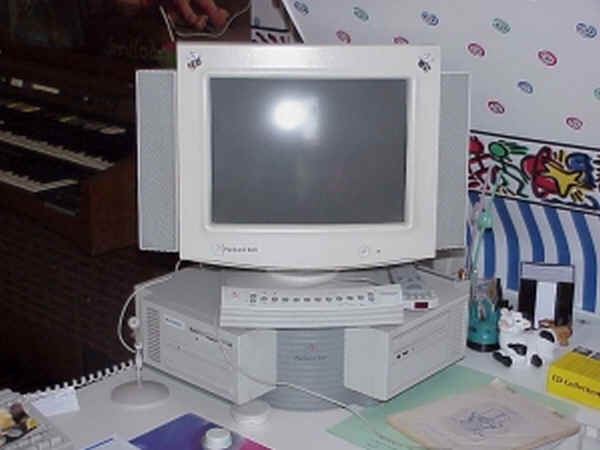
Does anyone have experience with reading in then writing out flux
transitions with a Kryoflux on an 8? floppy drive as well? If that is known
to work reliably
I?m buying one :)
Kryoflux?s next project should be the same thing but for ? mag tape. I think
Al did something like that years ago, but an off the shelf product for ?
tape would be spiffy.
J
Not just any Packard Bell... just this one.
it has a place due to form and design, certainly not performance.
http://www.smecc.org/itemsklkljl;_3.jpg
Please let me know if you find one.
Ed Sharpe archivist for SMECC
In a message dated 7/2/2016 7:53:14 A.M. US Mountain Standard Time,
cisin at xenosoft.com writes:
On Sat, 2 Jul 2016, David Griffith wrote:
> It seems that museums have traditionaly sought the best artifacts. I
> feel they should also exhibit crap from time to time to remind visitors
> of history's wrong turns.
It took a little while before Edsels became collectible.
Yugo
I remember ours has 4 pin connector too but not as robust as a ma bell
one..
ours comes in a orig box even.
I was mixed as to if I wanted to display it with ttys or with
sci-tech kids toys and devices display we have in a huge walk in display
case. ... it is sitting up in the front office ... I am sure there are
photos somewhere on one of the servers...but too tired to chase it tonite.
In a message dated 7/2/2016 11:08:44 P.M. US Mountain Standard Time,
cclist at sydex.com writes:
On 07/02/2016 09:54 PM, couryhouse wrote:
>
>
> No it gets printed to... there are TTYS in real world and print on
> strip then western union would oade each strip onto sheet of
> paper....what did they want for it?
>
Yes, I know--I once owned a model 14 TTY, complete with a pile of
mucilage-backed tape for the teleprinter.
But it was a beast, not a red plastic thing.
--Chuck
No it gets printed to... ?there are TTYS in real world and print ?on strip then western ?union would oade each strip ?onto sheet of paper....what did they want for it?
Sent from my Verizon Wireless 4G LTE smartphone
-------- Original message --------
From: Chuck Guzis <cclist at sydex.com>
Date: 7/2/2016 9:15 PM (GMT-07:00)
To: "General Discussion: On-Topic and Off-Topic Posts" <cctalk at classiccmp.org>
Subject: Re: Maybe interesting toy in junk shop...
On 07/02/2016 08:56 PM, Bill Sudbrink wrote:
> No, I don't think so.? I'm pretty sure that the paper tape on this
> thing is for output, probably printed or marked in some way because
> the paper seemed too flimsy to hold a readable punch pattern.? But
> now I'm pretty determined to go back tomorrow and see if I can get
> some more info.? I didn't look at the bottom of it, maybe there's a
> label.
Perhaps it's a device to print dialed numbers?
--Chuck
I would like that 6 proc black cube......ed sharpe
Sent from my Verizon Wireless 4G LTE smartphone
-------- Original message --------
From: Tothwolf <tothwolf at concentric.net>
Date: 7/2/2016 8:00 PM (GMT-07:00)
To: "General Discussion: On-Topic and Off-Topic Posts" <cctalk at classiccmp.org>
Subject: RE: Actually we want this Packard Bell
http://www.smecc.org/itemsklkljl; _3.jpg
On Sat, 2 Jul 2016, Jay West wrote:
> Ed wrote...
> ---------
> Not just any Packard Bell...? just this one.
> http://www.smecc.org/itemsklkljl;_3.jpg
> it? has a place? due to form and design, certainly not? performance.
> ---------
> IMOO.... no place at all. If it had some kind of cult following, or lots of
> people remembered it, maybe.
> But I doubt most people (let alone collectors) would look at that and say
> "oh, I've seen that before!".
>
> Now... maybe as an example of how hard mfg's tried to differential via
> terrible case designs... ;)
I think the same could probably be said for something like that
6-processor Pentium Pro that was sold in the late 90s which had a black
cube style case and a stand which allowed it to sit on its corner. Very
unusual design with both the case and boards, but few people will have
seen, let alone used one. As far as utility goes, they are just about
worthless now, except to someone who wants to collect one for nostalgia
reasons.
I myself wouldn't mind finding a Packard Bell Legend I (Intel 80286) only
because I once owned two of them (that were sold without my approval as a
pair to someone for $100, including the VGA monitors). The same also goes
for a Compaq Deskpro 386/20e (specifically the 'e' model) for similar
reasons. Both machines are not something all that useful from a utility
standpoint (I have dozens of late generation 486 and Pentium boards I
could put in a case which would be far more useful) but would be fun to
have just to tinker around with again.
I gave a kids teletter sort of tape sender receiver. There are two to b a kit.. what did they want for it we could use for an off site display. ?Ed Sharpe ARCHIVIST For smecc
Sent from my Verizon Wireless 4G LTE smartphone
-------- Original message --------
From: Fred Cisin <cisin at xenosoft.com>
Date: 7/2/2016 8:08 PM (GMT-07:00)
To: "General Discussion: On-Topic and Off-Topic Posts" <cctalk at classiccmp.org>
Subject: Re: Maybe interesting toy in junk shop...
On Sat, 2 Jul 2016, Bill Sudbrink wrote:
> I was poking around a junk shop that I visit from time
> to time and I saw a toy.? It didn't really strike me as
> that interesting when I saw it but I've been wondering
> about it since I left the place this morning.? The
> thing was mostly red plastic with a cardboard bottom.? It
> had a two-prong AC cord and a four prong "old fashioned"
> telephone jack.? It had two big buttons and a spool of
> paper tape mounted on the front.? The tape was about 1/4
> inch wide.? I call it a toy because it had that sort of
> feel about it.? It was not clearly labeled as such.? It
> was also styled in a way that suggested late 1960s to me.
> The whole thing was the size of a small shoe box.? I
> can't find anything like it in google searches.? I wonder
> if it might have some early modem like device in it.? Does
> this description "ring a bell" with anyone?
an auto-dialer for an alarm system?
Was it punched tape (used as ROM)?
or blank tape with some sort of marker?
On 07/02/2016 08:56 PM, Bill Sudbrink wrote:
> No, I don't think so. I'm pretty sure that the paper tape on this
> thing is for output, probably printed or marked in some way because
> the paper seemed too flimsy to hold a readable punch pattern. But
> now I'm pretty determined to go back tomorrow and see if I can get
> some more info. I didn't look at the bottom of it, maybe there's a
> label.
Perhaps it's a device to print dialed numbers?
--Chuck
On Sat, 2 Jul 2016, Bill Sudbrink wrote:
> No, I don't think so. I'm pretty sure that the paper
> tape on this thing is for output, probably printed or
> marked in some way because the paper seemed too flimsy
> to hold a readable punch pattern. But now I'm pretty
> determined to go back tomorrow and see if I can get
> some more info. I didn't look at the bottom of it, maybe
> there's a label.
Let's hope so.
If the 4-prong telephone jack is not being used for an actual telephone, .
. .
howzbout a telegraph recorder?
1/4" wide doesn't allow for much sideways, other than ON/OFF, unless there
is a print head of some sort inside, then it could even be a TTY
On 07/02/2016 07:32 PM, Bill Sudbrink wrote:
> I was poking around a junk shop that I visit from time to time and I
> saw a toy. It didn't really strike me as that interesting when I saw
> it but I've been wondering about it since I left the place this
> morning. The thing was mostly red plastic with a cardboard bottom.
> It had a two-prong AC cord and a four prong "old fashioned" telephone
> jack. It had two big buttons and a spool of paper tape mounted on
> the front. The tape was about 1/4 inch wide. I call it a toy
> because it had that sort of feel about it. It was not clearly
> labeled as such. It was also styled in a way that suggested late
> 1960s to me. The whole thing was the size of a small shoe box. I
> can't find anything like it in google searches. I wonder if it might
> have some early modem like device in it. Does this description "ring
> a bell" with anyone?
Sounds like a late-model Kilburg Dialaphone. 1960-ish. Early models
directly operated the dial of the desk telephone--later ones just pulsed
the line appropriately--something that AT&T objected to and that Kilburg
unsuccessfully fought. This was years before the Carterfone episode.
Memory was a paper tape with printed names on it.
That particular unit sounds like a very rare piece of kit.
Am I getting close?
--Chuck
On Sat, 2 Jul 2016, Bill Sudbrink wrote:
> I was poking around a junk shop that I visit from time
> to time and I saw a toy. It didn't really strike me as
> that interesting when I saw it but I've been wondering
> about it since I left the place this morning. The
> thing was mostly red plastic with a cardboard bottom. It
> had a two-prong AC cord and a four prong "old fashioned"
> telephone jack. It had two big buttons and a spool of
> paper tape mounted on the front. The tape was about 1/4
> inch wide. I call it a toy because it had that sort of
> feel about it. It was not clearly labeled as such. It
> was also styled in a way that suggested late 1960s to me.
> The whole thing was the size of a small shoe box. I
> can't find anything like it in google searches. I wonder
> if it might have some early modem like device in it. Does
> this description "ring a bell" with anyone?
an auto-dialer for an alarm system?
Was it punched tape (used as ROM)?
or blank tape with some sort of marker?
I was poking around a junk shop that I visit from time
to time and I saw a toy. It didn't really strike me as
that interesting when I saw it but I've been wondering
about it since I left the place this morning. The
thing was mostly red plastic with a cardboard bottom. It
had a two-prong AC cord and a four prong "old fashioned"
telephone jack. It had two big buttons and a spool of
paper tape mounted on the front. The tape was about 1/4
inch wide. I call it a toy because it had that sort of
feel about it. It was not clearly labeled as such. It
was also styled in a way that suggested late 1960s to me.
The whole thing was the size of a small shoe box. I
can't find anything like it in google searches. I wonder
if it might have some early modem like device in it. Does
this description "ring a bell" with anyone?
Bill S.
I should point out. one of yahoo's primary criteria for deep-sixing listserv
traffic. is if the reply-to is set to the list instead of the (arguably more
standard/compliant but less useful) reply-to-sender.
No, don't want to start that flame war again. Just saying. that's a yahoo
criteria.
J
I keep getting emails from the list server disabling my account for
excessive bounces. Is it possible to get a log showing where the problem is
coming from so I can complain to my ISP?
Thanks
Rob
Well with yahoo domain having a hard fail specified it looks like it's too
stay. The typical troublemaker with yahoo mail is lists modifying message
bodies or subject lines. Those practices will gauge have to end (and
frankly it can't be soon enough imho).
That said the usual consequence is that messages *from* yahoo through the
list get binned for Gmail users or anyone else who enforces DKIM. I've
noticed Gmail has started marking messages in Spam with the reason why
they're there and when they first started a *lot* if them were due to
signature fails. There are very few these days which make me believe the
lists I'm on have changed practices. Certainly yahoo hasn't rolled back
their dns records.
So unpredictability makes since sense as the bounces you see will be very
dependent on the domains *sending* the messages and their dns records. If
you have a thread with a couple yahoo uses talking back and forth you could
well see a series of bounces from users on servers that respect Yahoo's dns
records requesting a hard fail.
--
Greg
Long ago there was a thread about FOCAL-65 for the 6502, and I asked
the people involved but it seemed it never came to light.
http://ana-3.lcs.mit.edu/~jnc/cctalk/2001-September/1691.html
As it happens I appear to have both the user-manual and a quite thick
photocopied (not great quality) listing of FOCAL-65, that I am happy
to scan and upload somewhere.
However, if this already exists somewhere and can point to it, I can
put this scanning task aside.
thanks.
I know a few list members who have been doing this, after fixing CRT
cataracts.
Was that glass additionally leaded to cut down on X-rays at all? Is there a
risk to that?
These are mostly black and white CRTs.
--
Ian Finder
(206) 395-MIPS
ian.finder at gmail.com
Actually we want this Packard Bell http://www.smecc.org/itemsklkljl;_3.jpg
for the computer display at SMECC!
Also want any promo material, artwork, manuals etc etc etc....
drop me a line offlist with a title of SMECC Packard Bell please
to _couryhouse at aol.com_ (mailto:couryhouse at aol.com)
thisis what we are looking for
http://www.smecc.org/itemsklkljl;_3.jpg
In a message dated 7/1/2016 10:49:36 A.M. US Mountain Standard Time,
js at cimmeri.com writes:
Computers don't (yet) have voting
rights. :-)
But you're defining "spirit" and listing
criteria by which a machine is
appropriate or not. A PS/2 with an
80386 running Windows 3.1 is acceptable,
whereas a Packard Bell with an 80386
running Windows 3.1 is not. Yeah, you
and I would cringe at a PB being
discussed, but maybe there's someone out
there who really is fond of their PB.
So as Terry ("Tezza") acknowledges,
terms like "landmark," "classic,"
"collectible" are subjective (but I
don't think "vintage" is subjective --
that term is usually set by age alone).
This is why it's just easier to use a
single criteria -- age -- and leave it
at that. Why is age acceptable
everywhere else in collecting, but not
here? Otherwise, someone (the list
owner?) has to pontificate over a list
of acceptable computers. Good luck with
that.
- J.
For some things like video ?editing ?a tube monitor has better color gamet..sp?... than chap or enemy middle expensive lcds....
Most important to me is this color although for data and juSt to ?stretch ?time line across I use 40 Inch lcd flats.... ?
Good flats ?are good but price is very expensive. ...
Sent from my Verizon Wireless 4G LTE smartphone
-------- Original message --------
From: TeoZ <teoz at neo.rr.com>
Date: 7/1/2016 3:00 PM (GMT-07:00)
To: "General Discussion: On-Topic and Off-Topic Posts" <cctalk at classiccmp.org>
Subject: Re: what's vintage? was Re: Latest addition: A bondi-blue iMac
People junked most of the older small low res slow refresh non working (bad
caps) non widescreen LCD monitors by now. I kept one I got free and fixed
ages ago for bench testing (has just a VGA connection) since it is easy to
move around. Newer gaming video cards don't even have VGA out anymore so the
older VGA connector monitors are of no use. Could also be instead of
offering them for sale or free people just straight up recycle them because
of low demand for working ones. On a recycling forum I read people were
trying to sell working older units for $10 each with no luck. The last 2 LCD
monitors I purchased new were $100 (Both DELLs a 23" IPS 1080P and a 24"
1080P) so pricing is not a problem like it used to be in the 90's were a 17"
quality monitor was $800.
-----Original Message-----
From: Chuck Guzis
Sent: Friday, July 01, 2016 3:14 PM
To: General Discussion: On-Topic and Off-Topic Posts
Subject: Re: what's vintage? was Re: Latest addition: A bondi-blue iMac
On 07/01/2016 11:48 AM, Toby Thain wrote:
> Or, for free, a dumpster LCD. I find working ones discarded
> regularly, and 90% of the non-working ones are just bad inverter caps
> ($2 worth).
Been there, done that--and even depopulated the inverter section on one
PCB (badly designed--capacitors hot-glued to heatsinks, that sort of
thing) and replaced it with a cheap "universal" CFL inverter.? Still
works fine.
Strangely, I don't see nearly as many junked LCD displays today as I did
5 years ago for some reason.
--Chuck
---
This email has been checked for viruses by Avast antivirus software.
https://www.avast.com/antivirus
Actually we want this Packard Bell http://www.smecc.org/itemsklkljl;_3.jpg
for the computer display at SMECC!
Also want any promo material, artwork, manuals etc etc etc....
drop me a line offlist with a title of SMECC Packard Bell please
to _couryhouse at aol.com_ (mailto:couryhouse at aol.com)
thisis what we are looking for
http://www.smecc.org/itemsklkljl;_3.jpg
In a message dated 7/1/2016 10:49:36 A.M. US Mountain Standard Time,
js at cimmeri.com writes:
Computers don't (yet) have voting
rights. :-)
But you're defining "spirit" and listing
criteria by which a machine is
appropriate or not. A PS/2 with an
80386 running Windows 3.1 is acceptable,
whereas a Packard Bell with an 80386
running Windows 3.1 is not. Yeah, you
and I would cringe at a PB being
discussed, but maybe there's someone out
there who really is fond of their PB.
So as Terry ("Tezza") acknowledges,
terms like "landmark," "classic,"
"collectible" are subjective (but I
don't think "vintage" is subjective --
that term is usually set by age alone).
This is why it's just easier to use a
single criteria -- age -- and leave it
at that. Why is age acceptable
everywhere else in collecting, but not
here? Otherwise, someone (the list
owner?) has to pontificate over a list
of acceptable computers. Good luck with
that.
- J.
Hi all,
I've got an Dolch C100D Analyzer with an bunch of Probes lately,
And I'm lookinffor someone that has an Dolch LA with an Disassembler
Option - ROM installed and is able to read out it's contents.
I Do habe an C100D analyzer, got it w/o any documentation but the
LAM3250 docs available at the uni Stuttgart fits alsmost exactly.
It seems, that most of the Dolch LAs are internal powered from a Z80 so
it is'nt unlikely that the Options will fit in different models.
I'll get two Dolch 64300 tomorrow, one for repair..disassemblers
included, but the 64300 has ROM cassettes for plugin.
Kind Regards,
Holm
--
Technik Service u. Handel Tiffe, www.tsht.de, Holm Tiffe,
Freiberger Stra?e 42, 09600 Obersch?na, USt-Id: DE253710583
www.tsht.de, info at tsht.de, Fax +49 3731 74200, Mobil: 0172 8790 741
yes smecc saved one... I do not see a lot of them around anymore....
In a message dated 6/30/2016 6:40:37 P.M. US Mountain Standard Time,
terry at webweavers.co.nz writes:
My classic/vintage computer activity has taken a back seat lately but I
did
find a machine I had on the "classic" list for some time. It's now part of
the collection.
http://www.classic-computers.org.nz/collection/imac.htm
Some would say this is not vintage, classic or collectible (and so
shouldn't be discussed here). However, these are all subjected terms which
can be (and are!) argued about at length.
To me it's a noteworthy model which had some impact on personal computing
(notably by helping put Apple back in the game). Vintage? At only 18
years old perhaps not but a classic and collectible? As time goes by I
would say yes.
Terry (Tez)
Specifically, "TIB0203 Magnetic Bubble Memory: System Application Manual", 1979
Libraries in Australia and China apparently have this, but
unfortunately that doesn't help me much.
I'd be interested in other documents relating to TI bubble memory. I
already have "TIB0203 Magnetic-Bubble Memory and Associated Circuits",
November 1978, and both the April 1977 and March 1980 editions of "TMS
9916 Bubble Memory Controller".
> From: Ian Finder
> Does anyone here have scans to get started with
I've provided Rod with a mechanical drawing, and a scan, of an 11/35 front
panel (identical to the 11/40, except for the number). Here:
http://ana-3.lcs.mit.edu/~jnc/tech/pdp11/PDP-11_Stuff.html
if you have any use for it.
Noel
Just wanted to drop a line here- despite a shipping misfire, Rod Smallwood's replacement 8/e panel finally arrived yesterday and they look KICK ASS!
Thanks, Rod!
I'd love to start building artwork for the 11/40 panel- mine looks pretty sorry at the moment. Does anyone here have scans to get started with and best practices to use?
Thanks,
- Ian
Sent from Outlook<https://aka.ms/kr63o9> on iOS
Hey,
I'll be driving around southern and central California in a few weeks. Will be between LA and Yosemite Park.
Does anyone have a garage or other pile of computers that you want thinned-out? I can come-by and take some of it off your hands.
Thanks-
Steve.
I seem to remember there is an entry point that one can use to reinitialize
BASIC already loaded into core memory, with the intention of re-answering
the questions about MEMORY SIZE, Use SIN?, etc. Is this correct? I looked
in the docs I have b ut I could not find it. If no one has this info I
will have to disassemble, IN a HEX editor I see the questions are all at
the end.
-- Bill
+1 You tell em Will!
-Connor K
On Jun 21, 2016 4:05 PM, William Donzelli <wdonzelli at gmail.com> wrote:
>
> > I have sent Todd his contact info. He is willing to let one person come in and take pics and post to the group. He does NOT want to move one or 2 items of the most value; he wants to move out pallets of stuff. He is not closing shop; he just wants to move out some really old equip that has been there for years.
>
> Be sure to tell your friend that the mainframe collectors can
> certainly make cubic feet of equipment leave the warehouse quickly!
>
> --
> Will
The 2000 isn't fully compatible either i thought since its one of the few PCs using the 80186 processor. When i acquired mine (also without a monitor and i think without keyboard or software ) i sort of accepted id likely not get it running. But perhaps the ?software is out ?there and less of a concern than i thought.
I didn't know it was compatible with the cm-1 but i never checked what video card mine had.
Still an interesting system historically.
> From: William Degnan
> The problem was a missing KJ11
Ah. Well, if you want to add one (I assume you've just re-jumpered the
machine for the moment), I do have one we can copy (for the PC etch) - I'm
assuming here that originals are now unobtainium.
Also, if you have the KE11-E, but not the KE11-F (the former is a prereq for
the latter), and would like one, I have one I have no use for (Unix doesn't
use that version of the PDP-11 floating point), and would be willing to trade
it for something I do have a use for.
> My error. Lesson: Always check everything.
Yes, always a good rule when dealing with recovered machines. I always take
them apart and go through them completely, verifying all cables, etc from the
original documentation.
Noel
> From: William Degnan
> The IOT step is bombing (?) and loops through the addresses:
This may be a pointless question, but just to clear the ground first: the CPU
is otherwise functioning reasonably well? E.g. it's not dropping the 020 bit
when reading words from memory? (That would convert the '220' new PC in the
vector to '200', and produce exactly the behaviour you are seeing.)
If it is otherwise more or less working, so this is specific to IOT trap
handling, I agree with Fritz - a KM11 would be a big help.
Noel
I thought I'd throw this one out to those who know more than I about the
PDP 11/40
I am working with DaveR on vcfed.org/forum who asked me to run the
following program as a test from the front panel:
20 - 220 ; IOT trap vector (New PC)
22 - 340 ; IOT trap vector (New PSW)
200 - 012706 ; MOV #600,SP
202 - 600
204 - 240 ; NOP
206 - 0 ; HALT
210 - 4 ; IOT
212 - 240 ; NOP
214 - 0 ; HALT
216 - 0 ; HALT
220 - 0 ; HALT
222 - 0 ; HALT
START the program running from address 200.
----------------------
Problem is - The IOT step is bombing (?) and loops through the addresses:
204
206
210
200
204
206
210
200
endlessly.
Anyone care to speculate which CPU card is the culprit?
--
@ BillDeg:
Web: vintagecomputer.net
Twitter: @billdeg <https://twitter.com/billdeg>
Youtube: @billdeg <https://www.youtube.com/user/billdeg>
Unauthorized Bio <http://www.vintagecomputer.net/readme.cfm>
On Jun 30, 2016 1:19 AM, "Fritz Mueller" <fritzm at fritzm.org> wrote:
>
> Hey Bill,
>
> Do you have a KM11 maintenance card? Guy Sotomayor here sells kits
and/or assembled boards at
http://www.shiresoft.com/products/km11/KM11%20Replica.html. I built one up
myself based on a layout by Tom Uban at
http://www.ubanproductions.com/museum.html
>
> The easiest way to get to the bottom of this since you have a nice,
short, repro case would be to step through the microcode with a KM11 and
see where it goes awry. From that point, its fairly easy to come of up a
list of boards to swap and/or chips to check.
>
> If you want to go to the chip checking stage, you'll need some board
extenders and a logic probe, they are pretty cheap. Or you can grab a
surplus logic analyzer and some DIP clips off eBay if you want to get posh!
>
> I just went through this process with my 11/45, it was pretty educational.
>
> --FritzM.
Fritz,
It turns out that I was missing the KJ11 my cpu cards were wired to
expect. On the 11/40 this module is the little M7237 card for space E of
slot 3.
The machine in question did not come with this card, I assumed it was not
needed until I checked the cpu jumpers and discovered my error. Should
have done this 1st!
It was impossible to run the CQKC diagnostic for 11/40 or 11/45 -
http://www.vintagecomputer.net/temp/disassembly.txt
Instructions using IOT in particular.
Bill Degnan
twitter: billdeg
vintagecomputer.net
Looking for a Tandy TRS-80 Model 2000 compute monitor. Wikipedia description here:
https://en.wikipedia.org/wiki/Tandy_2000 <https://en.wikipedia.org/wiki/Tandy_2000>
The monochrome is model VM-1 Monitor, the colour is CM-1 Monitor.
Many thanks
Brendan
--------------//----------------
brendan at mcneill.co.nz
+64 21 881 883
And here is Ken's new post in the series
http://www.righto.com/2016/06/restoring-y-combinators-xerox-alto-day.html
Marc
> On Jun 21, 2016, at 10:59 PM, CuriousMarc <curiousmarc3 at gmail.com> wrote:
>
> The restoration is physically happening at my place. As noted below we have
> a small and quite knowledgeable group of people contributing, including
> actual hardware when we are missing a part (thanks Al !). A few of us are
> chronicling this on our favorite media from our favorite angle.
> I like to make short videos trying to convey the inside story of the
> restoration, on my YouTube channel:
> https://www.youtube.com/curiousmarc
> It's interspersed with all the other restorations, but two videos so far:
> https://youtu.be/YupOC_6bfMI
> https://youtu.be/xPyqQXFC2yw
> Ed Thelen likes to collect every bit of raw information floating around,
> including some of the team emails and throw them into equally raw site, as
> he does for the IBM 1401 restoration effort at CHM:
> http://ed-thelen.org/RestoreAlto/index.html
> Carl Claunch methodically recounts everything he does every day (and he does
> a lot), so when he works on the Alto, you'll know every detail:
> http://rescue1130.blogspot.com/
> Ken Shirriff makes deeply researched, superlative detailed posts on his
> blog. These are reference pieces, I admire them a lot:
> http://www.righto.com/2016/06/y-combinators-xerox-alto-restoring.html
> And it gets discussed on the Y-combinator (the owners of the machine) and
> hopefully here too.
> Seeing the interest, I will make an effort to post new links when they
> become available, unless of course Master Al beats me to it.
>
> Marc
>
> -----Original Message-----
> From: cctalk [mailto:cctalk-bounces at classiccmp.org] On Behalf Of Al Kossow
> Sent: Monday, June 20, 2016 8:54 AM
> To: cctalk at classiccmp.org
> Subject: Re: Y Combinator is restoring one of Alan Kay's Xerox Alto machines
>
> http://www.righto.com/2016/06/y-combinators-xerox-alto-restoring.html
> https://news.ycombinator.com/item?id=11929396
> http://ed-thelen.org/RestoreAlto/index.html
>
>> On 6/20/16 8:51 AM, Al Kossow wrote:
>> I post just went up on Saturday. It's nice that both CHM and LCM folks
>> are helping with this.
>>
>>
>>> On 6/20/16 8:41 AM, Liam Proven wrote:
>>> http://www.righto.com/2016/06/y-combinators-xerox-alto-restoring.html
>>>
>>> Found via:
>>>
>>> http://www.osnews.com/story/29261/Xerox_Alto_restoring_the_legendary_
>>> 1970s_GUI_computer
>>>
>>> There are 2 videos up so far, with disassemblies that may interest
>>> CCmpers.
>>>
>>> Some people from the list are involved, including Al Kossow, but I
>>> haven't seen the link posted.
>>>
>>
>
Hi
I collect vintage IBM laptops, have just joined the community, and wonder if anyone can help with the following:
1. Can write a Teledisk image of concurrent CP/M for Displaywriter to two 8 inch floppy disks which I can supply?
2. Can solder a cable fie me which will interface an ibm 6360 8 inch floppy to a PC. I am unable to do this myself.
3. I have an external 5.25 floppy adapter/a inside an ibm ps/2 p70 and wonder if the external 37 pin connector is pin compatible with the 37 pin connector of the ibm 6360 8 inch floppy drive?
I thought about connecting two out of the 3 cables from this drive to an IBM displaywriter (supplying the correct voltages etc) and the 37 pin connector to my external 5.25 adapter/a card?
Thanks for your help.
David
It's that time of year when a young man starts to take stock of
reality (for better or for worse) and decides that his load must be
lightened. This time the machine with on the block is an MAI Basic
Four deskside minicomputer. I'm not sure of the exact model but it
can be seen in the first three pictures in this gallery:
https://picasaweb.google.com/102190732096693814506/HaulOf10315?noredirect=1
Note: nothing else in that gallery is on offer at this time - maybe
later. However other random hardware may be thrown at you during the
transfer.
I have not powered it up. I was told it was working when taken out of
service many years ago, but we all know how that goes.
I have some documentation for it that I will be scanning (some of
which is not already on Bitsavers) but I will send it along to whoever
takes the machine afterwards. I do not have any disk or tape media
for it.
I'm not looking to get a lot for it - trades would be fine, preferably
for something that I can lift myself, however I am also looking for a
working DEC RX02 drive or a later IBM terminal controller (3174 or
similar) with Ethernet that I can use to run IBM real terminals on
Hercules.
Preference goes to:
1) someone local who can haul it away. I am not presently equipped
to deal with shipping anything this large.
2) someone will will get it sooner rather than later
3) someone who will make it sing again.
If you're coming to VCFMW in September, the storage unit holding the
MAI is just a few miles away from the hotel and we can do the loud-out
then. If you're here sooner, even better.
-j
Some people might have noticed that Mim.Update.UU.SE have not been
reachable the last week. This is because the University have decided to
put all systems behind firewalls, which hurt the Update computer club
pretty bad.
For people who would still like to get access to Mim, I have now setup
telnet to listen to a second port in addition to port 23. Mim is now
accessible by telnet on port 10023 as well, which is not blocked by an
firewall.
In addition, I also added ftp on port 10021 in addition to port 21, so
people who would like to get to files on Mim by ftp can do so again.
This also prompted me to make a couple of improvements to BQTCP/IP for
RSX. The changes are that the telnet daemon can now be set to listen to
an alternative port, and can also listen to several ports.
I also added the capability to the ftp client to specify which port to
connect to.
The TCP/IP package can be found at ftp://mim.update.uu.se:10021/
However, if you have the previous version of TCP/IP for RSX, you cannot
access this address, as the previous version ftp client did not accept a
port argument. So it's a bit of a chicken and egg thing. But using some
intermediate system, you can get the disk image to the machine, and
install the new version, after which things will be possible to use more
or less as before.
One more thing: NEMA, my very tiny EMACS clone for RSX, have gotten a
lot of work done lately, and if anyone is interested in this tool, I
really recommend that you fetch the latest version. A port to VMS is
also included with the files now, courtesy of Erik Olufsen.
NEMA is available at ftp://nema at mim.update.uu.se:10021/
Johnny
--
Johnny Billquist || "I'm on a bus
|| on a psychedelic trip
email: bqt at softjar.se || Reading murder books
pdp is alive! || tryin' to stay hip" - B. Idol
Just in case anyone is interested, I have just posted a video on YouTube of
my Rainbow 100+ (not the one I am selling) running in a dual head
configuration. The quality of the video isn't great, but it might interest a
few people.
You can find it here: https://youtu.be/y4p9plwjRio
Regards
Rob
> From: Fritz Mueller
> So far I haven't seen any place in PDP11GUI to set anything other than
> port and baud rate
You might have to use native OS tools to do that. On Unix, that will be
'stty'; on Windows, you'd have to use native Windows tools to do that; if you
go to the Device Manager, select your serial port, and click on 'Properties',
it has a tab ('Port Settings') for that (or, should I say, it used to - not
sure about the most recent versions, they're making it all smart-phone like
for brain-dead lusers).
> From: Don North
> Mostly PDP11GUI does not care, either 7b or 8b.
I'm kind of surprised to hear that; I assumed that PDP11GUI can download
binaries, and for that, 8-bit is kind of necessary?
Side-story: when I started bringing up my -11's, the first one I did was an
-11/23. So I needed a way for my Windoze box to talk to the -11's console
line, for ODT. I was too lazy to figure out how to use some existing
software, so I decided to write some. I wanted to be able to use it (later)
to talk to one -11 from another, and I didn't know how to do complex terminal
hacking under Windoze anyway, so I decided to write it under Unix. V6, to be
exact (I consider all later versions to be unholy perversions - well, V7
isn't too bad, I guess), running on Ersatz11 on the Windoze box.
Later, I wanted to be able to load .LDA files, which are 8-bit binary. One
problem. Native Unix V6 doesn't have the ability to output 8-bit binary over
a serial line (or input it, for that matter). When I first started using V6
at MIT, the DSSR people had already totally re-written the TTY driver, and
added that capability, so I never ran into this problem before. Also, the
native V6 stty() call isn't very flexible, and there are no spare mode bits.
So they'd added a new system call, ttymod() (sort of like ioctl(), but done
before it), to control all their wonderful extensions.
I decided not to replicate that, but rolled my own upwardly compatible
extension to stty(), which adds all that extended semantics. From there, it
wasn't too much work to get sending the absolute loader down the serial line
in its original binary form (which means all the old console bootstraps work,
too), and using that to load .LDA files.
Noel
(My original message to cctech has yet to appear. I thought I might try the
cctalk list).
While Motorola never shipped the MC6839 [1] the binary is available [2]
and I've been playing around with it [3]. While it's not producing the
exact same results as I get on a more modern machine, it appears to be
"close enough" for me to be happy with it. But I am having one issue that I
can't figure out.
The documentation for the FMOV operation says:
FMOV Move (or convert) arg1 -> arg2. This function is useful for
changing precisions (e.g. single to double) with full
exception processing for possible overflow and underflow.
Okay. And to call it [4]:
------------------------------------------------------------------------------
|Function|Opcode| Register entry conditions | Stack entry conditions
------------------------------------------------------------------------------
| FMOV | $1A | U = precision parameter word| push arg
| | | Y -> argument | push precision param word
| | | D -> fpcb | push ptr to fpcb
| | | X -> result | call FPO9
| | | | pull result
------------------------------------------------------------------------------
For moves, U contains a parameter word describing the size of the
source and destination arguments. The bits are as follows, where
the size is as defined in the fpcb control byte
Bits 0-2 : Destination size
Bits 3-7 : unused
Bits 8-10 : Source size
Bits 11-15: unused
And the size bits are defined as:
111 = reserved
110 = reserved
101 = reserved
100 = extended - round result to double
011 = extended - round result to single
010 = extended - no forced rounding
001 = double
000 = single
It appears that to convert from single to double, I would set U to $0001,
but the results are *so* far out of whack it's not even funny. I've tried
setting U to point to the value $0001 and that doesn't work. I've tried
shifting the bits (because in the FPCB they're the upper three bits) and
that doesn't work. I've tried reversing the registers and that doesn't
work. Does anyone have the actual source code [4]? Or know what I might be
doing wrong?
-spc
[1] A ROM with position independent 6809 object code that conforms (to
what I can find) with IEEE 754 Draft 8.
[2] Available in the file fpo9.lzh here
https://ftplike.com/browser/os9archive.rtsi.com/OS9/OS9_6X09/PROG/
[3] Using a 6809 emulator library I wrote: https://github.com/spc476/mc6809
Not much documentation I'm afraid.
[4] Register entry: ROM base address + $003D
Stack entry: ROM base address + $003F
[5] I'm lead to believe that Motorola release the code into the public
domain.
So I know for certain that this topic has come up before, but I cannot
for the life of me find the thread(s) it appeared in, so I'm asking
again (apologies in advance).
What is the name of the rounded, 3-pin power connector often seen on
early test equipment (I've seen it on older HP and Fluke stuff)? I have
an S-100 chassis that inexplicably uses one, despite dating from 1982 or
so. I need to track one of these cables down but I have no idea what it
is exactly I'm looking for...
Thanks as always,
Josh
So Motorola apparently never produced the MC6839, a ROM containing
position independent 6809 code for implementing (as far as I can see) IEEE
754 Draft 8. Motorola *did* however, release the resulting binary into
(from what I understand) the Public Domain [1] but I've yet to find the
actual source code, which would solve my current problem.
I'm playing around with the code in an MC6809 emulator [2] and trying to
use it (getting my retro-software fix in as it were). It works---not as
accurate as today's stuff, but close enough and it supports single and
double precision. The current issue I have is with the FMOV opcode
(register entry) described as:
------------------------------------------------------------------------------
|Function|Opcode| Register entry conditions | Stack entry conditions
------------------------------------------------------------------------------
| FMOV | $1A | U = precision parameter word| push arg
| | | Y -> argument | push precision param word
| | | D -> fpcb | push ptr to fpcb
| | | X -> result | call FPO9
| | | | pull result
------------------------------------------------------------------------------
For moves, U contains a parameter word describing the size of the
source and destination arguments. The bits are as follows, where
the size is as defined in the fpcb control byte
Bits 0-2 : Destination size
Bits 3-7 : unused
Bits 8-10 : Source size
Bits 11-15: unused
It's not clear if U should contain the actual parameter value, or a
pointer to the parameter value. It just doesn't seem to work no matter how
I code it. Anyone have any clue?
-spc (I'm at a loss here ... )
[1] Available in the file fpo9.lzh here
https://ftplike.com/browser/os9archive.rtsi.com/OS9/OS9_6X09/PROG/
[2] I wrote one: https://github.com/spc476/mc6809
Not much documentation I'm afraid.
So, I am trying to run PDP11GUI under Wine on Linux, and I am having
problems loading a machine description file. It seems when PDP11GUI
tries to kick off M4, it is expanding an extra backslash into the
command. So you get this sort of error message (note extra backslash
before m4.bat):
Can't recognize 'C:\Program Files (x86)\Joerg Hoppe\PDP11GUI\\m4.bat"
"C:\users\Public\Application Data\PDP11GUI\machines\pdp11.ini"
"C:\users\fritzm\Temp\tmp_pdp11gui_m4_out.ini' as an internal or
external command, or batch script.
I've verified that I can run m4.bat sucessfully manually if I set the
appropriate env vars first. But this doesn't help because it seems like
PDP11GUI deletes the file and then (fails to) regenerate it on each run :-(
Anybody else run in to this or have a suggestion for a workaround?
thanks much!
--FritzM.
DECprinter I, GE TermiNET30, C Itoh CIT-101e, PDP-11 manuals, PDP-8
diagnostic duplicates, TI SilentWriters etc etc.
http://www.datormuseum.se/available
/Mattis
if it was close I would jump on that terminet 30!
Ed#
In a message dated 6/27/2016 1:38:34 P.M. US Mountain Standard Time,
mattislind at gmail.com writes:
2016-06-27 21:41 GMT+02:00 Ian S. King <isking at uw.edu>:
> So far away.... <sigh> (Pacific Northwest, United States)
>
That is right. Forgot to mention that everything is outside Str?ngn?s in
Sweden.
/Mattis
>
> On Mon, Jun 27, 2016 at 12:20 PM, Mattis Lind <mattislind at gmail.com>
> wrote:
>
> > DECprinter I, GE TermiNET30, C Itoh CIT-101e, PDP-11 manuals, PDP-8
> > diagnostic duplicates, TI SilentWriters etc etc.
> >
> > http://www.datormuseum.se/available
> >
> > /Mattis
> >
>
>
>
> --
> Ian S. King, MSIS, MSCS, Ph.D. Candidate
> The Information School <http://ischool.uw.edu>
> Dissertation: "Why the Conversation Mattered: Constructing a
Sociotechnical
> Narrative Through a Design Lens
>
> Archivist, Voices From the Rwanda Tribunal <http://tribunalvoices.org>
> Value Sensitive Design Research Lab <http://vsdesign.org>
>
> University of Washington
>
> There is an old Vulcan saying: "Only Nixon could go to China."
>
On Fri, Jun 24, 2016 at 11:06 PM, Pete Lancashire
<pete at petelancashire.com> wrote:
> Rather have a C Itoh CT-101e ..
I can probably help with that. I'm in Ohio and I get out to Chicago
and NJ a couple of times a year. I have a cabinet of CiTOH terminals
I bought from my employer "some years ago". ;-) We used an
assortment of DEC VT10x, VT220, CiTOH 101 and CiTOH 101e terminals.
ISTR the CiTOHs were as much as $800 cheaper than DEC terminals at the
time. They were robust and at one point, I pulled out of the manuals
the magic escape sequence to "switch sessions" and use the local
printer port as a second comms line (we just had to bang out a custom
DB25 adapter since the entire company was standardized on Nevada
Western 6p6c modular serial and we didn't have a box of the right
adapters for the printer port). It was awesome having two live lines
in front of our usual switchbox setup for connecting to multiple
hosts.
> ... knew one of the developers
Neat!
> F/W was done in the US I can no longer remember the key combination but the
> terminal would let you know who did it
That would be fun to look up.
> Anyone wants to gain a cubic foot or two let me know
You got it!
-ethan
> From: Adrian Stoness
> friend found this now opening channels to rescue it
> its an 11 of some sort not sure witch one
??? Both URL's are the same picture - an envelope on the floor?
Noel
> From: Adrian Stoness
>> its an 11 of some sort not sure witch one
Ah, OK. That's either an -11/04 or -11/34 in the top left corner, with either
an RX01 or RX02 above it. (Not enought detail in the image to say.) The rest
of it seems to all be some sort of custom medical or other specialized
hardware.
(The /04 and /34 are very similar - the only difference is which processor
card(s) is/are plugged in - you can convert most -11/04's [it depends on the
specific backplane in use] to -11/34's by pulling the M7263 KD11-D -11/04
processor card, and plugging in instead the M8265 & M8266 KD11-EA -11/34A
processor cards, which still seem to be relatively prevalent.)
Noel
Questions for our HP specialists. I can't open the case of the HP 264x
terminals I just got. I see from the manual there is a small slot on the
side in which you have to insert a "key". Is the key just a small blade tool
or does it have to be more special shape than that?
Marc