> From: Pete Turnbull
>> The other thing that makes no sense is that the KDJ11-B (M8190) has
>> all that extra circuitry on it to support PMI, etc - all of which is
>> unused in the 11/73 application! Why not just plug in a (presumably
>> cheaper) M8192? In the /73 application, the two are basically equivalent.
> Don't forget the LTC :-)
?? The KDJ11-A has an on-board LTC - see EK-KDJ1A-UG-001, pg. 1-7.
> Otherwise, you'd need an additional bootstrap card such as an MRV11-D
> with -B2 boot ROMs, a DLVE1 (DLV11-JE) for the SLUs, something with an
> LTC, and termination.
Err, the KDJ11-A has on-board termination: see MP-01890 pg. 1 of 9, on the LHS.
> A BDV11 wouldn't work as it doesn't have the ROM capability
?? The BDV11 is a ROM board?
(And it works fine in a Q22 bus; the address recognition circuitry uses BBS7,
it doesn't look at BDAL 16 and above.)
Noel
I finally got my hands on a couple of MM57409 "Super Number Cruncher"
chips with 1985 date codes. I think it was probably introduced around
1982. It's a NMOS part with the same concept (though not compatible
with) the earlier PMOS MM57109 "Number Oriented Processor", which was
introduced in 1977.
In both cases, National took their existing 4-bit masked-ROM
microcontroller designs (MM5799 PMOS, COP440 NMOS), and the floating
point code they'd already written for calculator chips, and turned
them into math coprocessors. The MM57109 also had some support for
acting as a floating point general purpose processor.
The COP4xx has a test mode, so I should be able to dump the ROM of the
MM57409. The MM5799 almost certainly had a test mode as well, but I
haven't uncovered any documentation for it, so the ROM might have to
be dumped optically.
The MM57109 uses an 8-digit mantissa, and a divide takes an average of
78ms, and worst-case 223ms. The MM57409 has a 12-digit mantissa, and
worst-case dvidie time is 66ms, with no average stated. Both also
have a reasonably full complement of functions that would be found on
a typical scientific calculator, including transcendentals.
Both are quite slow compared to contemporary math coprocessors such as
the AMD Am9511A (second-source by Intel as the 8231A), and insanely
slow compared to the 8087.
I'm tempted to wire up one of these (either kind) to an Apple II, and
hack Applesoft to use it as a floating point decelerator. Back in the
day, a few companies sold Am9511A cards for the Apple II. Of course,
since Applesoft uses binary floating point but these National
Semiconductor chips use BCD, the necessary conversion code running on
the 6502 would make it even slower. Perhaps Atari BASIC would be a
better choice as it used BCD.
There is a nice HP-16C emulator for Windows - and Android.
http://www.wrpn.emmet-gray.com/
Also has Java version
(and sources)
Keven Miller
> ----- Original Message -----
> From: "Marc Howard" <cramcram at gmail.com>
> To: "General Discussion: On-Topic and Off-Topic Posts"
> <cctalk at classiccmp.org>
> Sent: Wed 07 Sep 2016 09:53 AM
> Subject: Re: HP-35/45 Simulator for PDP-8
>
>
>> I'd vote for the HP-1xC line myself. You can get 5 different calculators
>> (financial, 3 x scientific and programmer) for nearly the effort of the
>> first one.
>>
>> The HP-16C (http://www.hpmuseum.org/hp16.htm) would be especially helpful
>> as it can easily be converted to calculate with a 12 bit with carry width
>> and octal operation with just a few keystrokes. Even does 1's
>> complement/18 bits if you happen to have a PDP-1 lying around.
>
> From: Pete Turnbull
> all microPDP-11/73 machines had an M8190. The M8192 was mostly sold as
> an OEM board.
That's so bizarre (although the "Supermicrosystems Handbook", which covers
the 11/73, confirms it used the KDJ11-B). So the KDJ11-A (M8192) was not used
in any 'PDP-11/xx'?
The other thing that makes no sense is that the KDJ11-B (M8190) has all that
extra circuitry on it to support PMI, etc - all of which is unused in the
11/73 application! Why not just plug in a (presumably cheaper) M8192? In the
/73 application, the two are basically equivalent. (OK, there are two built in
serial lines on the M8190 - big whoop.) Both have 8KB caches (although the one
in the M8190 has slightly fancier tagging, IIRC), etc, etc. Maybe it's the ROM
(which the M8190 has, but not the M8192)?
Noel
Unfortunately, I won't be able to make it to VCFMW this year.
(Those of you who don't know me are probably thinking "So what?"
Those who do are probably split between "Aww, that's too bad"
and "Good; he's a pain in the...") In lieu of my "sparkling
personality" I'm making available the ENIAC simulator I would
have exhibited had I committed to coming early enough to reserve
a table.
If you attended VCFSE or VCFE this year, you may have seen an
early version of the simulator. It's now at a beta testable
level of operation. The files you'll want to download and some
minimal instructions for use are at:
http://cs.drexel.edu/~bls96/eniac/eniac.html
It's written in Go, so you should be able to compile it on a
variety of platforms. For those not wanting to compile it themselves,
I've included binaries for several options including Linux/amd64,
Linux/arm, FreeBSD/amd64, FreeBSD/i386, MacOS/amd64, and Win/amd64.
The Windows version has not been tested at all, and only minimal
testing has been done on the Mac version. You'll also need TCL/Tk
installed to get the wish program available as used by the GUI.
Suggestions, comments, criticisms, and questions are welcome, but
it will probably be a few weeks before I'll be able to make time to
do anything about them.
Enjoy.
BLS
So I have a fairly large group of 16-sector RK05 packs (i.e. PDP-8, -12) which
I have no use for, which I would like to trade for 12-sector RK05 packs (i.e.
PDP-11). Anyone have any of the latter, and need the former?
Alternatively, if anyone has any head-crashed 12-sector RK05 packs, I would be
interested in buying them (or trading something else) for them. (I am reliably
informed that one can replace the platter on an RK05 pack without too much
work, so I'd transplant the 12-sector hubs into the packs I already have).
(Replies to me, please, not the whole list - unless there's some point you
wish to make which would be of general interest.)
Noel
> From: Ethan Dicks
Let's look at this one first, this is probably the easier to solve.
>>> 2) Setting D10 in location 000000 results in D10 set in all the
>>> locations
>> Sorry, didn't follow that? Did you mean that if you store 02000 in
>> location 0, all other locations now report the 02000 bit set?
> Only 04000, but, yes.
Ah. That's D11. :-)
> If I set that bit in location 0, or other locations, it gets set in all
> locations. If I clear that bit, it clears.
So that's likely in the memory (although I suppose it could be the CPU,
_somehow_). It sounds like there's a latch somewhere in the output path
(because it affects all locations right away, not just once you've written to
them) that's getting set one way or the other, and and then, won't change. I
suspect the problem is with the flop for that bit, not in the circuitry
that's clearing/clocking that flop, since it only affects that one bit.
Looking at the MS11-J prints, there is indeed a '174 latch in the output
path; the one for D11 is in E30 (input pin 14, output pin 15). You might want
to throw a scope on it, and see if it is indeed acting consistently with the
symptoms (to make sure this is actually the cause).
Although why it can be either set or reset with a write, but freezes in one
state for reads, is puzzling. I'd suspect control circuitry, but it's only
that one bit. I don't think it can be something on the input side, because
the memory chips have input and output on separate pins, so if something was
hanging on the intput side, it shouldn't make it through the chip.
> Something appears to have died while I was powered-on and testing last
> night and now, the run light goes off right away after hitting boot,
> and I don't see the address lines or the data lines flickering.
Yeah, sounds like the CPU is halting. It's probably going to take a logic
analyzer to figure out what's going wrong. Too bad that machine doesn't have
a real front console, that would probably let you figure out what the problem
is.
Noel
Anybody has a spare one, to sell?
With all the discussions about the P350/P380, I went to my storage,
and found two p350s without power supplies :(
Cheers
> From: Ethan Dicks
> 12-sector packs are abundant compared to 16-sector packs
Really? Most of the RK05 packs I've seen for sale on eBay in the last couple
of years have been 16-sector - so I naturally assumed they were more common.
Well, I guess that explains why my offer to trade drew such a response! :-)
Noel
My 6800 has been mostly working, but it seems to be occasionally flaking
out. I don't know why. Sometimes you go to power it up, and there's no
response on terminal side. The 'fix' is sometimes to wiggle the memory/CPU
boards and then for some reason it's fine(ish). There are five cards
installed right now - the MP-A, MP-S, a heavily modified MP-M board (with
rams piggybacked on all the original RAM chips) and then two Digital
Research 16k boards. The system was modified for Flex 2.0
Today it flaked again and would not come back up, so I pulled the MP-M board
and the MP-A board and swapped slots. It came up, but memory at $0100 was
missing. I tried powering up, swapping slots, etc.. same deal. Then I
left the machine for an hour, powered up again.. boom.. now $0100 is back.
I don't fully understand the addressing system but if that MP-M is
configured as $A000 would that cover $0100 as well?
I've tried changing the jumpers on each of the DR 16k board to cover $A000..
but the machine will not boot. I will only work with either the MP-M alone
or those 16k cards with it configured to other spaces. In other words, the
machine does not accept any other card configured for $A000.
I'm wondering if anyone has any suggestions on how I might nail this down.
I'm thinking some of the RAMs on that MP-M are flaky, but it would be a
*nightmare* to try and diagnose it, with all the RAMs piggybacked, all the
little jumper wires, and everything soldered. I'd prefer to bypass it and
either use my other, less modified MP-M or just the DR boards, which are
socketed. If any of you have suggestions on how I might take this MP-M out
of the equation that would be awesome!
Brad
Greetings;
My googlefu is failing me and I was wondering if someone might be able to
help me identify one of the boot ROMs present in an M9312 bootstrap/term
board. The board has three ROMs, an RX01 (042130), an RX02 (042131) and
then a mystery code - 043127.
The M9312 ROM identification table does not list this ROM code - I suspect
it _might_ be for a DSD combined 8" drive and Winchester disk box, but I'm
under the impression this would appear as a DU device, and attempting to
boot from DU gets an ILL CMD, suggesting otherwise. I tried all of the
other possible mnemonics listed in the M9312 manual, so it doesn't appear
to piggy-backing on any of those either.
My thanks;
- JP
> From: Ethan Dicks
> What's happening now . is when I change one location .. it
> echoes across multiple locations...
> ...
> 1) Depositing any value is echoed 000020 later.
> ...
> Does this sound like a dodgy CPU, dodgy RAM or both?
It could be either. One possible cause of the symptoms you're seeing is that
address line A04 on the bus is being held to one value (high or low) by
something on the bus, so that whether the CPU tries to set it to 0 or 1, it
has no effect. Also, of course, there could be some fault in the CPU, so that
when it tries to do something with address 0, it gets 020 (or vice versa).
And similarly for the memory.
I'd try to write a small (two instruction) loop that sets that address line
high/low (e.g.:
5037 CLR @#1020
1020
775 BR .-4
and look and see if that address bit is flickering on/off on the UA11 (it will
be on, but dully; constant assertion is bright on, constant de-assertion is
full off). If so, the problem is almost certainly in the memory; if not, it
could be either.
> 2) Setting D10 in location 000000 results in D10 set in all the
> locations
Sorry, didn't follow that? Did you mean that if you store 02000 in location
0, all other locations now report the 02000 bit set?
Noel
Hi all ?
I?m trying to run a real-deal vt100 on a serial port connected to Linux (Xubunto 16.04). I?ve got this working *pretty* well, but it looks like the padding values in the default vt100 terminfo entry are not quite correct ? when running the vt100 at 9600 I still get occasional garbage characters on the screen, and 19200 is a hopeless mess.
I did figure out that if the terminfo contains ?xon?, the non-mandatory padding values in the terminfo are disregarded. Removing this, then disabling xon/xoff on both the vt100 and the tty device actually produces *better* results ? apparently the turnaround on xon/xoff isn?t quite fast enough to keep the terminal from being swamped at higher baud rates, and padding actually works better. But tracking down the source for the default vt100 entry turned up a comment that admits that the padding values there are a total guess. :-(
So, before I go diving too much further into the terminfo-tweaking-samp, I thought I?d ask if anybody has a good vt100 entry already on hand? (I?d take one for the VT52 as well!)
thanks much,
?FritzM.
Hi Ethan,
If you are going to VCF and I go, I'll Try to throw a MS11-JP in the van
for you.
It's yours for bugging the guy with the H960s one more time.
That should save you some chip chasing time.
Thanks, Paul
> From: Jules Richardson
> M8190-AE ; 11/83 CPU
> M8190-AB ; 11/83 CPU (or /73??) w/FPU
As far as I know, all the M8190's are _basically_ the same: they are the
KDJ11-B CPU, which support the PMI memory bus, can operate with a KTJ11-B to
provide a UNIBUS, etc. They are the CPU in an 11/83 (with QBUS only
backplane) and the 11/84 (with QBUS/UNIBUS backplane).
The various models of the M8190 vary in details (e.g. although all have a
socket for the FPJ11 floating point accelerator chip, the earlier ones don't
work properly with it), including the clock speed (15/18 MHz, etc).
The 11/73 uses the KDJ11-A M8192, a completely differente card.
Noel
> From: Jason Howe
> Some pretty interested stuff comes up on ebay occasionally which I
> might not have seen otherswise.
Exactamundo.
> when folks just dump an ebay item number rather than a full link, those
> posts should die
Why? It's a tiny bit more work to use them (prepend the number with the
string "http://www.ebay.com/itm/", and away you go), so one can't just click
and go, but are people really that unwilling to go to the slightest effort?
Noel
In a message dated 9/6/2016 11:55:46 P.M. US Mountain Standard Time,
pontus at Update.UU.SE writes:
On Tue, Sep 06, 2016 at 06:16:23PM -0700, Al Kossow wrote:
>
> I walked out of the donations meeting with the other curators today
> who thought it was a piece of s**t and didn't want to take it, calling
> it a 'dumpster fire'
>
Wow, what an attitude.. I don't know much about Unicomps but should
lesser know machines but unusual machines be preserved as well?
/P
Right on...
All machines are part of the overall history, true, some more significant
than others but... ALL have a place.
Good thing about lists like this is someone can be found to adopt some of
these systems. Ed#
On Tue, Sep 6, 2016 at 5:18 PM, Eric Christopherson
<echristopherson at gmail.com> wrote:
> Is this why modems went to 14400 instead of 19200?
No, that was because the V.32 modulation was easily extended to 12000
and 14400 bps by slightly expanding the QAM signal constellation,
requiring a little better SNR on the line, but keeping other
parameters the same and increasing the constellation size enough to
get 19200 bps was not expected to work within available SNR on most
POTS lines. That didn't stop some vendors from offering 19200 as a
proprietary extension to V.32bis. It's known unofficially as V.32ter,
but was never actually ratified as an ITU-T V-series recommendation.
V.32 at 9600bps uses 1800Hz carrier, 2400 baud, and 32 carrier states
(constellation points) using one trellis coding bit for 4 data bits,
so effectively 4 data bits per baud, and 2400 * 4 = 9600 bps.
V.32bis at 14400bps uses the same carrier and baud rate, and 128
carrier states (constellation points), with slightly more complex
trellis coding, so effectively 6 data bits per baud, and 2400 * 6 =
14400 bps. (There's also a fallback to 12000 bps)
V.32 and V.32bis are synchronous modulation, and when used with V.42
error control and a normal serial port configuration of 8N1, the modem
effectively removes the start and stop bits (20% overhead on the
serial port), though framing is added so that the throughput doesn't
go up by that full amount. This is noticeable when running such a
modem with a higher serial port baud rate (requiring flow control).
For instance, a V.32 9600bps modem without V.42 would be able to
transfer 960 characters per second, but with V.42 and a higher serial
port rate with flow control, can exceed that.
V.42bis compression can further improve the throughput provided that
the data is compressible.
To go beyond 14400 bps with conventional modulation and typical POTS
line SNR requires more complex techniques, used in V.34 for up to
33600 bps.
Abandoning conventional modulation and introducing a direct dependency
on the PCM line code used within the PSTN allows up to 56000 bps PCM
downstream and 33600 bps using V.34 modulation upstream (V.90), or
56000 bps PCM downstream and 48000 bps PCM upstream (V.92)
Well, looks like the seller cancelled the bids and suddenly item is no
longer available. Would like to believe it is a mistake but we all know
better...
-Ali
In a message dated 9/6/2016 10:13:30 P.M. US Mountain Standard Time,
derschjo at gmail.com writes:
On 9/6/16 9:09 PM, Jason Howe wrote:
> On 09/06/2016 08:59 PM, Mark Linimon wrote:
>> On Tue, Sep 06, 2016 at 06:16:23PM -0700, Al Kossow wrote:
>>> There is also a Unicomp 18 bit minicomputer, paper tape reader,
>>> and FFT processor circa 1972 in the garage (6ft rack) with full
>>> documentation.
>> I think it would be a damned shame if this went to recycling. I can't
>> drive the 30 hours to come get it though. (tbh the '99 pickup truck
>> does not have that kind of trip left in it anyways.)
>>
>> mcl
> That sounds amazing. I'm in Seattle. My time is pretty tight these
> days, but if someone up here was interested, I might be persuaded to
> do a tag-team driving run over a weekend. My '81 Ford has plenty of
> life left in her.
>
> I don't think I'm interested in it personally though, as I really have
> no idea what an Unicomp minicomputer is in the grand scheme of things...
>
> --Jason
>
I'd join you on that trip, except I have no idea where I'd fit another
6' rack at the moment... ah, physical space is a harsh mistress...
- Josh
think of it this way... if you have an 8 something foot ceiling and you
have a row of 6 foot tacks there is room for one more rack.... LAYING ACROSS
THE TO SIDEWISE! Ed# <grin!>
I just do not do the long drive well any more I remember I would drive
straight from AZ to San Jose non stop.... Now I think I would have to
break it into a 4 day trip to be comfortable. When it comes to large
trucks I just do not do them any more. The cost of shipping has gotten so
high ( or maybe it is just the money is just worth less now)
Ed# (wishing he was 40 years younger sometimes!) _www.smecc.org_
(http://www.smecc.org)
In a message dated 9/6/2016 8:59:10 P.M. US Mountain Standard Time,
linimon at lonesome.com writes:
On Tue, Sep 06, 2016 at 06:16:23PM -0700, Al Kossow wrote:
> There is also a Unicomp 18 bit minicomputer, paper tape reader,
> and FFT processor circa 1972 in the garage (6ft rack) with full
> documentation.
I think it would be a damned shame if this went to recycling. I can't
drive the 30 hours to come get it though. (tbh the '99 pickup truck
does not have that kind of trip left in it anyways.)
mcl
Anyone want this? Less than 4 his remaining.
Actually I'd love to have someone win it for me and sell it to me at VCFMW,
but I've never arranged such a thing so I don't know what to estimate the
cost to me would be. (Plus it probably won't stay at $49 for long.) I'd bid
on it myself and then worry about getting it to me, but they explicitly day
they don't accept third-party shippers.
> From: js
> That would be my preference as well. A "ccebay at classiccmp.org" list.
I think we all know that wouldn't work, for a number of reasons.
> Or at least in an indication in the subject line "ebay: [topic]" so
> they can get filtered out.
This, however, I can definitely see as a good move. I will add such a tag to
any eBay notification posts I make, and I encourage everyone else who posts
such to do the same.
> From: Peter Coghlan
>> It's a tiny bit more work to use them
> Any given posting to a mailing list is sent by one person and read by
> many. If there is a small effort to be made, it makes more sense for
> the sender to make it once than all the interested recipients to have
> to duplicate the effort.
Excellent point.
And the "eBay:" tag idea follow this principle too, I will note... So let's
remember to add that tag, everyone!
Noel
Yes it needs to be saved... and yet with all the extra and duplicate
stuff CHM has I bet they do not have one of these yet shun it...
curious. kick their shins for me Al ok?
Unfortunately not close for me to pickup.
all this stuff is all part of the history....
Ed#
In a message dated 9/6/2016 6:11:35 P.M. US Mountain Standard Time,
aek at bitsavers.org writes:
On 9/6/16 4:18 PM, Tom Gardner wrote:
> A friend of mine died recently; he was amongst many things an
electronics tinkerer and has a closet full of small parts in bin cabinets (resistors,
capacitors, ICs, transistors, hardware, etc.).
There is also a Unicomp 18 bit minicomputer, paper tape reader, and FFT
processor circa 1972 in the garage (6ft rack)
with full documentation.
I walked out of the donations meeting with the other curators today who
thought it was a piece of s**t and didn't want
to take it, calling it a 'dumpster fire'
Art was a friend of mine.
Hopefully it can go someplace where it can be appreciated.
Talk to Tom about it, unfortunately, time is short.
Hi All,
My local recycler contacted me to say he'd had some more old boards come
in. They're scheduled to be sent for processing next Wednesday, but in a
couple of hours I'm heading out of town for a few days - it's possible I
can rescue some of it next Tuesday when I'm back, so in the meantime
comments as to whether anything is useful/important/etc. would be appreciated!
Apologies for photo quality, in a hurry and the only vacant spot was the
floor of the employee bathroom :-(
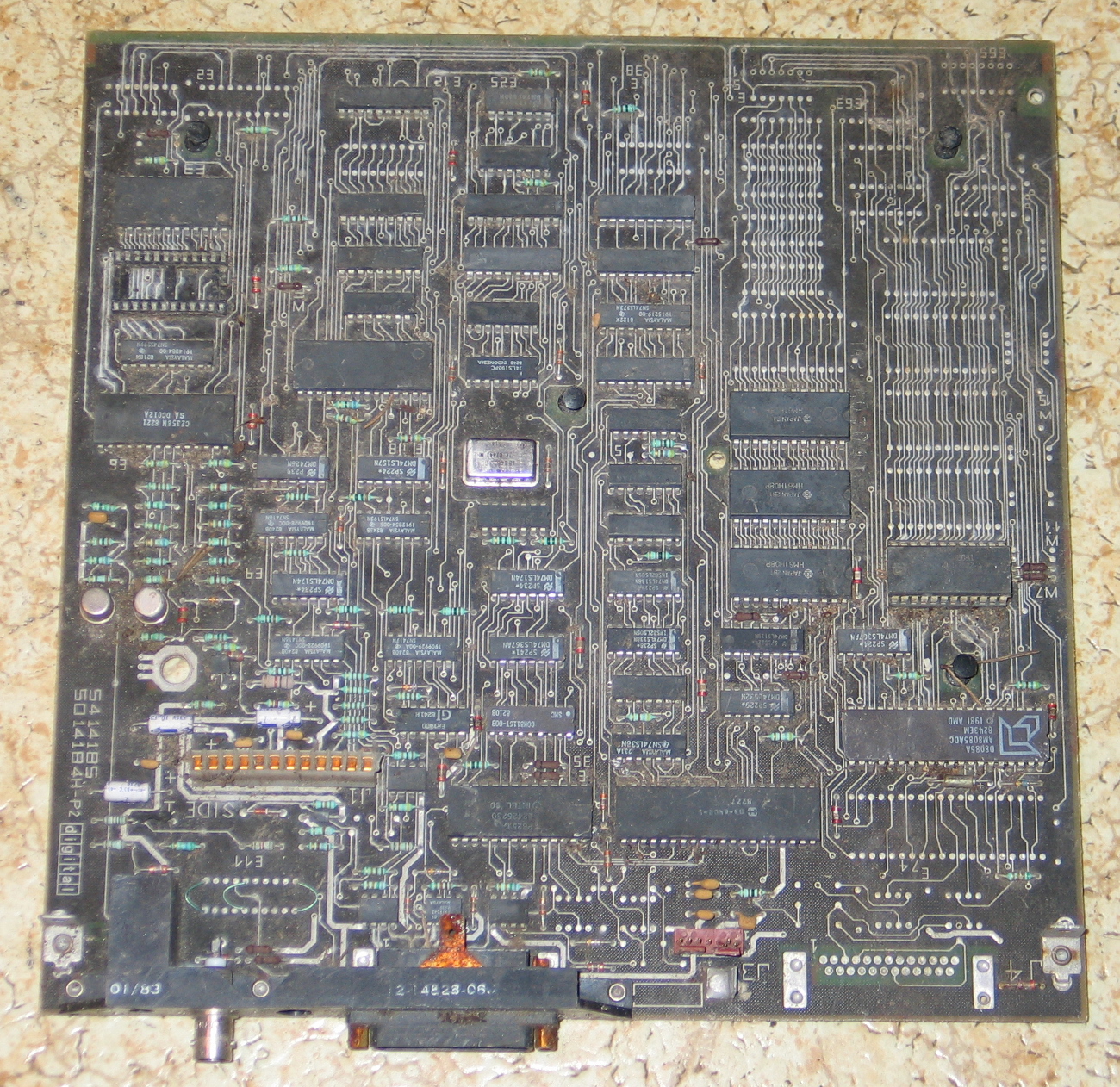
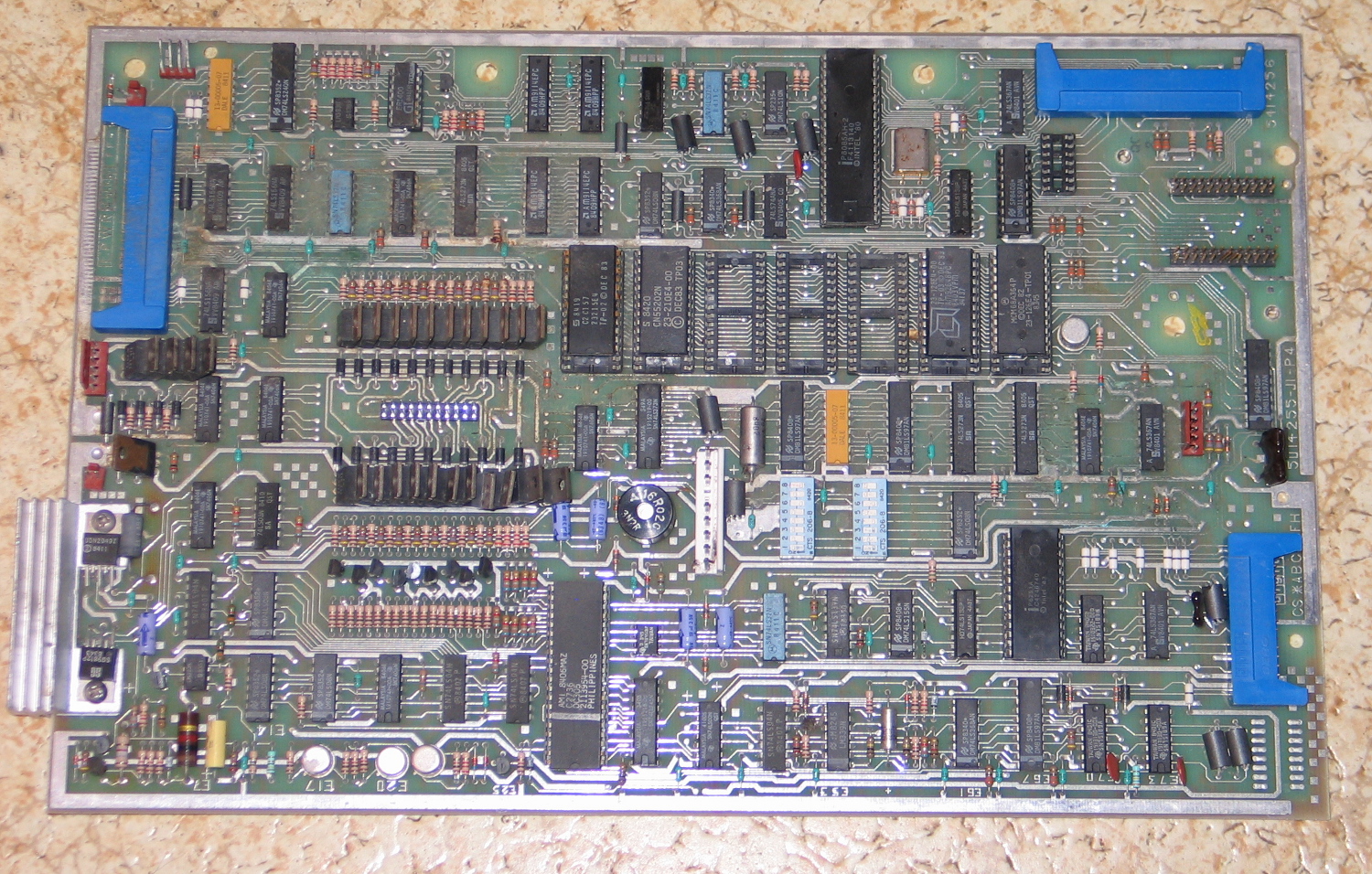
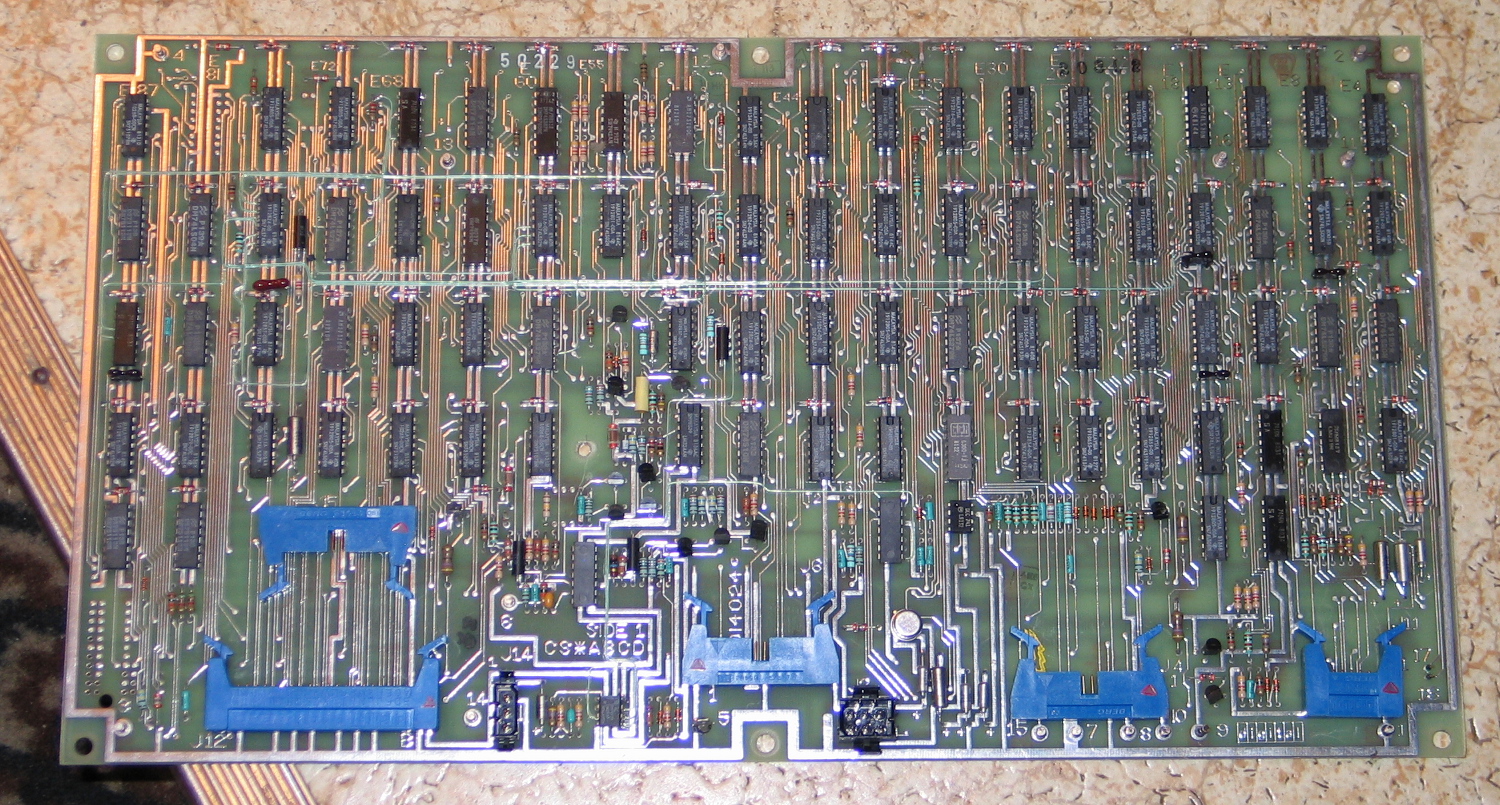
__Digital boards:__
M8014
M8012
M8061 (x2)
M8013
- I think the 8012 is a boot/terminator board, so that sounds handy. The
8061's and M8013 are disk, I think - do modern emulators of the drives
exist? If they do, maybe I should snag the controllers? Not sure about M8014.
http://www.classiccmp.org/acornia/ub/d1.jpg - terminal board? DB25F and
BNC on one edge. There was another similar board with two BNCs and a DB25F
which was marked "VT100 basic video" on the underside, so I'm assuming this
is related.
http://www.classiccmp.org/acornia/ub/d2.jpg - 8085 CPU, ROM, RAM etc.
Rows of transistors which perhaps suggests motor control, i.e. printer?
http://www.classiccmp.org/acornia/ub/d3.jpg - related to d2.jpg??
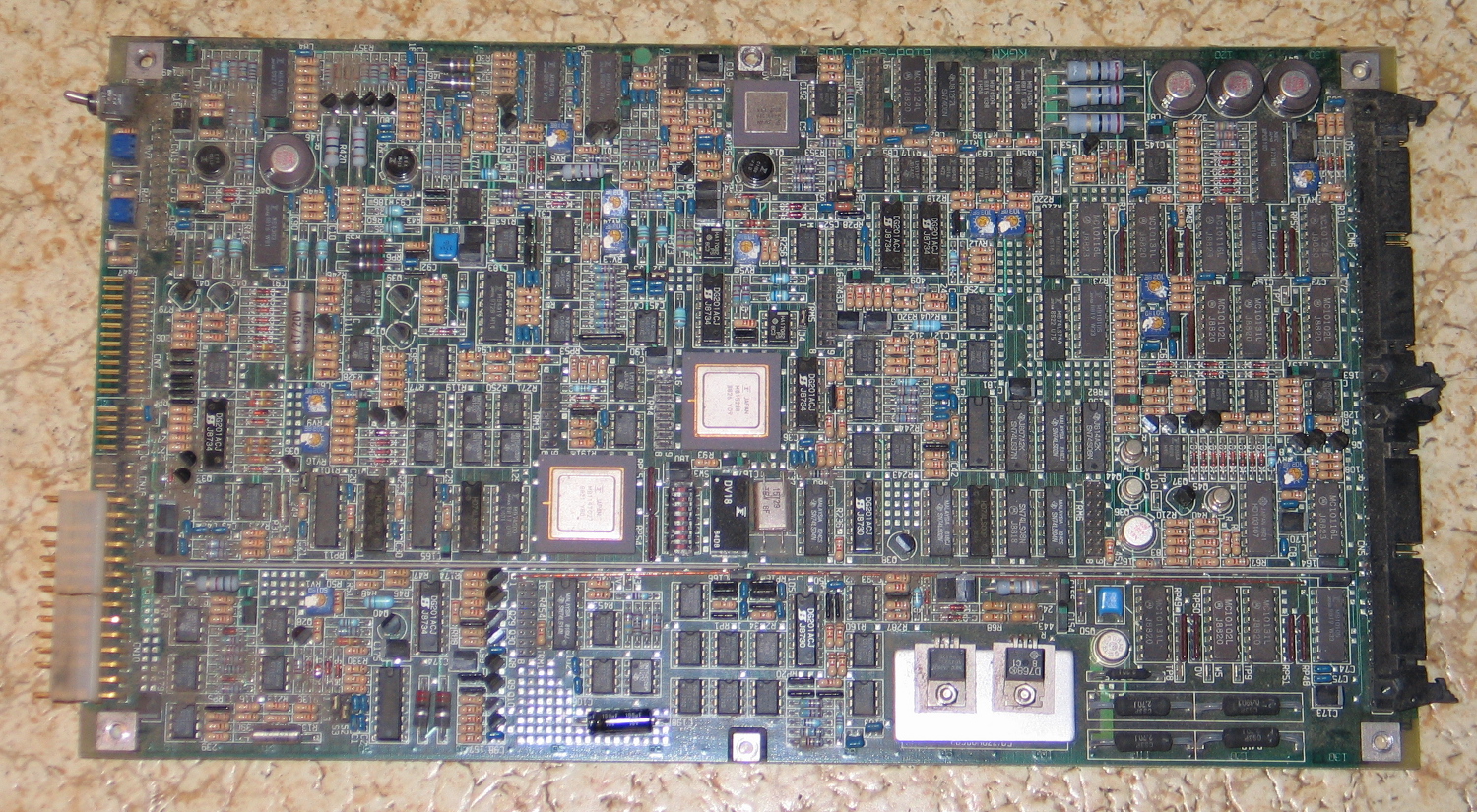
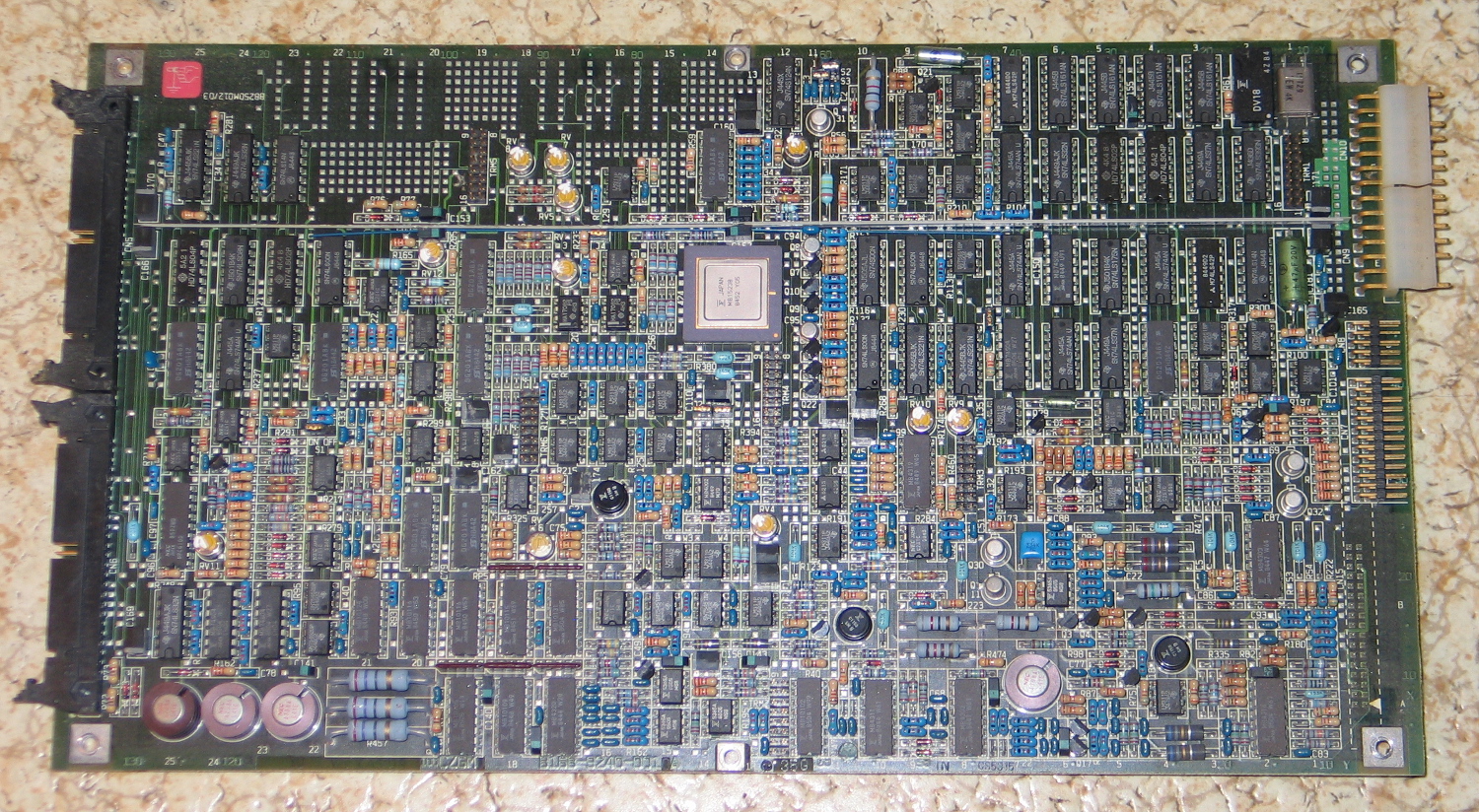
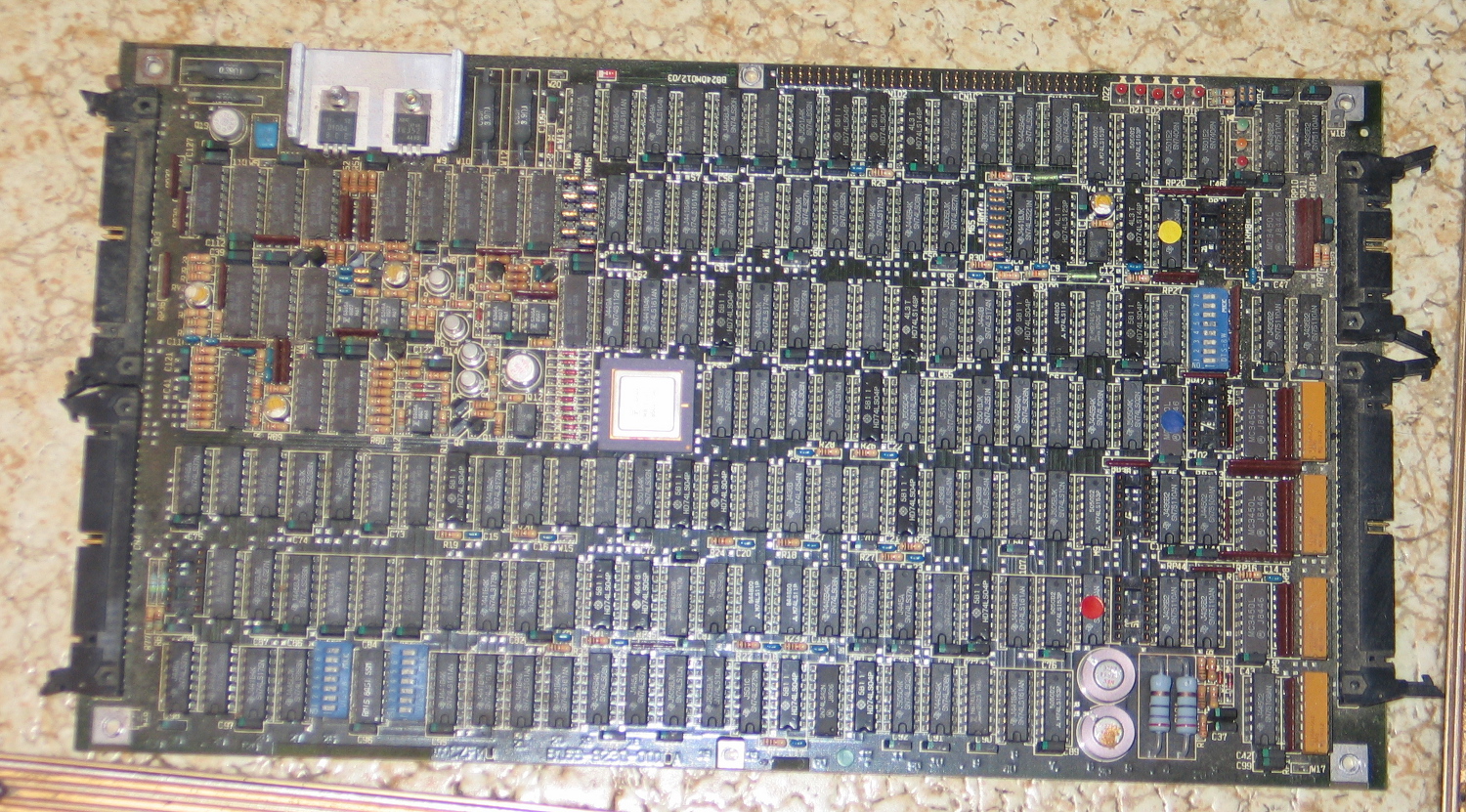
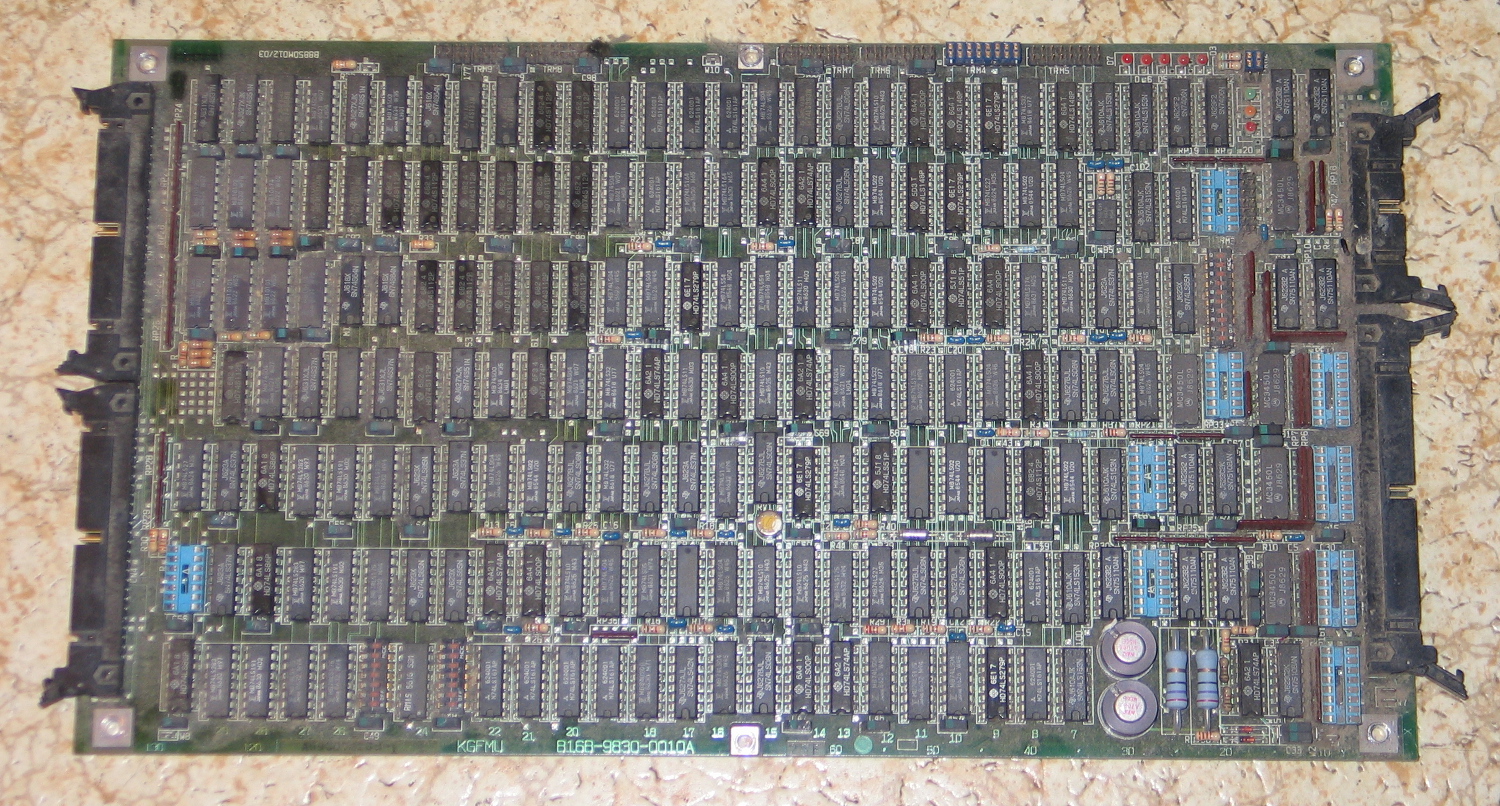
__Fujitsu boards:__
At least, the main ICs are Fujitsu; there's no indication who the boards
belong to. These are standalone boards, not ones that plug into a
backplane. My hunch is that they're logic board pulls from old hard disks
or tape drives - i.e. they're just garbage now.
http://www.classiccmp.org/acornia/ub/f1.jpg - 2x 50-way connectors,
switch in corner. PCB marked "KGKM B16B-934C-003"
http://www.classiccmp.org/acornia/ub/f2.jpg - 2x 50-way connectors. PCB
marked "CZGM B16B-9240-001"
http://www.classiccmp.org/acornia/ub/f3.jpg - 2 x 50-way connectors, 1x
60W, 1x 26W. PCB marked "CZFM B16B-9230-0010A"
http://www.classiccmp.org/acornia/ub/f4.jpg - 2 x 50-way connectors, 1x
60W, 1x 26W. PCB marked "KGFMU B16B-9830-0010A"
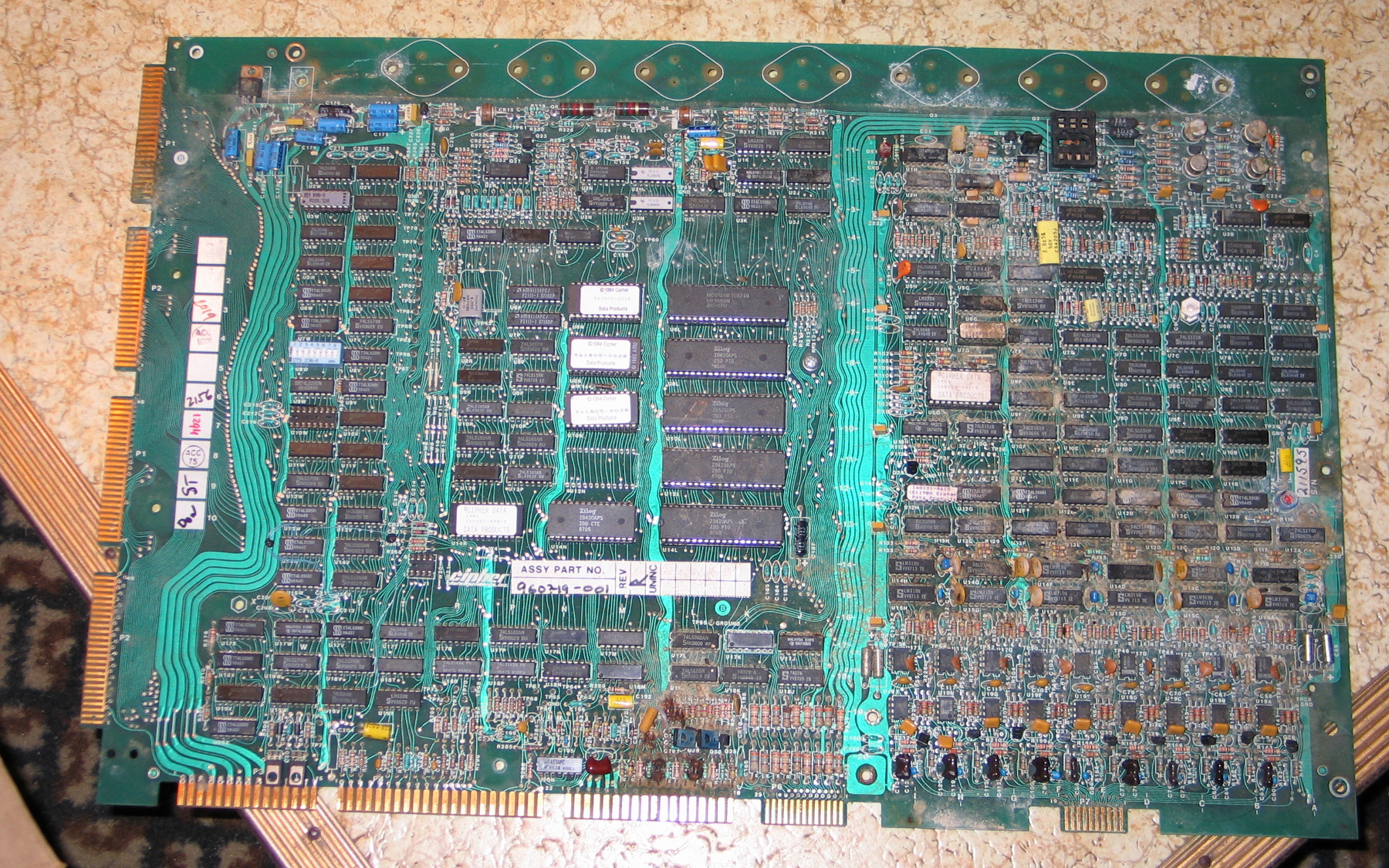
__Cipher boards:__
There are two of these:
http://www.classiccmp.org/acornia/ub/c1.jpg
I suspect they're from some form of terminal (or maybe printer?), and now
that they're separated from the rest of the system they're just junk. Note
that someone seems to have scavenged a bunch of power transistors (or
something) from them.
__Emulex boards:__
I don't think any of these are the exact same models as the ones I rescued
a little while ago, so I've included them here - but gut feeling is that
they're still just tape (i.e. not SCSI) and so they're not worth the trouble.
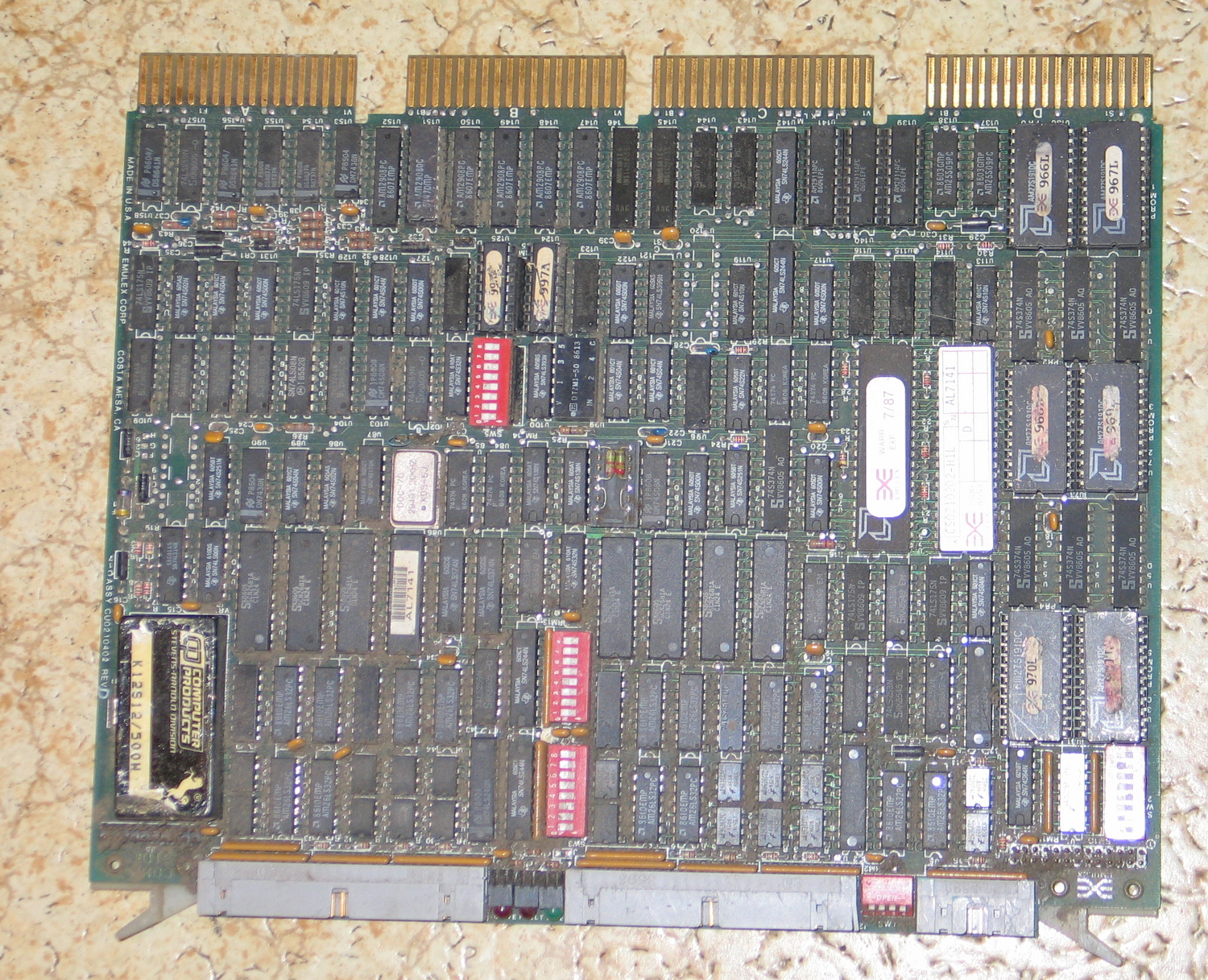
http://www.classiccmp.org/acornia/ub/e1.jpg - 2x50W, 1x?? (I forgot to
make a note). CU0210402 on the PCB, CS0110202 on the "main" IC.
http://www.classiccmp.org/acornia/ub/e2.jpg - 2x50W. TC0210201 on the
"main" IC.
There were a couple of others too each with a 60-way and pair of 26-way
connectors; I suspect those are SMD.
Chances are good I'll end up rescuing the DEC Mxxxx boards on Tuesday "just
in case", but if anything else stands out then please shout; gut feeling is
that they're PCBs from things that would have been quite wonderful once
when complete but are now completely useless to anyone.
cheers
Jules
I'm all over stuff like that.. especially with my TVT project. ?It has been a real slog finding correct looking vintage caps in particular. ?I wish I lived nearby!
Sent from my Samsung device
-------- Original message --------
From: Tom Gardner <t.gardner at computer.org>
Date: 2016-09-06 4:18 PM (GMT-08:00)
To: cctalk at classiccmp.org
Subject: Components available
Hi
A friend of mine died recently; he was amongst many things an electronics tinkerer and has a closet full of small parts in bin cabinets (resistors, capacitors, ICs, transistors, hardware, etc.).? The ICs look mostly old. His wife and kids have no interest and would like to find a good home for these parts rather than recycle the lot.
They are in Palo Alto CA
Anyone interested in using them could just pick them up in the next week or so.
Any other ideas?? Really hate to see these go to recycle.
Tom
(650) 941-5324 <tel:%28650%29%20941-5324>
Hi, All,
I've finally tracked down the simplest problems in my PDP-11/04 that's
been sitting unused for many years (the one that we formerly used as a
hardware test platform for Unibus COMBOARDs 30 years ago). The
primary faults were a half-bad 7474 in the console (the flip-flop
attached to the Run LED was not toggling when it should) _and_ an
apparently bad DL11-W that isn't passing grant - for now replaced with
a fully-functional module, but to be debugged later).
What's happening now, since I can finally enter octal at the console,
is when I change one location, 000000 for example, it echoes across
multiple locations...
To whit:
I use the console to fill 000000 to 000040 with zeros, and verify they
are all zeros. I deposit 177777 in 000000 and I get back the
following...
@L 1000
@D 177777
@L 1000
@E 001000 177777
@E 001002 004000
@E 001004 004000
@E 001006 004000
@E 001010 004000
@E 001012 004000
@E 001014 004000
@E 001016 004000
@E 001020 177777
@E 001022 004000
@E 001024 004000
@E 001026 004000
@E 001030 004000
@E 001032 004000
@E 001034 004000
@E 001036 004000
@E 001040 004000
@E 001042 177773
@E 001044 177777
I replace the 000000 at 000000 and get all zeros.
So I appear to have two problems:
1) Depositing any value is echoed 000020 later.
2) Setting D10 in location 000000 results in D10 set in all the locations
I have few spares for this machine. Lots of spares for my 11/34
(which I will want to test at some point soon), but this box (BA11-L)
has a DD11DK not a DD11-PK, so I can't just upgrade in place.
Does this sound like a dodgy CPU, dodgy RAM or both?
I have this minimally loaded...
M7263 PDP-11/04 processor
M7847 16K MOS RAM (half loaded)
M9312 with console ROM and papertape boot ROM (I have more ROMs available)
M7856 - DL11-W strapped to defaults as a console/RTC
many dual-height grant cards
M9302 terminator
UA-11 debugging board
Oh... and I see while typing that it just started halting immediately
after reset... so something just broke while it was powered on and
running the console ODT. :-( I guess I'm back to low-level hardware
debugging again.
But in the meantime, any CPU/RAM symptom suggestions? I have the
prints. I'm just looking for any "oh, yeah! That happened to me!"
with "...and I fixed it by testing X and replacing the bad ones".
All this so I can make a test bed for my M9313 boards and get them
working again to fix the DWBUA on my VAX 8300...
-ethan
were you able to pull up link at archive.org ok I listed
re:
the terminals site is still on archive.orghttps://web.archive.org/web/20150720142308/http://terminals.classiccmp.org/w
iki/index.php/Category:Alpha_Micro
ta da......
Ed#
In a message dated 9/6/2016 12:50:36 P.M. US Mountain Standard Time,
pontus at Update.UU.SE writes:
On Tue, Sep 06, 2016 at 08:01:17AM -0500, Jay West wrote:
>
> I did my best.....
>
I had no idea, thanks for all the extra work you put in for us.
And a thanks to the maintainer of Manx for working with on it! It's a
great
resource.
/P
It was written....
-------------------------------
> but Manx seems to be in the process of being relocated
>
Hasn't Manx been in that state for ages?
/P
---------------------------------
manx.classiccmp.orgterminals.classiccmp.orgcomputergraphicsmuseum.com/net/org
The owner of those three sites has the unfortunate honor of being the only
person ever asked to leave the free hosting at classiccmp.org.
I gave him 30 days to get his stuff hosted elsewhere.
I even backed up all his content and databases and put them on a 1.5TB
external hard drive and shipped it to him (while keeping the sites running
on the classiccmp server).
Even though I told him 30 days, I gave him about 180 days before I said "you
have to get these moved or I'll have to turn them off".
After about another 90 days or more, I did redirects back to his home site
so they at least weren't dead.
The content and databases are still on the classiccmp server, although
publicly inaccessible, just to make sure the new locations are up and
running before I delete the content locally.
I did my best.....
J
> So I have a fairly large group of 16-sector RK05 packs ... which I have
> no use for, which I would like to trade for 12-sector RK05 packs
Hi, all, I've had quite a few responses, so I think I have this covered now.
Thanks to everyone who responded; if you haven't gotten a reply yet, I'm trying
to catch up, you should hear soon! :-)
Noel
http://www.ebay.com/itm/-/191960867958
Apparently the buyer backed out, and the entire lot is now available as ONE
lot. There is no reserve.
Cindy Croxton
the terminals site is still on archive.orghttps://web.archive.org/web/20150720142308/http://terminals.classiccmp.org/w
iki/index.php/Category:Alpha_Micro
ta da......
Ed#
resending got error
In a message dated 9/6/2016 9:07:15 A.M. US Mountain Standard Time,
COURYHOUSE at aol.com writes:
the terminals site is still on archive.orghttps://web.archive.org/web/20150720142308/http://terminals.classiccmp.org/w
iki/index.php/Category:Alpha_Micro
ta da......
Ed#
In a message dated 9/6/2016 6:01:32 A.M. US Mountain Standard Time,
jwest at classiccmp.org writes:
It was written....
-------------------------------
> but Manx seems to be in the process of being relocated
>
Hasn't Manx been in that state for ages?
/P
---------------------------------
manx.classiccmp.orgterminals.classiccmp.orgcomputergraphicsmuseum.com/net/org
The owner of those three sites has the unfortunate honor of being the only
person ever asked to leave the free hosting at classiccmp.org.
I gave him 30 days to get his stuff hosted elsewhere.
I even backed up all his content and databases and put them on a 1.5TB
external hard drive and shipped it to him (while keeping the sites running
on the classiccmp server).
Even though I told him 30 days, I gave him about 180 days before I said
"you
have to get these moved or I'll have to turn them off".
After about another 90 days or more, I did redirects back to his home site
so they at least weren't dead.
The content and databases are still on the classiccmp server, although
publicly inaccessible, just to make sure the new locations are up and
running before I delete the content locally.
I did my best.....
J
the terminals site is still on archive.orghttps://web.archive.org/web/20150720142308/http://terminals.classiccmp.org/w
iki/index.php/Category:Alpha_Micro
ta da......
Ed#
In a message dated 9/6/2016 6:01:32 A.M. US Mountain Standard Time,
jwest at classiccmp.org writes:
It was written....
-------------------------------
> but Manx seems to be in the process of being relocated
>
Hasn't Manx been in that state for ages?
/P
---------------------------------
manx.classiccmp.orgterminals.classiccmp.orgcomputergraphicsmuseum.com/net/org
The owner of those three sites has the unfortunate honor of being the only
person ever asked to leave the free hosting at classiccmp.org.
I gave him 30 days to get his stuff hosted elsewhere.
I even backed up all his content and databases and put them on a 1.5TB
external hard drive and shipped it to him (while keeping the sites running
on the classiccmp server).
Even though I told him 30 days, I gave him about 180 days before I said
"you
have to get these moved or I'll have to turn them off".
After about another 90 days or more, I did redirects back to his home site
so they at least weren't dead.
The content and databases are still on the classiccmp server, although
publicly inaccessible, just to make sure the new locations are up and
running before I delete the content locally.
I did my best.....
J
Noel Chiappa wrote:
>
> > when folks just dump an ebay item number rather than a full link, those
> > posts should die
>
> Why? It's a tiny bit more work to use them (prepend the number with the
> string "http://www.ebay.com/itm/", and away you go), so one can't just click
> and go, but are people really that unwilling to go to the slightest effort?
>
Any given posting to a mailing list is sent by one person and read by many.
If there is a small effort to be made, it makes more sense for the sender to
make it once than all the interested recipients to have to duplicate the effort.
On the other hand, faulty spam filters may be more likely to stomp on messages
containing urls so there may be also be a case for not including urls in postings
if possible.
Regards,
Peter Coghlan.
For some time I have slowly been working on restoring our PDP-8 to
operating condition.
Here are some notes on the progress:
http://www.datormuseum.se/computers/digital-equipment-corporation/pdp-8
It is sort of working now after reforming capacitors in the PSU, adjusting
memory currents and replacing a 2N3639 in a MA, MB, PC (R211) board.
But bit seven is still showing a 0 when trying to set it. I found an old
note that I wrote somewhere in 1990 that indicated the same problem was
present then as well so it hasn't happen lately.
I have now concluded that the fault is in the core memory module itself.
The sense winding is broken on bit plane 7.
So what are my options?
What are the chances that a repair is successful? It looks really complex
to take it appart and get to to layer seven. Then to find the broken wire,
somehow replace it and splice it together with the rest of the sense
winding... Not an everyday job.
Does anyone have a known good spare module? I have some MM15 modules for
PDP-15 to trade with!
Could a MM15 module be adapted to be used instead? It is completely
different foot print and it is a three wire stack.
The Russian stacks sold on Ebay? But what guarantees are that those work at
all and can be adapted... Probably other memory currents and cycle time?
Some other technology that can be used to make up for the missing bit
plane. But what technology and how. With as little intrusion in the
machine. I don't really want to replace the entire memory system with a
battery backed SRAM...
Any ideas, thoughts or a working PDP-8 core memory module is highly sought
for!
/Mattis
I have a 350 and 380. Neither work. The 380 is reporting a possible memory
error on the LEDs. Will the 350's memory work in a 380 (or vice versa)?
Regards
Rob
Hi all, as per the subject some raised floor is about to become available.
As much as I wanted and was going to grab this flooring myself, I can't.
So this is the time for someone else who needs around 500-600 Sq.Ft. of
raised flooring to go get it!
This flooring is about 8in tall, so its not anything crazy like some of
the newer taller stuff.
The floor MAY be available, he is not 100% sure yet.
The deal is they are selling the building and if the new owners do not
want it, it is for grabs but must be picked up in the next 2-3 weeks.
I am not sure, but you probably have to grab it all.
The floor is located in Sewell, NJ as per the subject.
It will be available for low or no cost depending on the interest level...
Please contact Mike at:
mbrotzman.jhu at gmail.com
-Connor Krukosky
extra copy no DJ ex lib tight binding unmarked text pages aside from
library stamps etc
trade or? repy offlist Ed# SMECC www.smecc.org
_
COMPUTERS: THEIR IMPACT ON SOCIETY, AFIPS Conference Proceedings, Volume
27, Part 2, 1965 Fall Joint Computer Conference.
_
(https://www.amazon.com/COMPUTERS-Conference-Proceedings-Computer-Conference…
omputers+their+impact+on+society) 1967
On Sep 5, 2016 12:05 PM, "Peter Coghlan" <cctalk at beyondthepale.ie> wrote:
>
> Fritz Mueller wrote:
> >
> > > On Sep 4, 2016, at 6:08 PM, william degnan <billdegnan at gmail.com>
wrote:
> > >
> > > Even better, I found this post, this is my how to attach a vt100 to a
VAX
> > > 4000, you can apply to most any case
> >
> >
> > Hi Bill,
> >
> > Thanks for you help!
> >
> > I will say that I have the getty running fine, baud rate, serial
format, etc.
> > all okay. Works just fine at 1200 baud and below. At higher baud
rates, it
> > seems like the vt100 is dropping some characters or bits after certain
> > escape sequences, even with xon/xoff flow control enabled, so I?m
*pretty*
> > sure the issue is just with the padding values in the vt100 terminfo
spec?
> >
>
> I've got a VT102 Video Terminal User Guide (EK-VT102-UG-003) which
contains
> a table of fill characters required for different control codes / escape
> sequences / display characters at each possible baud rate. Here's what it
> lists for 19200 baud:
>
> 324 IND, LF, NEL, RI (Smooth Scroll)
> 191 DECCOLM
> 190 DECALN
> 144 ED (132 Col)
> 104 ED (80 Col)
> 32 IND, LF, NEL, RI (Jump Scroll)
> 6 EL (132 Col)
> 4 EL (80 Col)
> 7 DECINLM
> 2 All others except RIS and DECTST
>
> The appendix also seems to hint that the VT100 has different requirements
so
> this may not be very useful to you but it might give you a rough idea.
>
> Regards,
> Peter Coghlan.
The link I provided has exactly what keystrokes and settings to use for
8/n/1 and 19200, plus a link to the vt100 manual. VT102 is not the same.
B
Did you ever get your interact running?
I can help you with cassettes if you need.
There is also a way to use a wav file and play through an MP3 to cassette adapter
Let me know
Sent from my iPhone
Hi,
Last year I rescued a dual-wide 8-position q-bus backplane. I added the
wire wrap to convert it from 18 to 22-bit, and now can boot BSD2.11 from
CMD/CQD SCSI controller and CF card at DU0, via an AztecMonster
CF-SCSI adapter. If I remove the SCSI controller, I can boot XXDP
>from an RQDX3 connected floppy drive at DU0. My CPU is an M8192 from the
scrap-card guy on e-bay, and I'm using an M7195 SLU/ROM card for
console. It's got 23-14534/23-146E4 ROMs. I'm using a 2MW Clearpoint RAM card.
I'm fabricating a cool desktop flexiglass case, so I can put the tiny-pdp11/73
on the desk at work.
The difficulty I am having is I would like to configure the system with
both MSCP controller cards installed, so I can boot from either SCSI or
floppy, preferably with the SCSI still starting at DU0 so my BSD2.11 CFs
remain portable to my other system.
I changed the W1-W11 jumpers on the RQDX3 for 17760334 secondary MSCP address.
And, I installed W12 to start at MSCP unit number 4. I used the menu on
the SCSI controller to set it for DU0-DU3-only device mappings (SCSI ID 0-3).
My understanding is each controller needs the different CSR, and non-overlapping
MSCP unit numbers. I confirmed I (finally) got the RQDX3 address jumpers
because the bootrom memory map now displays 17760334-17760336 as in use, as
well as 17772150-17772152 for the SCSI controller.
I was expecting that I'd now be able to boot from the floppy at DU4
(BOOT> DU 4), but after a long pause, I get ?BOOTROM-F- DU 4 device error.
I also tried "BOOT> 17760334 DU 4", but still no joy.
Another oddness I noted was that with my original RQDX3 config, if I
plug the M7516 ethernet card in, that breaks booting from floppy.
Are there some other jumper changes I need to make on the RQDX3?
Does anyone have any other suggestions about what I might be doing wrong?
Mark
--
Mark G. Thomas (Mark at Misty.com), KC3DRE
On 09/03/2016 10:07 AM, Adrian Graham wrote:
> On 03/09/2016 17:39, "Jon Elson" <elson at pico-systems.com> wrote:
>
>> On 09/03/2016 10:56 AM, Noel Chiappa wrote:
>>>> From: Jon Elson
>>>>> needs new caps since one of the 1000uF 16V ones has bulged badly.
>>>>> ...
>>>>> If I go up to 25V I can get 16mm diameter which is the size of the old
>>>>> ones.
>>>> Capacitors that are subjected to high AC ripple current may need the
>>>> large surface area for cooling.
>>> Interesting point - but in his particular case, he should be OK replacing the
>>> old 16V cap with a similar-sized modern 25V cap?
>>>
>>>
>> Similar size - then no problem! But, some new cap types are
>> VASTLY smaller than the caps from 40 years ago.
> Hence my question, I'll stick with the same size but higher voltage.
>
> Cheers!
>
You do have to consider where in the circuit the capacitor is. If this
is a switching power supply (as I suspect) then if the cap is after the
switching transformer it MUST be a low ESR, high temp cap - otherwise it
won't last very long. If this is on the primary side and is simply
filtering the input rectified AC then ESR is not as big a problem, but
you need a good physical size if the switching supply puts out a fair
bit of current due to heating effects of low frequency ripple.
So, it all depends.
For general repair I would get the best grade of capacitor - say
Panasonic - with a nice low ESR and away you go.
John :-#)#
--
John's Jukes Ltd. 2343 Main St., Vancouver, BC, Canada V5T 3C9
Call (604)872-5757 or Fax 872-2010 (Pinballs, Jukes, VideoGames)
www.flippers.com
"Old pinballers never die, they just flip out"
I have a nice, clean DG MPT/100 I'm in the process of restoring. As you
might expect, I contacted Bruce at "Wild Hare" to see what
documentation and software he had for the critter.
He was able provide some helpful PDF documentation - but NO schematic or
software.
Without software, the MPT/100 is essentially useless. If anyone has the
5.25" floppy system and/or diagnostic diskette sets for this
workstation I'd really appreciate images of same.
If you have the floppies, but no images, and you lend me your floppies,
I'll make images and make them publicly available and return your
floppies (assuming you want them back).
If by some stroke of luck you have the schematics for the MPT/100 (DG
part numbers: Mainboard 001-002963 and Keyboard 001-002688) I could
really use them :)
The MPT/100 contains the DG microNOVA mN602 CPU and 64K of system RAM
plus video memory. Software for the MPT/100 includes a set of Diagnostic
diskettes and the MP/OS system diskettes.
Regards,
Lyle
--
73 AF6WS
Bickley Consulting West Inc.
http://bickleywest.com
"Black holes are where God is dividing by zero"
Hi there,
Does anyone have a pair of spare EPROM emulators which are capable of
emulating 27C010 EPROMs?
Ideally two identical ones, but that's optional.
I'm trying to reverse-engineer a Securicor Datatrak MkII navigation
receiver and build a signal generator which can emulate a chain of
Datatrak transmitters. I'm part of the way there, but I've hit something
of an impasse:
* My emulator isn't good enough to run the firmware on a PC (it
crashes when the RTOS starts to boot).
* My knowledge of the hardware is full of holes (especially the
simple-but-custom ASIC). Porting a monitor ROM using EPROMs would take a
fair while, even with the HP16700A to use as a "debugger". I'd like to
try patching the firmware, but with bare EPROMs that'll take a while to
get right.
I could swear these things were as common as housebricks on ebay a year
or so ago, but now they're not quite so common...
Incidentally, if someone (preferable in the EEA) has a spare HP 16717A
acquisition card (for the 16700A series logic analysers) for sale, I'd
be very interested in getting another one -- my second 16717A seems to
have died while in storage, and spying on the 68k has eaten up all the
pod inputs on my one working card.
Thanks,
--
Phil.
classiccmp at philpem.me.uk
http://www.philpem.me.uk/
Both these locations are NW of Baltimore, Maryland. I have no relationship with either seller but am willing to do in-person recon for people on this list if required.
Large lot of Apple stuff, $1200
Mostly Macs but a good amount of Apple II stuff (including a //c with all original boxes and paperwork)
Westminster, MD
http://baltimore.craigslist.org/sys/5763302040.html
Apple IIGS, $100
3.5 and 5.25 floppy drives, monitor, keyboard, mouse
New Windsor, MD
http://baltimore.craigslist.org/sys/5746461980.html
?
Brad Ackerman N1MNB PGP: 0x9F49A373
brad at facefault.org <*> http://bsa.smugmug.com/
I found a simple manual for a "System 2400" 24 bit computer. Can be
downloaded here: http://dvq.com/docs/dcs2400o.pdf
There's a reference to "dcs 2400" and on the title page, "Digital
Computer" from the rep. Gene Baumgardner.
Does anyone have more info on this computer, or the company who made it?
It looks like an interesting system.
-Bob
--
Vintage computers and electronics
www.dvq.comwww.tekmuseum.comwww.decmuseum.org
> From: Jon Elson
>> needs new caps since one of the 1000uF 16V ones has bulged badly.
>> ...
>> If I go up to 25V I can get 16mm diameter which is the size of the old
>> ones.
> Capacitors that are subjected to high AC ripple current may need the
> large surface area for cooling.
Interesting point - but in his particular case, he should be OK replacing the
old 16V cap with a similar-sized modern 25V cap?
Noel