Please forgive this, list-members, I know it's way OT:
https://www.gofundme.com/jeff-kris-kidder-xmas-eve-fire
My super great neighbors across the street lost their home to fire this
evening. =(
These folks are the best of the best.. as the saying goes "Couldn't have
happened a nicer guy!". Please spread it around as you feel is appropriate.
Like most of us, we're still kind of in shock over it.
I can only imagine how Jeff & Kris are.. thanks for your forbearance.
Now that I have an 8X300 (etc.) disassembler, which I've used to
disassemble the Western Digital WD1000 and WD1001 firmware, and the Zendex
ZX-203 firmware, I've become curious as to what other products used the
SMS300/8X300/8X305. Does anyone know of any?
In the early to mid-1980s, the 8X300 was a good choice for hard disk
controllers, because all instructions took 250ns, and a single instruction
could read an I/O port or RAM location, shift and mask, and write another
I/O port or RAM location. At the time, no MOS microprocessor was even close
to that.
Hi folks,
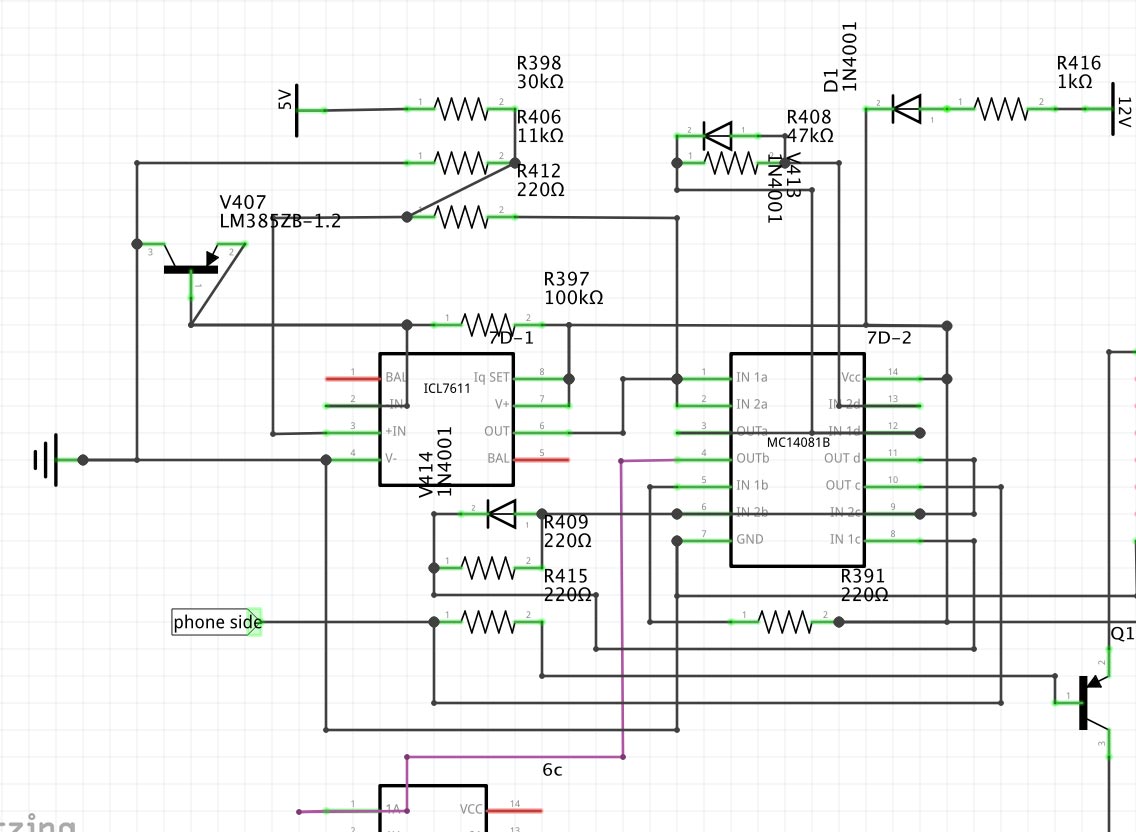
Thanks for all the help so far, I've moved on quite a way but I still
haven't managed to get my head around op-amps other than the basics. If I
may trouble your experienced heads with a small circuit diagram:
http://www.binarydinosaurs.co.uk/STCExecutelStartupCircuit.jpg
This is the full circuit of all the things I've been posting recently,
traced and drawn out as completely as I can manage. All the resistors and
diodes have been tested out of circuit and are OK and I've just realised 3
of the resistors are labelled wrongly. R409 is 47k, R415 and R391 are 100k.
IN- at the op-amp is 1.2V from the LM385ZB-1.2 which has pins 2/3 tied
together. IN+ is 1.3V. V+ is 5.3V. The purple trace is RESET for the 8085,
or should be.
Initially the LM385Z had rotted away because of battery leakage so I was
experimenting with diodes in series to try and get the IN- voltage down to
1.2V, and with two IN4148s (0.9V) the whole circuit sprang into life and I
got RESET at the 8085. For two seconds, then it would cycle for two seconds.
This maybe expected behaviour, I don't know.
3 diodes gave me 1.3V which produced nothing at the op-amp output, probably
because there was no difference between IN+ and IN-?
On a whim I managed to solder new legs onto the old LM385Z and it works,
giving 1.2V at IN-, but the output is still only 0.2V.
I don't mind admitting I'm stumped :)
--
Adrian/Witchy
Binary Dinosaurs creator/curator
Www.binarydinosaurs.co.uk - the UK's biggest private home computer
collection?
On Wed, Dec 21, 2016 at 5:54 PM, js at cimmeri.com <js at cimmeri.com> wrote:
>
>
> On 12/17/2016 1:23 PM, Stephen Pereira wrote:
>
>> I was (finally) lucky enough to acquire an Altair 680 back in November...
>>
>
> Is there any logic to the naming of these Altairs? Wonder why it wasn't
> "Altair 8080" and "Altair 6800". 8800 and 680 don't follow the same
> pattern.
>
> ------
>
> Had MITS made other Altairs...
>
> Altair 8800 = 8080
> 8850 = 8085
> 8860 = 8086
> 8880 = 8088
> 8286 = 80286
> 8386 = 80386
> 680 = 6800
> 680 = 6809
> 680 = 68000
>
> ;-),
>
> - JS
> ----------------------------
>
lol, I would love to hear that too if anyone knows any stories behind the
naming. Used to hurt my head to remember that it was an 8800 not an 8080.
I know the fairly well published story about the name Altair but companies
and their model numbers are always odd.
> From: Lars Brinkhoff
> I have this on AI:
>> the semi-original AI (that is, the KA-10 rather than the PDP-6) was
>> .. was given to a bunch of hackers from Concourse
Oh, right, now that you mention it, I very vaguely recall this.
I'm not sure why I thought they had taken a KA too - I think I may have been
confused by this email:
Date: Fri, 16 Sep 88 00:16:04 EDT
From: Peter Lothberg <ROLL at AI.AI.MIT.EDU>
Subject: The "crack team", is dissasembling MX, for it's trip to Sweden
To: INFO-ITS at AI.AI.MIT.EDU
The crack team has begun to work;
...
(As the system will not fill the container more than 40% or so, we vold like
donations of other stuff, like Lisp-machines, AAA terminals, a IMP,
Conection machines, retired 2060's etc, (I'm not joking...))
which does talk about taking other stuff. But I have this persistent memory
that they took a KA - maybe I should try and get ahold of Peter and see? There
is a later email:
Date: 11-Nov-88 0:39:51 +0100
From: Peter_Lothberg <ROLL%SESTAK.BITNET at MITVMA.MIT.EDU>
To: bug-its at ai.ai.mit.edu
Subject: The container and MX
Arrived to Stockholm and we unpacked the container on wendsday.
The container has, sure shaked, the cardboard paper that we put between
the cabinets, has bloue spots.....
But, everything was in the same position that we left it, so, hopfully it is
not hurt by the transport, or the cold here.
We have put the machine on several places, while we are waiting for our new
machine room to be completed.
which makes it sound like they only got the KL? It's also possibly I am mixing
two memories, and remembering this:
Date: Sat, 3 Oct 87 23:02:14 EDT
From: Alan Bawden <ALAN at AI.AI.MIT.EDU>
Subject: The operating system that wouldn't die! AAAAIIIIEEEEEE!!!!!
To: INFO-ITS at AI.AI.MIT.EDU
I thought I would take this opportunity to spread the word about something
that I don't think has been very widely publicized. Some of you may recall
that a while ago some fellows in Sweden contacted us about running ITS on
various PDP-10's that they owned? Well, we mailed them a set of tapes for
bringing up ITS on their 2020, which they were able to do without too much
trouble .. That all happened over a year ago. Recently we learned that these
guys have successfully -built- ITS paging hardware for their KA-10, and have
ITS up and running there as well! Totally Amazing.
Pretty astonishing accomplishment, that.
Noel
-------- Original message --------
From: william degnan <billdegnan at gmail.com>
Date: 2016-12-24 3:35 AM (GMT-08:00)
To: cctech <cctech at classiccmp.org>
Subject: Re: Transporting an LGP-30
> Well, I think you guys have convinced me that a trip is in order. Better
safe than sorry with a piece of equipment like this.
>
> Yep Chuck, this is the CA machine. I was surprised it never reared its
head on classiccmp the past few days. -C
Believe me, I for one was interested, and I was in contact with the
seller.?? The expense and effort, as much as >I'd love to work on restoring
>this, was too great to pull the trigger.
I thought about it also. ?I would have liked to have brought it back to BC and kept it here in Canada. ?But I began to wonder how it had ended up with these guys and talking to them I had my doubts about the amount of care taken in moving it around. ?And I assumed freight would be insane anyway. ?
I have posted a package of information and ROM images from my project to
clone the 98228A ROM on the VintHPcom group at groups.io. Progress on
laying out a PCB is going slowly as I have little experience and the
learning curve for using Kicad to lay out a board seems pretty steep.
Paul.
Hello,
This email message is a notification to let you know that a file has
been uploaded to the Files area of the VintHPcom at groups.io group.
*File:* 98228A.zip
*Uploaded By:* Paul Berger
*Description:*
Package with information and ROM images from my project to clone the
rare 98228A ROM that supports both 9885 and 9895 8" diskette drives.
You can access this file at the URL:
https://groups.io/g/VintHPcom/files/HP9825/98228A.zip
Cheers,
The Groups.io Team
_._,_._,_
------------------------------------------------------------------------
?All I want for Christmas is? a PC diagram for my Coleco ADAM; with
apologies to Don Gardner(1946). Wishing all the best of the holiday
season and may 2017 bring all your computing classic dreams come true.
Happy computing, Murray :)
> From: Johnny Eriksson
> From the KI10 and onwards it includes PXCT, since these have the
> concept of a previous context...
> Given a pager for the KA10 PXCT would make sense there.
It turns out the KA ITS machines have an instruction that does roughly the
same thing, but it's different. Here's the relevant code fragment from
SYSTEM;ITS >:
IFN KA10P,[
SUBTTL STUFF PECULIAR TO KA-10 PROCESSOR
;;;PAGING BOX INSTRUCTIONS
LPM=102000,, ;LOAD PG MEM STATE VECTOR DONT CLR ASSOC MEM
LPMR= LPM 2, ;CLEAR ASSOC MEM AND LOAD
SPM= LPM 1, ;STORE PG MEM STATE VECTOR
LPMRI=LPM 6, ;LOAD PM, CLEAR ASSOC REG, AND CAUSE INTERRUPT
EXPGNG==4 .SEE UPQUAN ;4 TO TURN ON EXEC PAGING
XCTR=103000,, ;EXECUTE INSTRUCTION WITH MAPPING CONTROLLED BY AC FIELD
;VIOLATION CAUSES USER MEM PROTECT INTERRUPT UNLESS INHIBITED
;VIOLATION ALSO SKIPS BUT THIS IS OF NO CONSEQUENCE UNLESS
;INTERRUPT IS INHIBITED SINCE PC WILL BE RESET FROM OPC
XCTRI= XCTR 4, ;XCTR WITH PAGE FAULT INHIBITED (SKIPS ON FAULT)
; AC FIELD VALUES FOR XCTR AND XCTRI
XR==1 ;MAP READ MAIN OPERAND OF SIMPLE INSTRUCTION (MOVE, SKIPL, HLL)
XW==2 ;MAP WRITE MAIN OPERAND OF SIMPLE INSTRUCTION (MOVEM)
XRW==3 ;MAP READ/WRITE OPERAND OF SIMPLE INSTRUCTION (E.G. IORM)
XBYTE==3 ;MAP BYTE DATA AND BYTE POINTER (ILDB, IDPB)
XBR==1 ;MAP BLT READ
XBW==2 ;MAP BLT WRITE
XBRW==3 ;MAP BOTH OPERANDS OF BLT
;KA10 PAGING BOX GOES BY WHETHER IT'S A READ OR WRITE (OR RW) CYCLE
;KL10 PAGING BOX WORKS DIFFERENTLY (SEE BELOW)
;DO NOT USE MULTI-OPERAND INSTRUCTIONS (DMOVE, PUSH, ETC.) WITH XCTR
The KL and KS are both different (although both use XCTR and XCTRI); the KL
stuff is later down in that file; the special KS instructions are in
KSHACK;KSDEFS > if anyone wants to look at them.
Noel
-------- Original Message --------
Subject: Re: ADM-3A Lower case ROM issue
From: "Ian S. King"
Date: Wed, December 14, 2016 1:30 am
To: "General Discussion: On-Topic and Off-Topic Posts"
<cctalk at classiccmp.org>
Take a look at the silk screen on the board - ISTR there's another chip
that needs to be added, some simple TTL logic. I converted mine several
years ago without problems - but that was with the original ROM.
--
Ian S. King, MSIS, MSCS, Ph.D. Candidate
--
Just as a follow-up - I got the two RAM ICs that were missing (2102 1K
RAM), and installed those along with the lower-case ROM, and everything
now works great.
Thanks everyone for your expertise and tips!
Steve
> Did the original KA10 have XCT too?
XCT is present in all PDP-10 processors. From the KI10 and onwards it
includes PXCT, since these have the concept of a previous context...
Given a pager for the KA10 PXCT would make sense there.
> Noel
--Johnny
> From: Lars Brinkhoff
> Does anyone know more about this PDP-6? Did it ever run ITS, like its
> PDP-10 successor?
I don't know about the software run on the two PDP-6's - by the time I
arrived at MIT, they were both powered off and never, as far as I know, ever
ran again. I would _assume_ that it ran ITS.
I don't recall if the physical remains stayed until the KA's were
de-commissioned, or of they were removed prior to that - I suspect they
stayed, since they were mixed in with the KA's - in the case of AI at least,
wired in together - but don't remember exactly. I don't recall if the I/O bus
was shared between the two CPUs on the DM machines, the way it was on the AI
KA and PDP-6.
The DM PDP-6 was part of the DM KA 'assembly' - DM was in two rows (front and
back) to the right of the right-hand door from the lobby into the machine
room. IIRC, the PDP-6 was in the front row, to the right? of the KA CPU. (The
back row contained memory boxes - a mix of different DEC memories. I don't
recall where the tape and disk controllers were - or the disk drives. I seem
to vaguely recall a few boxes to the left of the KA CPU? Maybe there are some
pictures of the MAC machine room that will show it.)
Noel
Hi folks,
I have an 8085-based viewdata telephone system on the bench that's proving
to be a labour of love in trying to get it running with zero documentation -
there are only 6 known examples that I've come across and all but 2 of them
are in museums, none known to work. If any of you fancy searching it's an
STC Executel 3910 and at least two of the hits you'll get will be my machine
before I bought it.
http://www.binarydinosaurs.co.uk/stcexecutel01.jpg
I've been in contact with all museums who have one, no luck on docs though
the Museum of Computing which is local to me MAY have some (Jason the owner
has 2 3910s himself), I just need to get down there and search for it :)
Kind-of-fortunately the viewdata side of things seems standard - all 74LS
TTL with an MC3242AP running 16x 4116-2 DRAMs, 27128 EEPROMs etc. The
viewdata side of things is powered by a Plessey MR9735-002 teletext
processor supported by a pair of 2112 RAM chips and an SAA5070 "LUCY".
http://txlib.mb21.co.uk/main.php?g2_view=core.DownloadItem&g2_itemId=2034
ROM selection is done by a PAL but my EEPROM reader has verified that's OK
and I have a dump of it as well as all the ROMs.
Unfortunately it's suffered battery leakage and it was seemingly stored on
its back in a very damp environment so some of the capacitors at the rear of
the board have rotted and bits of the analogue board for the 5" TV had
rusted to nothing, though I've replaced those.
What I originally thought was an analogue board issue that I posted about
here has turned into a total lack of timing issue so I've been tracing out
all the circuits and building a schematic of the board. All was well until I
came to the two chips you can see in the centre of this pic that have no
markings (9B and 10B on the board):
http://www.binarydinosaurs.co.uk/stcexecuteltimingcircuits.jpg
They aren't 'standard' 14-pin DIPs in that they don't follow the
GND-on-pin-7-Vcc-on-pin-14 layout. Pins 6 and 7 on both are wired together
(not to GND) and form the RESET signal for the 8085 via the 7414 at 10A,
source for this signal is unknown currently. Pin 5 on both appears to be Vcc
and pin 10 is GND or at least are pulled high and low respectively.
The XTAL you can see with its supporting resistors is connected to the 7404
at 12B, pin 12 of which goes to pin 1 of 10B (one of the mystery chips) and
pin 1 (X1) of the 8085.
Any clues? I'm going to search for reference 8085 boards (and I guess 8086?)
layouts to see if there are any similarities in timing circuits but for now
I'm stumped.
Cheers!
--
Adrian/Witchy
Binary Dinosaurs creator/curator
Www.binarydinosaurs.co.uk - the UK's biggest private home computer
collection?
Evening folks,
(it's evening here)
Typically for troubleshooting around $FESTIVAL I find a more-than-likely
dead MC14081B (CMOS quad dual-input AND gates) just as UK postage ends for
the next few days so getting a replacement won't happen until next week.
Question is, aside from having to make up an adapter board to change the
pins around and making sure Vcc is +5V is there any reason I can't use
something like a 74LS08 for testing? One of the outputs is RESET for an
8085A so nothing too demanding.
(I might have a CD4081B somewhere too, which is pin compatible according to
the datasheet)
Cheers,
--
Adrian/Witchy
Binary Dinosaurs creator/curator
Www.binarydinosaurs.co.uk - the UK's biggest private home computer
collection?
I have a small pile of late 90s Macintosh systems available for someone to pick-up in 92656.
Performa 6400/100 tower
Some PowerBooks - 3400, 5300, 7630
Also boxes of cables and software.
LaserWriter 4/600P
Makes a great Christmas present!
Thanks-
Steve.
Been having a baaaad month for hardware longevity. Lots of systems have
died in 2016... A miserable year.
Just took my only two Tadpole N40s out of cold storage and both are having
some serious issues, stopping at 260 post code, no video, no status LCD,
etc.
If I had one more system, I'm sure I could get one running.
If you have an N40 for sale, or that you'd consider selling, please ping
me. I'd love to pay you for it :)
Thanks,
- Ian
--
Ian Finder
(206) 395-MIPS
ian.finder at gmail.com
Hello folks,
I was (finally) lucky enough to acquire an Altair 680 back in November, and I have been able to get it back up and running, too.
Now that I have a fully working stock Altair 680, I am interested in acquiring expansion boards for it. If anyone has any Altair 680 expansion boards, especially a memory expansion board, that they are willing to part with, please let me know.
Thanks for listening.
smp
--
Stephen M. Pereira
Bedford, NH 03110
KB1SXE
So, I need to debulk my collection. A few years ago I took about 1/3 this much to the Foothill (now DeAnza, I guess) fleamarket and came away with $2k, which almost covered the cost of the storage locker it had been in! What you do with it would be up to you.
I've got about 15? 2x2x3 ish plastic totes full of cables, floppies, development tools (pascal, tmon) and there's an apple //e, several //c, se/30, classic, hard drives. LocalTalk connectors. All fairly clean and non-smoking. I think there's a mac rom emulator, an Apple // CFFA card, probably a puppy or two.
Must take it all! It's probably two pickups worth or one uhaul. My place is in downtown Felton, should be easy to park and load up although I'm physically limited in what I can do to help. Shipping is not an option unless you arrange a crating / hauling company.
Please reply off list for best results.
Cheers,
--sma
> I suppose it's likely they both used the same master/slave
> configuration. However, there's one thing I found that may indicate
> that the DM machine went in an other direction.
I think the latter may be true, I have this vague sense that the two DM
machines were never interonnected the way the AI pair were.
For one, the DM people didn't have a bunch of oddball hardware connected to
their main machine, the way the AI people did. (There was a special Evans+
Sutherland display processor, but that's about it. The ITS sources will
probably have a complete list, until the DM configuration section.) They also
didn't have as deep a bench of hardware people.
Also, I remember reading somewhere (it was decades ago, sorry, don't remember
the source) that AI's paging box was subtly different from the one on DM; the
AI one could IIRC, address 4 'moby's (a full PDP-10 address spare), and two (I
think? I'm pretty sure all the KA's had two moby's of main memory) were used
for the Fabritek 2-moby memory, one was for the PDP-6 (so the KA could see
into it) and one was for the PDP-11's. (AI had a number of PDP-11's attached
to it - one to drive the Xerox Graphic Printer, one to drive the Knight TV
system, and I think maybe one more, the so-called I/O -11 - or was that on MC,
which had two -11's - the standard KL front console -11, and I think one more?
I'm can't quite remember, although I'm pretty sure neither DM or ML had any
-11's. Anyway, on AI, the KA could see into the memory of its PDP-11's. If you
look at the ITS sources this probably is all laid out there.)
So probably the DM -6 and -10 were two separate machines.
> MX kl10 (expand ML group to high performance)
Actually, this machine was named MC when it first arrived, and kept that name
until its 'replacement', a KS, arrived, _many_ years later. (They didn't want
to give the new machine a new name, since there were a ton of mailing lists on
'MC', and it was easier to swap the machine names.) It was renamed 'MX' at
that point. It was called 'MC' since it was bought for the Macsyma Consortium
(part of LCS, not sure if it was part of the ML group, it might have been).
Noel
-------- Original Message --------
Subject: Re: WTB: Apple II Workstation Card
From: "Mark J. Blair" <nf6x at nf6x.net>
Date: Tue, December 20, 2016 2:20 pm
To: "General Discussion: On-Topic and Off-Topic Posts"
<cctalk at classiccmp.org>
> On Dec 20, 2016, at 10:56, Ethan Dicks <ethan.dicks at gmail.com> wrote:
>
> Looks like one just sold a week ago for $99...
>
> http://www.ebay.com/itm/Apple-IIe-Workstation-Card-Model-Part-Numbers-820-0…
>
> Maybe for that kind of money one will shake loose?
>
I'd pay $99 for one, but it would have to through a different channel
than eBay.
--
That's more than I'd _like_ to pay, but I don't have a lot of data to
compare it with...
Steve
Mark -
I worked for an Apple / IBM / network dealer, during graduate school (1983-1985).
The Corvus OmniNet solution was actually more popular for the Apple II --
especially with elementary schools (which was over 50% of store's Apple business).
Apple, as you noted, had multiple network solutions (LocalTalk, AppleTalk in 1985) during the 1980s and Macintosh introduction (1984).
LocalTalk
https://en.m.wikipedia.org/wiki/LocalTalk
AppleTalk
https://en.m.wikipedia.org/wiki/AppleTalk
---
In many ways, Steve Jobs "missed" the significance of networking for Macintosh launch (as did Microsoft with DOS) in this period ... even though he saw Xerox implementation, that eventually became 3Com.
greg
w9gb
===
> After playing with my Apple IIe all weekend, my new obsession du jour is to network it > with my vintage Macintoshes. So, does anybody have an Apple II Workstation Card > available for sale or trade? Act now, before I get distracted by another shiny object! :)
--
Mark J. Blair, NF6X <nf6x at nf6x.net>
http://www.nf6x.net/
Sent from iPad Air
Amazing! thanks Mark! Hope they are back in production soon.
Great to be able to have the II hooked to the Internet!
Ed# _www.smecc.org_ (http://www.smecc.org)
In a message dated 12/19/2016 12:48:07 P.M. US Mountain Standard Tim,
nf6x at nf6x.net writes:
> On Dec 19, 2016, at 11:34 AM, COURYHOUSE at aol.com wrote:
>
> too bad someone has not made a new modern network card to put old
Apple II on a current network...or have they?
There are the Uthernet boards:
http://a2retrosystems.com
Looks like the Uthernet II is not in stock right now. I might get on the
waiting list for the text run, so I can play with one. But I'm still
interested in playing with the vintage AppleTalk stuff, anyway.
--
Mark J. Blair, NF6X <nf6x at nf6x.net>
http://www.nf6x.net/
too bad someone has not made a new modern network card to put old Apple
II on a current network...or have they?
Ed#
In a message dated 12/19/2016 12:31:15 P.M. US Mountain Standard Tim,
nf6x at nf6x.net writes:
After playing with my Apple IIe all weekend, my new obsession du jour is
to network it with my vintage Macintoshes. So, does anybody have an Apple II
Workstation Card available for sale or trade? Act now, before I get
distracted by another shiny object! :)
--
Mark J. Blair, NF6X <nf6x at nf6x.net>
http://www.nf6x.net/
After playing with my Apple IIe all weekend, my new obsession du jour is to network it with my vintage Macintoshes. So, does anybody have an Apple II Workstation Card available for sale or trade? Act now, before I get distracted by another shiny object! :)
--
Mark J. Blair, NF6X <nf6x at nf6x.net>
http://www.nf6x.net/
C++ inventor Bjarne Stroustrup, Ph.D., Enigma machine expert Tom Perera,
Ph.D., and a panel discussion by computer historian Bill Degnan on the
40th anniversary of appliance computers featuring the Apple II,
Commodore PET 2001, and TRS-80 Model 1 will be the keynote sessions for
Vintage Computer Festival East XII, March 31-April 2, in Wall, New Jersey.
The event is produced by Vintage Computer Federation (www.vcfed.org), a
national user group devoted to enabling hobbyists and spreading
awareness of computer history. The Federation is a 501(c)3 non-profit.
Stroustrup (www.stroustrup.com), who developed the C++ programming
language at Bell Labs starting in 1978, will discuss "The Origins and
further Evolution of C++" on Saturday morning, April 1. He is currently
a visiting professor of computer science at Columbia University and a
managing director in the technology division at Morgan Stanley. His talk
is sure to be an excellent follow-up to C language author and pioneer
Brian Kernighan, who spoke at VCF East X in 2015.
Perera's company, EnigmaMuseum.com, is in the business of hunting for,
researching, restoring, and selling Enigma machines and related items.
His talk, "Inside the Enigma: The history, technology and deciphering of
an early laptop computer and the real story of the Imitation Game" will
be presented Friday, March 31 after lunch. The World War II German
Enigma was arguably an original form of laptop computer. This talk will
explain the history and technology of the Enigma and link it to the
movie "Imitation Game" which tells the story of the cracking of the
German Navy Enigma code and the extraordinary contributions of
mathematician Alan Turing to this endeavor. In order to keep the
audience interested and involved, the movie has allowed some
inaccuracies and omissions in the history and technology and in the
masterful portrayal of the eccentric mathematician Alan Turing by
Benedict Cumberbatch. This talk will trace the actual story of the
Enigma and the cracking of the Enigma Code and attempt to fill in some
of the Enigmatic aspects of Alan Turing's personality. Perera will also
give a more technical demonstration of how the machines work and a
real-time disassembly of an Enigma in a separate session that day. He
will give further demonstrations and will offer for sale his Enigmas,
Enigma simulators, other historic cipher machines, books, Enigma Library
CD-ROM, and related items on Saturday and Sunday. Perera was formerly a
professor of neuroscience at Columbia University, Barnard College, and
Montclair State University.
Degnan (www.vintagecomputer.net) is a co-founder of the Mid-Atlantic
chapter of Vintage Computer Federation, a professional programmer and
web developer, and formerly taught computer history at the University of
Delaware. At his panel, "1977: The year of the appliance computer"
you'll learn about the launch of the Apple II, Commodore PET 2001, and
Radio Shack TRS-80 Model 1. Bill will guide the discussion to explore
how the appliance computer facilitated the expansion of computers as an
appliance into small businesses, schools, and the home. Panelists will
be separated into three groups each representing the Apple, Commodore,
and Tandy/Radio Shack perspective. The panel will respond to questions
and share their knowledge and personal experiences. The discussion will
continue from 1977 through the milestones of 1980s 8-bit appliance and
home computing.
All three sessions will be 90 minutes which includes audience Q&A.
Further details will be shared as the event nears.
Yes please
-----Urspr?ngliche Nachricht-----
Von: cctalk [mailto:cctalk-bounces at classiccmp.org] Im Auftrag von
cctalk-request at classiccmp.org
Gesendet: Sonntag, 18. Dezember 2016 19:00
An: cctalk at classiccmp.org
Betreff: cctalk Digest, Vol 30, Issue 18
Send cctalk mailing list submissions to
cctalk at classiccmp.org
To subscribe or unsubscribe via the World Wide Web, visit
http://www.classiccmp.org/mailman/listinfo/cctalk
or, via email, send a message with subject or body 'help' to
cctalk-request at classiccmp.org
You can reach the person managing the list at
cctalk-owner at classiccmp.org
When replying, please edit your Subject line so it is more specific than
"Re: Contents of cctalk digest..."
I was happy to find a IBM XT for a good price at the scrapyard today in
very nice condition. It is missing the hard drive, but i have plenty of
those, the controller was still inside.
I had a little issue getting video working at first, i do not have a 9
pin cga monitor laying around, thankfully i found a 16 bit isa card that
also works in an 8 bit slot.
The machine starts up and runs its memory test, however it gives a 301
error. System halts and says press f1 to continue, but no luck, keyboard
is unresponsive. I have tried about 10 different keyboards on the
machine, including some model M keyboards with a ps2 adapter with no luck.
A quick search does turn up that 301 is a keyboard related error, but i
am not sure what exactly the issue is.
Am i doing something stupid here or am i looking at the possibility of
something being wrong with the machine?
--Devin
I'm not sure if it would make a difference but in your membership options to the list you can choose the format of the messages and how you'd like to receive them. I know my settings are plain text but I haven't played with the others to know if they have an option like that.
The only time I've seen base 64 coded stuff are spam pop-ups trying to bypass plaintext filters. Interesting to hear there's some legitimate usage happening.
-------- Original message --------From: jonas at otter.se Date: 12/2/16 4:45 AM (GMT-06:00) To: cctech at classiccmp.org Subject: Base 64 posts to the list
some list posts have begun appearing in Base 64 format. I read
the list in daily digest mode, and these posts are not converted to
anything sensible
> Jay wrote:
> Speaking of which - I'll put out a call again for if anyone wants to
> get a group purchase on the motor run caps for a TU55/56....
>
I'd be interested in a couple. I could only find some oversized stud-mounted
ones when I refurbed my TU56 and although they're perfectly functional they
don't look too good.
> Anyway, does anyone have experience of rack-mounting a TU56? It clearly
> doesn't go on slide rails, it bolts directly to the rack (hinge down
> the front
> panel for access). I have the manuals from Bitsavers, they imply there
> is some
> kind of spacer block that goes under the TU56. Does anyone know what
> that
> is exactly so I can attempt to make one if it is needed.
>
> -tony
I mounted my TU56 in an H960 recently(ish). The block you mention only acts
as a support while you bolt the TU56 in and isn't needed afterwards. The
TU56 is too heavy to easily support with one hand while you put in a couple
of bolts - the manual advises separating the front panel and reassembli8ng
after mounting but that seems more bother than it's worth. I bolted a piece
of scrap across the H960 to hold the TU56 up while I put the bolts in.
5-minute job.
>
> Date: Fri, 16 Dec 2016 13:12:45 -0600
> From: "Jay West" <jwest at classiccmp.org>
> Subject: RE: Rack-mounting a TU56
>
> Speaking of which - I'll put out a call again for if anyone wants to get a
> group purchase on the motor run caps for a TU55/56....
>
> J
>
Yes please.
--
Michael Thompson
> I remember reading somewhere (it was decades ago, sorry, don't remember
> the source) that AI's paging box was subtly different from the one on
> DM; the AI one could IIRC, address 4 'moby's (a full PDP-10 address
> spare), and two (I think? I'm pretty sure all the KA's had two moby's
> of main memory) were used for the Fabritek 2-moby memory, one was for
> the PDP-6 (so the KA could see into it) and one was for the PDP-11's.
I wasn't able to track down the source of that, but reading ITS sources did
confirm (see SYSTEM;CONFIF >) that the AI paging box had one more bit of
output address than the ones on DM and ML. And the PDP-6 memory appeared at
03000000.
I now recall that later in the AI KA's life, the Fabritek ('Moby') memory got
flaky, and it was replaced with a kludge (done by HIC, according to the ITS
source) which used a number of LISPM memory cards.
> (AI had a number of PDP-11's attached to it - one to drive the Xerox
> Graphic Printer, one to drive the Knight TV system, and I think maybe
> one more, the so-called I/O -11 - or was that on MC, which had two
> -11's - the standard KL front console -11, and I think one more?
So the I/O-11 code (see SYSTEM;IOELEV >) ran on 3 PDP-11's; two on MC (one
was the front console, interfaced through a DTE20, and one an I/O processor
interfaced through a DL10 - this latter one was used to hook up to the CHAOS
network).
The other machine running this code was the so-called "CHAOS-Ether-Gateway"
machine on AI (AI had two other -11's, as above). I had this vague memory that
that machine was there before it was hooked up to either the CHAOS net, or the
(3 Mbit) Ethernet, and it was doign something else, previously - but maybe not
- maybe it was added to give the AI KA access to the CHAOS network?
> From: David Bridgham dab at froghouse.org
> I thought I'd heard that the 10s were connected to the Chaosnet through
> 11s running MINITS.
That would have required building a 10-11 interface for them.. :-)
But if you look in SYSTEM;CONFIF > you can find this:
IFE MCOND MLKA,[
..
DEFOPT CH10P==1 ;CHAOS NET VIA PDP-10 I/O BUS, NOT FRONT-END
and then in SYSTEM;CHAOS >
SUBTTL CH-10 HARDWARE DEFINITIONS
IFN CH10P,[
CHX==470 ;I/O DEVICE NUMBER
;CONI/CONO BITS
So there were PDP-10 I/O bus CHAOS network interfaces. (Although I have
absolutely no, zero, memory of them! :-)
Noel
> From: Paul Koning
> Disassembling the mechanics is quite another matter. The spindle and
> head actuator assemblies are precision mechanisms with very tight
> tolerances and alignment requirements.
Oh, I wouldn't take out anything that would require precision realignment. (I
would certainly carefully read the entire maintenance manual before attempting
to lighten it by removing things.) But some could come out - e.g. if the
spindle drive motor uses a drive belt (many do), that would therefore be safe
to take out. And the power supplies - you might want them out anyway, to
recondition the caps, and check them out. Etc, etc.
Noel
> From: Lars Brinkhoff
> I wonder how the AI PDP-6 was used back in the day. I suppose ITS
> development moved to the KA10 using the virtual memory pager, leaving
> the 6 behind. But it was still attached as a slave CPU, right?
Yes. There is a document, "February 1972 ITS Status Report", AIM-238, which is
>from a point in time when both CPUs were in operation as a dual-CPU system,
with paging on the KA10, and it contains a considerable amount of technical
detail. It is available here:
https://dspace.mit.edu/handle/1721.1/6194
as a scan, and someone has recently OCR'd it, here:
http://its.victor.se/wiki/aim-238
The section you probably find most interesting is "Dual Processors" (pg. 29),
which describes the unified, shared I/O bus.
The earlier "ITS 1.5 Status Manual" might also be interesting; it covers a
point in time when I think they only had a PDP-6.
>> I think all the DM people are still around - why not ask one of them
>> for more?
> I will.
I'd be interested to hear anything about the DM PDP-6 which you find out.
Ideally it would be optimal to load any information into the Computer History
Wiki, but alas, creation of new accounts on that seems to be wedged at the
moment; I'm working on trying to get that solved.
Noel
Van: Ethan Dicks<mailto:ethan.dicks at gmail.com>
Verzonden: vrijdag 16 december 2016 20:43
Aan: General Discussion: On-Topic and Off-Topic Posts<mailto:cctalk at classiccmp.org>
Onderwerp: Re: Rack-mounting a TU56
On Fri, Dec 16, 2016 at 2:12 PM, Jay West <jwest at classiccmp.org> wrote:
> Speaking of which - I'll put out a call again for if anyone wants to get a group purchase on the motor run caps for a TU55/56....
I need a few.
-ethan
I have one TU56. There will come a day that I am up to connect it ?
Until then I don?t know in what shape the run caps are, so I probably
do wise to join in this group buy opportunity ? depending the cost ?
* Henk, PA8PDP
Hi all --
I'm in need of an RL02 cable (drive to drive). I picked up a second
drive for my PDP-11/40 and I'd like to get it hooked up.
Thanks as always,
Josh
> From: Henk Gooijen
> I really do not want to mess with the mechanical construction of the
> entire RP03 drive. ... I want to move them "as is".
Well, don't forget, you're probably going to want to go through them
thoroughly before you try and use them, and you might do a fair amount of
dis-assembly for that anyway. So a certain amount of 'taking apart' to get
it out would be useful.
Noel
Spotted on Craigslist, no prices known, no relation to seller, but
some nice items:
https://tucson.craigslist.org/sys/5846658097.html
Highlights (IMO): 3B2/400, Xerox Star, HP6000/300, Televideo 910 and
lots of micro and workstation stuff besides.
-j
An old cabinet that only IBM had the key, they came by took what they
wanted and left it full
I only got a quick shot of what's in there .. any interest ? Located
Portland, Oregon
https://goo.gl/photos/rSUZ9nnxsrxN8nku5
Henk,
Have you tried using a block and tackle to pull the drived up the stairs
using the planks?
Ed
--
Ik email, dus ik besta.
BTC : 1J5fajt8ptyZ2V1YURj3YJZhe5j3fJVSHN
LTC : LP2WuEmYPbpWUBqMFGJfdm7pdHEW7fKvDz
On Fri, December 16, 2016 21:23, Henk Gooijen wrote:
>
>
>
> Van: Tony Duell<mailto:ard.p850ug1 at gmail.com>
> Verzonden: vrijdag 16 december 2016 17:54
> Aan: General Discussion: On-Topic and Off-Topic
> Posts<mailto:cctalk at classiccmp.org>
> Onderwerp: Re: Anyone want an RK11-C manual?
>
> On Fri, Dec 16, 2016 at 4:31 PM, Henk Gooijen <henk.gooijen at hotmail.com>
> wrote:
>>
>> But I am not giving up hope ??? I recently acquired something I did not
>> think
>> to be possible to happen ??? I ???picked up??? an H960 rack with RP11
>> controller
>> and *three* RP03 disk drives aand 6 packs. The rack is already moved,
>> the
>> drives are a separate story. Each drive weighs 415 lbs. ???So what???
>> you might
>> ask. Well, they are in a cellar and three flights of stairs (10 steps, 6
>> steps,
>> and 4 steps) is too much for 3 strong guys to push one drive up the
>> stairs.
>> We are now looking into another option to get the drives (and a DEC
>> _line_printer, also very very heavy!) up to the first floor ???
>
> Can these units be dismantled without totally losing alignment,etc. At
> least
> remove PSUs, spindle motors, etc. I once moved an RA60 (much lighter,
> but still too heavy for one person to carry easily) downstairs by taking
> it
> almost completely apart. Incidentally, it is surprising how much the PCBs
> in a full cardcage weight, it is often worth pulling them all out.
>
> I suspect an RP03 dismantled like that would still be too heavy for one
> person
> to move, but with 3 people it might be possible.
>
> I hope your upstairs floor is strong enough for them... You do not want
> them
> coming back downstairs at 9.81m/s^2
>
> -tony
>
>
> Grin ??? I don???t plan to check whether Mother Earth???s acceleration is
> still working fine.
> Indeed, the RA60 is heavy. Just like RA81???s, the RA60 is not good for
> your back, but
> the RA60 is worse than the RA81. The RA60 is also ???longer??? compared to
> the RA81,
> and that does not help either when you hav to move an RA60 around.
>
> I really do not want to mess with the mechanical construction of the
> entire RP03
> drive. They are too rare. I want to move them ???as is???. The only thing
> that can be
> done easily is removing the side panels.
> However, the ceiling in the cellar has an opening although that is
> currently welded
> by a closing lid. The system was installed in the 80ties, and it is not
> remembered
> how the system got into the cellar back then. The system has operated in
> that cellar
> for almost 20 years (PDP-11/40, RP11, Kennedy 9100 ??? 3 H960 rack
> system).
>
> I used wooden planks (shelves) laid on the stairs, and then pushed the
> racks up.
> It was heavy, even for 3 strong guys --- OK, 2.5 ???? I removed the
> Kennedy tape
> drive to make the rack less heavy. The rack with the RP11 controller was
> also
> heavy, but I really did not want to pull or dismantle anything of it. We
> got it out
> of the cellar. The 11/40 (the 21??? version in BA11-F, IIRC) rack had, to
> my surprise
> an extra BA11-F with its H742 PSU ??? One H742 PSU is already heavy, so
> two of
> these beast made the rack way too heavy. I ended up with disconnecting
> the
> power harness and move the 11/40 separately. That made it possible to
> move
> the rack upstairs (with sweat and some swearing ^H^H^H^H^H^H^H^H calling
> in the help of some gods ????
>
> We did try moving one RP03 by pushing it upstairs using the ???planks???
> trick.
> Three guys asking ???are we pushing???? Yes, but the drive did not move
> at all.
> The RP03 is by far the most heavy item I encountered in 20 years!
> We are now looking into the option to hoist the drives via the hatch in
> the
> Ceiling. Needless to say we take all possible precautions ??? for people
> and for
> RP03???s.
>
> To be continued,
>
> * Henk, PA8PDP
>
>
>
Van: Jay West<mailto:jwest at classiccmp.org>
Verzonden: vrijdag 16 december 2016 21:05
Aan: 'General Discussion: On-Topic and Off-Topic Posts'<mailto:cctalk at classiccmp.org>
Onderwerp: RE: Rack-mounting a TU56
Ok I just double-checked my 8E racks, and it refreshed my memory.
The support bracket is not necessary. I believe that it provided no benefit after the TU56 was mounted... it was merely present in order to make it even possible for one person to bolt the tu56 to the uprights. It is a non-trivial amount of weight, so holding it in place while bolting it in is tenuous at the least and most likely impossible. The support bracket just provides a front edge to help hold it up during installation.
But given the weight, I'd not try it "just to see" ;) YMMV
That is my experience too.
But I did that mounting job in the rack back when I was 15 years
younger. Age does not help in this case.
It can be done by one person, but indeed ? it is not non-trivial!
If you start with an empty rack, and the TU56 is the first device you
want to install in the rack, you can lay down the rack on the floor
and then ?drop? the drive into the rack. Bolting it in place with the
4 screws at each side is ?piece of cake?.
I used this ?procedure? also to mount two RK05 drive in the top of an
H960 rack. Getting the rack upright with the two RK05?s was another
story ? The more a rack is filled (in the lower part), the heavier tilting
and laying down will become, but it is possible.
* Henk, PA8PDP
I?m working on getting my 9875A dual DC100A tape drive operational, but have come across a strange issue. This 9875A seems to have the reversed sense of on which reel the rewind places the tape as compared to my 85B and 9825T (which agree is the left hand one as viewed when inserting the tape into the drive). I don?t yet know that the 9875A is operating fully, but it passes the non-tape movement selftest.
The 9875A manual mentions it being useful for interchange among systems, and the tape structure (Standard Interchange Format - SIL) matches that of the 98x5 series, and it appears uses the same tape control chip as described in the April 1978 HP Journal article on the 9845. I guess there could be a failure on the tape control board that is reversing the motor control direction, as both drives behave in the same way, or is causing the firmware to think it is at the wrong end of the tape.
Has anyone used the 9875A in this way? I was thinking it could be a way to load binary programs into the 9825.
Van: Noel Chiappa<mailto:jnc at mercury.lcs.mit.edu>
Verzonden: vrijdag 16 december 2016 17:08
Aan: cctalk at classiccmp.org<mailto:cctalk at classiccmp.org>
CC: jnc at mercury.lcs.mit.edu<mailto:jnc at mercury.lcs.mit.edu>
Onderwerp: Anyone want an RK11-C manual?
As I finish going through the mounds of paper I've recently aquired, I now
have a extra (duplicate) copy of the RK11-C manual (in the format of the early
11/20 manuals, i.e. 11"x17" sheets).
Is anyone here qinterested in having it? Preferably somehow who actually has
an RK11-C - I know there's at least one person on CCTalk who has one.
If so, please let me know. (People who actually have an RK11-C get
preference. And if you already have a copy, please don't try and hoard a
second! :-)
Noel
I remember a week in 2005 (or thereabouts) when one RK11-C was on eBay.
It went for $57 (IIRC). There have been a few occasions since then that I
slap myself for not at least trying to get it ?
Never seen a single RK11-C ever since.
But I am not giving up hope ? I recently acquired something I did not think
to be possible to happen ? I ?picked up? an H960 rack with RP11 controller
and *three* RP03 disk drives aand 6 packs. The rack is already moved, the
drives are a separate story. Each drive weighs 415 lbs. ?So what? you might
ask. Well, they are in a cellar and three flights of stairs (10 steps, 6 steps,
and 4 steps) is too much for 3 strong guys to push one drive up the stairs.
We are now looking into another option to get the drives (and a DEC
_line_printer, also very very heavy!) up to the first floor ?
* Henk, PA8PDP
As I finish going through the mounds of paper I've recently aquired, I now
have a extra (duplicate) copy of the RK11-C manual (in the format of the early
11/20 manuals, i.e. 11"x17" sheets).
Is anyone here qinterested in having it? Preferably somehow who actually has
an RK11-C - I know there's at least one person on CCTalk who has one.
If so, please let me know. (People who actually have an RK11-C get
preference. And if you already have a copy, please don't try and hoard a
second! :-)
Noel
I was looking at some disassembled 4004 code when I came across
a SKIP operation.
It isn't normally an instruction but If you do a JCN with all the CCCC = 0,
it will do a NEVER jump.
This is the equivalent of a SKIP instruction.
I would suppose a JCN with CCCC = $8000 would be an always jump,
on page ( not real useful as JUN takes the same cycles and space ).
I thought at first there was some errors in the code because there
were JMS to the middle of JCN instruction but then I noticed that there
were no conditions specified for the JCN. A little thought and I realized
it was a way to skip over a single byte instruction.
Dwight
> It great to have such a detailed description of the DM PDP-6.
I hope you're not being serious! There was almost no detail there. But...
> I suppose that since the DynaMod group got their 10 shortly after the 6,
> they may have focused on getting the 10 up and running. Maybe they
> didn't bother to make the 6 run in timesharing mode.
I think all the DM people are still around - why not ask one of them for more?
Probably best to start with Al Vezza, the group leader; I don't have a
guaranteed e-mail for him, and a quick Google didn't show a page for him
anywhere, but the e-mail address on his WWW resignation note page is the same
as the one on his MIT information entry, so maybe it still works.
Jack Haverty was in the group for a while early on, too:
http://mailman.postel.org/pipermail/internet-history/2012-May/002288.html
Another possibility is P. Dave Lebling (PDL). Or Tim Anderson (TAA) if you
can't get ahold of him.
Noel
Hi
There has been so much PDP and other stuff lately I kind of feel out of place
asking about 6502 stuff.
Anyway, I've mentioned on the 6502.org that QuickSort is not always the fastest
sort. So I wrote a 6502 assembly sort but don't have a machine big enough to test it
on. I've only got my KIM-1 just working.
I was hoping someone would like to help me out, possible a Commodore64,
maybe even a PET or Apple II.
It needs about 24 page zero bytes and about 5K of RAM.
It sorts 1K of 16bit integers.
Anyway, if someone would like to help, let me know. I've made several passes
through the code and believe it to be close to bug free but know I'm bound
to have a couple left.
See it as a challenge!
Thanks
Dwight
Hi,
Recently I acquired pretty nice VAXstation 3100/30. It has GPX graphics
card, two RZ23 disks (one dead, second cause short circuit but after
removing tantalium capacitor on +12V line looks to be working) and MS42-AB
4MB memory extension card. Installed NetBSD under SIMH and disk image will
be moved to physical drive when I will find one (100MB is not enough). But
the bigger problem for me is to find 12MB or 16MB memory extension for this
machine. So I'm looking for MS42-BA or better MS42-CA (16MB) card. Maybe
there is somebody who is willing to part with it. My location is Poland.
Best regards
Jacek