> From: William Degnan
> Tried my M7838 EIS this morning. It is bad or there is a config/jumper
> issue to investigate.
When installing the KE11-E, you have to remove a jumper on the CPU's M7233
module. See pg. 2-1 on the KE11-E/KE11-F User's Manual (EK-KE11E-OP-001),
available online. Did yours come with the three flat cable jumpers?
If it's still not working, the KE11-E/KE11-F Technical Manual
(EK-KE11E-TM-002), also available online, will undoubtly prove useful.
Noel
Hi Josh,
I saw your posting on the 23rd Jan 16 regarding Bull DPS 6.
We are based in the UK and actually run 4 working DPS6 systems in the UK.
Any system (in its entirety or parts) we may be interested in if compatible with our existing system.
Do you still have it?
Many thanks,
Julian
Julian Metcalf
Finance Director
Like Technologies Ltd
0845 519 2244 Ext 111
This email and any attachments to it may be confidential and are intended solely for the use of the individual to whom it is addressed. Any views or opinions expressed are solely those of the author and do not necessarily represent those of Like Technologies Ltd.
If you are not the intended recipient of this email, you must neither take any action based upon its contents, nor copy or show it to anyone.
Please contact the sender if you believe you have received this email in error.
> From: William Degnan
> I do not have an EIS installed. I have one however, I can try it. I am
> unsure if it's good or not, but I guess I am going to find out.
Oh yeah, without that, you're totally hosed, Unix-wise. The V6 C compiler
puts out MUL etc all over the place (e.g. for structure pointer math), so
there's absolutely no way to run vanilla V6 Unix without it.
(The GCC compiler claims to be able to compile C to machines without the
EIS; it might be an interesting hack to see if that could be used to get
V6 running on a machine without the EIS. The machine language startups
would still need work, though. And the bootstrap. :-)
> Josh Dersch
> As I mentioned above
Right, but if his bootstrap isn't working, gotta debug that first.. :-)
> you'll also need to recompile the kernel
Actually, I don't think you need to re-compile anything, just link in m40.o
instead of m45.o; I think all the C code checks for 'cputyp == 40' or
whatever, as the case may be.
Noel
> William Degnan
> It "boots" to the ! prompt at least there's that.
Yeah, but not much has to be working for that to happen! :-)
> I am unsure if one can put an M7891 into a slot that has no NPG jumper
> installed
Yes, you can - but having a slot with no NPG jumper, and either i) no board
in in it at all, or ii) a non-DMA-speaking board in it, will prevent any DMA
device _further down the bus_ from working.
> I would have to check, or whether I can put this card into a DD11-B
No. It needs a MUD slot (UNIBUS in connectors A-B, essentially; more here:
http://gunkies.org/wiki/Modified_UNIBUS_Device
although other places have info about this too). (I'm not exactly sure how
the A/B connectors on DD11-B slots 2 and 3 are wired, it's something wierd,
look at the DD11-B prints for more.)
> or a slot without the NPG installed.
The NPG jumper is IRRELEVANT to everything except DMA devices (in that slot,
and downstream).
> Typing *anything* kills the system.
Well, technically speaking, that's not entirely accurate - clearly, from the
below typing "r" doesn't crash the machine. I gather you meant 'typing
"{anything}<CR>" crashes the machine'. Hmm.
> When I type say rlunix or foobar or whatever and hit enter, the prompt
> returns to the next line and the CPU stops. The system crashes,
> unresponsive, requiring restart from the front panel.
That sounds like the bootstrap isn't running properly.
Oh, I remember an issue I had with the boostrap when first trying to bring up
Unix in Ersatz-11 - does your -11/40 have the EIS board? Is the EIS working?
If not, the bootstrap won't run - it uses the MUL instruction. (MUL is not in
the base set on an -11/40, it's an option.)
If that's not it, we'll have to debug the bootstrap... Should't be too hard,
test versions can be loaded directly into memory with GUI-11, we don't have to
write them to disk. You've got a (hopefully good) disk to have the bootstrap
ponder over...
Noel
> From: William Degnan
> 64K.
That's 64KB, right? DEC used to talk of PDP-11 memory in words, back in the
day, so it's never quite clear unless the 'B' or 'W' is specified.
Anyway, 64KB out to be enough to run most things. I have't looked to see how
big a system with just RL and DL drivers, and a minimum number of disk buffers
(that's probably the easiest way to get the size down almost as far as it will
go) is, but it's probably in the region of 30-35KB (20KB text, and 10-15 KB
data). That leaves plenty for user processes (not max sized, of course).
> I'd like to get another M7891, mine is only 1/2 populated.
Oh, so that must have been 64KW - 128KB. That will give you plenty of room for
a decent-sized kernel, and user processes. Wonder why it won't boot, then?
Anyway, those are pretty rare. I have a couple of spare M7847's; they're only
32KB, but they'd help. You've got a couple of spare hex MUD slots now in the
DD11-C, right? Speaking of which, where is the M7891 plugged in? It couldn't
go in the DD11-B, or in the CPU backplane?
> typing anything kills the CPU and I have to restart the system..
Sorry, need exact details: after the '!' prompt, anything you type kills
the system on the first character? Or only "rlunix<CR>" does? How about
"foobar<CR>"? I'd have to look at the bootstrap source, but I think
typing a non-existing file name should take you back to the top-level
prompt.
Noel
> From: William Degnan
> doesn't hurt to try I suppose
Absolutely.
> My fear is that it will not have enough RAM on top of whatever other
> issues are present.
Oooh, good point - I hadn't thought of that.
I couldn't quickly find a 'minimum memory required' in the release notes for
V6; the 'Unix Summary' says it needs "48K to 124K words".
I think that might be a bit excessive; I seem to recall our -11/40 had, to
start with, only 48KB.
Anyway, try it, and let us know what happens. How much memory does the system
have on it now?
If it doesn't work, I can do some experiments and see what's the least amount
of memory one needs.
There are a whole bunch of parameters which will reduce the size of the
resident OS; if necessary, I can turn them all down to the minimum, and see
what we get - although just reducing the number of disk buffer may do it.
As for the applications, it does swap, so there's no requirement for more than
one process to be resident at a time, so whatever the largest is - probably
the C compiler - there only needs to be enough memory left over after the OS
is loaded, for that one. It looks like the shell is about 10KB, for example.
If it won't boot, don't trash the disk: if we send you another bootable disk,
we can make it tiny (only Unix, and enough files to get it running: /etc/init,
/bin/sh, etc), and if/once it books, you can mount the disk you just wrote and
move the bootable Unix system image over, and then reboot on the current disk,
to get to the rest of the stuff.
Do you have two working RL drives on the machine?
Noel
> From: William Degnan
> Can one be made using simH to dump and set up for RL02 that can then be
> ported as a RL02 disk image to actual RL02 drive?
I see someone has already provided a pointer to someone who ha done this; I'm
not sure if that system will boot on a hardware 11/40, or if it was built with
m45.s, or some simlar issue.
It would be pretty easy for anyone with a working V6 UNIX (either on hardware,
or emulated) to do this, _iff_ they have a V6 RL driver. ('Vanilla' V6 does
not include one.) My 'Bringing up V6 under Ersatz-11' page describes one:
http://www.chiappa.net/~jnc/tech/V6Unix.html#rl
You might want to get familiar with building V6 kernels, _any_ hardware
variations you wish to support (e.g. more than one DL11 seria line) will
involve re-building the kernel. Not to worry, it's a pretty simple process, it
only takes a few commands, and a few moments (more on a real machine, of
course :-).
That page include almost all the directions on how to do so, but note that one
must also edit 'rootdev' in c.c if the root file system is to be on an RL (no,
mkconf as distributed with 'vanilla' V6 won't do any of the legwork for you,
it does not know about RL drives).
Note that running 'vanilla' V6 Unix i) has some bugs/issue (e.g. you can't
set the date to this century; the user interface is _strictly_ for printing
terminals, etc, etc, etc), some of which are handled here:
http://www.chiappa.net/~jnc/tech/V6Unix.html#Issues
so I would advise checking it out. (You can skip all the Ersatz-11-specific
stuff, like the 'DOS Device' to allow Unix to read files from the host
file-system - a very useful capability in an emulated Unix!)
> From: Angelo Papenhoff
> http://www.tom-yam.or.jp/2238/rl/
Note that his page says "bootblock is rluboot from v6_rl02_unknown, which
lacks the source code"; I disassembled and commented the code, see above
links.
Noel
I thought this question was answered recently but I can't find the answer.
I have the RK disk version of UNIX6 for PDP 11/40 but I could not find an
RL02 version. does this exist? Can one be made using simH to dump and set
up for RL02 that can then be ported as a RL02 disk image to actual RL02
drive? I can get an image onto the drive, should the image exist. My PDP
11/40 is not compatible with Unix 7, but I would be happy with 5 or 7 if
it'll run on a 64K system.
Thanks
Bill
> Here:
> http://ana-3.lcs.mit.edu/~jnc/tech/pdp11/macro.tar
> is a tar file with the whole works, along with the MACRO-11 source.
BASIC is not ready yet, and won't be for a few days. The problem is that I
can't get it to assemble into a working version, which I would like to do,
before sending it out.
I _think_ that what happened is we made some change in the toolchain, to
support other things we were doing, and one of them 'broke' re-building BASIC
- except that since nobody was actually _doing_ anything with BASIC, we had no
reason to re-build it - and so nobody noticed we had 'broken' it.
If someone's desperate to get their hands on this, let me know, and I can go
ahead and send out what I have, with the proviso that you can't build a
working version from the MACRO-11 source at this point.
> If the first person to try MACRO could send me feedback, to see if the
> whole process works, I'd be grateful.
Did anyone grab the MACRO-11 TAR and try it yet?
Noel
Hi Camiel Vanderhoeven
I nearly got all about PDOS and the TM990 system......however only on 8" floopy disks.
I also have the complete documentation and a TM990/100M system with a DRAM and a Floppy-Controller board.
best regards
Walter Schubert
--
MicroSys Electronics GmbH, M?hlweg 1, D-82054 Sauerlach
Tel.: +49 8104 801-0, Fax: +49 8104 801-110
Sitz der Gesellschaft: Sauerlach, HRB M?nchen 48340, Ust.ID No: DE129296566
Gesch?ftsf?hrer: Dipl.-Ing. Richard Loeffl, Dipl.-Ing. Dieter Pfeiffer
http://www.microsys.de
On Tue, 1/31/17, geneb <geneb at deltasoft.com> wrote:
> On Tue, 31 Jan 2017, Alfred M. Szmidt wrote:
>> Can someone please fix the mailing list software? This has been
>> reported every once in a while by a bunch of people for over ten
>> years.
>
> Bounces aren't caused by the mailing list, they're caused by the
> destination mail server.
What I've been wondering for a while is the span of time over which
the bounces are counted. I can understand shutting a subscriber off
for getting 10 bounces in as many minutes. On the other hand if those
10 bounces are spread over two months, it seems rather severe.
BLS
As Alfred wrote:
"How about some credit where credit is due, and not rewriting history
willynilly. Toru Iwatani was the designer (not Nakamura) of Pac-Man,
Shigeo Funaki did the code and Toshio Kai the music. Nakamura was
simply the man behind the company, not the father of Pac-Man."
I agree that his company created Pac-Man and in a corporatized world,
then as is now, the owner(s) get the credit; i.e., Jobs of Apple, etc.
And "rewriting history willynilly"; as an historian I definately try
not doing that.
Happy computing.
Murray :)
I have several pallets of many boxes containing oodles of computer and
electronics magazines that need to go. I'm not sure what all is exactly
there but I'm going to be digging through them over the course of the next
several months, so I'll probably just continue to update this thread with
new material.
There may well be lots of complete runs of certain magazines, and probably
some frustrating discontinuities from boxes that didn't make it over. In
any event, there is a lot of good stuff.
Here's what I have pulled so far:
Popular Electronics, nearly a complete run from 1974 through 1984; also
1950s-1970s issues (uninventoried)
Electronics Magazine, 3 bound volumes, April - December 1959 (see photo) -
I plan to sell these in a complete set once I uncover all of them that I
still have. It's possible I still have a complete run from the 1920s
through the 1980s or so.
PC World, Vol 1. #3 on upwards, incomplete (see photo).
Dr. Dobbs, Volume 1, #2, photocopy of V1#1, many early issues from
inception in mid-1970s thru... (again, this is just what I've pulled so far)
Softalk, November 1982 onwards (incomplete, please see photos)
Byte, January 1977 (Vol. 2, #1) through March 1983 (again, just what's been
pulled so far, at one point I had maybe 5 complete runs of Byte)
All photos can be seen here:
http://s350.photobucket.com/user/Sel...ines/Batch%201
<http://s350.photobucket.com/user/Sellam_Abraham/library/Vintage%20Computer%…>
I'll try to answer any questions as best I can. As a preliminary FAQ of
sorts:
1. Yes, I will assemble bundles of magazines for different individuals upon
request and ship them all at once. I will probably want some for of payment
in advance though to secure the deal.
2. Yes, I will most likely ship via USPS media mail rate for the common
stuff (this is how I received most of my magazines over the years) as this
will be the cheapest method. For more valuable issues we can discuss more
secure modes of shipping.
3. Yes, I have complete runs of a lot of magazines, but it will take time
to dig them all out. I once had a complete run of nearly every (US)
computer and electronics magazine ever published. What I now have is
anywhere from a large to a substantial portion of that library. I don't
know, this is the first time I'll be going through everything to see what's
left.
4. These magazines have been stored in file boxes standing on their edges
for years, packed very tightly. In not so tightly packed boxes some issues
have curled up. In almost all cases, the magazines were kept in a cool,
dry, dark environment so they will all be in about the condition I got
them. In some cases I expect water damage.
5. I will charge more for the more sought after issues and peanuts for the
long run schlock. My desire is to sell in bulk. The more you buy, the
better your price.
That should cover things for now. Happy shopping.
Sellam
FYI FWIW I cross-posted this from
http://www.vcfed.org/forum/showthread.php?56035-Computer-amp-Electronics-Ma…
We applied some Magnetic Developer to a piece of LINCtape and can see the
tracks. You can clearly see the extra space between the Mark and Data
tracks. When we can get access to a microscope with an attached camera we
should be able to see the bits.
--
Michael Thompson
I am looking for schematics or any documentation for the LA180
interface for the PDP8/e. A scan would be great. I want to see if I
can use it to interface to a Centronics interface printer.
-chuck
> I _do_ have working binaries (I think) for the MACRO-11, BCPL compiler,
> and linker.. but they may or may not run under vanilla V6 ...
> Let me try them and see if they run under vanilla V6 ... and if so, then
> I can hand out the whole package.
OK, I have verified that all the tools to run and re-build MACRO-11 do in fact
run under vanilla V6. (Which is no big surprise - I'm very familiar with the
changes to MIT-V6+, and most of them were in area like the terminal driver,
etc; there was no reason to change any of the file-handling primitives.
Here:
http://ana-3.lcs.mit.edu/~jnc/tech/pdp11/macro.tar
is a tar file with the whole works, along with the MACRO-11 source. Just
download and explode, and read the 'README' file to start with.
It does not yet include the source for the 'bind' linker (used with the .REL
files that MACRO-11 puts out), because that's in BCPL, and there's no point in
adding the source for that until I've put the BCPL compiler itself out, which
I will do once I can confirm that it can correctly compile itself (it's
written in BCPL) and re-create itself.
If the first person to try MACRO could send me feedback, to see if the whole
process works, I'd be grateful.
Noel
jnc at mercury.lcs.mit.edu (Noel Chiappa) wrote:
> Hi, I don't know if this is of any use/interest at all, but I have retrieved
> an old/early copy of RT-11 Basic (V01-05 18-JUL-73, DEC-11-LBACA-A-LA1)
> modified to run under V6 Unix, if anyone has any use for such a thing.
>
> I also have a DEC MACRO-11 which runs under V6 Unix, which generates .rel
> files; there is a 'bind' (written in BCPL) which is a linker which reads .rel
> files. (There is a BCPL compiler, written in BCPL, to compile it.) Then there
> are two command 'relld' and 'ldrel' to convert back and forth from .rel to
> a.out.
I would also be very interested in getting a copy of all your BASIC and MACRO-11
sources. I can handle most of the usual media, but pulling it off an FTP
site might be best.
Thank you very much for thinking of us.
Alan Frisbie
I've got a Panasonic JU-455-5 AAG (5.25, 360K) that I'd like to use in a
Kaypro 4. I've worked out the configuration of the drive based on a
snippet of info on the net that had some jumper settings, but I can't get
the activity light to operate. I've set the configuration to use the
light when either motor on is detected, or the drive select, but neither
seem to work. I figure a "real" manual on the drive would help.
Note that the drive seems to operate without issue other than the drive
light. Boots, etc.
g.
Tnx!
--
Proud owner of F-15C 80-0007
http://www.f15sim.com - The only one of its kind.
http://www.diy-cockpits.org/coll - Go Collimated or Go Home.
Some people collect things for a hobby. Geeks collect hobbies.
ScarletDME - The red hot Data Management Environment
A Multi-Value database for the masses, not the classes.
http://scarlet.deltasoft.com - Get it _today_!
> From: Phil Budne
> I'd be interested in seeing it all preserved/available.
That is the goal.
> Maybe .. Apout would be a quicker way to run the binaries you have
> (than to have to hack the vanilla v6 kernel)
_Iff_ the existing binaries won't run under vanilla V6:
For me, going the Apout route would require learning about Apout. Bringing up
the MIT-V6+ under an emulator (so they could be run) would be a _lot_ less
work, since I'm already intimately familiar with it, and I already have
vanilla V6 running under an emulator (which I could use to produce a MIT-V6+
kernel that would boot under the emulator - the existing kernel images
wouldn't, they use disk controllers that the emulators don't support).
> I'm still looking for (NCP) ARPAnet code for v6!
That's there too - that's being discussed on the TUHS list. See the archives.
Noel
> From: Warner Losh
>> I have retrieved an old/early copy of RT-11 Basic (V01-05 18-JUL-73,
>> DEC-11-LBACA-A-LA1) modified to run under V6 Unix
>> ..
>> I also have a DEC MACRO-11 which runs under V6 Unix, which generates
>> .rel files; there is a 'bind' (written in BCPL) which is a linker
>> which reads .rel files. (There is a BCPL compiler, written in BCPL, to
>> compile it.) Then there are two command 'relld' and 'ldrel' to convert
>> back and forth from .rel to a.out.
> I'd be interested...
Interested in just the BASIC, or in the whole package?
For those who are interested in running any of this stuff on a UNIX of some
sort (as opposed to, say, taking the BASIC source and editing it to run under
some DEC OS, using the pre-existing MACRO-11 on such a system), there are
dependency issues one is going to have to deal with.
That's because the MACRO-11 is written in MACRO-11, and the BCPL compiler
(which one needs to compiler the linker) is in BCPL. So before either one
can be assembled/compiled... one needs a working assembler/compiler (as the
case may be), along with a linker. Can you say 'dependency loop'...? :-)
I _do_ have working binaries (I think) for the MACRO-11, BCPL compiler, and
linker.. but they may or may not run under vanilla V6 (they ran on the
much-modified MIT-V6+, which is kind of an early PWB with a lot of MIT
additions).
Let me try them and see if they run under vanilla V6 (which I have running
under Ersatz-11), and if so, then I can hand out the whole package. That all
will take a couple of days to deal with.
Noel
Hello All,
So maybe not quite classic but I believe in the vintage time frame - does
anyone, ideally in the greater LA but even SoCal area, have a line on an
Opal White 22U Compaq 9000 Series Rack? This is the half height rack not the
full height 42U which seems to be everywhere (you can see pictures of a
similar unit here:
http://www.vcfed.org/forum/showthread.php?55953-Compaq-22U-Rack-9122). I
don't have enough space for a full height one and the half height fits the
bill nicely. TIA and sorry for interrupting the DEC talk!
-Ali
Hi, I don't know if this is of any use/interest at all, but I have retrieved
an old/early copy of RT-11 Basic (V01-05 18-JUL-73, DEC-11-LBACA-A-LA1)
modified to run under V6 Unix, if anyone has any use for such a thing.
I also have a DEC MACRO-11 which runs under V6 Unix, which generates .rel
files; there is a 'bind' (written in BCPL) which is a linker which reads .rel
files. (There is a BCPL compiler, written in BCPL, to compile it.) Then there
are two command 'relld' and 'ldrel' to convert back and forth from .rel to
a.out.
Noel
I recently obtained Sony portable model - NWS-1250 from Japan.
There is a bottom label "AC 100V", however the PSU has 100-120V and
220-240V label.
The exact PSU model is Sony 1-413-548-11.
Is it safe to plug it in 220V AC or to wait the arrival of step-down
transformer ?
The other problem is that the disk has been wiped. Does anyone have NEWS-OS
CISC version media ?
Best regards,
Plamen
Doug! We would like a scan of your dad's certificate!
We have an ongoing collection on this computer at SMECC
1955 Honeywell computer business was originated from the Datamatic
Corporation, founded in Newton MA, as a joint-venture by Raytheon and
Honeywell, to produce large-scale computer systems. Raytheon sells its 40% interest
to Honeywell in 1957.. 1957 Installation of the first Datamatic D-1000
to Blue Cross/Blue Shield of Michigan.
Honeywell Datamatic 1000 uses 3 inch wide tape
we have a 3 inch very very heavy reel and the 30 something track tape
drive head.... could this someday be the start of the ultimate DIY tape
drive build and tape recover?
see more on this computer here... and we have modules for this tube
computer we need to photo and more stuff to scan and add.
http://www.smecc.org/honeywell_datamatic_1000.htm
In a message dated 1/29/2017 1:27:26 A.M. US Mountain Standard Time,
billdegnan at gmail.com writes:
On Jan 28, 2017 8:51 PM, "william degnan" <billdegnan at gmail.com> wrote:
>
>
> On Jan 28, 2017 8:40 PM, "Chuck Guzis" <cclist at sydex.com> wrote:
> >
> > On 01/28/2017 05:12 PM, Douglas Taylor wrote:
> > > I have a certificate that my father was given in 1957 for training on
> > > a Honeywell Datamatic 1000 computer.
> > >
> > > Here is a summary of this 'advance' in computer technology from the
> > > ACM:
> > >
> > > The DATAmatic 1000 (D-1000) is a high-capacity electronic
> > > data-processing system designed specifically for application to the
> > > increasingly complex problems and procedures of present-day
> > > business. The system incorporates significant new systems techniques,
> > > as well as several basically new component developments. One of the
> > > outstanding features of the D-1000 is its ability to feed information
> > > from magnetic tape into the central processor at a sustained rate of
> > > 60,000 decimal-digits per second, and to deliver data after
> > > processing back to magnetic tape at this same rate. The operational
> > > speed of the central processor maintains full compatibility with the
> > > high speed of information transfer. Consequently, the difficulties
> > > caused by programs which are either tape limited or processing-time
> > > limited do not arise in the majority of commercial applications of
> > > this system.
> >
> > Doug, you can probably re-live part of your dad's experience. There
are
> > some Datamatic 1000 manuals on bitsavers:
> >
> >
http://bitsavers.informatik.uni-stuttgart.de/pdf/honeywell/datamatic_1000/
> >
> > Big, wide tape reels.
> >
> > --Chuck
> >
>
> I am pretty sure I have the first print of that manual, but I thought
Datamatic was a pre-Burroughs machine not Honeywell...I am not home to
check, if you'd like me to I can Monday. That's the base 10 system,
right? I also have some orig decimal counter tubes IIRC too. I suppose
that all qualifies as pretty rare. Or I am confusing with a different,
similarly - named system.
> Bill
Yup I must be mistaken. Nevermind I'll check when I get back to my office
B
Thanks Guy!
Mystery solved!
I will put this note in with the memory stick..
Ed# _www.smecc.org_ (http://www.smecc.org)
In a message dated 1/28/2017 6:00:46 P.M. US Mountain Standard Time,
ggs at shiresoft.com writes:
At one time IBM was the largest manufacturer of memory and consumed *all*
of
it internally (e.g. for IBM products). At the time all of IBM?s ICs were
in
the ?aluminum? cans unless they needed more exotic cooling.
In the PS/2 days, we ended up using some IBM produced memory because we
could
get a better internal transfer price than buying out in the market because
the
various IBM fabs had a bit of excess capacity and wanted it used.
TTFN - Guy
> On Jan 28, 2017, at 11:44 AM, COURYHOUSE at aol.com wrote:
>
> The talk of PS2 memory brought something back to me I have in a
drawer
> here...
>
> ps2 memory - with weird square silver IBM Circuit packaged memory on
> the stick.
>
> What is the story on this? was IBM making it's own memory chips or
just
> repackaging them into
> their silver square packaging?
>
> Now I will have to dig these things out.
>
> Thank Ed# _www.smecc.org_ (http://www.smecc.org)
>
The talk of PS2 memory brought something back to me I have in a drawer
here...
ps2 memory - with weird square silver IBM Circuit packaged memory on
the stick.
What is the story on this? was IBM making it's own memory chips or just
repackaging them into
their silver square packaging?
Now I will have to dig these things out.
Thank Ed# _www.smecc.org_ (http://www.smecc.org)
Re:
> From: Chuck Guzis <cclist at sydex.com>
> I believe that ANSI refers to them as "partitions", IIRC, defined by a
> special page in the MODE_SELECT command. Each partition has its own EOD.
>
> Using the MODE_SENSE code page 11h will turn up information as to a tape
> bing multi-partitioned.
As it happens, they (partitions vs. set marks) are different concepts.
A DDS-1, -2, -3, -4 can be either a single unpartitioned tape *or* it can
have precisely/exactly/only two partitions.
(I didn't check newer DDS standards)
Completely separately from any discussion of partitions: a tape basically
consists of entries of type "Data" (user data) and "Separator Marks".
The standards (e.g., ECMA-139 / ECMA-150 / ECMA-170 for DDS-1, ECMA-198 for
DDS-2, ECMA-236 for DDS-3, and ECMA-288 for DDS-4) specify:
"In this ECMA Standard, there are two types of Separator Marks
which are referred to as Separator 1 and Separator 2.
Some other standards, e.g. those which define an interface
between a tape drive and a host computer, use the terms "file mark"
and "set mark" to denote Separator Marks.
It is recommended that Separator 1 be equated to file mark
and Separator 2 be equated to set mark.
("file mark", of course, is also referred to as an EOF (End Of File))
I knew DDS-* drives were insanely complicated, but after reading parts of
the standards, I now realize I was grossly underestimating just how
insanely complicated they are!
SDLT-1 supports "set mark" (and they're called that, not "Separator Mark 2"
:), but not partitions.
DLT-1 and Ultrium-1 support neither "set mark" (nor multiple kinds of
separators) nor partitions.
Stan
(ECMA = European Computer Manufacturers Association)
ISO/IEC 17462 = ECMA-288
Hi all,
I?m working on an RK11-C, and need to repair a couple of components that are flown between backplane pins via crimp terminals that slip directly onto the wire wrap pins. I?m having trouble sourcing these connectors, probably because I don?t know the correct terms to search under. Anybody have a suggest?
cheers,
?FritzM.
I have a carton of old 1S/2D floppy diskettes here. I used them 28 years ago
to make backups.
I have no use for them, and I have no idea if they still work.
They will need to be formatted. There are in boxes of 10. A few might be
2S/2D.
FFS to a good home.
Cindy Croxton
Electronics Plus
1613 Water Street
Kerrville, TX 78028
Thanks all for getting me going.
I cheated at first with a real Maxtor 20 GB hard drive, and Alexadre's suggestion to FDISK with just a few cylinders, and that worked.
Now, going to a CF card, same plan, no errors with FDISK, FORMAT C:/s, and I can see command.com is there if I boot from a floppy.
I am able to read/write to the CF just fine, copy to it with /V and all OK.
It will not boot from XTIDE, and I get this error.
I read that some CF will not work.
Can you recommend ones that do, and I will go get one.
They one giving me trouble is:
Sandisk Ultra II, I have had it for years in the junkbox.
SDCFH-2048 is what XTIDE reports.
Will a new, current CF fix the problem?
Enlighten me on what boot menu callback means.
Thanks,
Randy
Yippie!
But what a long haul it was.
Just getting the data on a disk that I could read was a nightmare. I bought a USB 3.5 floppy drive (Sabrent SBT-UFDB, $19 at Frys), and it does not write 720K reliably. Comments on the net say it does not work, under windows 7 lots of errors, but bringing up in Linux (Fedora) it sort of does work. Remember to unmount so that it flushes the data out to the floppy!
After several back and forth tries with abort, retry, fail errors, I finally got xtidecfg to run on the target (Compaq model 1, the luggable XT).
Next, I could not flash the EEPROM. Turns out I had one 74F573 in upside down. $100 Digikey overnight later, I got one (several, I spared all the parts and the EEPROM just in case).
OK now XTIDE comes up on boot, and responds with the timeout screen and lets me select the floppy for the boot.
I have a Compact Flash adapter and card, while I wait for the soldering iron to heat up and make the power cable for it, I wanted to ask, what are the next steps?
FORMAT, or FDISK /MBR?
What is the recommended way to initialize the CF flash and put a system on it?
Anything special to do, so that I can use the whole 2GB of the flash?
Thanks to anyone who has been there and done this...
Randy
Hi,
Maciej mentioned "winding a tape past a medium error and read...".
I have several times successfully skipped past media errors on DDS-1
drives by doing a FSF (Forward Skip File ... tells drive to skip to the
next EOF). (Although, IIRC, once I encountered a read error, I couldn't
do that ... I recall having to 'sneak up' on the error by positioning
the drive to the prior EOF and then skipping forward. But since I haven't
done it for more than 10 year, maybe my memories are classic, er, rusty.)
My recollection is that DDS-1 (and perhaps -2?) had 'set marks' that
few people knew about, and even fewer ever used. The explanation
I recall is that the drive could do a "forward to next setmark" *much*
faster than "forward to next EOF". (BTW, when reading, a setmark
was reported like an EOF (although if you requested extra status you
could tell them apart).)
I never tried using the skip-to-next-setmark to get past errors,
partially because the tapes I was recovering years ago didn't have setmarks.
(Set marks are one reason I prefer my tape archiving format, since I record
them,
as well as retry information :)
Al: thanks for expanding my answer about cutting out a portion of the tape
... I'd forgotten about helical recording.
(Note that on ordinary multi-track tapes, cutting a section
does indeed lose data from n different places on the tape ...
any tape that requires multiple passes over the tape to get from BOT to
the full capacity of the tape.)
Stan
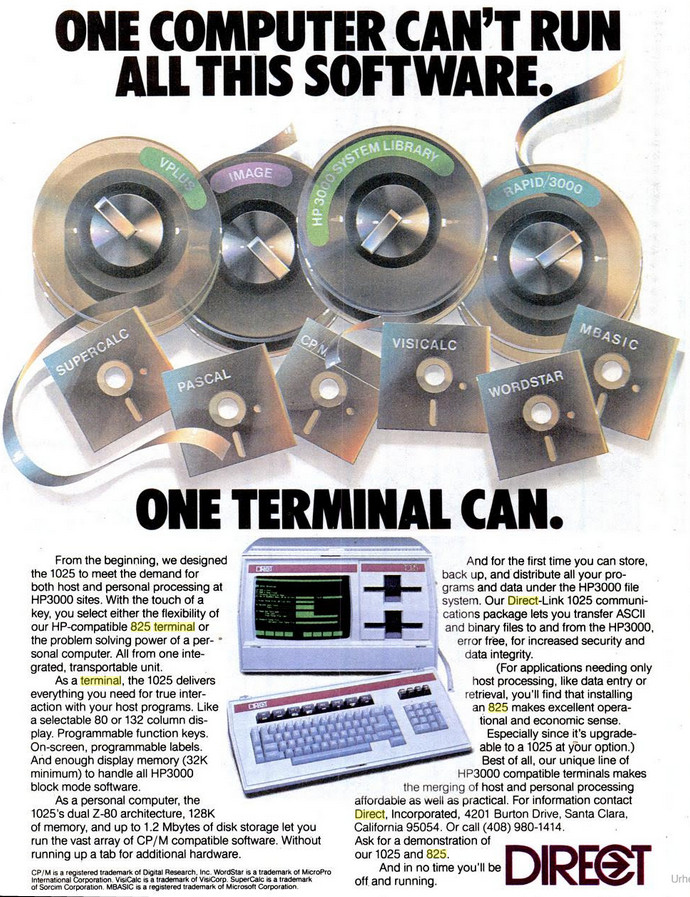
finally got one of the Basic Four S10. Does someone have a service
manual for these or the Direct Inc. models ? The one i got was a little
bit damaged due to shipping within Europe. Found at least one transistor
and one cap that broke off the video monitor board. Will try to fix that
next week.
The Basic Four S/10 was developed and build by Direct Inc, Santa Clara,
California. They sold the machine as a serial terminal (Dec/HP) as well
as a terminal in combination with a CP/M 2 board.
Direct 825 with CP/M: http://basicfour.de/pics/s10/Direct_825.jpg
Direct 831 as a terminal without the second cpu/floppy controller board:
http://basicfour.de/pics/s10/s-l500.jpg
and the basic four s/10: http://www.obsoletecomputermuseum.org/mai/
Btw, I'm also looking for MAI Basic Four Software for the Models 2000,
210/510/730
Thx
machine with floppy and terminal boards: http://basicfour.de/pics/s10/3.jpg
---------------------
Armin Diehl
ad at ardiehl.de
I hope this is considered apporopriate for this list, if not, I am sure y'all will
let me know. :-)
And, yes, it is about a truly classic computer.
I am trying to restore my 1961 General Electric EF-140 Analog Computer. The
insulation on all of the wires has basicly turned to stick goo. I would really like
to rebuild it. Does anyone have or know where I might find a wiring diagram
for this box? I got it thru National Technical Schools when I was about 11 years
old and sadly, while it survived, my mother threw out all of the courses and
manuals that came with the correspondence course I took back then.
If someone has it but it's buried away, no problem. I just loaned it for a
static display at the University where I used to work in the CS Department.
I expect they will want to keep it for at least the Semester.
On another note, it's good to be back on the list after many years away.
I still have and use a number of systems that people here would consider
more in line with their notions of Classic Computers. Some of you may
even remember me. I was and still am big on PDP-11's and VAX. But I
also have a number of old Micros as well (and some of the newer ones that
try to bring the old flavor back like the Maximite and The P112.)
bill
Hi all --
Went spelunking in a hoarder's basement this morning (long story) and came
out with a few interesting items, including a Northern Scientific NS-600.
>From what I can tell it's from the late 60s and is capable of storing and
analyzing digital data (and can display it on a tiny scope display).
There isn't any real documentation out there, just a few research papers
here and there noting its use in various experiments. Anyone have anything
on this?
Thanks,
Josh
I need the schematics. I'm not sure I trust all those "manual" sites on the web that want to sell you a PDF for $15.
My monitor seems to be acting up.
Thanks in advance,
Cheers,
Corey
corey cohen
u??o? ???o?
Hi,
We have a friend with a "tape" (DDS, DLT, or LTO ... don't know which yet)
to which was written a system backup. Thousands of files, with an EOF
between each file, and a double EOF + EOT at the end.
The problem:
They then accidentally overwrote the start of the tape yesterday
with about 1 KB of data, plus EOT.
(By EOT I mean the "logical end-of-tape" indicator placed there
by the drive firmware when a tape is rewound / unloaded after
it's been written to.)
So, we want to try to recover the files after that 1 KB + EOT.
On reel tape, no problem. I'd read until I hit the double EOF, and then
skip the partial file (by looking for the next EOF), and then...gravy.
But, DDS/DLT/LTO drives won't let me get past that darn logical end-of-tape.
Are there solutions anyone can suggest?
I've only heard of two approaches:
1. find a drive with modified firmware, one that treats an EOT like an EOF
While I heard some existed for DDS-1 drives, that lead was 20 years old :)
2. insert tape, start writing (at the start), write until I'm sure I've
written over the area where the EOT was,
power cycle the drive
read from the start, skipping over the data I just wrote, handle the
possible corrupted record, and the I've got good data from past the EOT
(note that this method loses a small amount of old data past the EOT
that we overwrote).
On DDS drives, I used this technique once or twice successfully,
although I seem to recall I couldn't do the "read until I get to
the good stuff" because of the probability of a bad record on the
tape (where the power fail was) ... but the solution was to load the tape
and then say "skip forward 3 EOFs", and the skip-to-EOF would
quietly ignore (usually) any bad record before the EOF.
BTW, if this is DDS, it's unlikely to be newer than DDS-4 (but possible),
if it's DLT, it's likely one of the first two or three generations,
and if it's LTO, it's extremely unlikely to be anything other than LTO-1.
thanks,
Stan
The fourth release of the HP 3000 Series III simulator is now available
>from the Computer History Simulation Project (SIMH) site:
https://github.com/simh/simh
This release adds the HP 32234A COBOL II Extended Instruction Set firmware,
enabling execution of programs produced by the COBOL II ('74 and '85)
compilers. The new SET CPU CIS option enables the firmware.
In addition, two new debug tracing options were added. The SET CPU
DEBUG=OPND command turns on memory byte operand tracing to show the values
supplied, e.g., to the CMPS (Compare String) instruction. The SET CPU
DEBUG=EXEC command turns on execution tracing for a specific instruction or
instruction family.
The full set of new features is listed in the release notes that accompany
the simulator source files. In addition, an updated HP 3000 Simulator
User's Guide that covers the new commands is provided in Microsoft Word
format with the source download and also as a PDF file at:
http://alum.mit.edu/www/jdbryan/hp3000_doc.pdf
The preconfigured MPE-V/R disc image available here:
http://simh.trailing-edge.com/kits/mpe-vr-software-kit.zip
...has been updated to add the COBOL II runtime routines to the system
Segmented Library and COBOL example programs to the OPERATOR.SYS account.
The startup command files also now enable the COBOL II instruction set.
-- Dave Bryan
I am trying to build the DECUS TECO with VT support for OS/8.
TECO came from ibiblio and the assembler listing says it is OS/8 TECO
VERSION 7. I am using MACREL-V1B. It all assembles without error, but
the linker fails with a NO ROOM message.
I can't find any information on what NO ROOM means from the MACREL
documentation.
This is using SIMH PDP8 with 32k words.
I also found MACREL V2 source, but it in in MACREL, but I have not
tried to bootstrap it using V1.
I was hoping to make source editing just a little bit easier.
-chuck
> From: Jay West
> A fully working 11/34, in a complete period rack (with all side panels
> and filler panels), and 4 working RL02's, VT220, a Decwriter ...
> $1000 isn't realistic at all. It should definitely be higher than that.
I concur.
My methodology for _accurately_ valuing something like this is to create as
comprhensive a list of sub-items as possible, then value them, and then add
it up; something like this:
$A Bare H960
$B 2 x H960 side panels
$C BA11-K (box and power supply)
$D BA11-K slides
$E DD11-PK backplane
$F PDP-11/34 CPU boards
$G MS11-L
$H 4 x RL02 drives
$I 15 x RL02 packs
etc etc. Alas, the listing doesn't say exactly which boards are in the 11/34
(and not even any pictures of the insides). I don't know exactly how much $A,
etc are - I have varying levels of experience with these things, but for
instance, I know that MS11-L's are much desired, and command high prices.
Note that the listing does have a reserve, so their actual asking price is
above $5K. Getting that total out of one bidder may be a bit too far; they
might have better luck getting it sold if it was a couple of smaller
lots.
Noel
Hi,
Thanks for the notes/comments/suggestions.
Recovery service: not that I've found. Most of the ones I know of have *us*
as their HP 3000 experts (i.e., we help them :) ... when I've asked in
recent years
about handling damaged or overwritten DDS (or newer) tapes, I've always been told 'no'.
The "cut out some tape" would definitely not work. At least LTO, probably DLT,
have multiple tracks and the tape makes multiple passes from start of tape to end of
tape as it writes the entire tape. That means on a 16 track tape, you'd lose part
of 16 different sections if you cut out a piece of tape (ignoring the question of whether
or not the drive could resynch after such an error :)
Eric's reply is closest to home ... that's why I mentioned a 'hacked' drive,
hoping someone might know specialists who have one.
Chuck mentioned an approach I had mentioned: the power kill during writing approach.
I'm hesitant to try that as it will (based on dim memory of doing it 15 years ago
on a DDS) lose a small bit of data ... if it works at all.
I'm giving up for now.
thanks,
Stan
> From: Eric Smith <spacewar at gmail.com>
>
> I hope someone can prove me wrong, but I think that short of a major effort
> to hack the drive firmware, the data is gone. Modern tape drives are "too
> smart" to allow reading past logical EOT, and the tape format is too
> complex to allow fooling the firmware by any simple means.
>
> ------------------------------
> From: "Nico de Jong" <nico at farumdata.dk>
>
> I've had the same problem some years back, with a DDS-3, IIRC
>
> I did some research, and the most reasonable outcome was that it was not
> possible by normal means, because some algorithm reading synchronisation
> data couldnt find out what was happening, so, the backup was ruined.....
>
> ----
> From: Chuck Guzis <cclist at sydex.com>
>
> With nothing left to lose, I suppose that one might overwrite the EOT
> and then kill power during the write, then attempt to read backward from
> the end of the tape.
>
> ------------------------------
> From: "js at cimmeri.com" <js at cimmeri.com>
>
> Would it be possible to just physically
> cut the 1kb + EOT portion of tape out,
> and then attempt to read from
> beginning? I suppose this would depend
> on how the backup data is formatted on
> the tape (using some kind of container
> format with error checking, for instance).
>
> ------------------------------
> From: Jerry Weiss <jsw at ieee.org>
>
> Have you approached a commercial recovery service for a quote?
> A few do tape media. Whether they quote or not may provide a data point about how feasible it may be.
----
For the NCAR Mass Storage System, when we upgraded our tape drives to Sun STK T10000 models, we lost the ability to skip past the EOT mark with standard firmware. We asked Sun to provide a firmware modification that let us issue four or so reads after reaching the EOT mark, and the drive would then continue on until it found good data again. We didn?t need it very often, but it was handy to recover single copy data.
I have a friend who wants to add more memory to a PS2 model 30. They are
off in the wilds of Oz and acquired this for a good price and would like
to just upgrade it to run some programs they have which do not run on
modern faster systems.
I know this is a snake pit to deal with, and can get more info if
someone can get me some information or point me at references for them
to look at.
What I'm really interested in doing is seeing if just the memory can be
had, and it isn't easy to find Sim modules these days, though I suspect
there are metric tons of them rotting in places forgotten and not
recycled yet.
anyway any info to get started would be useful.
i see there are entire systems on epay, and may suggest just buying one
of them and cannibalizing them for their memory should the asking price
for the individual SIMM parts be ridiculous. i could buy the system, us
the system to be sure the memory does something and send them the
memories alone for reasonable shipping. It would also net them a backup
hard drive which are very scarce in even good times as well.
I'm hoping that the memories were common to other systems and not some
oddball special IBM part. Old advertisements that show up on google
show a number of people making them, but that doesn't mean they can be
found now of course.
thanks
jim
I'm starting the long process of selling off my entire collection. There's
a lot to go through. Some more details are here:
http://www.vcfed.org/forum/showthread.php?55964-Selling-Off-the-Collection
And some photos are here:
http://s350.photobucket.com/user/Sellam_Abraham/library/
Keep in mind the machines represented here are the cream of the crop. I
have much more stuff in the form of 40 pallets that needs to get sorted
through and moved on. I'll be much more inclined to sell off that stuff
quickly, but with these I am ready to take my time. That being said, I'll
entertain any reasonable offer.
I still have a bunch of photos of magazines to post (just scratching the
surface). Pallets worth.
Probably best to contact me directly if you're interested in something. I
have much, much more.
Thanks for looking!
Sellam
How much is the - -Bell Labs MAC-8 Microprocessor Trainer Kit
thanks Ed#
In a message dated 1/25/2017 11:01:50 P.M. US Mountain Standard Time,
sellam.ismail at gmail.com writes:
I'm starting the long process of selling off my entire collection.
There's
a lot to go through. Some more details are here:
http://www.vcfed.org/forum/showthread.php?55964-Selling-Off-the-Collection
And some photos are here:
http://s350.photobucket.com/user/Sellam_Abraham/library/
Keep in mind the machines represented here are the cream of the crop. I
have much more stuff in the form of 40 pallets that needs to get sorted
through and moved on. I'll be much more inclined to sell off that stuff
quickly, but with these I am ready to take my time. That being said, I'll
entertain any reasonable offer.
I still have a bunch of photos of magazines to post (just scratching the
surface). Pallets worth.
Probably best to contact me directly if you're interested in something. I
have much, much more.
Thanks for looking!
Sellam