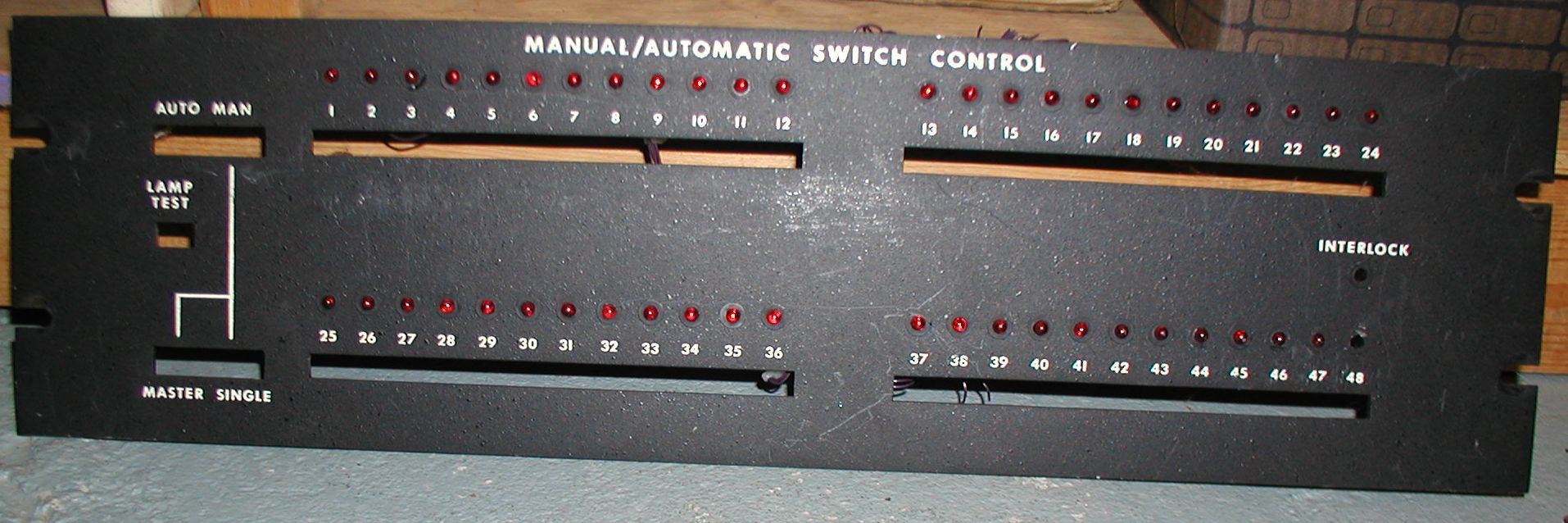
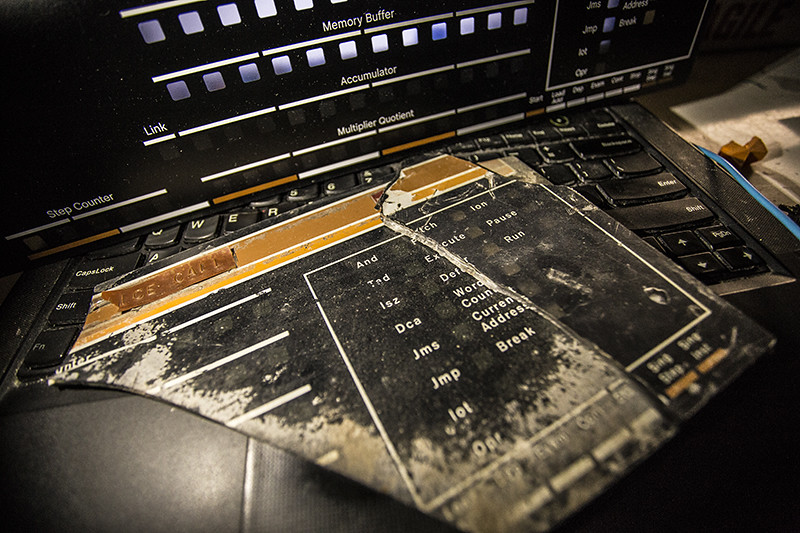
added info this would have been for
_RSTS_ (http://www.dmv.net/dec/pdf/rsts80rmsintro.pdf) of course.
Ed# _www.smecc.org_ (http://www.smecc.org)
In a message dated 5/18/2017 4:51:21 A.M. US Mountain Standard Time,
cctalk at classiccmp.org writes:
back in the 80s there was a fellow at dec mark hunt wrote a bbs for
the 11/70 ... wonder what ever happened to Mark?
Ed# _www.smecc.org_ (http://www.smecc.org)
In a message dated 5/17/2017 11:30:29 P.M. US Mountain Standard Time,
cctalk at classiccmp.org writes:
On Thu, May 18, 2017 at 06:38:24AM +0100, Rod Smallwood wrote:
>So whats stopping you?
That question applies to so much ...
John Wilson
D Bit
back in the 80s there was a fellow at dec mark hunt wrote a bbs for
the 11/70 ... wonder what ever happened to Mark?
Ed# _www.smecc.org_ (http://www.smecc.org)
In a message dated 5/17/2017 11:30:29 P.M. US Mountain Standard Time,
cctalk at classiccmp.org writes:
On Thu, May 18, 2017 at 06:38:24AM +0100, Rod Smallwood wrote:
>So whats stopping you?
That question applies to so much ...
John Wilson
D Bit
Is anyone out there using X11 on VMS and the xv image viewer?
--
David Griffith
dave at 661.org
A: Because it fouls the order in which people normally read text.
Q: Why is top-posting such a bad thing?
A: Top-posting.
Q: What is the most annoying thing in e-mail?
Al just recently put this up on Bitsavers, November 1974 drawings for the first 2.94MHz Ethernet transceiver: http://bitsavers.trailing-edge.com/pdf/xerox/alto/ethernet/Ethernet_Transce…
Neat to see the 15 pin AUI to Thicknet transceiver (well, a lower bandwidth version of the 10MHz ones I grew up with) drawn out so clearly. Also shows something I've never seen in real life, an "Ethernet Dummy Transceiver" which is, I guess, something like a two-port DELNI ? (obviously showing my DEC introduction to AUI Ethernet there.)
Tim
I received the following email from Michael Veselov. Please address
your inquiries directly to him at mihail.veselov at gmail.com:
------------------------------------------------------------------------------
Hello!
We have 3 old Russian computers ???-3 and we want to sell them. There
are photos here:
https://drive.google.com/open?id=0ByRamH3wFb6SYU1kclZQNWxkQUU
Is it interesting for you?
--
With best regards,
Michael
Is anyone going to Hamvention this weekend?
I am trying to finalize trip details, and wondering if anyone else is
going (or lives near there)
Was considering taking an RV, but still considering options.
Jim
--
Jim Brain
brain at jbrain.comwww.jbrain.com
On Wed, 17 May 2017, David Griffith via cctalk wrote:
> I ask because I've been scraping together patches for xv and collecting them
> into a Github repo[1]. I've finished adding all the patches collected by
> Greg Roelofs, patches from OpenBSD, and now I'm working on eliminating unsafe
> calls like strcpy() and sprintf(). Could I get some of you VMS people to
> check out my work and submit any necessary changes?
Well! That is a horse of a differant colour!
I will be glad to let you do the work instead of me and I will be glad
compile it and run it and submit bug reports etc. This is work worth
doing IMHO.
I also have a long neglected plan to port the heirloom troff/nroff code
over to VMS just because I am too lazy to switch to Digital Standard Runoff.
No matter what the platform, of all the image viewers/editors out there,
XV is the viewer I love the best!!!!!!
--
Richard Loken VE6BSV : "...underneath those tuques we wear,
Athabasca, Alberta Canada : our heads are naked!"
** rlloken at telus.net ** : - Arthur Black
I posted for sale last week a "LSI 11" system which I've since had help
properly identifying as an 11/03. I never called it an 11/34 but my
photobin indicated it was, and some people were confused, so my apologies.
The updated information is in the replies to the original ad (link below),
along with photos of the whole unit, which I neglected to include
originally:
http://www.vcfed.org/forum/showthread.php?57667-LLNL-LSI-11-Homebrew-system
Also, I have decided upon a $200 asking price, or your best offer.
I will also be replying to those who have already contacted me about this
system.
Thanks!
Sellam
On Tue, 16 May 2017, David Griffith via cctalk wrote:
> Is anyone out there using X11 on VMS and the xv image viewer?
Yes, I am. My Alphaserver 4100 is down at the moment since I had to move
it and it has been waiting four months for me to put it back together.
XV works fine with VMS and there are a bunch of patches to get some more
recent formats running on it but I could not resolve all the dependancies
when I last tried to compile them in. I am now retired so maybe I will find
the time to get all that software glued together.
--
Richard Loken VE6BSV : "...underneath those tuques we wear,
Athabasca, Alberta Canada : our heads are naked!"
** rlloken at telus.net ** : - Arthur Black
On Tue, 16 May 2017, Cameron Kaiser wrote:
> Retirement as an attempt to gain more free time just doesn't work.
I have already learned that in only four months.
--
Richard Loken VE6BSV : "...underneath those tuques we wear,
Athabasca, Alberta Canada : our heads are naked!"
** rlloken at telus.net ** : - Arthur Black
the tcp for MPE5...
!
In a message dated 5/15/2017 3:05:09 P.M. US Mountain Standard Time,
cctalk at classiccmp.org writes:
Wow, nice find. I have bought from thus guy before, but this time it's not
me...
Marc
Sent from my iPad
> On May 12, 2017, at 12:33 PM, Al Kossow via cctalk
<cctalk at classiccmp.org> wrote:
>
>
> Did someone on the list outbid me on these?
>
> http://www.ebay.com/itm/262963986628
>
Contact me off list if you're looking for an RX01 drive. Will ship
worldwide. Roughly 60 lbs in a 24x24x20 box so you can calc shipping
yourself.
I have one drive on Ebay now (SN 11-10407
<http://vintagecomputer.net/temp/rx01_11-10407_front.jpg>), looking to see
what the market price / discount price would be for these. Condition is
"serviceable" I don't have the controllers to test. ESR test of power caps
was good. I would trade two drives for one working controller (UNIBUS).
Photos
http://www.vintagecomputer.net/temp/
Inquiries/Reasonable Offers
http://www.vintagecomputer.net/contact.cfm
Bill
On 14-05-17 19:00, steve shumaker <shumaker at att.net>g wrote:
> Saved some Data I/O manuals from the dumpster when a local firm tech
> pubs library closed down. Manuals are loose sheet style in original
> Data I/O 3 ring binders. Except as noted, they are lightly used in
> very good condition and appear to be complete.
There is a yahoo group for Data I/O programmers;
https://groups.yahoo.com/neo/groups/Data_IO_EPROM/info.
Greetings,
Fred Jan
Saved some Data I/O manuals from the dumpster when a local firm tech
pubs library closed down. Manuals are loose sheet style in original
Data I/O 3 ring binders. Except as noted, they are lightly used in
very good condition and appear to be complete.
29B Universal Programming System Operator's Manual in the "horizontal"
format binder copyright 1985. two available
GangPak Manual copyright 1987 one available
Unisite Universal Programmer User Manual in "vertical" (standard)
format binder. binder in used condition documentation seems
intact/complete. Release date appears to be Jun 1995. one available
Unisite Universal Programmer User Manual in "vertical" (standard)
format binder. binder in good condition documentation seems
intact/complete. Release date appears to be Jul 1992. This one has
update notes and some misc product lit with it. one available
Unisite Universal Programmer User Manual in "vertical" (standard)
format binder. binder in used condition and is NOT an original Data I/O
binder. documentation seems intact/complete. Release date appears to
be Oct 1996. In addition to the basic User Manual, this one has User
Notes covering 7 different releases ranging from 5.5 to 6.2. one available
Programmable Logic Development System Operators Manual. Binder in
standard vertical format in good condition copyright 1986 with User
Notes Update dated Nov 1987. one available
Unisite-xpi Programming System User Manual (with legacy Unisite
Programmers) Binder in standard vertical format in good condition
copyright Jun 2001. two available
Logic Diagram Package dated Sep 1990. Complete set of Dat I/O logic
diagrams for all supported devices as of pub date. Binder in standard
vertical format in good condition copyright Sep 1990. one available.
Free for Shipping: Individually, any binder will fit a medium flat rate
box. Email me off list to claim one.
FWIW, these have all been scanned if someone wants a soft copy.
steve
I originally attempted to post this to simh at trailing-edge.com,
but they have a policy of automatically rejecting any messages from
non-subscribers, and as I only read that list via the Web
interface, it doesn't seem worth it to subscribe just in order to
post one message. However, I suspect that Brian Knittel and/or
Mark Pizzolato probably see stuff that's posted here too.
---
Once upon a time (i.e., prior to early January, 2016), the
SimH IBM1130 GUI worked like this (on Windows):
You start the simulator in a console window and issue the
commands (either manually or via a command file argument):
-------------------------
reset
detach prt
delete printer.txt
att dsk0 dms.dsk
att prt printer.txt
boot dsk
-------------------------
At this point, the simulator, after having booted the DMS
operating system, enters a "Wait state" and drops
back to the SimH prompt. The console window shows
(if you've started the simulator with the command file
argument "guijob" containing the above commands):
-------------------------
IBM 1130 Simulator V4.0-0 Beta git commit id: e8ea427d
guijob-2> detach prt
Not attached
PRT: creating new file
Loaded DMS V2M12 cold start card
Wait, IAR: 0000002A (4c80 BSC I ,00028 )
sim>
-------------------------
The line printer icon in the GUI now "shows paper" which,
if you view it (thereby "tearing it off" and causing
the creation of a new printer file) will show the boot
message from DMS.
At this point, you can submit a "job deck" by dragging a
file to the GUI's card reader icon -- e.g., one of the
decks from the software kit at ibm1130.org
(such as a job to print the LET [Location Equivalence Table] list.job,
a sample Fortran program for.job or one of the more substantial
Fortran programs like csort.job or swave.job, etc.)
Each time you drag the "job deck" file over the GUI's
card reader icon, the depicted input tray "fills up" and
the console shows, e.g.
sim> attach cr "C:\ibm1130\dms\list.job"
sim>
You then click the green PROGRAM START button, the blinkenlights
flash briefly, the card reader "empties", the printer "shows paper"
(if it was empty beforehand) and, most significantly here,
**the simulator enters Wait state and drops back to its prompt
when the program has finished**. The console window now shows (e.g.)
sim> attach cr "C:\ibm1130\dms\list.job"
sim> cont
Wait, IAR: 0000002A (4c80 BSC I ,00028 )
sim>
You can continue to submit jobs, without rebooting DMS, by dragging
a new deck to the card reader icon, and clicking PROGRAM START.
Each time, the simulator swallows the "cards", flashes the blinkenlights,
adds output to the line printer file, and enters Wait and drops
back to its prompt.
The "git commit id" in the IBM1130.exe used for the above example is e8ea427d from
https://github.com/simh/Win32-Development-Binaries archive
simh-4.0-Beta--2016-01-07-e8ea427d.zip (January 7, 2016).
If I use the IBM1130.exe from the very next archive
simh-4.0-Beta--2016-01-29-b8049645.zip (January 29, 2016), I get
a different result (using the same file of startup commands):
-------------------------
IBM 1130 Simulator V4.0-0 Beta git commit id: b8049645
guijob-2> detach prt
Not attached
PRT: creating new file
Loaded DMS V2M12 cold start card
-------------------------
Here, the simulator has not entered a Wait state and dropped back
to a prompt. If I try to drag a "job deck" file to the card reader
icon, the attempt is rejected with a Windows error gong and
the card reader remains empty.
I can get around this by performing the following:
Click the red "IMM STOP" button.
Drag the "job deck" file to the card reader icon. The reader
"fills up".
In the console window, type "boot dsk" to re-boot DMS
(clicking PROGRAM START doesn't work here!),
The card reader empties, the blinkenlights flash and apparently
the program runs. However, the simulator does not enter
Wait state when the program is finished. (Nor can I click on
the lineprinter icon to "tear off" and view the results at this point.)
However, if I again click the red "IMM STOP" button and then
click the lineprinter icon, I can see the results of the
program that just ran. Or, I can click IMM STOP, submit a
new job deck to the card reader, type "boot dsk" (you have
to re-boot DMS; PROGRAM START won't work!),
and the new program will run and add its results to the lineprinter output.
The very latest Win32 build of IBM1130.exe, from
simh-4.0-Beta--2017-05-02-e9dea63b.zip (May 2, 2017)
exhibits slightly different (but still apparently broken)
behavior.
When the startup command file executes, the initial result looks
correct (i.e., the same as the January 7, 2016 result above):
-------------------------
IBM 1130 Simulator V4.0-0 Beta git commit id: e9dea63b
guijob-2> detach prt
Not attached
PRT: creating new file
Loaded DMS V2M12 cold start card
Wait, IAR: 0000002A (4c80 BSC I ,00028 )
sim>
-------------------------
Note that the simulator has entered the Wait state and dropped back
to its prompt, and you can now drag a job deck to the card reader
and start the program normally by clicking PROGRAM START.
However, at this point the simulator reverts to the broken behavior
exhibited by the January 29, 2016 example above -- when the program is
finished running, the simulator does not enter Wait state and
drop back to a "sim>" prompt. The console window looks like:
-------------------------
IBM 1130 Simulator V4.0-0 Beta git commit id: e9dea63b
guijob-2> detach prt
Not attached
PRT: creating new file
Loaded DMS V2M12 cold start card
Wait, IAR: 0000002A (4c80 BSC I ,00028 )
sim> cont
-------------------------
and the simulator remains unresponsive until the IMM STOP button
is pushed. Then we see:
-------------------------
IBM 1130 Simulator V4.0-0 Beta git commit id: e9dea63b
guijob-2> detach prt
Not attached
PRT: creating new file
Loaded DMS V2M12 cold start card
Wait, IAR: 0000002A (4c80 BSC I ,00028 )
sim> cont
Immediate Stop key requested, IAR (4c80 BSC I ,00028 )
-------------------------
At this point, the GUI becomes responsive again, and the
line printer output can be "torn off" and viewed, or a
new job can be dragged to the card reader.
However, you cannot then use the PROGRAM START button to
start the new program. If you do, the simulator will issue
a "cont" command, but the card reader will not empty and
the new program will not run.
You have to type "boot dsk" in the console window to reboot DMS.
At this point, the loaded card reader will empty by itself,
the new program will run, and the program's output will be added
to the lineprinter listing.
For each additional job deck you want to run, you have to use
the IMM STOP, load card reader, "boot dsk" (reboot DMS)
sequence.
So it appears something happened to break the normal functioning
of the 1130 GUI back in January of last year, which has not yet
been completely repaired.
>I've made little more progress in deciphering the operation
>of Carl Claunch's "Lunar Landing" program, as featured in one
>of his 1130 YouTube videos. (I'm guessing he's the actual author
>of the program -- he mentions on one of his blogs that he was
>interested in space before he became interested in computers.)
Alas, not my program. It was one of many programs distributed by Share to
1130 users, thus it was contributed by somebody.
Carl
Can anyone ID what this panel is from? I picked it up recently for parts but the more I study it the more I suspect it may have been part of a computer system. At least one status light references 'No Write Ring'. The displays at the top are terrific, 7-segment incandescent units!
Photos at:
http://www.radar58.com/panel/
Thanks,
Cory
Hi,
I was contacted though my site by someone looking for a boot disk for their
California Computer System S-100 2200 computer with Morrow's Disk Jockey
DJ/DMA floppy disk controller. I checked and found what might be a
suitable disk.
I imaged the disk and the file has been uploaded to my web site along with
a PDF of the directory the original owner printed and inserted into the
disk sleeve. Does anyone have such a drive controller and would like to
take a look at this image to see if it's usable? Uploaded, here:
http://vintagecomputer.net/disk_images/Morrow/
There may be something wrong with the disk. The label reads
8" Morrow E14 Phil's System Disk Backup 9/22/86
Permanent error on boot track
Despite what was printed on the lable I was able to image the disk without
error. I am hoping the error referred to in the hand-written label is not
a physical error and can be edited/corrected. Maybe this disk is
salvageable, maybe the error is a BIOs thing.
There was talk about trying to find a diskJockey boot disk on this list a
few weeks ago (right?), if so I hope this is useful. If anyone attempts to
read, let me know how it goes.
Bill
Hello all.
I have for sale a nice, working Tandy 1400LT DOS portable, in fine shape
and working order.
Please click the link below for full details and photos:
http://www.vcfed.org/forum/showthread.php?57669-Tandy-1400LT-DOS-Portable-w…
!
Please contact me directly at this e-mail address for the quickest response.
Thanks!
Sellam
wonder if the is a same key as the intelect 8 uses.?
Ed#
In a message dated 5/10/2017 7:28:16 P.M. US Mountain Standard Time,
cctalk at classiccmp.org writes:
Is this a thing? There's an archive of vintage physical computer keys?
This would be very cool. Heck one could potentially even 3d print a key for
short term usage.
-------- Original message --------From: Dennis Boone via cctalk
<cctalk at classiccmp.org> Date: 5/10/17 4:13 PM (GMT-06:00) To: "General Discussion:
On-Topic and Off-Topic Posts" <cctalk at classiccmp.org> Subject: Re: Key for
Intel MDS-800
If someone has one, let's get it added to the ccmp keys list: blank
type, cut info, etc.
De
On 5/10/2017 6:02 PM, wrcooke at wrcooke.net wrote:
In EAGLE I am having very good luck with:
* Getting some nice B&W versions of the scans (Thanks everyone, but
especially Paul)
* importing them into EAGLE under layer 200 and 201 (reversing bottom
layer)
* setting layers to some light colors (pale yellow and pale green are
my choices)
* moving them so they line up (not perfect, but I tried)
* Move all of the PCB footprints to match up with holes
* Turn off top layer
* start routing bottom layer (tedious, but not too hard)
* repeat for top layer
A pic of progress:
https://s6.postimg.org/vkffvf8sh/Capture.png
--
Jim Brain
brain at jbrain.comwww.jbrain.com
> From: Guy Sotomayor Jr
>>> We need to move our business and I have about a ton of
>>> classic cimputer junk in the SFBA that need to go or get scrapped:
>>> Symbolics 3645? (from Guy Sotomayer a few years back)
>>> PDP 11
> I stopped by and picked up some stuff from Peter today. ... He did
> mention that he has to be out of his space by May 31st and anything
> that isn't picked up will be scrapped.
> I did take some pictures that I'll put up sometime tomorrow but what
> Pete has on his list below seems pretty accurate.
WHat kind of -11, do you happen to recall?
I assume someone will have grabbed the 'Bolics machine... Hyper-desirable.
I do hope someone will be able to scoop up all this stuff. Even if all
you do it put it up on eBay, that's still better that having it go to
scrap!
Noel
The Model 33's I bought back when I was a teenager, were all ex-Telex use and had exceedingly complicated wiring harnesses as well as built-in modems. They had paper tape readers and punches with various auto-start/auto-stop relay options.
The exceedingly complex wiring harnesses were to add various options. The wiring harnesses made the wiring of the unit look, literally, a thousand times more complex than it actually was.
In the end all I ever did was find the magnet wire, and the keyboard contact wire, for the main unit and the punch.
I usually also found a useful current loop supply in the base. Sometimes I would find bipolar relays and 20mA/60mA conversion supplies. I was a little surprised at some of the current loop supplies - some of them weighed 20 pounds and were obviously made for driving exceedingly long lines (open-circuit voltage way over 100VDC). Seemed odd these were in there considering the units had modems just a foot away from magnet and keyboard switch.
Tim N3QE
This came up recently due to a small coincidence. Does anyone remember
this early MS-DOS game for PC compatibles?
It was designed to look exactly like the spreadsheet, so you could
play in the office, but you had to "shoot" falling numbers by doing
arithmetic...
It looked just like a mockup of 1-2-3 r2.01, the classic version.
>From very vague memory...
There was an answer line at the bottom. Numbers would trickle down the
current column. You had to add, subtract, multiply or divide and input
the correct answer. If you didn't, your mistakes piled up, like
incomplete lines in Tetris, giving you less room and so less time to
do the computation, until you died.
Then a new column began, I think. When all the columns were full of
figures, you'd died and had to start a new game.
It wasn't much of a game, but it was kinda fun, and it was a perfect
mockup of the spreadsheet, so it would pass casual over-the-shoulder
inspection.
--
Liam Proven ? Profile: https://about.me/liamproven
Email: lproven at cix.co.uk ? Google Mail/Talk/Plus: lproven at gmail.com
Twitter/Facebook/Flickr: lproven ? Skype/LinkedIn/AIM/Yahoo: liamproven
UK: +44 7939-087884 ? ?R/WhatsApp/Telegram/Signal: +420 702 829 053
I am trying to reproduce a PCB design, and I have removed all the ICs,
scanned the boards, and am trying to draw it up in EAGLE. But, it would
much easier if I could import the actual PCB as a bitmap under my PCB
layout, to ensure I have have everything in the right place.
Sadly, my graphics manipulation skills are suboptimal, and I am
wondering if there is anyone on the list that could take my scans and
convert them into 2 color bitmaps of the correct size such that I could
import. When I tried to convert, the difference between light green and
dark green essentially removed most of the traces.
Jim
--
Jim Brain
brain at jbrain.comwww.jbrain.com
Hello,
I have a clone PDP11, including an SMS QBUS board and a 8" drive.
Not sure if it's the same model as yours.
The controller runs MSCP for floppy with RX02 or IBM format , and for an
MFM hard disk like Seagate ST251.
Board code is SMS FWD0106.
I should have some manual and drivers for it somewhere, if you manage to
find the board, but utilities like formatter aren't for VAX, IIRC.
Andrea
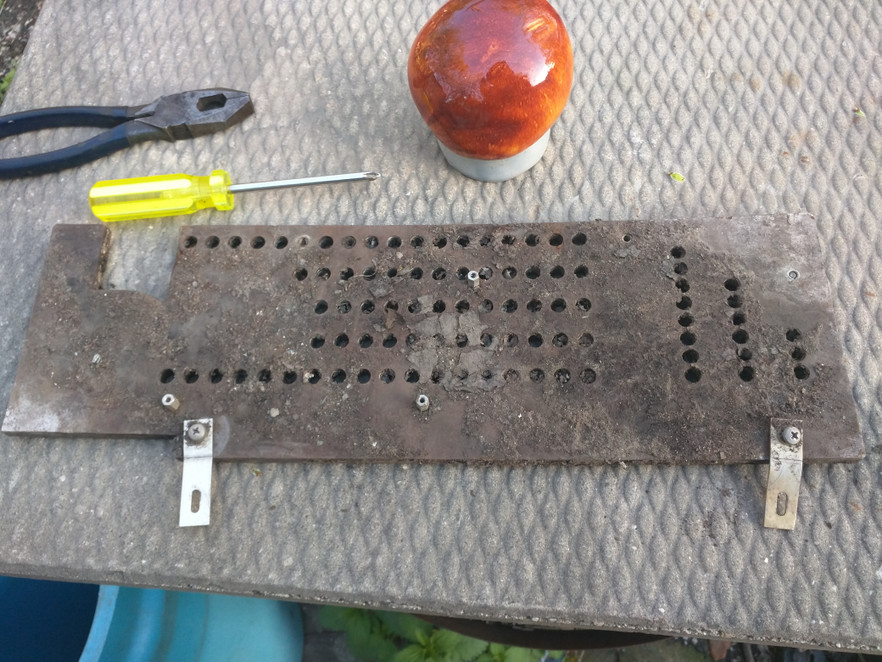
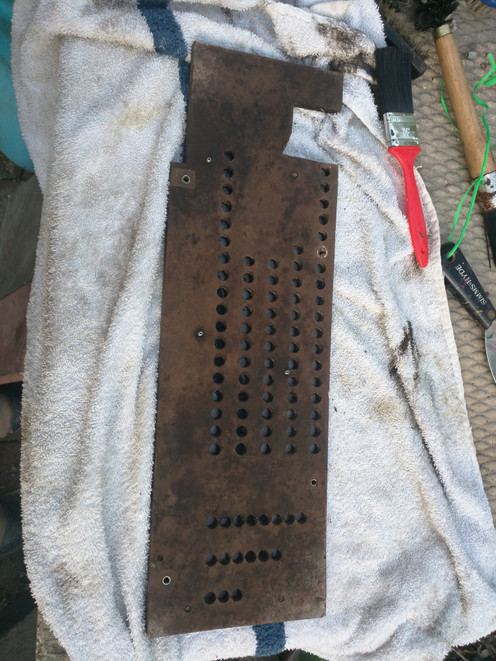
i rescued 2 today that were buried for a yr in mud cleaned it up the one
that was still one peic
https://imagizer.imageshack.us/v2/882x662q90/923/M4e2cc.jpg
noticed it was starting to curve as it dried so i cleaned the mud off it
and put it between a towel and some concreat blocks? that should stop it
>from curving right and help corect the bit that started?
https://imagizer.imageshack.us/v2/496x662q90/922/RjHMCe.jpg
i got a second one of these thats snaped in half i found in the same
location still has all the studs atached so prolly use it for parts to fix
this one or ill fire up the shop bot at the hackerspac
any advice?
So it seems in the early days of the PET a company by the name of
Forethought Prouducts sold an expansion module called the BETSI which
plugged into the expansion bus of the PET and gave you four S100 slots. If
you google around you can find a flyer advertising the unit and optional
power supply and the owners manual which touches on assembly, component
locations and the schematics. It talks about adding sound voards, additional
video outputs, expanding ram and attaching directly to a larger S100 frame.
Beyond that I can find absolutely nothing else about it, much less a more
recent photo of one. Has anyone here ever used one? How practical were they
in reality? Suppose I went and built one. Does anyone have the PCB layout
templates so I could get a board etched or will I have to stick to the
schematic and build one by hand?
-John
Hi Michael,
dear board
Did you solve your power supply problem?
My Draftmaster I did work for 1 hour, I did even manage to do a demo plot.
Then it died, right before my eyes the display got brighter and brighter and now - nothing when powering on, except a humming sound.
I think that I?m responsible for the dead, as the plotter stood in an attic for 20 years, meanwhile power was raised from 220 to 230v (+-10%)
in Europe.
I realized that the input power can be adjusted between 220 and 240v at the power inlet of the plotter (on the top
there is a small stage for a screwdriver, then the cover opens and the rotating think can be taken out)!!
Anyhow, now I have 41 and 83 Volts at the 42 and 85V test points,
but always 0 Volts at the +5,-12,+12,+15V test points.
The fuses are good and the secondary transformer seems good as well.
Right now I am waiting for an esr-meter to test the capacitors,
any clue would be extremely helpful for me!
With nice greetings Philipp
PS: tinkering with this masterpiece of engineering is fun, but now my back hurts, but it is worth it
> Date: Mon, 8 May 2017 21:02:39 -0400
> From: william degnan <billdegnan at gmail.com>
> Subject: Re: BETSI Expander for the Commodore PET
>
> On Mon, May 8, 2017 at 8:35 PM, John Ball via cctalk <
> cctalk at classiccmp.org>
> wrote:
>
> > So it seems in the early days of the PET a company by the name of
> > Forethought Prouducts sold an expansion module called the BETSI which
> > plugged into the expansion bus of the PET and gave you four S100 slots.
> If
> > you google around you can find a flyer advertising the unit and optional
> > power supply and the owners manual which touches on assembly, component
> > locations and the schematics. It talks about adding sound voards,
> > additional
> > video outputs, expanding ram and attaching directly to a larger S100
> frame.
> > Beyond that I can find absolutely nothing else about it, much less a more
> > recent photo of one. Has anyone here ever used one? How practical were
> they
> > in reality? Suppose I went and built one. Does anyone have the PCB layout
> > templates so I could get a board etched or will I have to stick to the
> > schematic and build one by hand?
> >
> > -John
> >
> >
> At VCF SE Don French talked about the S100 expansion he created for the TRS
> 80 Model 1. Guess these did not meet with much success.
>
BTW, I spoke with Don over dinner after the show and he told me that his
son apparently
archived some stuff when he moved out to NV (he had told me earlier that
most of his
machines got sold/trashed/lost during his divorce ). I particularly asked
him to look for
one of the S100 expansion boards... Will let you know if he found any...
Earl
All this talk about 8 inch floppies got me to look at a unit I have
stored away. It is a rack mounted dual 8 inch floppy drive, SMS FWT
Series.
Model - FWT0522I-R
It has one IDC connection on the back, 34 pin.
The formatter in the unit has numbers - 1001828-0001 H and 0003451-0001
J written on it.
Bitsavers didn't have anything about the FWT05 model, does anyone know
if a Qbus controller exists for this?
If it does perhaps I could get it working and hook it up to my MicroVax
II, that would be an odd combination.
Doug
"And the teletypists knees and feet were always kept warm..."
What is the weight of this modem Pete?
Being the the earlier rev of 101 was earlier technology for SAGE I
wonder how large it was?
Ed#
In a message dated 5/8/2017 9:40:52 P.M. US Mountain Standard Time,
cctalk at classiccmp.org writes:
Bell 101C
https://goo.gl/photos/hrhAwvzMBLWWteXu6https://en.wikipedia.org/wiki/Bell_101
-pete
Hi guys,
Just tying up some unfinished business. Right at the beginning of this
thread I said...
>Guys in the building next door to me (a Science lab) have found some 8
inch floppy disks.
>They want to see what?s on them, or at least to archive them.
>They have no idea what machine these disks were used with, or the software
was used to write the files.
>They may be CP/M, or some other format entirely.
Now that I've got the 8 inch disk drive up and running and have some
experience with it, I thought I've give these disks a go.
It turns out these disks are from a VAX machine. Assuming the OS is VMS, I
scoured the Internet for something that might read them.
Eventually I found Hunter Goatley's v 1.3 of Paul Nankervis's ODS2 at
http://vms.process.com/scripts/fileserv/fileserv.com?ODS2 . This program
reads VMS disks from PCs. The zip had a Win32 executable included.
The executable seems to run ok in the DOS window of the Win98 machine I've
attached the drive too, in that the Command Line Interface seems fine and I
can type and issue commands. However, I've had no luck with mounting the
disk in ODS2. The error I get (consistent over all disks) is:
"Sector 1 read failed 87
PHYIO Error 500 Block 1 Length 512 (ASPI: 0 0 0)
Mount failed with 500"
I may have reached the limit of my skill envelope. Before I abandon the
task and suggest to these researchers to consider sending these disks to
Chuck C., does anyone know...
1. What that error means?
2. If it would make a difference that I'm running the Win32 exe in Windows
98, rather than NT, 2000, XP etc.? The documentation doesn't mention
Windows 98, however the program does start to a CLI without a problem.
3. I'm not sure ODS2 was built with 8 inch disks in mind? Would it make a
difference? CP/M disks in the 8 inch drive can be accessed and
read/written to under MS-DOS by the machine I have the drive hooked up to,
so I don't think it's a hardware issue.
4. How likely is it that disks from a 1985 VAX is in some weird proprietary
format OTHER than VMS?
Any comments most welcome.
Thanks!
Terry