Fred N. van Kempen <waltje(a)pdp11.nl> wrote:
> > Noone wants the boards ???
> Nope.
I do! Though I won't be able to do much with a VAX 7000 because of how DEC
mucked up its architecture unfortunately (using an Alpha bus in a VAX etc.), I
would be interested in any and all XMI and/or VAXBI boards.
MS
>On Jan 20, 14:23, Joe Abbott wrote:
>> Does anyone have images of Rom 0 and Rom 1 for
>>Cromemco SCC S100 single board Z80 computer?
after which, Pete wrote:
>I'm very disappointed to find my SCC's single EPROM
appears to be
>something the previous owner made for his own
purposes -- it only has
>36 bytes of code in it. Sorry, Joe. I guess this
one was bought
>without the monitor/BASIC ROMs, which were optional.
Just my luck! Thanks anyway, Pete. Hopefully someone
out there will be able to help.
I'd bet yours contains the code to disable the onboard
roms and jump to the floppy boot rom. My System Zero
manual mentions this and lists the asm code as well as
a hardware mod. Might be why there doesn't seem to be
many of these roms around.
Joe
__________________________________
Do you Yahoo!?
Yahoo! Hotjobs: Enter the "Signing Bonus" Sweepstakes
http://hotjobs.sweepstakes.yahoo.com/signingbonus
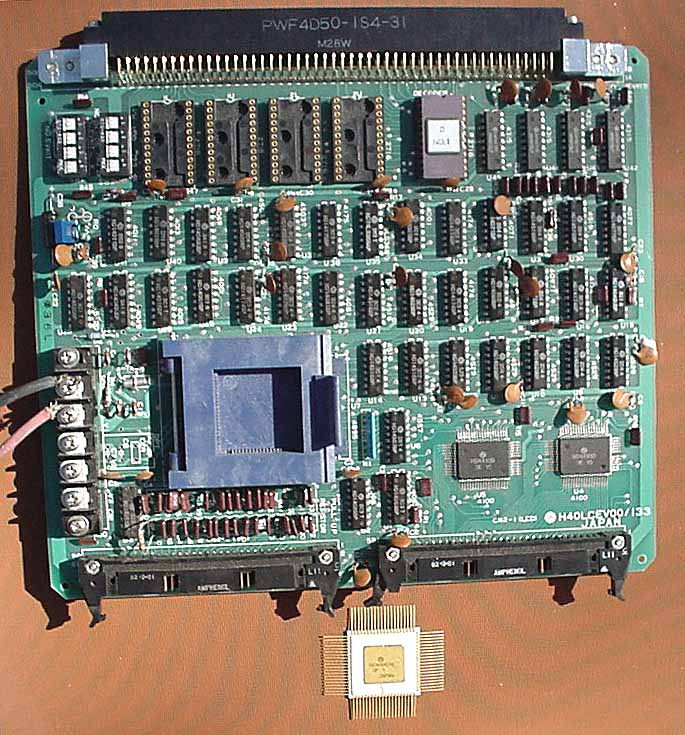
I found this in a pile of scrap boards the other day.
<http://www.classiccmp.org/hp/misc/hitachi.jpg>. It looks like it might be
some kind of evaluation board. Does anyone know exactly what it is? It has
the Hitachi logo on it along with the number H40LCEV00/133. The ZIF socket
contained the IC at the bottom. It's a Hitachi HD44857E. I haven't been
able to find out what it is either.
Joe
>
I don't have a reference for exactly "DT uL909759"
--
I'm in the process of scanning the 1969 f data book and have finished the
logic part. The scan will be up at www.bitsavers.org/pdf/fairchild/_dataBooks
later today.
Found this today. It's about 6 1/2" x 7" and has 8 30 pin SIMM sockets
and a 60 pin ribbon cable header on it. It's marked 701-2214-001. Does
anyone know which Data I/O machine it's for?
Joe
I have a SGI Indigo and Indigo II along with a pile of Sun stuff. I'm
wondering if I can replace all the funky monitors with one modern multisync
SVGA monitor. Anybody know of any reason that this won't work, or have any
recommendations about what kind of video adapter I need or where to get
one? (13W3 to SVGA).
Joe
Does anyone have a manual for an M7891 (128kx18 MOS memory)?
What at the switch settings? or more specifically, what do the 9 pos &
4 pos switches do? (address, no doubt)
I have one which shows a red light when I try to read/write from the
console odt. I just want to make sure the switches aren't set
incorrectly before I declare it broken.
And are their any prints on the net? (I couldn't find any)
thanks!
-brad
Hi
Actually the thought of a tube based computing isn't all
that far fetched. I read an article about creating tiny
tube circuits that use emission form a tiny nano wires
end to create free electrons that can then be used for things
like gates or flipflops. The voltages and power levels are
quite small.
Still, I find it hard to see how even a small tube can work
faster than a 90 nm transistor. The biggest speed issue
we have today is the external wiring and not the gate speeds.
Dwight
On Jan 20, 14:23, Joe Abbott wrote:
> Does anyone have images of Rom 0 and Rom 1 for
> Cromemco SCC S100 single board Z80 computer?
I'm very disappointed to find my SCC's single EPROM appears to be
something the previous owner made for his own purposes -- it only has
36 bytes of code in it. Sorry, Joe. I guess this one was bought
without the monitor/BASIC ROMs, which were optional.
So now we both want an MCB-416 EPROM set (or images).
On the plus side, I've found a 4FDC floppy controller manual (and a
couple of 16FDC manuals). I'd like to get the 4FDC manual scaneed.
Could anyone in the UK do this for us? It's 46 8.5" x 11" pages, plus
one double size schematic.
--
Pete Peter Turnbull
Network Manager
University of York
>From: "R. D. Davis" <rdd(a)rddavis.org>
>
>Quothe John Lawson, from writings of Tue, Jan 20, 2004 at 03:55:27PM -0500:
>> And no one has had the utter madness to suggest a replica of the Mark I
>> or II relay machine..... or the SSEC.... or any of the Bell System relay
>> computers....
>
>Relays don't normally glow, alas, but they do make nice sounds.
>
>My preference is for a digital computer using water instead of
>electricity, but no one's mentioned one of those yet.
>
Hi
Actually I've given quite a bit a thought about
making a computer that uses marbles instead of electricity
or water. You'd put a bucket of marbles at the top and
turn the crank. Gravity would bring the mrbles to the bottom
where one could scoop them up and recycle.
Dwight
forgive any inaccuracies to those who may know better (or can remember
better...)...
what you will be interested in finding out is the deflection per inch
voltage required for the beam deflection. I seem to remember ranges of
10-50 volts per inch. You will need to know the filament voltage of course
and its amperage. What I don't recall is what the necessary acceleration
element voltages were. The grid was used to control the beam brightness
with a greater negative voltage with regards to the other elements dimming
the beam (I think). The electrostatic plates should have the beam in center
with zero volts and then deflection is accomplished by positive and
negative voltages. If you can not find precise data then you can find the
full deflection voltage by experiment once you have a center beam. I
suspect that the long tube should give you a more sensitive tube in that
the deflection voltage may be on the low end of the range.
best regards, Steve Thatcher
Original Message:
-----------------
From: Tom Uban uban(a)ubanproductions.com
Date: Wed, 21 Jan 2004 09:50:46 -0600
To: cctalk(a)classiccmp.org
Subject: Advice on electrostatic deflection CRT ?
Hello,
I have what I believe is a custom CRT. It has a 12" round face, is
approximately 20" long, and uses electrostatic deflection. It was
manufactured by Thomas Electronics Inc. in Wayne NJ and is hand
marked as model number 12E35P31, 12-2-78.
I am hoping to put this CRT into service and need to come up with a
set of specifications which will likely work with it. What other
physical information do I need to take from the CRT in order to
help determine the specifications?
Any suggestions for creating the power supply and deflection drive
electronics are welcome.
Thanks!
--tom
--------------------------------------------------------------------
mail2web - Check your email from the web at
http://mail2web.com/ .
On Jan 21, 11:56, Brad Parker wrote:
>
> The end of the power cord is snipped off this 11/34a I have in front
of
> me...
>
> It has a blue wire, a brown wire and a green striped wire.
>
> I'm assuming the green striped is ground. Brown hot and blue
neutral?
>
> (I think this is a standard, but I shy away from voltages above 48vdc
:-)
That is indeed the standard in Europe.
--
Pete Peter Turnbull
Network Manager
University of York
Fred N. van Kempen <waltje(a)pdp11.nl> wrote:
> Nobody wanted the VAX 7000, so I'll try to take some pictures of it,
> before it visits the Evil Melter.
Well, if no one can take the whole machine, can you at least pull all XMI (and
VAXBI if any) cards out of it before it's melted down? I would want those, and
would even be willing to pay for them (depending on what it has, if any).
MS
Hi
He can most likely test it out by jumpering it into
an oscilliscope. Most use electrostatic deflection.
Dwight
>From: "melamy(a)earthlink.net" <melamy(a)earthlink.net>
>
>forgive any inaccuracies to those who may know better (or can remember
>better...)...
>
>what you will be interested in finding out is the deflection per inch
>voltage required for the beam deflection. I seem to remember ranges of
>10-50 volts per inch. You will need to know the filament voltage of course
>and its amperage. What I don't recall is what the necessary acceleration
>element voltages were. The grid was used to control the beam brightness
>with a greater negative voltage with regards to the other elements dimming
>the beam (I think). The electrostatic plates should have the beam in center
>with zero volts and then deflection is accomplished by positive and
>negative voltages. If you can not find precise data then you can find the
>full deflection voltage by experiment once you have a center beam. I
>suspect that the long tube should give you a more sensitive tube in that
>the deflection voltage may be on the low end of the range.
>
>best regards, Steve Thatcher
>
>
>Original Message:
>-----------------
>From: Tom Uban uban(a)ubanproductions.com
>Date: Wed, 21 Jan 2004 09:50:46 -0600
>To: cctalk(a)classiccmp.org
>Subject: Advice on electrostatic deflection CRT ?
>
>
>Hello,
>
>I have what I believe is a custom CRT. It has a 12" round face, is
>approximately 20" long, and uses electrostatic deflection. It was
>manufactured by Thomas Electronics Inc. in Wayne NJ and is hand
>marked as model number 12E35P31, 12-2-78.
>
>I am hoping to put this CRT into service and need to come up with a
>set of specifications which will likely work with it. What other
>physical information do I need to take from the CRT in order to
>help determine the specifications?
>
>Any suggestions for creating the power supply and deflection drive
>electronics are welcome.
>
>Thanks!
>
>--tom
>
>
>--------------------------------------------------------------------
>mail2web - Check your email from the web at
>http://mail2web.com/ .
>
>
>
>
From: "Pierre Gebhardt" <cheri-post(a)web.de>
>...but what interface describes the "p" at the end of the model >description ?
IPI? Lack of doco on the net makes me think it might be some sort of custom
OEM interface, however.
>Somewhere in the Internet it says that B stands for SCSI-4000, but what
>is SCSI-4000 exactly ?
Longshot: Perhaps that refers to the Adaptec ACB-4000 interface in some way.
It's an proto-SCSI to MFM adapter.
Ken
Hi Frank
Good to here from you. It sounds like I have a XIIIA even
though the silk screen doesn't say so, the switch configuration
matches. I'll see if this brings the boards to life.
Dwight
>From: "Frank McConnell" <fmc(a)reanimators.org>
>
>Dwight K. Elvey wrote:
>> Anyone have the switch specs for this board?
>
>XIII or XIIIA? In either case, yes.
>
---snip---
I have a clean vt-100 terminal and keyboard. I can try to scan it, but
you will have to live with the yellow numbers on the blank spot where
an Id is found, and the VAR sticky label on it. Let me know if you
don't find something else suitable
joe heck
I have located several vintage minicomputers that I would like to add to my
collection, being offered
for a quite reasonable price. Unfortunately, they are currently located in
the UK. Shipping for a CPU
that I estimate weighs between 25 and 30kg via UPS or Federal Express works
out to about US $250.
If I go that route, I'll be paying 3/4 of the total cost of the deal on
freight, for a one-week delivery time
via air. Let's say that I'm perfectly happy to wait a month or two for the
machines to arrive slowly on
a boat. What options are available? I'd be interested in hearing anyone's
experiences in getting large
heavy items shipped overseas as economically as possible.
Thanks,
--Bill
Hi guys,
on ebay Germany, a Fujitsu M2294p drive is being sold.
http://cgi.ebay.de/ws/eBayISAPI.dll?ViewItem&item=3268253232&category=42794…
The thing is that I can't figure out what interface it has.
E stands for ESDI
S(A) for SCSI
B for SCSI-4000
...but what interface describes the "p" at the end of the model description ?
By the way, a Fujitsu M2235B found his way into my collection.
Somewhere in the Internet it says that B stands for SCSI-4000, but what is SCSI-4000 exactly ?
Any kind of industrial SCSI-interface ?
I've never seen one before.
Thanks in advance for your hints.
Pierre
______________________________________________________________________________
Erdbeben im Iran: Zehntausende Kinder brauchen Hilfe. UNICEF hilft den
Kindern - helfen Sie mit! https://www.unicef.de/spe/spe_03.php
Hello,
I have what I believe is a custom CRT. It has a 12" round face, is
approximately 20" long, and uses electrostatic deflection. It was
manufactured by Thomas Electronics Inc. in Wayne NJ and is hand
marked as model number 12E35P31, 12-2-78.
I am hoping to put this CRT into service and need to come up with a
set of specifications which will likely work with it. What other
physical information do I need to take from the CRT in order to
help determine the specifications?
Any suggestions for creating the power supply and deflection drive
electronics are welcome.
Thanks!
--tom
I've got a TPC image, that was originally from a MM: drive, and I've written it back out to a MU: drive (4mm in this case). I'm just trying to read the tape, I'm not trying to do anything fancy like boot from it. Is there any reason that I should have trouble doing this?
Zane
--
--
| Zane H. Healy | UNIX Systems Administrator |
| healyzh(a)aracnet.com (primary) | OpenVMS Enthusiast |
| | Classic Computer Collector |
+----------------------------------+----------------------------+
| Empire of the Petal Throne and Traveller Role Playing, |
| PDP-10 Emulation and Zane's Computer Museum. |
| http://www.aracnet.com/~healyzh/ |
> Much more difficult to use? Yea, that DIR command is *complicated*.
You have to view it in the context of the standard Atari DOS commands of the time. CPM was loads more difficult than the standard Atari DOS command set -- if you could even call it a command set. :)
---
Damo
I have an AppleColor RGB monitor taking up space. This is the 12" (or so)
tube used with the IIgs, and connects to the machine with the Dmumble
cable (I can't remember how many pins - might be 15). This worked last
time I tried it out, about two months ago. Anyone need it (with the cable)
for a big five bucks? Shipping from 10512.
William Donzelli
aw288(a)osfn.org
Hi all,
I saw on eBay an auction for one TE16 tape drive capstan wheel.
I have two TE16's in my collection (www.pdp-11.nl) and when I
moved them to my new museum (check "The making of ..." link),
I noticed that one capstan is orange colored and has white mold
stips on it, and the other capstan is black colored and is very
sticky ... :-(
I have read about went-goo capstans of the TU58 recently.
Should I go for the auction?
The problem is that this is a short term solution, and just for
*one* of my tape drives. Is there an other option, preferably
a better one to solve the capstan problems?
tnx,
- Henk, PA8PDP
A bit ago there was some chat about ADF scanners, and cheap sources.
Just spotted a raft of second user HP ADF scanners at one of my occasional
suppliers. At prices from ?35 (+ Carriage + VAT, min order ?70 so you
could get a couple of PCs to go with it..) they seem fairly
reasonable. I've had good experiences with their after sales service
too. They mostly do ex-corporate stuff, so have lots of older PeeCee and
similar server kit available should you want anything along that line.
http://161.58.154.50/cgi-bin/osa/ViewPage.cgi?templateName=category.htx&cat…
(or if that's too long, www.concordeuk.com click "online auction" then
"online store")
no affiliation, just a customer.
Rob
On Jan 20, 14:23, Joe Abbott wrote:
> Does anyone have images of Rom 0 and Rom 1 for
> Cromemco SCC S100 single board Z80 computer? My
> manual states first half of Rom 0 contains monitor
> progrom and remaining Rom 0 and Rom 1 contain 3k Basic
> Interpreter. Source code or hex listing would be OK
> too. I believe Eproms were part no. MCB-416 and they
> are 2716s.
I have a Cromemco SCC, but I'm afraid mine only has the first EPROM
(yes, it's an NEC 2716). I can dump the data from that.
It seems I also want the second half. Anyone else got it?
--
Pete Peter Turnbull
Network Manager
University of York
the museum was just given a nice IBM PC that is a luggable... sort of like a compact!
have not seen many of these... are they scarce? would like to find any advertising material or manuals etc that would complement it in the IBM display... had not really planned on having each and every model on display but this is kinda cute... let us know if you have any related or scans of related stuff!
Thanks Ed Sharpe archivist for SMECC
Please check our web site at
http://www.smecc.org
to see other engineering fields, communications and computation stuff we
buy, and by all means when in Arizona drop in and see us.
address:
coury house / smecc
5802 w palmaire ave
glendale az 85301
see more at the home page www.smecc.org
In Memoriam...James M. Early
Jim was a friend of the museum and a mentor to me during the formation of it back in the days it occupied some shared space with Computer Exchange Inc. in the old industrial part on Desert Cove in Phoenix Arizona.
Jim wrote several articles and spent extensive time editing on Volume #2 and #3 of "VINTAGE ELECTRICS.
His background at Bell Laboratories proved invaluable when we cataloged some of the more obscure artifacts in the K. D. Smith Collection. K. D. Was his first supervisor at Bell Laboratories.
His words always possessed wisdom and humor, Jim we will miss hearing you...
-Ed Sharpe, Archivist for SMECC
Thanks Ed Sharpe archivist for SMECC
Please check our web site at
http://www.smecc.org
to see other engineering fields, communications and computation stuff we
buy, and by all means when in Arizona drop in and see us.
address:
coury house / smecc
5802 w palmaire ave
glendale az 85301
I'm watching this program called Mythbusters on the Discovery Channel
where they examine various contemporary myths or urban legends and either
debunk or confirm them. The first was various myths about microwave
ovens. They actually perform the various myths (putting in a spoon, fork,
aluminum/aluminium foil) on camera in a sort of scientific way.
The second myth is Lucille Ball recounting how the fillings in her teeth
caused her to pick up radio signals from a local radio studio. So to test
this, they needed to build a radio transmitter. They showed the team
heading over to Foothill College (local Silicon Valley college) for the
famous 2nd Saturday of the month ham swap. They even described it as
"legendary" (it is).
They showed various scenes of scrounging and some of the nerds there and
one was even someone I know(!) (It was Barry Tuttleman for you locals)
Kinda cool.
--
Sellam Ismail Vintage Computer Festival
------------------------------------------------------------------------------
International Man of Intrigue and Danger http://www.vintage.org
[ Old computing resources for business || Buy/Sell/Trade Vintage Computers ]
[ and academia at www.VintageTech.com || at http://marketplace.vintage.org ]
Hi,
I have an Commodore 128D that I have had for about 5 years or so, that I
have done absolutly nothing with, and I would love if there was some
one, who would like it.
the only issue is that it would be pickup only, and I am in Melbourne,
Australia.
Benjamin
Dear Dan Veeneman,
Do you have any old "ONTV" boxes (descramblers/receivers) that you'd like to
sell -- I'm a young collector of odd media from my youth and I'd really love
to get a hold of one of these things to put on top of my TV.
Thanks in advance!
Eric
www.langrafix.com
773.486.9673
I found you here from an "ONTV" search on google:
http://www.classiccmp.org/pipermail/cctalk/2002-June/002738.html
There's one of these puppies on eBay right now, I spotted it in my
wanderings, and out of curiousity I went to look it up on Google - and
didn't find much at all to explain WHAT the thing actually is.
I find "Hierach Storage Controller" and something about it being a "Mass
storage controller" - but not much more. It's a hell of a best for being
an overblown HBA... What is it really?
Whats this about a hierachy? :P
Thanks folks;
The ever curious JP
It looks like docs are for a MINC -11 to me , ....Docs match what I have.
JP Hindin
<jplist(a)kiwigeek.c To: Al Kossow <aek(a)spies.com>
om> cc: classiccmp(a)classiccmp.org
Sent by: Subject: Re: DEC MINC-11 question
cctech-bounces@cla
ssiccmp.org
01/19/2004 07:26
PM
Please respond to
"General
Discussion:
On-Topic Posts
Only"
On Mon, 19 Jan 2004, Al Kossow wrote:
> The engr drawings for the MINC are up now at
> www.bitsavers.org/pdf/dec/qbus/MP00652_MNC11engrDrw_1978.pdf
They are?
Sure looks like a 404 to me.
-JP
The doc's are very useful. Thanks. I have checked the power supply,it's OK.
The docs are for original MINC-11. I have one with different CPU and memory
( dual Qbus cards ).
Do you know where to find docs on KDF11-A (M8106)and MSV11-MB (M7506)?
Tomorrow I should start looking for clock activity on some of the cards. I
see a used KDF11-A at DCP in Melbourne, FL. for $66....if I go for the
shotgun method of troubleshooting.;-(((
>The engr drawings for the MINC are up now at
>www.bitsavers.org/pdf/dec/qbus/MP00652_MNC11engrDrw_1978.pdf
Hutch
On Jan 20, 20:18, Jules Richardson wrote:
> On Tue, 2004-01-20 at 19:42, meltie wrote:
> > On Tuesday 20 Jan 2004 12:40 pm, Jules Richardson wrote:
> > 17" Iiyama Vision Masters that'll multisync up to an SGI with BNCs?
>
> Never tried them with an SGI, but the spec on them is pretty good -
> 27-92KHz horizontal, 50-160Hz vertical, and a 160MHz bandwidth.
> check university newsgroups, or local usenet groups for your area.
I've
> seen several crop up around here (Cambridge) in the past.
A friend of mine at work has two spare SGI 17" monitors that were used
with Indigos, and coincidentally he asked me this afternoon if I wanted
them. He's going to chuck them if no-one does. Are these any good to
you?
--
Pete Peter Turnbull
Network Manager
University of York
On Jan 20, 10:02, Cynde Moya wrote:
> Can anyone tell me what the BC20K is used on?
According to one of my DEC optons and modules microfiche, it's a
PCL11-B Y Cable. Another one says it's a TDM Bus Node Cable, 10',
which fits. I'd guess it's a ribbon cable, since all the other BC20x
cables are.
--
Pete Peter Turnbull
Network Manager
University of York
Hi,
The 9122C was made by HP as a HP-IB floppy drive using the SS-80 protocol
(AFAIK). (I have a 9122D which I think has the same specs running on my
HP-85 / HP-87 set-up using the EMS ROM). Anyway, I came across the following
on Google:
http://www.isa-j.co.jp/NEW/english/HP-IB/p_hpib_b.html
Company claims to be making a compatible drive, but the rest of the site is
in Chinese writing so I couldn't find a price. Has anyone come across this
drive, or know of any other compatible drives? It's not that the 9122 series
is that rare, but a modern equivalent (especially one with a 1G hard drive!)
certainly is an attractive option for those still using Series 80 and other
HP-IB machines 'for real' rather than tinkering with them like me.
Regards,
John (UK)
I just found this whilst doing a mostly unrelated search:
http://www.4cheapparts.com/cgi-bin/checkitout/checkitout.cgi?networkpSTORE:…
If I'm reading this right, these guys have:
(1) PDP 11/23 @ US$695
(1) VAX 11/730 @ US$995
(3) VAX 11/750 @ US$295 each
(2) PDP 11/84 @ US$1,307.12 each
...and a plethora of other DEC gear. There's also some HP1000 series
peripherals and lots of other stuff. Might be worth looking into.
--
Sellam Ismail Vintage Computer Festival
------------------------------------------------------------------------------
International Man of Intrigue and Danger http://www.vintage.org
[ Old computing resources for business || Buy/Sell/Trade Vintage Computers ]
[ and academia at www.VintageTech.com || at http://marketplace.vintage.org ]
> I've been asked about a quarter-inch tape standard from 1976, called ECMA-46
0Bh X3.55-1982, X3.56-1986, ECMA-46, ISO 4057-1979
>from the scsi spec..
There is a copy of X3.56-1977 hiding in the back of a quantex tape drive manual
that I scanned this morning.
This is one of the original 1/4" tape formats, for a drive with a fixed position
four-track head stack (the norm prior to what became the QIC11 moving head 4 track
standard)
The scan is here:
www.bitsavers.org/pdf/quantex/TM1001_650_Jul81.pdf
the spec is appendix A
Does anyone have images of Rom 0 and Rom 1 for
Cromemco SCC S100 single board Z80 computer? My
manual states first half of Rom 0 contains monitor
progrom and remaining Rom 0 and Rom 1 contain 3k Basic
Interpreter. Source code or hex listing would be OK
too. I believe Eproms were part no. MCB-416 and they
are 2716s.
Thanks in advance,
Joe A
__________________________________
Do you Yahoo!?
Yahoo! Hotjobs: Enter the "Signing Bonus" Sweepstakes
http://hotjobs.sweepstakes.yahoo.com/signingbonus
We're lucky here in Austin, TX to have the Goodwill Computer
Store. They often get old classics from people and sell them
for non-ePay-like prices. I was just there today, and they
had 3 Kaypro II machines for $20 per machine. On a scale of
1 to 10, they were quality 5, 6, & 7 or so. Alas, no software...
but it beats $50-$100 deals on ePay.
der Mouse wrote:
...
>Once, years ago, I was involved in building a designed-on-the-spot Qbus
>board.
Which raises a question I've been meaning to ask.
Has anyone made their own unibus boards? Is this fool-hearty?
I have half a mind to look over the "IDE for Soviet unibus" zip file I
found and make my own uniboard board with a modern day CPLD and IDE
interface.
How crazy is that?
I have 4-8 layer PCB's fabricated regularly and have a reasonable CAD
setup to do that, so design, layout & fabrication is not a problem, nor
is TTL design (heh, especially at unibus speeds :-) And I write VHDL for
CPLD's all the time and program them.
Seems like a 4 layer board with gold fingers would work - the few boards
I've handled seemed pretty thick, however. I'm guessing the thickness
needs to be correct.
I have not (yet) looked at a unibus card schematic - would be it hard to
create a bus master IDE interface?
Is a unibus controller a relatively straight forward TTL design ?
I should probably ask on the PUP list also, but I thougth I'd see if
anyone here has opinions.
And, if I did manage to create a realiable IDE interface, would anyone
else want one?
(I realize cost would be the overriding factor - believe it or not on
small runs like I do the PCB is by far the most expensive part)
-brad