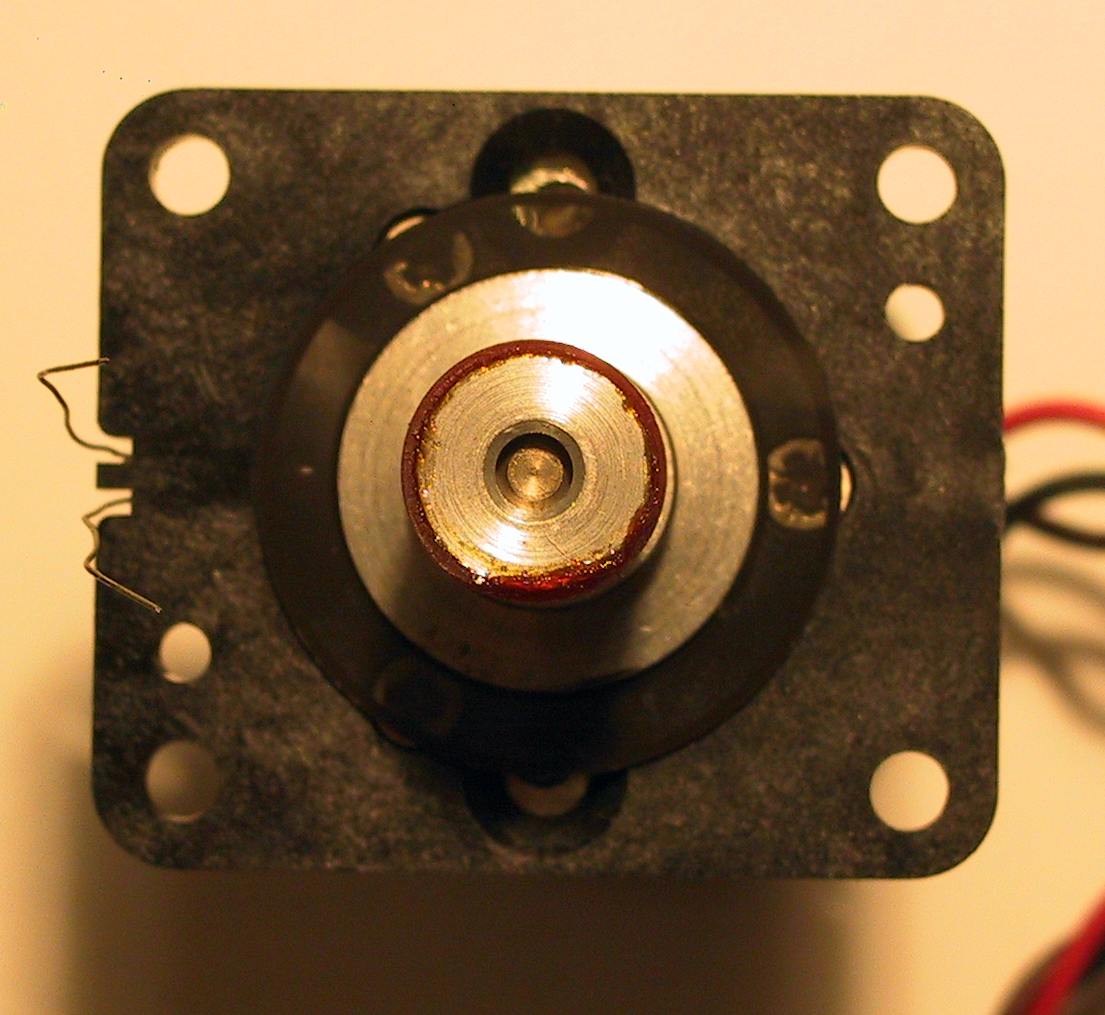
The end of the power cord is snipped off this 11/34a I have in front of
me...
It has a blue wire, a brown wire and a green striped wire.
I'm assuming the green striped is ground. Brown hot and blue neutral?
(I think this is a standard, but I shy away from voltages above 48vdc :-)
-brad
I have ploughed a bit thru the voluminous online doc, and invoked SYSGEN
and read thru it's help files.... but I still have no understanding of
just how to make a Device known to VMS.
Specifically, I want to make a 9trk tape machine (M4 Data = TE16 ?)
available. Another listmember was kind enough to provide me with SCSI
cables, since the M4 machine is SCSI. I tried:
SYSGEN> AUTOCONFIGURE ALL/SELECT=(_list of tape dev names_) which did
'something' and returned to the SYSGEN> prompt - but attempts to ALLOC or
MOUNT the dev return 'device unknown' errors, nor are the new devices list
in SHOW DEV.
So of course I'm (as usual) one or two GOTOs short of a Subroutine...
;}
Cheers
John
Steven and Al....
I need the corvus software for apple IIe's. I'll keep a lookout for the
mac version as well.
Harve Thorn
On Fri, 23 Jan 2004 12:00:38 -0600 (CST) cctech-request(a)classiccmp.org
writes:
>
> Message: 1
> Date: Fri, 23 Jan 2004 07:05:20 -0500 (EST)
> From: "Steven N. Hirsch" <shirsch(a)adelphia.net>
> Subject: Re: Corvus Omninet and Apple IIe - need docs
> On Thu, 22 Jan 2004, Al Kossow wrote:
> > If someone happens to have release 2.0 or later of the CIII
> > software for the Mac, I could use a copy. It should be three
> > floppies.
>
> I was given a device which was claimed to be a Mac Omninet adapter.
> If
> memory serves (and it's buried in the garage at the moment), it was
> a
> small "project" box with a DB-9 connector and Omninet mini-plug on
> short
> tails. Does this sound right?
>
> Which Mac model was this intended to work with? Which version of
> MacOS?
> And, lastly, does anyone have _any_ version of the support
> software?
>
> Steve
________________________________________________________________
The best thing to hit the internet in years - Juno SpeedBand!
Surf the web up to FIVE TIMES FASTER!
Only $14.95/ month - visit www.juno.com to sign up today!
I have two DEC workstations a 3000 and a 5000 and a good working
keyboard but no mouse.
Has anyone any experience of making a PC mouse work on a DEC?
Is this feasable or should I spend my time hunting down a genuine DEC
mouse instead?
All suggestions, help and advice gratefully received.
Robin
_____
<< ella for Spam Control >> has removed 1499 Spam messages and set aside
221 Newsletters for me
You can use it too - and it's FREE! www.ellaforspam.com
>Then it's high time somebody produced a _real_ computer kit. As in a pile
>of standard logic chips (no microoprocessors, no programmed devices, no
>FPGAs, although I will allow RAM :-))....
I would really, really like to see something like this...it'd help me
getting started with learining electronics, which is something I've really
wanted to do and not had any practical time to do.
I'm selling off one of the SBC6120 prototypes from VCF 6.0 on eBay
http://cgi.ebay.com/ws/eBayISAPI.dll?ViewItem
<http://cgi.ebay.com/ws/eBayISAPI.dll?ViewItem&item=2782363270>
&item=2782363270
(I decided that four prototypes was more than anybody could need :-)
This is the one on the far right (sitting on the easel) in the picture
http://www.vintage-computer.com/images/vcf6/sbc6120.jpg
This unit includes the lights and switches front panel, black aluminum
bezel for wall hanging, a 16Mb Compact Flash card for mass storage
(that's the equivalent of eight RK05Js!) and a wall wart style power
supply. It's all ready to plug in; all you need to add is a terminal.
If you haven't heard of it, the SBC6120 is a fully functional PDP-8
clone built with contemporary (more or less!) electronics. The SBC6120
executes the PDP-8/E instruction set, includes a full 32K words of main
memory and KM8E compatible memory management, has a KL8E compatible
interface for an RS232 console terminal, can connect to any IDE/ATA disk
drive, and best of all (as you can see from the pictures!) has a fully
functional lights and switches front panel. The SBC6120 can run all
standard DEC paper tape software, such as FOCAL-69, with no changes.
OS/278, OS/78 and, yes - OS/8 V3D or V3S - can all be booted on the
SBC6120 using an IDE disk drive as mass storage devices.
Bob Armstrong
>Hand-cranked exterior window shades? Pfeh!
You know, that is just what I was thinking... they put all this effort
into it and then ruin the whole thing by using hand cranked window shades!
>It looks like these folks are getting ready for Armegeddon in style.
I think they watched "Stripes" too many times.
-chris
<http://www.mythtech.net>
Actually on-topic (scary!) Anyone need an old 386 laptop? See below.
Reply-to: beenlostonce(a)yahoo.com
--
Sellam Ismail Vintage Computer Festival
------------------------------------------------------------------------------
International Man of Intrigue and Danger http://www.vintage.org
[ Old computing resources for business || Buy/Sell/Trade Vintage Computers ]
[ and academia at www.VintageTech.com || at http://marketplace.vintage.org ]
---------- Forwarded message ----------
Date: Fri, 23 Jan 2004 11:06:29 -0800 (PST)
From: Tanya Deans <beenlostonce(a)yahoo.com>
To: donate(a)vintage.org
Subject: donation question
I have an old Everex laptop. Don't know what model. Has sticker saying the
processor is Intel 32-bit. I purchased it used in 1993 for school and
since then it's just been sitting around the house. Is this something
you'd be interested in or should I just trash it? Don't know if it's worth
anything to anyone. Thanks.
- Tanya Deans
In a fit of madness I bid on that 11/730 government auction. And, now
it appears I've won.
So, how to get a 72"x60"x48" 1000lbs pallet from PA to MA?
I assume the sanest thing is to high a "logistics" firm to truck it to
me. I have access to a loading dock and pallet jacks so I can receive
it in a sane manner.
I am curious if others have done this and if they have and "advice"
(like, "next time take your medication before reading email!" :-)
-brad
Hey Al...
Way to go!! Many tks for the tip. Just what I needed!
Thank you!
I'll keep an eye out for the Mac disks.
Harve Thorn
Fayetteville, AR
> Date: Thu, 22 Jan 2004 18:54:16 -0800
> From: Al Kossow <aek(a)spies.com>
> Subject: Re: Corvus Omninet and Apple IIe - need docs
> To: classiccmp(a)classiccmp.org
> Message-ID: <200401230254.i0N2sGZ1014989(a)spies.com>
>
>
> The Constellation III manuals for the Apple II and Mac
> are now on line at www.bitsavers.org/pdf/corvus
>
> If someone happens to have release 2.0 or later of the CIII
> software for the Mac, I could use a copy. It should be three
> floppies.
________________________________________________________________
The best thing to hit the internet in years - Juno SpeedBand!
Surf the web up to FIVE TIMES FASTER!
Only $14.95/ month - visit www.juno.com to sign up today!
The Constellation III manuals for the Apple II and Mac
are now on line at www.bitsavers.org/pdf/corvus
If someone happens to have release 2.0 or later of the CIII
software for the Mac, I could use a copy. It should be three
floppies.
On Jan 22, 15:50, Vintage Computer Festival wrote:
> On Thu, 22 Jan 2004, Pete Turnbull wrote:
> > On Jan 22, 12:15, Doc Shipley wrote:
> > > On Jan 22, 2004, at 11:54 AM, Vintage Computer Festival wrote:
> > > > (I'm going to pick you guys off one at a time until I've got
you
> > > > all... ;)
> > >
> > > <cough>netcop<cough>
> >
> > Maybe we should all turn on our "Reply-To:" headers and see what
> > happens. We could all set them to "vcf(a)siconic.com" so the results
can
> > be properly monitored ;-)
>
> Hey, that would be fun! Equally fun would be for me to modify my
> .procmailrc to send any spam message I get to each individual
Reply-To
> addressed message I receive ;)
Oh! I hadn't thought of that :-(
--
Pete Peter Turnbull
Network Manager
University of York
Any idea what a Unitron mac512 clone from brazil would be worth these days? Someone in a mac forum I belong to is looking for one and they are pretty rare.
http://www.lowendmac.com/clones/unitron.html
On Jan 22, 23:21, Pete Turnbull wrote:
> While I was looking up my NatSemi Interface databook, I notice it
lists
> the DS8640 as an exact replacement for an SP380 (quad 2-input NOR bus
> receiver), and an 8T380 is the same thing.
That should say "similar thing". I knew there was a difference between
SP380 and N8T380, I just couldn't remember what -- as someone pointed
out, the N8T380 has schmitt inputs.
--
Pete Peter Turnbull
Network Manager
University of York
Correct. MM is for core, MS is for chips.
I was too lazy to check what I was writing.
I even have MM11-LP (96 kWords) in my 11/35.
I passed the morse code exam last December, and since
I had to choose a new call, the postfix PDP seemed a
nice one. "PDP" in morse code is not the best choice,
but I just could not resist. I am not active on HF,
waiting until Spring to install a antenna (aerial).
nice weekend all,
- Henk
> -----Original Message-----
> From: Frank Arnold [mailto:fm.arnold@gmx.net]
> Sent: donderdag 22 januari 2004 20:10
> To: cctech(a)classiccmp.org
> Subject: RE: M7891 switch settings? (unibus)
>
>
> >From: Gooijen H <GOOI(a)oce.nl>
> >Subject: RE: M7891 switch settings? (unibus)
> >
> >I have scanned 11/34 field maintenance print sets.
> >They are at http://www.mainecoon.com/classiccmp/
> >And if I am not mistaken the MOS memory is there too.
> >AFAIK is MS11 correct, just the suffix letter makes
> >all the difference (core, 11/44 MOS, etc.)
>
> MS11-xx is alway semiconductor memory of different capacities
> and speed as specified by the last two caracters
> (to the best of my knowledge...)
>
> MM11-xx are the true core memories with the ferrite cores.
> (Wanna see a MM11-YP, 32k x 18 core-stack? Then bump the
> cofee-machine)
>
> several years after Mos memory became available people were
> still talking about core if they just meant the mainstorage
> or R/W-Memory, regardless of the technology it was built with.
>
> >
> > gd luck,
> >- Henk, PA8PDP
> ^^^
> Heh heh, on what frequency is it radiating?
> Do you remember the little proggys that would make a pdp
> produce sound on an AM-receiver not tuned to any station?
>
> >> -----Original Message-----
> >> From: Brad Parker [mailto:brad@heeltoe.com]
> >> Sent: donderdag 22 januari 2004 1:18
> >> To: arcarlini(a)iee.org; General Discussion: On-Topic and
> >> Off-Topic Posts
> >> Subject: Re: M7891 switch settings? (unibus)
> >>
> >>
> >> "Antonio Carlini" wrote:
> >> >> Does anyone have a manual for an M7891 (128kx18 MOS memory)?
> >> >
> >> >Is that an MS11 of some sort?
>
> if it is 128kx18, then it is a MS11-LD, and has an integrated parity
> controller. I should have the maintenancemanual somwhere if
> it of use to
> anyone. I will sent a free copy to aomeone who likes to
> convert it to .pdf
> file to be put on-line. (Will have to dig it from the garage, however)
>
> Frank
Witchy <witchy(a)binarydinosaurs.co.uk> wrote:
> Also, if it's looking for a cluster then shut it down to get to the
> dead-sergeant prompt (>>>) and type SET VAXCLUSTER 0 to turn off the
> clustering software.
The console ROM has no such command. The ROM knows nothing about VMS and
clusters.
MS
While digging out the keyboard to scan (see my recent message about
that), I noticed that I had a rather old book that perhaps some here
might be interested in information from.
It's an RCA reference book from 1963, and it contains a lot of data on
various types of vacuum tubes and semiconductor devices of the day,
>from vacuum tubes still in use today like the 6L6 I think I saw
mentioned recently to picture tubes (even a few colour types) to tube
types I've never heard of like "nuvistor" and "novar". There are a
number of cross-reference tables of various things, indexed by various
useful things. There is a pile of somewhat similar information about
semiconductor devices (though a good deal less in terms of pages in the
book) and a number of pages on batteries. There are then several pages
of ads for devices like multimeters and oscilloscopes and signal
generators, ending with a calendar for 1963 and a few pages of
address-book. There are a few mildly interesting one-page things, like
one giving a number of RCA sales offices, complete with phone numbers
like "WHitehall 4-2900".
I would take a good deal of persuading to part with the book itself.
But if anyone is interested in data from it, including scans of various
portions, drop me a line.
/~\ The ASCII der Mouse
\ / Ribbon Campaign
X Against HTML mouse(a)rodents.montreal.qc.ca
/ \ Email! 7D C8 61 52 5D E7 2D 39 4E F1 31 3E E8 B3 27 4B
On Jan 19, 20:49, Witchy wrote:
> > PS. Fix your mailer! Yours are the only messages that default to
reply to
> > you and the list (boo!)
>
> Nothing to do with me I don't think - I'm on bog-standard outlook
2000 here
> and haven't changed settings for years.
It *is* your mailer. It appears to be putting an unneccessary
"Reply-to:" header in, and when the list software sets its "Reply-To:",
it gets concatenated to yours instead of replacing it:
From: "Witchy" <witchy(a)binarydinosaurs.co.uk>
To: "General Discussion: On-Topic and Off-Topic Posts"
<cctalk(a)classiccmp.org>
Date: Mon, 19 Jan 2004 20:49:49 -0000
Message-ID: <EAELLACDNKNOEIOECBEEOEJBEJAA.witchy(a)binarydinosaurs.co.uk>
MIME-Version: 1.0
Content-Type: text/plain;
charset="us-ascii"
X-BeenThere: cctalk(a)classiccmp.org
X-Mailman-Version: 2.1.2
Precedence: list
Reply-To: witchy(a)binarydinosaurs.co.uk,
"General Discussion: On-Topic and Off-Topic Posts"
<cctalk(a)classiccmp.org>
Given your Outlook puts in the correct "From:" header, adding a
"Reply-To:" is redundant and arguably incorrect.
For a short while, late last year, I had my MUA add a "Reply-To:" and
the result was exactly the same. A few other people had the same
problem, and appear to have fixed it.
--
Pete Peter Turnbull
Network Manager
University of York
On Jan 22, 12:15, Doc Shipley wrote:
> On Jan 22, 2004, at 11:54 AM, Vintage Computer Festival wrote:
> > On Thu, 22 Jan 2004, ed sharpe wrote:
> >
> > BTW, you have the Reply-To: set in your mailer as well.
> >
> > (I'm going to pick you guys off one at a time until I've got you
> > all... ;)
>
> <cough>netcop<cough>
Maybe we should all turn on our "Reply-To:" headers and see what
happens. We could all set them to "vcf(a)siconic.com" so the results can
be properly monitored ;-)
--
Pete Peter Turnbull
Network Manager
University of York
Hi,
A quick question (should even be on topic... theoretically... )
I've a SGI Crimson, in a older PowerSeries 4D frame that I need to move
>from upstairs to downstairs.
Looks alot like so: http://www.schrotthal.de/sgi/4d/440_powerseries.jpg
Anyways, cause its little ol' me, I need to get it as light as possible,
so I don't kill myself (or drop it) trying to get it down the stairs.
I did _completely_ disassemble the thing to dust it, and get it upstairs
in the first place.
I've already pulled the boards/drives which relieves a lot of the
weight, however, I also want to pull the PSU to relieve its weight, then
hopefully I can carry the "carcass" downstairs by myself.
However, for the life of me, I can't remember how the devil I got the
skins off to get access to the PSU. (And I'm still "googling")
Anyone know?
Thanks,
David
PS: If this isn't quite on topic, my apologies, I'll quietly go back to
poking and prodding...
PPS: If it is on topic, and anyone has a set of proper red Crimson skins
they'd like to unload, please let me know. :-)
Here's my take on the issue of not being able to use standard drivers and
receivers for UNIBUS and Q-bus. Aren't both of these buses old enough that DEC
made devices for both of them using only discrete logic, no ASICs? If they did
make UNIBUS and Q-bus devices w/o ASICs using only standard discrete logic, as
I'm sure they did, what did they use for drivers and receivers?
MS
On Jan 22, 13:27, Joe R. wrote:
> I missed the first part of this discussion and I just found this
message
> by chance. However it is NOT TTL, it's DCL according to my 1971
Signetics
> Digital 8000 Series TTl/MSI catalog. Since it's not TTL this catalog
> doesn't have a data sheet for it
> >----- Original Message -----
> >From: "Patrick Finnegan" <pat(a)computer-refuge.org>
> >To: "General Discussion: On-Topic and Off-Topic Posts"
> ><cctalk(a)classiccmp.org>
> >Sent: Wednesday, January 21, 2004 12:10 AM
> >Subject: Re: brew-your-own-unibus boards?
> >
> >
> >> On Tuesday 20 January 2004 18:06, Tony Duell wrote:
> >> > Driver : 8881 (quad 2 input NAND with open collector outputs)
> >>
> >> Does anyone have a spec sheet on the 8881's?
The essential data is in the back of most QBus handbooks, along with
data for 8640 and 8641. 8881 is a quad 2-input NAND bus driver. 8640
is a quad 2-input NOR bus receiver, 8641 is a quad bus transceiver.
The driver outputs are open-collector.
Bus Driver 8881, 8641:
Input high voltage Vih 2.0V min
Input low voltage Vil 0.8V max
Input high current Iih 60uA max [note 6]
Input low current Iih -2.0mA max [note 6]
Output low voltage,
70mA sink Vol 0.8V max [note 1]
Output high leakage
current at 3.5V Ioh 25uA max [notes 1,3]
Propagation delay to
low state Tpdl 25ns max [notes 1,5]
Propagation delay to
high state Tpdh 35ns max [notes 1,5]
1. This is a critical parameter for use on the I/O bus.
All other parameters ar shown for reference only.
2. This is equivalent to being capable of driving 16
unit loads of standard 7400 series TTL integrated
circuits.
3. Current flow is defined as positive if into the
terminal.
4. Conditions of load are 390 ohms to +5V and and 1.6
k ohms in paralel with 15pF to ground for 10ns
min and 50pF for 35ns max.
5. Times are measured from 1.5V level on input to 1.5V
level on output.
6. This is equivalent to 1.25 standard TTL unit loading
of input.
8881 Pinout:
___ ___
| U |
Y1 |1 14| Vcc
A1 |2 13| Y4
B1 |3 12| A4
Y2 |4 11| B4
A2 |5 10| Y3
B2 |6 9| A3
GND |7 8| B3
|_______|
While I was looking up my NatSemi Interface databook, I notice it lists
the DS8640 as an exact replacement for an SP380 (quad 2-input NOR bus
receiver), and an 8T380 is the same thing.
An 8881 is very similar to a 7401. The main difference is that bus
drivers can typically sink 50mA Iol or so at Vol, whereas a 7401 is
only rated for 16mA -- about half what you would expect to need. The
speeds are about the same: 7401 has faster Tpdl (15ns max versus 25ns
max), but slightly slower Tphl (typically 35ns, max 45ns, albeit for a
slightly lower threshold of 1.3V, versus 35ns max for 1.5V thresholds).
--
Pete Peter Turnbull
Network Manager
University of York
All,
Looks like we will be able to save these from the Evil Melter,
enough people have expressed their interest. Some points of
interest:
- they are in Santa Clara, CA, not The Netherlands ;-)
(sorry, my German and Spanish friends)
- they are in a "take em all or go away" deal; this scrapper is
not one of the friendliest in the trade... still, he *does* let
me go through things, which he never allowed before...
- i currently dont have time to work on the systems, as I am about
to go to boston, so will just get them and store them in a safe
place until march, when i am back here.
So.. to all who wanted some of the gear: I am going to arrange for
pickup of the stuff (all of the 7 racks, including the ones with all
the lab peripheral shtuff) and take out the cruft. Someone local
wants to pick up the programmable power supplies saturday, so that
is good ("one rack down, 6 to go!") and the digital voltmeter is
also "taken". I will try to compress the stuff into 2 or three of
the racks (the H960 clones from Tek) to save space.
I *assume* nobody wants the Tek displays/terminals.
Nobody wanted the VAX 7000, so I'll try to take some pictures of it,
before it visits the Evil Melter.
Cheers,
Fred
I'm in need of two scsi cables, the ones with the 50 pin centronics
connectors on both ends. One cable needs to be about 5 foot, the other cable
needs to be about 1.5 feet. A 50 pin centronics terminator is needed too.
Also looking for an AGP card that has a fairly mainstream chipset (so X11
will support it) that does 1024x768 in 32K colors. Nothing fancy.
This stuff is only vaguely classic computer related in that I'm trying to
finish off building a PC (AMD K6-2/450!) used to support my classic machines
(for burning tapes, disks, etc.).
Thanks!
Jay West
On Jan 21, 17:40, Joe Abbott wrote:
> Just my luck! Thanks anyway, Pete. Hopefully someone
> out there will be able to help.
I hope so!
> I'd bet yours contains the code to disable the onboard
> roms and jump to the floppy boot rom. My System Zero
> manual mentions this and lists the asm code as well as
> a hardware mod. Might be why there doesn't seem to be
> many of these roms around.
Could be. The first EPROM "lives" at 0000H so mine contains:
0000 3E 00 LD A, 0
0002 D3 23 OUT (23H), A ; dunno what this port does
0004 3E 01 LD A, 1
0006 D3 22 OUT (22H), A ; nor this one
0008 21 16 00 LD HL, 16H ; 22
000B 11 00 24 LD DE, 2400H ; 9216 or start of non-SCC memory
000E 01 07 00 LD BC, 7
0011 ED B0 LDIR ; copy 7 bytes from 0016-001C to
2400
0013 C3 00 24 JP 2400H ; and execute there
0016 3E 80 LD A, 80H ; set top bit
0018 D3 2A OUT (2AH), A ; don't even know this one
001A C3 00 C0 JP 0C000H ; start of RDOS?
--
Pete Peter Turnbull
Network Manager
University of York
I have ten Apple IIe's, a Corvus full of MECC and other software. I have a 4 drawer file cabinet full of Apple eucational software, and *lots* of extra Omninet Apple transporter cards, cables, and trunk adapters.
Everythings works just fine.
But..... I have no documentation for the Corvus hardware or software.
The hardware specs are:
Corvus model 74MB7 Rev C SN 398-GN9230-P
The Apple cards "Corvus Systems Transporter 8010-10969 rev E"
The adapters "Corvus Systems trunk adapters A 8010-12393 01"
The cables are marked "OCS II TU 6010-078681-01 low voltage computer cable"
The software is "Corvus Systems Constellation III V3.0"
I need *both* the software and the hardware docs. Of course, I would certainly be glad to find either one!
Any help locating these manuals, as well as any helpful hints, would be much appreciated.
Many tks!!
Harve
Harve Thorn
Fayetteville, AR
________________________________________________________________
The best thing to hit the internet in years - Juno SpeedBand!
Surf the web up to FIVE TIMES FASTER!
Only $14.95/ month - visit www.juno.com to sign up today!
cctech-request(a)classiccmp.org schrieb am 22.01.2004:
>Message: 29
>Date: Thu, 22 Jan 2004 08:04:58 +0100
>From: Gooijen H <GOOI(a)oce.nl>
>Subject: RE: M7891 switch settings? (unibus)
>To: "'General Discussion: On-Topic and Off-Topic Posts'"
> <cctalk(a)classiccmp.org>
>Message-ID:
> <1A9EACFF5B9EB9489F00104C00ECF641027B0EC7(a)hqvenlomail.oce.nl>
>Content-Type: text/plain; charset="iso-8859-1"
>
>I have scanned 11/34 field maintenance print sets.
>They are at http://www.mainecoon.com/classiccmp/
>And if I am not mistaken the MOS memory is there too.
>AFAIK is MS11 correct, just the suffix letter makes
>all the difference (core, 11/44 MOS, etc.)
MS11-xx is alway semiconductor memory of different capacities and speed as
specified by the last two caracters (to the best of my knowledge...)
MM11-xx are the true core memories with the ferrite cores.
(Wanna see a MM11-YP, 32k x 18 core-stack? Then bump the cofee-machine)
several years after Mos memory became available people were still talking
about core if they just meant the mainstorage or R/W-Memory, regardless of
the technology it was built with.
>
> gd luck,
>- Henk, PA8PDP
^^^
Heh heh, on what frequency is it radiating?
Do you remember the little proggys that would make a pdp produce sound on
an AM-receiver not tuned to any station?
>> -----Original Message-----
>> From: Brad Parker [mailto:brad@heeltoe.com]
>> Sent: donderdag 22 januari 2004 1:18
>> To: arcarlini(a)iee.org; General Discussion: On-Topic and
>> Off-Topic Posts
>> Subject: Re: M7891 switch settings? (unibus)
>>
>>
>> "Antonio Carlini" wrote:
>> >> Does anyone have a manual for an M7891 (128kx18 MOS memory)?
>> >
>> >Is that an MS11 of some sort?
if it is 128kx18, then it is a MS11-LD, and has an integrated parity
controller. I should have the maintenancemanual somwhere if it of use to
anyone. I will sent a free copy to aomeone who likes to convert it to .pdf
file to be put on-line. (Will have to dig it from the garage, however)
Frank
Hi, Joe,
(CC to Classiccmp)
You lucked out. Data I/O says that what you have there is the 8MB board.
Enjoy!
-=-=-=-=-=-=-=-=-=-=-=-
Bruce Lane, Owner & Head Hardware Heavy,
Blue Feather Technologies -- http://www.bluefeathertech.com
kyrrin (at) bluefeathertech do/t c=o=m
"If Salvador Dali had owned a computer, would it have been equipped with surreal ports?"
the museum was just given a nice IBM PC that is a luggable... sort of like a compact!
have not seen many of these... are they scarce? would like to find any advertising material or manuals etc that would complement it in the IBM display... had not really planned on having each and every model on display but this is kinda cute... let us know if you have any related or scans of related stuff!
Thanks Ed Sharpe archivist for SMECC
Please check our web site at
http://www.smecc.org
to see other engineering fields, communications and computation stuff we
buy, and by all means when in Arizona drop in and see us.
address:
coury house / smecc
5802 w palmaire ave
glendale az 85301
I found these. Does anyone want them? The socketed ICs have been pulled
but otherwise they appear to be in good condition. TI 990/203A Memory card.
HAD 16 4164s installed and 16 empty sockets. TM990/101MA CPU card. HAD a
9900 CPU, four 2114s, two 9902s and two 9904s installed.
Joe
At 10:30 PM 1/21/2004 -0600, you wrote:
>In message <200401212038.18544.finnegpt(a)purdue.edu>, Patrick Finnegan writes:
> >Tom Uban declared on Wednesday 21 January 2004 07:15 pm:
> >> http://www.ubanproductions.com/Images/console_joe.jpg
> >> http://www.ubanproductions.com/Images/console_joe_tom.jpg
> >>
> >> I have a real keyboard to fill the hole. I am going to have to create
> >> some new electronics as much has been stripped, but what a cool
> >> project!
> >
> >Hah, I know where you got that from... I saw it there just a week or two
> >ago. I'm glad that it went to a good home... I did't have anywhere
> >near enough space to put it.
>
>Whoa! Are you saying that the console for the 6000 series
>machine that PUCC had is just now leaving campus? I remember
>when they decomissioned those machines around '89 or '90.
>In fact, I snagged a couple of manuals that were sitting in
>the hallway afterwards.
>
>By the way, do they still have those 205s and that ETA-10
>they had way back? I've got to figure they got rid of them
>a while back, but you never know.
Yep, the console had languished at salvage for more than a decade, in
a back corner. Much of the electronics has been stripped, but the structure
is pretty complete and the CRTs and much of the HV is still there.
The 205 carcass is still there, being stripped for gold, no cards left,
just backplane blocks and coaxial interconnect.
I don't know what happened to the ETA-10, but I'm guessing it was sold.
--tom
I just got in an XGA monitor. Now, I vaguely remember that this was a
precursor to SVGA. Correct?
Is this worth saving from a historical point of view? I'm thinking yes.
Here's some terse information:
http://www.webopedia.com/TERM/X/XGA.html
--
Sellam Ismail Vintage Computer Festival
------------------------------------------------------------------------------
International Man of Intrigue and Danger http://www.vintage.org
[ Old computing resources for business || Buy/Sell/Trade Vintage Computers ]
[ and academia at www.VintageTech.com || at http://marketplace.vintage.org ]
I have scanned 11/34 field maintenance print sets.
They are at http://www.mainecoon.com/classiccmp/
And if I am not mistaken the MOS memory is there too.
AFAIK is MS11 correct, just the suffix letter makes
all the difference (core, 11/44 MOS, etc.)
gd luck,
- Henk, PA8PDP
> -----Original Message-----
> From: Brad Parker [mailto:brad@heeltoe.com]
> Sent: donderdag 22 januari 2004 1:18
> To: arcarlini(a)iee.org; General Discussion: On-Topic and
> Off-Topic Posts
> Subject: Re: M7891 switch settings? (unibus)
>
>
> "Antonio Carlini" wrote:
> >> Does anyone have a manual for an M7891 (128kx18 MOS memory)?
> >
> >Is that an MS11 of some sort?
>
> I thought MS11 was core. This is MOS. maybe I'm confused.
>
> -brad
In a message dated 1/21/2004 10:45:48 PM Eastern Standard Time,
vcf(a)siconic.com writes:
I just got in an XGA monitor. Now, I vaguely remember that this was a
precursor to SVGA. Correct?
Is this worth saving from a historical point of view? I'm thinking yes.
Is it an IBM 9517? XGA was IBM's hires VGA I think after they made the 8514
display and adaptor. Debuted on the PS/2 models.
I have what I believe is a custom CRT. It has a 12" round face, is
approximately 20" long
--
.. and has a second one mounted next to it, and a keyboard underneath?
There may be schematics for such a device in the Computer History Museum
archives if so.
I haven't even seen a TE16 capstan roller, but since TU58s have
a similar mechanism to the HP-85 cartridge drives, the following
advice may be of use:
1. erd posted the following in the vintage-computer mailing list:
> [...] I have used 1/2" tygon tubing from the local hardware store
> (think "large aquarium hose") to refurb DEC TU58 drives (same tapes,
> same capstan, same melting problem).
>
> I got a foot of it a few years ago and have yet to run out (even though
> between HP line analyers, VAXen, and a VT103, I have nearly a dozen
> drives to overhaul).
2. katie posted the following in the MoHPC forum:
> In the plumbing department at Home Depot I found some stuff called
> Magic Wrap, it's a roll of very thin rubber 1" x 16'. I cut a 2" x
> 1/4" piece of this stuff stretched it out to about the width of the
> roller then wrapped it around (several turns) the cleaned off roller
> as tight as I could. Then I smoothed it out by spinning the drive
> wheel at high speed and grinding down the rubber with an emery
> board. This sort of melts the rubber and fusses it to itself getting
> rid of the overlap and making the whole thing perfectly symmetric.
> To spin the drive wheel I disconnected one of the motor leads and
> put it on a variable power supply. You can use up to 12 volts but
> I found 5 or 6 volts ran the wheel plenty fast with tons of torque.
> Basically, you want to use it like a lathe and I found that the
> tape head makes a good tool rest!
3. rhahm wrote:
> I use 3/8" latex tubing from Lowes Hardware and LockTite glue. I
> also leave the capstan on the motor during the repair.
4. http://www.voidware.com/calcs/hp85rep.htm
I do not recommend heat shrink tubing as it tends to come off. Test the
repair by retentioning a sacrificial tape (use the CTAPE command on the
HP-85) two or three times in a row. If the tubing does not come off, then
it'll probably stay put for a couple of years.
If you are wondering what is the thickness of the rubber on the roller,
the following picture is of an original HP roller with decayed coating
still in place.
http://www.series80.org/Pictures/HP85-TapeDriveCapstan.jpg
**vp
Bob Lafleur spoke thusly:
>I have a Compaq Portable III with a 3.5" floppy drive that seems to
>have
>gone bad. Does anyone know if this is a "standard" drive that could be
>replaced with a current 3.5" drive? If not, is there a specific type of
>drive I need to use for a replacement?
>
>I haven't even ventured to see how to go about opening the machine yet,
>so I
>don't know if it's easy or hard. Any pointers would be helpful. Thanks.
I also had a Compaq Portable III - - it had a 5.25" FDD.
It left the plant 17th March 1988 - the date of my birth!
It got stolen from my grandmother's summerhouse in 1999 - and the
insurance company gave me 1500 dollars for it!
(Disclaimer: It was my mother who 'did all the talking' to the company -
I got a lot of money because of the proprietary accounting software on
the machine - The check came as a surprise to both of us)
I was offered 7 inch diameter 600' tape reels (1/2 inch), fully
reconditioned (cleaned and actually recertified) for $6.25 per tape. I was
thinking of picking up some. I really like the small reels, normal size
reels are great for backup, but for OS load tapes and file transport I like
the 7 inchers.
A) Is this a good price?
B) Anyone want me to order some for them? (obviously depends on A)
Jay
> What is the best way to get a copy of the manual and/or schematics from CHM?
I'll talk to the powers that be. From memory, they have a complete CDC 6600 print
set (about 4 feet of 8x11 binders) so I suspect the console will be in there.
On 21 Jan 2004 15:55:40 +0000, Gordon JC Pearce <gordonjcp(a)gjcp.net>
keyed in:
> On Wed, 2004-01-21 at 15:43, William Donzelli wrote:
>>> The problem with NOS is that the glass is slightly porous and the
>>> valves
>>> will have gone a bit soft by now.
>>
>> This is basically false.
>
> Well, I call it as I see it. I have literally dozens of new old stock
> valves, in their original cardboard sleeves. Some are useable, some
> are
> absolutely shagged. It's not all just cheap brands, too.
Space heaters generally decay due to the escape of gasses into the
envelope. This can be caused by two mechanisms: outgassing and leakage.
When the tube is manufactured care is generally taken in choosing the
metals/glasses to ensure that they have a low gas content. Initially
the envelope is evacuated under fairly high vacuum and baked to allow
any adsorbed gasses to outgas. The longer the baking, the better the
vacuum. Consequently, the cheapies will use cheap metals/glasses and
shortcut the bake-out time. Finally, the tube is sealed and the getter
is fired (i.e. evaporated). The getter is an active metal that you find
plated around the base of the tube. The getter generates a high vacuum
in the tube by combining with active gas species and trapping the inert
ones. Since getter is expensive, cheap tubes go short on this item with
the subsequent outgassing of the guts causing the decrease in
conduction.
The second mod of failure is by leakage of helium. Although this gas
exists at about 5 ppm in air it abhors a vacuum and will over time leak
into the tube. Glass is permeable to helium. (HeNe lasers fail due to
the leakage of He. You can take a dead HeNe and resurrect it by placing
it in pure helium for several weeks...). The inclusion of gas into a
tube is evident by the blue glow one sees in a tube that is going over
the hill. Moral: don't own tube equipment if you're in the balloon
business.
As an aside, during the '60s is saw a control computer being developed
for the military that consisted of several hundred tubes integrated
into a volume of approximately 20x20x20 cm. The "tubes" were fabricated
by forming cavities in ceramic layers with beta emitters for cathodes
and plates and interconnection evaporated onto the ceramic. These
layers were then stacked to form the controller. The average tube was
on the order of a 1/2 cm^2 or less. This baby didn't glow, but I would
like to have the bucks that went into its manufacture...
Claude Ceccon