Steve Davidson <steve(a)scshome.net> wrote:
> Do you still have the V4.2 source online anywhere? Trying to copy it from
> harhan.org is painful at best.
If you want it to be less painful, buy me a T1 subscription (would have to be
>from WorldCom/UUNET, I have a Class C NET from them and I won't give it up) and
a sync serial card for either VAXBI bus or Q22-bus that can handle it.
MS
On Mon, 8 Mar 2004 Paul Koning <pkoning(a)equallogic.com> wrote:
> >>>>> "Guy" == Guy Sotomayor <ggs(a)shiresoft.com> writes:
>
> Guy> Hi, Does anyone know how much 3-phase power (at say 220v) a
> Guy> KL-10 requires?
>
> Guy> I just acquired some commercial space to move my collection into
> Guy> and I noticed today that there are several 220v 3-phase power
> Guy> drops that I hadn't noticed previously. I'm kind of hoping that
> Guy> I'll have enough 3-phase to be able to start resurecting my
> Guy> KL-10, but I need to know how much I need.
>
> I remember a big plug rated at probably at least 50 amps.
Sounds about right.
> One suggestion would be to check the name plates either on the chassis
> near the power inlets, or on the power supplies. You might also use
> the power cable and plug dimensions as a guideline; find the current
> rating of the cable used for the power inlet. That should be somewhat
> over the actual amount needed but not massively so -- power syhstem
> designers don't usually overdesign cables by large margins.
Yes, they do.
The VAX8600 was targeted at large IBM sites, so they put in an oversized
power cable and receptacle, that was the same as for the IBM equipment
they planned to replace.
So the 8650 I have here have a cable and receptacle specified for
410V@32A/phase, but it runs just fine on 16A/phase.
And our KL-10 sat on this *huge* 410V@63A/phase thingie. That receptacle
was just large enough to be silly. And the power cable is not something
you carry around in your hand...
Johnny
Johnny Billquist || "I'm on a bus
|| on a psychedelic trip
email: bqt(a)update.uu.se || Reading murder books
pdp is alive! || tryin' to stay hip" - B. Idol
Antonio Carlini <arcarlini(a)iee.org> wrote:
> The fastest you can get on Qbus is the DSV11.
I know, I have one, and I used it for my Inet connection when I lived in Dallas
and had a 64 kbit/s DDS line. It's rated for up to 256 kbit/s with one channel
active or 64 kbit/s with both channels active.
> That can almost
> handle 1Mb/s (it fails when fed a constant stream of minimal
> length HDLC frames so it was rated at 256kb/s - the next
> lower useful speed).
Do you have any more details about DSV11 operation above the rated 256 kbit/s?
What exactly is the real limit and what are the limiting factors? I have the
technical description (EK-DSV11-TD), but it isn't absolutely clear.
> The DSB32 is also
> not an option if you have a VAX 7000
I'm not using a VAX 7000 (and don't consider it a real VAX thanks to LSB and
whatever else they broke in NVAX+ when they fit it into an Alpha pinout), but
I'm curious why. I mean, how is DSB32 special? I recently searched for DSB32
on Google and came upon a posting by you saying the same thing, there you also
said it had something to do with the way its firmware locked memory. What
exactly is wrong with it? Does it strictly follow the VAXBI spec or was it
given an exception? Does it use IRCI/UWMCI pairs exactly as the spec says or is
it broken? Or is the VAX 7000 kludge the one at fault here in that the memory
is not presented to VAXBI as prescribed by chapter 8 of the VAXBI spec (the
Must Respond Set for Memory Slave), and DSB32 just happens to be the only
device that uses everything that the spec says is allowed? Or will all VAXBI
devices that use BVP (interlocked queues) not work on VAX 7000 because its VAXBI
interface to memory (through XMI and LSB) does not support IRCI and UWMCI?
That would be DSB32, AIE/AIO (DEBNx TK50/TK70/Ethernet), all BI-to-CI adapters,
DWBUA if some UNIBUS device accesses memory with DATIP-DATO (which turn into
IRCI/UWMCI), what else? You said DMB32 should work, I guess it isn't using
interlocked queues. But then again IRCI and UWMCI are the in the Must Respond
Set for memory nodes (section 8.2.2), so it would just mean that VAX 7000 is
not a real VAX as I've been saying all along.
> I suspect that for T1 speeds you'll be stuck using an
> Alpha or possibly a DECnis,
Well, neither Alpha nor DECnis firmware run 4.3BSD-Quasijarus, so those are not
my options (I love my 4.3BSD-Quasijarus based router and won't give it up), but
there is one more option: build a new sync serial card! We can even build both
Q22-bus and VAXBI versions.
MS
Ok I'm extremely irked.
Friday afternoon the classiccmp server decided it didn't have a slave drive.
It has done this once or twice before, for some reason the system can't see
the drive anymore so it flags it as non-existent. Usually after a reboot it
goes fine for a few months at least. Most odd. I'm guessing it's the crappy
Western Digital 160gb drive I bought. Don't think I'll be getting any more
Western Digital for a while. It came back up friday afternoon and I saw a
few emails go through the list so I assumed all was well again. Stupid Me.
So I promptly decided to ignore the list for the weekend, had a very full
weekend with lots of other stuff (work & home) to do. Sunday night I noticed
that the list hadn't passed any traffic since friday night. First thing I
checked was the drive, but that was ok. It was a very bizzare odd problem.
Sendmail appeared to be working fine but mailman wasn't queueing any
messages. Both inbound and outbound mail were definitely working though.
Odd - the pid files for mailman were dated in the future, but the system
date was correct (and had been). I tried pretty much every trick I could
think of to no avail. I finally gave up around 1am and said the heck with
it, I needed sleep and have some WorkStuff to take care of. Tonight will
probably be an all nighter due to a different work-related server issue. I
had even tried re-installing mailman 212, figuring a binary got corrupted in
the fiasco friday afternoon. No Joy. Looks like all messages were sent to
the shunt directory, which means a mailman executable failed. Some message
about can't unicode because bytes 0-4 are not cardinal. Ick.
So this morning I upgraded to mailman 2.1.4. That seems to have done the
trick. Pid files are still dated in the future though. What fun.
All appears to be back up and running. I apologize for the extended outtage.
You'll forgive me if I ignore this list for a few days, I just don't want to
think about the server for a bit. It's self-interest, I figure if I stay
away from it for a few days I won't be so ready to unplug it and chuck it
out the 2nd story datacenter window.
Regards,
Jay West
---
[This E-mail scanned for viruses by Declude Virus]
hi all,
Eric bought an item that I had on E-bay about 6 weeks ago and I've
emailed several times but I haven't gotten a response. After yesterday's
posting I heard from a friend of his that also hasn't been able to contact
him. Is there anyone in the same area as Eric that can check and find out
what's happened to him?
I had a phone number for him and I just tried calling it and the guy that
answered said that Eric doesn't have that number any longer. It sounded as
if he's gotten a lot of calls for Eric.
Joe
Eric are you out there? If then you need to contact me. I've sent you two
E-mails and haven't gotten a reply.
Joe
Hey ya'll... please take a look at these three pictures:
http://geocities.com/lyosnorezel/keyboard1.bmphttp://geocities.com/lyosnorezel/keyboard2.bmphttp://geocities.com/lyosnorezel/keyboard3.bmp
The first two show the keys, the third shows one of two connectors that it apparently interfaces the computer with. The two "plugs" are 8pin jacks... like cat5 but in a wider, more spread out form. The most noteable things about this keyboard are as follows:
Interesting Keys:
Cancel
Move
Help
Action
Over Type
Finish
Copy
Lock
Code (instead of ctrl)
shift + 6 would give you the "cent" or "penny" sign (a "c" with a line though it)
F1, F2, F3, F8, F9, F10 all have lights
Return instead of Enter
1/4 1/2 fraction key... 1/4 is on top... key is next to "P"
Number pad:
GO
Next
Arrow Pad:
Mark
Bound
Anyone know system this keyboard is from? The only markings are from the company "Datapoint Corporation" "Model No. 93-1222-001" "Serial No. 978870"
It's UL and CSA certified. Other then this there are absolutely no markings.
Thanks.
Lyos Gemini Norezel
---------------------------------
Do you Yahoo!?
Yahoo! Search - Find what you’re looking for faster.
Brad Parker <brad(a)heeltoe.com> wrote:
> (but amazingly, it keeps going at 115bytes/second; the traceroute makes it
> look like it's some sort of dialup)
Yes, my connection is a 31200 bps permanently-up circuit-switched
connection (I wouldn't call it dialup as regular dialups don't get Class C NETs
like I have). I have this service because it is the lowest-priced business
Inet service from WorldCom/UUNET (now called MCI). It had to be a *business*
service from them in order for me to get a Class C NET from them, and it had to
be WorldCom as they were the only ones who just gave it to me without charging
me an extra arm and a leg for it. (Also WorldCom was cheaper than all other
business Inet services, though again I only considered business services as
they are the only ones that give full Class C NETs.) Except for being slow
(but that's fair, you get what you pay for), I'm very satisfied with UUNET and
won't switch.
MS
Hi
Most all hard disk heads will damage the surface if
rotated backwards. This is because the back edge is
sharp enough to cut you as well as dig into the
surface.
Dwight
>From: "Johnny Billquist" <bqt(a)update.uu.se>
>
>On Tue, 9 Mar 2004 Gooijen H <GOOI(a)oce.nl> wrote:
>
>> I am not sure that removing the brake will help.
>
>More likely not. In fact, the break is there for a reason. To stop the
>drive when spinning down. Otherwise, it will spin for a long time. I also
>suspect that the break is engaged until you try to spin the disk up, so
>that the disk don't swing back and forth just because you move the drive
>around.
>
>> I once heard the following rumour:
>> the brake in combination with the 'heavy' motor
>> makes sure that the disk platters always rotate
>> in the same direction, never for a short instance
>> in the other direction (vibration, power flutter,
>> whatever reason). Rotation in the opposite direction,
>> for any short moment, will cause the air on which the
>> r/w head fly to disappear and result in an immediate
>> head crash ...
>
>Are you suggesting that a platter, weighting several kilograms, spinning
>at something like 3600 rpm, suddenly can change spin direction at a
>millisecond notice?
>
>> As I said, it is a rumour I once heard a few years ago.
>> Has anybody heard of this too?
>
>That's one of the more outrageous rumours I've ever heard. :-)
>The amount of energy required to do that trick would blow every fuse in
>your house, and then some. We're talking about living mass here. Physics,
>you know... ;-)
>
>However, vibration can cause a head crash...
>
> Johnny
>
>Johnny Billquist || "I'm on a bus
> || on a psychedelic trip
>email: bqt(a)update.uu.se || Reading murder books
>pdp is alive! || tryin' to stay hip" - B. Idol
>
[resend - looks like original got lost this weekend]
Hi,
If anyone has diagnostic experience with an R80 or RA81, I'd like to
pick your brain a little...
If this is better done off line, email is fine. I suspect not everyone
is interested on how to revive an R80 :-)
(why *I* find it infinitely fascinating is something I'll never understand)
I have an R80 which does not spin up or come ready:
- All of the voltages are good (all the ones I checked anyway).
- The drive belt had come off but I managed to get it back on
- I can't seem to get it into diagnostic mode; the 8 leds' on the
bottom pcb show 0101 0101 (hex 55).
- When it powers up all of the external lights go on and stay on.
- if I reset (click the switch ont the pcb to "R", the lights go
out
- if I then push the run/start it lights and after about 5 seconds
the fault light comes on and run/start goes out.
- if I push the fault light all lights go on and then the right most
one stays on
- push fault again and they all go out (I can then repeat the run/start
sequence)
I'm guessing the above behavior means the micro is operating, but then I
set the rotaries to "FF" and hit 'enter' (i.e. put the toggle to 'E')
the led's don't change at all. The manual says they should flash and
change as a I enter diag mode. I wanted to use diag more to force a
spin up but no joy.
Does the unit have to be connected to a controller to go into diag mode?
I have an RB730 which this connects to. Connecting is does not seem to
really change it's behavior.
-brad
I am not sure that removing the brake will help.
I once heard the following rumour:
the brake in combination with the 'heavy' motor
makes sure that the disk platters always rotate
in the same direction, never for a short instance
in the other direction (vibration, power flutter,
whatever reason). Rotation in the opposite direction,
for any short moment, will cause the air on which the
r/w head fly to disappear and result in an immediate
head crash ...
As I said, it is a rumour I once heard a few years ago.
Has anybody heard of this too?
gd luck with your drive,
- Henk, PA8PDP
> -----Original Message-----
> From: Brad Parker [mailto:brad@heeltoe.com]
> Sent: dinsdag 9 maart 2004 2:50
> To: General Discussion: On-Topic and Off-Topic Posts
> Subject: Re: R80/RA81 diagnostic experience?
>
>
> >Tony Duell wrote:
> >>
> >>IIRC there's a microswitch which detects that the tensioner
> >>lever is in the 'tensioned' position, but nothing more. Of
> >>course the drive does check that the spindle is rotating at
> >>the right speed when it's spun up.
>
> I pulled the HDA - the belt tension switch was fine.
>
> I found, however, the electric brake was *extremely* tight. So much
> friction that I doubt very much the motor could spin at all.
> I removed it (I'll sand down the 'brake pad' later).
>
> Hoping for a small miracle I fired it back up but still no joy - the
> motor (now free) refused to spin up.
>
> [a side note: the unit does not seem to reset no power up -
> it comes up with all lights on until I click the reset manually.
> sometime tells me this is a symptom]
>
> I need some prints so I can trace the motor power back to the micro...
>
> Any have prints for an R80 (or RA80/RB80/RM80). Or an RA81?
> I suspect they are similar in terms of motor drive...
>
> -brad
I just got a call from a friend of mine who has a number of NOS
Panasonic LDV-1000 Video Disk Players. These are the type that were used
in some of the early video games like Cinamatronics Space Ace. Is there
any interest in them from list members? Apparently the only thing wrong
is that the boxes got damaged but the units themselves are fine. Let me
know via email if you are interested.
After wanting a Commodore 64 SX for such a long time, a kind man
finally gave me one. (it was
the victim of a garage-clean out. I got it back home and it worked fine
for a while. later
that night I was writing basic programs and this strange color washed
over it's little screen
then it went blank.
Cycling power did not restore any picture.
I left it unplugged overnight, (thinking the problem may have been heat
related)
but it's still in the same state this morning.
Any one have any knowledge? Is it really dead? Is there anything I can
do?
A little info can be found here:
www.pdp-11.nl/peripherals/disk/ra81-info.html
According to the table, when the rightmost light [B]
stays on (and the FAULT light of course), it would mean
you have spin-up problems. Did you tension the belt with
the lever at the right-hand side (at least there it is
in an RA81 drive)?
success,
- Henk, PA8PDP
> -----Original Message-----
> From: Brad Parker [mailto:brad@heeltoe.com]
> Sent: maandag 8 maart 2004 15:50
> To: General Discussion: On-Topic and Off-Topic Posts
> Subject: R80/RA81 diagnostic experience?
>
>
>
> [resend - looks like original got lost this weekend]
>
> Hi,
>
> If anyone has diagnostic experience with an R80 or RA81, I'd like to
> pick your brain a little...
>
> If this is better done off line, email is fine. I suspect
> not everyone
> is interested on how to revive an R80 :-)
>
> (why *I* find it infinitely fascinating is something I'll
> never understand)
>
> I have an R80 which does not spin up or come ready:
>
> - All of the voltages are good (all the ones I checked anyway).
> - The drive belt had come off but I managed to get it back on
> - I can't seem to get it into diagnostic mode; the 8 leds' on the
> bottom pcb show 0101 0101 (hex 55).
> - When it powers up all of the external lights go on and stay on.
> - if I reset (click the switch ont the pcb to "R", the lights go out
> - if I then push the run/start it lights and after about 5 seconds
> the fault light comes on and run/start goes out.
> - if I push the fault light all lights go on and then the right most
> one stays on
> - push fault again and they all go out (I can then repeat the
> run/start sequence)
>
> I'm guessing the above behavior means the micro is operating,
> but then I set the rotaries to "FF" and hit 'enter' (i.e. put the
> toggle to 'E') the led's don't change at all. The manual says they
> should flash and change as a I enter diag mode. I wanted to use
> diag more to force a spin up but no joy.
>
> Does the unit have to be connected to a controller to go into
> diag mode?
> I have an RB730 which this connects to. Connecting is does
> not seem to really change it's behavior.
>
> -brad
Ive got well over 50 SONY QW5122F tapes brand new still wrapped up. 200/420M
capacity. Not sure what they work on though. .25 cents each.
Also have other QIC80 tapes, but no MC3020 anymore. Inquire for others.
--
On Mon, 8 Mar 2004 Brad Parker <brad(a)heeltoe.com> wrote:
> Gooijen H wrote:
> >A little info can be found here:
> >www.pdp-11.nl/peripherals/disk/ra81-info.html
>
> thanks!
>
> >Did you tension the belt with the lever at the right-hand side (at
> >least there it is in an RA81 drive)?
>
> I did, and it seems to be right, but who knows. Is there any sort of
> lock out or micro switch which senses proper belt tension?
Yes, I think so. Also, there is a transport safety for the heads. It's a
lever on the HDA, which you should turn to unlocked.
Does the R80 have the terminal interface on one card like the RA8x drives
do? If so, plug a terminal in there and talk with the drive. 1200 bps I
think, though it could be 300. 8N1.
> This is an R80 drive, btw. I'm assuming the RA80, RB80 and RM80 are all
> very similar at the drive end (not the controller end - which is very
> different).
Yes, it's the same HDA.
Johnny
Johnny Billquist || "I'm on a bus
|| on a psychedelic trip
email: bqt(a)update.uu.se || Reading murder books
pdp is alive! || tryin' to stay hip" - B. Idol
TSIA
Not sure if I posted this already. I was wondering if anyone has an extra
original manual for the HP 10529A logic comparator.
Thanks!
Jay West
---
[This E-mail scanned for viruses by Declude Virus]
-----BEGIN PGP SIGNED MESSAGE-----
Hash: SHA1
I just received a call. He has a KayPro 2 and KayPro 4 that he'd like to
sell.
They are located in Ottawa, Canada.
What's the going price for these?
Earlier tonight I had a cybernex terminal, a wang and a S-100 machine dropped
off, as well as a Hyperion and a Toshiba T5200/100. A Zeus should be
arriving latter on.
- --
Ottawa, Canada
Collector of vintage computers
http://www.ncf.ca/~ba600
-----BEGIN PGP SIGNATURE-----
Version: GnuPG v1.2.2 (GNU/Linux)
iD8DBQFATRC6LPrIaE/xBZARAmu5AJ0Sx+fMTVQvUwnLmqG+a2xLVg00WgCfcUGW
AlZH+FCSdU97BMLCXe1QSY4=
=BSzD
-----END PGP SIGNATURE-----
I figure there's pretty much zero chance of this, but thought I'd ask :)
I have an HP 7906 drive that is rackmounted in one of the "newer" style
cream colored rounded edge HP racks. I want to mount it in one of the older
dark grey HP racks. The mounts are completely different. So, I'm looking for
7906 drive rails that go in the older style cabinet. I do have L brackets
that go in the older cabinets, but with 7906 drives it's pretty important to
be able to pull them out a bit and work on the bottom.
Anyone have a set for trade?
Jay West
---
[This E-mail scanned for viruses by Declude Virus]
On Mar 8, 11:01, Paul Koning wrote:
> Pete> You can, but I was always told (and read somewhere) there
> Pete> should be two stripes between, not one.
>
> Interesting. Your source is mistaken... Quoting from the Ethernet
> Specification, Version 2 (DEC/Intel/Xerox), section 7.6.2:
Makes sense, I can't think of any reason to require a minimum of two
"intervals" (for want of a better word). See my other post; I bet the
book has simply been misinterpreted a few times, and that's where most
peopel got it from (the standard itself didn't used to be terribly
accessible).
--
Pete Peter Turnbull
Network Manager
University of York
On Mar 8, 16:10, Johnny Billquist wrote:
> I'm pretty sure that the stripes are at 2.5 m.
They are. I'm looking at a length of etherhose right now.
> I'm also pretty sure that the standard says you should have 5 meters
> between transcievers.
That's what I thought, but I don't actually have a copy of the
standard, just my well-thumbed copy of Charles Spurgeon's "Ethernet"
book. It says the stripes are 2.5m apart but transceivers can be
placed at 5m or 7.5m or any multiple of 2.5. Well, 2.5 is a multiple
(in the mathematician's sense of 1 x 2.5) so maybe 2.5 is OK.
> But I have actually never really understood why. Maybe just to not
damage
> the cable to much with vampire taps? There cannot be an electrical or
> signal reason for this, as far as I can tell.
I can't think of one either. The reason for the 2.5m spacing is that
it's an odd fraction (about 1/19th) of a wavelength, so when you put
taps on the cable, the small reflections caused by the discontinuities
are out of phase and don't tend to be additive.
--
Pete Peter Turnbull
Network Manager
University of York
This was too good not to pass on!
Joe
>
> Start with a cage containing five monkeys. Inside the cage, hang a
>banana on a string and place a set of stairs under it. Before long, a
>monkey will go to the stairs and start to climb towards the banana. As
>soon as he touches the stairs, spray all of the other monkeys with cold
>water. After a while, another monkey makes an attempt with the same
>result - all the other monkeys are sprayed with cold water. Pretty
>soon, when another monkey tries to climb the stairs, the other monkeys
>will try to prevent it.
>
> Now, put away the cold water. Remove one monkey from the cage and
>replace it with a new one. The new monkey sees the banana and wants to
>climb the stairs. To his surprise and horror, all of the other monkeys
>attack him. After another attempt and attack, he knows that if he tries
>to climb the stairs, he will be assaulted. Next, remove another of the
>original five monkeys and replace it with a new one. The newcomer goes
>to the stairs and is attacked. The previous newcomer takes part in the
>punishment with enthusiasm!
>
> Likewise, replace a third original monkey with a new one, then a
>fourth, and then the fifth. Every time the newest monkey takes to the
>stairs, he is attacked. Most of the monkeys that are beating him have
>no idea why they were not permitted to climb the stairs or why they are
>participating in the beating of the newest monkey. After replacing all
>the original monkeys, none of the remaining monkeys have ever been
>sprayed with cold water. Nevertheless, no monkey ever again approaches
>the stairs to try for the banana. Why not? Because as far as they know
>that's the way it's always been done around here.
>
> And that, my friends, is how company policy begins.
>
>
At 10:43 AM 3/8/04 -0500, you wrote:
>Not affiliated with seller.
>These don't look like anything I've seen before.
>
>"20 HP Calculator RAM Mod's #5 1818-2805 NEW"
>http://cgi.ebay.com/ws/eBayISAPI.dll?ViewItem&item=2792071263
>
>The seller here says Calculator. I wouldn't jump so quickly to that
>conclusion. In the slim chance they fit something a lister has...
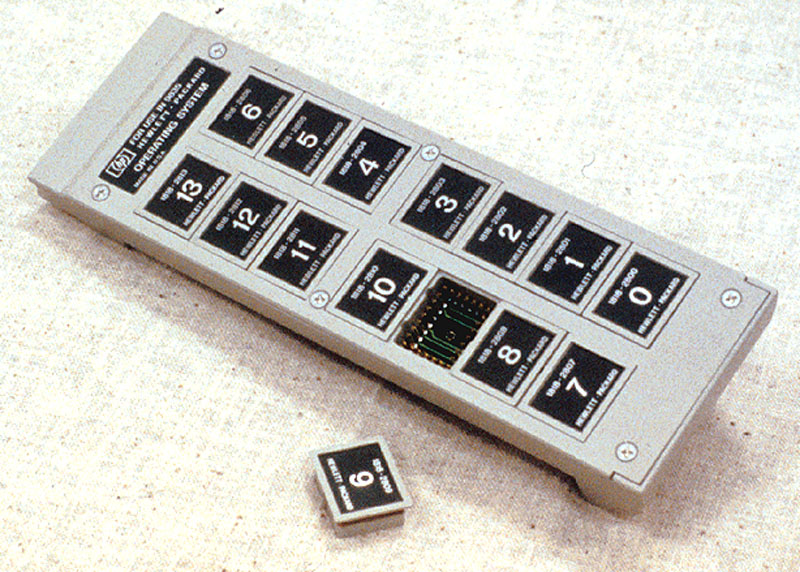
Idiot! They're OS ROM (R O M) modules for a HP 9835 calculator. They're
totally useless for anything else.
Joe
More:
"The ROMs used in the 9835 are rather unusual. The ROM carriers look
exactly like the ROMs for the HP 9825 but without labels. But instead of
only holding one ROM, each carrier has sockets for four ROMs. The
individual ROMs are small square boxes similar to those used in the HP 85.
The 9835 ROMs come in sets of 1, 2 or 4 individual ROMs and the ROMs can be
mounted in any order in the carrier or in any position in the 9835. The
fourteen operating system ROMs are similarly mounted in a pull out drawer
on the left side of the 9835. Flash! I've just learned that one collector
has a 9835 with ROM drawers that hold six ROMs each instead of four. That's
something that I haven't heard of before. "
See more at <http://www.classiccmp.org/hp/hp9835.htm>
Joe
Not affiliated with seller.
These don't look like anything I've seen before.
"20 HP Calculator RAM Mod's #5 1818-2805 NEW"
http://cgi.ebay.com/ws/eBayISAPI.dll?ViewItem&item=2792071263
The seller here says Calculator. I wouldn't jump so quickly to that
conclusion. In the slim chance they fit something a lister has...
John A.
Hi,
Does anyone know how much 3-phase power (at say 220v) a KL-10 requires?
I just acquired some commercial space to move my collection into and I
noticed today that there are several 220v 3-phase power drops that I
hadn't noticed previously. I'm kind of hoping that I'll have enough
3-phase to be able to start resurecting my KL-10, but I need to know how
much I need.
Thanks.
--
TTFN - Guy
On Mar 5, 18:16, Paul Koning wrote:
> The rules aren't quite what you said -- the transceiver rule is that
> you put them on the stripes. You can put transceivers on adjacent
> stripes.
You can, but I was always told (and read somewhere) there should be two
stripes between, not one.
> Cable ends are NOT at stripes; the recommended cable
> lengths are funny numbers chosen to get reflections not accumulate
> over multiple segments. The rule says "odd multiples of a half wave
> at 5 MHz, which translates to odd multiples of 23.4 meters.
I agree, I forgot about that. Oops!
--
Pete Peter Turnbull
Network Manager
University of York
On Mon, 8 Mar 2004 Guy Sotomayor <ggs(a)shiresoft.com> wrote:
> Hi,
>
> Does anyone know how much 3-phase power (at say 220v) a KL-10 requires?
>
> I just acquired some commercial space to move my collection into and I
> noticed today that there are several 220v 3-phase power drops that I
> hadn't noticed previously. I'm kind of hoping that I'll have enough
> 3-phase to be able to start resurecting my KL-10, but I need to know how
> much I need.
220V 3-phase? Hmm. I think somewhere around 40A per phase should do it.
We ran our KL-10 on 410V 63A/phase, but that was a bit overkill.
But I'm also pretty sure that 410V 16A/phase was not enough.
Johnny
Johnny Billquist || "I'm on a bus
|| on a psychedelic trip
email: bqt(a)update.uu.se || Reading murder books
pdp is alive! || tryin' to stay hip" - B. Idol
Any one have thoughts on 9-track tape drive "O" rings?
The O ring on my TS-11 was under compression for some time and appears
to have stretched to the point where it is too large to fit a tape on
the hub. I'm guessing this is a common problem.
I would think these O rings are pretty common. Does anyone have a
source?
-brad
>> DA26 : never seen it used
>
>Used on an NCD 88k color x-windows terminal for video. Probably also
>used on other things.
IIRC, its also used on the Apple DOS cards. I'd have to go check a cable
to be sure, but I'm pretty sure its 26 pins, in a DA shell (same size
shell as AUI uses)
-chris
<http://www.mythtech.net>
Hi all,
Recently I found this really cute, but weird-looking thingie. It
seems to be a handheld tool that allowed operators, field engineers
and so on to manually punch a bit of code onto paper tape, or to
modify (patch) an existing tape.
It was made by, or distributed by "Data Processing Accessories"
in the U.K.
Ideas, anyone?
--f
On Mar 5, 22:47, Tony Duell wrote:
> > As Paul and der Mouse suggested, I agree that it would be worth
making
> > up a short flexible AUI cable. Cat 5 is 100-ohm, and ribbon cable
is
> > not far off that IIRC; you could use STP instead of UTP to get the
> > shield (some Sun cables are STP), or just ignore it for really a
short
> > (a few inches) cable. Or a chunk of old good-quality serial cable
>
> I wonder if IDC cable would work for a very short (a few inches)
length?
> Just enough to turn the transceiver 'round the corner' or whatever.
I'm fairly sure it would, and that's what I meant when I mentioned
ribbon cable. Didn't der Mouse suggest that? I have a Newbridge ATM
Route Server which is a Sun chassis mounted in a Newbridge box, and I'm
fairly sure it has a similar arrangement to connect the Sun port to the
panel on the Newbridge case.
I'm a great believer in adhering to standards. Most of the time :-)
In this case the standard says, in effect, "use this cable and this
layout and it's guaranteed to work". It doesn't say it's guaranteed
not to work if you don't :-)
--
Pete Peter Turnbull
Network Manager
University of York
Does anyone know of a source for replacement
lamps for a PDP-8/E console? I have an otherwise
immaculate console board that I would like to
use in its original condition, e.g., w/o an
LED conversion, but one of the bulbs has been
broken, and, at any rate, additional failures
are likely.
Thanks,
Bill
To Whom it May Concern,
I have some old Tandy computer equipment and many secondhand 8" Disks. I have been told that you might be interested? Who are you and what do you do?
My name is Les and I live in Plymouth.
Les
>I'm trying to figure out what this board is/does. It's a DEC hex height
>board marked M8597A. On the back it's also marked PDP 8A Control.
DX10, PDP8 interface
Megan Gentry
Former RT-11 Developer
+--------------------------------+-------------------------------------+
| Megan Gentry, EMT/B, PP-ASEL | email: mbg at world.std.com |
| Member of Technical Staff | megan at savaje.com |
| SavaJe Technologies, Inc. | (s/ at /@/) |
| 100 Apollo Drive | URL: http://world.std.com/~mbg/ |
| Chelmsford, MA 01824 | "pdp-11 programmer - some assembler |
| (978) 256 6521 (DEC '77-'98) | required." - mbg KB1FCA |
+--------------------------------+-------------------------------------+
Message: 2
Date: Fri, 5 Mar 2004 08:00:09 -0500
From: "Brian Mahoney" <brianmahoney(a)look.ca>
>Almost a year ago, April 24, 2003, the Toronto Star did an article on
>collecting featuring myself and Kevin Stumpf. Even though the guy took lots
>of shots in my basement, regretfully only Kevin made the big time, standing
>in front of his ex-Ontario Power Generating IBM 1800. (Maybe it was
>because
>he had a tie on and I didn't.)
>We got the whole back page of the Technology Today section, well ... except
>for a gigantic Canon ad. Kevin's site was mentioned as was my own
>collector's list at Geocities (which everyone here should be on!)
>If there is any interest, I could scan this aticle and put it up on my site
>for a bit.
>BM
Ping!
By a staggering coincidence, the 1800 mentioned (which is mine - Kevin had
been storing it for me) finally showed up at the Corestore today, in a very
large truck! I'll be updating the web page below with more photos tomorrow
night.
A couple of the pics from the article mentioned (I presume the same article)
are at:
http://www.corestore.org/1800.htm
If I can get my arse into gear and this thing running, I'll drag it to VCF
East... IPL diagnostics from punched cards, wheeeeeee! :-)
Mike
http://www.corestore.org
_________________________________________________________________
Learn how to help protect your privacy and prevent fraud online at Tech
Hacks & Scams. http://special.msn.com/msnbc/techsafety.armx
>> IIRC, its also used on the Apple DOS cards. I'd have to go check a cable
>> to be sure, but I'm pretty sure its 26 pins, in a DA shell (same size
>> shell as AUI uses)
>
>That's not correct. The size of the shell is between a DA and DB, and it
>has 19 pins.
Are you sure? Are you thinking of the same cable that I am?
I just did a quick check, and I found via Google a page that gives the
pinout for the Mac's PC Compatibility Card's cable. It shows it as a 26
pin connector.
I'm no longer at work where my cables are, so I can't physically inspect
them. I thought the connector on the DOS Compatibility card was the same
"physical" connector that is on the PC Compatibility card (although the
cables, and I believe the pinouts are different). Again, I can't
physically check mine, so I can't be 100% sure. Maybe the DOS card
version was different (I know the cable for the DOS card is a 4 headed
cable as it breaks out the joystick via the cable, while the cable for
the PC card is a 3 headed cable with the joystick port residing on the
card itself).
And of course, Apple had a 3rd style card for the Performa 630/640 DOS
model. I haven't really played much with mine of that model, so I don't
know what it has (actually, I seem to recall that it didn't use a
loopback cable at all)
And then there are always the Orange Micro versions, all bets are off
with those. I've never really played with them.
But maybe you are thinking of a different card then I am. Apple also had
an Apple IIe card for the Mac that had a loopback cable. I don't recall
what it has for connectors. And I have no idea what possible cards there
were for the Apple II series, or what possible other similar cards were
for the Mac beyond Apple's, Orange Micro's, and Reply's (which was really
the same as the first Apple card as it was built by Reply and first only
available from Apple, later to be available directly from Reply)
-chris
<http://www.mythtech.net>