I am looking for ek-mic11-sg-001, it is listed on Manx, but the link there
does not work since the original site disappeared. I have the archive tar of
Manx but it isn't in there either. Does anyone have a copy?
Thanks
Rob
A couple weeks ago people expressed interest in my salvaged MacSSH source
and I finally got a round tuit. It's very pretty, all symmetric and frilly,
and perfectly circular.
I make no guarantees. If you get it working, I want your changes. :) However,
I have salvaged as many of the resource forks as I can and manually massaged
the files. I have not tried to build it. CW6 or better strongly advised. I
threw the .sit into
gopher://gopher.floodgap.com/1/archive/by-request/source-code
--
------------------------------------ personal: http://www.cameronkaiser.com/ --
Cameron Kaiser * Floodgap Systems * www.floodgap.com * ckaiser at floodgap.com
-- You're only as good as the last problem someone had. -- Ballmer on security
ben bfranchuk at jetnet.ab.ca wrote:
> Does one have to go with ebay? Can I just send you the $$$?
Yes that would be fine. You don't need to use eBay but for some reason many builders seem to prefer it even though it is more expensive. I don't understand why but I guess that's their choice. It is one of life's many mysteries.
Thanks!
Andrew Lynch
Mouse wrote:
> I sent them mail saying "I would want documentatino on how to talk to
> the hardware, because your GUI will not be suitable for me" (any UI
> that's suitable to most of pretty much any market has an excellent
> chance of being somewhere between unpleasant and unsable for me).
Well, since I wrote the user interface for KryoFlux, I'd be very
interested in what would work for you, even if you don't intend to use
whatever changes we might make.
The GUI was designed to be extremely easy to use, even for
non-technical people such as those in libraries and archives. There
are advanced features, but they are mostly hidden unless specifically
wanted. I think it turned out pretty well, if I do say so myself. Some
examples:
http://www.softpres.org/kryoflux:ui:stream-plothttp://forum.kryoflux.com/viewtopic.php?f=2&t=262
As it happens, even though I wrote the graphical user interface, I
didn't need to know anything about how to talk to the hardware. The
GUI just uses the existing software supplied. Anyone could have done
it really.
> Document it enough I can write my own software to drive it, and I might
> be interested in the hardware. I will not be interested in
> undocumented hardware and, as mentioned above, I will not be interested
> in the software (unless it's open sourced, and then only insofar as it
> forms documentation on how to talk to the hardware).
That is fair enough. If it is not suitable for you, it's just not. We
do have the stream file/protocol documented, which is the main
complicated part: http://www.softpres.org/kryoflux:stream
It would be nice to document completely as you want, but we have very
limited resources, and unless there is much demand for something, we
would find it hard to prioritise it. I think you might agree that your
requirement is a little unusual... :)
Kieron
like this
http://pckeyboards.stores.yahoo.net/customizer.html
On Sat, Nov 5, 2011 at 11:56 AM, Zane H. Healy <healyzh at aracnet.com> wrote:
> I wish I had a good idea. I'm typing this on an Apple Extended II ADB
> keyboard plugged into a USB-to-ADB converter so I can use it on my Mac Pro.
> On the PC I tend to use a no-name keyboard I got 20 years ago, but really
> like the SGI PS/2 keyboard that came with my O2. I really wish someone
> would make a good replica of the Apple keyboard, but as a USB keyboard. In
> part because I love the shelf behind the function keys. This is also why I
> like the IBM Model M keyboards.
>
> I seem to remember someone is making a keyboard like you're looking for,
> but it isn't cheap.
>
> Zane
>
>
>
>
> At 6:46 PM +0000 11/5/11, Mark Benson wrote:
>
>> I'm looking for a good action, high quality keyboard of the same
>> action/type as an IBM Model M or the really great Cherry keyboards of 'the
>> day' to use on modern machines to code with and work at a terminal. My
>> Logitech G110 is fine for general work (it's a decent keyboard in it's own
>> right) but the 12 macro keys on the end confuse the b-jebus out of me and
>> also the key-spacing is designed for gamers no typists.
>>
>> I don't want to fudge an older PS/2 keyboard via a USB adapter as it
>> generally doesn't work 100% right and I occasionally get keys dropped or
>> doouble-typed. I also need the 'Windows' keys that a lot of older decent
>> keyboards lack.
>>
>> I'm willing to drop decent money to get one, so anyone got any ideas?
>>
>> --
>>
>> Mark Benson
>>
>> http://DECtec.info <http://dectec.info/>
>> Twitter: @DECtecInfo
>> HECnet: STAR69::MARK
>>
>> Online Resource & Mailing List for DEC Enthusiasts.
>>
>
>
> --
> | Zane H. Healy | UNIX Systems Administrator |
> | healyzh at aracnet.com | OpenVMS Enthusiast |
> | | Photographer |
> +-----------------------------**-----+------------------------**----+
> | My flickr Photostream |
> | http://www.flickr.com/photos/**33848088 at N03/<http://www.flickr.com/photos/33848088 at N03/> |
>
Four Ubuntu 11.11 machines in the past week, thanks, and that's even when it isn't my job. Please don't assume knowing something about VMS implies NOT knowing something about UNIX.
-Dave
--
Dave McGuire
New Kensington, PA
leaknoil <leaknoil at gmail.com> wrote:
>On 11/4/2011 5:07 PM, Gene Buckle wrote:
>>
>> Hell, I'd offer up that VMS 5 was more secure than your average unix
>> variant right out of the box.
>>
>> g.
>>
>
>I get the feeling you guys haven't installed a current linux distro in a
>very long time. Tell me how debian is less secure out of the box ? Oh
>you can't. Right sorry.
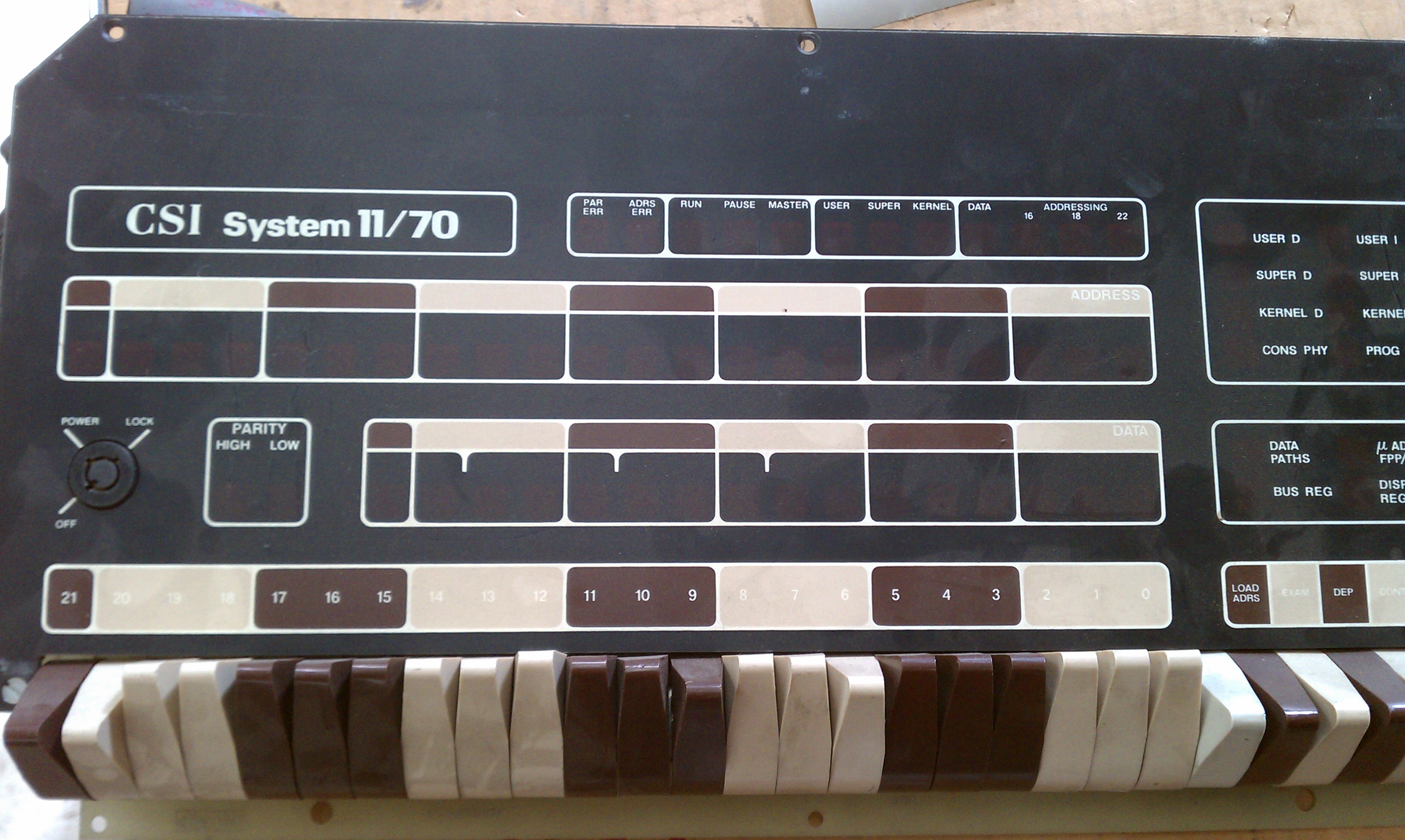
> Here's a variation of the pdp 11/70 with a chocolate-brown and white color
> scheme: http://661.org/images/csis1170.jpg
CSI was a computer typesetting company. Pretty much cradle-to-grave in terms of end user support.
"Composition Systems Incorporated" I think.
There was at least one other company that specialized in typesetting for classified ads that used PDP-11's for typesetting. Their name is not coming to mind at the moment but they were surprisingly common at metropolitan newspapers. I remember them using the 3270-like capabilities of VT-oh-something terminals.
Tim.
When running OS8 on a PDP8/a system I get an error message that reads "ahain
error". Has anyone ever seen or heard of this. I cannot find info anywhere
on this. One thought we have is that maybe the message should read "chain
error" and was mis-spelled in the program that generates it. Any thoughts?
Thom
I am sure that I represent a very small number of the members of this list,
the great majority of whom have more technical knowledge in their pinky
than I have in my whole body. But I may represent those of us at whom the
Kryo-Flux is at least partially aimed. I built my Sol-20 from a kit
because I wanted a personal computer, could program in BASIC, FORTRAN, a
little COBOL, a little C, and I knew which end of a soldering iron to hold
on to. I am still a Heathkit/Dynaco kind of a hardware guy. I have a
general understanding of maybe half of the technical concepts discussed on
the list and can't contribute much beyond my 'power user' knowledge of
S-100 machines and CP/M and what I remember from Sol Libes' S-100
Microcomputing, PC Tech Journal, BYTE, Interface Age, etc. I could patch a
BIOS if necessary but my longest assembly language routine was about 13
bytes long. But I lurk here because I still have my Sol, some NorthStar
drives, and even an 8" drive (which I once had Steve Ciarcia help me get
working on my IBM AT!).
My interest in the KryoFlux and the DiscFerret is both personal and
potentially of use to the wider micro community in that I still have
hundreds of 5.25" and 8" disks, many of them original, many more not. I
simply enjoy tinkering with my machine and old software. I publicly give
loud thanks to Jim Battle, Dave Dunfield, and others who have provided
emulators, but I lack the determination (and space) (and my skills are VERY
rusty) to set up my PC and Sol with both 5.25" and 8" drives under both
NS-DOS and CP/M to read (and write?)and transfer the variety of hard and
soft-sectored formatted software I have (with Kryo-Flux and DiscFerret in
their present states). And I want to be able to preserve this software.
Most of the big-name commercial software I have has already been preserved
(but I may have a missing version). I was a software junkie back then and
have more stuff than I can even recall. I am more than willing, nay, I am
eager to save this stuff. I can offer my time and effort but I don't have
the skills at the currently necessary levels to further the general effort.
But what I need is a more semi-'turnkey' solution. I want something like
Grumpy Ol' Fred's Xeno-Disk running under Windows or OSX or linux talking
to a Kryoflux or DiscFerret attached to my still operating (for now) 5.25",
8" and plain vanilla 3.5" drives (and one at a time is fine). I want to be
able to save my old programs in a format that can be used by the emulators
available. I will send copies (and what documentation I have or can
create) to any preservation society that wants it. This may not be much of
a contribution but it is what I can do. And I suspect that there may be a
whole lot more of 'me' out there. Whether we do it for fun, for nostalgia
or for giving back to the micro community, it has got to be a 'plug 'n'
play' type solution. I don't have and never expect to see some of the more
exotic formats that some on this list deal with regularly. OTOH, I believe
that I represent a mainstream portion of 'old geeks' who were the early
adopters in the '70's and '80's and can still contribute something now if
we have the tools.
Maybe what I want will eventually happen. Maybe publicity efforts by
libraries, preservation societies, etc. can make people aware that their
cache of old disks has value and that they can contribute them directly or
they can buy a device that easily connects their current computer to older
drives so they can do it themselves. I don't mind paying $150 for the
hardware AND software to do this. I hope that there are others (hopefully
many others) like me out there. Are there? I don't know, but if you are
reading this, please chime in.
I applaud the people involved in these efforts. I have sent N* formatted
disks and some technical docs to Phil (and have offered the same to
KryoFlux). But that's about all I can do now. I'll just keep 'lurking'
and hope that a solution which fits me will get here before I 'shuffle off
this mortal coil.'
Bob Stek
Saver of lost Sols
Hi all,
I wanted to give a little update on our progress making our universal
floppy controller KryoFlux even better.
For those that have not heard of it - what does it do?
- Reads all kinds of floppy disks with a "standard" PC drive (e.g. 3",
3.5", 5.25", 8")
- Reads custom formats used by vintage computers like Acorn Electron,
Apple, Amstrad CPC, Archimedes, Atari 8-bit, Atari ST, BBC, Commodore
64, Commodore Amiga, MSX, IBM PC, PC-8801, Sam Coupe, Spectrum, E-MU
Emulator & Emulator II, DEC RX01 & RX02
- Stores _all_ data present on disk, including custom formats and copy
protection (e.g. for preservation / long term storage of original game
disks)
- Connects comfortably via USB
- Track data visualisation built right into the GUI:
http://softpres.org/kryoflux:ui:stream-plot
- Host software available for Windows, Linux and Mac OS X.It's free for
private use!
- Hardware schematics are public as well and can be freely used in an
private, non-commercial environment. That means the hardware is free as
well, you don't have to buy anything to use it.
- Pre-built hardware (only EUR 90.-) available for those that can't or
don't want to build something on their own.
- Already used by hundreds of users as well as archives, museums and
libraries all around the globe:
http://www.wired.co.uk/news/archive/2011-05/10/british-library-digital-arch…
How did we make it better?
- Now also writes images back to disk. Writing IPF files creates
pristine clones of preserved disks long gone before. It also writes data
other controllers refuse to write.
- Now supports one-pass dumping of "flippy" disks with a modified 5.25"
drive. The problem dumping these is explained here:
http://forum.kryoflux.com/viewtopic.php?f=3&t=3#p1991
<http://forum.kryoflux.com/viewtopic.php?f=3&t=3#p1991> , comprehensive
video tutorial explains how drives can be modified:
http://forum.kryoflux.com/viewtopic.php?f=2&t=253#p2021
<http://forum.kryoflux.com/viewtopic.php?f=2&t=253#p2021>
- We released the full source code to our own format, IPF, introduced
over ten years ago, that stores original data as found on original
disks, e.g. custom formats and copy protection.
We spent over ten years on preserving games, now KryoFlux brings
extended floppy imaging to home users as well.
More information is available on our website: http://www.kryoflux.com
Or check the trailer if you like: http://www.youtube.com/watch?v=FOtwq5eqeuA
Can we do better? Please let us know!
Best,
Chris
At 01:38 PM 11/4/2011, THOM RESTIVO wrote:
>When running OS8 on a PDP8/a system I get an error message that reads
>"ahain
>error". Has anyone ever seen or heard of this. I cannot find info anywhere
>on this. One thought we have is that maybe the message should read "chain
>error" and was mis-spelled in the program that generates it. Any thoughts?
The OS/8 USR (User Service Routine) has a CHAIN function that allows a
program to exit and start up another program. For example, the FORTRAN
compiler has multiple phases and chains from one phase to the next.
CHAIN requires that the program being chained to be on the system boot
device (SYS:), otherwise you'll get a CHAIN ERROR message from USR.
What program are you using when you see this error? Are you running
that from the SYS device? If not, that's the fix.
As far as the "AHAIN" versus "CHAIN" - I don't know why it's spelled
incorrectly, but it wouldn't surprise me that it's someone's idea for
bumming a bit for some reason from an infrequent error message.
-Rick
> RCA had a bit-slice part in one of their 1970s COSMOS databooks, with an
> app note in the back, but I've never been able to find that particular
> COSMOS databook again
I think... it was in the back of one of their memory databooks.
I think that everybody except AMD really fell flat trying to fit bitslice parts into their marketing.
> A meta-comment: I've been watching the KryoFlux discussion and,
> whatever I may think of the hardware[1] or past management policies[2],
> I'm very positively impressed with the people who are representing
> KryoFlux[3] here.
>
[..]
>
> [1] What I've heard sounds good; I've never even seen it personally, so
> I can't say much authoritatively.[4]
>
>
> [4] Given that it hooks up to a stock drive (at least that's the
> impression I've gotten) and is largely open and getting opener, I'm
> tempted to get one against possible future need. (I'm not thrilled
> by USB, but I've got enough USB-capable machines, and will likely
> get more, that it's tolerable. And, while I currently have no real
> use for it, it is not unlikely that will change someday, and I'd
> hate to discover them gone when I do want their product.)
Chuck has passed the offer of trying the board for free (ok, return postage, as I can't print a US or Canadian label from here).
If you want to try it, please feel free to chime in. I just can't change the status of the software for now, so you would have to go with the binaries.
Cheers!
> I may be dense today, but after digging through the kryoflux.org site I'm
> not having any luck finding the schematic.
Don't be shy, download the software (Win32/64 is latest). It's free, no registration required, and schematics are included.
Cheers!
> Being a hardware geek myself, are current schematics available for the
> kryoflux? I had asked a year or so ago and got pointed to old schematics
> that were a couple revisions out of date.
Just download the latest software package, it has the schematics included.
Enjoy.
Cheers,
Chris
Heh. OpenBSD's original claim to fame was that it provided a certain arrogant ass with a way to thumb his nose at his peers. I'm glad enough grownups eventually joined in to make it a useful project.
-Dave
--
Dave McGuire
New Kensington, PA
leaknoil <leaknoil at gmail.com> wrote:
>On 11/4/2011 7:33 PM, Mouse wrote:
>>> What would you do to a current Debian distro to make it more secure ?
>> Boot the NetBSD install CD.
>We are heading into platform war territory here but, shouldn't that be
>OpenBSD ? Security was their claim to fame over NetBSD. Still it
>wouldn't be any more secure than a current linux install. I think we are
>talking about things as they were ten years ago. Today most OS are
>really pretty tight out of the box. Much more so then they were in 1988
>or 2010 for that matter.
2011/10/31 Eric Smith <eric at brouhaha.com>
> Benjamin S?lberg wrote:
> > So if you multiplex 8 leds you need 8 times the peak current to keep the
> > same luminance ?
>
> 8:1 multiplex requires 8 times the peak current to get the same average
> power. Years ago I saw some claims that with multiplexing you can use
> lower average power for the same perceptual brightness, due to retinal
> persistence. However, I've seen other people claim that this is not true.
> It would be entertaining to set up a double-blind test and find out.
>
>
I would expect a double-blind person would say that he couldn't see any
difference :-)
Joke-a-side.. If multiplexing really did save power then just pulsing a
single led would do the same..
It might be true... think bicycle lights ?
--
Med venlig hilsen / Best regards
Benjamin S?lberg
On 4 Nov 2011 at 0:26, Chuck Guzis wrote:
>>/Not only does it support raw imaging of flux transitions, we also /
>>/support output of sector image formats for pretty much all major home
/>>/platforms of the last 25 odd years (as well as a few strange ones). /
>That's a pretty bold claim. I'm not saying that you haven't, just
>that I've got several cabinets full of samples and some are very odd
>indeed.
>Suppose I were to send you a specimen copy of one without providing
>any details (pretty much what I'm given to work with). Do you think
>you could send me a duplicate and a sector-by-sector dump?
>
>I'd really be impressed.
Chuck,
how about the following: You just try this for yourself; it already
supports so many generic FM and MFM formats, chances are, a broad range
will work out of the box.
My offer would be as follows: I send you a board, you give it a try with
your various test disks. If your data does not read as expected, or
there is something we don't support yet, but should be supporting, you
make a STREAM dump and put it on our FTP. We'll take a look. I'd have to
ask for a EUR 50.- deposit, which I will gladly refund the moment you
send it back (are 60 days long enough to give it a try?). I am not
asking you to sign anything and it does not come with any obligations.
Plus: If you'd want to keep it, you keep it for EUR 50.-. Your only risk
would be the return postage... And I'd of course like to hear all
feedback you have, even if negative, here on the list.
What do you think?
--Chris
Had a IIe, a gs, and several Mac SEs and SE 30s take missing this past
weekend, along with some empty filing cabinets and a pedestal for a TI
DS-10 drive. DS-50 disappeared a while back. Anyone else having a problem?
jbdigriz
I figured it was about time I gave VMS a shot, but to get a hobbyist license I need to join Encompass US. encompassus.org seems to be down in a not-so-good way. Anyone have any insight on that?
- Dave
Hi,
Some time ago, I asked for some help locating documents for
the Percom LFD-400 disk system. A number of people kindly
helped out so I thought I would give a brief progress report
to the list.
1) I removed various hacks on the MP-C and MP-S boards to
return them to "factory" spec.
2) I implemented a switch on the MP-A CPU board to turn the
onboard RAM on and off. This made debugging much easier.
At this point, I was able to boot into SWTBUG with the
MP-A RAM turned on.
3) I debugged several problems with the GIMIX 16K static RAM
board. The original owner reported that this card always
caused problems. No schematics seem to be available for
it so the troubleshooting was slow going. The most
interesting problem was that one of the 5 volt regulators
(there are 4 on the board) was only providing 1.8 volts.
As well as powering one of the 4K banks, this regulator
was supplying power to some of the address decoding chips.
With the out of spec supply, these chips were interfering
with the correct operation of the address bus, preventing
the whole system from operating. Other problems included
some dead RAM chips, some bent pins on socketed chips and
39 undocumented dip switches. If somebody turns them up,
I would love to get the docs for this board. At present,
I have determined that 16 of the switches control the address
of the 4 4K banks of RAM. I have left the other 23 switches
as they were set when I acquired the system. Experiments as
simple as turning them all on or off result in a non-
functioning system.
4) I implemented the MP-B motherboard enhancement documented
in the September 1978 issue of Interface Age. Fortunately,
my MP-B was built with sockets, so the modifications can be
easily removed if it should be necessary to restore the
system to "factory" behavior.
5) I tied the MP-B mod into the address decoding on the 32K GIMIX
card and the system now has 48K less 32 bytes of RAM and boots
into SWTBUG with the MP-A RAM turned off.
6) I then proceeded to the Percom floppy interface board and
determined to my great pleasure that it was functioning perfectly.
I was able to jump into MINI-DOS+ with the SWTBUG 'Z' command,
format a disk and create some files. I did this initially with
a different 5 1/4 inch floppy drive as the original Percom (Shugart)
drive had some problems.
7) I corrected two issues with the Percom drive and it now functions
correctly. The first issue was shorted caps on the logic board.
These were easily identified as they were smoking. The second
problem puzzled me for a while. The drive worked fine as long as
I did not put the cover on it. MINI-DOS is, unfortunately, pretty
cryptic with its error reporting, only giving integer error codes.
The magazine articles that I got don't document them. I finally
figured out the problem when I noticed that the drive stopped working
when I leaned over it. Turned out that there was some dust partially
obscuring the index sensor. With the lid off and the overhead light
shining on the drive, there was enough index signal for the drive to
work. Put the cover on, or even shade the drive, and the internal LED
was not producing enough light to detect the index holes.
Interestingly, canned air was not enough to dislodge the dust. I had
to reach in with a small, soft, unused paint brush and poke around
to get it to the state where it works reliably with the cover on.
One neat thing about the drive is that it has two sets of index and
write-protect sensors. It is "flippy". It only has one read/write
head, but you can insert a double sided diskette in either side up
and use both sides.
So, now I need some software.
For those visually inclined, I put some pictures here:
http://wsudbrink.dyndns.org:8080/swtpc6800/
Pictures 1 to 11 are of the AC-30 cassette interface and CT-64 terminal
that I will be working on next.
Pictures 16 and 17 are of the 6800 cover (I'm missing the screws).
Pictures 18 to 21 show the output and listing of an SWTPC BASIC program I
wrote to solve last week's Car Talk puzzler.
Pictures 22 to 25 show SWTBUG working and using both serial interfaces.
Pictures 27 and 28 show booting from SWTBUG into MINI-DOS+, getting a file
listing and loading BASIC from a diskette.
Pictures 30 to 35 show the beast itself. The cards from front to back are
1) The GIMIX 32K RAM
2) The GIMIX 16K RAM
3) The Percom floppy interface
4) The SWTPC MP-A CPU
5) The I/O card to the left (slot 0) is the MP-C and the card to the right
(slot 1) is the MP-S.
Picture 34 also shows the Percom floppy drive.
Picture 35 is from the back. You can see the switch to control the MP-A
RAM and also the small brown card that is the MP-B addressing enhancement.
Bill
> From:?David Griffith <dgriffi at cs.csubak.edu>
>
> Here's a variation of the pdp 11/70 with a chocolate-brown and white color scheme: ?http://661.org/images/csis1170.jpg
>
> --
> David Griffith
> dgriffi at cs.csubak.edu
The Rhode Island Computer Museum has two 11/70 panels from CSI.
The CSI systems ran a regional newspaper.
--
Michael Thompson
Has anyone tried to read the data from the Mostek 3851 PSU (ROM, I/O)
used with the 3850? I am looking to replace these tiny computers with a
modern FPGA or similar...
Thanks,
John :-#)#