At 1:01 -0600 1/5/12, Mouse wrote:
> > [In FORTRAN, a]ny variable whose name starts with the letters I J K L
>> M or N (alphabetic letters between I and N (which is the start of
>> "INteger")) is assumed to be an int, unless you tell it otherwise.
>
>...and others are assumed to be real. But is the first two letters of
>"integer" where that came from? I'd always assumed it came from
>mathematical convention, which uses letters i through n (often modified
>with subscripts and the like) for things such as summation indices that
>are most appropriately translated into programming languages as
>integral types.
"Perrier".
(H to O, exclusive)
Sorry for long-delayed response, and bad pun.
--
- Mark 210-379-4635
-----------------------------------------------------------------------
Large Asteroids headed toward planets
inhabited by beings that don't have
technology adequate to stop them:
Think of it as Evolution in Fast-Forward.
I'm not on the net everyday, I'm working my way through the dialog.
What's most important is that someone who w/o doubt can image them. I don't care about the physical disks so much. Just that they're in the hands of someone who can make the most of them (and yes I would like to partake in the digital booty). All I have thus far is an Apollo m/b. Don't even know if it works, but maybe someday...
----- Original Message:
> Date: Thu, 12 Jan 2012 12:36:03 -0800 (PST)
> From: Gene Buckle <geneb at deltasoft.com>
<snippage>
> For those interested: http://www.pagetable.com/?p=46 - there is a zip file
> linked there that will allow you to create byte-exact versions of the
> following versions of BASIC (using the cc65 assembler):
> Commodore BASIC 1
> OSI BASIC
> AppleSoft I
> KIM-1 BASIC
> Commodore BASIC 2 (PET)
> Intellivision Keyboard Component BASIC
> MicroTAN BASIC
What, no 8K AIM65 version? Hrmph!
BTW, thanks to Dwight and another AIM65'er the ROMs and manual for the
little-known AIM65 Pascal have been (re)discovered and the original author
is even still around, so as soon as we get past the memory map issues
hopefully there will be *four* languages for the AIM65: BASIC, Forth, PL/65
and Pascal (plus the assembler of course).
mike
-------- Original Message:
> Date: Wed, 11 Jan 2012 19:18:12 -0500
> From: Dave McGuire <mcguire at neurotica.com>
> Subject: Re: "Modern" e-mail clients suck! (Was: QUOTING (Was: Truce,
> compromise reached? - Re: teaching programming to kids - Re: Looking
> for 8080/Z80 BASIC
> Is this where we get to compare resumes? Oh goodies! Add another digit
> to the quoted number of machines in your current datacenter and then
> you'll be in the right order of magnitude to compare to datacenters that
> I've managed nearly single-handedly.
...
> I'm a professional...
---
You wouldn't know it from reading your "mine's bigger than yours" posts like
the above and your customary "I'm right and you're an a**hole", not to
mention the amount of time you seem to have for these tired same-old
same-old MS/Win-bashing threads every couple of months; they really don't do
much for your professional image.
Just imagine how much more work you could get done if you practiced a little
restraint...
On a related note, what are people's feeling's about the following....
I've recently had some discussions with someone who collects a particular
brand of classic computer from the early 1980s. He has a few of these but
they are never, ever switched on or tested. He doesn't want to test them
as he feels doing so may damage the old electronics. Consequently they are
never plugged in.
This attitude is an anathema to me. I strive to maintain computers in my
collecton so they can be fired up and demonstrated to people working as
they were in the day. Otherwise they are inert "dead" collection of metal
and plastic (still of interest as regards case design maybe). I like to
know if a computer is working or not, and if not perhaps try to fix it. To
me, if you won't start up an old computer for fear that something will (or
has) failed then, for practical purposes, it's broken. The end result is
the same. It's inert.
Is this "scared to switch on" attitude common in the classic computer
community, or do most reflect the same feelings I have about it.
Terry (Tez)
> Date: Wed, 11 Jan 2012 10:58:51 -0200
> From: "Alexandre Souza - Listas" <pu1bzz.listas at gmail.com>
> I'd like to understand what you, old buffs, has with newer technology.
> I have gmail and (personal servers) accounts, use web, windows XP and have
> NO problems with all of that.
>
> Someone here is clearly wrong.
I think what you have to keep in mind is that, as in most instances of
closed minds, prejudice and ignorance, the very people who bad-mouth
Windows, Yahoo etc. the most also brag the loudest that they would not stoop
to using it; therefore they obviously have no relevant experience and their
opinions have no more authority than a KKK member's opinion of a
non-caucasian's intelligence. Fortunately their frequent personal attacks on
anyone who's 'on the other side' are generally less violent... ;-)
It's probably safe to say that on average Windows users are more interested
in just _using_ their computers than in tuning and tinkering and as a result
probably have more issues than your average Unix or Linux user, but that's
more a reflection of their interests or needs, not their intelligence or
even their computer's OS.
But if a business' Windows system really needed rebooting every day I
suspect their IT person would very shortly be looking for another job.
And when people who say they support a Windows installation complain about
not being able to back up or migrate to another disk/computer as I read in
the previous round of this tedious ritual, that tells me more about their
competence than any flaws in Windows (and there are some, to be sure).
Sadly, no matter how often or how many people complain that they're tired of
these rants, the folks in question either don't care or just can't help
themselves.
Apologies for adding to the pile...
m
- BA350 filler/faceplate, standard DEC tan, clean front - needs a home for the price of shipping
- DEC Y SCSI BN21V-0B (2 F AMP - 1 M HD50), $2O or other reasonable offer
-Jim/Boston jtp..chinalake.com
>> > for aprticualr ICs which then go to collectors who never power
>> them up...
>> They were a dot matrix, very fast and had a pneumatic bladder under
>> the head to lean it forward to the platten.
>> Zinc diecast case I think
>> iirc one 4040 did machine control the other was input
>> buffer/character
>> set to pin pattern
>
> I suddently want one of these :-) I can't see it would be worth
> shipping,
> so I am unlikely to get one, but it sure sounds fun....
>
Yes, you do want one (or two) of those :-)
I used them a lot during the '80s. We had one at work as our main
printer for listings etc, and we sold a bunch to a customer who used
them for printing pallet labels with barcodes and large text used on
their production line for submersible pumps, in a dirty industrial
environment. They were built like tanks. The print head used a patented
"flexhammer" system, instead of pins the dots were made by leaf springs
which had their ends bent over and shaped to a little square point. The
springs were held bent off the paper by solenoids, which de-energised to
print the dots, whereby the spring would shoot forward against the paper
to make the dot and then rebound and be held by the magnet again. They
claimed the printheads had a life of a billion characters or something
like that. They would print on just about anything up to thin card,
provided it had tractor feed holes. They were absolutely indestructible,
you could probably run over it with a lorry without even denting it. The
only thing that ever broke was a small bulb in an optical encoder on the
carriage motor, that had to be replaced about every other year.
There were two models, the 4540 which was two-colour (black and red),
and the 4544 which was four-colour with a very wide ribbon. Ours had the
serial interface board with barcode option, which had its own processor
to generate graphics, very large characters and barcodes. I can't
remember them using 4040s though, I think ours had a Z80 on the main
board and another on the interface board. I may be wrong though.
You would love one, I'm sure I would if I could find one and if I had
room for it... Absolutely the nicest printer I have ever seen.
/Jonas
----- Original Message
> Date: Wed, 11 Jan 2012 00:44:13 -0800 (PST)
> From: Fred Cisin <cisin at xenosoft.com>
...
> I meant that a 1.2M drive is a poor choice to use for the Cromemco 5.25"
> formats, as a substitute for his TM100, because, as you said, it is
> really a small 8" drive instead.
>
> It sounded like he was trying to use 1.2M drives for the 400K 5.25"
> formats. That CAN be made to work, but introduces a few unnecessary
> hassles.
Yes, you're right; it can substitute nicely for an 8" drive but not a 5.25"
DD drive.
>> If by 80track/double density you actually mean 'quad' density, that's not
>> really supported although if the drive also rotated at 300RPM instead of
>> 360 then I suppose you could use 1/2 of it as a 360K DD disk.
>
> I have seen 800K "quad" disks from Cromemcos. (I detest the term "quad
> density", since it is double density with more tracks, resulting in quad
> CAPACITY, but not quad density on the tracks.)
Agreed; a confusing term which is why I put it in quotes, but unfortunately
the one folks usually use.
You've obviously seen a much wider variety of disks than I have and I don't
doubt that Cromemco used 'quad' disks somewhere, but I don't think the RDOS
on the FDC supports that format.
>> If you want to go to the trouble of making a 34<>50 pin adapter then
>> you're
>> good to go; on the other hand, the nice thing about the FDCs is that they
>> have both 34 pin and 50 pin headers, so as long as you connect the /ready
>> signal to pin 34 of the 34-pin header you can put all 4 drives on the
>> same
>> 34-pin cable in any mix of 5.25DD, 5.25HD and 3.5HD .
>
> I had heard (incorrectly?) that the 34 pin connector was only configurable
> for the 5.25" data transfer rates (125K, 250K) V the 50 pin connector
> being configured for the 8" rates (250K, 500K) >
> Is that completely wrong?
The signals that are relevant on the 34 pin connector are in parallel with
the equivalent signals on the 50 pin connector, so the controller doesn't
know or care which connector is being used. The extra 8" signals are not
relevant to the HD drives except for the /RY signal which is not used by
5.25" DD drives like the TM100 but is expected from an 8" drive and thus has
to be jumpered from (50)-22 to (34)-34.
m
> I am looking for a terminal emoulator program that runs on the Epson HX20.
> The copy of SIDHA-Dialog that was on a website is corrupt. I contacted the
> website owner, he agrees, in fact it's not a tar fiel atall, but an html
> error page!. Does anyone know of a terminal emulator for the HX20?
In http://electrickery.xs4all.nl/comp/hx20/doc/EpsonTechSuppManS1_2.pdf are
simple BASIC examples for file transfer. I remember making a very simple
(half-duplex) terminal program of similar routines.
Not as good as the real stuff, but better than nothing...
Fred Jan
> Date: Wed, 11 Jan 2012 01:03:09 -0800
> From: Josh Dersch <derschjo at mail.msu.edu>
> To: General Discussion: On-Topic and Off-Topic Posts
> <cctalk at classiccmp.org>
> Subject:
> Message-ID: <4F0D504D.9060302 at mail.msu.edu>
> Content-Type: text/plain; charset=ISO-8859-1; format=flowed
>
> On 1/10/2012 3:00 PM, Fred Cisin wrote:
>> Are you attempting to format single or double sided? WHICH is your
>> TM-100?
>> Are you attempting to format 40 track or 80?
>
> It's a TM-100-2A (originally from an IBM PC). Formatting single sided
> at the moment, 40 tracks.
I didn't see an answer to my question whether you're correctly specifying
the drive/disk type for RDOS?
d;;;xy
where
d=drive (A)
;;; = 5.25"
x=sides (S or D)
y=density (S or D)
Also, what speed is your Z80?
As mentioned, if you're using the 40 track DD format you have to use a 40
track DD drive; an 80 track DD drive might work, but an HD drive spins at
the wrong speed, among other issues.
As a matter of fact at the time Dave and I both worked on a version of what
became his RT program, but I gave up while he obviously persevered; I don't
think there were any gotchas in his final version but now I'm going to have
to try it out again just to get reacquainted.
m
From: Chuck Guzis
Sent: Monday, January 09, 2012 10:10 PM
> On 9 Jan 2012 at 21:09, dwight elvey wrote:
>> Of course, English isn't the only natural language but some think it
>> is.
> No, but Basic English (note the caps) has a pedigree:
> http://en.wikipedia.org/wiki/Basic_English
> To the best my knowledge, other languages, say, Old Church Slavonic,
> do not have a similar pedigree..
What do you mean by "pedigree" in these statements?
Basic English (which, contra the Wick, is "Business, Arts, Science,
Industry, Commerce English") is the failed pipedream of a single person
(and I'm speaking here as someone with 40+ years and undergraduate and
graduate degrees in linguistics). It's an attempt to round off the
corners of a natural language in order to make it easier for those
unfortunate enough to be born elsewhere than in the United States of
America to be governed by those more graced by God.
In what way does that constitute a pedigree?
And it's interesting that you chose, of all languages, Old Church
Slavonic as your example. OCS was based on the South Slavic languages
of the 10th Century (CE) Balkans, with vocabulary borrowed as needed
>from Koine ("New Testament") and Byzantine Greek to fill in the needed
concepts for expressing (Orthodox) Christian theology in languages which
did not share that world view. The Christian scriptures were translated
into this refined and enhanced language for the purpose of converting
the heathen Slavs from their old ways of belief.
It worked. I'd say that that's a pretty damn good pedigree as these
things go.
Damn, this soapbox didn't look so tall when I climbed up here.
Rich Alderson
not speaking for anyone but himself, and so including no .sig that might
lead some reader to think otherwise.
Josh Dersch <derschjo at mail.msu.edu> wrote:
> I have both a 16FDC and a 64FDC (for the moment) and right now I have it
wired to a single
> 5.25" drive (w/proper termination). I've tried three different drives --
a Tandon TM-100, an
> unmodified 1.2M 5.25" drive, and one that's modded to spin at 300rpm.
Same exact behavior on all three.
Sounds like you have the basics covered. Are you running your Z-80 CPU
board at 4MHz?
Though I'd find it unlikely that *both* controllers would be seriously out
of adjustment, I'd also check that the data separator oscillator is at the
right frequency. Instructions are in the FDC user manuals for checking and
adjusting that.
Date: Tue, 10 Jan 2012 15:00:21 -0800 (PST)
From: Fred Cisin <cisin at xenosoft.com>
Subject: Re: Cromemco FDC
<snip>
> Although most 1.2M drives can be configured for 80 track DOUBLE (NOT
> "HIGH"!) density, it adds additional unnecessary variables. 1.2M is the
> WRONG drive for that FDC port. It might be feasible to cable the 1.2 (or a
> 1.4M!) drive to the 8" port, but don't even try until you get the "normal"
> stuff working.
------
I hate to argue with you of all people, Fred, but what is your reasoning?
Why "DOUBLE (NOT "HIGH")" and why is 1.2M the "WRONG" drive type?
IMHO it's the opposite: HIGH (NOT "DOUBLE") and 1.2M HD is the BEST choice
with a 16 or 64FDC.
>From the controller's point of view a 1.2MB HD drive/disk is
indistinguishable from an 8" DD drive/disk, and a number of us are indeed
happily using 'normal' 360RPM 5.25" 1.2MB HD drives & diskettes and even
3.5" HD drives (set to rotate at 360RPM); the only mod needed is to switch
the pin 34 jumper from the PC standard /Disk Change to /Ready.
If by 80track/double density you actually mean 'quad' density, that's not
really supported although if the drive also rotated at 300RPM instead of 360
then I suppose you could use 1/2 of it as a 360K DD disk.
If you want to go to the trouble of making a 34<>50 pin adapter then you're
good to go; on the other hand, the nice thing about the FDCs is that they
have both 34 pin and 50 pin headers, so as long as you connect the /ready
signal to pin 34 of the 34-pin header you can put all 4 drives on the same
34-pin cable in any mix of 5.25DD, 5.25HD and 3.5HD .
As I've mentioned, for whatever reason (RPM, transfer rate, short
inter-sector gaps?) most people have far more trouble creating
Cromemco-readable 5.25"DD disks from an image on a PC than 5.25"HD (as 8")
versions (not to mention 'real' 8" drives); that's certainly been my
experience.
And of course you do get more than three times the capacity.
mike
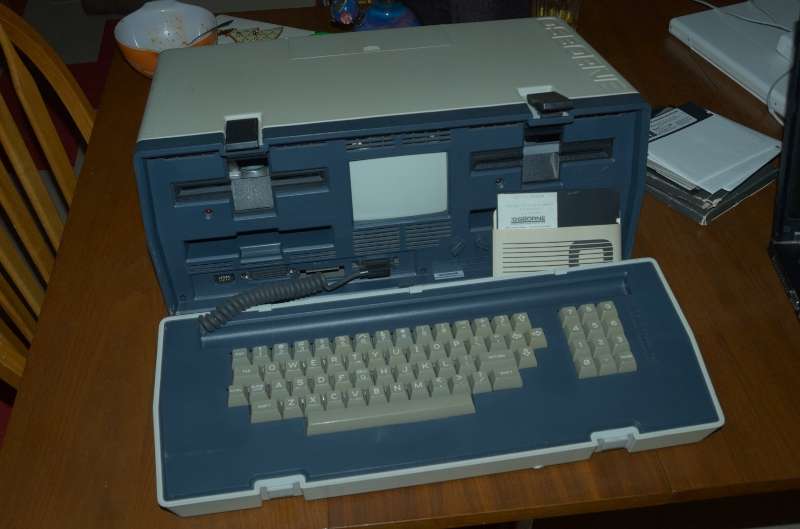
found a mint looking osborne 1 today local computer recyler they had not
even looked at it yet so i managed to get it for decent price got it home
opened it up found some cpm disks nice little bonus and a mint looking
interior
http://img268.imageshack.us/img268/4927/osborn.jpg
i tried firing it up and it powers up for fraction of a second when it trys
to do its power on beep and dies.
http://youtu.be/WXzI-FIr50w << see here what its doing (my ipod tuch sure
is usefull)
i'm guesing its the power supply but want to make sure befor i tare it
apart. i've got another one that does weird things that also needs
servicing but one of the face plate screws is striped so unable to get it
open to look..
On 1/9/2012 11:57 AM, Bill Sudbrink wrote:
> Bill Sudbrink wrote:
>
> By the way, based on your description of the symptoms, I still suspect
> the 1793 is going bad.
>
Do you think it's likely that two cards (the 16 and the 64FDC) I have
would have 1793s that are failing in exactly the same way? (Is this a
common failure mode for these?)
Thanks,
Josh
I just tripped over an unusual cable:
It has a trapezoidal thin black box labeled "TRS0-80", but no part number,
one side has a few inches of cable with a 40 pin card edge connector,
the other side has a few feet of cable with a 50 pin edge connector.
40 pin was probably model 1 expansion bus (I hafn'y messed with model
2/12/16). But what did Radio Shack use on model 1 with 50 pin?
--
Grumpy Ol' Fred cisin at xenosoft.com
Hmm...questioning statistics with conspiracy...if that does not raise
the big red kook flag, I do not know what would.
ANYWAY...
Market reports and surveys from years past are actually pretty
interesting to read. Gartner is probably the best known of the bunch.
Is anyone actively saving these reports? I assume CHM is.
--
Will