Bill Sudbrink wrote:
> So, the 2532 predates the 2732?
I have no idea whether the TMS2532 was announced before or after the
Intel 2732, but it's obvious that TI was far along the development path
before Intel announced the 2732.
Dave Wade wrote:
> I have some "TMS2532" chips.
Bill Sudbrink wrote:
> Data sheet claims pin compatibility with 2732.
No, the TMS2532 doesn't make any such claim. It claims that it is "pin
compatible with existing ROMs and EPROMs (8K, 16K, 32K and 64K), but
that does not include the 2732, and their reference to 32K and 64K was
only in regard to ROMs. The TMS2532 is most definitely *not* pin
compatible with 2732, and attempting to program a 2532 as a 2732 will
likely damage it. They aren't read-compatible either, but damage is far
less likely to occur when attempting to read a 2532 as a 2732 (or vice
versa).
pin TMS2532 2732
--- ------- --------
18 A11 CE*
20 PD/PGM* OE*/Vpp
21 Vpp A11
As with the earlier TMS2716, which was not compatible with the Intel
2716 or anyone else's, TI tried to second-guess what the standard pinout
for the 2732 would be, and failed. At least they anticipated this
possibility and referred to their part as the 2532; if it had matched,
they could later have dual-marked it 2532 and 2732.
On 30/04/2012 13:16, Bill Sudbrink wrote:
> Jim Brain wrote:
>> I know others have defended the Willem units, and I'll add my note as a
>> satisfied customer.
> I'll add another.
>
>> Be aware most Willems will require a parallel port. Most newer units
>> will also sport a USB port, but it's for power only.
> If you decide to use the "USB power" be sure whatever USB port on your
> computer can handle it. I had mine plugged into one of the "back"
> ports on my computer and it worked fine. Later, I put the same
> motherboard in a different case that allowed me to hook up some "front"
> USB port connectors to the pin headers on the motherboard. Apparently,
> these ports did not supply enough current and the Willem behaved badly.
> I was just considering pitching it when it occurred to me to plug it
> into the back port as before. Sure enough, that fixed it.
>
>> Either way, buy a unit with a socket for an external power supply. The
>> on board charge pump can't do enough with USB supplied power to handle
>> all of the EPROM programming variants.
> Yes, after the above experience, I went ahead and rigged up a "wall
> wart" supply.
>
> Bill S.
>
I have some "TMS2532" chips. Any suggestions on how to program them (I
have a project in mind that will need these or a similar device)
On 29 Apr 2012 at 18:46, Richard Smith wrote:
> This thread reminds me of a computer we built at school from discrete
> transistors. Each transistor was a NOR gate with three resistors on
> the base and a collector resistor. All soldered onto squares of tag
> board. We put a bunch of them together to build a shift register with
> small laps as output. That would be about 1969 or 1970. Does anyone
> remember any more? It must have been a published design somewhere.
In the late 60's and 70's, radio shack sold some little one-bit-flip-flop boards with lamps. Each flip flop was a little square of circuit board.
There may have been other logic functions available one-to-a-board. I'm pretty sure they were discrete transistors for the most part (even the round package SSI Motorola RTL typically had two gates or flip flops per package.)
You could buy multiples and configure them as a counter, and I'm pretty sure they could be wired as a shift register too.
May have been "Archerkit" brand name. Or "Pbox" brand name although what I remember were not Pbox's but circuit boards.
I tried using websearches to find pictures or docs, but the Googles, they do nothing!
Tim.
At 07:16 AM 4/30/2012, Bill Sudbrink wrote:
> If you decide to use the "USB power" be sure whatever USB port on your
> computer can handle it. I had mine plugged into one of the "back"
> ports on my computer and it worked fine.
Has anyone made a device that provides a simple indication of the power
supplied by a USB port? Or is there a standard for indicating how much
a device needs to get from the port? This is obviously a source of
consumer frustration.
- Joh
> From:?Jon Elson <elson at pico-systems.com>
> Date:?Sat, 28 Apr 2012 18:20:30 -0500
> Subject:?discrete transistor computer
> A while ago somebody mentioned thinking about building a
> discrete transistor computer. ?I ran across the link again of
> the one I saw (only online)
> http://www.6502.org/users/dieter/mt15/mt15.htm
>
> With all SMT, he packs the boards very closely, performance
> is of course not so great with discrete junction transistors running
> in saturation.
>
> Jon
The Rhode Island Computer Museum has four discrete transistor computers.
A PDP-9 and three PDP-8/S systems.
The RCS/RI crew in Providence has a PB-250.
--
Michael Thompson
> Why not the SD card? Cheaper, smaller and easy to interface! :)
My gut feeling is that compact flash will live a little longer in terms of being able to get interface hardware a decade into the future. But I could be wrong and SD might have more legs (certainly fewer contacts). And as you point out the serial interface to a SD card is very straightforward so I think you have a good point!
Tim.
I have had this machine for a while now and decided today to at least start
cleaning it up. It is very dirty inside. The trouble is I can't see how to
get at the motherboard, which I can needs cleaning; it seems to be under a
riveted plate and I can't see any way to get it at it, or even just to
remove the cover for the option cards. Is there a trick to this that I am
missing? I have looked around for manuals, but there don't seem to be any
online. I am also unsure how to remove the option cards, do I just turn the
plastic knob clockwise? It is stiff and I don't want to apply too much force
and break something.
I also just noticed that it is missing the power switch, don't suppose
anyone has one going spare? It looks like probably any DEC rocker switch
would be OK. You can see the type I mean by looking at this
http://www.recycledgoods.com/zoom.aspx?productID=19036.
Incidentally, I opened up the PSU to clean that out. It looks pretty bad:
there are quite a few patch wires there, extra components clearly added
after it was built, components that look poorly placed, two resistors
soldered together in series by their leads, an inductor soldered with large
blobs of solder that look worse than anything even I could do. I am left
wondering if this typical of these PSUs or if I have just got something that
has been hacked about.
Thanks
Rob
According to http://so-much-stuff.com/pdp8/repair/subst.php a D672 crosses
to a 1N3656 diode, which you can (theoretically) get from amazon.com (or
your local flavor thereof)
I would resist the urge to plug something that looks similiar in to see
what happens. You run the risk of damaging something else.
Clint
On Sun, 29 Apr 2012, RobJ wrote:
> The saga of my broken PDP11/24 PSU (H7140) continues. I have now found a
> shorted diode and need to find a suitable replacement. On the printset it is
> described as "D 672 TR=14NS PIV=60V SI".
>
> What would be a suitable replacement?
>
> There is a local Maplin that would be open today that has this one:
> http://www.maplin.co.uk/switching-diode-46386, would that be suitable?
>
> Regards
>
> Rob
>
(Sending again because I sent it from the "wrong" account, apologies if this
gets duplicated)
The saga of my broken PDP11/24 PSU (H7140) continues. I have now found a
shorted diode and need to find a suitable replacement. On the printset it is
described as "D 672 TR=14NS PIV=60V SI".
What would be a suitable replacement?
There is a local Maplin that would be open today that has this one:
http://www.maplin.co.uk/switching-diode-46386, would that be suitable?
Regards
Rob
On Thu, 26 Apr 2012 06:15:06 -0500, cctech-request at classiccmp.org
wrote:
> Send cctech mailing list submissions to
> cctech at classiccmp.org
>
> To subscribe or unsubscribe via the World Wide Web, visit
> http://www.classiccmp.org/mailman/listinfo/cctech
> or, via email, send a message with subject or body 'help' to
> cctech-request at classiccmp.org
>
> You can reach the person managing the list at
> cctech-owner at classiccmp.org
>
> When replying, please edit your Subject line so it is more specific
> than "Re: Contents of cctech digest..."
>
>> I'll say. The kind that can buy into a phrase like "Cryogenic
>> processing renders the Reference-II absolutely grainless."
>>
>> I read that as "brainless" at first, and I still think that's
>> what they meant.
>
> There were some classics sold (?) over here.
>
> Like 'carpet earthing clips', of which yuu must always use an odd
> number
> so that more charge runs away than comes back.
>
> Or electret foils. I have no problem with the existance of electret
> foil,
> or indeed of its use in audio (microphones). Butsticking an odd
> number of
> trianges cut from it on your record turntable, pointing in the
> direction
> of rotation would, IMHO, make no improvement tot the sound.
>
> Or cuttint the corner off your amplifier front panel (appearmetn and
> odd
> number of corners sounds better).
>
> And we all rememebr the green pen :-)
>
> -tony
On April 1, 1962, Swedish Television had an item on the news where a
well-known technical expert explained that the broadcasting company had
just installed new equipment which would allow viewers to see the
programmes in colour, if they cut up a ladies' nylon stocking and fixed
it over the screen. I believe quite a few people actually tried it.
It became one of the best known April Fools jokes in Sweden, at least
with those who were around at the time.
/Jonas
A friend from Tucson, Arizona, is selling all his books since he will be
moving soon. Since his collection includes some computer classics, I
thought there might be some interest here.
http://tucson.craigslist.org/gms/2980831256.html
-- Jecel
I have an HP9836CU (series 9000/200) without monitor cable.
The computer seem to boot up, the monitor, when powered, has no
activity.
The cable (15 pin Dsub male to male) is pin to pin ? all pin used ?
I'm going to build the cable, but I'm not sure about pinout
There is a service manual with circuit diagrams ?
I've found only the manual on the HP Australian museum, but is a board
level manual.
Thanks in advance
Alberto
------------------------------------------------------
Alberto Rubinelli Mail : alberto at a2sistemi.it
A2 SISTEMI Web : www.a2sistemi.it
Via Costantino Perazzi 22 Tel 0321 640149
28100 NOVARA (NO) - ITALY Fax 0321 391769
Skype : albertorubinelli Mobile +39 335 6026632
MUSEO DEL COMPUTER / COMPUTER MUSEUM
http://www.oldcomputers.it Mail:info at oldcomputers.it
Tel 0321 1856032 Fax 0321 2046034
------------------------------------------------------
Le telefonate con numero nascosto sono filtrate
Calls with no caller identifier are filtered
------------------------------------------------------
This is vintage for certain values of vintage, but I suppose
this is as good a forum to ask as any. I suspect it's a
little too new/esoteric for most people here, since it's
really only about 5 years old, but it's right before the
series went downhill, which is certainly a common enough
topic of discussion around here. :-)
I have two NIB (sealed) copies of Filemaker Pro 6, one for
Windows and one for Mac. I additionally have one opened
upgrade copy of Pro 7, but to my recollection it hasn't
actually been used (because we didn't realize it was an
upgrade before we opened the box). All should be 100%
legal and ethical to use.
Anyone want? Free to a good home. Pro 6 was a nice version
of Filemaker, 7 maybe slightly less so.
- Dave
Hi everybody,
does anybody have documents related to the Super-Eagle drives made by Fujitsu (Model M2361A)?
Documents for the predecesor (namely Eagle, M2351A) have been around for quite some time on bitsavers.org, but strangely, though the Super-Eagles are not that rare, no online-versions of its decuments are around. The Super-Eagle is different in certain aspects compared to the Eagle, so using the Eagle-documents is not a solution.
One of my drives to be used with a PDP 11/24 via an Emulex-Controller turns off itself 2 seconds after turing it on and I'l like to find the reason for that some day.
Documents are usually of great help here :)
Kind regards,
Pierre
?
-------------------------------------------------------------------------------
Pierre's collection of classic computers : http://classic-computing.dyndns.org/
i'm going to be venturing down the road of making some is anyone
interested in any prolly be july befor i have anything in stone got
access to a vacuum molder and such but got to make molds first for it.
when i talk trays i mean as close to a reproduction of the original
DEC trays as i can get
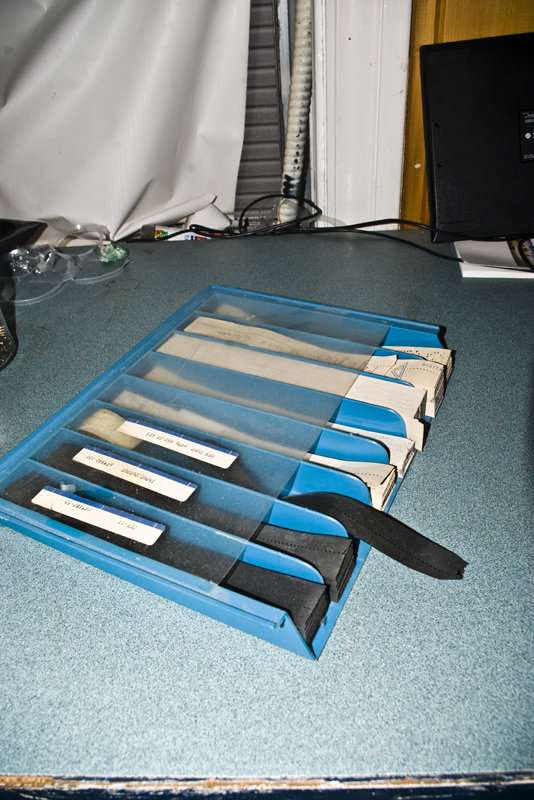
http://img299.imageshack.us/img299/5597/data.jpg
> My expeirence is that more compelx ICs are noticably less reliable than
> simple ones.
That's much too simple analysis even if it were correct. Failure rates in
ICs are primarily down to processing, packaging and handling (and to a
lesser extent die area), not complexity.
>
> I would think the 555 had a much better lifetime than any
> microcontrolelr
> therefore.
You would be wrong however. Today's ICs have a much better lifetime.
Statistically today's commercial grade ICs have a significantly better
lifetime than military grade ICs of the 555 era.
>
> The origianl 555 (as opposed to the 7555, etc) is large-ish junciton
> bipolar and thus less likely to suffer static damage than a MOS
> microcotnroller. It also has a much wider supply votaeg range and is
> less
> likely to be damaged by supply problems.
That's not a definition of reliability - it's one of robustness. Within
their specifications the 555 would be less reliable (IMHO of course).
>
> And of coruse if a microcontroller fails, unless you have the program
> to
> put into it, you're stuck. If a 555 fails, well, there's a tube of 50
> in
> my spares box. And I cna go to any number of suppliers anf buy one.
>
Agreed, but off-topic ;o)
> -tony
>
Bob
Tony Duell and <unknown> wrote:
>
>> > How coome 2 of use here (at least) seem to have contradictory =
>> findings?
>>
>> Because it's anecdotal. BTW here's the definition:
>> (of an account) not necessarily true or reliable, because based on
>> personal accounts rather than facts or research
>
> By the same token, your evidence is anecdotal to me. You have not
> provided (for perfectly valdi reasons) any hard data, and certainly
> not
> any hard data that I can verify. OK, I haven't either.
>
> But I ahve to say that while you may not beleive what I see, I
> certainly
> do. I know what components I rpelace...
>
>> Fine. There's lots of things that I've started to say on this list
>> to =
>> deal with an
>> argument and couldn't because it would violate various NDA's that I
>> have =
>> to
>> live under (I kinda like my job). Arguments on this (and other
>> fora) =
>> while
>> fun aren't worth sacrificing my livelihood.
>>
>> I'm sorry if you can't/won't understand how large companies work and
>> the
>> restrictions that are put on employees and the products (though some
>> =
>> have
>
> I mosster certainly understnad that (having signed a fair few NDAs in
> my
> time too, and yes, I do honour them). And that's the 'valid reasons'
> I
> mentioend.
>
> But to be fair, if I can't verify the data, why on earth should _I_
> beleive it? You could be telling me anything.
>
> -tony
Now this is getting silly. There is no point in trying to say that what
Tony is seeing is wrong: unless he is psychotic he is actually observing
something that really has happened to him. And all that "I have this
fancy job in industry and I have signed lots of NDAs, so I am important,
while Tony is just a geek living with his parents" is a) rude and
patronising and b) hiding behind these NDAs you claim to have signed. So
go out and find publically available research reports or whatever on the
Internet to prove your point, instead of trying to impress us with smoke
and mirrors.
However I think <unknown> is probably right in one respect about modern
computers being more reliable: considering the complexity of a modern
$500 PC, it is probably much more reliable than anything made in the
'70s *at a corresponding price for the period*, i e today's cheap junk
is more reliable thatn cheap junk from the '70s and '80s. OTOH Tony is
also right that old computers were/are at least as reliable: they were
better made than today's cheap junk.
/Jonas
>
>
> Date: Tue, 24 Apr 2012 21:29:22 -0500
> From: Jim Brain <brain at jbrain.com>
>
> Message-ID: <4F976182.50500 at jbrain.com>
>
> Anyone know an inexpensive source for prototype DIY circuit boards?
> From time to time, I like to use them to prove out ideas, and I'm
> running low on stock.
>
I have been using E-Teknet in Arizona for some time. They are not the
cheapest,
but they are very good. The match your board characteristics with the best
shop in China to make it. I've never had a bad board from them, and I
have done
everything from two-layer boards smaller than a postage stamp to 6-layer
boards the size of a full sheet of paper. If you order 4 or less they
don't charge
you for the testing.
Jon
Hellooooooooooooooo world.
Vintage Computer Festival East 8.0 is less than two weeks from now: it
happens on May 5-6, 2012, at the InfoAge Science Center (2201 Marconi
Rd., Wall, New Jersey, USA.)
This year's VCF East will be the biggest ever. As of last weekend, we're
up to six lectures, eight technical workshops (the newest being an
all-weekend, kid-friendly "learn to solder" class), and two dozen
hands-on exhibits. You'll also find our book sale, consignment sale,
lunch, museum tours, prizes, and more.
This year's lectures are highlighted by keynotes at 12:30 each day.
Saturday's keynote is Dr. Thomas Kurtz, who co-invented the BASIC
programming language. Sunday's keynote is Daniel Kottke, who was Steve
Jobs' college buddy, India travel companion, Apple 1 board debugger, and
Apple II, III, and Macintosh engineer. We are thrilled that Kurtz and
Kottke accepted our invitations!
Admission to VCF East 8.0 is very inexpensive. Adult tickets are just
$10 per day and $15 for the whole weekend. Anyone 17 and younger are
admitted free. Tickets are sold at the door. Directions, lodging, and
related details are also on the VCF web site at
http://www.vintage.org/2012/east/ and be sure to 'like' us at
http://www.facebook.com/vcfeast8.
All questions, such as admission, how to exhibit, how to become a VCF
sponsor or vendor, etc., as well as any other questions from the public
and from media, should be addressed to event producer Evan Koblentz --
evan at snarc.net, or call him at (646) 546-9999.
Proceeds from the VCF East 8.0 benefit the InfoAge center, which is a
grassroots, all-volunteer educational facility, and the MARCH user group
(Mid-Atlantic Retro Computing Hobbyists).
Thanks, and we hope to see you at the VCF East!
On Sun, Apr 22, 2012 at 4:36 PM, Zane H. Healy <healyzh at aracnet.com> wrote:
> At 3:32 PM -0400 4/22/12, Dave McGuire wrote:
>
>> On 04/22/2012 03:22 PM, Fred Cisin wrote:
>>
>>> Compact-Flash seems to have almost disappeared.
>>>
>>
>> Huh? Not at all. It is the mainstay of pro-level digital camera
>> work. It has just disappeared from consumer-shit-grade stuff because it
>>
>> is "huge". Heh. (still aching from moving an RK07 last night, and
>> that's on the "light" side of my stuff!)
>>
>> -Dave
>>
>
> To the best of my knowledge the only Pro-level digital camera that doesn't
> use Compact-Flash is the Leica M9 (trust me, there is no room in there).
> What sucks is that Costco no longer carries it in the stores (at least not
> my local ones).
>
> The new Nikon D4 has two slots, one for the older Compact-Flash cards, and
> one for the new XQD cards. http://en.wikipedia.org/wiki/**XQD_card<http://en.wikipedia.org/wiki/XQD_card>
>
I use a SD to CF adapter in my canon digital rebel without an issue, as I
can no longer find CF (I also haven't tried a camera store but they are
probably a ripoff...)
js at cimmeri.com wrote on Mon Apr 23 21:47:23 CDT 2012:
> Does anyone have any Venix manuals they're no longer needing that they'd
> like to sell?
>
> I'm running Venix 1.0 on a DEC Pro 350.? The manuals for this version
> would be dated 1984 - 1986.
I haven't the Venix 1.0 or Pro version manuals.
What I do have are the Venix/11 2.0 manual set as well as the base (root)
distribution on 9-track tape.?? Unfortunately, the second distribution
tape with the /usr filesystem has gone missing.
Does anyone else on the planet have the Venix/11 2.0 tapes?
Please let me know if you do.
Cheers,
-scott
Does anyone have any Venix manuals they're no longer needing that they'd
like to sell?
I'm running Venix 1.0 on a DEC Pro 350. The manuals for this version
would be dated 1984 - 1986.
Please PM me.
Thanks,
John Singleton
> A metal-film resistor, used
> below its ratings, will outlive any microcotnroller.
>
> -tony
>
Well maybe (though no guarantee there), but the 555 would likely have the
same sort of lifetime as a microcontroller - arguably poorer.
Bob