I'd like to mount a couple of SSDs on top of a couple of unused card slots in a server
and figured someone must have made a bracket for doing this. Has anyone seen one, and if
so, what is it called?
It's easy enough to make with a piece of aluminum and a bracket with two long L flanges
but I'd like to just buy the things if they exist.
I've finally reached the stage of my PDP-11/35 restoration where I'm
ready to turn it on and debug logic.
A copy of the PDP-11/40 Maintenance Printset would be INCREDIBLY
helpful, as would a bus extender and a KM11.
Ideally, I don't want to buy these - this is a one-off project for me,
I'd really like to borrow them for about 1-2 months and then return
them. I'd be happy to pay a "rental" fee, even.
I'm located in the SF Bay Area, if someone local can let any of these go
for a little while, I'd be quite grateful.
Thanks!
-Seth Morabito
PDP-11/35 Restoration Blog: http://www.loomcom.com/blog/
I have the following items for sale
Apple II SCSI Card- Works great, will include a copy of the SCSI
Utilities disk $175.00
Apple II MicroDrive- Made by ReactiveMicro, Allows you to use IDE or
CF Cards with your Apple II or IIGS. Will include a IDE-CF Adapter $250.00
Kaypro II- Mint condition with all books and software $200
Commodore SX64 Mint condition with FastLoad Cartridge, original
software, carry bag, owners manual $250.00
2 SGI Indigo Systems with monitor, keyboard and all kinds of
manuals/software- FREE If you pick up
1 Sun Blade 2000- FREE If you pick up
1 IBM RS/6000 43P Model 150- FREE If you pick up
Will have more as I get through it.
Shipping is extra, Local Pickup is welcomed in Flushing Michigan
PayPal Preferred
On 2012-07-13 19:00, "Jerome H. Fine" <jhfinedp3k at compsys.to> wrote:
>Johnny Billquist wrote:
>> >[Snip]
>> >Ooo. So TECO-8 actually lie in their documentation... Even worse.
>> >A year in the range 1986-1994 would just have looked like 1970-1977.
>> >That's ugly of them.
> What seems even more evident to me is that DEC took
> (as most other companies did as well) the attitude that
> even the internal representation of date and time was
> not important enough to allow the same information to
> be exchanged between operating systems on a consistent
> basis.
Sorry, but I fail to see the point. The internal representation of a
date will almost by necessity be different between different OSes and
hardware. Having a bunch of 16 bit values represent a date on a PDP-8
would be incredibly stupid and difficult, not to mention that OS/8 have
no concept of time to more detail than a day. And even that needs to be
updated manually every day.
So, ignoring the internal format, which can't really be portable anyway,
you then get to representation. There will always be dates that cannot
be represented in whatever format you choose. So what is the point of
bringing up that argument? It is nice if the dates that you might
reasonably expect to be processes be possible to express on the system.
As for communicating with other systems, in the communication I would
suspect/expect that you use an intermediate format (a nice text string
for example) that both agree on. And then you can convert from the
internal format to and from this intermediate format, as long as the
date is within a range expressable on that system.
When you go outside the date range for the system, you can either try to
do something reasonable, or give an error. I think that is a choice that
is best left to the writers of the code to decide on a case by case basis.
By the way, Unix express time as a number of seconds since Jan 1, 1970,
00:00 UTC.
And time is horribly complex. You know that even if we keep it fairly
modern, different countries switched from Julian dates to Gregorian
dates at different times, the last being Russia, in the early 20th century.
If you really think that you can come up with a reasonable, portable
design, that is "universal", I think I know of a few organizations that
would like to hear from you.
Until then, I'm pretty much satisfied with things the way they already
are. Yes, OS/8 have been broken for 10 years now. But to fix it require
more than just changing the internal storage for the date.
RSX got fixed, and depending on which bits you look, it might stop
working right 2070(?), 2099, 2155 or 34667.
I don't know about RT-11, but I do know that RT-11 is totally separate
>from RSX, and any problems are not shared, but unique.
Johnny
--
Johnny Billquist || "I'm on a bus
|| on a psychedelic trip
email: bqt at softjar.se || Reading murder books
pdp is alive! || tryin' to stay hip" - B. Idol
I'm getting around to doing some work on my veneered and generated
HP5307A frequency counter. Looking at all the gold-plated PCB
goodness inside, the first thing that jumps out at me is a bulging
electrolytic. It's a 940 uF, 40V unit. Not 1000 uF, but 940. Not
50V, but 40V. I'm going to substitute a pair of 470uF, 50V units
paralleled as a substitute, but this had me wondering if anyone knows
why the strange values, particularly since +/-20 percent tolerances
are common on electrolytic caps.
--Chuck
OK, here's what I believe is a correct macro for inserting the
current date and time as an HTTP Date header, portable across
different TECO environments as best I can make it. I tried to login
to the TOPS-10 machine at pdpplanet, but encountered difficulties.
Therefore, I have only tested this end-to-end on a Win32 environment
where I'm running TECOC. I started with DATE.TES in the TECOC
distribution and changed things around to try and make it as small as
possible when squished. Right now I'm at 1,109 bytes of squished
TECO. I could squeeze out 33 more bytes if I change the code that
builds up a string containing the days within a month by replacing
the 31 at I// commands with an insert using literal control characters
but I'm trying to keep my source file free of control characters, with
a small concession for ESC characters.
If others are willing to try this on their TECOs and tell me the
results, that would be great. The environments that are different
>from my test environment are:
PDP-8, OS/8 Different date, time encoding
PDP-11, RT-11 Different date encoding
PDP-11, RSTS/E Different date, time encoding
TOPS-10 Different date, time encoding
TOPS-20 Different date, time encoding
<http://user.xmission.com/~legalize/vintage/http-date.zip>
If you're not in my time zone (Salt Lake City, -0600 from GMT), you
will want to change -0600 in the macro to the appropriate offset.
Some observations from doing this little sub exercise:
- nQq extracts the nth character code from the string portion of
Q-register q. Using another Q-register as the numeric argument to this
command confused the parser of my TECO, hence the use of an intermediate
Q-register by doing 'Q0QM U1'. It didn't uniformly confuse my TECO,
so there were some cases where I could use QqQq directly in some
expressions. This might cause a portability issue for other TECOs.
- I could make this macro much shorter if I hard-coded the date and
time decoding for a particular OS.
- I could make this macro much shorter if I hard-coded the time zone
offset from GMT, or even just lied and pretended my web server's local
time *was* GMT.
- Indexing the string %SunMonTueWedThuFriSatSun% and inserting 3 chars
was much less code than doing a comparison for each value.
- Extracting repeated code into a macro was most effective in reducing
squished size.
- The string portion of a Q-register can be viewed as an array of bytes;
I use this to build an array of days in each month. This reduced
the size of code computing day-in-a-year from day/month and day/month
from day-in-a-year. The array is also used to handle underflow and
overflow when applying the GMT offset.
- I made the labels reasonably small in order to squeeze out more
bytes, but since I don't use more than 96 labels, I could have reduced
them to a single character. I decided against this.
- SQU.TEC will recursively squish my macro definitions, but I kept
running into a problem with the day and month strings I was loading
into 1.str until I re-read the SQU.TES source and learned that if
I use % as the delimiter, then SQU will not treat these Q-register
string loads as macro definitions, but as literal text.
- Computed goto @O!tag0,tag1,tag2! made it easier to handle decoding
the different date/time formats in different environments.
- You can't insert or append character codes directly into a Q-register,
but you can insert character codes into the buffer and pull a portion
of the buffer into a Q-register.
- DATE.TES reports the wrong day of the week, probably because it uses
an algorithm that is no longer valid for years > 1999. I switched
to the Sakamoto, Lachman, Keith and Craver algorithm published in
Wikipedia. This also eliminated me having to compute day-within-year.
- n%q can be used to add n to Q-register q, avoiding the Qq + n Uq
phrase, but n%q leaves the result as a numeric argument to the next
command, so ESCs must be inserted to gobble these up.
- TECO numeric expressions have no operator precedence and are
evaluated strictly left to right. Sometimes this means that extra
parenthesis are necessary to get the right evaluation order and
other times parenthesis can be omitted and still retain the proper
evaluation order.
Squished output, made printable:
=-=-=-=-=-=-=-=-=-=-=-=-=-=-=-=-=-=-=-=-=-=-=-=-=-=-=-=-=-=-=-=-=-=-=-=-=-=-=
!HTTP-DATE.TEC![M[D[Y[H[N[S[0[1@^UY\0J31I$QY&3"=29I$|28I$'31I$30I$31I$30I$31
I$31I$30I$31I$30I$31I$0XM0K\@^US\U1Q1*3U13<Q1Q1I$1%1$>\@^U0/U0Q0-10"<I0$'Q0\/
^BU0-1EJ/256OD1,D8,DT$ODG$!D1!Q1-7"=Q0"<Q0&32767U064UY|0UY'(Q0/16384*32)+
(Q0&31)+1972%Y$MYQ0/32&31UDQ0/1024&15UM|-1EJ&255-4"=Q0-(Q0/1000*1000)UD
Q0/1000+1970UYMY0U01UM12<Q0QMU1QD-Q1U1Q1">Q1UD1%M$'1%0$>|ODG$'''OD$!D8!Q0&7
+2010UYMYQ0/8&31UDQ0/256&15UMOD$!DT!Q0-(Q0/31*31)+1UDQ0/32U0Q0-(Q0/12*12)+1
UMQ0/12+1964UYMYOD$!DG!Q0&31UDQ0/32&15UMQ0/512+1900UYMY!D!-1EJ/256
OT1,T8,TT$^H*2U0OTG$!T8!12UH00UN00USOO$!T1!-1EJ-4"=(24*60-^H)*60U0OTG$'^H*2U0
OTG$!TT!^H*60U0!TG!Q0/3600UHQH*3600U1(Q0-Q1)/60UNQ0-Q1-(QN*60)US!O!-600U0Q0
"<-Q0U1Q1-(Q1/100*100)%N$QN-59">1%H$-60%N$'Q1/100%H$QH-23">1%D$-24%H$QM-1QMU1
QD-Q1">1%M$1UDQM-12">1%Y$MY1UM'''|-Q0+(Q0/100*100)%N$QN"<-1%H$60%N$'-Q0/100
%H$QH"<-1%D$24%H$QD"=-1%M$QM"=-1%Y$MY12UM31UD|QM-1QMUD''''IDate: $
^U1SunMonTueWedThuFriSat$QYU0QDU1QM-3"<Q0%1$-1%0$|Q0-2%1$'23*QM/9+Q1+4+
(Q0/4)-(Q0/100)+(Q0/400)U0Q0-(Q0/7*7)MSI, $QDM0I $
^U1JanFebMarAprMayJunJulAugSepOctNovDec$QM-1MSI $QY\I $QHM0I:$QNM0I:$QSM0
I GMT
$]1]0]S]N]H]Y]D]M$$
=-=-=-=-=-=-=-=-=-=-=-=-=-=-=-=-=-=-=-=-=-=-=-=-=-=-=-=-=-=-=-=-=-=-=-=-=-=-=
Source file, made printable:
=-=-=-=-=-=-=-=-=-=-=-=-=-=-=-=-=-=-=-=-=-=-=-=-=-=-=-=-=-=-=-=-=-=-=-=-=-=-=
!HTTP-DATE.TEC!
! ------------------------------------------------------------------------- !
! Insert the current date and time as an HTTP Date: header !
! ------------------------------------------------------------------------- !
! The date and time varies by computer and OS, encoded in -1EJ: !
! -1EJ=256*m+n Computer (m) Operating System (n) !
! 0 PDP-11 0 RSX-11D !
! 1 RSX-11M !
! 2 RSX-11S !
! 3 IAS !
! 4 RSTS/E !
! 5 VAX/VMS !
! (compatibility mode) !
! 6 RSX-11M+ !
! 7 RT-11 !
! 1 PDP-8 0 OS/8 !
! 2 DEC-10 0 TOPS-10 !
! 3 DEC-20 0 TOPS-20 !
! 4 VAX-11 0 VAX/VMS !
! (native mode) !
! 100 Unix 0 Unix !
! 101 IBM PC 0 MS-DOS !
! 1 Win32, OS/2 !
! 102 Amiga 0 AmigaDOS 1.3 !
! ------------------------------------------------------------------------- !
[M [D [Y [H [N [S [0 [1 ! save used Q-reg's !
! M.num = month in year, 1-12 !
! M.str = days in months as characters adjusted for leap years !
! D.num = day in month, 1-31 !
! Y.num = 4-digit year !
! Y.str = macro to build M.str from Y.num !
! H.num = hour in day, 0-23 !
! N.num = minute in day, 0-59 !
! S.num = second in minute, 0-59 !
! S.str = macro to insert 3 chars from 1.str !
! 0.num = scratch value !
! 0.str = macro to insert 2-digit number with leading zero !
! 1.num = scratch value !
! 1.str = argument to S.str !
! <<<<<<<<<<<<<<<<<<<<<<<<<<<<<<<<<<<<<<<<<<<<<<<<<<<<<<<<<<<<<<<<<<<<<<<<< !
! Y.str = macro to build M.str = days in month as characters !
! using Y.num = current year !
@^UY\
0J ! Go to start of buffer !
31 at I// ! January !
QY&3 "= 29 @I// | 28 @I// ' ! February !
31 @I// ! March !
30 @I// ! April !
31 @I// ! May !
30 @I// ! June !
31 @I// ! July !
31 @I// ! August !
30 @I// ! September !
31 @I// ! October !
30 @I// ! November !
31 @I// ! December !
0XM ! M.str = temporary string !
0K ! delete temporary string !
\
! >>>>>>>>>>>>>>>>>>>>>>>>>>>>>>>>>>>>>>>>>>>>>>>>>>>>>>>>>>>>>>>>>>>>>>>>> !
! <<<<<<<<<<<<<<<<<<<<<<<<<<<<<<<<<<<<<<<<<<<<<<<<<<<<<<<<<<<<<<<<<<<<<<<<< !
! S.str = macro to insert 3 chars from 1.str !
@^US\
U1 ! 1.num = 0-based word index !
Q1*3 U1 ! 1.num = char offset in 1.str !
3< ! for 3 chars... !
Q1Q1 @I"" ! insert one char !
1 %1$ ! 1.num++ !
> ! end !
\
! >>>>>>>>>>>>>>>>>>>>>>>>>>>>>>>>>>>>>>>>>>>>>>>>>>>>>>>>>>>>>>>>>>>>>>>>> !
! <<<<<<<<<<<<<<<<<<<<<<<<<<<<<<<<<<<<<<<<<<<<<<<<<<<<<<<<<<<<<<<<<<<<<<<<< !
! 0.str = macro to insert two digit number, with leading zero !
@^U0/
U0 ! 0.num = arg !
Q0 - 10"< ! if 0.num < 10? !
@I"0" ! insert zero !
' ! end if !
Q0\ ! insert 0.num !
/
! >>>>>>>>>>>>>>>>>>>>>>>>>>>>>>>>>>>>>>>>>>>>>>>>>>>>>>>>>>>>>>>>>>>>>>>>> !
^B U0 ! 0.num = encoded date !
-1EJ/256 @O!D1,D8,DT! ! handle special date decodings !
@O!DG! ! handle general date decoding !
!D1!
Q1 - 7 "= ! RT-11? !
! ------------------------------------------------------------------------- !
! RT-11: ^B = ((((year-2003)*16+month)*32)+day)*32)+(year-1972)&31 !
! ------------------------------------------------------------------------- !
Q0 "< ! if high bit set? !
Q0&32767 U0 ! strip high bit !
64 UY ! Y.num = corresponding year !
| ! else !
0 UY ! Y.num = 0 !
' ! end if !
(Q0/16384*32) + (Q0&31) + 1972 %Y$ ! Y.num += remaining part of year !
MY ! M.str = days in months !
Q0/32 & 31 UD ! D.num = day !
Q0/1024 & 15 UM ! M.num = month !
| -1EJ & 255 - 4 "= ! if RSTS/E? !
! ------------------------------------------------------------------------- !
! RSTS/E: ^B = ((year-1970)*1000)+day within year !
! ------------------------------------------------------------------------- !
Q0 - (Q0/1000*1000) UD ! D.num = day in year !
Q0/1000 + 1970 UY ! Y.num = year !
MY ! M.str = days in months !
0U0 ! U.num = 0 !
1UM ! M.num = January !
12< ! for 12 months... !
Q0QM U1 ! 1.num = days in month 0.num !
QD - Q1 U1 ! 1.num = D.num - 1.num !
Q1 "> ! if D.num > days in month? !
Q1 UD ! D.num -= days !
1 %M$ ! M.num++ !
' ! end if !
1 %0$ ! 0.num++ !
> ! end !
! D.num = day in month !
! M.num = month in year !
| ! otherwise, !
@O!DG! ! general case !
' ! end if !
'
'
@O!D!
! ------------------------------------------------------------------------- !
! OS/8: ^B = (((month*32)+day)*8)+((year-1970)&7)+k !
! where k = 4096 if year>1977 !
! and k=0 otherwise !
! ------------------------------------------------------------------------- !
!D8!
Q0 & 7 + 2010 UY ! Y.num = year !
MY ! M.str = days in months !
Q0/8 & 31 UD ! D.num = day !
Q0/256 & 15 UM ! M.num = month !
@O!D!
! ------------------------------------------------------------------------- !
! TOPS-10, !
! TOPS-20: ^B = (((year-1964)*12+month-1)*31+day-1) !
! ------------------------------------------------------------------------- !
!DT!
Q0 - (Q0/31*31) + 1 UD ! D.num = day !
Q0/32 U0 ! 0.num /= 32 !
Q0 - (Q0/12*12) + 1 UM ! M.num = month !
Q0/12 + 1964 UY ! Y.num = year !
MY ! M.str = days in months !
@O!D!
! ------------------------------------------------------------------------- !
! RSX-11: ^B = ((year-1900)*16+month)*32+day !
! VAX/VMS: ^B = ((year-1900)*16+month)*32+day !
! Amiga: ^B = ((year-1900)*16+month)*32+day !
! Unix: ^B = ((year-1900)*16+month)*32+day !
! Win32: ^B = ((year-1900)*16+month)*32+day !
! OS/2: ^B = ((year-1900)*16+month)*32+day !
! MS-DOS: ^B = ((year-1900)*16+month)*32+day !
! ------------------------------------------------------------------------- !
!DG!
Q0 & 31 UD ! D.num = day !
Q0/32 & 15 UM ! M.num = month !
Q0/512 + 1900 UY ! Y.num = year !
MY ! M.str = days in months !
!D!
! Get HH:MM:SS in Q-reg's H,M,S !
-1EJ/256 @O!T1,T8,TT! ! handle special decodings !
^H*2 U0 ! 0.num = seconds since midnight !
@O!TG! ! handle general decoding !
! ------------------------------------------------------------------------- !
! OS/8: ^H = 0 !
! ------------------------------------------------------------------------- !
!T8!
12 UH ! H.num = 12 !
00 UN ! N.num = 0 !
00 US ! S.num = 0 !
@O!O! ! output time !
! ------------------------------------------------------------------------- !
! RSTS/E: ^H = minutes until midnight !
! ------------------------------------------------------------------------- !
!T1!
-1EJ -4 "= ! RSTS/E? !
(24*60 - ^H)*60 U0 ! 0.num = seconds since midnight !
@O!TG! ! handle general decoding !
'
^H*2 U0 ! 0.num = seconds since midnight !
@O!TG! ! do general case !
! ------------------------------------------------------------------------- !
! TOPS-10: ^H = 60ths of a second since midnight !
! (or 50ths of a second where 50 Hz power is used) !
! ------------------------------------------------------------------------- !
!TT!
^H*60 U0 ! 0.num = seconds since midnight !
! fall through to general case !
! ------------------------------------------------------------------------- !
! RT-11: ^H = (seconds since midnight)/2 !
! RSX-11: ^H = (seconds since midnight)/2 !
! VAX/VMS: ^H = (seconds since midnight)/2 !
! Amiga: ^H = (seconds since midnight)/2 !
! Unix: ^H = (seconds since midnight)/2 !
! Win32: ^H = (seconds since midnight)/2 !
! OS/2: ^H = (seconds since midnight)/2 !
! MS-DOS: ^H = (seconds since midnight)/2 !
! ------------------------------------------------------------------------- !
!TG!
Q0/3600 UH ! H.num = hours !
QH*3600 U1 ! 1.num = hours (in seconds) !
(Q0 - Q1)/60 UN ! N.num = minutes !
Q0 - Q1 - (QN*60) US ! S.num = seconds !
!O!
-600 U0 ! offset from GMT !
Q0 "< ! if offset < 0? !
-Q0 U1 ! add offset to local time !
Q1 - (Q1/100*100) %N$ ! N.num += minute offset !
QN - 59 "> ! if minutes overflowed? !
1 %H$ ! H.num++ !
-60 %N$ ! N.num -= 60 !
' ! end if !
Q1/100 %H$ ! H.num += hour offset !
QH - 23 "> ! if hours overflowed? !
1 %D$ ! D.num++ !
-24 %H$ ! H.num -= 24 !
QM-1QM U1 ! 1.num = days in month !
QD - Q1 "> ! if days overflowed? !
1 %M$ ! M.num++ !
1 UD ! D.num = 1 !
QM - 12 "> ! if month overflowed? !
1 %Y$ ! Y.num++ !
MY ! rebuild M.str !
1 UM ! M.num = 1 !
' ! end if !
' ! end if !
' ! end if !
| ! else !
! subtract offset from local time !
-Q0 + (Q0/100*100) %N$ ! N.num -= minute offset !
QN "< ! if minutes underflowed? !
-1 %H$ ! H.num-- !
60 %N$ ! N.num += 60 !
' ! end if !
-Q0/100 %H$ ! H.num -= hour offset !
QH "< ! if hours underflowed? !
-1 %D$ ! D.num-- !
24 %H$ ! H.num += 24 !
QD "= ! if days underflowed? !
-1 %M$ ! M.num-- !
QM "= ! if months underflowed? !
-1 %Y$ ! Y.num-- !
MY ! rebuild M.str !
12 UM ! M.num = 12 !
31 UD ! D.num = 31 !
| ! else !
QM-1QM UD ! D.num = last day of month !
' ! end if !
' ! end if !
' ! end if !
' ! end if !
@I"Date: " ! Insert Date: header !
! Insert DAY, DD Mon YYYY !
@^U1%SunMonTueWedThuFriSat%
QY U0 ! compute day within week from !
QD U1 ! methods of Sakamoto, Lachman, !
QM-3 "< ! Keith and Craver !
Q0 %1$
-1 %0$
|
Q0 - 2 %1$
'
23*QM/9 + Q1 + 4 + (Q0/4) - (Q0/100) + (Q0/400) U0
Q0 - (Q0/7*7)
MS ! Insert DAY !
@I", " ! Insert ,<SP> !
QD M0 ! Insert DD !
@I" " ! Insert <SP> !
@^U1%JanFebMarAprMayJunJulAugSepOctNovDec%
QM - 1 MS ! Insert name of month !
@I" " ! Insert <SP> !
QY\ ! Insert YYYY !
@I" " ! Insert <SP> !
! Insert HH:MM:SS !
QH M0 ! Insert HH !
@I":" ! Insert : !
QN M0 ! Insert MM !
@I":" ! Insert : !
QS M0 ! Insert SS !
@I" GMT
" ! Insert <SP>GMT<CR> !
]1 ]0 ]S ]N ]H ]Y ]D ]M ! restore used Q-reg's !
$$
=-=-=-=-=-=-=-=-=-=-=-=-=-=-=-=-=-=-=-=-=-=-=-=-=-=-=-=-=-=-=-=-=-=-=-=-=-=-=
--
"The Direct3D Graphics Pipeline" free book <http://tinyurl.com/d3d-pipeline>
The Computer Graphics Museum <http://computergraphicsmuseum.org>
The Terminals Wiki <http://terminals.classiccmp.org>
Legalize Adulthood! (my blog) <http://legalizeadulthood.wordpress.com>
I have another card I can't identify:
It's a Q-bus card; in copper on the front of the card it's marked
"BSW-Q". on the back, it's marked "4522 111 89361". On the front,
there's a sticker that reads "4522 117 0825" and "1996830". I think
the latter might be a date code. The 4522 numbers look suspiciously
like 12NC numbers, which to me suggests that this is not a DEC part
(maybe Philips?)
Camiel.
The RICM is still wrestling with the core in the PDP-8.
After replacing some diodes on the core stack we have all addresses working.
We observed an interesting core memory behavior during our debugging
last Saturday.
We started the memory alignment procedure by looking at the
STROBE FIELD 0 signal and the amplifier output on pin E1 of the sense
amplifier. The STROBE signal was very late compared to Figure 5-6 in
the 8/L Maintenance Manual. We ran a short JMP loop and adjusted the
relationship with the trimpot on the M360 delay module. When we halted the
processor and tried a examine core we only got just zeros.
We adjusted the M360 delay back where it was and single step worked
again. We found that the strobe-to-one-bit relationship was almost
100ns earlier when in single-step than it was with the processor
running. We checked the whole timing path from MEM START at pin N2 of
the M113 in slot C03, through all of the gates, delays, and
flip-flops, and found no timing difference between single-step and
running. Right now it looks like there is a 100ns delay difference
between the READ(1) signal that turns on the current in the core and
the bit signal showing up on the E1 pin of the sense amplifier when in
the single-step and running.
Is this normal behavior?
--
Michael Thompson
On 2012-07-15 12:29, Richard<legalize at xmission.com> wrote:
> In article<4FFEAC19.2080507 at update.uu.se>,
> Johnny Billquist<bqt at update.uu.se> writes:
>
>> >However, with only 13 bits for integers in TECO, I'm not sure how you
>> >would go about to solve it in a reasonable way...
> I'm not sure why you think TECO has 13-bit integers on a 12-bit
> machine...
Maybe because it does...? :-)
Johnny
--
Johnny Billquist || "I'm on a bus
|| on a psychedelic trip
email: bqt at softjar.se || Reading murder books
pdp is alive! || tryin' to stay hip" - B. Idol
On 2012-07-12 12:11, Rick Murphy <rick at rickmurphy.net> wrote:
> At 12:12 PM 7/11/2012, Richard wrote:
>> >For OS/8, you only get *3* bits for the year plus a high 4K bit set if
>> >the year is out of range? Does this mean years higher than 1977 are
>> >encoded as 4096+(year-1977)?
>> >...
>> >Can anyone with RT-11 or OS/8 and TECO v40 verify what is described above?
> As already mentioned, this is consistent with OS/8 date code - 3 bits
> of year and two of extension.
>
> You can't enter dates later than 1999:
>
> .DATE 31-DEC-99
>
> .DATE
> Friday December 31, 1999
>
> .DATE 1-JAN-00
> BAD DATE
> .DATE 1-JAN-2000
> BAD DATE
Right. But that is a limitation of the command decoder, and have very
little to do with any other part of OS/8 date handling. The date
encoding in OS/8 itself actually worked until 2002.
> What 31-DEC-99 gives you from TECO:
> .R TECO
> *^B==$$
> 16375
>
> (12 * 32) + 31) * 8 = 3320
> (1999 - 1970) & 7 = 5
> 3325 DEC, 6375 OCT plus 4096 gives 16375.
>
> You can't tell what this really means (it could be 1983, 1991, or 1999)
> but that's an OS/8 failure, not TECO.
No. That is a failure in TECO. OS/8 obviously knows if it is 1975, 1983,
1991 or 1999. The information is not preserved in TECO. TECO fail.
The problem is that OS/8 keeps two bits for the extension of the years,
while TECO compressed that into just one bit. Loss of information follows.
However, with only 13 bits for integers in TECO, I'm not sure how you
would go about to solve it in a reasonable way...
Johnny
--
Johnny Billquist || "I'm on a bus
|| on a psychedelic trip
email: bqt at softjar.se || Reading murder books
pdp is alive! || tryin' to stay hip" - B. Idol
I am hoping that one of you might be able to shed some light on a
strange behavior in the RICM PDP-8/L.
It looks like we have everything working OK except for a strange
behavior when the processor is run at full speed.
Single-stepping Instruction Test 1 works OK, so at least the processor
logic is mostly functional.
We tried just running Instruction Test 1 at full speed, but it halted at 0501.
We looked at the code in that area and found that the contents of
location 0500 was all zeros.
We loaded a little program consisting of: IAC, IAC, JMP .-2 and found
that it would replace the first IAC with zeros.
More experimenting showed that if any of the address bits 6-11 were
on, the program would work OK.
If you run the processor at full speed through an instruction at xx00,
that location is replaced with zeros.
We swapped all of the G221s, G228s, and G224s. None of the module
changes affected the strange behavior.
We swapped the M617 in slot A9, but that didn't make a difference.
The read/re-write current waveforms look OK for all addresses.
At this point we really don't know what is causing this behavior, so
any ideas would be helpful.
--
Michael Thompson
On 2012-07-13 07:25, Rick Murphy <rick at rickmurphy.net> wrote:
> At 06:51 AM 7/12/2012, Johnny Billquist wrote:
>> >Right. But that is a limitation of the command decoder, and have very
>> >little to do with any other part of OS/8 date handling. The date
>> >encoding in OS/8 itself actually worked until 2002.
> What you mean is that you can set the system date information to
> correspond to dates as late as 2002 if you either do it by hand (ODT)
> or with some other program. However, being able to set the date to
> something in 2001 doesn't help you much, because nothing that I know of
> that's shipped with the OS handles dates past 1999. (Note: I don't know
> if any of the OS/78 or OS/278 kits did anything here.)
Correct. The command decoder is not the only piece of software that
can't handle dates beyond 1999, but the example you gave showed the
specific limitation of the command decoder.
But I never claimed that OS/8 was Y2K safe. I only pointed out that the
internal representation of a date in OS/8 was in fact good until 2002.
> For example, setting the date to 31-DEC-77 then setting the two
> extended date bits on gives you:
> .DATE
> Monday December 31, 19 1
>
> OK, that's still the Command Decoder. How about DIR?
No, it's not the command decoder (as in the decoding and parsing of the
command), but it's the date command output itself that do not handle
dates beyond Y2K.
> .DIR 2000.*
>
> 31-Dec-101
>
> 2000 .TX 1 31-Dec-101
>
> 1 Files in 1 Blocks - 615 Free blocks
>
> Looks like the date handling is pretty broken. Unless you're aware of
> something that actually displays the right date for such things.
No. It is broken. In this case DIRECT. I would suspect every utility
that ever existed, more or less, in OS/8 to not handle dates beyond Y2K.
But that could be fixed, and it's a separate issue from the date command
accepting years beyond 1999 as input.
Just for information, older versions of RSX, for example, have exactly
the same bug. 2001 shows up as 101 in various places, even though RSX
itself is actually good until the year 34667.
In a way though, 101 is pretty logical. Program that displayed years as
two digit numbers were actually often just showing an offset from the
year 1900, and 2001 is, by that view, 101. But it's not pretty. Nor
actually a correct display of the year.
> Oh, and the other fun aspect:
> .DATE 1-JAN-77
>
> .DIR 2000.*
>
> 01-Jan-77
>
> 2000 .TX 1 31-Dec-77
>
> 1 Files in 1 Blocks - 615 Free blocks
>
> When you change the date, you might also be changing the creation dates
> for files by one or more multiples of 8 years.
Right. That is a known limitation that is documented. Dates on files do
only cover a 8 year span, so they simply guess which 8-year span to
apply to file dates. It was a "problem" already in 1978.
> The failure to include extended date bits in directories means that
> whatever date your files were created in, they're assumed to be within
> eight years of the current date. Changing the date changes what the OS
> thinks the creation date is for a file.
Correct.
>>> >>What 31-DEC-99 gives you from TECO:
>>> >>.R TECO
>>> >>*^B==$$
>>> >>16375
>>> >>
>>> >>(12 * 32) + 31) * 8 = 3320
>>> >>(1999 - 1970) & 7 = 5
>>> >>3325 DEC, 6375 OCT plus 4096 gives 16375.
>>> >>
>>> >>You can't tell what this really means (it could be 1983, 1991, or 1999)
>>> >>but that's an OS/8 failure, not TECO.
>> >
>> >No. That is a failure in TECO. OS/8 obviously knows if it is 1975,
>> >1983, 1991 or 1999. The information is not preserved in TECO. TECO fail.
> It's also a failure in OS/8. 12 bits gives you potentially 11 years of
> date range (4096 days at 365 days per year); the 14 bits they're using
> could have given almost 45 years of date range if DEC had decided to
> change the date format to be days since 1-jan-1970. It would have made
> sense given that the current format has so many problems (can't be
> compared using simple arithmetic, for example).
This is a different issue, but sure. Different date formats could have
made the system work for longer. There is actually no reason why you
need to stuff all the information into just one 12-bit word either. But
it's all a tradeoff between speed, space, and complexity. DEC chose
initially to store the date in one 12-bit word, with different bitfields
reserved for different parts of the date. Not super compact, but easy to
deal with. It ran out of range in 1978, they did the simplest form of
extension by reserving two more bits in another word in memory, while
not doing anything at all about dates on files.
That scheme in turn ran out in 2002, but I suspect DEC was happy enough
with that, since at Y2K, a lot of other things would break anyway (as
you showed above), so an extension of the date format that carried
longer would not be very useful anyway without going through and fixing
all other code there was, which is a lot, and which they didn't do.
But the fact that TECO can't tell a date from beyond 1985 is not
something you can blame OS/8 for anyway. TECO made its own choice on how
to represent dates. Information in OS/8 gives you unique dates until
2001, but TECO does not. You can't possibly blame OS/8 for that.
>> >The problem is that OS/8 keeps two bits for the extension of the
>> >years, while TECO compressed that into just one bit. Loss of
>> >information follows.
>> >
>> >However, with only 13 bits for integers in TECO, I'm not sure how you
>> >would go about to solve it in a reasonable way...
> True, there's not much that can be done given the data type. 13 bits
> packed just doesn't get you enough range.
>
> The TECO source doesn't say anything about this limitation, but it just
> ignores the high-order date bit:
>
> CTL.B, TAD I (7777
> RTL
> RTL
> RAL /PUT EXTENDED DATE BIT IN LINK
> L7200, 7200 /CLA
> CDF 10
> TAD I (7666
> CDF 0
> JMP I (NCOM
Ooo. So TECO-8 actually lie in their documentation... Even worse.
A year in the range 1986-1994 would just have looked like 1970-1977.
That's ugly of them.
Johnny
--
Johnny Billquist || "I'm on a bus
|| on a psychedelic trip
email: bqt at softjar.se || Reading murder books
pdp is alive! || tryin' to stay hip" - B. Idol
I have found a TK50 tape which has written 'VMS 2.5' on it.
I have no read the tape so I do not know if contains anything
at all. If it does contain something, it could be an installation
duplicate or just a backup of some system.
Free for who wants it, I only ask for the postage fee to be paid
(approx $10 - $15 for worldwide shipping)
Ed
--
Dit is een HTML vrije email / This is an HTML free email.
Zeg NEE tegen de 'slimme' meter.
The Seattle Retro-Computing Society meets in Paul Allen's Living Computer
Museum the forth Saturday of the month.
(http://www.seattleretrocomputing.com ) We missed a couple of meetings
because the building was being remodeled. Work is starting on museum
exhibits for the general public. There is no announced opening date yet.
You can request a tour of the existing site on their web site.
http://www.pdpplanet.com
I have posted some photos of the museum and our club meetings.
http://www.swtpc.com/mholley/Living_Computer_Museum/SRCS.html
Michael Holley
(There may be a duplicate of this message.)
Stuck them on eBay, no one bid. I've never actually used Paradox. Are these worth saving? Anyone need them (hopefully w/the intention of sharing them wif the community)?
youre both morons you know
------------------------------
On Thu, Jul 12, 2012 8:48 PM PDT Chuck Guzis wrote:
>On 12 Jul 2012 at 22:41, Dan Gahlinger wrote:
>
>>
>> Why would I need a Paradox when I don't even own a boat?
>
>Seems to me that a Paradox would come in handy if you wanted a second
>opinion on your condition...
>
>
>On second thought, I concur. The fingers seem to match the Apple II
>slot (power and data lines in the correct positions), so it is very
>likely an Apple II card.
Naaah, I disagree.
Sure, it yelled "Apple" at me immediately.
But it looks like the power is in the middle, by C1... and Apple II power
is at the (what would be in this pic) right hand side, and those look like
signals going to the 244.
On an Apple the pins 45 and 47 (the way this card is numbered) would be
daisy chained to the other side.
Not Apple IMO.
W
According to the documentation for TECO v40:
^B <CTRL/B> (caret/B) is equivalent to the current date
via the following equations:
OS/8: ^B = (((month*32)+day)*8)+((year-1970)&7)+k
where k = 4096 if year>1977
and k=0 otherwise
RT-11: ^B = (((month*32)+day)*32)+year-1972
RSTS/E: ^B = ((year-1970)*1000)+day within year
RSX-11: ^B = ((year-1900)*16+month)*32+day
VAX/VMS: ^B = ((year-1900)*16+month)*32+day
TOPS-10: ^B = (((year-1964)*12+month-1)*31+day-1)
Notice how the year is added as the least significant bits for OS/8
and RT-11.
For OS/8, you only get *3* bits for the year plus a high 4K bit set if
the year is out of range? Does this mean years higher than 1977 are
encoded as 4096+(year-1977)?
For RT-11, notice how year-1972 is packed into *5* bits (0..31), so
years after 1972+31=2003 start carrying over into the bits for the month
and day.
Can anyone with RT-11 or OS/8 and TECO v40 verify what is described above?
--
"The Direct3D Graphics Pipeline" free book <http://tinyurl.com/d3d-pipeline>
The Computer Graphics Museum <http://computergraphicsmuseum.org>
The Terminals Wiki <http://terminals.classiccmp.org>
Legalize Adulthood! (my blog) <http://legalizeadulthood.wordpress.com>
Does anyone know of any adaptors to fit a "modern" drive (be it IDE,
SCSI, ATA, CompactFlash etc) into a machine with an ST-506/412
interface?
Or more reasonably knowing this list, does anyone know of schematics
and board kits? :)
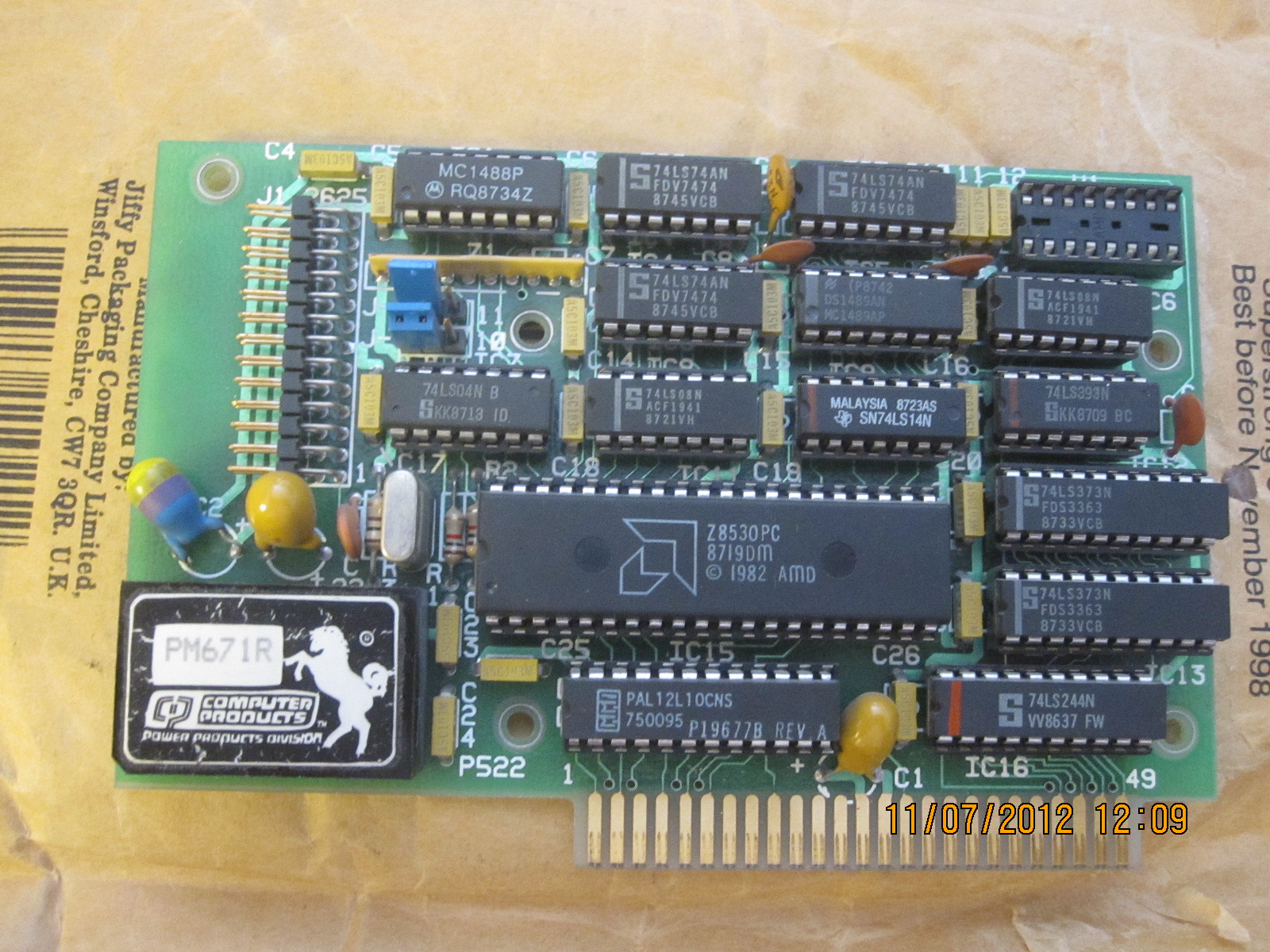
My dad turned this up the other day. He'd been tidying his desk and
come across it! He's no idea where it came from, or what it's out
of...
Anybody got any ideas?
Picture at http://www.irrelevant.com/rob/IMG_3002.JPG (708KB)
It look a bit like an ISA card missing it's bracket but I've not got
one to hand to compare it too. Label shows a horse, CP Computer
Products, Power Products Division and a matrix printed "PM671R".
Underside has "Artwork PC19640, REV.B. Detail PC19641. Assembly
PC19642. G T P 244" in copper.
Main chip is an AMD Z8530PC. There's a PAL and a MC1488 & 9,
otherwise the rest is 74LS TTL. All socketed. 26 pin internal header.
No external sockets. Date codes are mostly 1987.
It certainly feels like some sort of RS232 serial card, based on the
chips, but I've not seen one without an D-type socket on before.
Any ideas? Anybody have a use for it? FTGH just pay postage.
Rob
>
>Wasn't there a short-lived "S-50" bus once upon a time?
There was an SS-50 bus which was a 680x bus by as far as I remember mostly
SWTPC and Gimix, and that was based on 0.1" headers with the sockets on the
motherboards. There was also an SS-30 bus for I/O -- similar to the Apple
II in that each slot had a decoded select signal.
Dave Dunfield knows more than most of us about this :-)
W
We're moving, and I need to down-size considerably.
I want to sell the following DEC gear as a lot for $2000.
You must be able to pick it up in Colorado Springs.
Everything goes together, please - no cherry-picking. You take it all, and you can dispose of the stuff you don't want.
Here's the highlights:
PDP-8E. Years ago, I was able to key in stuff from the front panel, but it didn't seem to execute. But I think it's not too far from working.
PDP-11/05. The 5V power rail doesn't work, and the core memory is flakey, but years ago I hooked up an external 5V supply, cabled the Unibus to an external DD11 with MOS memory, and booted and ran RT-11 using my RX01 emulator board. The front panel is ugly, but all the switches and lights work. Includes spare CPU and memory-controller cards, but at least some of them don't work.
VT05 terminal. DEC's first general-purpose video terminal. Quite rare, I think. It works, last time I tried.
VT100 terminal. Works.
PDP-11/03-L system box. It's a rack-mountable BA11 chassis with CPU, memory, BDV11, and serial card.
PDT-150. Works. Have a spare CPU board also.
VAXstation 3100-M38.
AlphaStation 200 -4/166.
"Pizza box" storage box. Accepts 3 SCSI SBB disk drives.
About 2 linear feet of microfiche, tech and maint. info. These alone are worths 100's of $$ on eBay. This is mostly "good stuff".
Option Module List books, 4 volumes.
VMS CDs.
Digital Technical Journals - I think it's a complete set.
DEC handbooks - about 4-5 linear feet.
A variety of modules, including Unibus, Q-bus, u-VAX, and some straight-8 flip-chip cards.
Also available, but for an additional cost:
Original Commodore PET, 8K RAM, chiclet keyboard. It was my very first computer in 1979.
Atari 800 system.
HP-85.
A home-brew S-100 system that I built, based on a PDP-8i switch panel and vintage LEDs.
Pete
Contact me at:
saipan59
at
Q
dot
com.
Or call:
719 282 1033 (weekends, or evenings before 10PM Mountain)
I have quite a pile of TSX-plus docs that need to find a good home -
so far three or four binders. TSX is an extension of RT-11. Please
contact me off list. Bitsavers has dibs. Free for postage (media rate
should not be too bad).
--
Will