Hoping some of the people here can help, I'm trying to compile a listing of
hardware that versions of the Spacewar code were ported to after the PDP-1
during the 1960s. There was the PDP-6 version which was done at Stanford
SAIL, and there were the PDP-7 and 8 versions which appeared in the DECUS
catalog in the early 70s (which means they could have technically been
done in the very late 60s), and the early 70s PDP-10 version (which was
just a port of the PDP-6 version).
Is anyone aware of any non DEC hardware it was ported to in the 60s? I
haven't been able to find any concrete evidence that it was on anything
other than DEC hardware in the 60s.
Thanks!
--
Marty
Kurt: Please respond directly to Stan Paddock's questions below. Thanks
---- Jud
Justin (Jud) McCarthy
251 SW 9th Ave
Boca Raton, FL 33486
Home (561)391-1422 Cell: (561)504-7048
In a message dated 12/25/2012 2:00:16 P.M. Eastern Standard Time,
stpaddock at sbcglobal.net writes:
Jud,
As you know we have two fully operational 1401 systems each with a 1403
printer.
Each printer still has the same paper feed box they had when I started
there 5 years ago.
It is anmazing how far a box of paper goes when we come in one day a week
and then some days we don't print at all.
I hate to see the paper go to waste tho.
How full is the box and what is the total cost shipped to
Computer History Muesum
1401 North Shoreline Boulevard,
Mountain View, CA 94043
Stan
----- Original Message -----
From: _JHMcCarthy at aol.com_ (mailto:JHMcCarthy at aol.com)
To: _director at ctandi.org_ (mailto:director at ctandi.org) ; _Robgarn at mac.com_
(mailto:Robgarn at mac.com) ; _ed at ed-thelen.org_ (mailto:ed at ed-thelen.org)
; _stpaddock at sbcglobal.net_ (mailto:stpaddock at sbcglobal.net)
Sent: Tuesday, December 25, 2012 6:37 AM
Subject: Fwd: Continuous feed computer paper anyone?
FYI. Take action as appropriate. ---- Jud
Justin (Jud) McCarthy
251 SW 9th Ave
Boca Raton, FL 33486
Home (561)391-1422 Cell: (561)504-7048
____________________________________
From: _kurt.m.nowak at gmail.com_ (mailto:kurt.m.nowak at gmail.com)
Reply-to: _cctech at classiccmp.org_ (mailto:cctech at classiccmp.org)
To: _cctalk at classiccmp.org_ (mailto:cctalk at classiccmp.org)
Sent: 12/24/2012 4:02:21 P.M. Eastern Standard Time
Subj: Continuous feed computer paper anyone?
Does anyone want any 14-7/8" X 11" continuous feed paper? I have a
partial box full that I was going to just take to the recycling. Asking
the cost of shipping plus a little extra for my troubles. These are over
$50 a box new....How times have changed! Email me off the list.
-Kurt
Jochen writes:
> I suspect CI cables are just ordinary 50 Ohm coax, but heavily
> overspeced in best DEC tradition. ;-)
Dave writes:
> I agree (now) that they're most likely 50-ohm, but that particular
> coax is anything but ordinary. ;) I'm sure they over-specced it like crazy.
OK I found some hanks (chopped up from computer room removal) of old blue "thick" CI cable. I was actually gonna take it home and use it for some recabling of my radio station anyway when this subject came up on cctalk.
Externally it is 0.4" like many RG-8 and RG-213 types.
Internally the center conductor is 11AWG, silver plated solid copper. Yep, silver plated.
The dielectric is 0.238" diameter polyethelyne foam. Again, a little smaller diameter than usual for RG-8 types, but I think in ratio with the inner conductor being smaller and the properties of foamed poly, gives 50 ohm impedance.
Then, the amazing thing is what's outside the dielectric. There is a layer of foil, a THICK layer of braid, then another layer of foil, then another THICK layer of braid. I don't think I've ever seen a RG-8 type coax with 4 layer shielding. Most RG-213 types have a single thinner layer (and some have foil). I don't think the braid is silver plated, I think it's just tinned, may test that out later.
If you wanted to put crimp-on N or UHF connectors onto this stuff, the funny dielectric diameter might cause some heartache, as could the extra thickness of the double braids.
I have some hanks of "reddish-orange" DEC Thicknet Ethernet cables too, will check out what's inside them. I seem to recall them being solid polyethelyne dielectric but it's been more than a decade since I cut into any.
Tim N3QE
> From: Lyle Bickley <lbickley at bickleywest.com>
> Date: Mon, 24 Dec 2012 16:32:29 -0800
> Subject: Re: Spacewar hardware?
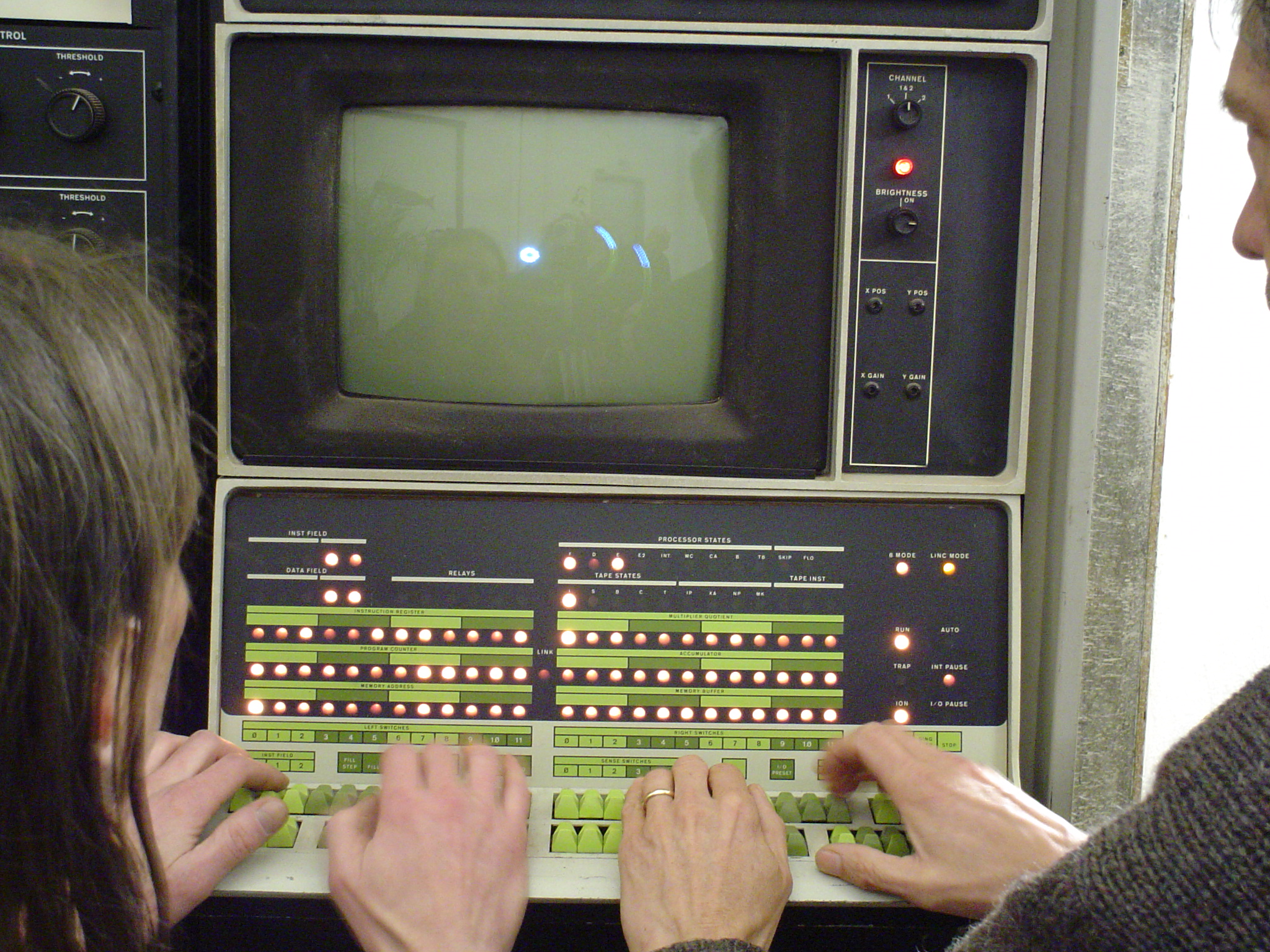
Here is an image of me playing Spacewar on a PDP-12. I am the on on the right.
http://www.rcsri.org/collection/pdp-12/spacewar.jpg
--
Michael Thompson
I'm looking for one or two DEC E2057 (VAX 7700 CPU) modules.
I'd also like to find some CI cables. (the thick blue coaxial cables)
Anybody gots? Please contact me off-list of is.
Thanks,
-Dave
--
Dave McGuire, AK4HZ
New Kensington, PA
Though not a direct copy of the original Spacewar, it is very clear that it was inspired by Bushnell playing Spacewar on various computers.
-----Original Message-----
From: Martin Goldberg [wgungfu at gmail.com]
Received: Monday, 24 Dec 2012, 12:33pm
To: General Discussion: On-Topic Posts Only [cctech at classiccmp.org]
CC: General Discussion: On-Topic and Off-Topic Posts [cctalk at classiccmp.org]
Subject: Re: Spacewar hardware?
On Sun, Dec 23, 2012 at 11:16 PM, Rick Bensene <rickb at bensene.com> wrote:
> Jay wrote
> >
> >
> > I also recall their being a free-standing game version of the thing.
> >
>
> Nolan Bushnell, of Atari fame, built what he felt could be an arcade
> version of Spacewar in 1970. He built it in his daughter's bedroom.
>
> Bushnell licensed the design to a company (I can't remember the name)
> that ended up building about 1500 or so of them, calling them
> "Computer Space". They are extremely sought-after collector's items
> today. I have no idea what hardware was in the machines.
>
> Rick Bensene
>
That's actually not a version of Spacewar, nor is it based directly off the
game. It was "inspired by," and created by Nolan Bushnell and Ted Dabney.
The hardware is a custom TTL based state machine (no software). They
licensed it to Nutting Associates in Mountain View. We have the full story
in our book:
http://amzn.com/0985597402
--
Marty
Backing up a usb device sure but as Cindy pointed out its likely a poor backup media itself. Some friends and I all had 64mb flash drives back when they were new. We all lost our copies of some source code we had been using it for (portable coding drive so we could use each others systems and have our progress). Left a sore spot despite them being nice for quick trips or transferring files.
For those of you that could not make it in December, we will be having
another warehouse day on Jan 13, 2013, Saturday, beginning at 9AM, and
lasting until about 1PM.
Some of this stuff is too bulky/heavy to ship, and some I have no clue on,
so bring test disks, and let's have some fun J
Cindy Croxton
Electronics Plus
1613 Water Street
Kerrville, TX 78028
(830)792-3400 phone (830)792-3404 fax
AOL IM elcpls
_____
No virus found in this message.
Checked by AVG - www.avg.com
Version: 2013.0.2805 / Virus Database: 2637/5982 - Release Date: 12/23/12
Does anyone want any 14-7/8" X 11" continuous feed paper? I have a
partial box full that I was going to just take to the recycling. Asking
the cost of shipping plus a little extra for my troubles. These are over
$50 a box new....How times have changed! Email me off the list.
-Kurt
Thanks. However, as you mention, this is a software package that is
different than the software that came with the ProClock. It looks like
this Comm software supports the ProClock, but does not provide
the functionality of the original software. Also, trying to unpack this
package, gets me into some odd circular exercise. It goes through two or
three iterations of different package archive formats and ends up back at
the original package.
Any other leads to the Practical Peripherals ProClock software?
Thanks,
Win
------------------------------
*Date: Mon, 24 Dec 2012 10:56:48 -0600
From: "Cindy Croxton Electronics Plus" <sales at elecplus.com>
To: "'General Discussion: On-Topic and Off-Topic Posts'"
<cctalk at classiccmp.org>
Subject: RE: Practical Peripherals ProClock software?
Message-ID: <004101cde1f7$a9a02970$fce07c50$@com>
Content-Type: text/plain; charset="us-ascii"
http://www.apple2.org.za/gswv/a2zine/GS.WorldView/v1999/Oct/
The Modem.mgr.manual explains it all.
The Modem.mgr.ProDOS.SDK.bin apparently contains the software.
Although it is modem software, according to page 1 of the manual, it
supports the clock card that you have.
According to this advertisement,
http://books.google.com/books?id=ii8EAAAAMBAJ&pg=PA54&lpg=PA54&dq=Practical+
Peripherals+ProClock+software&source=bl&ots=4j8YEITLyM&sig=MXmvaWIq5Ahrgeu5H
XyGkSeBFMc&hl=en&sa=X&ei=I4fYUOqZKuyr2AXe74DYBw&ved=0CGcQ6AEwBg#v=onepage&q=
Practical%20Peripherals%20ProClock%20software&f=false (page 54, bottom right
corner) this card was apparently released about Oct 1985.
You might need a new battery before it works!
Cindy Croxton
-----Original Message-----
From: cctalk-bounces at classiccmp.org [mailto:cctalk-bounces at classiccmp.org]
On Behalf Of Win Heagy
Sent: Saturday, December 22, 2012 12:11 PM
To: cctalk at classiccmp.org
Subject: Practical Peripherals ProClock software?
Hi,
I have a Practical Peripherals ProClock for my Apple IIe. It has everything
in the box, but I seem to be unable to read the software utilities disk.
Can anyone point me to the software online or possibly send me a zipped
image? I googled and cannot find anything.
Thanks, Win
wheagy at gmail.com*
Hi,
I have a Practical Peripherals ProClock for my Apple IIe. It has
everything in the box, but I seem to be unable to read the software
utilities disk. Can anyone point me to the software online or possibly
send me a zipped image? I googled and cannot find anything.
Thanks, Win
wheagy at gmail.com
Eric writes:
>>> Jochen writes:
>>> Aren't those just ordinary RG-8/U / RG-213/U style 50 Ohm koax cables
>>> with ordinary TNC connectors and an extraordinary blue color?
Guy Sotomayor wrote:
>> Don't know. From what I can remember (I have a bunch of them) they're fairly
>> thick and heavy.
> That's certainly consistent with RG-8/U (obsolete) or RG-213/U.
I was just looking at some of the old CI cables in the computer room floor. This is all bought-from-DEC stuff from early 1990's.
The long ones are typically blue and labeled "12 AWG". They look a lot like RG-8/213 types.
There are some skinny jumper cables on the CI panel internals that look to be a much skinnier kind of coax, also blue, looks like RG-174.
In the "real world" I am much more likely to see LMR-400 or Belden 9913 specified today, than the RG-type specifications.
Tim.
Recently came into posession of a WD "Blue Rings" NAS setup. I've rapidly come to the conclusion that
it really isn't very good as a NAS, and doesn't even do what it's supposed to (I can't even get SSH to stay
up or reliable connections from computers).
It has a ARM-based board with an Oxford OXE800, VIA Ethernet, onboard USB, provisions for a serial port
(provided I supply a level converter to go to RS-232 from the supposedly "standard" 3.3V to a real standard).
The big downside is the BGA RAM chip with only 32MB. I guess it's probably in the junker category since
there really isn't any way I can expand the RAM (1 BGA 256Mb DDR chip, no extra pads), but I thought I'd
check because I've been interested in the Pi for a bit and then this dropped into my lap - any thing that can
be done usefully with this HW?
Hi Ben,
I might have one here.i would think boxing and putting on a pallet
would be best. What drives etc you need? I'm guessing total weight
about 150 pounds max.
Thanks, paul
Hi Folks,
I have been making good progress restoring a PDP-8/m and would like to buy a vintage hard drive and controller for it. Anyone know where I might find those? An RK05 or Diablo-31 drive would be nice. Will also need an RK8E controller board set.
Have had some near misses: A Diablo-31 was up on eBay but it turns out that it's missing a head. Found an RK05 listed for sale on a fellow's site. After I agreed to buy it, haven't been able to get a reply, though. Located the controller listed for sale at another company site. The phone system takes messages but they haven't been returned (so far). Email bounces. Hmmm.
Please let me know if you know of any possibilities.
Thanks,
Steve
steve at tronola.comhttp://www.tronola.com/
but what SME do you have Dave?
We have an AMR-1000 here..... <spacebar>
Ed#
In a message dated 12/23/2012 7:54:13 P.M. US Mountain Standard Time,
cctalk-request at classiccmp.org writes:
Message: 7
Date: Sun, 23 Dec 2012 14:25:20 -0500
From: Dave McGuire <mcguire at neurotica.com>
To: General Discussion: On-Topic and Off-Topic Posts
<cctalk at classiccmp.org>
Subject: Re: Kerrville, TX warehouse pics
Message-ID: <50D75AA0.2010603 at neurotica.com>
Content-Type: text/plain; charset=ISO-8859-1
On 12/23/2012 02:00 PM, COURYHOUSE at aol.com wrote:
> Big concern.. as with tape I shoot injest the tape into the
> edit bay. toss tape on storage shelf and have the orig. saved on tape
> and .... the edited version can also be saved back to tape as
> well as saved on the network attached storage units.
>
>
> I fear in the future having memory card crap out !
That's not nearly as catastrophic as a spastic space bar!
-Dave
From: Jerry Wright <g-wright at att.net>
> assign TT1: DDA
> Mount DDA0: 'file name'.dsk
>
> E11 comes back with can't open file.
The apostrophes (or quotations marks) should be around the entire filename,
not just the part before the .dsk extension. And you don't need them at all
if the filename doesn't contain blanks or forward slashes or other weird
characters.
> It will let me just mount it with out a file. but if
> I'm going to write to it, I would guess there needs to
> be a container file.
It's true, a DD: controller with no working units isn't very useful!
E11 doesn't give an error message though, since it doesn't want to be
picky about the order of the ASSIGN TT and MOUNT DD commands. For all
it knows you were just about to attach files/etc. to DDA.
John Wilson
D Bit
That's what I'll call it, since I don't know the correct term Osborne
used. It's the plastic plug with pins that jumper the external video
card-edge port on an Osborne 1 portable. Without it, the Osborne
either goes into external video-only mode or, according to one doc I
read, it will damage the hardware.
One of my O1 machines is missing this part. Does anyone either have a
spare one or know of any plans out there to build your own?
-j
--
silent700.blogspot.com
Retrocomputing and collecting in the Chicago area:
http://chiclassiccomp.org
>
> I'm looking at this:
>
>
http://www.ebay.com/itm/Shugart-model-801-8-Floppy-Drive-/230897115754?pt=US
_Floppy_Zip_Jaz_Drives&hash=item35c28a626a
>
> and it seems to be very similar to the drives in my Intel MDS box (blue
if that matters, and that's all I have of an MDS system). The listing calls
it a Shugart 801. I seem to recall Fred stating that a S* 800 was a *good*
drive to utilize w/some peecee disk controllers.? Is an 801 also *good*? I
e-mailed the seller intending to grill some info out of him.
>
Here is a set of pictures picture of the jumpers from my MDS drive with
Shugart 801's in it. Do they match up with yours?
I don't have the system it came from only the drive. Note how drive 0
jumpers differ from drive 1 significantly. You can see from the pics that
the outside of the case was pretty dirty, fortunately cleaned up nicely.
The inside was just fine, no grime.
I did not look up the jumpers in the manual, just took the pics for future
reference.
http://vintagecomputer.net/intel/MDS-720/
Bill
what about using SD cards? someone told me the innards were
better than the ones they use in USB drives and other have told me there is not
much difference?
Thanks Ed # _www.smecc.org_ (http://www.smecc.org)
In a message dated 12/22/2012 9:51:23 A.M. Mountain Standard Time,
cctalk-request at classiccmp.org writes:
Message: 14
Date: Fri, 21 Dec 2012 17:44:42 -0800
From: Chuck Guzis <cclist at sydex.com>
To: General Discussion: On-Topic and Off-Topic Posts
<cctalk at classiccmp.org>
Subject: Re: Kerrville, TX warehouse pics
Message-ID: <50D5108A.9090001 at sydex.com>
Content-Type: text/plain; charset=ISO-8859-1; format=flowed
On 12/21/2012 05:13 PM, barythrin at gmail.com wrote:
> Backing up a usb device sure but as Cindy pointed out its likely a
> poor backup media itself. Some friends and I all had 64mb flash
> drives back when they were new. We all lost our copies of some source
> code we had been using it for (portable coding drive so we could use
> each others systems and have our progress). Left a sore spot despite
> them being nice for quick trips or transferring files.
I'm still using my 256 and 512MB flash drives. But you have a point;
the consumer flash USB drives are not known for their robustness. When
customers ask to have data returned on USB flash, I balk a bit, and
insist on sending along a CD or DVD with the flash--and then hang onto
the data for at least 30 days.
Just like floppies, storage environment and handling means a lot. If
you're used to carrying a USB drive around in your pocket along with
your keys, you should probably have a backup of that data somewhere.
I mostly find pen drives useful for sneakernet and substitutes for CD
ROMs on systems that lack drives.
A useful comparison between SLC and MLC flash:
http://www.supertalent.com/datasheets/SLC_vs_MLC%20whitepaper.pdf
Speaking for myself, I have data backed up in several places, one of
them being off-site in a vault, against the day that we have a sudden
300m rise in sea level. :)
--Chuck
Thanks... that was what I was afraid of.
As some of you know I do some video work
and storage is a big issue in the camera.
most of my larger cameras use mini DV.
BETACAM or DVC-PRO... but all that is
going away in favor or memory storage devices.
Big concern.. as with tape I shoot injest the tape into the
edit bay. toss tape on storage shelf and have the orig. saved on tape
and .... the edited version can also be saved back to tape as
well as saved on the network attached storage units.
I fear in the future having memory card crap out !
Ed Sharpe --- _www.smecc.org_ (http://www.smecc.org)
In a message dated 12/23/2012 11:00:31 A.M. Mountain Standard Time,
cctalk-request at classiccmp.org writes:
Message: 13
Date: Sun, 23 Dec 2012 10:38:50 +0100
From: Jochen Kunz <jkunz at unixag-kl.fh-kl.de>
To: cctalk at classiccmp.org
Subject: Re: Kerrville, TX warehouse pics
Message-ID:
<20121223103850.386b48ad9951fa64951e54cd at unixag-kl.fh-kl.de>
Content-Type: text/plain; charset=US-ASCII
On Sat, 22 Dec 2012 12:53:48 -0500 (EST)
COURYHOUSE at aol.com wrote:
> what about using SD cards?
Same cheap shit as cheap USB drives. Especially MicroSD.
If you wane be (halfway) save you have to go for industrial grade SD
cards. Depending on size you will have to pay 10 times as much per GB
compared to consumer grade stuff.
--
\end{Jochen}
\ref{http://www.unixag-kl.fh-kl.de/~jkunz/}
----- Original Message -----
Date: Sat, 22 Dec 2012 22:35:18 -0800
From: mc68010 <mc68010 at gmail.com>
How does this work ? I assume it is 90 column right ? You have a
character wheel then another wheel that I assume goes to 90 with stops
along it. Four latches but, they cant be in the same positions. What do
'S' and 'T' stand for ? Side and Top ? How do you advance the card ?
http://www.ebay.com/itm/c1966-UNIVAC-found-Mainframe-Computer-Wright-Line-P…
------ Reply:
I just happen to have one of these (unlike that ratty specimen it's in
pretty well mint condition aside from a dried-out ribbon); for sale if
anyone has ~$100 & S to throw away ;-)
Remember the old Dymowriters? Same idea.
1 - Pull out card holder.
2 - Insert card.
3 - Dial letter to punch (and print!) and press (wait for it...) PUNCH
- card advances to the next column.
4 - Repeat (3) until End Of Card.
5 - Remove card; goto 1 until Finished.
The wheel with levers sets the Tab stops; the T button (you guessed it ;-)
Tabs to the next space, and speaking of Space I'm sure you can guess what
the S button does...
80 columns BTW...
m