And one more thing,
Am wondering about the possibility of setting up an interface between
modern Unix email and the embedded client for cc:Mail on the HP 200LX.
Various versions of cc:Mail are available from archive.org and
vetusware.com, but the missing link seems to be the "client" type
connection from the cc:Mail post office to the internet, i.e. for the
PO machine to connect periodically and collect mail, rather than just
acting as a server.
Have not been able to find much technical information about cc:Mail. I
did see a Lotus development kit for sale somwhere but seems to have
lost the link.
Does anybody here know anything about this? Are there any books or
technical documents on cc:Mail available anywhere?
/Tomas
I ran across a reference to this on FB.? It appears to be from 2008, so
may be well known or obsolete material.
The other interesting info at the end of the article is the contact name
and info about someone who restores or works on tape heads.
Might be interesting to at least contact and ask if he's still around
http://www.wendycarlos.com/bake%20a%20tape/baketape.html
Contact John French, at JRF Magnetic Sciences (973-579-5773) for further
details on magnetic tape head restoration and storage, and other related
services and products.
FB page with the info.
https://www.facebook.com/ReelToReelTapeRecorders/photos/a.532104240183459/3…
The fellow who does a lot of tape recorder (reel to reel) repair has a
FB group worth dropping in on.? This is the link to a photo with a
pretty bad Ampex head.
thanks
Jim
>
> On 12/16/2020 05:40 PM, robinson--- via cctalk wrote:
>> Hi all,
>>
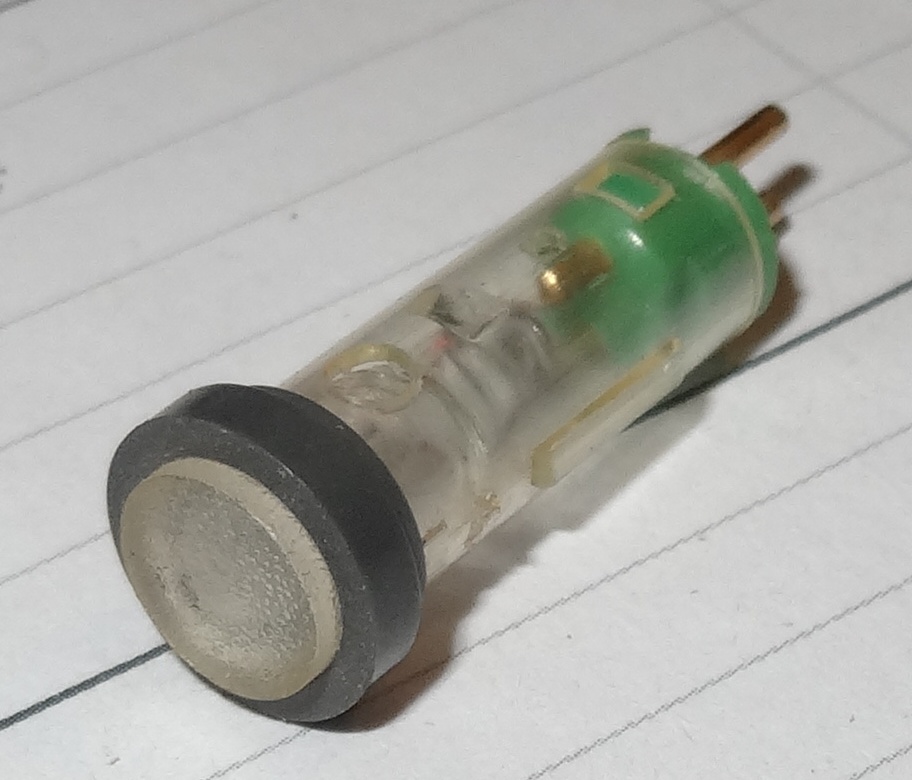
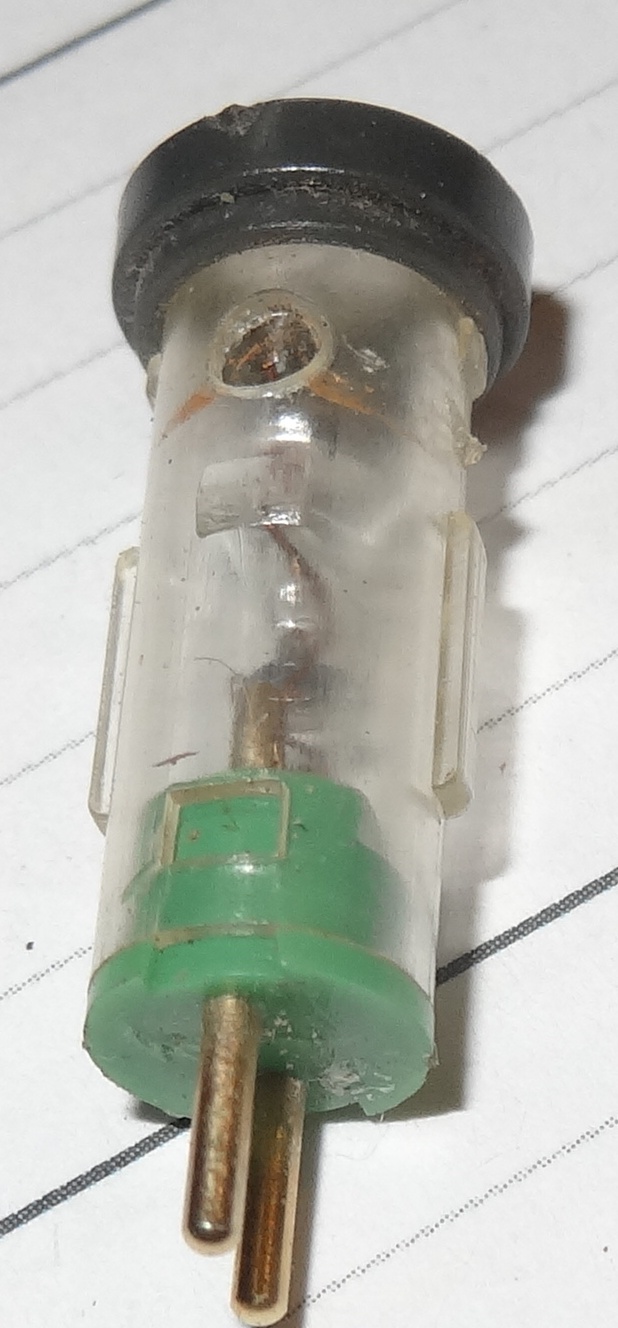
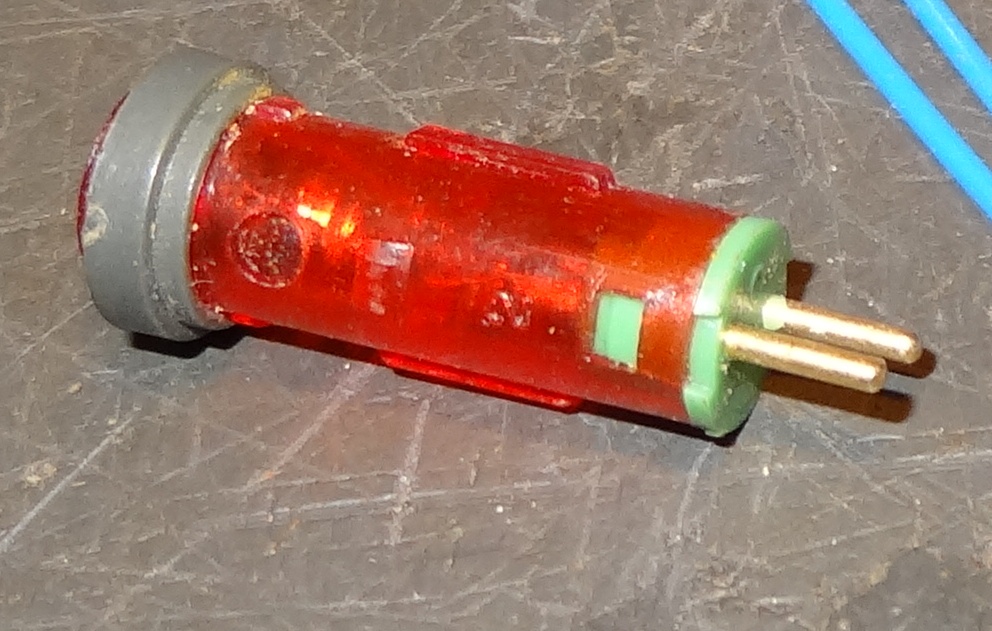
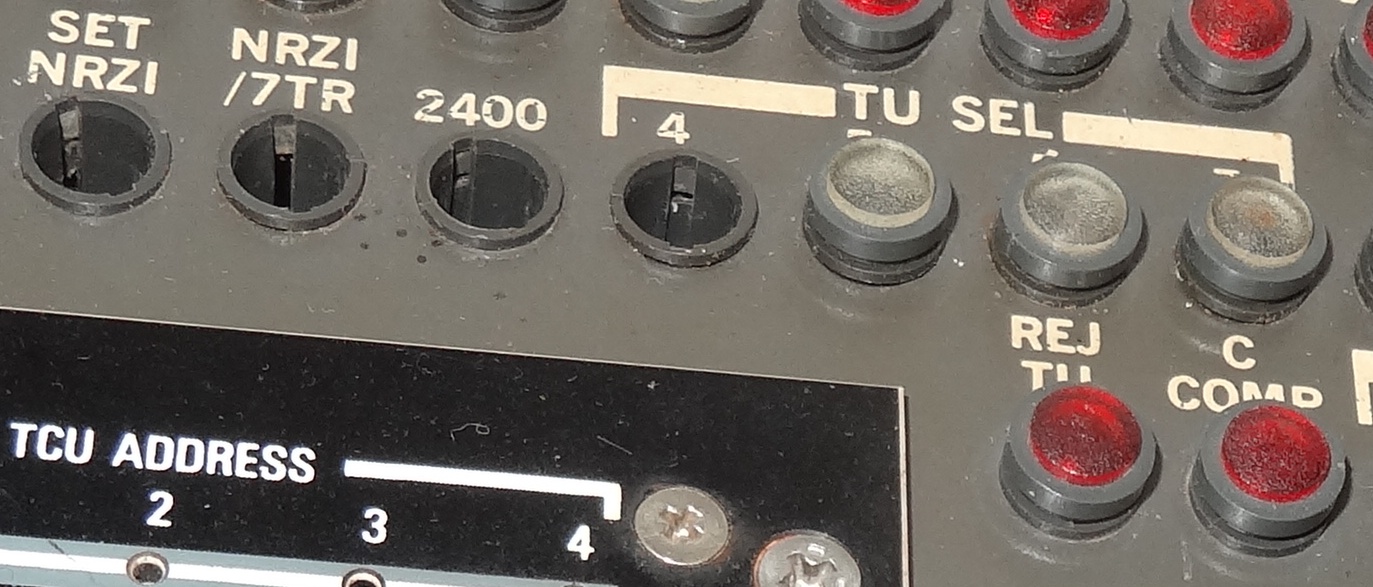
>> I am setting up an IBM 2803 and 2804 INTEFACE test panel.
>> I need some lamps and lamp holders for it,
>> lamp voltage not important,
>> lamp color not important.
>>
>> Does anyone have any for sale
>> or know where I can get some please.
>>
>>
> These are going to be VERY hard to find. Some people have
> saved 360 front panels, but are not likely to part with the
> bulbs. What you might need to do, if function is not
> required, is to get a single lamp from somebody, and 3D
> print some pieces to assemble into a facsimile.
Last time I was at the Living Computer Museum, I talked to the guy restoring their 370 panel, who was using LEDs, because the original bulbs are all but unobtainable and do not lave a long service life. This is likely to be something you end up needing to approximate with modern components.
Adam
I'm listing this stuff just in case someone is desperate for
any of it.
All items are as-is and free. Pickup only here in London, ON.
I'm too old and too tired to run around shipping things.
I'll hold on to this stuff for a couple of weeks; after that it's
the recycling bin.
Softech microsystems UCSD p-System 8" floppy disks:
CPM40D CPMDISK (BOOTER)
UG84AT.C UPGRADE IV.03 Jun 16 1982
N8P4AT 8080 NATIVE CODE GENERATOR Jun 16 1982
LXP4BT UCSD Pascal Compiler Jan 1983
LXP4AT.B UCSD Pascal Compiler Jun 16 1982
UGC4AT.A UPGRADE Jun 16 1982
OII40D ADAP ORIENTER Jan 5 1983
IZP4BT.B Interpreter Jan 26 1983
CZP4BT.B CPM ADAPTABLE Jan 26 1983
SAP4BT.A SYSTEM Jan 26 1983
CPM4BD CPM READABLE Jan 26 1983
N8P4BT 8086 Native Code Genator (sic) Jan 26 1983
Hayes V-series Smartmodem 9600 (in box)
XT parallel port card
Apple mouse A2M4015
2 x Tandem binders
1 x GA binder
General Automation GA-16/220/330 microconsole and system console reference card
Raytheon PTS-100 reference card
Interdata model 70 and 80 programmer's guide reference card (1971)
Databooks:
M6800 Microcomputer Family - a 79 page Motorola pamphlet containing specs etc.
AMD Am29800 Family High Performance Bus Interface 1981
AMD MOS/LSI Data Book 1976
Synertek 1979 Data Catalog
Microprocessor Data Package - International Electronics Unlimited booklet
on IMP MM5750, MM5751 CPU set
Data Sheets:
CR-112 4K MOS RAMs from Texas Instruments - reliability report for TMS 4030, 4050, 4060
IMS2620 High Performance 16Kx4 Dynanic RAM - inmos #110 May 1983
IMS2630 High Performance 8Kx4 Dynanic RAM - inmos #111 November 1983
IMS2600 High Performance 64Kx1 Dynanic RAM - inmos #101 November 1983
GTE 8104/8114 Static RAMs 1024x8 N-MOS April 1980
Texas Instruments MOS/LSI Memory and Microprocessor Products June 1976
Books:
The SNOBOL4 Programming Language - Griswold et al
Manuals:
Courier 270 Information Display System Operator's Manual pub # 30-0002-00-00 Jun 1975
ICC 40+ Data Display System Installation and Operation
GA 16/220 prints - this is a very complete set:
CUP NO. I, CPU NO. II, SYS. CNSL. INTF. W/IPL, 8K RAM, MEMORY SERVICE MODULE, TTY/with PS,
RS-232/TTY, COMPACT MIB, COMPACT PS
Has anyone got a couple of the white plastic rivets which are used to
hold the Jupiter Ace case together?
They consist of a 4-point clawed rivet of about 5mm long, and a pin
which pushes down the centre to open it out.
I need five of them ideally - but even two or three would get the case
buttoned up, if not perfectly.
I've checked the local plastic supplier catalogues and haven't found
anything which quite matches up.
Cheers,
--
Phil.
philpem at philpem.me.uk
https://www.philpem.me.uk/
Hi,
Some years back, I was asking if anyone had information about the speech
synthesizer
developed for the Altair 8080 by Wirt Atmar of AICS (in New Mexico).
No "hits".
Most places on the web claimed the Computalker was first, given the date as
1976 or 1977.
(Earlier speech synthesizes existed, but they were external boxes that one
interfaced to,
or were standalone (often with a large/weird keyboard).)
Today, I stumbled over a fairly bad OCR of Byte magazine from August, 1976
at
https://archive.org/stream/byte-magazine-1976-08/1976_08_BYTE_00-12_Speech_…
It has two articles about speech synthesizers for S-100 bus systems.
The first is by the Computalker people, who say:
At the time this article
goes to press, a synthesizer
module incorporating several
detail refinements and im-
provements over the circuits
of this article is being de-
veloped by the author and
associates.
and
A detailed user's
guide will be supplied with the
Computalker module
Note the future tense!
The second is by Wirt Atmar, whose product *was already shipping*.
Near the end of his Byte article, Wirt lists currently available products:
At the present time, two speech synthesizers
are both commercially available and affordable by
the hobbyist.
One is the Votrax produced by:
Vocal Interface Division
Federal Screw Works
500 Stephenson Dr
Troy Ml 48084
Price, approximately $2,000
Interfacing: Parallel or Serial (RS-232)
The second is the Model 1000 manufactured by:
Ai Cybernetic Systems
PO Box 4691
University Park NM 88003
Price, $425
Wirt had told me (twenty years ago or so) that he thought his was the first
for microcomputers (e.g., a user installed card, not an external box).
Now, I'm sure ... but it was realllly close!
Wirt demonstrated his product at the earlier MITS World Altair Computer
Conven-
tion, where it won first prize.
He advertised it poorly/infrequently, since it was mostly a side business.
And, that shows, since history doesn't remember it.
Stan
> I can't pick up in ON, unfortunately, but if someone who is in the area
> could please pick up this "Microprocessor Data Package" and ship it to
> me, I'd be willing to pay anything reasonable, or maybe slightly
> unreasonable.
You probably know this already, but if you're willing to pay, there are 'pack
and ship' services who will show up at a location, take the stuff to be
shipped, go pack it up, and ship it. I have used PakMail:
http://www.pakmailcanada.com/
several times to retrieve things in this way (they shipped my PDP-11/45 from
Ontario, although the seller did a lot of the packaging in that particular
case), and have generally been happy with them. I don't see a London location,
but maybe one of their other Ontario locations:
http://www.pakmailcanada.com/pakmail-canada-locations
is close enough to be useable?
Noel
Were you the winner of the eBay auction? It went for a very reasonable price. It was very difficult for me to not bid on it - those are great boards for use with early S100 systems :)
Mike
Hi,
I'd like to apologize for referring to the OCR of the Byte article as a
"fairly bad OCR".
I was thinking of the garbled sections that may be the result of trying to
OCR graphics.
The vast majority of the text comes across clearly, and I don't want to
insult whoever volunteered their time to do the OCR'ing ... I know how
tedious it can be!
I've been spoiled by OCR programs that produce their output as pdfs with
searchable text,
and should have remembered the results I get when I look at just their text!
Stan
Paul writes:
> General overstrike requires a bitmap display, or some sort of persistent
display.
Although he carefully specified 'general overstrike', I'll still mention
how the HP 2641A (an APL terminal) did it. When about to enter a newly
received character into memory, the terminal checked if a non-blank was
already in that spot ... if yes, it looked up the pair in an internal ROM
table and replaced the existing character code with a new character code
designed for APL\3000 (a code that, when received, would display as the
appropriate overstrike).
That meant that we couldn't use the terminal at Burroughs, because our APL
had a few overstrikes that weren't in the table.
Stan
I came across this among some junk I had.
Don
.TY NEMON.DOC
LEVEL 5 MACRO-10 MNEMONICS
=============================
COINCIDENT WITH THE RELEASE OF THE LEVEL 5 MONITOR SERIES, THE
MNEMONICS FOR THE HARDWARE INSTRUCTIONS USED IN THE MACRO-10
ASSEMBLER HAVE BEEN UPDATED TO REFLECT CHANGES TO THE MONITOR, AND
NEW OPERATING PROCEDURES. ALTHOUGH THEY HAVE NOT ALL BEEN IMPLEMENTED
AS YET, A PARTIAL LISTING FOLLOWS:
TRCE TRANSLATE REDUNDANT CODE TO ETHIOPIAN
ROTC REQUEST OPERATOR TAKE OFF CLOTHES
TDCE TRY TO DUMP CORE EVERYWHERE
HRR HASH RELOCATION REGISTERS
XCT EXTEND CYCLE TIME
ANDCMB ALLOW NO DIRECT CURRENT IN MEMORY BANKS
AOSE ALERT ONE SYSTEMS ENGINEER
SETNM START EJECTING TRANSISTORS AT NEAREST MACHINE
SETCM STOP EVERYTHING TO CRASH MONITOR
SETAM START EATING TAPE ON ALTERNATE MONDAYS
TLCN THROW LIFEPRESERVER INTO CHANNEL FOR NON-SWIMMER
MULM MONITOR UPDATE FROM LUNAR MODULE
MOVMS MAINTAIN ONLY VARIABLE MAGTAPE SPEED
FSBRI FIVE SONIC BOOMS OVER REMOTE INTERFACE
HRRES HIJACK REMOTE READER TO ENGINEERING SCIENCE
HRREM HALT AND REVERSE ROTATION ON EVERY MAGTAPE
JUMPE JUMBLE USERS' MEMORY ON PARITY ERROR
IDPB IMMEDIATELY DROP PARITY BIT
SETCAI SUDDENLY ELECTRIFY TERMINAL ON CRUDELY ARTICULATED INPUT
JFFO JAIL AND FINGERPRINT FLIPPANT OPERATOR
ORCMB OPERATOR REQUEST TO CHANGE MAIN BATTERIES
SKIP SEARCH FOR KNOT IN INPUT STRING
SKIPL SKIP ON KNOT IN POWER LINE
ORCBI ORDER REDUNDANT CHANNELS TO THE BACK OF THE I/O BUS
SUBI START UNLOADING BAGGAGE FROM THE I/O BUS
PUSH PUNCH USING SEMI-CIRCULAR HOLES
JUMPL JUMP AND UNRAVEL MAIN POWER LINE
SOSL SMEAR OUTPUT ON SLOW LINE PRINTERS
TRON TRY TO REWIND OPERATORS' NECKTIE
SOSN SEND OUTPUT TO SUPERVISORS' NECKTIE
AOBJN ADD ONE BIT TO JOB NUMBER
IMULM INSIST THAT MALICIOUS USERS BE LOCKED IN MEMORY
FMPR FORGET MEMORY PROTECTION AND RELOCATION
FMPRB FAKE MONITOR PROBLEMS AND RESET BRIEFLY
CAIE CHANGE ADDRESSING TO INEFFECTIVE FROM EFFECTIVE
TRN TRANSLATE TO ROMAN NUMERALS
DPB DETACH PROCESSOR BRIEFLY
DIVB DECODE INTEGERS TO VERIFIED BRAILLE
SETCAI SNICKER ON ERRONEOUS TYPEIN FOR CAI
DIVMB DESTROY INDIVIDUAL MEMORY BANK
ORCB OUTPUT A RECORD CODED IN BRAILLE
TRCE TRANSFER ON ROMAN CATHOLIC ENGINEER
TLNE TRANSFER ON LUTHERAN ENGINEER
TROA TRANSFER ON ATHEIST
SOS SERVICE ONLY STUDENTS
SOJG SERVICE ONLY JEWISH GRAD STUDENTS
TDC TAKE DISK TO CHIROPRACTER
TSCA TURN SYSTEM CLOCK AHEAD
FADRB FILTER AIR ON DETECTING ROPE BURNING
FADM FILTER AIR ON DETECTING MOUNTIE
PUSHJ PROCESS USER'S SHORTHAND JOB
TDCA TYPE DOCUMENTATION, CENSORING ANECDOTES
MOVEM MONITOR OUTPUTS A VULGAR ERROR MESSAGE
ADDM ALLEVIATE DELAYS IN DECTAPE MOUNTING
AOSL AWAKEN OPERATOR IF SNORING LOUDLY
CAIE CENSOR ALL INPUT FROM ENGINEERING
DPB DISPLAY PASSWORDS FROM BATCH
FSBM FAST SPLICE OF BROKEN MAGTAPE
BLT BEGIN LOSING TIME
S0JG STACK OPERATOR (JUST GIRLS)
TSON TIME SLICE OF ONE NANOSECOND
JRST JOG 'ROUND SEVEN TRACK TAPE
TSC TRANSFER SWAPPING TO CARDS
I'm listing this stuff just in case someone is desperate for
any of it.
All items are as-is and free. Pickup only here in London, ON.
I'm too old and too tired to run around shipping things.
I'll hold on to this stuff for a couple of weeks; after that it's
the recycling bin.
Hardware:
12 x M594
2 x M971
M970
R002
BC08R-01
H8611
VT-52 coils (flyback, etc)
VT-100 current loop interface card
VAX PASCAL manuals:
AA-D030A-TE VAX/VMS Primer (VMS V01)
SPD 25.11.4 VAX-11 PASCAL 1.1
AA-H484A-TE VAX-11 PASCAL Language Reference Manual
AA-H485A-TE VAX-11 PASCAL User's Guide
AA-J181A-TE VAX-11 PASCAL Installation GUide/Release Notes
AA-J180A-TE VAX-11 PASCAL Primer
3" DEC binder for the PASCAL manuals
single package of prints:
PC11 M7810-C-1 "11/25/74"
Asynchronous Line Interface M7800-0-1 "75"
DL11-0-2 Installation Procedure "4-75"
LP11 Interface M7930-0-1
RK05-0-2 "72"
RK11-D-1 "73"
individual prints:
DUV11-DA-1 Field Maintenance Print Set "12-13-76"
PC11-0 engineering drawings "70"
H720-E
Fiche:
2 x DECUS PDP-11 Catalog 1977
DECUS PDP-11 Catalog 1978
Logic Handbook 1970
Logic Handbook 1973-74
Control handbook 1969
Manuals:
VT100 User Guide EK-VT100-UG-002
VT52 DECscope Maintenance Manual EK-VT52-MM-001 (1976)
RTM Register Transfer Modules (1973)
Media:
EC-N4783-48 ManageWORKS Workgroup Administrator & SDK March 1995 (trial software)
DECdirect CD Catalog Winter 1995
ONYX Electronic Systems and Options Catalog V1.0 (floppies)
Listings:
MAINDEC-11-DEFPB-A-D Feb 21, 1976 PDP11-45/55/70 FP11C part 2
MAINDEC-11-DEFPA-A-D Feb 21, 1976 PDP11-45/55/70 FP11C part 1
MAINDEC-11-DCKBA to DCKBE-C-D March 21, 1975 PDP11/45-11/40 BASIC CP TESTS
Hi,
First, apologies if I asked this years ago (I've searched my archives, no
hits :)
When was the concept of memory "above" the screen invented for terminals?
I.e., previously displayed data that had scrolled up and off the screen ...
but could be retrieved (usually by scrolling down).
(Sometimes called "scrollback", or "offscreen memory".)
(BTW, I'm talking about terminal-local memory, not a scrollback implemented
by the computer to which the terminal is connected.)
The HP 2640A, 1974, had (IIRC) several pages of memory available ... the
user could scroll
backwards and see what had been on the screen before it scrolled off (as
long
as it hadn't been lost by having too much subsequent output).
I suspect the DEV VT100, 1978, had it, but I can't find definitive proof
online (sure, I can find VT102 emulators that have scrollback, but reading
an old VT102 manual doesn't make it clear that it has it.)
thanks,
Stan
As the excavation of Bob's junkpile continues I have finally hit the MFM
layer. Specifically about 10 5.25 hard disks that look to be old style
MFM drives.
Vertex V150
Miniscribe 6085
ST 4038M Seagate Franklin telecom AT-40
Miniscribe 3650 HH
Seagate ST4096
Priam ID45-H
Rodime RO203E
RD54
Real ST506
Pair of ST412's.
Anyone recognize what kinds of systems may have used these? The RD54 is
of course DEC, and I'm guessing the ST506 and 412's were from either a
Rainbow or a Professional/350. But the rest are weird. Maybe Convergent
miniframes? Probably not PC's as Bob had a lot of weird stuff.
Thoughts? I'll see if I can get a mfm reader and suck data into files I
can post for others to read/try/giggle at. But as there isn't much
labelling I have no idea what is on them.
Also did find Wordperfect and speller for what I think is Rainbow on
5.25 floppies. Let me know if you need a copy, or if a copy exists in
archives (also two DEC disks for Learning the Rainbow or something like
that)
Chris
1 Perq 1, one chassis without motherboards of another Perq1, sides,
lids, 1.5 sets of ends, pair of Perq2 endpanels, two keyboards (1 and 2
style) and a portrait monitor.
Pictures of all the stuff at https://www.crystel.com/bob/perq4
Not many pictures of this stuff from all angles, so feel free to copy
and put on real sites.
Anyone need more of these Sun3/4 VME boards? Need to make more space.
CZ
Does anyone know anything much about this early desktop computer and its OS?
Example: https://www.ebay.com/itm/Perkin-Elmer-3600-PETOS-Like-Microsoft-BASIC-Compu…
Although it predated the PC, MS supplied the BASIC and apparently the
CLI resembles early DOS.
I ask because there is someone in the Free Pascal Compiler fora
looking for help getting data off one -- they're still using it for
data monitoring!
https://forum.lazarus.freepascal.org/index.php/topic,52458.0.html
--
Liam Proven ? Profile: https://about.me/liamproven
Email: lproven at cix.co.uk ? gMail/gTalk/gHangouts: lproven at gmail.com
Twitter/Facebook/LinkedIn/Flickr: lproven ? Skype: liamproven
UK: +44 7939-087884 ? ?R (+ WhatsApp/Telegram/Signal): +420 702 829 053
If anyone goes to the Gateway sale, please, please tell Doug that Adam
Thornton is doing fine in Tucson but misses him and the store greatly.
Thanks,
Adam
Thought you folks might be interested in a quick update on my folly here.
At the beginning of November I drove down to the bay area to pick up the
two fire-damaged PDP-11 systems -- a PDP-11/70 and a PDP-11/45. (I also
made a few other stops and got a few other items, but that's not what I'm
here to talk about...)
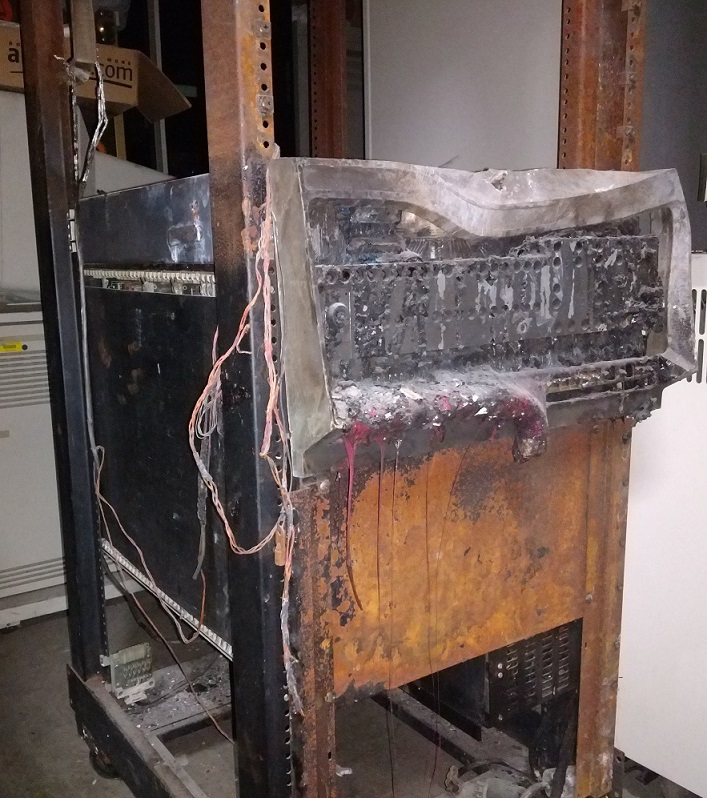
Over the past few weeks I've gone over the two systems and my assessment is
that the 11/70, while completely filthy, is completely restorable. The
fire/heat damaged the front panel enough to discolor the plexi and start
melting a few switches (http://yahozna.dyndns.org/scratch/1170/1170.jpg)
but that's the extent of the damage. My only fear is that the fingers on
the backplanes might possibly have some corrosion here and there, but I've
started going through and cleaning the boards and the backplane slots and
so far I haven't run into anything that looks troubling.
The 11/45 is considerably further gone. It took a serious amount of heat,
enough for the pig iron frame for the front panel to start melting (
http://yahozna.dyndns.org/scratch/1170/1145.jpg). The front panel is
completely destroyed, as is the wiring harness for the power distribution.
But... the metal of the chassis and the power supplies seems to have
protected the boards and the backplane. There are no melted or even
discolored wire-wrap wires on the backplane, and the boards look fine. As
an experiment I took the non-11/45-specific boards out of the backplane (a
Plessey memory board, an RL11 controller, and an M9301 bootstrap terminator
-- this one was right up front where things were the hottest and the
handles had started to melt) and tested them in my PDP-11/40. They all
work fine. So I think that, maybe, with a LOT of effort, the 11/45 could
live again.
I'm tackling the 11/70 first (Al kindly sold me a new front panel for a
very reasonable price so it already looks 100% better) and once I'm done
with that I hope to move on to the 11/45. In the meantime I'm hoping to
keep my eyes peeled for parts for the /45. I found a seller on eBay with
"restored" H7420a power supplies for $68, with free shipping so I grabbed a
pair. I realize this is unlikely, but I was curious if anyone has 1) any
parts of the 11/45 power wiring harness, or 2) (really unlikely) an 11/45
front panel in any condition. Well, any condition better than "melted into
slag," I suppose. I can build my own wiring harness, but if I can save
myself the trouble, that'd be nice.
- Josh
Hi everyone,
The Nostalgic Computing Center <http://www.nostalgiccomputing.org/> has a
virtual PDP-8 running TSS/8
<http://www.nostalgiccomputing.org:8080/aterm.html?m=pdp8&t=PDP-8&r=24&c=80>
in its collection. We use the SIMH PDP-8e emulator to support the machine,
and we recently updated the machine to run the TSS/8 distribution created
by LCM+L, found here on GitHub
<https://github.com/livingcomputermuseum/cpus-pdp8>. The LCM+L distribution
is slightly different from other TSS/8 distributions available on the web
in that it provides some additional goodies such as ALGOL and LISP.
The NCC demonstrates how various classic computers worked by providing
automated scripts that interact with the machines in the collection.
For example, to demonstrate each of the programming languages supported by
a machine, scripts are provided to create, compile, and run a simple
Fibonacci sequence generator. We've done this for the TSS/8 system, but the
scripts aren't working for FORTRAN or ALGOL, and we're wondering if anyone
on this list might know why.
Specifically, in the case of FORTRAN, the compiler exits with an error code
6204. This occurs even when trying to compile trivial "hello world"
programs, and it appears to occur in all other TSS/8 distributions we've
tried as well (i.e., this particular problem is not unique to the LCM+L
distribution). We haven't found error code 6204 specifically documented in
the TSS/8 user/admin manuals, but the manuals do document other error codes
in the 62xx range. Documented error codes in the 62xx range appear to
reflect file I/O errors, so we're wondering if perhaps one of the files
supporting the FORTRAN compiler is corrupt in all of these distributions.
For example, here is a transcription of a simple session demonstrating the
problem:
.R EDIT
INPUT:
OUTPUT:FTEST
A
WRITE(1,10)
10 FORMAT(5HHELLO,/)
END
E
^BS
.R FORT
INPUT:FTEST
OUTPUT:
6204^BS
.
We tried enabling the floating point processor to see if lack of FPP might
cause FORT to abort, but enabling the FPP did not solve the problem. The
SIMH configuration file for the machine currently looks like:
set throttle 800K
set df disabled
set rf disabled
set rk enabled
set dt enabled
att rk0 tss8_rk_lcm.dsk
set cpu 32k
attach ttix 4000
load boot.bin
run 200
Note that BASIC, FOCAL, and LISP all seem to run very nicely on the machine.
The problem we're experiencing with ALGOL appears to be a glaring compiler
bug, but the compiler was distributed widely through DECUS, and it is
difficult to imagine that it would have been released with an obvious bug,
so we are wondering if perhaps we're not interpreting the user manual
<http://svn.so-much-stuff.com/svn/trunk/pdp8/src/decus/8-213/decus-8-213.pdf>
correctly. Here is a transcription of a session that exhibits the problem:
.R EDIT
INPUT:
OUTPUT:ATEST
A
'BEGIN'
'INTEGER' I;
I := 1;
WRITE(1, I); SKIP
'END'
$
E
^BS
.R ALGOL
INPUT:ATEST
OUTPUT:
*TOO MANY UNDEFINED [UEXPRESSION*
^BS
.
The compiler seems to be complaining that the simple assignment statement
on line 3 of the program is somehow incorrect. If we change the statement
to "I := 1 + 0;", the error message goes away, and the program runs, but
it prints "0" instead of the expected "1". Also, if we change the program
to:
'BEGIN'
'INTEGER' I;
'FOR' I := 1 'STEP' 1 'UNTIL' 10 'DO'
'BEGIN'
WRITE(1, I); SKIP
'END'
'END'
$
it compiles successfully and it prints what is expected, the numbers 1
through 10.
Does anyone have experience with the ALGOL/8 compiler? If so, does this
behavior make sense, and can you let us know what we're doing wrong?
Note that the same ALGOL60 program compiles and runs as expected on the CDC
mainframes and the TOPS-20 system at the NCC.
thanks!
Kevin
I found a box of 45 Atari ST diskettes in my basement, from my 1980's
520 ST (or maybe my brother's 1040 ST).
I don't have a floppy drive, so I can't tell whether they're readable.
Some are originals, for example for 1St Word, the word processor, and
Regent Base, a relational database program.
Others are copies.
If you send a PDF of a USPS media rate shipping label, 4"x5"x6", 3lb,
they're yours. Coordinate with me so you don't send a label after
somebody else has already sent one.
Van Snyder