Hi! I'm looking for info on the SUN-3 floating point accelerators like the
FPA, and FPA+. Programming info, header files, maybe even the libraries if
they're avaliable.
Also, before I pop in to motorols.com, does anyone have a quick little
snippet of code to excersize a 68882? I just upgraded my SUN-3/280 to a
'882, and I want to verify that everything's working right before I solder
in some sockets and start playing with the clock.
Thanks!
Bob
Ok, I scored quite a few drives for my data conversion machine project
yesterday:
Iomega Ditto Easy3200 (floppy interface)
Colorado T4000 (SCSI)
Exabyte EXB-8200 (SCSI)
Bernoulli Box 20+20 (DC-37 proprietary?)
WORM Drive of some type (SCSI)
QIC-150 tape drive (SCSI)
Iomega 150 MultiDisk (SCSI)
Iomega 90 Pro (SCSI)
DAT of some type (SCSI)
Iomega Jaz (SCSI)
Iomega ZIP (IDE)
Conner 420 (floppy interface)
Colorado 250 (floppy interface)
Archive 4320NT DAT (SCSI)
Conner 700 (floppy interface)
Colorado T1000 (floppy)
SyQuest EZ135 (SCSI)
The trick now is to figure out what is downward compatible with what and
eliminate those drives. The Conner 700 is obviously compatible with the
420, the Colorado T4000 is probably downward compatible with the T1000,
the Iomega 150 is downward compatible with the 90, I think the Ditto drive
is basically the same as the Colorado Jumbo drives and the Conners, so I
would want to choose the one that is most downward compatible in terms of
maximum storage.
I have no idea what various DAT formats there are so I'll have to research
that. Ditto for the WORM drives (I have one more somewhere in my
collection).
Did the Bernoulli Box have a proprietary interface? If so, does anyone
have one they want to get rid of?
I would imagine I can hook as many of the floppy interface drives as I
need to a single cable, providing I can crimp on the proper connectors.
Will there be any issues with conflicts or power? I imagine as long as
I'm not using two drives on the same cable at a time then I should be
fine.
I think I have QIC-40/80 covered. My Tecmar QT-125e does QIC-2 up to
125MB, but from what I can tell from research that standard goes up to at
least 500MB. I'm still trying to figure out what QIC-1000 is.
Tecmar is still around (www.tecmar.com) but they only do Travan and DAT.
Their older products (QIC and 8MM) are obsolete and they don't have
drivers available.
I guess what I really want to know is if the various tape drives from
different manufacturers for a certain specification, say QIC-40/80, read
and write the same low- or high-level format. So for instance, if I
create a tape on a Colorado drive and stick it into a Conner drive, will
the Conner be able to read it?
--
Sellam Ismail Vintage Computer Festival
------------------------------------------------------------------------------
International Man of Intrigue and Danger http://www.vintage.org
* Old computing resources for business and academia at www.VintageTech.com *
That, and they _never_ significantly lower the price of their media.
A Zip disk still costs $15.00 in quantity 1 in this era of 19 cent
CDRs; Jaz 1GB are still $100.00 per, and may heaven help you if you
need a Bernoulli 90MB cartridge! In 1991, they were about $90.00--
today, they're about $90.00.
>It's just another IOMEGA boondoggle, though. I avoid any contact with
IOMEGA anymore, as
>not one of their products, and I have dozens, has ever lived up to
their widely publicized
>claims. They clearly lie about their device characteristics, and
freely admit it if
>pressed.
The 11/93 is hardly "classic", but to my DIGITAL collection
it is still a nice addition and I would like to get it running.
I agree with Jerome that the M9047 grant continuity card could
be removed and move all other boards one position 'up', but the
system had the M8047 when I got it, so I left it there.
Perhaps the cooling of the cpu board is better ...
> What do the DL interface connections consist of? I have a set
> from an 11/94 system, but they really don't seem to fit from a
> hardware point of view into a Qbus system, in particular, in a
> BA23 box.
That is exactly what I have. It is an 11/93 in a BA23 box.
I read somewhere that the 11/94 uses a KTJ11 (?) board to bridge
to UNIBUS, and that the 11/94 system comsumes more power.
The rear panel that connects to the M8981 in my BA23 box has the
following parts on it:
+ 8 9-pin D-shape (DE-9) connectors for 8 extra terminals
+ 1 25-pin D-shape (DB25) connector with "CONSOLE" text next to it
+ 2 7-segment displays
+ 1 DIP switch block with 8 switches
The M8981 board has on the front side a 40-pin male header, next
to it are the 8 LEDs followed by a 50-pin male header. Behind the
LEDs is an other DIP switch module.
The 40- and 50-pin headers are connected to the rear panel with 2
flatcables.
I am still looking for the DIP switch positions.
I will gather all info on the 11/93 and put it on my website. Of
course with several pictures of the system.
Several Google searches did not produce much technical detail info.
TIA,
- Henk.
I'm rather new to the mailing list, and I poked through some of the
previous messages on the site, but didnt see this one directly answered.
I live in texas, and know of a few here haaug meet, first saturday, san
antonio's 2nd sat, but is there a place where I can find out more of them
located in this area (texas, oklahoma, arkansas, lousiana)? I figure here
would be the best place to ask, because I'm really not interested in
buying pc stuff, but love old unix equipment, and misc electronics. Any
huge festivals that I should be going too every year that I'm not? (I go
to trenton nj)... what about surplus places (I love to find junk at places
that take computers to scrap them for metal... I get some awesome deals
there)? Any help would be nice :)
Thanks,
jon
Well, my latest acquisition finally arrived from England (why are all the good
things in Europe...). Anyways, I finally have a Hollerith Manual Card
Punch. You can see a picture of one at the Computer Museum of America
web site: http://www.computer-museum.org/collections/hollerith.html
Mine was made in england, by International Computers and Tabulators Limited.
Does anyone know if that company was a part of what became IBM, or did
they just make an unauthorized copy of the machine?
My punch is slightly different that the one at that web site, in that it
never had a nameplate below the keys, and the uppermost button on the picture
isnt a part of my card punch. Basically, you have the 12 keys that punch the
12 hole positions and advance the card one row, with a button to inhibit the
advance so you can multi-punch the same row (or allows skipping a row), and a
second button that releases the remainer of the card. The button that is
missing in the design of the punch I have must not have been very useful, as
I cant imagine what else a person would need to do.
There is an adjustable card stop, so that you can set the punch to allow you
to skip any number of initial columns on each card automatically. The chad
just drops to the ground underneath the punch.
If I can find some information about this punch, i'll make a nice web page
about it.
-Lawrence LeMay
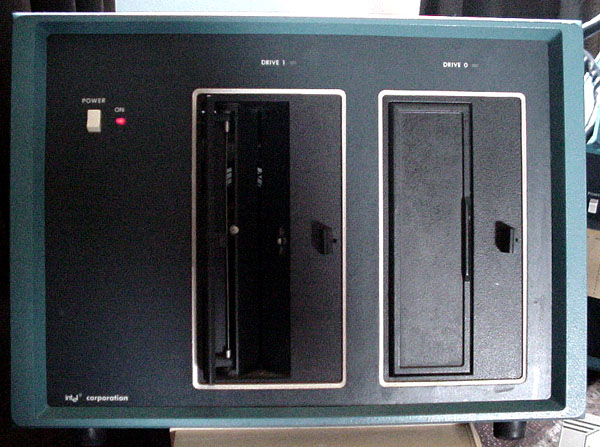
<http://cgi.ebay.com/aw-cgi/eBayISAPI.dll?ViewItem&item=2002926621>. He
has no docs, drives or software with it. Damm! and I just threw out a drive
chassis that went with this one! FWIW it uses CDC drives like these
<http://www.classiccmp.org/hp/mds-800/cdc-dr-f.jpg>. I don't know if
Shugart drives can be made to work with his controller cards or not But
Intel uses a different connecting cable and a different set of controller
cards for the Shugart drives. One the MDS-800s, the Shugart drives uses
M2MFM encoding that's not capable with any other system that I know of but
the CDC drives use MFM encoding and the "standard" CPM disk format aka IBM
3470 format.
Joe
On February 14, Richard.Sandwell(a)roebry.co.uk wrote:
> Hey, Doc - off list to save everyone's bandwidth... What do you think to an
> RS/6000 E30? I'm going to have a look at one tomorrow for not_much_money. I
> have 2 questions - is it MCA or PCI?
> And is the memory proprietary - or just standardish stuff?
>
> Thanks in anticipation of your wise word :)
Dontcha just hate Reply-To: headers? I have my mailer filter them
out. ;)
-Dave
--
Dave McGuire
St. Petersburg, FL "Less talk. More synthohol." --Lt. Worf
> -----Original Message-----
> From: Clint Wolff (VAX collector) [mailto:vaxman@earthlink.net]
> Actually, there are FIVE formats: DAT, DDS, DDS-2, DDS-3, and DDS-4.
> I don't know the exact differences between DAT and DDS, but most
> drives won't accept a DAT tape...
I thought DAT was the audio format (48Khz, 16[?}bit, up to 4 channels),
and the tapes are pretty identical to DDS?
I do have a DDS (DDS2, I think) drive that will read/write audio DAT in
my Indigo2.
Chris
Christopher Smith, Perl Developer
Amdocs - Champaign, IL
/usr/bin/perl -e '
print((~"\x95\xc4\xe3"^"Just Another Perl Hacker.")."\x08!\n");
'
> -----Original Message-----
> From: Tothwolf [mailto:tothwolf@concentric.net]
> That would work well if all the tape drives that use the
> floppy interface
> followed the rules, but not all do. I guess it would be
> possible to build
> a board with some logic chips that could isolate individual
> drives from
> the bus, but I think it would be much easier for now to only
> connect one
> drive at a time.
Do you mean to say there are floppy-tape systems that ignore
DS? How do they work?
Chris
Christopher Smith, Perl Developer
Amdocs - Champaign, IL
/usr/bin/perl -e '
print((~"\x95\xc4\xe3"^"Just Another Perl Hacker.")."\x08!\n");
'
> -----Original Message-----
> From: Sellam Ismail [mailto:foo@siconic.com]
> On Thu, 14 Feb 2002, Fred Cisin (XenoSoft) wrote:
> > A write-only device.
> What's the purpose of a write-only backup device???
Um... he means that it's not very reliable. A polite way of
saying that you'd be better off backing up to a _real_ write-only
device, like a terminal, or your system's "null device." :)
Chris
Christopher Smith, Perl Developer
Amdocs - Champaign, IL
/usr/bin/perl -e '
print((~"\x95\xc4\xe3"^"Just Another Perl Hacker.")."\x08!\n");
'
A couple weeks ago, I was given the following manuals and thought I'd see if
anyone wanted them, otherwise they're getting dumped.
- 3 Teletype corporation binders labeled "Technical Manual" -- there's more on
the labels, but I don't want to type it all out. If you're intested I'll
write it all down and post it. These are from ~1974.
- IBM Customer Engineering Manual of Instruction for "24 card punch" and "26
printing card punch" (appears to be from ~1962)
- IBM Personal Computer Professional Graphics Display Technical Reference
(includes specs, logic diagrams, etc) (1984)
I don't own, nor do I plan to own, any of this equipment, so I thought I'd
pass these on to anyone interested... you'd need to pay shipping but that's
it. Though, if you have anything interesting in the old-UNIX-computer-parts
realm, I wouldn't mind trading either :)
- Dan Wright
(dtwright(a)uiuc.edu)
(http://www.uiuc.edu/~dtwright)
-] ------------------------------ [-] -------------------------------- [-
``Weave a circle round him thrice, / And close your eyes with holy dread,
For he on honeydew hath fed, / and drunk the milk of Paradise.''
Samuel Taylor Coleridge, Kubla Khan
On Feb 14, 6:53, Doc wrote:
> On Thu, 14 Feb 2002, Zane H. Healy wrote:
>
> > >There are currently 5 DAT formats (DDS, DDS-1, DDS-2, DDS-3, and
DDS-4)
> > >and all are backward compatible.
> >
> > But, can a drive from manufacturer "A" read a DDS-1 tape written on
> > manufacturer "B's" drive? It's been my understanding that sometimes
even
> > different model drives from the same manufacturer can't read the same
tape.
>
> I've never seen that with either 4mm DDS-x or with 8mm DAT formats.
> We do classroom loads of RS/6000s from tape quite often, making
> tapes on, and installing from, a very wide assortment of drives. I've
> never seen a load fail if the drive was rated for the tape format.
Nitpick alert: DDS = DDS-1 (ie, it's the same thing -- originally called
DDS but now sometimes called DDS-1 so that it's clearly not one of the
later versions). So there are only 4 formats, not 5.
Nitpick 2: 8mm is not DDS or DAT. It's Exabyte videotape.
--
Pete Peter Turnbull
Network Manager
University of York
Hi --
I have no idea if this link is still active, but if it is, I am
interested in knowing if you still have any USS Altair stuff -- such as
the data plate mentioned. My email address is:
stonecipherca(a)state.gov
Any info would be appreciated. Thanks --
Charlie
On February 14, Richard.Sandwell(a)roebry.co.uk wrote:
>> Hey, Doc - off list to save everyone's bandwidth...
>> Thanks in anticipation of your wise word :)
> Dontcha just hate Reply-To: headers? I have my mailer filter them
>out. ;)
<Giggles like a kid ....>
Ooops...don't take offence anyone - and thanks for *all* your wise words
and links..
Fingers crossed, this time tomorrow.....and its got the key, and its got
the installation media.
I think the word was "chuffed" - that'd describe it...
//Rich
Has anyone got a keyboard/mouse combo for the R3000 Indigo they want to
sell or trade? In fact I'd be happy to talk about any R3000/R4000 bits? Its
for a good cause, I want to help out with the linux port....
Mail me off-list if you can help,
TIA
//Rich
Okay guys, this is from my wife, who works for Hubbell Wiring Devices...
:-)
--- David A Woyciesjes
--- C & IS Support Specialist
--- Yale University Press
--- mailto:david.woyciesjes@yale.edu
--- (203) 432-0953
--- ICQ # - 90581
Mac OS X 10.1.2 - Darwin Kernel Version 5.2: Fri Dec 7 21:39:35 PST 2001
Running since 01/22/2002 without a crash
> ----------
> From: Theresa Woyciesjes
>
The green dot is the marking that UL allows manufacturers to use on
Hospital Grade devices only after the product has been tested and performs
to the UL specs for Hospital grade.
> The Isolated Ground triangle is a designation that is required by UL and
> C.S.A. (Canadian Standards Ass.) to mark Isolated Ground outlets. Orange
> may be the most popular color for the receptacle, but it is not considered
> to be a clear enough marking for UL & C.S.A. The outline of the triangle
> does not have to be any specific color, only easily recognizable. The
> interior of the Triangle must be orange.
> Hospital Grade IG receptacles will have both the green dot and the
> triangle.
>
BTW - The reason someone may want IG receptacles in their home is to
protect the ground - you know that computers use the zero ground as the
reference for binary code - well, if you are running your computer and your
wife turns on the vacuum or the blender, the motor load can throw noise onto
the ground - causing your computer to read a 0 as a 1. If you have your
computer plugged into a IG receptacle that is properly installed with it's
own ground wire, the interference caused by the motor load will go out on
the house grounding system with out effecting your PC.
>
>
>
> Theresa - Ann Woyciesjes
> Hubbell Wiring Device - Kellems
> National & Strategic Accounts
>
>
> >>> David Woyciesjes <DAW(a)yalepress3.unipress.yale.edu> 02/14/02 10:56AM
> >>>
>
> Do you have a minute?
>
> > ----------
> > From: Robert Schaefer
> >
> > ----- Original Message -----
> > From: "Tothwolf"
> >
> > > On Wed, 13 Feb 2002, Robert Schaefer wrote:
> > >
> > > > s/almost// The green dot is part of what makes it `Hospital Grade'
> > > > (The Code now specifies a Hospital Grade MC cable too-- can you
> guess
> > > > the difference between it and `regular' MC?) Red means a circuit on
> > > > the Legally Required Stand-by System (read `on the generator').
> > >
> > > I would hope that they would be on some sort of system that keeps the
> > > voltage constant during the transfer from utility to generator power
> > too.
> >
> > I don't know. I do know that the IV pumps are battery units, and only
> the
> > charger plugs in. I've spent too much time in Hospitals lately, I
> guess!
> >
> > >
> > > > Isolated ground recpts will have a green triangle on them, but are
> not
> > > > necessarily orange in color, all the ones in the upstairs of my
> house
> > > > are white. If I tried to install orange recpts anywhere but the
> > > > basement/garage, my wife would have killed me!
> > >
> > > I thought they had an orange triangle on them? Many of the ones I've
> > seen
> > > are that way. Maybe hospital grade isolated ground receptacles have a
> > > green triangle on them instead of an orange one?
> >
> > I'm 99% sure it has to have a green dot to be hospital grade, and I'm
> 90%
> > sure it has to be a green triangle on it to meet Code requirements.
> That
> > said, I've seen and installed more than one with an orange triangle on
> it.
> > Kinda like calling it a Centronics port, I guess. ;)
> >
> > >
> > > Why did you install isolated ground receptacles in your home? The only
> > > real application for them is when you have a metallic raceway
> (conduit)
> > > and want the ground return wire independent of that raceway. I haven't
> > > seen conduit in too many homes yet ;)
> >
> > You haven't seen my house yet. FWIW, I'm in the middle of negotiations
> > with
> > my boss about a 15KW nat. gas fired 480V 3P generator. I'm also
> thinking
> > about pricing a Technical Power transformer, to run some of my machines
> > on.
> >
> > What can I say? At least I'm not a burden on Society! ^_-
> >
> > >
> > > -Toth
> >
> > Bob
For pick-up:
I've got 10 surplus Wyse60 terminals (kinda complete
and in working order but the screens are a bit burned-in)
I'll propably keep two of them so 8 are aviable
Also got one surplus Computone rs232 concentrator
plus some cabling. I have to check for the ISA-PC
card that comes with it .............
Pickup in The Netherlands, The Hague
I will not be shipping the stuff. Don't have
the experience nor the time..........
Contact me off-list
Sipke de Wal
-------------------------------------------------
http://xgistor.ath.cx
-------------------------------------------------
On February 13, Jim Arnott wrote:
> the Bernoullis that I have are both straight SCSI 1. (90 & 230)
The early Bernoulli Boxes use a dc37 connector that, if memory
serves, is a stripped-down SCSI interface..but I could be wrong about
that. The later ones are standard SCSI on standard connectors.
-Dave
--
Dave McGuire
St. Petersburg, FL "Less talk. More synthohol." --Lt. Worf
On February 13, Vintage Computer Festival wrote:
> Did the Bernoulli Box have a proprietary interface? If so, does anyone
> have one they want to get rid of?
I believe I have a bernoulli interface or two...send me your shipping
address.
-Dave
--
Dave McGuire
St. Petersburg, FL "Less talk. More synthohol." --Lt. Worf
> From: Douglas Quebbeman <dhquebbeman(a)theestopinalgroup.com>
> To: "'classiccmp(a)classiccmp.org'" <classiccmp(a)classiccmp.org>
> Subject: RE: Drive inventory
> Date: Thu, 14 Feb 2002 12:02:42 -0500
> Sender: owner-classiccmp(a)classiccmp.org
> Reply-To: classiccmp(a)classiccmp.org
>
> >
> > In other words, if your tape has hardware compression, you may be out
> > of luck without the exact drive that wrote it.
> >
>
> So far, we're able to read DDS3 tapes from a Sony drive where
> we used hardware compression in a Sony DDS4 drive, so at least
> Sony is designing some continuity in *their* product line...
It has been my experience over several years that the only problems
with incompatible hardware compression on DDS drives was with the
original generation of DDS and DDS-DC drives, before DDS2. The
type of drive that was retro-named DDS1.
carl
--
carl lowenstein marine physical lab u.c. san diego
clowenstein(a)ucsd.edu
> From: David Woyciesjes <DAW(a)yalepress3.unipress.yale.edu>
> To: "'classiccmp(a)classiccmp.org'" <classiccmp(a)classiccmp.org>
> Subject: RE: Drive inventory
> Date: Thu, 14 Feb 2002 10:53:21 -0500
> Sender: owner-classiccmp(a)classiccmp.org
> Reply-To: classiccmp(a)classiccmp.org
David Woyciesjes wrote:
> > ----------
> > From: Doc
> >
> > On Wed, 13 Feb 2002, Sellam Ismail wrote:
> >
> > > DDS-2 and DDS-3 use physically different media. I don't know how this
> > > figures if the standards are all supposed to be backward compatible.
. . .
> > A DDS2 drive will read DDS1 archives, and write a DDS1 tape in DDS1
> > format. I dunno about DDS3. Every shop I've worked with who used DDS3
> > drives used DDS3 tapes exclusively.
> >
> > Doc
> >
> ---
> DDS3 is 125m. Have one right here :) DDS3 drives work fine with DDS2
> tapes, under NT4 and VMS. That's the size combination we're using here at
> work.
Note that DDS3 drives write DDS2 format when loaded with DDS2 media.
Likewise, DDS2 drives write DDS1 format when loaded with DDS1 media.
carl
--
carl lowenstein marine physical lab u.c. san diego
clowenstein(a)ucsd.edu
At 15:21 14/02/2002, Christopher Smith wrote:
> > Computers that are unable to be rebuilt "will be recycled
> > responsibly to generate reusable materials," according to the
> > press release.
>
>... and translated, this probably means: "Anything that we don't know
>what to do with will be turned into bicycle spokes and sent to China."
"Anything that we don't know what to do with will be sent to China to be
turned into bicycle spokes", shurely?
:)
--
Cheers, Ade.
Be where it's at, B-Racing!
http://b-racing.co.uk
> -----Original Message-----
> From: Richard Erlacher [mailto:edick@idcomm.com]
> Careful, now ... EXABYTE drives are 8mm helical-scan drives,
> while the DDS
> types are not. I have a number of Exabyte drives and I've
> found that, after
> the EXB8200, few of them will use tapes that aren't of the
> "DATA" type. I've
> tried standard handycam tapes, and the %$#@! things
> immediately spit them out!
Yep, that's my experience with the Eliant 820. All things
considered, OTOH, it makes a great backup device anyway, holds
7G native on a 160M cartridge, and came for free in a haul of
on topic VAX accessories. :)
> Likewise, the cleaning tapes, which puzzles me a great deal.
> I've had no such
> trouble with SONY cleaning tapes, however, probably because
> EXABYTE buys SONY
> transports.
That's good to know. I should find a cleaner for it.
Chris
Christopher Smith, Perl Developer
Amdocs - Champaign, IL
/usr/bin/perl -e '
print((~"\x95\xc4\xe3"^"Just Another Perl Hacker.")."\x08!\n");
'
>
> In other words, if your tape has hardware compression, you may be out
> of luck without the exact drive that wrote it.
>
So far, we're able to read DDS3 tapes from a Sony drive where
we used hardware compression in a Sony DDS4 drive, so at least
Sony is designing some continuity in *their* product line...
-dq