List FYI: correspond w/George directly concerning this wonderful haul
of TTY gear...
---------- Forwarded message ----------
Date: Fri, 21 Feb 2003 21:40:20 -0800
From: George B. Hutchison <w7ksj(a)attbi.com>
To: greenkeys(a)mailman.qth.net
Subject: [GreenKeys] Teletype Machine Availability
GreenKeyers - - -
This evening I received a telephone call from a gentleman advising me of
the availability of the following teletype equipment. It is free for the
taking.
It is located in the Seattle area.
He does not want the people at "The Source" to be rattled by a bunch of
telephone calls, so please e-mail me should you have an interest.
The list includes:
1 Ea Model 37 KSR
8 Ea Model 28 KSR
1 Ea Model 35 ASR
5 Ea Model 35 KSR
6 Ea Model 14 TD
1 Ea Model 14 RO Reperf
7 Ea Model 15 KSR
1 Ea Model 15 Perforator-Transmitter (Model 19 KBD)
1 Ea Model 43 RO
1 Ea Model 43 KSR
Fair quantity multi-copy paper.
The equipment must be removed fairly soon, as the space it is in has been
designated by the building owner for another purpose. If it is not wanted
by anyone, to the landfill it goes. I have no room for it.
73,
George, W7KSJ
_______________________________________________
GreenKeys mailing list
GreenKeys(a)mailman.qth.net
http://mailman.qth.net/mailman/listinfo/greenkeys
HI:
I am looking for a 5 1/4" floppy drive for a TRS-80. The cable would be
great too! Please let me know the cost. Thank you.
Sorry about my posting yesterday asking for a 1 1/4" drive. It was a typo.
[demime 1.01a removed an attachment of type application/ms-tnef which had a name of winmail.dat]
In a message dated 2/21/03 4:48:39 PM Pacific Standard Time,
tim.challenor(a)tcns.co.uk writes:
> So - can anyone point me in the
> direction of any complete (pref. working) DG Nova systems with Dasher
> terminals, LP/TP2 printer, gemini disks, 9 track tape, and paper tape
> reader/punch kit? Any-and-all offers considered! I am in London, UK
>
I wish you luck. I know where most of this is in Portland, Oregon, USA. We
have Finlay, a DG collector/scrapper here with some of the older stuff.
It is a long way from London though and Finlay has an unrealistic, IMHO, idea
of value.
I could arrange shipping.....and put you in contact if you are interested.
I think Lufthansa is flying PDX to Frankfurt, Germany. I should investigate
air freight.
Paxton
Astoria, Oregon
USA
I picked up some of a exerciser box made by Century Data Systems of Anaheim, Ca. It's marked T2000B Exerciser. I THINK it might for the old Marksman T-series DC-300 tape drives. Is anyone here familar with this box or with the T-series tape drives?
FWIW CDS was an early manufacturer of hard drives (1960s) and was later bought out by Calcomp.
Joe
Hi,
First off I want to thank all who contributed on using VHS tapes as
storage, I really appreciate your input. Now my problem is with my TI-99\A
home computer. I have noticed that the keyboard is dying. I have been
having to hit the keys harder and harder and now some don't work at all. I
took it apart and the keyboard seems to be one unit (not disassemble-able).
The keycaps don't seem to want to come off either. I was hoping to take the
keys apart and clean the contacts but I don't want to break them, if they
aren't so posed to come off. Does anyone have any experience cleaning these
keyboards? If they are a "toss and replace" component, does anyone know
where I could get one?
Thanks for any help you can provide.
Andrew Strouse
( kittstr(a)access-4-free.com )
ard(a)p850ug1.demon.co.uk (Tony Duell) wrote:
> > With my contemplation of purchasing a new Sony Picturebook, I was wondering:
> > [...]
> What about the HP65? [...]
Well I don't have an HP65, I only have an HP67 which still works.
On the other hand my brand new Sony Picturebook died on me after only a
couple of weeks. (while the machine was on battery power something
sorted inside, the machine died, and I smelled burnt insulation).
Great progress!
**vp
Hi George:
Most Model 32 machines seem to be Telex units; they have a rotary dialer
and four buttons at the front -- but the dialer is not for telephone
numbers (as it is on model 33 TWX machines which can have either a
rotary-dialer or touch-tone-dialer). Telex machines do not communicate
with modem frequencies, but use a speciallized DC signalling scheme,
described below. However, you can drive the unit with a standard current
loop interface. I can put you in touch with someone who has done this, if
you'd like.
If you do not have a dialer, but instead have a blank panel on the right
side (CCU), you have a "private-wire" machine, which is for a simple 20- or
60-mA current loop.
The M32 and M33 are based on the same crappy design, which was targeted for
low-use/low-cost applications, (as opposed to almost every other teletype
model, with bullet-proof parts for 24/7 operation). But I digress.
M32: 5-bit baudot (1-start/2-stop?), 50-baud, ~ $0 to $50
M33: 8-bit ascii (1-start/2-stop/even-parity), 110-baud, ~ $100 to $1200
According to my manual the telex CCU is for what they called
"Circuit-Switching-Service," and the buttons are labelled: START, DIAL,
LOCAL, and CONN(STOP), or possibly labelled: REQUEST, CONN, LCL, and
DISCONN. As I understand it, Telex is a dialup service that uses DC
signaling (no modem) and is 50-baud baudot. Telex was a service Western
Union brought to the US starting in 1958, after it had been used in Europe
for a long time -- the 50-baud was a European standard. I belive that Telex
machines had some sort of line-interface box (not a modem like an M33 twx)
in the stand.
Here's part of the manual description of the four-button
"Circuit-Switching" (Telex) CCU: "The dialer is a conventional telephone
type...contacts open and close to send dialing pulses...in the idle
condition, there is a positive current of 0.005 ampere in the telegraph
loop. When the calling station operator depresses the START button, it
causes the shunting of a major portion of the loop resistance, and the loop
current increases to 0.060 ampere. The START button must be held while
switching apparatus in the telegraph exchange is made available. When the
circuit is ready, the telegraph exchange interrupts the 0.060 ampere loop
current for about 0.025 second. This "proceed-to-dial" signal causes the
DIAL lamp to illuminate at the calling station, and it locks the shunt to
the loop resistance so that the operator may release the START button and
proceed to dial the number of the called station...When dialing is
complete, the exchange furnishes the connection and signifies this by
reversing the telegraph loop current from positive to negative, which
causes the typing unit motor to start and the CONN light to illuminate.
Message transmission can now be exchanged between the connected
teletypewriters. The line signals are 0.060 ampere marking and zero current
spacing."
gil
>From: "George R. Gonzalez" <grg2(a)attbi.com>
>
>Hi, I have just bought a nice clean TELEX machine, it's a TTY-32, 5-level
>coding,
>with what looks like a phone line hookup, dial-type phone.
>
>I wonder if anybody knows what the modem standard is for this, and/or any
>phone number I could call to test this thingy out!
>
>Thanks,
>
>George
;-----------------------------------------------------------
; vaux electronics, inc. 480-354-5556
; http://www.vauxelectronics.com (fax: 480-354-5558)
;-----------------------------------------------------------
Er, I don't think the modem was invented in late 50's.
Modems have been used to send data over phone lines (and over radio) since at
least 1940.
They may have been called "Terminal units", but they did the basic modem
things of mod/demodulating data onto an audio carrier.
cctech-request(a)classiccmp.org schrieb am 20.02.2003:
>----------<snip>-----------
>Message: 13
>Date: Wed, 19 Feb 2003 12:50:39 -0800 (PST)
>Subject: Re: FYI: 25th Anniversary of Ward Christensen's BBS
>From: "Eric Smith" <eric(a)brouhaha.com>
>To: <cctalk(a)classiccmp.org>
>Reply-To: cctech(a)classiccmp.org
>
>Stan Sieler asks:
>> but...does anyone know the first data of a binary (not ASCII)
>> file transmission via modem?
>
>I assume that was a typo, and you want the date, not the data?
>
>> (I know of some done in 1975, from an IBM
>> mainframe to a DG Nova.)
>
>At least as early as 1965 IBM sold equipment that could do this, so
>I rather imagine people probably did binary transfers even in those days,
>but I don't have any proof of it.
>----------<snip>-----------
Hi,
I found this:
http://www.smecc.org/sage_a_n_fsq-7.htm at photo 22 it claims:
22. Simplex.jpg. This console provided operation and maintenance of the Long
Range Inputs and Outputs. Simplex because there was no redundant hardware.
Each radar station fed digitized data to the DC over public telephone lines (a
first - they had to invent the modem!). The DC also sent data to the
neighboring DCs and to the Command Center (the AN-FSQ-8 computer).
From: Vintage Computer Festival <vcf(a)siconic.com>
Date: 02/20/2003 7:58 PM
> On Thu, 20 Feb 2003 acme(a)ao.net wrote:
>
> > > OR you can get a copy of MS-DOS 4.00 and patch it to run on the Z-100.
> >
> > Jeez, Joe, now I'm really gagging. MS-DOS on a Z-100? Yuck.
>
> The Z-100 was intended as a dual OS machine. You had the best
> (presumably) of both worlds: CP/M and MS-DOS.
Sure -- that's how I set mine up, but to me, running MS-DOS on it makes it too
much like a run-of-the-mill PC, whereas running CP/M-86 gives it more of a
"vintage" flavor. Make sense? (I'm not feeling very articulate today)
Later --
Glen
0/0
Anybody know what this is for? It's about 4 x 6" and has a 3 pin power connector, a 2 pin connector for a reset signal and ONE 7 segment display. There is no other connectors or I/O. It has the part number 64783-66502 on it but I can't find anything from HP with a 65783 model number.
Joe
you have opened up a can of worms now...or maybe I have because
of my comment... what is your definition of a computer? My first
thought was the HP65 that was programmable and that was 1974.
Early computers didn't have to have a language like BASIC. They
just needed to be able to run a program that a user could put
in.
Best regards, Steve Thatcher
>--- Original Message ---
>From: Roger Merchberger <zmerch(a)30below.com>
>To: cctalk(a)classiccmp.org
>Date: 2/20/03 9:08:43 PM
>
With my contemplation of purchasing a new Sony Picturebook, I
was wondering:
>
>What was the first portable computer that weighed less than
1Kg?
>[[I'm assuming that it'd be older than 10 years, so it should
be ontopic...]]
>Any pointers appreciated! :-)
>
>Thanks,
>Roger "Merch" Merchberger
I think there were larger platters.
On Thu, 20 Feb 2003, Murray McCullough wrote:
> Hi Jules,
> To my knowledge the largest hard drive platter was 24". IBM the inventor
may have produced
> an experimental platter of ~1 m as a demonstration project to management
and maybe these platters
> were 'sold' or distributed to IBM employees?
In about 1976 University of Missouri Bioengineering Program acquired an "IBM
surplus image system" from somebody "unknown" out west. They sent a couple
of graduate students to pick up the system in a U-Haul truck which was very
overloaded. When we rolled the PSU down the hall on castors it left grooves
in the floor tile because of the weight. There were 3 cabinet units each 6
feet high and 5 feet wide. One was the power supply, one was the disk
controller and the other was the disk. It had a "very large" disk platter
that ran vertically, if I remember correctly they were about 3-4 feet in
diameter. Interesting noise when they spun up, kind of like turbine engine.
There were two clamshell halves that were opened to access the platter, each
track had a fixed head over it. Stored on each track was the image on a
single display station. By switching between tracks you could access
different images. There was a vacuum pump to remove the air if you opened
the clamshells to adjust the heads. Each of the display stations had an
integrated keyboard and a proximity or optical pen to select menu items.
We wanted to investigate distributing medical images rapidly throughout a
hospital. It was a one of the kind and after a few head crashes that was
the end. We then bought a Ramtek display of 256 X 256 by 8 bits instead for
$50K.
It sat in a real compuer room with:
an Interdata 8/32
a PDP 11/50 running MUMPS with 2 RK05's
a PDP 11/20 running DOS-11 with 3 RK05's and a TU10.
The SEL, PDP 8 with ASR-33, IBM 026 and IBM 029 were next door.
Back in the punch card days of old.
Mike
I just bought this <http://cgi.ebay.com/ws/eBayISAPI.dll?ViewItem&category=25399&item=2507112537> off of E-bay. Obviously it's some kind of disk drive tester. I opened it up and the entire front panel is hand wired but I also found a commercail circuit board in it. On the board it says "MFD Checker II" "Sony" "Made in Japan". Does anyone know anything about a MFD checker? It looks as though the circuit board was once the major part of another machine and that they took the switches, displays and indicator lights off of it and rerouted them to the front panel. However there are a few things that they didn't put on the front panel; a 80 vs 70 track select (yeah 70 track), a drive select, a 300 vs 600 RPM select and a good number of test points such as the write gate. However on the front panel you can now select 2MHz, 1 MHz, 500kHz, 250kHz, 125kHz or 67.5kHz. Anybody know what that's about? I'm guessing that it controls the bit frequency that's written to the disk and that it's used to test the disk coercivity. On the original board you could only select 1F or 2F. I should add that a 2nd baord as also been added into the case. It's a handwrapped vector board with 20 SSI ICs. I'm sure that it's used to generate and select the extra frequencies and other as yet unknown functions.
Anybody care to speculate?
Joe
I'm trying to get Sparcstation 1 up and running with Redhat Linux, but I
don't have any sun mice.
I noticed as the install CD boots it looks for a mouse-systems mouse. I
have some other workstation mice around here somewhere, and I think at
least some of them were marked mouse-systems. Has anyone managed adapt any
other mice for use on a Sparc?
I know there are some commercial sun to ps/2 adapter, but $75 is a bit much
to spend on an adapter for a $5 computer.
I though about using a serial mouse, but porting the PC driver to Sparc is
way beyond my current skill level.
I could always just buy a sun mouse, but the shipping/currency conversion
charges are likely to be more than the cost of the mouse itself.
Any ideas appreciated...
Maybe it was a demo / tutorial tool for use with an HP 64700 set up for
emulating a 68040?
> Anybody know what this is for? It's about 4 x 6" and has a 3 pin power
>connector, a 2 pin connector for a reset signal and ONE 7 segment display.
>There is no other connectors or I/O. It has the part number 64783-66502 on
>it but I can't find anything from HP with a 65783 model number.
>
> Joe
_________________________________________________________________
Tired of spam? Get advanced junk mail protection with MSN 8.
http://join.msn.com/?page=features/junkmail
Guys. Stop. Topic. Nuf said.
> -----Original Message-----
> From: Mail List [mailto:mail.list@analog-and-digital-solutions.com]
> Sent: Friday, February 21, 2003 6:23 PM
> To: cctalk(a)classiccmp.org
> Subject: Re: Let the witch trials begin! Re: OT: Re: Going OT Re: (no
> subject)
>
>
> Hello Sellam,
>
> > "should probably"? It's embedded in the Constitution!!!
>
> Yes, but remember, the Constitution can be changed, if the people
> of the United States decided to change it. Hopefully that article will
> remain as it is.
>
>
> Best Regards
>
>
>
>
>
> At 08:06 AM 2/21/03 -0800, you wrote:
> >On Fri, 21 Feb 2003, Mail List wrote:
> >
> > > That's why separation of church and state is probably a
> very good idea.
> > > The people in this country have come here from every region of the
> > > world, and have brought their religious beliefs with
> them. Religion
> > > should probably remain a personal matter, and not be made
> part of the
> > ^^^^^^^^^^^^^^^
> > > government's areas of concern, other than to protect the
> peoples rights
> > > to practice what form of religion they choose.
> >
> >"should probably"? It's embedded in the Constitution!!!
> >
> >--
> >
> >Sellam Ismail Vintage
> Computer Festival
> >-------------------------------------------------------------
> -----------------
> >International Man of Intrigue and Danger
> http://www.vintage.org
> >
> > * Old computing resources for business and academia at
> > www.VintageTech.com *
Folks:
I am looking for a TRS-80 5.25" drive and cable. Anyone have one available
for purchase?
Thank you.
[demime 1.01a removed an attachment of type application/ms-tnef which had a name of winmail.dat]
Although we're veering off-topic pretty far, I'll add two items:
At 09:53 AM 2/21/03 -0500, you wrote:
>The mistake probably should have been caught first by whoever
>prepared the background material, then by those that prepared
>that into the display overlay, then by those who were doing the
>mixing, and then by someone else who actually might monitor
>the final output results.
>
>Did anyone, other than myself, see that?
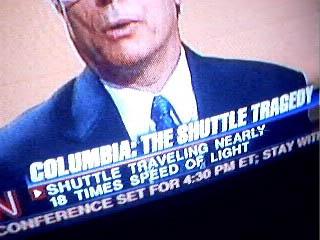
Yes. You can see a snapshot of the ridiculous graphic at
http://www.decodesystems.com/cnn-columbia.jpg
CNN used to have the motto "Live From Everywhere." After the
Oklahoma City bombing that changed. I'll leave it to the
reader to decide why.
Cheers,
Dan
John wrote:
> one, I can sell individual cords for this price no problem.
Damn! You should have ordered 250 or so! :)
> Fate: Having said this, someone on the list will now
> admit that they have a bunch for _$5.00_... <g>.
Well, probably some even had some for free (I got three with
one of the VAXen) but hey.. $6 is a decent price. Especially
if you *need* one to get the VAX powered :)
I guess I'll have to do some shopping here, too, 'cos I need
about 14 of them..
--f
(Did a little Googling yesterday)
Bob Scarborough
(http://www.pipechat.org/archives/2001/April/digest1990.html) says
<quote>
In the 1930s, the acronym "modem" came into use, a contraction of
"modulator/demodulator". This was used in FDM multiplexing, to denote an
analog/analog function, where voiceband signals were modulated up into
"channel group" spectra of 12 to 110 KHz along with 11 others by using
carrier tones and selected sideband energy.
</quote>
The timeline http://www.greatachievements.org/greatachievements/ga_9_3p.html
at has
<quote>
1955 Modem first described by Ken Krechmer, A. W. Morten, and H. E. Vaughn.
1958 AT&T introduces datasets (modems) for direct connection.
</quote>
Bob
-----Original Message-----
From: Frank Arnold [mailto:fm.arnold@gmx.net]
Sent: Friday, February 21, 2003 6:23 AM
To: cctech(a)classiccmp.org
Subject: Re: cctech digest, Vol 1 #379 - 30 msgs
cctech-request(a)classiccmp.org schrieb am 20.02.2003:
>----------<snip>-----------
>Message: 13
>Date: Wed, 19 Feb 2003 12:50:39 -0800 (PST)
>Subject: Re: FYI: 25th Anniversary of Ward Christensen's BBS
>From: "Eric Smith" <eric(a)brouhaha.com>
>To: <cctalk(a)classiccmp.org>
>Reply-To: cctech(a)classiccmp.org
>
>Stan Sieler asks:
>> but...does anyone know the first data of a binary (not ASCII)
>> file transmission via modem?
>
>I assume that was a typo, and you want the date, not the data?
>
>> (I know of some done in 1975, from an IBM
>> mainframe to a DG Nova.)
>
>At least as early as 1965 IBM sold equipment that could do this, so
>I rather imagine people probably did binary transfers even in those days,
>but I don't have any proof of it.
>----------<snip>-----------
Hi,
I found this:
http://www.smecc.org/sage_a_n_fsq-7.htm at photo 22 it claims:
22. Simplex.jpg. This console provided operation and maintenance of the Long
Range Inputs and Outputs. Simplex because there was no redundant hardware.
Each radar station fed digitized data to the DC over public telephone lines
(a
first - they had to invent the modem!). The DC also sent data to the
neighboring DCs and to the Command Center (the AN-FSQ-8 computer).
Does anyone have the docs for the HP 98630 Breadboard Interface card? This is a DIO size card that fits the HP 9000 series 200 and 300 computers. It has a large bread boarding area on it and some SSI ICs for interfacing to the host computer. I need to find out the pin out of the interface and any addresses, interrupts, etc that it uses.
Joe
Hi George.
Most likely this is a 45.45 Baud tty, often used by HAM radio amateurs.
Nowadays most amateurs have turned to PC solutions for RTTY reception.
We call that teletype a "carrot crusher" over here in Holland.
The 5-bit code is called Baudot, and allows for uppercase characters,
numbers and some punctuation.
When you say "wait a minute, how is that possible with 32 combinations?"
Simple, 2 characters are reserved to shift the whole mechanism from
"LETTER" to "DIGIT", so depending on the previous reception of such a
special character the characters that follow are readable or garbage.
Radio amateurs include something called UOS (Unshift on Space). When
the "LETTER" character is not properly received, the first space char
makes everything "normal" again.
So, to connect a 5-bit teletype to (any) computer you need a conversion
program to convert ASCII to Baudot, and at the correct transmission speed.
73
- Henk, PE1CKF Ham Radio amateur and PDP-11 addict.
> -----Original Message-----
> From: George R. Gonzalez [mailto:grg2@attbi.com]
> Sent: vrijdag 21 februari 2003 14:31
> To: cctalk(a)classiccmp.org
> Subject: TELEX machine, modems
>
>
> Hi, I have just bought a nice clean TELEX machine, it's a
> TTY-32, 5-level coding,
> with what looks like a phone line hookup, dial-type phone.
>
> I wonder if anybody knows what the modem standard is for
> this, and/or any
> phone number I could call to test this thingy out!
>
> Thanks,
>
> George
Hi all,
Is any of you (preferrably within driving distance of Holland ;-)
plagued with some DEC rodents they'd be willing to, uhh, exterminate
in a nice and painless [for the rodents] way?
Got some DECstations and VAXstations I'd like to play with in
graphics mode...
Also: does anyone have a spare VS2000 "console kit" ?
Cheers,
Fred