>
> . If you have any interest in these boxes, please contact me off list and
> I can supply you with configurations.
Thanks,
Paul Anderson
useddec at gmail.com
(217) 586-5361
> IIRC, _The Medium is the Massage_ had a photo of printing
> on an (raw) egg yolk. A good example of what you *could*
> do with inkjet technology
Tomorrow's World, a BBC TV programme, did a live demonstration of
just such a thing back in nineteen seventy something.
Lee.
I've got a rather ancient 8" diskette (hard-sectored; 32 sectors) with the
Harris Lanier brand on it. About all that I know is that it was created
during the 1970's and contains word processing documents.
It looks to be MFM with the usual n, 1.5n and 2n frequency distribution,
but I'm not getting much meaningful from digesting the bitstream.
Does anyone have any clues?
Cheers,
Chuck
> -----Original Message-----
> From: cctalk-bounces at classiccmp.org
> [mailto:cctalk-bounces at classiccmp.org]On Behalf Of Chuck Guzis
> Sent: Tuesday, July 25, 2006 2:50 PM
> To: cctalk at classiccmp.org
> Subject: Re: Help on odd diskette
>
>
> On 7/25/2006 at 5:46 AM Segin wrote:
>
> >I said reader? I meant drive. Hell, I don't even have a computer for
> >which a drive was ever made for one of those!
>
> Fortunately, 8" drives aren't yet hard to come by. And
> hooking one up to a
> PC floppy controller (or a Catweasel) isn't difficult either.
>
> FWIW, if anyone wants to take a stab at solving this puzzle,
> I've got a
> catweasel dump of a representative track that I can make available for
> download.
>
> CHeers,
> Chuck
>
>
>
Chuck:
I'd be interested in taking a look at the bitstream.
Kelly
Andrew Hastings of the controlfreaks list has put some old computer industry
ads up on the web: http://www.dvq.com/oldcomp/oldads.htm
They are chronological, so pick your favorite year and enjoy.
Excellent job - I was filled with memories.
Billy
Maybe I'm behind the curve on this, but here's something that may be
important to those of you with SCSI hardware; Plextor was praised by many as
the best/most compatible CD/DVD (esp. scsi)drives money can buy.
-----Original Message-----
From: Sales Main [mailto:sales at plextor.com]
Sent: Tuesday, July 25, 2006 12:13 PM
To: Julian Wolfe
Subject: RE: SCSI DVD-R/RW?
Hello,
No, unfortunately we no longer make any SCSI drives whatsoever.
Thank you for your interest in Plextor products.
Regards,
Plextor Sales Team
Plextor Corporation
48383 Fremont Blvd. Ste 120 | Fremont CA 94538 |
phone: 510 . 440 . 2000 | fax: 510 . 651 . 9755
-----Original Message-----
From: Julian Wolfe [mailto:fireflyst at earthlink.net]
Sent: Monday, July 24, 2006 12:42 PM
To: Sales Main
Subject: SCSI DVD-R/RW?
Do you guys make a SCSI DVD-R or DVD-RW? I need one for my Alpha box.
> I was thinking software simulator... still a challenge?
Yes, just due to the complexity. Much of the low level stuff would have to be reverse engineered
for the later machines, since that is what software survives, but it is not documented as well as the
earlier stuff. I also suspect the only language that survived is COBOL, though there was FORTRAN
and BASIC (a C was written as an experiment in Santa Barbara and LISP at the U of Utah, but there
is no sign that they survived).
Burroughs used the concept of "S-Machines" (interpreted instruction sets in microcode) on several
of their low and mid range systems. Same idea a P-code. Docs exist for the instruction sets for
some of their high level languages (there was no assembly lang for the system).
The cold-load on all but the very last of the systems were from cassette. I have them, but need to
read their contents.
I am still looking for the service manaul or diagnostic info on the MSD SD-2
Disk Drive. I have the 4 schematics that are posted on the net, but need a
bit more help.
Also, if anyone has a dead (or live!) one they want to get rid of PLEASE let
me know.
Thanks.
Hi Chris,
Do you have the prom images that need to be programed? If so I know I can
program the national series. i do not htink that I have any blanks in stock
at the moment, but I am located in Amery WI. If you can send the images as a
binary or hex file, they should be able to be programed.
Phil
> How about the B-1700? I used one once and it was really interesting.
> Has anyone archived any old tapes or software for those machines? Any
> known emulators?
The situation on that series is a little better than most of the Burroughs
machines. CHM has a not-quite last generation machine (19xx) as does William
Donzelli. Some software came with the CHM machine, I went to one of the last
guys who took care of them in TN a few years ago and brought back a large
stash of maint docs/sw and a card set from a 19xx he had in storage. Since
there are a lot of B-1xxx alums in the Bay Area, there is some possiblity
the CHM machine could be restored. A hardware simulation of the machine
would be a challenge.
Unfortunately, there were lots of interesting software/langs for the
machine, and almost nothing has survived that I've been able to find. Same
is true for the B5xxx/B6xxx etc. series. Univac and Burroughs had a scorched
earth policy and almost nothing survives today from their old machines.
Hi all
> >
> >
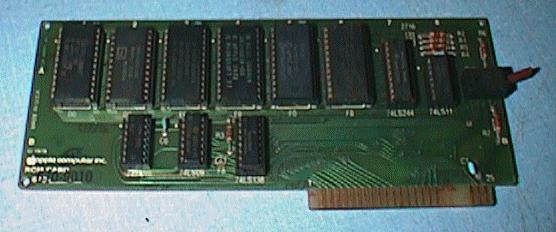
> > The second is an Apple-labeled 12k ROM card with part number 960-9104. It
> > has six sockets and appears to be ORGed at $D000. There's a jumper labeled
> > "2716" and a small red toggle switch. Maybe it can program EPROMS? Five of
> > the six slots are filled with Apple ROMs - the D8 ROM is missing.
>
>My guess would be this is the AppleSoft ROM card. It goes in slot 0
>(IIRC) on a machine with Integer BASIC on the motherboard. The switch
>selects between AppleSoft and Integer BASICs.
http://www.retro.co.za/ccc/apple2/apromcrd.jpg ?
W
Hi,
Does anyone know what the available bandwidth of "standard"
parallel ports might be? E.g., on PC's I believe bus speed
is emulated at 8MHz (?) for I/O instructions (legacy). But,
what about other machines with parallel (printer) ports?
Thx,
--don
> From: "Chuck Guzis" <cclist at sydex.com>
>
> Actually, it's pretty amazing how an 8088 at 8MHz is entirely usable under
> DOS (or CP/M-86).
>
> Does anyone know if MS Network can be run on an XT or does it have
> 286-specific code? I can't recall.
>
>
On review, looks like I missed the intent of your actual question, Chuck...
IIRC, the mid-80's IBM's PC Lan and MS's LAN Manager both ran on 8088's using DOS 3.3 and above and NETBIOS. I don't believe that a 286 was required.
Jared
Hi, all:
I've got a DEC PDP-8/I with the typical current-loop TTY interface. I also
have an ASR-33 teletype. The teletype, though, isn't a DEC-modified
version; it's got a Data General card in it instead of the 4915 card DEC
installed in their teletypes.
I'm Data General ignorant, I'm afraid. :/ So here's my questions:
-Do your typical Data General systems use a 20ma current-loop to talk with
ASR-33s?
-What's the pinout for DG/Teletype connections? Is it something that can
be made DEC-friendly by simply wiring a different connector to the DG
TTY's cables, or are the differences in signals more extensive?
-If the solution isn't that simple, does somebody have a 4915 card they
wanted to part with (or a schematic of one) (or a DEC-outfitted ASR33 they
wanted to trade for a DG-outfitted ASR33 <g>)?
Any help appreciated. Thanks!
-O.-
Hello,
I have a Zenith version of the Heathkit 89. Inshipping the tube fell back and pulled some wires out of the board. Can you help? I need eith a photo or a description of where they go. The wires in question plug straight into the back of the tube. That part is fine. I need to know where they go on the board. There are 2 browns (still fastened) 1 yellow(fastened) green, black, red and white (unfastened) The places where they come out of the bard are labeled G1,G2,G,G4 but I don't know which wire went to wich board location.
Your assistance would be appreciated.
thanks, Charlie
> Anyone know anything about the MLP-900 from Standard Computer Corporation?
There may be some things at CHM from Gordon's archives.
It is doubtful one has survived. The only surviving QM-1 I know of is in
Canada.
So, has anyone ever heard of a MENTEC SBC-100? I just acquired a pair of
DEC-clone boxes, each has a Mentec board, which has screen printed on it "SBC
100-04" and a label that says "SBC 104B" on it.
The board is a quad-height QBUS module, with a J11 chip, 4x 10-pin headers for
serial ports, and 4MB (2MW) of ram soldered onboard. There's also a 8-pin DIP
on the board labelled "19.660M" which I'm guessing is a 19.660MHz oscillator,
a 16-switch dip switch, and a pair of 27C128 EPROMs that are
labelled "R10-70A (C) 1991 MENTEC", and R10-71A.
Pat
--
Purdue University ITAP/RCAC --- http://www.rcac.purdue.edu/
The Computer Refuge --- http://computer-refuge.org
While not strictly OT, I figure if any crowd would know an answer to this,
this one would. I'm building some electronic toys that need a retro look.
I'm looking for some toggle switches (SPST) with long paddle handles, very
old school. All I can find in the regular catalogs have anemic small
paddles. Any pointers?
Ken
After over two years, I have finally completed converting scanned docs
for my BASICON MC-1N from JPEG (!) to ASCII and put up a small page
describing this somewhat obscure INS8073-based microcontroller. The
docs (posted _with_ permission) will probably be interesting to anyone
who is looking for information on the INS8073. There is, naturally, a
lot of material that relates specifically to the MC-1N and its memory
map and its on-board peripherals (an 8255 PPI and an MM58174A
clock/calendar), but the bulk of the manual is about NSC Tiny BASIC.
One of the motivations for finishing the docs was to better understand
the RB5X (INS8073 w/*3* 8255 PPIs and 8K of SRAM). The memory map may
be different, but that's trivial to transpose.
http://www.penguincentral.com/retrocomputing/INS8073/
If anyone has any questions, stories, ideas, etc., for INS8073
projects, I'm interested, on-list or off-list.
-ethan
I obtained a socket 7 SBC from Weirdstuff late last
fall. It has the capability of interfacing to a
*variety* of lcd dislplays. Phor phun I had in mind to
*hopefully* connect these old Thinkpad panels dating
fron the 770c (IINM) era. The sbc manual gives a
pinout, so my basic question is are these things
(lcd's) generic enough in the way they interface to be
able to use *most any* source of signals. The sbc uses
a C & T 65550 ic, and their are drivers for W3.1, WNT?
(3.51 methinks...book not in front of me), and of
course beloved W95. You can set jumpers according to
what *type* of panel yer using, according to
resolution, etc. I can scan the relevant pages and
e-mail them if anyone is curious. Grassyarse.
__________________________________________________
Do You Yahoo!?
Tired of spam? Yahoo! Mail has the best spam protection around
http://mail.yahoo.com
> From: "Chuck Guzis" <cclist at sydex.com>
>
> Actually, it's pretty amazing how an 8088 at 8MHz is entirely usable under
> DOS (or CP/M-86).
>
> Does anyone know if MS Network can be run on an XT or does it have
> 286-specific code? I can't recall.
>
>
Indeed, there is a Microsoft Client for DOS that will function within a
MS-flavor network. I've used it successfully in the past for various
reasons, and DOS of course doesn't support long names, it is fully
functional as a client (and with some tricks, a server) in the MS
networking realm.
If you are interested in experimenting, Google for "DOS MSClient". I'd
make this site my first stop:
http://www.jacco2.dds.nl/samba/dos.html
and view the "Network Client for DOS" section.
With just a few tricks, you can actually get the DOS machine to act as a
file server, too. All is explained in Jacco's discussion.
BTW, I've used both the TCP/IP and IPX stacks with DOS clients.
For those that have a truly warped sense of humor, you can make your XT
(or even a HD-less PC) into a HTTP and FTP server. Check out these two
sites:
http://8088.eznos.orghttp://www.eznos.org
Makes for some real geeky entertainment on a slow evening with nothing
else to do!
Jared
I've observed pulses in the 100-200ns range on an PowerMac using a PCI
parallel port card and a three instruction bit twiddle. You need to remove
the filter caps on the I/O connector to use it at that speed.