>I could imagine that some of the lubricants that they used on the
>surfaces could have contributed to stiction. Although, the heads do
fly >when at speed, they do have to drag on the surface. For this they
also >put a very thin layer of lub on the surfaces.
Billy Pettit has been surprisingly quiet about all of this...
The one case of lubricant stiction I know of for a fact is in Quantum
Q540. Apple had a huge field failure problem because of this in HD40s.
They modified the firmware to giggle the head on powerup to help prevent
landing zone lubricant accumulation.
> Westerb Dynex drives were the inspiration for the top loading 5 and 10
> mb 2314 type patter and head drives.
Top-loading single platter drives are descendants of the IBM 5440 series
used on the System 3, which were copied by most of the players in the
day (Pertec, Wanco, Western Dynex, Diablo, etc.). DEC used the case
design for the RL01/2 but added an embedded servo track.
2314s are 20 surface top loading 'washing machine' drives. End of the
line for the head technology started on the 1311 (10 surface).
Had the chance last week to talk to one of the guys at Memorex who did
their early 2314 clones in the late 60's (sold to DEC as the RP01 and RP02).
none of the disks I have are likely to work. I do have
the floppy and expansion units. And Land O Goshen the
mobo has test points! And no no signs of life...
__________________________________________________
Do You Yahoo!?
Tired of spam? Yahoo! Mail has the best spam protection around
http://mail.yahoo.com
I've read several replies indicating that the drive needs to be taken apart.
People have also advocated just "hitting" the drive to break the stiction.
Holding the drive and giving it a quick twist around the spindle axis has always
worked for me and avoids potential problems with disassembly or damage.
Has anyone seen stiction on the IDE or later drives? The only stiction I've seen
has always been on the 5 1/4" MFM/RLL type drives, and probably ESDI/SCSI/SASI
as well although my experience is limited on those drives.
Something else I've noticed is that if a drive has stiction, that stiction will
return after the drive sets for a while again. Anyone know what actually causes
stiction?
Hi all. I'm writing an article for MIT's Technology Review magazine about
vintage computer replica kits. I need someone to interview RIGHT AWAY.
It's currently 1:30AM here on the east coast but that is okay. So, if
you're awake and have any opinions about the various replica kits, or
especially if you've built one or plan to get one soon, then email me
OFF-LIST but RIGHT NOW. (Sorry for the late notice!!) I'm at
evan at snarc.net. Be sure to leave your phone number because I don't have
time for playing tag tonight.
Thanks! At least 15 minutes of fame gauranteed. :)
- Evan
--- Tony Duell <ard at p850ug1.demon.co.uk> wrote:
> >
> > Andrew wrote...
> > > BOG (no, not the toilet!)
> > Absolutely no clue.
>
> Could it be BOT, which is Begining Of Tape (one of
> the sensors in a tape
> drive, the other being EOT (End Of Tape).
>
> Or SOG, neaning Sync On Green, refering to an
> analogue RGB video monitor
> where the gree nvideo signal is in fact composite
> video and includes the
> sync signal.
>
> -tony
>
Hmmm.... I could have mis-read "SOG" as "BOG",
I guess.
I have been rather tired lately.
Regards,
Andrew B
aliensrcooluk at yahoo.co.uk
> > Andrew wrote...
> > > BOG (no, not the toilet!)
> > Absolutely no clue.
>
>
Isn't there an expression: Bog standard
Which just means ordinary or stock configuration?
Kelly
Hi there,
Been lurking (and learning) for a few weeks here.
Lots of interesting topics for sure.
Do any of you have inverse assemblers for the HP1631D logic analyzer ?
Specifically, I am looking for the files that go with the 10342B interface
(RS232/422 and HPIB capable) but I'd also be interested in inverse
assemblers for any CPU. I have one to date.
BTW, the 1631D is connected to my PC using an HP disk drive
emulator written by a fella from the Yahoo HP group. The files
are therefore loaded and saved right from my PC via HPIB. The code
is pretty new but already functional. This meant reverse engineering
the CRC being sent from the original HP driver over the HPIB link - no
small job in itself.
This is my second attempt at posting on the list - I apologize if this
ends up being a duplicate post.
Regards to all,
Benoit Robert
--- Jay West <jwest at classiccmp.org> wrote:
> Andrew wrote...
> > BOG (no, not the toilet!)
> Absolutely no clue.
>
> > FGPA (I think that's right)
> Probably FPGA, or Field Programmable Gate Array.
> Think of it as a prom that
> you can program to be a processor, not just data.
>
Ahhh.
> > If there isn't already a definitions/terms list
> > on classiccmp.org could one be added?
> On first blush, I would think this untenable.
> There's just too many terms,
> and most are probably already there in places like
> wikipedia. But should we
> add one to the classiccmp website perhaps? I
> dunno...
>
> Jay
>
You are probably right. Just to clarify my
idea, I was thinking of a table that would
say list:
FPGA = Field Programmable Gate Array
After a quick view on the table someone
could then go to Wikipedia, Google or some
other search engine and search for:
"Field Programmable Gate Array"
which would produce alot more relevant results
then just searching for:
"FPGA"
Anyone think it might be useful now??
Regards,
Andrew B
aliensrcooluk at yahoo.co.uk
From: Tom Watson <sdc695 at yahoo.com>
>
> Another tact might be to see if the sender HAS a port 25 on their
> machine. I suspect that the 'bot machines don't.
>
A number of very large mail providers split sending and receiving mail onto
different groups of machines, so you can't count on the sender listening for
mail.
Hi there,
Been lurking (and learning) for a few week here.
Lots of interesting topics for sure.
Do any of you have inverse assemblers for the HP1631D
logic analyzer ? Specifically, I am looking for the files that
go with the 10342B interface (RS232/422 and HPIB capable)
but I'd also be interested in inverse assemblers for any CPU.
BTW, the 1631D is connected to my PC using an HP disk drive
emulator written by a fella from the Yahoo HP group. The files
are therefore loaded and saved right from my PC via HPIB. The code
is pretty new but already functional. This meant reverse engineering
the CRC being sent from the original HP driver over the HPIB link - no
small job in itself.
Regards to all,
Benoit Robert
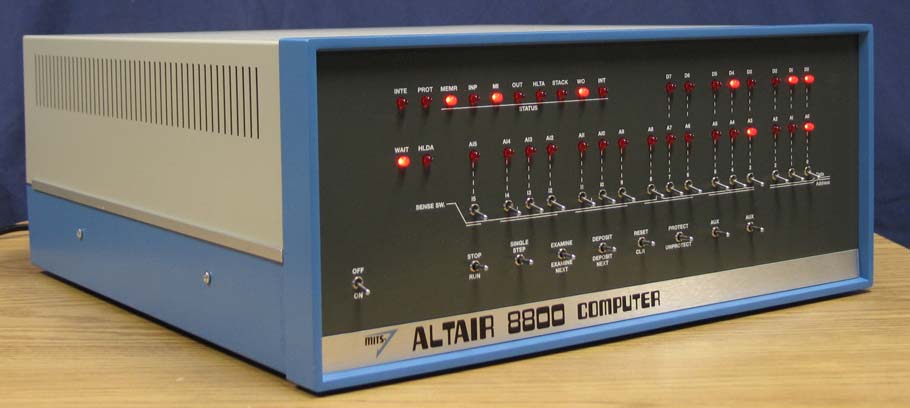
I thought I'd introduce myself. I'm Grant from Alaska. :) Any other
Alaskan's in here?
I'm new to the group, still a little new to "real" classic computers. I'm
the http://www.altairkit.com guy.
I really started getting into them back in 2004 when I wanted to build a
computer kit. I'd watched movies like "Pirates of Silicon Valley", read a
Bill Gates biography, built a few kits like a Veronica PLL/stereo coder,
but it still wasn't enough. I wanted to build a computer. Someone I knew
harassed me in a friendly way that all I was doing was assembling one from
a bag of parts. But it still meant something to me.
I started with the idea of using a Macintosh 128k as a building block. I
decapped a few of the PALs to read out the fusemap, but gave up the project
after reading about Apple going after people for providing copies of System
1.0-5.0 on their web sites. I then started on the Apple-1. I worked on
and off on that, until January 2006 when I found that a guy named Steve
Gabaly beat me to it. I was able to quickly give up the idea and move onto
an Altair - AND buy his Apple-1 kit. : ) What would make the Altair
easier is actually being able to buy and hold a working machine in my
hands. I didn't have access to an Apple-1 except for some high resolution
PCB scans.
I'm going to copy and paste a part of my web page into here for the sake of
indexing robots. If 50 years from now my web site is down someone might
want the full story. ;)
See the link below for the story wtih pictues, otherwise look for the
=========s for my intruduction to resume! : )
http://www.altairkit.com/creation_of_a_kit_story.html
--------------------------
So an Apple I kit is out of the question, it's been done! My next favorite
computer is the Altair, and it is actually obtainable! I found an Altair
for sale with quite a few extra memory and I/O boards. It was in fairly
good condition and had a few manuals, so I was happy. The D0 switch didn't
work so I couldn't actually toggle in any programs, and in fact I never
fixed that switch before completely disassembling the entire computer!
The best part about the Altair that I had just bought was that it had been
used by ARP Instruments as part of an experimental computerized music
synthesis project. Included with it was a bunch of documentation on synth
control, some disks containing the code, and some custom interface
cards. I love time capsules, but the ARP story is for another day...
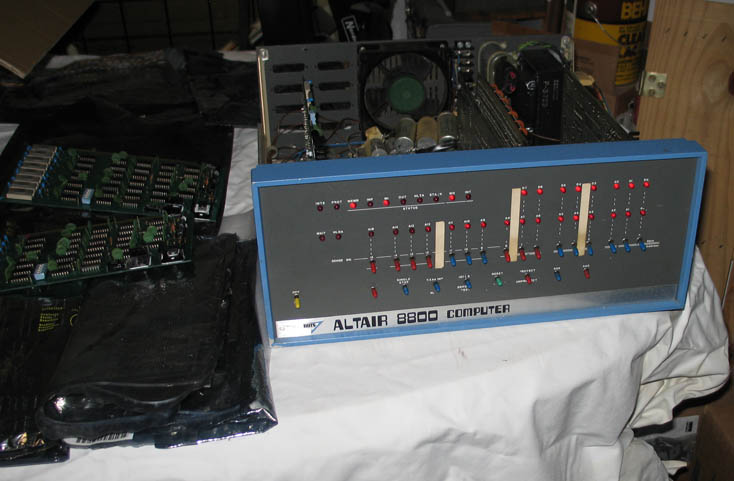
http://www.altairkit.com/images/061118-ARP_unpacked_2597.jpg
The ARP Instruments Altair - its alive...sort of...
I began the project not wanting to "destroy" my Altair. I had after all
paid a lot of money for it! Todd Fischer replied to me in an e-mail "One
flag comes up that suggests that you're not as committed to this idea as
you seem. When you write "I'm not interested in the project enough to buy
a perfectly working Altair just to desolder all of the parts!", it tells me
that you are limited in your intent.". I stuck to the idea of not
desoldering the Altair for a good 5 months! In the mean time I had sent
away some pictures of the CPU board to several companies that offered "Raw
PCB to Gerber" conversion. That is where a raw PCB is placed on a
calibrated high resolution scanner. With the aide of a human, the computer
recreates the copper, drill, silkscreen, and solder mask (if present)
Gerber cad files. I received responses that ranged from $200 to
$1300. Since that was JUST for the CPU card and I had quite a few that
needed to be reproduced, I decided to try "scanning" myself. I attempted
to do this quite a few times using different software packages.
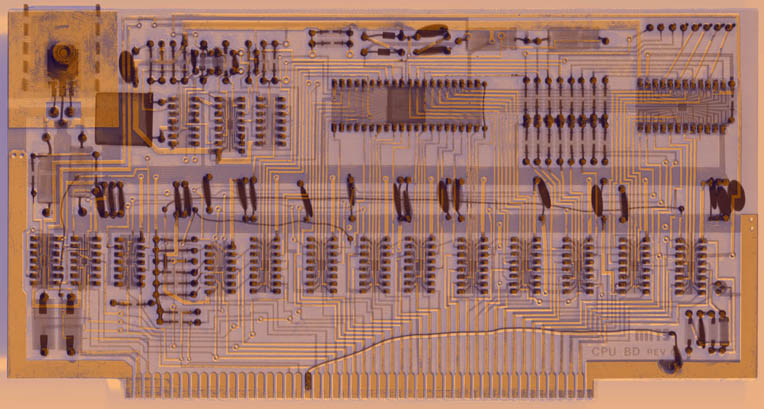
Just to show you how hard I tried to avoid disassembling my original Altair
boards... Since I work for a company that produces digital x-ray
equipment, it was easy to get x-rays of the MITS boards. I actually
scanned the bottom of the board, made that layer of the board translucent,
and then overlayed the x-ray. This looked pretty good, but it is a LOT of
work to "scan" a board by "tracing" the traces! It was pretty neat being
able to see the traces that were underneath the ICs...even the traces under
the dies! Quality is important to me, and I wanted boards that were as
close to the original MITS boards as possible. I finally decided to turn
to the PCB scanning outfits...
http://www.altairkit.com/images/061118-Altair_8800_CPU_BD_Rev0-Composite.jpg
The scanned/x-ray composite Altair CPU board. This is a scaled
version. The file I was using was 300dpi.
In the end, I decided to use <http://www.mhtest.com/>Mile High Testing
Services to scan my boards. They were second to the cheapest and their web
page made me feel confident. (If you contact them, tell Steven that Grant
says "Hi"!) This involved me desoldering every single part off of the
boards and then cleaning off all the solder/flux. See a pattern
here? Someone gives me good advice and I try to take a different
direction. ;) Advice from Steve Gabaly, creator of the Apple 1 kit, went
like this "...if I were going to make an Altair I'd have the boards
reproduced by a PCB scanning service and get a perfect set of boards in a
few weeks with no hassle..."
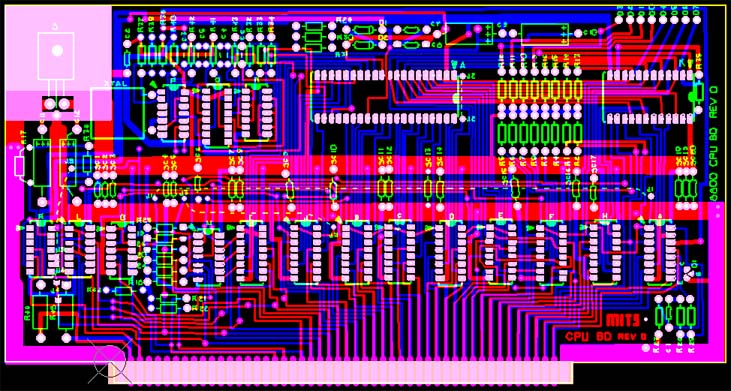
It wasn't QUITE "no hassle" because of the poor quality silkscreen on the
original MITS boards. After spending an average of 10 hours on each PCB
cleaning up and restoring the silkscreen, my cad screen looked something
like this:
http://www.altairkit.com/images/061118-CPUBD_Gerber.jpg
The Altair CPU board Gerber file including my solder mask layer, the fonts
don't seem to render very well on screen...
I went through each PCB with a fine tooth comb. I repositioned all of the
silkscreen elements to where I thought the original intent would have
been. I also created a solder mask for the PCBs to improve appearance and
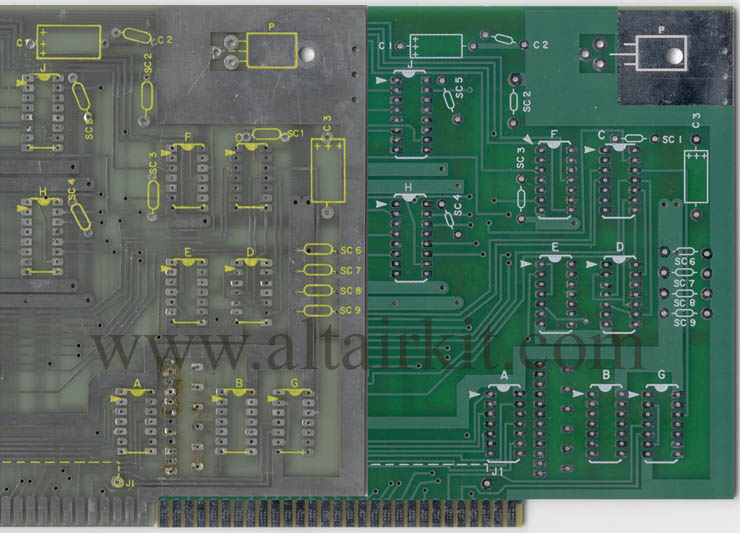
to make it easier to assemble. Here are some sample before and after
pictures of the 1k memory card. These don't show the worst cases, but are
still good comparisons.
http://www.altairkit.com/images/061007-2-88-1MCS_Right.jpg
MITS board on the left and reproduction board on the right
The MITS silkscreen was used where ever possible. Sometimes I had to copy
and paste letters/numbers from other parts of the board. Quite a few times
the first letter was on top of a pad, etc. I also shrunk the symbols so
they would fit between the pads. The arrows now point to pin one instead
of being on top of pin 2, etc...
Before I found <http://www.pcbnet.com/>Imagineering Inc (they have
inexpensive boards!) I avoided getting PCBs with a solder mask/silkscreen
manufactured until the design was proven. There is the chance that the
scan could have an error. So a prototype Altair was made using copper only
boards. Here are a few pictures of the prototype:
===============================
That is where I stop the kit story for this post. There IS more on the
website if you're interested. So, in the end, what did I get? I WAS ABLE
TO MAKE MY KIT!!!!!!!!!! : ) Of course, I had to MAKE the kit first... ; )
http://www.altairkit.com/images/061119-completed_altair_1974.jpg
I'm working on a few other vintage computer related projects. I hope that
I am able to provide other people with the same experience. : ) Hobby
electronics kits like this won't last forever, especially these old ones
with all of the old discontinued parts. Enjoy while it lasts!
Grant
Thanks for all of the comments guys. :) I had hard time getting on here
or I would have responded sooner. :) I'm glad that people who wrote about
it seemed to like it. I have ordered parts for 20 and will be selling them
again for a reduced price (compared to the ebay auctions).
I'm looking forward to making other kits of other systems. I also have a
few original projects, like a 19,008 LED bit mapped display. Blinkin'
light Pong anyone?
>The outside looks very cool and pretty accurate, though I'm not
>entirely sure if the number of connector punchouts on the rear panel
>is correct..
The case is mechanically identical. The rear panel is the same as my
221846K (that Altair was used as the source for the kit). I didn't even
know what the two 1/4" holes under the DB25s were for until after I had
received the first case. In fact, I didn't even remember noticing
them! They are for the cassette interface. :)
>But the solder-masked boards are wrong, at least for
>the vintage Altair that I own(no masking, just tinned traces).
I thought this too, and did it to make mine different...however I recently
saw an 8800 on ebay with a green mask! It might have been a rev1 or even
rev2 board. The source boards did not have a solder mask. I made the mask
because I thought it was an improvement (and because it makes things a
little different).
>OTOH, the crappy stranded white wire to connect the CPU board to the
>front panel is a nice "authentic" touch. I envied the guys with >Imsai
boxes...
Thats part of the experience that you're paying for when you get the kit! ;)
Grant
From: Gene Ehrich <ygehrich at yahoo.com>
>>With 12338 positives? Thats a 99.1 percent approval rating.
>>Quite respectable.
>
>If 108 people are unhappy enough to leave a negative I dont care what
>the percentages are he's a crook
So you're bad at human nature as well as math.
I have a client trying to sell me approx 6 working RL02 drives, a
variety of Q-bus items, and a Digidata tape drive.
I do not want to sit on the drives, if you have any interest please
contact me off list. I need to let them know by Friday afternoon.
Drives can be palletized and shipped or picked up in the midwest.
Thanks Paul
217-586-5361
I have a 3000/37 that I run on occasion. I did have a /42 before my big move last year. I didn't have enough room so, I had to let it go.
Both machines ran MPE/V which I got from HP during their great Y2K upgrade/giveaway.
I'd really like to find a machine that runs MPE/IX. I see them on Ebay occasionally but, they are either too much money on on the other side of the country.
See yas, SteveRob
----------
From: Richard
Sent: Thursday, December 14, 2006 1:07 PM
To: General Discussion: On-Topic and Off-Topic Posts
Subject: HP-3000 (was: HP HP-2117F on ebay)
Speaking of old HP minis, does anyone have an HP-3000 in their
collection? Not the newer ones, but the ones from the mid to late
70s.
I have MPE/V that ran on my /42. Is that what you're looking for?
SteveRob
----------
CHM has a Series II, Series III and a model 44. Finding MPE that will
run on these is the problem. There has been talk of a classic 3000
simulator for a while, but I've not been able to find early enough
software releases for the machines with good hardware documentation.
The 4x series machines have a console processor is a HP proprietary
microcontroller unlike those that came out of Fort Collins.
In the early '80s at ADP Network Services (old timesharing service), we
connected a couple of IBM and compatible mainframes (IBM 4381, Amdahl
470) to our packet switching network. It took our systems guys a bit of
work, but indeed, they did connect the 3725 to a PDP-8... and from that,
to the rest of the packet switching network. (The network was originally
designed and optimized for PDP-10's, which coexisted with the blue
boxes.) The IBM side ran under CICS. As I recall we eventually needed 4
PDP-8's (as network bridges) to carry all of the traffic from the 2 IBM
boxes-- supporting 400 or 500 simultaneous users. Ah, the old days...
Brad Pritts (now strictly an end user!) (We had several hundred PDP-8's
which we used as network nodes.) Eventua Message: 24 Date: Thu, 14 Dec
2006 11:35:42 -0500 From: Sridhar Ayengar <ploopster at gmail.com> Subject:
Re: IBM 3725 Communications Controller To: General Discussion: On-Topic
and Off-Topic Posts <cctalk at classiccmp.org> Message-ID:
<45817D5E.5000305 at gmail.com> Content-Type: text/plain;
charset=ISO-8859-1; format=flowed Patrick Finnegan wrote:
>>>>>> Imagine this hooked up to a PDP8! or an Imsai! now thats cookin.
>>>
>>>
>>>> The machines that this hooks to are a lot larger than the largest
>>>> PDP-8. 8-)
>>
>>
>>
>> There's no reason you couldn't hook this to, say, the P/370 that was just
>> on eBay (and had a bus and tag port). That's smaller than even an 8/e.
>
>
Except that (if memory serves) this kind of coprocessing communications
aggregator would be able to pass more data than the P/370 has I/O bandwidth.
Anyway, I've seen many P/390 installations that are bigger than a PDP-8.
Peace... Sridhar
--- Richard <legalize at xmission.com> wrote:
>
> In article
> <7.0.1.0.2.20061214162747.0602ec50 at yahoo.com>,
> Gene Ehrich <ygehrich at yahoo.com> writes:
*>> snip <<*
> > >With 12338 positives? Thats a 99.1 percent
> approval rating. Quite respectabl
> e.
> >
> > If 108 people are unhappy enough to leave a
> negative I dont care what
> > the percentages are he's a crook
>
> Just out of curiosity, have you ever run a busines
s
> where the
> customers are pulled from the general public?
>
> There's nothing you can do about people who are
> assholes all by
> themselves and expect you to burgle turds from the
ir
> ass and smile
> while doing it in the name of "customer service".
Exactly.
I am really only a buyer and have only ever
sold one item. I currently have a rating of 99
on there. Thats 101 positives and 2 negatives.
The first negative was added accidentally by
a buyer, long before the option to mutually
agree to remove feedback was added, and he
sent me an email to apologise for his mistake.
The 2nd one is, however, valid. I won too many
items at the same time and relied heavily on
my emails to check what was paid for etc.
I missed an item and didn't realise until it
was far too late (I had a seperate email
account specifically for it back then and only
checked it every 2-3 weeks).
You will always find someone with negative
feedback. If you didn't, then I'd be rather
suspicious - especially if they have more than
1,000 positives.
Regards,
Andrew B
aliensrcooluk at yahoo.co.uk
I'm looking for AAA-sized rechargeable batteries. Good capacity would
be nice, but the main thing I'm looking for is that it should be able to
supply a fairly high peaky current draw.
Any suggestions?
Peace... Sridhar
Listowners perogative to ask a question that is only halfway on topic.... ;)
I figure some people here may have some good suggestions - offlist please.
There is a SpamAssassin machine(s) filtering spam being sent to the list
that sits in front of the classiccmp server (we're also making use of Pyzor,
Razor, milter-ahead, and clamav). It's been doing a wonderful job, such that
most spam is kept out of the moderators faces. However, over the past few
months I've noticed that more and more is getting through (not to the list,
but to the moderators eyes who have to kill it all manually). Same goes for
many of my customers.
What concerns me is that 99% of the new spam making it through is vaguely
sensible english phrases (apparently automatically pulled from online books,
or from usenet post archives, etc.). If there was also an advertisement
text, Spamassassin could catch that. However, the text is all just english
phrases (I've noted them to be targeted phrases, like having to do with
computers, sometimes old ones) BUT... the advertisement is a graphic
attachment. Since SpamAssassin can't do OCR on the small gif or jpg
attachment that says "buy viagra here"... I am not sure what to do about
this. It comes from all over, not just a few servers, etc.
Before you say "just kill all emails with graphic attachments"... keep in
mind that these spamassassin machines do their job for thousands of domains
that I host, not just classiccmp.org. So just killing all emails with
graphic attachments is simply not an option. If anyone can give me a few
ideas that will work well for ISP/hosting-class environments, I'd love to
hear it. Off-list please! Thanks in advance for any advice.
Best regards,
Jay West
Hi Eric,
The Computer History Museum recently acquired a SDS 910, 920, and
accepted donation of a SDS 930 (940 predecessor) from History San Jose.
See pics at
http://www.flickr.com/photos/lee_courtney/sets/72157594391790915/ and
http://www.flickr.com/photos/lee_courtney/sets/72157594391722530/.
If your Dad is in the Bay Area would be happy to give him a tour at the
Museum. Just had one of the original SDS/XDS HW designers come thru over
Thanksgiving.
Cheers,
Lee Courtney
Product Line Manager - Linux for Consumer Devices
Wind River
500 Wind River Way
Alameda, California 94501
Office: 510-749-2763
Cell: 650-704-3934
Yahoo IM: charlesleecourtney
> -----Original Message-----
> From: cctalk-bounces at classiccmp.org
> [mailto:cctalk-bounces at classiccmp.org] On Behalf Of Eric Flanzbaum
> Sent: Monday, December 11, 2006 10:38 PM
> To: cctalk at classiccmp.org
> Subject: Re: PDP-11/70 Panel brought back to life
>
> > Well, it took a few years, but I finally brought my
> PDP-11/70 > panel back to life:
>
> > http://www.saccade.com/writing/projects/PDP11/PDP-11.html
>
> > I'm afraid I don't have the space or power (or noise
> tolerance!) > to have the real thing around. Has anybody
> else brought panels > back to life? I'm aware of the Spare
> Time Gizmos / Ersatz-11 > work, and of course the incredible
> "Gallery of Old Iron". Any > others?
>
>
> Very nice! I have an 11/70 panel sitting around -- and that
> looks like an intriguing project to try.
>
>
>
> I own XDS (SDS) Sigma 9 Panel and brought it back to life. It was
> quite an undertaking, as the panel consists of about 100 lamps -- and
> hand wiring all of them took quite a bit of labor.
>
> It now blinks -- in some sort of random "computing" fashion -- but is
> essentially a useless piece of eye-candy when it comes to being a
> useful computer (after all, I don't have anything else except the
> programming console). But I must admit, it is a pretty sight watching
> all those blinkenlights flicker on and off :-)
>
> I wired it up basically in tribute to my father for a present -- who
> was employee #9 (or maybe #10) at SDS way back in the early 1960s.
>
>
> I also own an SDS 940 programming console -- but I've chosen to leave
> that untouched (a dead soul, if you will).
>
>
> -Eric
>
>
> P.S. -- I'd post a video of it in action, but I don't own a video
> camera (I'll have to borrow one). I did take a bunch of snapshots in
> succession and piece them together -- kind of a kludge -- but you get
> an idea of what it looks like after watching it. Not nearly as nice
> if it were a smooth video though. If anyone is interested, and I can
> get around to it, I'll post a picture or two, and the "piecemeal"
> video on a website in the (maybe near) future.
>
>