The unit that seems most commonly available is branded "Ion" and
comes with a USB link built in.. specs for it sound like a fairly
good "consumer" grade turntable. There is also a device available
that takes a turntable preamp signal and converts it to digital audio
on a USB link. Thus allowing those of us with audiophile grade
units to continue using them....
steve shumaker
At 09:44 AM 2/7/2007, you wrote:
>Please, if you know a source of good stuff like this let us know.
>
>My wife's got a ton of LP's that haven't come out on CD... and they never
>will.
>Kind of be nice to play them instead of just collecting them.
>
>Bill
>
>On 2/7/07, Cameron Kaiser <spectre at floodgap.com> wrote:
>>
>> > Anyway, this is the big reason why you can, with looking, still buy a
>> > turntable to play your records.
>>
>>In fact, I just bought my folks a USB turntable (i.e., a turntable with a
>>built-in USB Audio output) so that they could start digitizing their old
>>LP catalogue. I imagine, though, with the way they care for their LPs that
>>they may outlast whatever CD-Rs they make of them.
>>
>>--
>>--------------------------------- personal:
>>http://www.armory.com/~spectre/ ---
>> Cameron Kaiser * Floodgap Systems * www.floodgap.com *
>>ckaiser at floodgap.com
>>-- Adore, v.: To venerate expectantly. -- Ambrose Bierce
>>----------------------
Christian Corti writes:
> I have some Synertek 2650-P-01 (date code 7720) that
> are definitely *not* 2650 CPUs, along with some
> AMI 1315-P-2 (seems to be some kind of keyboard
> encoder). They come from some old Courier 270
> display terminals. So what's a 2650-P-01 ?
Synertek made character generator chips (really mask ROM)
and LSI video scan generators that commonly appeared
in 70's devices. Doesn't help narrow down what was
in that terminal, but the point is they did a lot of stuff
for that market (including CPU's in the first microprocessor
terminals).
Didn't somebody from that era at Synertek talk at VCF
East last year?
Tim.
I hate to re-open a common thread, but I've tried both Goo-Gone and a
hair drier to remove old labels from diskettes, and it hasn't gone well:
Hair drier: I have to heat the disk so much that I warp the jacket if
I'm not careful. Way too much work (5+ minutes of low heat) per disk.
Goo-Gone: doesn't appear to penetrate the paper of the label! I mean,
it does, but I have to apply it twice (both times with my finger,
otherwise the cloth soaks up too much)... and only then does it
marginally work. But worse, what's left over is some petroleum-ish film
that I can't remove, even with soap and water. Check the following photo:
http://www.oldskool.org/misc/residue.jpg
So I wonder how well a new label will stick with that film on it...
So, are there any other alternatives? Or am I incredibly inept and
missing a step or botching a procedure?
--
Jim Leonard (trixter at oldskool.org) http://www.oldskool.org/
Help our electronic games project: http://www.mobygames.com/
Or check out some trippy MindCandy at http://www.mindcandydvd.com/
A child borne of the home computer wars: http://trixter.wordpress.com/
> There's a wire-wrap machine of some sort on Ebay
This is a semi-automatic unit.
A from-to list is generated on a computer with lengths
and the unit moves to the start-end points. The manual
wire-wrap gun sits in the slot that the table moves to.
Don't see the wire bins.. Normally a light would appear
next to the bin to pull the wire from.
arcarlini at iee.org wrote:
> It is rare that they fail completely (they usually slowly develop
> errors over time in heavy use until you have to replace them). But
> let me tell you, if you get the one rare one that does fail, it fails
> SPECTACULARLY. As in, it takes the drive with it!
I've had one CD-R shatter and the drive was indeed unusable after that.
I tried to repair it, but after an hour of clearing bits out and putting
the thing back together, testing, dismantling, rinse, lather, repeat
I decided it wasn't worth the hassle. I still have it in case I
magically
run out of CD drives in some far distant future ...
Antonio
-------------------------------------------------------
One of the last projects we did at Philips US, was a study to see how fast
we could spin the disk before it shattered. A friend of mine, a mechanical
engineer, did the testing. He had a blast. It was like a mini version of
Mythbusters. Even had the high speed television camera.
To accelerate the process he would often nick or chip the edge of the inner
hole. When they split - literally - it was right through the front door of
the drive. He finally got his own lab so the rest of us would feel safer.
But what a fun job he had! He loved his work.
Billy
aliensrcooluk at yahoo.co.uk wrote:
I remember CD caddies :)
I recall back at secondary school in my first
year there (year 7 for UK'ers), in 1990/1, that
the new computer in the library used CD's
which were in see through plastic.
Essentially the "CD" of the time was like
floppy discs - the writable media (medium?)
was encased in protective plastic shell.
I haven't seen any like that ever since.
I don't suppose anyone on this list has any
like that?? If so, I'd love to see a picture of
it, please.
Regards,
Andrew D. Burton
----------------------------------
I have a couple at home but can't get to them right now. If you want, I'll
write myself a tickler note and send you one the next time I come across
them. Also see them in the flea markets occasionally.
Billy
aliensrcooluk at yahoo.co.uk wrote:
Woah...
I thought CD's were invented in 1982?
I remember it easily as thats the year my
younger brother was born.
Or was that the year they first came to the
UK/Europe??
Regards,
Andrew D. Burton
--------------------------------------------
CDs were being developed for more than a decade before they became
commercial products. When I worked at Philips in the Optical Storage Group,
I made several trips to the Philips labs in Eindhoven. There, Philips has
displays of many of the original CD's and players, a few still working. It
also gave me a chance to talk to some of the original engineers, at least
the few who haven't retired by now.
Going commercial with the new technology was a hell of a battle for Philips
and later Sony. It was not instantly embraced.
Billy
Hi
The one I'm looking for was made at a similar time but about
a year later was made by Diehl and sold here in the US by
SCM. It was also transistors and it used two delay lines.
It booted from a metal tape with two rows of holes. I assume
clock and data.
It had a connector that was suppose to be able to read punch
cards. It could store a program of about 60 steps.
I used one of these years ago but I don't recall if it had
conditional flow. I think most people would consider conditional
flow to be the defining line between a calculator and a
computer. At least from the users point of view.
No one would dispute that the guts of these calculators were
computers.
Dwight
>From: Scott Austin <us21090 at yahoo.com>
>
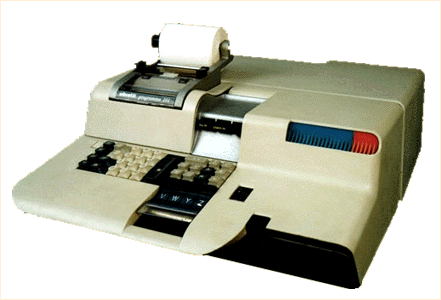
>I like the looks of the Olivetti Underwood Programma 101. It even had two
>blinky lights: green (solid=ready, blinking=busy) and red (error)
>http://www.silab.it/frox/p101/boxbig.gif
>
>If I recall correctly it was the first computer(*) I programmed. Back in
>'72-73, while in Jr. High (btw, not "Middle School").
>
>Several interesting things about the P101:
>
>Introduced in 1965 (same year as PDP-8).
>
>No ICs; all discrete components. The boards were placed component side to
>component side, designed with one board's components fitting in the spaces
>between the components of the other board.
>
>Programs were stored on magnetic cards, which Olivetti received patents for
>(HP had to pay about $900K in royalties for the technology use in the
>HP9100)
>
>Its approximate 240 bytes of memory used acoustic delay line technology.
>
>Scott Austin
>
>(*) Computer? Programmable Calculator? I'll let someone else debate about
>this.
>
>
>
>
>
>
>
>____________________________________________________________________________________
>Looking for earth-friendly autos?
>Browse Top Cars by "Green Rating" at Yahoo! Autos' Green Center.
>http://autos.yahoo.com/green_center/
_________________________________________________________________
Search for grocery stores. Find gratitude. Turn a simple search into
something more.
http://click4thecause.live.com/search/charity/default.aspx?source=hmemtagli…
--- arcarlini at iee.org wrote:
> Jim Leonard wrote:
**>> snip <<**
>
> I'd like to read up on DVD technology too but I've
> not been able
> to locate much (I'd like to read the various
> standards that
> detail the physical layer and so on, not some
> non-technical
> overview - I can find plenty of those.)
**>> snip <<**
>
> Antonio
>
Yeah, me three.
I'd like to know what the difference is between
a writable (write/rewrite) CD/DVD and
ordinary ones.
How do you "write-protect" a CD/DVD??
This would be useful knowledge, especially
when I get a DVD-recorder (sometime this
year).
Regards,
Andrew D. Burton
aliensrcooluk at yahoo.co.uk
Right at the end of the latest Egg Money advert, is that a TRS Model 3 or
Model 4?
This link should be viewable for a while:
http://www.visit4info.com/preview-flash.cfm?vm=0&type=2&adid=41634
Also, a previous ad has featured a CBM PET shaped "mockuter" (mock
computer), with the tape deck replaced with an oversized trackball:
http://www.youtube.com/watch?v=M0nZwyua8Ao
Cheers,
Ade.
--
No virus found in this outgoing message.
Checked by AVG Free Edition.
Version: 7.1.411 / Virus Database: 268.17.25/669 - Release Date: 04/02/2007
--- Adrian Graham <witchy at binarydinosaurs.co.uk> wr
ote:
> On 6/2/07 21:55, "aliensrcooluk at yahoo.co.uk"
> <aliensrcooluk at yahoo.co.uk>
> wrote:
>
> > I remember CD caddies :)
> >
> > I recall back at secondary school in my first
> > year there (year 7 for UK'ers), in 1990/1, that
> > the new computer in the library used CD's
> > which were in see through plastic.
> > Essentially the "CD" of the time was like
> > floppy discs - the writable media (medium?)
> > was encased in protective plastic shell.
>
> Sounds like the Philips 1x speed CD that was used
by
> DEC as the RRD40. It
> took standard CD-ROMs but they were inserted in a
> plastic shell because the
> drive had no tray or any other means of supporting
> the CD.
>
> My own RRD40 caddies are 250 miles away but I've g
ot
> a drive at work :)
>
> In the meanwhile, look towards the bottom of this
> page:
>
> http://home.claranet.nl/users/pb0aia/cm/sroom.html
>
> --
> Adrian/Witchy
> Binary Dinosaurs creator/curator
> Www.binarydinosaurs.co.uk - the UK's biggest priva
te
> home computer
> collection?
>
Thanks.
Yeah, that looks about right. So why were the
caddies ditched?? Was it simply cost, or that
the CD drives themselves were improved?
Regards,
Andrew D. Burton
aliensrcooluk at yahoo.co.uk
--- arcarlini at iee.org wrote:
> aliensrcooluk at yahoo.co.uk wrote:
>
> > Yeah, me three.
> >
> > I'd like to know what the difference is between
> > a writable (write/rewrite) CD/DVD and
> > ordinary ones.
> > How do you "write-protect" a CD/DVD??
>
> The "ordinary" ones are pressed at a factory. A
> glass
> master (I _think_ it is glass) is produced and is
> used to press the CD. As long as it is assembled
> correctly (and especially, it seems, sealed around
> the
> edges) then that it likely to be the most stable
> form of CD. Unless something gets inside and start
s
> to eat the aluminium, then it should be fine.
> (Obviously
> I'm excluding physical damage, etc.)
>
> For +/-R media the laser burns a pit in a special
> layer
> in the disc to create a pit. For the +/-RW forms t
he
> laser causes a
> reversible phase change to create an optical pit
> (heating it
> up again causes the change to reverse, hence
> blanking the pit).
>
> >From the point of view of the user, the +/-R form
s
> cannot be
> erased once they are written, although you can wri
te
> a new
> table of contents (TOC), so that it looks like you
> have
> overwritten the old data, but in fact it is still
> there
> There are programs which will dig it out for you.
I
> supposed
> theoretically you could blank a CD-R by burning
> every possible
> pit, but if you are security conscious, just break
> it (or
> shred it). When you "finalise" a DVD-R it can no
> longer be
> written to. I _think_ that all that has happened i
s
> that
> some bits have been set on a reserved area of the
> medium
> to tell the drive not to write to it any more.
> Unless
> you have a rogue drive (or maybe rogue software)
> then this
> is probably as safe as a floppy write-protect tab.
>
> The +/-RW forms can be fully erased and reused
> (1000x is the
> claim, yeah right!). Regardless of whether these a
re
> more or
> less stable than -R, they are clearly of limited u
se
> for
> long term archiving, since there is always a risk
> that they
> will get blanked and reused for "something more
> important".
>
> There's also DVD-RAM, but I don't think that's ver
y
> important
> for our purposes.
>
> Then there is the whole +/- debate, but these days
> that has
> mostly died away. You ?20 (high-end :-)) DVD
> rewriter will
> write to
> CD-R,CD-RW,DVD-R,DVD+R,DVD-RW,DVD+RW,DVD-RAM
> and dual layer DVD-R (~8GB, but the disks are abou
t
> 5x the
> cost of a DVD-R).
>
> Antonio
>
Thanks for that.
Regards,
Andrew D. Burton
aliensrcooluk at yahoo.co.uk
While the subject of *removing* diskette labels has cropped up before
(for example,
http://www.classiccmp.org/pipermail/cctech/2002-October/003294.html), I
don't think I've seen any discussion on where to obtain *new* ones. I'm
setting up a PCjr system for a friend and would like to prepare a nice
set of software for him, but I have no labels. A while ago, I tried
generic Avery mailing labels that I thought would work, but after a few
months the adhesive dried up and they all fell off. Any suggestions?
Newly-created sources preferred; I tried some old labels in "new old
stock" I have but after 20 years they're dead on arrival; they don't
stick as soon as you pull them off their backing.
On a related note, what's the best adhesive to re-apply labels that have
fallen off? I have some commercial software (games, etc.) where the
label is historically relevant and I'd like to re-attach it.
--
Jim Leonard (trixter at oldskool.org) http://www.oldskool.org/
Help our electronic games project: http://www.mobygames.com/
Or check out some trippy MindCandy at http://www.mindcandydvd.com/
A child borne of the home computer wars: http://trixter.wordpress.com/
>
> Jay West wrote:
> > Al wrote...
> >> I have a HUGE softspot in my heart for the TRS-80
Model I, having
> >> purchased a 16k, Level I unit in December of
1978. A unit, I still own
> >> today,
> > That's the one system I don't have in my
collection that I'd really like
> > to - a TRS-80 model I with tandy monitor and
perhaps the expansion unit.
> > I never owned one, but a lot of my friends in the
late 70's timeframe
> > did and we always fought about if my Apple ][+ was
better than their
> > TRS80 :)
> >
> > Jay
>
> That must have been a short argument. I used both a
lot in high school.
> The model I was unreliable in the extreme. The
model III's were much
> better in that regard.
And for the counter-argument, I have a model 1 that
I've had from new,
and which has never failed me. COnversely I had
nothing but trouble with
the Apple ][, a design which i feel is marginal at
best!
-snip-
-tony
************************
Interesting. Most people seem to say nice things about
the Apple ]['s design. I'd love to hear some informed
bashing ;) . Could you elaborate some about the
machine's short comings from your perspective?
My biggest annoyance is being unable to determine what
state the softswitches are in at any given time. I
also understand the cassette interface left something
to be desired (I've always enjoyed the luxury of
floppies). Beyond that, the machine just oozes quirky
charm in my eyes.
- Liam Busey (an Apple ][/ ][+ fan)
____________________________________________________________________________________
Need a quick answer? Get one in minutes from people who know.
Ask your question on www.Answers.yahoo.com
I've got a CBM 8032 that powers up "fine", but the screen is filled with "!" on
every other character position. When some letters are repeated, they can change,
i.e. "nnnn" becomes "onon" which seems like (without checking the ASCII charts)
that the "n" and "!" are ORed to become the "o". Anyone have any ideas what the
problem might be? Most of the schematics I have are buried someplace, so I
thought I would start here.
>> "Personal papers" aren't on paper any more, if they exist
>> at all they are directories full of email.
> Why is this a "huge issue"? My father made xerox copies of his
> important papers; I make regular backups. What's changed?
The volatility of the preservation medium, future ability to recover
a document in obscure formats, and the sheer volume of digital content
vs saved paper.
Is everything you're 'backing up' checksummed? How do you KNOW
it hasn't already been corrupted?
> As strange as it seems, I think we lost a lot of personal
> correspondence when hard disks became the rule on PC systems.
This is a huge issue amongst archivists.
"Personal papers" aren't on paper any more, if they exist
at all they are directories full of email.
On the CBM 8032, I downloaded the schematics from
http://www.zimmers.net/anonftp/pub/cbm/pet/, and that helped a lot. Tony's
comment about odd and even made things start to make sense. My only question
there was did the count start at zero or one :). It appears that the count does
start at zero (even). I have some doubts about the schematics since D3 is the
one line (on a clear screen) that seems to be always high, and that doesn't
correspond to bit 0 always on. BUT it appears that the 4114 at C4 is bad, and
I'll scope it out before removing it and putting in a socket.
BTW, what is the difference (if any) between the 8032 with the wide plastic
label, and the 8032 with the two plastic logos? The one on the right says "CMB
Model 8032" and the one of the left says "Commodore". I have both models, but
this one is the one with the two plastic logos.
And many thanks for the help on copying a floppy on the Mac 128. That worked
like a champ. I did find that putting an icon into the trash didn't eject the
disk for some reason. However the flower E worked great.
Thanks!
I have a Mac 128 and I want to duplicate the system disk. Probably a stupid
question, but how do you make a copy of a disk on that computer (single internal
disk drive.) Needless to say, I am not a Mac person. Thanks!
some pcs didnt have dma. Tandy 1000...IBM
Peanut...Sanyo MBC-5xx too IIRC...
--- cctalk-bounces at classiccmp.org
<bfranchuk at jetnet.ab.ca> wrote:
> Tony Duell wrote:
>
> > I thought every PC (maaning IBM compatible) did
that. The floppy system
> > in the PC. XT and ZT has a DMA channel associated
with it. You ask it to
> > read some secotyors from the current track, it
does so and transfers the
> > data into memory, then gives you an iterrupt when
it's done.
> Well on some computers, like the COCO the IRQ only
is used
> to end the cpu polling loop for the floppy.Since the
default
> OS is CP/M err MSDOS I expect the hardware is not
used effectivly.
> >
> > I know for a fact that other tasks carry on
running on this (slow) linux
> > machine when it's doing floppy drive operations.
> >
> > -tony
>
____________________________________________________________________________________
Looking for earth-friendly autos?
Browse Top Cars by "Green Rating" at Yahoo! Autos' Green Center.
http://autos.yahoo.com/green_center/
I sent a longer email to Al off-list, but I wanted to let the rest of you
know about something the company I work for (Kristine Fallon Associates) is
doing. We did a study for the Art Institute of Chicago about how their
Department of Architecture and Design could collect and preserve the
"digital design data" (CAD files, images, Poiwerpoints, etc.) that
architects are using more and more. Our report is online at
http://www.artic.edu/aic/collections/dept_architecture/ddd.html. We are now
just about finished creating a working prototype archival system. I'm
programming a Web client for entering the metadata and a programmer for the
AIC is doing the back end. We are using the DSpace archive software
(developed by MIT and HP) as the storage mechanism.
Our approach is certainly not directly applicable to preserving software --
we suggest using PDF's as wrappers for a lot of data -- but I think the
report addresses a number of important, and common, issues.
Bob
+++++++++++++++++
Message: 18
Date: Mon, 5 Feb 2007 15:54:47 -0500
From: "William Donzelli" <wdonzelli at gmail.com>
Subject: Re: Preservation of correspondence
To: "General Discussion: On-Topic and Off-Topic Posts"
<cctalk at classiccmp.org>
Message-ID:
<e1d20d630702051254l6a6d3c01qdae2375b462c7c64 at mail.gmail.com>
Content-Type: text/plain; charset=ISO-8859-1; format=flowed
>One of the things I've been disturbed to discover is CHM appears to be one
>of the few institutions who are attempting to archive software.
CHM is a fairly unique institution, that is why. There are only a
handful of computer museums that are run like museums. Many "computer
museums" are just glorified users groups, informal circles of friends,
or just guys that like hoarding machines and docs.
--
Will
_________________________________________________________________
FREE online classifieds from Windows Live Expo ? buy and sell with people
you know
http://clk.atdmt.com/MSN/go/msnnkwex0010000001msn/direct/01/?href=http://ex…
Hi,
a friend would like to buy an AT&T 3B1 (7300) for her husband. She
asked me to help. Apparently he has fond memories of them.
I've seen these (long ago) and used one once but really have no clue.
Are they obtainable? Anyone have one they want to sell?
Any pointers or advice appreciated... thanks!
-brad
Brad Parker
Heeltoe Consulting
+1-781-483-3101
http://www.heeltoe.com
> What do government and corporate data archives do?
> Surely a long-lived company like IBM has already had to deal with this
> problem?
They deal with the problem by throwing things away. There are essentially
no corporate archives of software older than a few decades. This goes back
to the discussions here a while back about companies discarding software
after a product's life ends.
One of the things I've been disturbed to discover is CHM appears to be one
of the few institutions who are attempting to archive software.
Corporate archives today are essentially all paper or microform. Trying to
deal with digital content is not a solved problem there. If you look at the
literature, they are only thinking in terms of documents, not software, with
the exception of trying to preserve some subset of software needed for document
recovery.
Quoth Chuck:
> I just had a thought about another possible alternative for write-
> protect tabs.
>
> How about the foil tape used in the construction trades, such as 3M
> 425? I seem to recall that the adhesive on this stuff is pretty
> heavy-bodied and should stick well, but be easy to remove.
You could also use book tape if it's a mechanical sense system.
Very heavy, quite sticky plastic.
Take a look on VCM ... there is one on there now.
http://www.vintagecomputermarketplace.com/bid.cfm?ad=2707
> a friend would like to buy an AT&T 3B1 (7300) for her husband. She
> asked me to help. Apparently he has fond memories of them.
>
> I've seen these (long ago) and used one once but really have no clue.
> Are they obtainable? Anyone have one they want to sell?
>
> Any pointers or advice appreciated... thanks!
>
> -brad