I have a Windows 98SE system setup with a 1.2mb 5.25" floppy drive
for running putr to create disks to use on my PDP-11/73 system. I
seem to remember someone suggesting that it was best to bulk erase
the DSDD 5.25" floppies before attempting to format and use them with
putr. Is that correct? I've been having trouble with putr and I'm
wondering if it is due to my failure to bulk erase the floppies
before using them.
Also, is it necessary to start Win98SE in "DOS mode" to run putr or
can putr be run from the DOS prompt from within Win98SE?
Thanks,
David
Thanks to Dave McGuire and Julian Wolfe and helpful responses from
many people on this list, I now have a BA23 box with the following
configuration:
M8190 KDJ11-B CPU
M7551 MSV11-Q 4mb memory
M7555 RQDX3
M8043 DLV11-J
RX33 floppy (temporarily stolen from a DECmate III+)
RD54
The system starts up and passes the memory test and drops me into the
boot code so I think it is working correctly.
I also have an Emulex ESDI controller and some ESDI drives as well as
a Viking SCSI controller but I'm trying to get the system up with
just the RQDX3 first.
My question is, can anyone point me to an RX33 (or RX50) disk image I
can use with putr to create an XXDP boot floppy for this system so
that I can test and format the RD54?
Thanks!
David
I'm restoring a few more 5150s and realized that, although my MFM
hardware stores are being depleted, I'm just maggoty with SCSI drives,
>from 40MB to 18GB. Can anyone recommend any 8-bit ISA SCSI adapters by
model, name, or whatever I can use to search for them on ebay?
Also, do such 8-bit adapters have an onboard BIOS? It would be great if
I didn't have to boot off of a floppy disk just to access the hard
drive... I have a CorelSCSI card at home, but when I plug it in it
doesn't do anything at POST, and I don't have a driver or software to
test the card anyway :-/
PS: If anyone knows of any sources for the ADP50 or similarly functional
8-bit ISA IDE adapters, that would be much appreciated as well. Thanks!
--
Jim Leonard (trixter at oldskool.org) http://www.oldskool.org/
Help our electronic games project: http://www.mobygames.com/
Or check out some trippy MindCandy at http://www.mindcandydvd.com/
A child borne of the home computer wars: http://trixter.wordpress.com/
> I believe I have an 8088 compatible network client, but all my
> network cards are 16-bit etc.
Most 3Com ISA cards, such as 3C509B-TPO, will work in 8 bit slots.
Lee.
Is this online anywhere to anyone's knowledge? I assume it's in the techrefs
[1] (which I don't have, unfortunately), but I'm sure I've seen the schematic
online somewhere in the last few years.
IIRC it's only a handful of latches, buffers and address decoding - so not a
complex bit of hardware.
[1] The circuit on the MDA card is probably the same... if someone could
confirm that then I could at least trace it from a real MDA card here :)
cheers
Jules
>
>Subject: What is an HP1858-0054 transistor array?
> From: ard at p850ug1.demon.co.uk (Tony Duell)
> Date: Thu, 05 Apr 2007 18:38:14 +0100 (BST)
> To: cctalk at classiccmp.org
>
>I am working on the reset circuit of an HP9816 computer. The output side
>is rrlatively conventional, but it takes an input from a chip that I
>can't identify.
>
>The chip is a 16 pin DIL package marked with the HP house-number
>1858-0054. That's not in my equivalents list. The chip seems to have been
>made by RCA, and tracing the connections to it show that 2 of the pins
>are grounded, but none of them go to any power line. I susepct it's a
>transistor array, therefore (HP1585-xxxx numbers tend to be transistor
>arrays too).
>
>I've unsodered the chip, but trying to work out the internal arrangement
>is non-trivial, partly because there seem to be parasitic diodes, and
>secondly because I am not convinced it's just transistors brought out to
>the pins. There may be a long-tailed pair, for example. It doesn't match
>any of the arrays in my RCA databook.
>
>As I said, it's on the main processor board (the big board at the bottom)
>of an HP9816 computer. It's U115 on this board, at the front left corner,
>just behind the 16MHz clock oscillator can.
>
>Does anyone have any suggestions as to what it might be? Anyone have an
>HP9816 with this IC labelled with somethign other than an HP house number?
Search for RCA CA3080, 3081, 3082 and also look at 3046. RCA did a large
number of transistor arrays (and MOS transistor arrays).
The common layouts were 8 common transisters with emitter(grounded) base
and collectors brought to pins, 8 common collector (VCC) with emitter and
base brought to pins. Others include differential amps, darlington arrays
and some combination arrays. You have noticed there are a large number
of parasitic diodes as a side effect of forming the devices on one die.
FYI here is a sample of some of the devices:
The common collector and common emitter devices were handy for LED
segment and digit drivers but were not limited to those uses.
Ca3081, ca3082 are examples of this.
Diferential arrays like the ca3026, CA3028, ca3046, ca3049, ca3053, ca3054
were largely used for RF and analog applications but could be handy
for ECL interface to other logic.
The CA3018, ca3084 were a darlington pair and two uncommitted transistors.
CA3036 dual darlington array with all collectors common.
CA3019 and 3039 diode arrays, handy when one needs matched temperature
tracking diodes.
Just a few off the top of my head that I'd used never mind the more
appication specific Opamps and communications circuits blocks (mixers,
IF amps, Audio amps and TV chroma, sync, video processing). RCA had a
very extensive line of monolythic devices.
Allison
>
>-tony
Hello. I was wondering if you still have the DEC LG01 operators guide available? It is model: Ek-OLG01-IN-003
Thanks,
Ronnie Lane
CONFIDENTIALITY NOTICE: This transmission may contain confidential and proprietary information intended only for the use of the individual or entity to which it is addressed, and/or may contain information that is private, privileged, confidential, and disclosure of which is prohibited by applicable law (including, without limitation, the HIPAA Privacy Rule, 45 C.F.R parts 160 and 164.) If you have received this transmission in error, any disclosure, copying, distribution, downloading, uploading or the taking of any action in reliance on the contents of this information is strictly prohibited, and you are requested to immediately notify the above sender by the above telephone or email address. If you are a patient, and do not wish to receive similar transmissions in the future, please immediately notify the above sender by the above telephone or email address.
Hi,
>....I've run it on the IBM Sandalfoot (PowerPersonal, not exactly an
>RS/6000), ThinkPad PowerPC, and Motorola PowerStack. I think I've heard
>of it also running on the 7025-F50, but don't quote me on it.
Sounds like I'm out of luck then, my RS/6000 is a "Powerserver 7013"; AIX it
is then....
> It's a pointless exercise as there really isn't any software
>available for it.
Good point, though for what I had in mind just the stuff supplied with the
OS (NT4.0 Server) probably would have sufficed.
TTFN - Pete.
Date: Sun, 8 Apr 2007 07:12:15 -0500
From: "Dave Dunfield" <dave06a at dunfield.com>
Subject: Re: ImageDisk update
>> I was afraid of that - Getting a 5160 to network (to get the
>> images off) is a little painful - I believe I have an 8088 compatible
>> network client, but all my network cards are 16-bit etc.)
>Ok - I should have said "configured for 16-bit" - I'm sure that some of
>my network card will operate in 8-bit- I just have to figure out which
>ones, find the docs and/or configuration utility, finf the 8-bit client
>etc. etc. ... Doable - just more work than I'd like - thanks to all for
>all the card suggestions.
>Dave
---------------------
Interlink/Interserver? Laplink? PC-Anywhere/DOS?
Hardly any work at all...
m
Date: Sat, 7 Apr 2007 08:42:34 -0400 (EDT)
From: "Steven N. Hirsch" <shirsch at adelphia.net>
Subject: Re: ST506 WTB:Micropolis 1325
>I have an extensive collection of MFM/RLL drives and have _never_ run
>across one with that interface in a 3.5" form-factor. Not sure that
>anything of this sort existed. 5.25" 1/2-ht. was about as sophisticated
>as they got.
>Steve
----------------
Not a very extensive collection then ;-)
Almost everybody made 'em; Miniscribe 8425, Seagate ST125, etc. etc.
I've got a box full here.
mike
I picked up a very nice RT system the other day from a list member which
includes the 5085 graphics processor and 5081 colour display. We've just been
setting it up today (or trying to), and an obvious question arises...
The 5085 has some sort of comms input ability on a BNC connector (and output
on another BNC, but that's terminated). The RT has a little "breakout box"
which hooks up to the 5085 link card on one side and has four BNC outputs on
the other.
My *assumption* is that one of these outputs (and the breakout box came with a
coax cable already hooked up to BNC #1) links to the BNC input on the back of
the 5085, forming the comms channel between the 8085 and the RT.
However, it would be nice if someone can verify this! The RT documentation
doesn't cover the 5085 link option (so far as I've found yet, anyway). The
5085 documentation doesn't cover it either (as it only details how to hook the
5085 up to the peripherals and then boot the hardware).
Obviously I'm a little reluctant to go randomly plugging cables in,
particularly as the breakout box has four BNCs on board - although it could
well be that the RT 5085 link board was capable of driving up to four 5085
processors independently.
Google seems to know almost nothing about the 5085 option :-(
cheers
Jules
--
there's a carp in the tub
there's a carp in the tub
so nobody's taken a bath
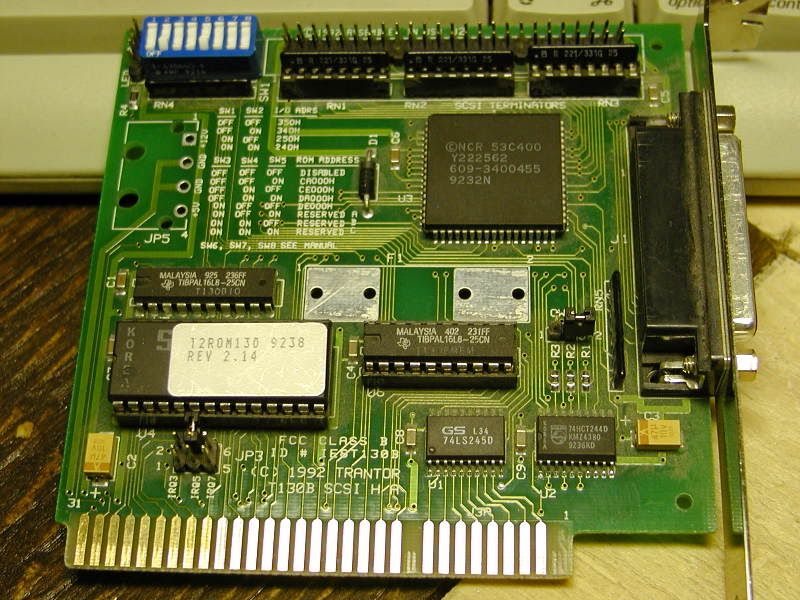
>There are two unpopulated sockets on my two T130Bs. One is a 20-pin DIP,
>which I suspect is probably something like an LS374 and the other is the
>boot ROM. For yucks, I'd love a snapshot of the ROM and affirmation of
>what the other upopulated socket is. In return, I could verify that your
>setup's right.
The URL below links to a photograph
http://i11.photobucket.com/albums/a166/ballsandy/Computer%20related/T130B.j…
>Do you know it's a) working and b) low-level formatted to 512 bytes/sector?
A) yes B) no
>I suspect DOS might just query the fact that there's a drive there, without
any knowledge of whether it'd be capable of reading/writing data.
???
>I assume the ROM on the SCSI board is taking over control of the system
>boot - and probably has no knowledge that BASIC is actually lurking in the
>host system's ROM. If you get to the point of being able to boot DOS from a
>SCSI disk, I bet there's a way to hop into the system's on-board BASIC via
>the DOS debug program...
Well I gurss I have no choice but to get to basic through DOS. It means
lugging an extra disk but I'll do anything to get the onboard BASIC.
_________________________________________________________________
Check Out Our List Of Trendy Restaurants. You'll Eat It Up!
http://local.live.com/?mkt=en-ca/?v=2&cid=A6D6BDB4586E357F!378
Date: Sat, 7 Apr 2007 12:29:49 -0500
From: "Ethan Dicks" <ethan.dicks at gmail.com>
Subject: Re: ST506 WTB:Micropolis 1325
<snip>
>There were probabably a few others. I doubt there were any 3.5"
>drives over 40 MB, though.
<snip>
Seagate ST151 and 157R, just to name two...
>> The largest MFM drive ever made was _probably_ the Maxtor 2190 at 190MB
>> unformatted. ISTR that there was a logical limit to the number of
>> cylinders due to the control protocol (or perhaps limitations in the PC
>> BIOSes of the time) and physical limits to the number of sectors/cylinder
>> and the number of platters (the 2190 had 15 or 17?)
>That's certainly close to the largest, if not the absolute largest.
>DEC took the XT2190 and formatted it at 154MB as the RD54. I have a
>few in MicroVAXen. Much more solid than the RD53 (Micropolis 1325),
>and no jumper moving required (there's a single solderable jumper that
>must be installed to turn a generic 1325 into an RD53 so that the
>customer-runnable formatter recognizes it).
>-ethan
XT1240R: 196MB (RLL2,7) vs XT2190: 159MB (MFM)
m
I've seen a bunch of more or less generic, 8-bit capable, allegedly bootable
ISA cards based on the 53c80 & 53c90 over the years. It's a really
widespread family, and it supported by many OSes. The various c90 variants
were quite good for the time. I didn't spend that much time with 8-bit ISA
systems, so I can't be in any way authoritative on which ones would work.
The 53c400 is also 8-bit capable, and near as I can figure you can get cards
with them for a penny a pound, but I've never seen one with a boot rom, and
while there are claims that you can put a disk on one, I've never seen one
do anything more than drive a scanner.
I'm pretty sure the AIC-6260 & AIC-6360 can do 8-bit, but it's also one I've
never seen with a boot rom (which means little). In fact, I've only seen
one example that wasn't on a sound card.
Ken
>
>Subject: Re: IBM PC printer adapter schematic
> From: "Ethan Dicks" <ethan.dicks at gmail.com>
> Date: Sat, 07 Apr 2007 18:29:29 -0500
> To: "General Discussion: On-Topic and Off-Topic Posts" <cctalk at classiccmp.org>
>
>On 4/7/07, Tony Duell <ard at p850ug1.demon.co.uk> wrote:
>> I wrote:
>> > That's handy to know - every once in a while, I long for a machine
>> > with 2 or 3 parallel adapters, for things like old Connectix cameras,
>> > LCD displays and the like. I've never assembled an ISA machine with
>> > more than one printer adapter....
>>
>> Well, you can have as may printer adapters as yopu like if you can set
>> them all to different addresses and if you're writing your own software
>> to talk to them...
>
>Naturally. The problem I see is that only the older cards might let
>you set the printer port to respond to arbitrary addresses - the ones
>I have are almost (entirely?) all of the style where you move a single
>jumper for LPT1 vs LPT2 (primary vs secondary address).
>
>I wasn't as worried about the OS interpretation since I don't intend
>to *print* to my printer port.
The current system has three printer ports in it! No big deal and there
are standard addesses that the OS (win or nt) recognize with no difficulty.
I use three as one is dot matrix (LQ570), one Laser (HP4l) and the third
is inkjet(color). I happen to be using the a PCI, ISA and mainboard
based ports so where's the problem?
All the ISA cards I have allow for at least two if not many more possible
printer ports. And same for serial, though after two the IRQ assignments
can be weird.
Allison
> Your assumption is correct. You'll probably want the RT PC Options
> Installation manual off my site:
Dug around and found my hardware tech ref vol 1. Should I scan it?
> I'm still concerned about what documentation and resources there are out there
> for the cat though - I mean quite a few must have been sold, and owners must
> have thrown together quite a bit of code to drive them - but every time I've
> dug around on the 'net it's been unclear as to what kind of user community
> exists to actively share code and experiences.
This list would be a good place for it. I know of code that was done to read
a couple of different hard-sectored formats (DG and Processor Tech) I was just
looking at hacking that to read some Tektronix 8002A development system discs
(hard sectored 32/trk)
Intel M2FM would be very useful to read as well.
> I'm curious if anyone knows about VG datasystem 2000 or
> System Industries.
System Industries was a fairly well known manufacturer of third
party disk subsystems
I've seen VG Datasystems before, but I don't remember the context
Maybe I'm just thinking of Vector General, though.
After finding an IBM portable PC in the trash, I did the usual restoration
and now it's time to have fun.
I grabbed a Trantor T130B scsi card and set it as follows:
IRQ---5
I/O---340H
Bios address---CA00H
I then attached a seagate ST-296N 80+ meg hard drive, set it to ID 1 and
powered the system on.
The card detects the drive and the system addresses it as C: and then
because the drive is not formatted I have to floppy boot and patition and
format it.
This is where things got strange.
As the floppy loads, the drive works a bit and the activity lamp comes on
and stays on, then the floppy drive stops loading and I need to do the three
fingered salute. (ctrl+alt+del)
The hard drive lamp stas on and the second floppy boot is successful but
fdisk errors out with no fixed disks present. I thred several different dip
switch settings on the card, all go the same way except for a few when the
system can't even see the card. The boot floppy holds DOS 3.30 and came from
an ACER system since I did not receive any origional floppies with the
system, just two games and a damaged DOS 6.2 disk
What's going on? The termination and cables are fine and should I set zero
wait state to on or off? I currently have it set to off.
EDIT:
For some strange reason, the ROM on the card takes over the boot when no
scsi devices are installed.
Usually what happens is that if the system can't find anything to boot from,
it will dump you into the onboard BASIC. When the card is installed and
there is nothing to boot from, I instead get "looking for SCSI or floppy
devices to boot from". Is there anyway for me to stop it looking for
something to boot from and go to BASIC? To me it really limits me to using
basic off disks.
_________________________________________________________________
This Easter, Get Active With Live Maps!
http://local.live.com/?mkt=en-ca/?v=2&cid=A6D6BDB4586E357F!101
It's the fan. No doubt about it, it's the fan in the back of the RX02
causing the RL02 to fault.
I disconnected the fan and the RL02 no longer faults upon spinup. The moment
I put the molex back on the fan of the RX02 - the RL02 immediately faults.
I decided to take a closer look at this fan in the back of the RX02, so I
took out the 4 screws and pulled off the plastic "wedge shaped" housing. The
fan in there is one of those older odd-looking ones. Not sure how to
describe it. Instead of your "normal" muffin fan where the windings are hard
to see and they are around the hub... this is the kind where the fan hub
sits on one side of a large rectangular hunk of iron? Steel? I dunno... big
chunk of heavy metal :)
Betcha if I replace that fan with the more normal kind I don't have such a
problem. The current fan isn't noisy, works good... but I'm betting the huge
coil on it is a problem.
Jay
Just in case someone doesn't know this, you can look up any old HP part
(and now Agilent) at:
http://www.parts.agilent.com
In some cases they will show a picture. If you lookup said part, you
will find this:
Part Number: 1858-0054
Description: Mod and Ser Nbr Reqd TRANSISTOR ARRAY 16-PIN PLSTC DIP
Price: $10.25
Quantity on Hand:
Item Status: Limited Supply - Contact Agilent
Item Type: Agilent Qualified Part
And, they list all products where they know it to be found.
Following Jay's excellent lead, I bought the 'correct' rack slides for
my 11/34 a few months ago. Today I took some time and put the 11/34 in
the rack.
The best part was tilting it 90 degrees to get access to the backplane!
woo hoo! nerd heaven!
Oddly, when I rotated it I heard a strange metal tinlking/clinking.
hmmm... took bottom off and found a metal circular key wedged in the
bottom wires. now *that* could have caused some problems!
wonder what it's for. the 11/34 has no key.
anyway, thanks for the inspiration jay!
-brad
Hans, are you about on here still? One of our guys at the museum has been
trying to get hold of you without success - I said I'd put a message on here...
cheers!
Jules