I've recently been looking at setting up an old HP Vectra P-90 to run Linux
(or some form of *nix) and started wondering what ports exist for "classic"
systems.
Looking around I see that "NetBSD" in particular supports quite a few
architectures including VAX, SGI, NeXT etc etc, but I've struck out
regarding Linux ports.
So, can anyone point me at a website listing Linux ports to architectures
other than PC's. And what modern *nix ports, if any, do other list members
use on their classic iron?
TTFN - Pete.
------------Original Message:
Date: Sat, 14 Apr 2007 07:51:58 -0700
From: "Chuck Guzis" <cclist at sydex.com>
Subject: Re: HP "calculators" (was Re: World's first computer on
ebay!)
I said "X=Y=7" in GWBASIC changes both X and Y the same way
regardless of their initial values. LET X=Y=7 changes them a
different way, regardless of their initial values. If there's a
conditional operator in either of those statements, I can't find it.
Yes, it's true that BASIC doesn't differentiate lexically between the
assignment operator and equality test, but that seems to be unrelated
to the behavior of the two statements I gave. In fact, I don't know
what the operation performed by GWBASIC is in "X=Y=7".
Cheers,
Chuck
----------Reply:
We can't be talking about the same thing here; I program a fair
bit in BASIC and use this technique quite often; (Y=7) is equivalent
to 0 or -1 (0000H or FFFFH, depending on Y, when it is in a place
where a numeric variable is expected. So if I read your examples
correctly, when Y is 7 then (Y=7) is -1; in essence TRUE has a
value of -1 and FALSE has a value of 0.
The conditional operator is implied, which is why it's useful when
an explicit IF/THEN is awkward; If Y=7 then (Y=7) is -1 else (Y=7) is 0.
Y never changes.
No?
Just try: Y=7:PRINT Y=7: Y=6: PRINT Y=7
or: Y=7:PRINT Y>6:Y=6:PRINT Y>6
or: A$="X":PRINT A$="X":A$="Y":PRINT A$="X"
or, to make it even more obscure:
INPUT "Guess a letter":A$:PRINT mid$("WRONGRIGHT",-(A$="Z")*5+1,5)
Admittedly, it's counterintuitive; X=Y=7 sure looks like a multiple assignment.
m
-------------Original Message:
Date: Sat, 14 Apr 2007 10:37:11 -0400 (EDT)
From: der Mouse <mouse at Rodents.Montreal.QC.CA>
Subject: Re: HP "calculators" (was Re: World's first computer on
ebay!)
>> The odd thing is that GWBASIC will pass a statement of the form
>> X=Y=7, but Y will be 0 and X will be -1 at the conclusion of
>> execution, regardless of the value of y or x at the beginning.
>> OTOH, LET X=Y=3 will set both X and Y to 0. GWBASIC is full of
>> stuff like this.
> Eh???? Did I miss something?
Yes, I think so.
> Those are not multiple assignments but very useful logical tests.
Then why do they change Y?
------------Reply:
They don't. That's why I think I must have missed something.
m
>
>Subject: Re: Dreaming of a lean installation method
> From: davis <davis at saw.net>
> Date: Sat, 14 Apr 2007 02:36:18 -0700
> To: General at saw.net, "Discussion at saw.net":On-Topic Posts Only
> <cctech at classiccmp.org>
>
>Ensor wrote:
>
>> Hi,
>>
>> > I bought the MINIX version for the Atari ST and installed it, but
>> >I used it as a toy, I don't remember recompiling the kernal. It had
>> >full kernal source, and all the tools to rebuild....
>>
>> It sure came with the sources, but I'm 99.999999999999% certain you
>> could not rebuild the kernal because no compiler was included in the
>> distribution.
>>
>> >....I think you're mistaken saying it was useless.
>>
>> It certainly fulfilled it's aim of being a platform to learn about
>> modern OS design and implementation, but without applications or a way
>> to develop them, it's usefulness is ultimately limited (by what is
>> included in the distribution).
>>
>> Don't forget, very few people had 'net access back then, those of us
>> who were on-line were mostly on FidoNet and there was nothing online
>> for Minix that I could find (and I tried pretty hard).
Minix is not up to V3.x and easily found on the net even old V1.5. It's
sources are available. It does not come with a compiler after all it's
an OS. It was expected that MINIX would be cross compiled on a platform
that supports a suitable compiler. there is nothing to say it's not
possibel to create a native MINIX compiler and then run/compile natively
assuming the platform is big enough to support it.
I might point out that CP/M was initially cross compiled on a PDP10
for the 8080 and in the later years rewritten in C and a VAX was used.
It's not unusual to have a OS that does not come supplied with
compilation tools.
Allison
> Subject: Dreaming of a lean installation method [was Re: *nix on
> "classic" systems]
I'll expand on my original suggestion: fork something from the NetBSD 1.x
line, call it ClassicBSD or OldSchoolBSD or whatever, pick a fairly fixed
set of hardware to support and commit to keeping things small and stable.
This includes the painful process of throwing things out (in the kernel and
in userland) that aren't essential to keeping old gear running or flat too
big to keep around. Something vaguely like the 4.3BSD-Quasijarus
philosophy, but with less....weirdness.
To be survivable, you'll need to make sure what you roll out is the most
conservative set of things that can actually be maintained. You need to
have the guts to put the foot down and say things like "Your favorite
program is too big, too slow and way too much work to keep current on the
kind of machines we support, so we won't even try to support it" and "even
though one of the machines we want to support theoretically could have a USB
card in it, almost all don't and we can save X amount of memory and Y amount
of support time by stripping the whole subsystem out, so that's what's going
to happen" or "SMP? No. Just no.".
ClassicBSD would need to be about 'have to have' functionality, not 'nice to
have' functionality. Just as long as we all agree NetHack stays.
Note that "fork" != "stagnate". You'd need to build a community, but for a
handful of committed folks folding security and other patches back in is
straightforward if very time consuming, especially if you've already
stripped out big, impractical stuff. Lots of projects do it with more or
less success.
BTW...if you aggressively avoid eye candy, even X11 can be relatively useful
on old hardware. Strip out all the bloaty modules and drivers (you probably
don't need OpenGL and font smoothing is a luxury you can't afford) turn off
all the fancy options (no, you can't have opaque moves...not yours) and keep
to a bare minimum WM.
There are even lighter choices...fork a "classic" X release (like 11.3...as
if your hardware supports any of the functionality added since then) or
someone could raise from the dead/port MGR or some such.
Ken
As I go through & clean up my unibus type stuff I have come across a few
things I know for sure I don't want or I have way more of than I thought....
RX01 drive (needs a lot of cleanup), two RX01 unibus controllers
a large stack of M7800's
DR11 dec and clones
A lot of dec corp cabs (white/beige) in various sizes
Items I'll need if anyone has available:
RX02 unibus controller
Cable that connects RL02 controller to backpanel bulkhead (and bulkhead
connector), or controller to drive cable
Cable and rackmount panel for DZ11
Top cable clamp for BAll-K
Misc. 861 power controller 3-pin molex cables
Console cable from M7856 to DB25
RL02 cable from controller to back of rack
I have a 3rd party 4 serial port unibus board - I'd love the cables that go
>from the card to the backpanel bulkhead & connector
Hello, Retrocomputing fans,
My first full-time job in the software field was at a company called
Systems Research, Inc, in Okemos, Michigan, in the U.S.A. Our company
made a front-end, based upon the HP-21MX machine, which could be used on
a Burroughs Medium System, and take the load of Burroughs' burdensome
TD-830 terminal protocol off of the main processor. They also produced
terminals which emulated the TD-830. These terminals were called the
SRI Century Terminal. The software engineers managed to fit the entire
code for the protocol into 7K of ROM memory. That left 1K on the ROM
open. Some of us were asked to write a TTY protocol for the same
machine, so it could be a dual-purpose terminal -- and to fit it into
the remaining 1K. To make a long, reasonably interesting story short,
we did. In the process, we wrote some of the UGLIEST code I've ever
seen, including a jump into string storage, just because, if one pushed
a register or two on the stack, it would get done what was needed, and
save almost ten bytes. <Shudder>
Anyway, I digress. I have a fondness for this example of jungle
coding, and would like to obtain one of these terminals. Realistically
speaking, the terminal was not a remarkable item; it was made on a
standard OEM frame. It does have sentimental value to me. I've located
some of my old cohorts, and none of them knows where to find one of
those terminals. Burroughs ended up buying SRI, causing me, and many
others, to leave, and they gave the Century their own name.
Unfortunately, I don't know what that name might be. And, whatever THAT
name might be, it could have been changed to another when the Unisys
name took over. If anyone has any information about this machine, I
would greatly appreciate it. Thanks!
Peace,
Warren E. Wolfe
wizard at voyager.net
Rumor has it that Ensor may have mentioned these words:
>LOL, the 6809 assembler I'm using at the moment is run from the command
>line (though I'm firing it up through a batch file and editing the source
>with "notepad" - who needs an IDE?).
Needs? Well... dunno about "needs" but Roger Taylor over at www.coco3.com
has written a beautimus IDE called "Rainbow" that you can interface your
favorite assembler into (It comes with CCASM, a very nice 6809 assembler)
and is interfaced right with M.E.S.S. so with several classic machine
emulations, click a button, all the assembling is done, if there's no
errors, it automagically creates/formats/writes the .dsk files & starts
M.E.S.S. with the disk already mounted & ready to go.
It makes writing & debugging code for the CoCo a dream, and he's expanding
it to include other machines & assemblers so you can write code for the
Commodore 64, Atari 800, etc. type machines.
The software is new, and technically you could use it to write code for an
offtopic machine, but it really is aimed at the ol' 8-bitters, so hopefully
this isn't too offtopic. IMHO, it's a lot closer than where the whole Linux
thread...[1]
I'm not affiliated with him other than being a very satisfied customer.
Laterz,
Roger "Merch" Merchberger
[1] Damn Small Linux (http://www.damnsmalllinux.org/). Whole distro's 50
Meg, boots from CD/USB/HD, runs in RAM, with X. Pretty slick. ;-)
--
Roger "Merch" Merchberger | "Profile, don't speculate."
SysAdmin, Iceberg Computers | Daniel J. Bernstein
zmerch at 30below.com |
I'm buttoning up the 11/45 as the machine is complete & running. I spent the
afternoon making my filler panels clean & a lighter shade (they were a bit
yellow). All I have to do is clean up the cable management inside the rack
and put the back doors on.
However, I find myself one 10.5" DEC H960 filler panel short. Would anyone
have a 10.5" filler panel available?
In trade, I can offer a non-dec H960 filler panel (or two) that is meant to
be attached with velcro. They are very white around the edges, black center.
They look new. Yes, I could use one of these in place of the DEC snap-on
kind but I'd rather not.
Now I just have to figure out exactly how H960 back doors mount on, what
hardware is required, find missing springs & such... :)
Jay
Built a number of wireless data apps in the 80s and 90s.
Interested in finding cards, code, APs and anything related from mfgs
like Moto, Windwave, WiLAN, NCR, Proxim, Telxon etc.
Any responses appreciated.
Thanks,
Steve
Hi,
> I beleive (although, like you I've not checked because, also like
>you, I have as little to do with Sinclair machines as possible)....
It's not that I don't appreciate the skilful design work which went into the
ZX-80/81/Spectrum (much of which seems to be cribbed from "The Cheap Video
Cookbook" BTW), it's just that the first machine I had at home was a ZX-80
and programming the thing was a nightmare.
You were constantly having to program "around the system" because of the
"tight" way the hardware and firmware were tied together. It really was a
never ending, uphill battle, to get the thing to do anything useful which
eventually just got plain annoying....
I've not actually touched a Sinclair machine since I got my first Atari in
1983; and I hope never to again.... ;-)
TTFN - Pete.
>
>Subject: BA11V
> From: ard at p850ug1.demon.co.uk (Tony Duell)
> Date: Fri, 13 Apr 2007 23:00:54 +0100 (BST)
> To: cctalk at classiccmp.org
>
>>
>> Sounds nice. I have a few BA-11VA (four dual width slots)
>> and it's a challange to put enough boards to make a bootable
>> viable sytem in that. An 11/23, 256k ram, DLV11J and a Rom
>
>As an aside, there was a thing in the UK called a 'York box' (I believe
>it was developed at the University of York) to link machines to the
>X25-based Janet (Joint Academic NETwork).
>
>It consisted of a BA11V box containing an SBC21 (Falcon) CPU, a 32KW RAM
>card, a RRV11 (parallel port) and a DPV11 (sync serial port). The
>DPV11 talked to the X25 network, the host system was connected either
>using the DRV11 (16 bit parallel interface) or using one of the
>asynchrononous serial interfaces on the SBC21.
>
>I belive it was used with VAX and certainly PERQ hosts (I think I have
>the EPRQ software for it somewhere, I do have a York box in the pile...)
Back here (and at DEC) we used them for RDC (remote diagnostic controller)
also a falcon, a MXV11 or two (serial, rom and ram).
Allison
Actually you were right the first time - Windows,
Icons, Mouse and Pull-down menu - or atleast according
to the guy demonstrating the Amiga (1000?) on BBC
Micro Live (from 1984/5). Find the video for it on
YouTube, or i will post the link to it tonight when im
on my laptop. - Andrew B (via mobile phone)
--- cctalk-bounces at classiccmp.org
<classiccmp at memory-alpha.org.uk> wrote:
> >...."WIMP" for Windows, Icons, Menus and Pulldowns
(or was it
> >"Pop-ups" or "Pointers"?)....
>
> "W"indows, "I"cons, "M"ouse, "P"ointer
>
>
> TTFN - Pete.
>
I'm told my mystery box was made by Olivetti. Remember
the unknown box with the "10 inch" drives.
____________________________________________________________________________________
Need Mail bonding?
Go to the Yahoo! Mail Q&A for great tips from Yahoo! Answers users.
http://answers.yahoo.com/dir/?link=list&sid=396546091
Hello all - I'm just starting to get my collection up online, but I
thought I'd post a pic of one of the more curious items to see if
anyone has ever seen one. I picked it up about ten years ago and was
never able to find anything about it. Now saying that, I just gave it
another Google before posting, and now find the manufacturer Xitron
still exists, and found one quoted passage about the XPT itself.
Perhaps I could contact them for more info. Anyway, here's the link.
Feel free to check out the pics there so far. More coming soon...
http://www.flickr.com/photos/chiclassiccomp/451709551/in/set-72157600033400…
--
Si.7k
On 13 Apr, 2007, at 11:58, cctalk-request at classiccmp.org wrote:
> Message: 24
> Date: Thu, 12 Apr 2007 22:18:46 -0400
> From: Robert Borsuk <irisworld at mac.com>
> Subject: Unlock Macintosh Harddrive
> To: "General Discussion: On-Topic and Off-Topic Posts"
> <cctalk at classiccmp.org>
> Message-ID: <B1797082-8A8F-43F5-AAEC-F7E0F9325085 at mac.com>
> Content-Type: text/plain; charset=US-ASCII; delsp=yes; format=flowed
>
> Does anyone remember how to unlock a Macintosh OS 8 Harddrive?
> I've got a Quadra 800 I'm working on but the harddrive is locked and
> doesn't allow for read or writes.
>
> (Aside from formatting)
>
> Thanks
> Rob
Could it be as simple as selecting the hard drive's icon, doing Get
Info and unchecking the locked flag?
Or maybe it has been locked at a lower level than that.
Roger Holmes
> > there is a noticable flicker in the display when
there is
> HD activity.
>
> Have you tried another monitor?
I havent tried another monitor - but its a good idea -
thanks.
Ian.
__________________________________________________
Do You Yahoo!?
Tired of spam? Yahoo! Mail has the best spam protection around
http://mail.yahoo.com
I have a nice Powerlite TurboSparc laptop, which in
general
works great. However - I've noticed that if I connect
an
external monitor, there is a noticable flicker in the
display
when there is HD activity.
I've tried a few things:
1) First I removed the internal 2.5" SCSI disk and
mounted
it in an external Sun shoebox. This made no
difference.
2) I tried an external 3.5" HD (with no internal
drive)
again no difference - so persumably the HD is OK.
3) I tried beefing up the original PSU (2.5Amp) to
5Amp. This
actually reduced the flicker a little, but not much.
Any other ideas? I'm wondering if there is some
suppressor
circuitry on here that is failing in some way?
Other than that, the unit peforms great, and because
of
its compact size - its a nice unit for running older
"vintage" software. The internal LCD panel works fine,
no
flicker is visible on that.
Thanks in advance.
Ian.
__________________________________________________
Do You Yahoo!?
Tired of spam? Yahoo! Mail has the best spam protection around
http://mail.yahoo.com
--------------Original Message:
Date: Fri, 13 Apr 2007 09:16:46 -0700
From: "Chuck Guzis" <cclist at sydex.com>
Subject: Re: PC-MOS?
<snip>
I think there are some simple ideas that are not amenable to
"improvment" by addition of extra functionality. I've still not
figured out all of the weird settings on my FM receiver, even though
it affords no more additional functionality than the receiver I
purchased in 1968. And, although it has a volume control knob, it
lacks a tuning knob, a shortcoming in my book.
<snip>
------------Reply:
Amen to that! I think replacing tuning etc. knobs with up and down
buttons is one of the worst examples of time-wasting "progress";
I love my ancient Pioneer receiver with a normal slide-rule dial
_and_ a digital frequency display.
If you add it all up, including the time we spend fiddling with
computers, VCRs, microwaves, etc. we may be living longer but
are probably actually living less, and with more stress caused
by the frustration.
BTW, back to the original subject: I've got a few multi-port RS232
cards if anyone wants one (no drivers though).
m
Could you put a date on that (along with some proof)?
- Andrew B (via mobile phone)
--- cctalk-bounces at classiccmp.org
<pete at dunnington.plus.com> wrote:
> On 13/04/2007 07:13, Andrew Burton wrote:
> > Actually you were right the first time - Windows,
> > Icons, Mouse and Pull-down menu - or atleast
according
> > to the guy demonstrating the Amiga (1000?) on BBC
> > Micro Live (from 1984/5).
>
> But you don't need a mouse, specifically; it could
be any pointing
> device. And many systems use context-sensitive
pop-up menus that are
> not pull-down. The original acronym was for Windows
Icons Menus and
> Pointer.
>
> --
>
> Pete Peter Turnbull
> Network Manager
> University of York
Hi folks,
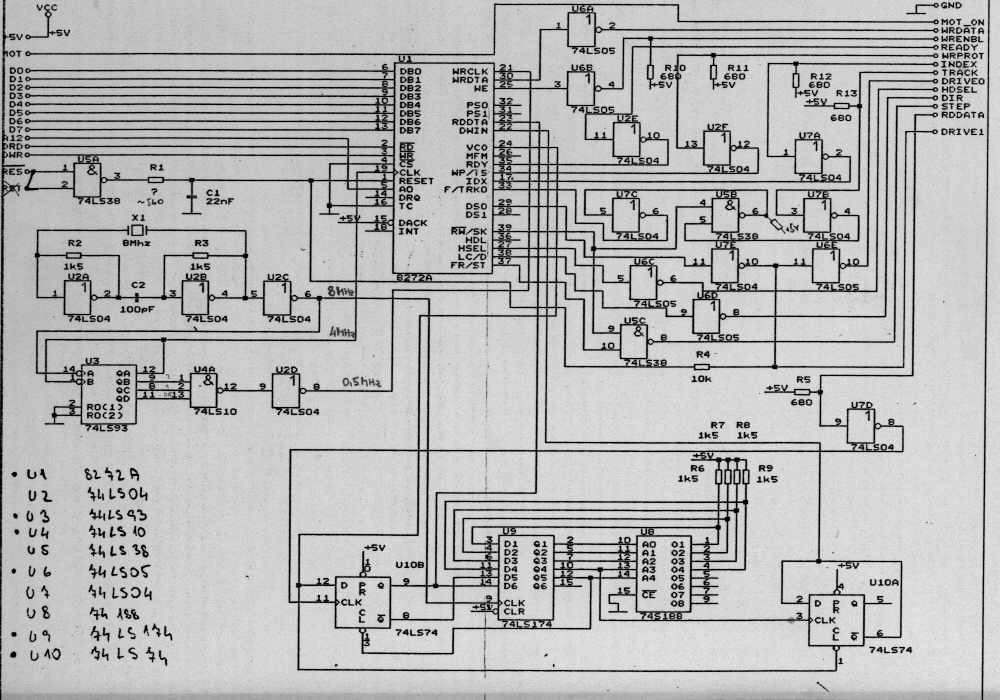
I've got the first stage of my floppy disc reader working! Meaning, the
data separator and synchroniser works - I have a circuit that outputs a pulse
whenever the MFM 'magic sync sequence' (0x4489) is detected. In theory, I can
use that to sync the reader against sector boundaries on IBM-format discs, or
track boundaries on Amiga discs.
The data separator is an Verilog HDL reimplementation of the data separator
used in Petr Simandl's Sinclair Spectrum +2A floppy disc controller
(<http://www.simandl.cz/stranky/zxs/obrazky/zx_radic_89k.jpg>, but there's a
better quality schematic at <http://www.worldofspectrum.org/BackToThePlus3/>).
I'm driving the whole thing off a 32MHz TTL oscillator, divided down to 16MHz
for 3.5" DSHD, and 8MHz for 3.5" DSDD. I haven't tried FM encoded data yet,
though I have no reason to suspect it won't work, as long as I can figure out
what the clock divider needs to be set to.
I'm seriously miffed that I spent an afternoon trying to figure out why I
could get the separator to lock onto a DSDD disc but not a DSHD - seems most
of my DSHD discs are of marginal quality. The MPF920 in my desktop read them
fine, but the rather battered Panasonic JU-257A427P (complete with broken
drive door return spring) I was using with the FDR couldn't read them at all,
hence the huge number of SYNC pulses. Garbage in, garbage out.
I guess the next step is to do the RAM interface and bit timer, then the
MCU interface and firmware. The whole thing is currently squashed into a
Xilinx XC9572XL 3.3V CPLD, with a little room to spare for the acquisition
circuitry. The data-separator and sync detector are only using 29 of the 72
available logic macrocells, so I've probably got enough room for a 16-bit RAM
address latch, with space to spare. Can't really tell until I start
implementing it though.
Current power consumption is roughly 5V at 325mA while reading, according
to the display on my bench PSU.
For anyone who cares, I've thrown a couple of screenshots from my logic
analyser on my website:
Main blog entry:
<http://blog.philpem.me.uk/?p=129>
720k (250kbps) sync - with SYNC lagging by one DWIN transition:
<http://blog.philpem.me.uk/wp-content/uploads/2007/04/hpla-fdd-reader-syncin…>
1.44MB (500kbps) sync - revised sync logic - SYNC doesn't lag now:
<http://blog.philpem.me.uk/wp-content/uploads/2007/04/hpla-fdd-reader-syncin…>
If anyone wants to see the (messy) Verilog code I've got at the moment,
contact me off-list and I'll send you a copy. It's probably very badly
written, but it works.
The tool I used to grab the screenshots from the analyser (a HP 1651B) is
also due to go online 'at some point' (read: when I can be bothered to fix
some of the bugs)... It basically emulates a HP Thinkjet and converts the
graphics output into a .BMP file, which is then converted to a PNG with
Irfanview and PNGOUT.
If and when this project gets a bit further off the ground, I plan to set
up another mailing list to handle discussions related to the disc reader --
for now, though, I think it's probably best to keep the discussions on the
classiccmp list.
For anyone that cares, I'll be posting announcements on the 'floppy-reader'
mailing list on my server
(<http://mail.philpem.me.uk/mailman/listinfo/floppy-reader_philpem.me.uk>).
It's open-access, so anyone that feels like commenting is welcome to do so.
Thanks,
--
Phil. | (\_/) This is Bunny. Copy and paste Bunny
classiccmp at philpem.me.uk | (='.'=) into your signature to help him gain
http://www.philpem.me.uk/ | (")_(") world domination.
Hi folks,
does anyone have an extender card for the Honeywell H316 CPU boards?
My new H316R had that broken chip in the ASR interface and I replaced
it. But nothing works... So I will have to track down what's wrong with it.
I could use an extender card. That would help a lot.
If anyone has more than one, I would be very happy to get it.
And if someone has just one card, I would like to borrow it for some
time. I would pay all shipping costs, of course!
Thanks a lot,
Philipp
P.S.: What about the H316 posting above? I wrote some replies and a PM
to Tony Wardle - but nothing happened :-(
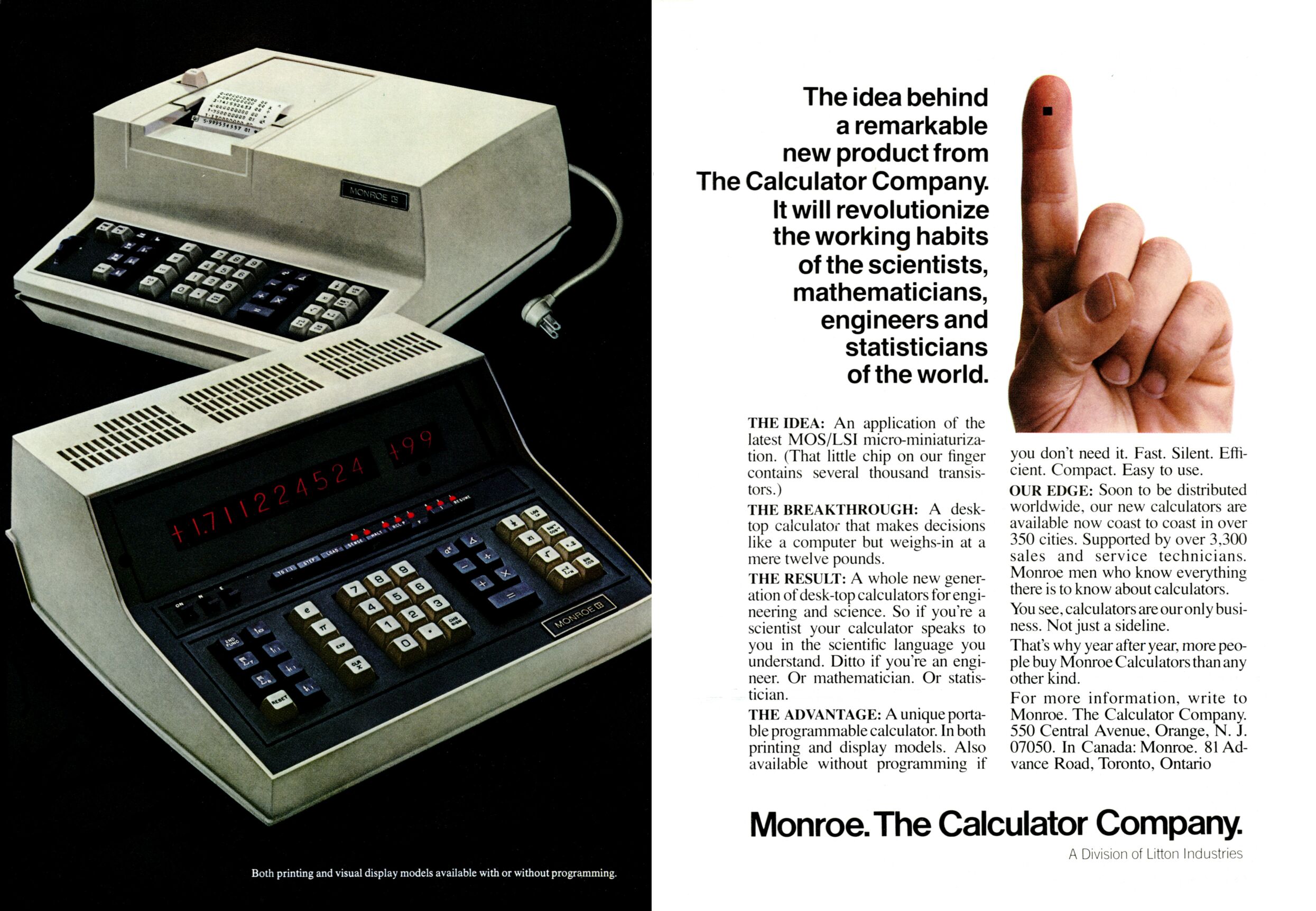
I have a desktop Monroe 1655 "calculator" that would also qualify then. I used it in 1971 at high school. It was built by Monroe.
http://www.dvq.com/ads/monroe_sa_6_70.jpg
I picked one up on eBay a few years ago complete with a card reader, cards, spare bulbs, etc (not shown in the picture).
The programming language had various conditional jumps, boolean functions, and would of course do all the math you wanted. The jumps probably let you "jump" to a specific program address. There wasn't much program space, but it was a great exposure for me back then.
best regards, Steve Thatcher
woodelf wrote:
> Patrick Finnegan wrote:
>
>> As I've learned before from this list, the only thing which that question
>> generates is a flamewar about what is a computer, and what's a "home
>> computer".
>
> I have yet to see a real HOME computer. Most game boxes I have seen
> - Coco, C-64 ect. where marketed as home computers but what do you need
> a home computer for?
To assist you in managing your household, or Course! A home computer would
be, I imagine, a computer installed somewhere in a closet or the basement,
and it'd have connections for thin clients all through the house. It'd
control your furnace, communications systems, lighting, heating, water
supply, you name it. You'd use it to determine at what level of ambient
light the room lighting switches on and at what times the curtains open
and close, or what temperature your bedroom needs to be a the time you
get up on workdays. It'd make sure your bath tub is filled at the right
time. and that your toast and coffee are ready in the kitchen when you
finish your bath, displaying your email on the kitchen's display while
you breakfast.
No, haven't seen many of them, yet. Only in a few proof-of-concept "home of
the future" type projects.
,xtG
tsooJ
> Does anyone on the list collect non-IBM S/360 or S/370 "clones"?
> there was a firm called Two-Pi that in the early 80's was successful
> enough to be purchased by Four Phase.
CHM has an Amdahl 470 and a Siemens 4004 (RCA Spectra).
There were lots of people who built byte-oriented machines with instruction
sets similar to the 360 and I know there are people who have Interdata, and
Univac 9x00 machines. Memorex built a 16 bit 360 like machine, and I have some
docs and software for that.
The artifacts of these sorts of machines haven't been preserved very well. Same
for Burroughs, Univac and NCR (business as opposed to scientific computers).