Found the following in an old usenet post. Seems on-topic. :)
De
> The Modified Julian Day was adopted by the Smithsonian Astrophysical
> Obser- vatory (SAO) in 1957 for satellite tracking. SAO started
> tracking satellites with an 8K (non-virtual) 36-bit IBM 704 computer
> in 1957, when Sputnik was launched. The Julian day was 2,435,839 on
> January 1, 1957. This is 11,225,377 in octal notation, which was too
> big to fit into an 18-bit field (half of its standard 36-bit word).
> And, with only 8K of memory, no one wanted to waste the 14 bits left
> over by keeping the Julian Day in its own 36-bit word. However, they
> also needed to track hours and minutes, for which 18 bits gave enough
> accuracy. So, they decided to keep the number of days in the left 18
> bits and the hours and minutes in the right 18 bits of a word.
> Eighteen bits would allow the Modified Julian Day (the SAO day) to
> grow as large as 262,143 ((2 ** 18) - 1). From Nov. 17, 1858, this
> allowed for seven centuries. Using only 17 bits, the date could
> possibly grow only as large as 131,071, but this still covers 3
> centuries, as well as leaving the possibility of representing
> negative time. The year 1858 preceded the oldest star catalog in use
> at SAO, which also avoided having to use negative time in any of the
> satellite tracking calculations.
> This base time of Nov. 17, 1858 has since been used by TOPS-10,
> TOPS-20, and VAX/VMS. Given this base date, the 100 nanosecond
> granularity implemented within VAX/VMS, and the 63-bit absolute time
> representation (the sign bit must be clear), VMS should have no
> trouble with time until:
Dear folks,
I'd give a lot to get these, but unfortunately it requires
dmil for certain reasons I do not know and I am in Germany
:-(((
There is a Rolm 1602B in Mechanicsburg (2850/3217):
http://cgi.govliquidation.com/auction/view?id=1197257&categoryId=1004
Simultaneously there is the ULTRA-RARE operators console for
this beast in Richmond (2856/2017):
http://cgi.govliquidation.com/auction/view?id=1203684&categoryId=e2856
So these two together would make a very nice rugged nova!
I really hope, that these find a good home and maybe meet
each other...
Regards,
Erik.
(Primarily a bit of advanced warning for those overseas who may be interested!)
The BCS is 50 years old this year, and to celebrate the Computer Conservation
Society are organising an event at both Bletchley Park and in London, running
>from July 12th to the 14th.
Lots more details, including booking info, available at:
http://www.bcsat50.org
cheers,
Jules
I wonder if anyone has the boot disk for this system?
I have them buried and can't find them and need to boot
the system for a project sooner than I'll find them.
Thanks
Jim
If anyone within striking distance of Birmingham (UK) wants an AS/400, I've
got one which you can have for the cost of coming over and taking it away
(strictly pick-up only, it's far too bulky to post).
I believe it's a model 9404, with an expansion cabinet - each cabinet is
similar in size to a DEC BA123 cabinet, IE not massive, but big enough....
And that's all I know about it, I've never even plugged it in!
Contact me off list if interested. Thanks.
Alternatively, does anyone have an address/phone number of a UK based IBM
dealer/scrapper who'd come and haul this machine away (there's currently a
skip located two houses down from where I live, I'm resisting the temptation
for now....)?
TTFN - Pete.
>Date: Sat, 21 Apr 2007 20:51:30 -0400
>From: Robert Borsuk <rborsuk at colourfull.com>
>On Apr 21, 2007, at 2:46 AM, Jeff Walther wrote:
>
>> Rob,
>>
>> Amongst the SE/30 collection crowd there is near fanatical interest
>> in the old Xceed Color 30, Color 30HR, and MacroColor 30 -- the
>> cards which install in an SE/30 and are compatible with the
>> Grayscale board.
>>
>> I've been slowly working my way around to designing a new card to
>> do the same function. FPGAs are fast and affordable and SRAM or
>> fast SDRAM is also affordable in the quantities needed.
> I designed the hardware upgrades and wrote the drivers for the Color
>30HR and the MacroColor30HR. I should have all the original source,
>schematics, and the Layout of the original FPGA (icky) for that card
>also. I should also (somewhere) have the schematic and stuff for the
>grayscale adapter. Let me see what I can do.
Wow, Rob. That would be fantastic. Thank you. Please let me know
if there are any expenses related to duplication for which I can
reimburse you.
Jeff
>Date: Sat, 21 Apr 2007 22:55:55 +0100
>From: Roger Holmes <roger.holmes at microspot.co.uk>
>On 21 Apr, 2007, at 09:24, cctalk-request at classiccmp.org wrote:
>
>> Message: 23
>> Date: Sat, 21 Apr 2007 01:46:53 -0500
>> From: Jeff Walther <trag at io.com>
>
>> If any of your documentation is related to hardware design as opposed
>> to user guides and user manuals I would be very grateful if I could
>> get a look at it.
>
>You probably need 'Designing Cards and Drivers', part of the Inside
>Macintosh series.
You are correct and I have that. But thank you, because I might not
have been aware of it. You had no way of knowing.
I also have "Guide to the Macintosh Family Hardware", and the Inside
Macintosh series. If I was an experienced video card designer, that
is all that I would need. They explain the interfaces, more or less.
But I would also like some materials that would teach me something
about the art. For example, there are a number of different ways
to handle updating the frame buffer so that one avoids artifacts on
the display. What are the pros and cons of each and how do they
apply in this particular situation?
I could try to build cards for each of them and test it out. But I
probably can't afford that many proto-types. On the other hand, I
might be able to get several designs out of one or two prototypes by
making good use of the flexibility of FPGAs.
Still, I'd love to read about some designs that worked and see what
choices other folks made.
>> One specific thing I've been wondering about is how one implements
>> quickdraw acceleration. Was there an Apple guide to doing this in
>> some of the developer materials, or was it something which each
>> company worked out on their own -- deciding which Quickdraw calls to
>> trap and send to the video card?
>
>Though I've never done it for hardware acceleration purposes, I would
>think you just need to override some of the standard routines in the
>QuickDraw bottleneck. StdLine, StdRect, StrRRect, StdOval, StdPoly,
>StdBits, StdRegion and StdText. The ones you don't need are for
>reading/writing pictures and picture comments. I have used these to
>capture data for pen plotters, raster printers and into applications.
>Alas on OS-X we now need to be able to read PDF - a much more
>complicated format and proprietary to Adobe, though with the great
>benefit of platform independence for files.
Cool. Thank you for the ideas. I will look at those commands and
develop ideas on trapping and accelerating them.
Jeff Walther
>
>Subject: Junkbox CP/M system?
> From: Jos Dreesen <jos.dreesen at bluewin.ch>
> Date: Sun, 22 Apr 2007 22:13:35 +0200
> To: General Discussion: On-Topic and Off-Topic Posts <cctalk at classiccmp.org>
>
>
>
>Anyone knows of websites discussing true junkbox CP/M systems ?
>
>The P112 might be nice, but my junkbox contains only the standard Z80...
>
> Jos Dreessen
Lookup ALPACA on Yahoo groups.com. There are several Z80 systems on the net.
Allison
All:
I just got a complete working Hawthorne Technologies 68000-based SBC.
It?s a 5.25? form factor computer based on the 68000 CPU. It has two serial
ports in addition to a floppy controller which is PC-compatible - it uses
360k diskettes and PC drives and the disks can be read-written on a PC.
Among the disks provided was an editor, debugger, assembler, and Forth.
What it doesn?t have (that I can see) is a C-compiler. Does anyone have this
SBC with a C-compiler?
BTW, I made disk images so if anyone needs them, I got ?em.
TIA.
Rich
--
Rich Cini
Collector of Classic Computers
Build Master and lead engineer, Altair32 Emulator
http://www.altair32.comhttp://highgate.comm.sfu.ca/~rcini/classiccmp
Hello all,
Just been sorting through all my junk as part of a spring clean.
One ?sort of on-topic? item that seemed too good to throw away is a MIDIman
Winman 4x4 MIDI interface on an EISA card.
Pictured here (warning 4MP image):
http://ozpass.co.uk/files/Winman-4X4.jpg
The card offers 4 in/out MIDI channels and was pulled (a long time ago) from
a system running Cubase VST on Windows ?98. Functional to the best of my
knowledge.
If anybody wants the card it?s yours free-of-charge (excluding cost of
delivery).
Let me know off-list.
Regards,
Austin.
P.S. Based in Manchester, UK.
I'm building up a demo S100 system for VCF. I'm considering using a
modern switching power supply for regulated power and abandoning the
onboard voltage regulators on each card. I know the last CompuPro boxes
took this route so it must be feasible. What is the general
wisdom/experience with this approach?
Thanks!
No virus found in this outgoing message.
Checked by AVG Free Edition.
Version: 7.5.463 / Virus Database: 269.5.6/770 - Release Date: 4/20/2007
6:43 PM
> Date: Tue, 17 Apr 2007 10:09:32 -0500
> From: "Jay West" <jwest at classiccmp.org>
> Subject: Re: Linux question
> To: "General Discussion: On-Topic and Off-Topic Posts"
> <cctalk at classiccmp.org>
> Message-ID: <002a01c78102$69f9e150$6500a8c0 at BILLING>
> Content-Type: text/plain; format=flowed; charset="iso-8859-1";
> reply-type=response
>
> Someone wrote...
> >> At one point in time I would have ventured that 70-90% of the list
> >> had some sort of CP/M machine, but I bet that number is now well
> >> south of 50%.
> I will make my own generalization - that the above is
> probably not correct
> ;)
>
> Doc wrote...
> > The response to any query on this list depends on the
> rarity of the
> > hardware, the level of past experience with that hardware (a lot of
> > listers have worked with systems they don't currently own),
> the clarity
> > and amount of detail in the question, whether there's a
> tasty flame war
> > ongoing, and the positions of the moon, Mars, and Uranus.
> Actually, that's a very good synopsis.
>
> > I've asked questions here and gotten dead silence; asked the same
> > question again in a few weeks and gotten lots of response
> and several
> > solutions.
> And completely correct here too - I have had the exact same
> thing occur on
> quite a few occasions. Sometime peoples minds are just
> elsewhere, and that's
> ok.
>
> > Trying to make something of that or draw some conclusion
> from it is Not
> > Right.
> Well, I'll go as far as "incorrect" :D
>
> Jay
>
I have been on this list for around 10 years and can say with pretty
fair certainty that the mix of posts has changed substantially during
that time. Jay, perhaps you don't notice this because the type of
things you're most interested in - old HP and DEC gear - are still
actively discussed. But discussions of the small stuff: 8-bit micros,
CP/M machines, Apple Lisa's, HP Series 80, etc., have all but
disappeared. There used to be a pretty active discussion about these
sort of machines on the list, and a lot of resources to draw on, but no
longer. Posts about those sorts of hardware are few and far between and
are, when they do occur, usually generate no threads.
As I previously said, that's an observation/conclusion, and other are
entitled to agree, disagree or vituperate, but I think it's backed by
empirical evidence. Some may not like the conclusion, or claim it's
incorrect, but this is something I've observed for at least a few years
and I have a lot of archived posts that seem to bear me out. I thought
it was pretty obvious that I was using an example - in this case the
relative response to the Linux post vs. the Kaypro post - as an example
of a general trend. Naturally, the naysayers, serial disagreers and
chronic debunkers conveniently ignore the obvious and pretend that I am
trying to draw a broad conclusion from a single occurrence, even though
they know (or damn well should know) that's not the case.
Sun has (on the Ultras) prtdiag from Solaris, can't recall what IBM has
under AIX but it isn't as instructive. Linux has stuff in /proc that
lists everything.
BTW the Onyx2/Origin2(something) sleds are the same as the Octane sleds.
>Date: Fri, 20 Apr 2007 16:12:10 -0400
>From: Robert Borsuk <rborsuk at colourfull.com>
>On Apr 20, 2007, at 3:51 PM, Teo Zenios wrote:
>
>> I hope you did not throw away anything too rare (if you have more
>> to junk
>> let me know). The cards I listed were just the DSP cards I have,
>> probably
>> have 50+ Nubus cards by now.
>>
>> The 8*24GC is a nice card for an 030 (I don't have one yet). Has 2
>> slots for
>> Gworld RAM (it uses IIfx RAM, wish I could find GWORLD for my
>> Thunder/24
>> cards). I hear the AMD GPU on the GC gets toasty.
>>
>> TZ
>Teo,
> A bunch of storm cards, Xceed video cards, etc. I think I might
>have kept one or two of each. I would have to see.
>Are you in the states? I have a box on documentation that I've been
>looking for a home.
>I wanted someone who might have an interest in Nubus cards, like
>yourself. If you are, send me your address off list.
>
>Rob
Rob,
Amongst the SE/30 collection crowd there is near fanatical interest
in the old Xceed Color 30, Color 30HR, and MacroColor 30 -- the cards
which install in an SE/30 and are compatible with the Grayscale board.
I've been slowly working my way around to designing a new card to do
the same function. FPGAs are fast and affordable and SRAM or fast
SDRAM is also affordable in the quantities needed.
If any of your documentation is related to hardware design as opposed
to user guides and user manuals I would be very grateful if I could
get a look at it.
One specific thing I've been wondering about is how one implements
quickdraw acceleration. Was there an Apple guide to doing this in
some of the developer materials, or was it something which each
company worked out on their own -- deciding which Quickdraw calls to
trap and send to the video card?
Jeff Walther
Anybody have a WAMECO floppy disk controller for sale or trade? Please
reply offlist.
Jack
No virus found in this outgoing message.
Checked by AVG Free Edition.
Version: 7.5.463 / Virus Database: 269.5.6/770 - Release Date: 4/20/2007
6:43 PM
The TRS-80 Model I CAN run CP/M. There were several add-on boards that
allowed for the swapping in of RAM into the ROM address space.
One was called "The Omikron Mapper". And I'm sure there were others.
My CP/M Capable list is:
LNW-80 Model I
Apple IIgs w/CP/M card
IBM 5150 XT with CP/M Card
Atari-ST (CP/M 68000)
Timex/Sinclair 2068 with Timex Portugal Disk System
That's it!
Al
Phila, PA
> From: Dave McGuire <mcguire at neurotica.com>
> I'm pretty sure the TRS-80 Model I is incapable of running
> unmodified CP/M because it has ROM in low memory that cannot be
> remapped...is this correct?
>
> -Dave
>
>
I HAVE A BUNCH OF CADO COMPUTERS.
IF YOU WANT THEM, EMAIL BRAD STONE AT _COMPORT at AOL.COM_
(mailto:COMPORT at AOL.COM)
************************************** See what's free at http://www.aol.com.
current e-mail flyer states so. Don't know if they're
pre- or post ADB. If yer lucky enough to live nearby,
go look :)
__________________________________________________
Do You Yahoo!?
Tired of spam? Yahoo! Mail has the best spam protection around
http://mail.yahoo.com
>
>Subject: Re: Quick survey on equipment
> From: Dave McGuire <mcguire at neurotica.com>
> Date: Sat, 21 Apr 2007 12:00:55 -0400
> To: "General Discussion: On-Topic Posts Only" <cctech at classiccmp.org>
>
>On Apr 21, 2007, at 12:38 AM, Ensor wrote:
>> BTW Can TRS-80 Model 1's or Memotech's run CP/M (I had an "SDX"
>> disc pack for my Memotech at one time, but that didn't run CP/M;
>> rather it had a basic "disc filing system" in ROM)?
>
> I'm pretty sure the TRS-80 Model I is incapable of running
>unmodified CP/M because it has ROM in low memory that cannot be
>remapped...is this correct?
>
Correct as standard CP/M. there was a version that allowed for that ROM.
It was not standard and dur to that and the small TPA it would not run
most appications available. If you had source you could reassemble/compile
as needed and then run it for the new 4200h start adresss (nominal is 100H).
Allison
On 21 Apr, 2007, at 09:24, cctalk-request at classiccmp.org wrote:
> Message: 23
> Date: Sat, 21 Apr 2007 01:46:53 -0500
> From: Jeff Walther <trag at io.com>
> If any of your documentation is related to hardware design as opposed
> to user guides and user manuals I would be very grateful if I could
> get a look at it.
You probably need 'Designing Cards and Drivers', part of the Inside
Macintosh series.
> One specific thing I've been wondering about is how one implements
> quickdraw acceleration. Was there an Apple guide to doing this in
> some of the developer materials, or was it something which each
> company worked out on their own -- deciding which Quickdraw calls to
> trap and send to the video card?
Though I've never done it for hardware acceleration purposes, I would
think you just need to override some of the standard routines in the
QuickDraw bottleneck. StdLine, StdRect, StrRRect, StdOval, StdPoly,
StdBits, StdRegion and StdText. The ones you don't need are for
reading/writing pictures and picture comments. I have used these to
capture data for pen plotters, raster printers and into applications.
Alas on OS-X we now need to be able to read PDF - a much more
complicated format and proprietary to Adobe, though with the great
benefit of platform independence for files.
Roger Holmes
Author/Part Author/Maintainer of MacPlot, MacPalette, MacDraft,
MacInteriors, Graphic pack, XRip, 3DWorld, Microspot Interiors,
Microspot Modeller etc.
ANNOUNCEMENT: for immediate release
The third annual Vintage Computer Festival Midwest will be held again
this year at Purdue University in West Lafayette, Indiana, USA. The
VCF is an event celebrating computing history with speakers and
exhibits, and is supported almost entirely by hobbyists. As before,
there will be a small vendor section, including consignment sales.
The event will be a two-day event for the first time, this year, and
will be from 10am until 6pm on Saturday and Sunday, July 14th and 15th.
Ticket prices will be $5/day, with children 17 and under having free
admission.
For more details, including how to be an exhibitor, vendor, attendee,
speaker, etc, please see the following URL, or contact me (Patrick
Finnegan) @ vcfmw at computer-refuge.org.
We are currently looking for speakers for this year's event, so if
you're interested in talking about a vintage computing subject, please
let me know!
http://www.vintage.org/2007/midwest/
Thanks go to the Purdue University Rosen Center for Advanced Computing
for their support of the show. Please come and help make this show a
success!
Pat
--
Purdue University ITAP/RCAC --- http://www.rcac.purdue.edu/
The Computer Refuge --- http://computer-refuge.org
I will be in the Bay Area from the 7th thru 9th of May, part of my
annual working vacation. If anyone wants to show off their collections
of Big Iron - well I would't complain! Or if not, maybe just a pizza
dinner rag chew jam session...
I leave this Tuesday, but will be able to pick up email in Boulder in
about a week.
--
Will
I think last month someone here asked for a link to
an article they had seen where X-Y waveforms
were generated for CRT character generation.
I believe the link they want is this:
http://www.nixiebunny.com/crtgen/crtgen.html
Also on David's web site, and by my accounting
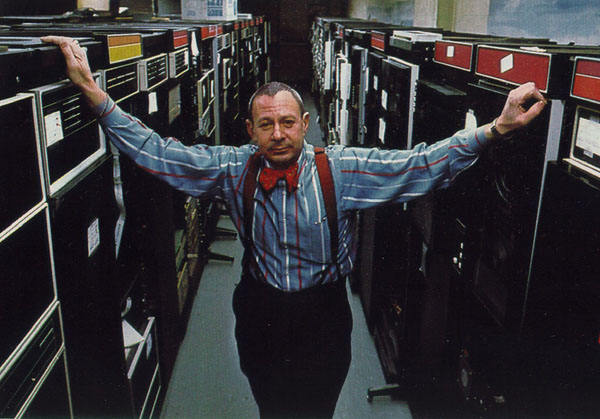
completely classiccmp-worthy is this picture (from a
70's National Geographic magazine!) of the proprieter
of American Used Computer, standing between
H960's filled with lots of DEC Mini's and peripherals:
http://www.nixiebunny.com/sonny.jpg
Tim.