That's most kind of you.
I do go up to Coventry and Birmingham from time to time.
So could collect.
Rod
-----Original Message-----
From: cctech-bounces at classiccmp.org
[mailto:cctech-bounces at classiccmp.org] On Behalf Of Dave Caroline
Sent: 26 April 2007 11:04
To: General Discussion: On-Topic and Off-Topic Posts
Subject: Re: VAX 4000-200 and DECserver terminal server.
I have some stuff stored in the protacabin outside will check later
today or tommorow, in the east midlands free for collection
Dave Caroline
On 4/25/07, Rod Smallwood <RodSmallwood at mail.ediconsulting.co.uk> wrote:
> Hi
> A while back I aquired a VAX4000-200 (made circa 1990) via the DEC
> 'Old boy' network.
> Some list members were kind enough to help me get the system password
> reset.
> It booted, ran and the icing on the cake was it was loaded with VMS
> 6.2 and TCPWARE.
> That made it compatible with current networks.
> A BNC cable and cheap hub got me to 10baseT and with it a connection
> to my office network.
>
> Recently I was given a pile of terminals and printers. I managed to
> salvage two VT420's one HP700 and two LA75 Printers.
> That brought my system up to three VT420's and an LA75 + Spares.
>
> As some of you will know I worked for DEC for 10 Years +. The
> system I'm building up represents my idea of the 'Golden Age' of DEC
> (1980-1990)
>
> I want to use all DEC kit therefore the HP 700 is surplus. What I need
> is a DECServer with four or more DECconnect or RS232 ports on it.
> Most of them are BNC 50Ohm thin ethernet or AUI in and DECconnect or
> 25Way D out. They look a bit like a hub with a BNC connector in a
> depression in the top.
>
> Rod Smallwood
>
>
>
>
Date: Tue, 24 Apr 2007 17:25:44 -0400
From: Allison <ajp166 at bellatlantic.net>
Subject: Re: Hand-rolling a CP/M machine
<snip>
>>> 8085 (Also makes for simple systems)
>>
>>Those are somewhat common if you hang around DEC equipment.
>As I am.
<snip>
>Allison
------------
Oh no, Allison, you're not common at all ;-) Quite unique, in fact.
m
On 4/26/07, Jules Richardson <julesrichardsonuk at yahoo.co.uk> wrote:
> Ethan Dicks wrote:
> >> It does have a SCSI connector within the A590 I think, but I'm
> >> not sure how picky it is about what drives it'll work with.
> >
> > Not very picky.
>
> Ok... so it doesn't need a SCSI drive that's happy with being low level
> formatted to something other than a 512 byte sector size, for instance?
Nope. You do want 512 bytes per sector. Bog standard. I've attached
everything from 20MB up to 4GB drives onto my Amigas from the A1000 up
through my A4000, and the only time things were ever fiddly was with
pre-capacity-reporting drives or non-SCSI controllers like the A2090.
If you have something as modern as an A590 and any embedded SCSI
drive, it should work as described in the A590 docs. There's probably
a copy of the A590 prep disk running around. I think you might need
that for Kickstart/AmigaDOS 1.3, but by 2.0, ISTR, the OS knew about
the A590/A2091 from the get-go. If you happen to have a Kickstart 1.2
ROM in your A500, you won't be able to autoboot the hard disk, but you
will be able to access it after booting with a boot floppy.
> I think many of them are still in service which is why they haven't turned up
> used - plus there's more paranoia these days about data security, so I wonder
> if more are going to the shredders without being recycled as working units.
Perhaps. They could also be left running until they die. We were
losing an average of one Seagate 72GB UltraSCSI drive per month at the
Pole. All of the 9GB drives through 146GB drives failed at a combined
rate of less than one every two months, except for the 73GB drives.
It wasn't just that we had more 73GB drives than any anything else -
on a per-unit basis, the failure rate was dramatically higher in the
same environment.
They won't be of much use in your Amiga anyway. ;-)
-ethan
With all of this recent 8-bit and CP/M talk, it's prompted me to do a
little digging on what it would take to put together a CP/'M machine
on my own. I already have a couple of commercially-produced boxes.
This is about taking a Z-80, some RAM, some ROM and a storage unit and
making it run CP/M.
I've been reading the various threads, so I have a general idea of
what has to happen, but I'm still fuzzy on a few specifics, no doubt
due to my lack of deep experience with the Z-80.
The point of ROM vs RAM at $0000 has been gone over a few times. Do
"standard" CP/M machines use a shadow-ROM technique, or what, to
cold-start? We used to use a trick with the 68000 that would map ROM
at $000000, _and_ at some higher address, with the first few
instructions jumping to the higher ROM image, , and either an I/O pin
that toggled the address mapping for the lower ROM image, or just
watching for the first pulse from A23, such that the act of jumping up
to the higher ROM address itself would remove ROM from the bottom of
the memory map, revealing RAM.
How did CP/M systems handle 64K of RAM? Was there one primary way it
was done, or did every hardware vendor do it differently? I should
probably just confine my efforts to 48K of RAM and use the upper 16K
for a boot ROM, but if it's easy to support 64K of RAM, why not?
To confirm, the minimal I/O system is some flavor of serial interface
for console I/O (presumably piped to a display smart enough to handle
ANSI codes), and some form of block-addressable storage with a CP/M
filesystem, right? (I'm ignoring handy I/O like parallel printer
ports and 8255-type GPIO and the like, for the moment) Is it required
that the storage unit be writable? Is there a minimum size for the
display? That wouldn't matter for hanging a VT100-equivalent off of
the console port, but if I were to use some flavor of textual LCD, it
would very much matter. To find another way to ask, would the body of
extant CP/M apps freak out if you try to run them on a display that's
under 40 chars wide or under 24 chars tall? Do they expect 64 chars
wide or 80 chars wide? I don't think the OS itself actually cares how
wide or tall the display is, but perhaps some of the CUSPs, like DIR,
might.
Rather than taking a bare Z80, wiring on a Z8530, an SRAM or two and
an EPROM, I was contemplating beefing up my 1976 SDS Z-80 Starter Kit
to the point where it could run CP/M. I've written about it here
before, when I first got it, to remind those that don't know or don't
remember what it is, it has a ~2MHz Z80, 1K of 21L02 SRAM, room for
one more K, one 2716 with "ZBUG", two empty 2716 sockets (one attached
to an EPROM programming circuit), a keypad and 7-segment LEDs, a
largish wire-wrap area, and two S-100 slots. Presuming I wire the
SRAM, a larger-capacity EPROM, and some serial device into the
wire-wrap area, is there anything I should look for in an S-100 card
that would be interesting to install? A video card (rather than a
serial console), perhaps? I think I have one or two S-100 video
cards, but I was never clear on how one attaches a keyboard to that
rig - is there an ASCII keyboard port typically provided on an S-100
video card, or is that a separate peripheral?
Thanks for any and all answers to my noobish CP/M questions,
-ethan
On 4/26/07, Jules Richardson <julesrichardsonuk at yahoo.co.uk> wrote:
> Hmm, I think that's what's in my Amiga A590 enclosure. It's certainly not
> SCSI, but I'm sure the connector's not proper IDE either.
The A590 (and A2091 ZorroII card) support SCSI on the 50-pin
connector, and XT IDE (only) on the 40 pin connector. The 40-pin
connector is unpopulated on the A2091, but it's the same controller
chip on both, and has the same features in both.
I've used it with a WD 40 MB XT IDE drive from a Commodore x86 PC. It works.
> > And they were bl**dy unreliable too! :-(
>
> That worries me about the Amiga one. It does have a SCSI connector within the
> A590 I think, but I'm not sure how picky it is about what drives it'll work with.
Not very picky. You'll find that with the Kickstart version in your
machine, you are limited to 4GB or less for drive size, but other than
that, as long the drive answers the packet for drive capacity (ACB4000
MFM bridge wouldn't answer, for example, but every embedded SCSI drive
I know of will), the AmigaDOS drivers will be happy.
> [1] I don't buy new stuff, not for PCs - not when the price drops so much for
> "previous generation". Unfortunately SCSI drives of 36GB and up don't seem to
> be readily available.
I got a few in 2003, cheap, but I'm not seeing server drives as
abundantly as I used to. The ones behind me are loaded with "SAS"
(Serial-attached-SCSI, AFAIK), so perhaps the days of SCA-connector
UltraWIDE SCSI drives are waning at last.
-ethan
Hi
A while back I aquired a VAX4000-200 (made circa 1990) via the DEC
'Old boy' network.
Some list members were kind enough to help me get the system password
reset.
It booted, ran and the icing on the cake was it was loaded with VMS 6.2
and TCPWARE.
That made it compatible with current networks.
A BNC cable and cheap hub got me to 10baseT and with it a connection to
my office network.
Recently I was given a pile of terminals and printers. I managed to
salvage two VT420's one HP700 and two LA75 Printers.
That brought my system up to three VT420's and an LA75 + Spares.
As some of you will know I worked for DEC for 10 Years +. The system
I'm building up represents my idea of the 'Golden Age' of DEC
(1980-1990)
I want to use all DEC kit therefore the HP 700 is surplus. What I need
is a DECServer with four or more DECconnect or RS232 ports on it.
Most of them are BNC 50Ohm thin ethernet or AUI in and DECconnect or
25Way D out. They look a bit like a hub with a BNC connector in a
depression in the top.
Rod Smallwood
Hi,
> Repair was usually a new floppy, new FDC and new sound chip. Why
>the sound chip? Well... no, someone else can tell it.
I dimly recall that Atari used one or two signals from the I/O port on the
sound chip as part of the disc interface - drive/side select?
TTFN - Pete.
All:
In my research on this Hawthorne SBC I got (I contributed the disk
images to Dave?s efforts), I discovered that it was covered in various forms
in The Computer Journal (TCJ). I have many issues in the series but not all.
So, I was wondering if anyone had the complete series and whether it was
worth scanning and posting.
Rich
--
Rich Cini
Collector of Classic Computers
Build Master and lead engineer, Altair32 Emulator
http://www.altair32.comhttp://highgate.comm.sfu.ca/~rcini/classiccmp
> I'm assuming that a couple of hours of heating the base plate to
> about 130F (about 55C) will do as much good as anything will.
There was a posting in the HP tape thread about using a lamp to heat
the tensioning belt here within the past six months. Can't find it
right now, though.
I've observed the same thing with blue-labeled DC300s and 450s
>
>Subject: Re: Hand-rolling a CP/M machine
> From: "Ethan Dicks" <ethan.dicks at gmail.com>
> Date: Wed, 25 Apr 2007 14:40:08 -0400
> To: "General Discussion: On-Topic and Off-Topic Posts" <cctalk at classiccmp.org>
>
>On 4/25/07, woodelf <bfranchuk at jetnet.ab.ca> wrote:
>> >> You can copy the screen logic for TRS80 as that is a basic 64x16 as well.
>> > Good thing to keep in mind.
>>
>> Well if anybody is doing VDM-1's the big problem is that you can't find
>> the Character ROM any more. I like the idea of TTL display like VDM-1
>> but since this is not the late 70's a 80x24 screen is reasonable
>> and the data out is a simple VGA format, since the monitors are easy to
>> come by.
>
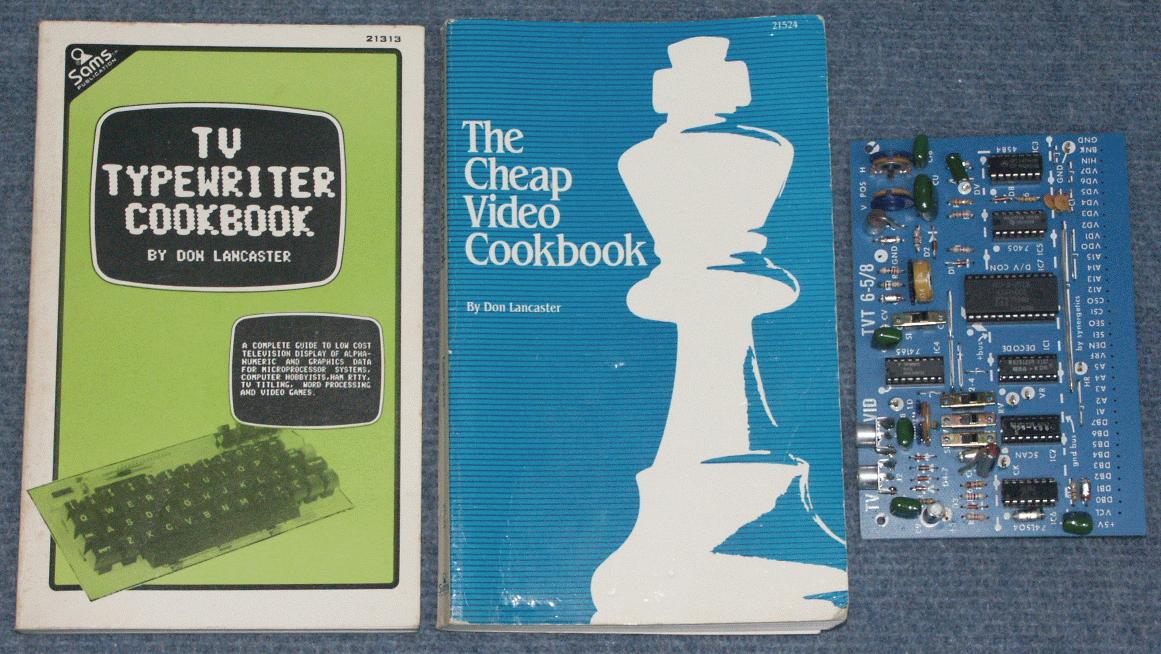
>As in the old Chargen ROMs like on this board?
>
>http://www.classiccmp.org/dunfield/d/h/tvt.jpg
>
>(I have one that I bought new and has yet to be attached to a KIM-1).
>
>With as fast as CMOS ROMs are today, why not use a 27C64 and burn your
>own charset to it? It's not tough to do, but is there a technical
>reason it wouldn't work?
It works very well and it's easy to find a pattern like 2513 (5x7) or
a 6674 (7x9) and burn an Eprom. Compared to the parts of that day
even 2716 is both big enough and plenty fast. I like to use 27C64s
as I have a bunch of pulls and it's no big deal building up a pattern
as a copy or custom.
FYI: to do it by hand all one needs is a sheet or a few of grid paper
and a #2 graphite thingie. The order you enter the data is row for
the low address lines (usualy 4 address lines) and the high address
lines are the ascii value (0-127) that corosponds with the char.
Allison
>
>Subject: Re: Hand-rolling a CP/M machine
> From: "Chuck Guzis" <cclist at sydex.com>
> Date: Wed, 25 Apr 2007 11:49:49 -0700
> To: "General Discussion: On-Topic and Off-Topic Posts" <cctalk at classiccmp.org>
>
>On 25 Apr 2007 at 13:24, woodelf wrote:
>
>> Well if anybody is doing VDM-1's the big problem is that you can't find
>> the Character ROM any more. I like the idea of TTL display like VDM-1
>> but since this is not the late 70's a 80x24 screen is reasonable
>> and the data out is a simple VGA format, since the monitors are easy to
>> come by.
>
>At the expense of getting booed off the topic, if you need simple
>80x24 and are using something like an 8085, the 8275/8276 CRT
>controller with an 8257 DMA controller (in auto-initialize mode)
>doesn't take a lot of extra glue. The gotcha is that "special
>effects" like bolding and underlining take up space on the display
>(Doesn't the Wyse 50 do that?). There is a "transparent" mode, but
>management of the screen buffer becomes a real headache. I've never
>tried to interface an 8257 to a Z80, so I don't know if the timing
>works there.
Perfectly reasonable, though at first it was a simple system.
The Z80 and 8257 (or 8237) coexist fairly well. There are some signal
differences for the glue TTL but it works. Back in the day it was also
popular to do that becase 8257 was cheaper and faster then Z80 DMA and
didn't have to be clocked synchronous like the Z80 DMA.
Allison
See below. Please reply to Jamie direckly.
--
Sellam Ismail Vintage Computer Festival
------------------------------------------------------------------------------
International Man of Intrigue and Danger http://www.vintage.org
[ Old computing resources for business || Buy/Sell/Trade Vintage Computers ]
[ and academia at www.VintageTech.com || at http://marketplace.vintage.org ]
---------- Forwarded message ----------
Date: Tue, 24 Apr 2007 15:04:51 -0500
From: "Malernee, Jamie" <JMalernee at sun-sentinel.com>
To: vcf at vintage.org
Subject: florida members?
Hi,
I'm a writer with the South Florida Sun-Sentinel, working on an article
about local people who collect vintage computers as a hobby/passion. Do
you have any members in the Florida area, or more specifically the South
Florida area, who I might be able to contact for my article?
Many thanks,
Jamie Malernee
Staff Writer
South Florida Sun-Sentinel
(954) 356-4849
200 E. Las Olas Blvd.
Fort Lauderdale, FL 33301
----- Original Message -----
From: "Keys" <jrkeys at concentric.net>
To: "General Discussion: On-Topic and Off-Topic Posts"
<cctalk at classiccmp.org>
Sent: Wednesday, April 25, 2007 6:20 PM
Subject: Re: Reporter in south Florida wants to talk to computer collectorin
same
>
> ----- Original Message -----
> From: "Jay West" <jwest at classiccmp.org>
> To: "General Discussion: On-Topic and Off-Topic Posts"
> <cctalk at classiccmp.org>
> Sent: Wednesday, April 25, 2007 7:27 AM
> Subject: Re: Reporter in south Florida wants to talk to computer
> collectorin same
>
>
>> Sellam wrote....
>>> See below. Please reply to Jamie direckly.
>>
>> This is the same one that contacted me two days ago and that I posted to
>> the list yesterday. Looks like the same reporter contacted Sellam the day
>> after me. I wasn't going to post her phone number to the list but... The
>> contact info is all the same, so to those who responded to my post
>> already - contact her directly.
>>
>> Jay West
>>
> Anyone have the first post I missed it. Thanks JK
Forrest M. Mims III was one of the founders of MITS in 1969. He developed
various model rocketry kits and left MITS a year or two later. MITS later
on contracted with him to write the Altair Operators Manual in exchange for
an Altair computer. That Altair has been on display at the Smithsonian for
over 17 years.
He later on wrote a book called "Getting Started in Electronics" for
RadioShack which was given to me in 1997. This book "got me started in
electronics" and led me to eventually reproduce the Altair.
So last week I received an unsolicited e-mail from Mims congratulating me
on the work. : )
I'm probably a "youngster" compared to many here, but anyone else have an
experience like this? Meet someone from the past through unrelated
projects that all tie togther?
http://www.sunandsky.org/MITS_History.phphttp://www.sunandsky.org/http://www.forrestmims.org/http://www.forrestmims.com/
Grant
Dear friends,
Anyone knows where can I find a hardware or software emulator for the
TMP68301 microcontroller from Texas? I want to do some messing with an old
processor board.
Thanks
Alexandre Souza
-------------- Original message ----------------------
From: cctalk-request at classiccmp.org
> 3. Re: Lack of 8-bit threads (was Re: Linux question) (Chuck Guzis)
> Message: 3
> Date: Sun, 22 Apr 2007 08:50:00 -0700
> From: "Chuck Guzis" <cclist at sydex.com>
> Subject: Re: Lack of 8-bit threads (was Re: Linux question)
> One other fairly popular "nearly compatible" that I recall is the
> Mitsubishi PC. Like the Convergent-designed 6300 It was a headache
> for a lot of applications. Not really inferior to the 5150, but
> different enough to be frustrating.
The 6300 (and 6300 Plus) were designed and built by Olivetti, probably by the same engineers who used to keep Mussolini's trains running on time. Their DB-25 video connector is the only reliable way ever discovered to break a Radio Shack Daisy Wheel Printer II (aside from tossing the beast into a smelter). Convergent did the 7300 and 3B1 Unix PCs (vastly superior machines in my arrogant opinion, but I'm partial to just about any MC68k series systems that didn't come from Cupertino).
--
Ward Griffiths wdg3rd at comcast.net
The reason folks don't think of installing Windows as a painful experience is roughly the same reason men don't think of childbirth as a painful experience. Mike, http://www.theregister.co.uk/2007/03/30/letters_3003/
Sridhar Ayengar wrote:
That's really strange, because 3M and Scotch are the same company.
Peace... Sridhar
-----------
Billy:
3M manufactured for dozens of companies. They would make bulk tape (usually
18" wide) for almost anyone, including the 3M and the Scotch brand name.
Many companies would supply the formula for the binder, oxide slurry, and
suface coating.
So even though the tape came from the same production line on the same day,
it could be radically different.
3M was excellent about controlling the IP. So even though they made tape to
spec for a competitor, the detailed data would not reach their brand name
group.
At one time in the late 60's I visited their production line. They claimed
that they were making 90% of all the .5" tape on the market at that time.
Billy
>
>Subject: Re: Hand-rolling a CP/M machine
> From: woodelf <bfranchuk at jetnet.ab.ca>
> Date: Wed, 25 Apr 2007 15:23:36 -0600
> To: General Discussion: On-Topic and Off-Topic Posts <cctalk at classiccmp.org>
>
>Ethan Dicks wrote:
>
>> With as fast as CMOS ROMs are today, why not use a 27C64 and burn your
>> own charset to it? It's not tough to do, but is there a technical
>> reason it wouldn't work?
>
>That works but to find the PROM data you have to look at some very old
>memory data books. I have yet to find any nice 8x11? fonts that fit
>in a 9x12 character block could be copied.
>
>> -ethan
Motorola, Signetics or SMC databooks from the 80s.
Or do what I did back in the hazeltine days, graph paper and a book of fonts.
Allison
>
>Subject: Re: Hand-rolling a CP/M machine
> From: Warren Wolfe <wizard at voyager.net>
> Date: Tue, 24 Apr 2007 15:36:14 -0400
> To: "General Discussion: On-Topic and Off-Topic Posts" <cctalk at classiccmp.org>
>
>On Tue, 2007-04-24 at 12:01 -0400, Ethan Dicks wrote:
>
>
>> Right. That much I get... so once CP/M is running, it's ordinary not
>> to refer to the boot ROMs? There's typically not a requirement to
>> keep some low-level BIOSy stuff in ROM?
>
>
> No, there is no requirement to keep ANY ROM available after boot.
>It is preferable, in most cases, to have the entire address space made
>up of RAM once the system is actually running, as opposed to booting.
>Some cases involve copying the ROM contents to RAM during boot, and then
>disabling ROM. Again, as has been implied, EVERYBODY chose their own
>method -- some were better than others, naturally enough. As a matter
>of fact, for those systems which implement ROM at 0000 for booting, the
>ROM *MUST* be disabled for any even half-way normal CP/M system to run.
>(See the previous discussions on CP/M for Radio Shack Models)
Basically I like to call it this way.
CP/M doesn't care how it gets there, only that it does.
>> Right. I know that there are *many* CP/M hardware configurations; I
>> am trying to get down the nub of as minimal a hardware design as
>> possible.
>
>
> CPU, 64k RAM, disk(ette) controller, ROM able to be disabled (could
>be on controller), serial port. Anything else is gravy.
>
I'd simplify diskette controller to mass storage (any form).
>> Sure. For the minimal system I have in mind, I'm planning on a VT100
>> or some modern machine running a terminal emulator (Kermit, et al.) to
>> handle screen formatting.
>
>
> Perfect.
Yep. Works well enough.
>> > A video card will chew up valuable RAM, and many of them are only 16x64,
>> > but it does let you do real-time screen updates, games etc.
>>
>> Ah... now we are onto something - games... are there many games for
>> CP/M that require a video card, or were most happy with whatever sort
>> of TTY-type device (ANSI codes or not) was out there?
>
> Video card manufacturers often produced games. Probably the most
>common target video card was the VDM-1 card, as in the Sol-20 by
>Processor Technology. I have one of those cards in my IMSAI. 16x64,
>and takes up 1 K of memory. I've seen boots that involve a VDM-1, and
>one 2708 (1K EPROM) that leaves 62K for RAM, and uses the VDM-1 memory
>for stack during boot, IIRC. Ugly, but it works. VDM-1 cards require
>S-100 bus, or massive hacking. That makes them, probably, outside the
>parameters of the "quickest and cheapest" setup you've set.
the logic for rolling your own VDM1 equivilent is 1K of ram in the
address space and a screen refresh (H and V timing, line counters)
are about 10 or so TTL peices. It's actiully simple if you do not
have to build a S100 bus interface. You can copy the screen logic
for TRS80 as that is a basic 64x16 as well.
Real time updates are possible as the refresh/scan logic keep the video
going and the CPU does the memory updates for games.
Allison
This message has been processed by Symantec's AntiVirus Technology.
Unknown00000000.data was not scanned for viruses because too many nested levels of files were found.
For more information on antivirus tips and technology, visit
http://ses.symantec.com/
Time to kill of the CP/M thread !
( just kidding, I am still wanting to build a junkbox CP/M system ..)
Our IT department has been cleaning out :
Next to stuff I do not find interesting ( Sparcstation 20, ultrasparc
5, DEC 3000) there was a uvax 3800, with 2 expansion cabinets.
I first saved the QBUS scsi controller (cqd-223/tmj)
Then common sense went down the drain and I set aside the uvax itself.
Now which disks would be worth saving ?
(Many RZ-28 in their own cabinet ,and 2 each of RF31, RF71, RF72 )
Should I bother at all with the RF-drives, or just go SCSI only ?
Jos
( stuff located in Zurich, Switzerland )
This is just a quick reminder that VCF Midwest 3.0 is scheduled for July
14-15 at Purdue University in West Lafayette, Indiana. Our esteemed Pat
Finnegan is again the prime mover and shaker behind the largest
extravaganza Indiana has seen since Farmer Ted in Baxton pulled a plow
clear across his cornfield with his teeth.
There is a possibility of having a working IBM 129 punch and 082 sorter
combination at the event. They are currently located in St. Louis, MO. I
am starting to investigate the logistics of hauling them the 272 miles
>from St. Louis to West Lafayette. Is anyone willing to participate in
this utter folly? If so, you get to punch the first card at VCF East 3.0!
Please e-mail me directly if you want to help with this. After the event
they'll be heading out to California to join the VCF Archives.
Upcoming VCF events worldwide:
VCF Europa 8.0 - Munich, Germany THIS WEEKEND!
VCF East 4.0 - Wall, NJ June 9-10
VCF Midwest 3.0 - Purdue University, Indiana July 14-15
VCF 10.0 - THE BIGGIE: you won't want to miss this one... November 3-4
For a complete schedule of upcoming VCF Events:
http://www.vintage.org/events.php
Thanks!
--
Sellam Ismail Vintage Computer Festival
------------------------------------------------------------------------------
International Man of Intrigue and Danger http://www.vintage.org
[ Old computing resources for business || Buy/Sell/Trade Vintage Computers ]
[ and academia at www.VintageTech.com || at http://marketplace.vintage.org ]
Someone in Colorado Springs is offering up a nice Heathkit H89 system with
dual floppies and a printer and probably some manuals and software for the
cost of shipping.
First responder gets the contact info.
--
Sellam Ismail Vintage Computer Festival
------------------------------------------------------------------------------
International Man of Intrigue and Danger http://www.vintage.org
[ Old computing resources for business || Buy/Sell/Trade Vintage Computers ]
[ and academia at www.VintageTech.com || at http://marketplace.vintage.org ]