Via the Dayton Hamvention and Dan C., I now have a nice "new"
corporate cabinet for my 11/23+ and two RL02's, installed and
working. It came with an 874-D Remote Power Controller which I
would like to use as intended (i.e. turn everything on by flipping
the BA-11SA front panel power switch). That switch connects
directly to a 3-pin male Molex connector on the rear of the BA
chassis. The 874-D has several 3-pin female Molex connectors
labeled "DEC Power Bus".
Am I correct in assuming that I just need a 3-wire extension cable
between the BA chassis and one of those Power Bus connectors?
If so, is there a DEC part I should be looking for? If not, any
ideas which mating connectors to order (it's not critical that I
use factory original pieces)? The two connectors are not identical
families (the BA-11SA's connector is flat on one side and rounded
on the other; on the 874-D they are rectangular).
Thanks for any help.
-Charles
Hi,
I have been dusting off some old Palm Pilots (III and V, mostly) and
am running into "decayed link" syndrome on most of my searches. I'm
finding fragmentary web pages and links to abandoned projects from 7-8
years ago, and only a few things that encompass what I'm working with.
I joined the Palm Developers Network, but they don't make older SDK
files available for download. I'm really looking for the kit they
used to have available that allows one to develop PalmOS 3.3-era stuff
- so around 1999 or so, I think. Does anyone on the list have
something that sounds like that? If so, please reply to me directly
rather than clutter the list with stuff about Palms.
To tie this search into recent events, I did see a few, very few,
Palms at Dayton. The best price I ran across was a Palm V w/cradle
and wall wart for $10 (and another for $15 with box). Unfortunately,
that's more than they go for elsewhere. I got home and ran across a
Palm Vx at the nearby thrift for $6.99 w/cradle and wall wart (along
with a Garmin 12 GPS for $1.91!)
Since the DragonBall is essentially a dressed up MC68000, I've always
appreciated the PalmPilot innards, but I've never had a need to build
my own apps. These days, everyone wants to support the Tungstens and
Treos, etc., and have left monochrome Palms in the dust.
Thanks for any assistance in locating ancient development tools.
-ethan
There are around 400 MSDOS group discs produced by FOG.
There were only a couple on the FOG cdrom, does anyone
know if these have already been archived?
They appear to span 1986-1990
Hi,
Is there an easy way to save a image of the Lotus 123
system disk for a rainbow.
Not sure what they used for copy protection but image disk
does not like it.
- Jerry
All,
I have the chance to get an inexpensive "HP DLT40" drive or two...
>from my googling, it seems that these drives can read/write DLT III
(10GB), DLT IIIxt (15GB) or DLT IV (20GB) tapes. Are DLT IV tapes
(20GB uncompressed) worth the effort of tracking down and shipping?
We pitched out several hundred new-in-box DLT IV tapes from South Pole
over six months ago, partially because we hadn't unwrapped one in over
4 years (we had moved up to SDLT @ 110GB each, some time prior to 1
Jan 2003). Old though they are, I'd consider an inexpensive SDLT
drive and a stack of tapes to be a somewhat useful density to use for
backup on any system I have lying around. What's not as clear,
though, is if tapes that hold less than 20% of that are worth more
than the cost of shipping. At the moment, I can get a couple of
drives for essentially free (under $5, and, no, not at Dayton). What
concerns me is the expense of the tapes, and more from a shipping
standpoint than an actual per-tape cost. If we were throwing out
these tapes last year, I can't imagine that I can't find someone else
doing the same this year - it's just a matter of how much it costs to
receive them.
Given the things I'd like to back up (laptop, main Solaris file
server), I'd want to be able to rotate tapes in a sensible scheme so
as not to write to the tapes too often, but I have enough stuff to
cover that one 20GB tape per month just isn't enough; I'd need several
tapes per month at that density. Over the course of a year, I'd
probably need tens of tapes, but perhaps with a higher density (SDLT,
say), I could get away with a dozen or so tapes per year, but the
drive and tapes wouldn't be as close to free as DLT IV (I've seen eBay
prices on SDLT drives in the $20-$50 range). We stopped using SDLT at
Pole last year (2006 data was written to SDLT and Ultrium tapes), so,
again, I can see that the modern world isn't going to be as interested
in them as some of the newer, multi-hundred-GB-per-tape schemes.
I guess another way to phrase this might be, does anyone on the list
know of a source of extremely inexpensive piles of DLT IV or SDLT
tapes - either density media quickly adds up to more than the present
cost of drives, so in the end, it's the weight of the tapes that's the
limiting factor.
Thanks,
-ethan
http://cgi.ebay.com/Digital-Rainbow-100-pc_
W0QQitemZ180115684124QQihZ008QQcategory
Z4193QQrdZ1QQcmdZViewItem
nicely equipped. In Canaduh LOL LOL
I am still looking for the color card and a monitor.
Canada is too far for me to ship.
____________________________________________________________________________________
The fish are biting.
Get more visitors on your site using Yahoo! Search Marketing.
http://searchmarketing.yahoo.com/arp/sponsoredsearch_v2.php
>
>Subject: Re: DEC Pro380 disk drives
> From: "Ethan Dicks" <ethan.dicks at gmail.com>
> Date: Wed, 09 May 2007 08:44:20 -0400
> To: "General Discussion: On-Topic and Off-Topic Posts" <cctalk at classiccmp.org>
>
>On 5/8/07, Allison <ajp166 at bellatlantic.net> wrote:
>> The RQDX1/2 are the same board and mostly interchageable depending on
>> firmware rev. It's a Quad width board.
>
>What are the essential differences between an RQDX1 and RQDX2?
>AFAICR, the RQDX1 doesn't pass grant below it so it *must* be the last
>board on the bus, but the RQDX2 doesn't have that limitation; and, the
>RQDX2, I think, knows about one or two more drives than the RQDX1. a)
>is that correct? and b) is that all?
>
>I have at least one RQDX1, several RQDX3, and I don't think I have any
>RQDX2, but one never knows what one will stumble across.
>
>-ethan
They looks the same but the handle has a different rev. The real differences
are bug fixes. Essentially the RQDX2 is a bugfixed RQDX1 with later firmware
that is aware of a larger (at that time) assortment of drives. In the real
world of MSPC controllers RQDX3 is most desireable and RQDX1 the least.
FYI: some flavors of RQDX1/2 didn't pass interrupt grant and MUST be the last
card in the chain.
Allison
Rainbow graphics card only $89.63! Give me 10!!!
http://cgi.ebay.com/DEC-54-15688-RAINBOW-GRAPHICS-CARD-5415688_W0QQitemZ120…
Honestly, who would be using such a pig these days?
The price this guy is asking is indicative of his
belief that someone actually NEEDS a card for his
lousy 'bow. I ran into a guy in Kentucky who wanted
extra TI PC's, being that the software he used for
some geological surveys he made a living off of ran on
them. But that's a highly unusual application. Anyone
know of someone still using a Rainbow?
____________________________________________________________________________________Shape Yahoo! in your own image. Join our Network Research Panel today! http://surveylink.yahoo.com/gmrs/yahoo_panel_invite.asp?a=7
Well, this is either the stupidest thing I've ever done, or a really
cool find that will fill me with joy.
I just won a Friden Flexowriter on eBay (Item #180115571829). I've
been looking for one of these for almost ten years, and up popped
this one, with no bids but mine. It's almost local, so I'll be
picking it up in person to avoid shipping. It'll cost more in
gasoline, but it should protect against the danger of shipping damage.
I'd love to hear from anyone else who has one, or who has worked on
one. I've downloaded the MIT memos regarding the operation of the
PDP-1 and TX-0 Flexowriters from Bitsavers, but that's literally all
the documentation I have. I'm not even sure what character set this
one has -- it is lacking the upper-case symbols on the number keys,
for instance, and the "1" key seems to be on the right ("2, 3, 4, 5,
6, 7, 8, 9, 0, 1"). I understand they were frequently customized
with their own character codes, as well.
The Flexowriter in question is "not working", although it looks like
it's in excellent shape physically. I've become quite handy with
typewriter mechanisms recently (don't ask), so I'm hoping that
whatever the problem is is fixable without terrible difficulty. If
not, I'm close to Los Altos Typewriter, who (I believe? I'm not sure
on this) repaired the Soroban console for the Computer History
Museum's PDP-1.
Wish me luck with this potential white elephant.
-Seth
OK, its really a CP/M box with some PLATO software, but it *does* have
the PLATO specific keyboard. Maybe I could write something in Tutor!
After investigating all the options, UPS still was the cheapest to get
it out of the UK though. Unless someone wants to check it as baggage
when flying back from the UK to the US for me?
--
"The Direct3D Graphics Pipeline" -- DirectX 9 draft available for download
<http://www.xmission.com/~legalize/book/download/index.html>
Legalize Adulthood! <http://blogs.xmission.com/legalize/>
Pete Turnbull <pete at dunnington.plus.com> skrev:
> On 19/05/2007 11:35, Johnny Billquist wrote:
> > > "Glen Slick" <glen.slick at gmail.com> skrev:
>
> > > >>> > >PMI memory goes in slots 1 and 2, CPU goes in 3
>
> > > > From my understanding of this after looking at various manuals
this is
> > > > true for an 11/73 or 11/83 with an H9872 backplane in a BA23
box, but
> > > > not for an 11/84.
>
> BA23 is H9278, actually.
Doh! The numbers keep getting twisted around. :-)
> > > Correct. So if people could stop assuming that an 11/84 have a
q-bus, we
> > > would get a long way towards clearing this up.
>
> Except that it does have a (short) QBus :-)
Wire-wise, yes. Protocol wise the manuals imply that some signals don't
behave the same, even though they are named the same.
I haven't had time to really analyze this to see what signals actually
change, and in which way, so I'm mostly quoting the manual on this.
> OK, we're agreed that the standard config for an 11/83 puts the memeory
> before the processor, and the standard config for an 11/84 puts the
> memory after the processor :-)
Yes. That we agree on, and that is probably the most important piece.
> The P-series 11/84 which I've found described in one of the later 11/84
> manuals used an MSV11-R, which is a normal QBus memory, not PMI.
Well, according to the field guide, that *is* PMI memory. :-) But not
ECC memory like the MSV11-J.
Johnny
--
Johnny Billquist || "I'm on a bus
|| on a psychedelic trip
email: bqt at softjar.se || Reading murder books
pdp is alive! || tryin' to stay hip" - B. Idol
Did you ever find a service manual or schematic? I am looking for the
same thing.
Philip "Scott" Haun
Senior Instrumentation Specialist
Indyne (KICS) Photo & Media Services KICS-700
Phone 321.853.7842
Fax 321.853.7750
http://kics.ksc.nasa.gov/services/video/index_photo.cfm
*** Please reply to me directly. I'm way behind on my ClassicCMP reading...
For various reasons, none of them good, I have a couple of computers,
and some cables & parts, that _must_ disappear from my house ASAP. At
this point, I'm not worried if I get anything for them. But I won't turn
it down cash (or good beer) in return. I'd rather not have to ship them,
having lack of time.
Here's a quick list of the machines. IIRC, they don't have HDDs. More
info available upon request.
- Mac SE/30, with network card not installed.
- Cardinal PC10. 386 CPU, looks like a Mac SE, with a 10"(?) color screen.
- Digital Multia.
- Digital Alpha 200MHz? with plans on how to adapt an ATX power supply
for it. IIRC, there might even be a ready made adapter.
- Dell Optiplex P4 1GHz, 512MB RAM. Spare MB w/CPU, PCI riser & power
suppply.
- Compaq PIII 600(?) small desktop, 256MB RAM (?)
- SuperMicro P4DP6 server class system, 1GB RAM, 2GHz Xeon (can take 2).
Full tower case, power supply.
- Box o cables - power, SCSI, serial, paralell.
- random parts.
--
--- Dave Woyciesjes
--- ICQ# 905818
--- AIM - woyciesjes
"From there to here,
From here to there,
Funny things
are everywhere."
--- Dr. Seuss
> RARE EXTERNAL HARD DRIVE & 8" FLOPPY SYSTEM RARE (#330121685672)
Chrislin OEMed AED Qbus disc/floppy controllers.
You need an AED card to make this work (with the correct configuration prom).
There is a breakout board in the back to take the 50 pin cable that comes in
and fans it out to the 34/20 and 50 pin cables needed by the drives.
I just verified that M8637-Ex cards works fine in both 11/83 and 11/84
systems. The same goes for M8637-Dx cards.
I don't think I have any M8637-Bx or -Cx cards, so I can't try that.
So to make it clear: MSV11-JD and MSV11-JE works fine in both Q-bus and
Unibus systems.
Johnny
--
Johnny Billquist || "I'm on a bus
|| on a psychedelic trip
email: bqt at softjar.se || Reading murder books
pdp is alive! || tryin' to stay hip" - B. Idol
It's in decent shape, but far from perfect. That hinge
things has probably seen better days, but it's still
holding on. I hate to throw this thing out, but I'm a
gonna if no one claims it.
____________________________________________________________________________________
Bored stiff? Loosen up...
Download and play hundreds of games for free on Yahoo! Games.
http://games.yahoo.com/games/front
> On 19 May 2007 at 21:52, r.stricklin wrote:
>
> > I wondered if anybody could help me identify what it might be. Parts
> > have date codes in 1985; chips of note are 32k in 70ns 4Kx4 SRAM;
> > intel 8086, 8259, and 8254; and a pair of 12-bit monolithic DACs. I/O
> > is by one DE9m and one DB25m.
>
> There's a possibility that this is a Wavepak Data Acquisition board
> from Computational Systems, Inc. (CSI). It came out around 1984 and
> was very popular for those needing FFT-type data acquisition. It
> could also be a similar unit from Data Physics--both CSI and DPC were
> early players in PC FFT data acquisition. Their boards were
> freakishly expensive, if memory serves--in excess of $5K.
If it were a data acquisition board surely it would have ADC's not DAC's?
The use of DAC's surely implies an output board of some kind. The use of
standard DB type connectors and lack of trim-pots etc. would seem to support
this.
Jim
>From: ard at p850ug1.demon.co.uk (Tony Duell)
>
> >
> > You know, with a 8086 onboard, that thing has to have a ROM/PROM on
> > it somewhere with firmware for the 8086. Why not dump it and see if
>
>Why?
>
>It would be entirely possible to have the software for the 8086 in the
>RAM that's on that board. Load the RAM from the ISA bus, then enable the
>8086 (say by de-assertign the reset pin) and let it run.
>
>I have at least one DSP card for the ISA bus that had no ROM on it. Just
>the (ROMless, I hasetn to add) DSP, a lot of high-speed RAM, the analogue
>interface chip and buffer amplifiers and an ISA interface circuit.
>
Hi
I have a Modem board with a DSP that has no ROM. It loads from
the system. If there is a ROM it would most likely have such a name.
Do remember that the 8086 was a full 16 bit bus. There would most likely
be 2 ROMs and the ascii may be split across the two to read as on contiguous
text from the bus.
Dwight
_________________________________________________________________
Make every IM count. Download Messenger and join the i?m Initiative now.
It?s free. http://im.live.com/messenger/im/home/?source=TAGHM_MAY07
Pete Turnbull <pete at dunnington.plus.com> skrev:
On 20/05/2007 03:22, Jerome H. Fine wrote:
>> > I have also read that the MSV11-JD and MSV11-JE boards should NEVER
>> > be used together. Can anyone else confirm or deny this?
>
> No reason not to, except that you'd end up with an unusual amount of
> memory (3Mbytes). It certainly won't hurt anything, though of course
> you would need to set the start address of the lower board to the
> correct value. It's settable to any 16KB (8KW) boundary.
What do you mean "unusual amount"? I've been running one 11/83 like that
for the last two years until today actually, when I upgraded to 4 megs. :-)
I used to run my 11/84 like that as well. Currently it's shut down.
Haven't had time to organize my computer room after I moved, so it just
sits there...
>> > I suspect that 3 * MSV11-JD boards may be used in a BA123 box with 4
>> > ABCD slots, but since I don't have any MSV11-JD boards, let alone 3
>> > of them, I can't verify this.
>
> I don't recall ever trying *that*, but it too would work, so long as you
> set the start address of each board correctly, and again you'd end up
> with 3Mbytes, which is an unusual amount. The manual just says you can
> use "one or more MSV11-J memory modules", without mentioning size or
> maximum number.
3 megs "unusual"? Hah! ;-)
Johnny
--
Johnny Billquist || "I'm on a bus
|| on a psychedelic trip
email: bqt at softjar.se || Reading murder books
pdp is alive! || tryin' to stay hip" - B. Idol
> If it were a data acquisition board surely it would have ADC's not
> DAC's? The use of DAC's surely implies an output board of some kind.
A DAC along with a comparator, of which there appear to be a couple on
the board, can easily be used for A to D conversion.
Lee.
Ok, it's not a computer, but it's certainly computer related...
i have an MGE systems 50KVA UPS available that we just removed from
service yesterday.
Unit has been running for 10 years ( we moved up to a newer unit )
under maintenance from MGE.
This is a 480VAC 3phase input, charging a string of 40 batteries at
about 512 volts, and providing an output of 220 3phase through a step
down transformer.
It's a big heavy thing, approx 1700 lbs for the UPS and same for the
battery box, in a stage of partial disassembly now ( to get it out of
the room it was in ).
Best part is it's free... just come by and pick up ( liftgate truck
is required... its heavy and we don't have a loading dock )
We're located in Tucson AZ. It should be a matter of nuts and
bolts and having a good electrician to reassemble this fellow if you
wanted to bring the whole thing up or.. if you have one of these,
it's a great source of spare parts ( since they aren't made any longer )
Mike
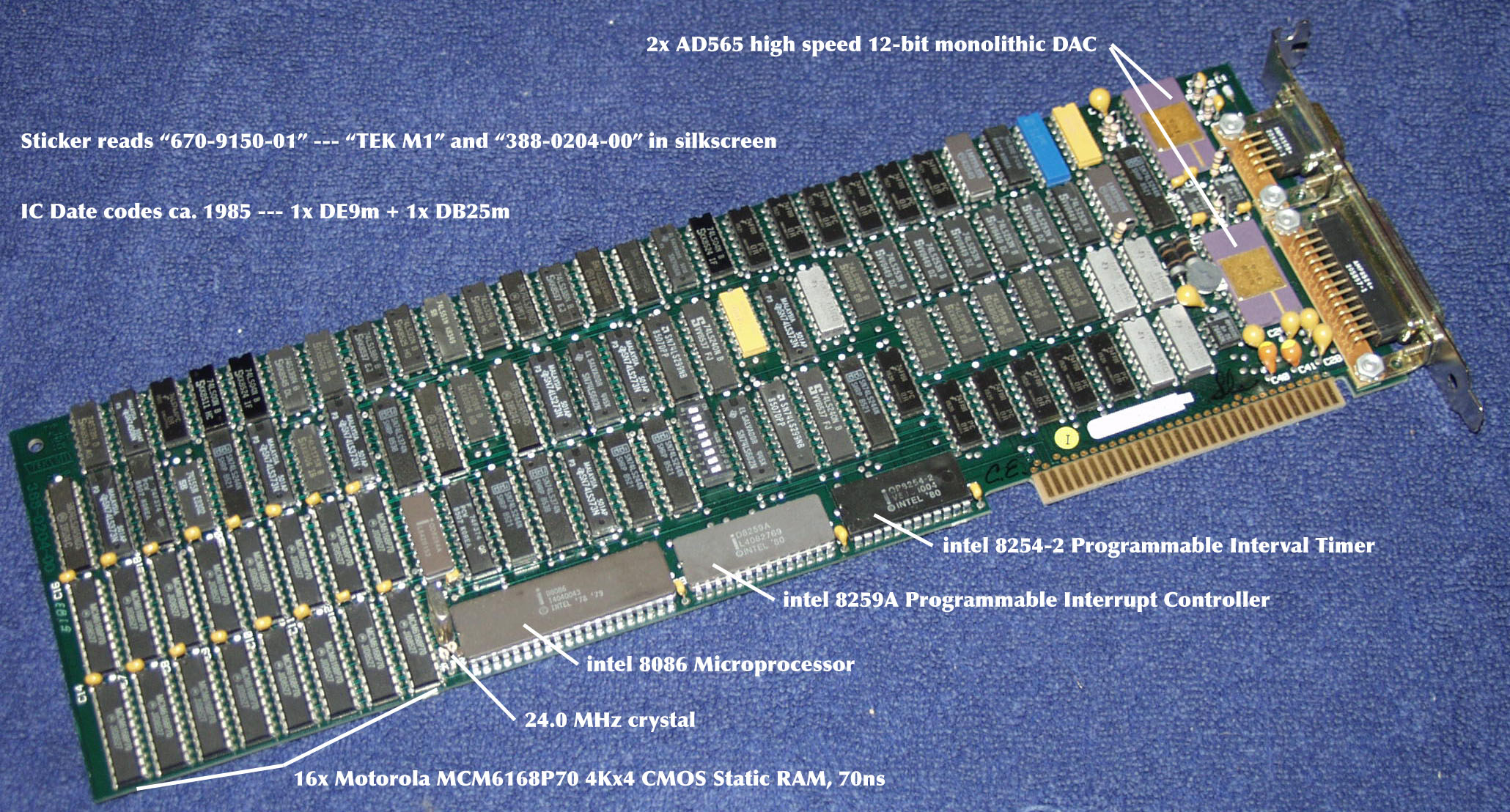
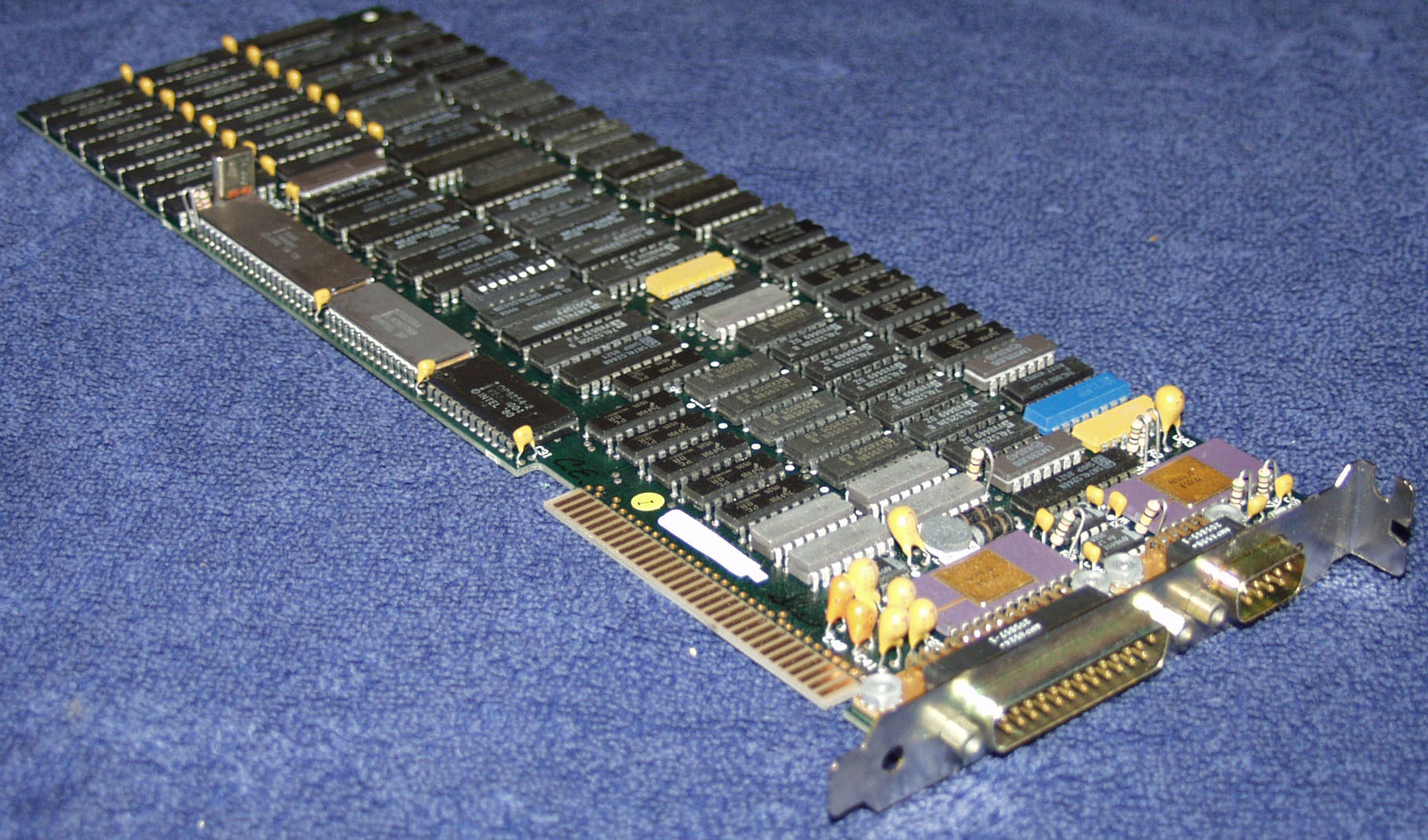
Howdy, guys.
I've got an 8-bit ISA card here that I pulled out of an IBM PC/AT
5170 machine (which apparently was a VM/PC development machine at one
point, and contains program code for the PC3277/GA).
I wondered if anybody could help me identify what it might be. Parts
have date codes in 1985; chips of note are 32k in 70ns 4Kx4 SRAM;
intel 8086, 8259, and 8254; and a pair of 12-bit monolithic DACs. I/O
is by one DE9m and one DB25m.
Pictures here:
http://www.typewritten.org/~bear/junk/unknown-card-annot.jpghttp://www.typewritten.org/~bear/junk/unknown-card-obl.jpg
Ideas?
ok
bear
I came across a good looking 551 and not so good looking 555 and some carts
and plug ins. I have no interest in them. If anyone has any interest,
contact me off list and I'll submit offers for you. The current owner does
not ship, but I can try to.
Paul Anderson