Since I had a Kenbak I decided I wanted an assembler for it. It gets
pretty annoying writing code by hand... I spent a while researching and
found it would be a pretty big deal to write one from scratch. I found
"AS" and have written a target code file for the KENBAK. It is still in
beta, however so far it works perfectly. The only thing left to do is WARN
people when they do something stupid.
I designed the mnemonic set for maximum flexibility and readability. As
you can see my include file has the parameters in long hand. ; ) Its a
goal of mine to get these into schools. I think this assembly language
would be pretty easy for someone who has studied basic or C.
What do you think? Here is sample output from the assembler building a
program from the Kenbak Laboratory Exercises manual. Its the first one in
the book. (I threw in NOOP and HALT at the end for fun) I converted the
octal listing into opcodes, and then reassembled it. I get the same
results. ; ) I've e-mailed the author about including the Kenbak code
generator in the distribution and asked if he could add a command line
option for using octal in the program listing instead of HEX. ; ) If he
won't, I WILL!
Let me know what you guys think... Anyone here have a Kenbak? If not, and
you want one...I've got a few spots left. : ) http://www.kenbakkit.com
Before I include the program listing, here are all of the possible
instructions. This 132 IC TTL computer is purely amazing...
[ADD/SUB/LOAD/STORE] [Addressing Mode], [Register], [Address]
[OR/AND/LNEG] [Addressing Mode], [Register]
[JPD/JPI/JMD/JMI] [Register], [Condition], [Address]
SET [0/1], [Position], [Address]
SKIP [0/1], [Position], [Address]
BSHIFT [Direction], [Places], [Register]
ROTATE [Direction], [Places], [Register]
NOOP (no parameters)
HALT (no parameters)
macro assembler 1.42 Beta [Bld 55]
(i386-unknown-win32)
(C) 1992,2007 Alfred Arnold
68RS08-Generator (C) 2006 Andreas Bolsch
Mitsubishi M16C-Generator also (C) 1999 RMS
XILINX KCPSM(Picoblaze)-Generator (C) 2003 Andreas Wassatsch
TMS320C2x-Generator (C) 1994/96 Thomas Sailer
TMS320C5x-Generator (C) 1995/96 Thomas Sailer
KENBAK-1 TTL Computer Assembler (C) 2007 Grant Stockly
WARNING: KENBAK code generator still in beta
AS V1.42 Beta [Bld 55] - source file ./a/ken.asm - page 1 - 8/29/2007 0:00:48
assembling ./a/ken.asm
PASS 1
1/ 0 : page 0
2/ 0 : cpu KENBAK
3/ 0 : include kenbak.inc
22/ 0 : listing on
23/ 0 :
4/ 0 :
5/ 4 : ORG 004o ;First non-special address
6/ 4 :
7/ 4 : Loop:
8/ 4 : 03 01 ADD Constant, RegisterA, 1
9/ 6 : 1C 80 STORE Memory, RegisterA, Lamps
10/ 8 : E4 04 JPD Unconditional, Zero, Loop
11/ A :
12/ A : 00 HALT
13/ B : 80 NOOP
AS V1.42 Beta [Bld 55] - source file ./a/ken.asm - page 2 - 8/29/2007 0:00:48
symbol table (* = unused):
------------------------
*ARCHITECTURE : i386-unknown-win32 - | *BIGENDIAN : 0 - |
*BRANCHEXT : 0 - | *CASESENSITIVE : 0 - |
CONSTANT : 3 - | *CONSTPI
: 3.141592653589793 - |
*DATE : 8/29/2007 - | *FALSE : 0 - |
*FULLPMMU : 1 - | *HAS64 : 1 - |
*HASDSP : 0 - | *HASFPU : 0 - |
*HASPMMU : 0 - | *INDEXED : 6 - |
*INDIND : 7 - | *INDIRECT : 5 - |
*INEXTMODE : 0 - | *INLWORDMODE : 0 - |
*INMAXMODE : 0 - | *INSRCMODE : 0 - |
*INSUPMODE : 0 - | LAMPS : 80 - |
*LISTON : 1 - | LOOP : 4 C |
*MACEXP : 1 - | MEMORY : 4 - |
*MOMCPU : EBA - | *MOMCPUNAME : KENBAK - |
*NEGATIVE : 5 - | *NESTMAX : 100 - |
*NON_ZERO : 3 - | *PACKING : 0 - |
*PADDING : 1 - | *POSITIVE : 6 - |
*POSITIVE_NON_ZERO : 7 - | REGISTERA : 0 - |
*REGISTERB : 1 - | *REGISTERX : 2 - |
*RELAXED : 0 - | *TIME : 0:00:48 - |
*TRUE : 1 - | UNCONDITIONAL : 3 - |
*VERSION : 142F - | ZERO : 4 - |
44 symbols
37 unused symbols
AS V1.42 Beta [Bld 55] - source file ./a/ken.asm - page 3 - 8/29/2007 0:00:48
codepages:
----------
STANDARD (0 changed characters)
0.01 seconds assembly time
36 lines source file
1 pass
0 errors
0 warnings
>
>Subject: Re: INS4004D in Pro-Log M900 PROM Programmer
> From: "Ethan Dicks" <ethan.dicks at gmail.com>
> Date: Tue, 28 Aug 2007 14:16:18 -0500
> To: "General Discussion: On-Topic and Off-Topic Posts" <cctalk at classiccmp.org>
>
>On 8/27/07, dwight elvey <dkelvey at hotmail.com> wrote:
>> From what I've seen in the spec sheets, one would just use
>> a slightly modified 2716 socket of any machine. A few lines
>> of code should be enough. No special voltages, just special
>> sequences. All easily handled in software.
>
>My recollection is that the 2716 needs something like 21V or 26V on
>the programming pin. As for a modified socket, I have an old "Z-80
>Starter Kit" SBC that happens to have a built-in EPROM programmer on
>one of the three ROM sockets. There's a toggle switch to disconnect
>the programming voltage, but once enabled, you simply write to the
>address range of that EPROM socket, and after the data are presented
>to the ROM, the circuit wiggles the programming pin to write the
>EPROM.
It also requires the "write pulse" to be 50milliseconds long. Write
is accomplished by supplying VPP (12, 21 or 26V version dependent)
then playing the OE/ and CE/ pins.
Allison
>
>It would not be difficult, in principle, to add this feature to, say,
>one of the empty ROM sockets on a PET, especially if you had an
>external benchtop power supply injecting the programming voltage
>(rather than generating it inside the PET housing).
>
>-ethan
It seems that these Onyx 2 rack systems are pretty available. If I
wanted to max out the system configuration, what's the theoretical
max? I didn't even know they could gang 4 racks like the one I have.
As I understand it, they subdivide a rack into "bricks" and then
components (disk drives, graphics cards, etc.) plug into the brick.
I believe the bricks are identified by a single letter code. Does
anyone know of a reference for this sort of SGI stuff? I know SGI has
manuals online, but it helps to know the specific manual to use as a
starting point.
The racks have an integrated power supply, so maybe they identify the
amount of equipment per rack based on power consumption?
--
"The Direct3D Graphics Pipeline" -- DirectX 9 draft available for download
<http://www.xmission.com/~legalize/book/download/index.html>
Legalize Adulthood! <http://blogs.xmission.com/legalize/>
Hi,
The 2716 requires the following signals/voltage for programming:-
Read Operation
/EP (Pin 18) => Logic 0
/G (Pin 20) => Logic 0
Vpp (Pin 23) => +5V DC
Program Operation
/EP (Pin 18) => Logic 0 to Logic 1 50mS (approx) pulse, per location to be
programmed
/G (Pin 20) => Logic 1
Vpp (Pin 23) => +25V DC
Verify Operation
/EP (Pin 18) => Logic 0
/G (Pin 20) => Logic 0
Vpp (Pin 23) => +25V DC or +5V DC
To program one, the sequence is...
1 - Raise Vpp to +25V DC
2 - /EP at Logic 0
3 - Raise /G to Logic 1
4 - Supply Address information
5 - Supply data information
6 - Provide a Logic 0 to Logic 1 45-55mS pulse on /EP
7 - Drop /G to Logic 0
8 - Read data to verify the contents
9 - Get next address location, and go back to step 3
Do this for the required locations you want to program/verfiy. When finished
burning/verifying the 2716, you can drop Vpp back to +5V DC for normal read
operations.
Seeyuzz
River
Hi,
I got two M900 programmers. One works, but the other one doesn't. I only
have the 2716 module for them, which is good, but I do not know where you
can get other personality modules for them.
I use a Microprofessor that has the EPROM Burner expansion for burning my
EPROMS. However, I am currently designing my own EPROM burner so I can do
2708 and 8755A chips.
I was going to make it all fancy-pants where it would do all the right
programming voltages and address translations (for different address pin
locations on different chips) etc, but I think it would be easier to make my
own "personality modules" which will ease the hardware design.
The chips I need/want to program are 2704, 2708, 2516, 2716, 2732, 2732A,
2532, 2564, 2764, 27128, 27256, 2816 and 8755A. I have checked out the
capabilities and prices of current EPROM burners, but they are far too
expensive for what I want, do much more than I need, and they usually do not
do the 2704/8 or 8755A without an expensive personality module.
So, in light of my enjoyment in building old computers, I'm building a
complete system just for the fun of it and to burn EPROMs for me. As the
2708 uses a few voltages, I decided to use a CPU that also requires a few
voltages - the 8080 chip. So, it will be an 8080 system, running 40K of RAM,
8-16K of ROM, a pair of 8255 for EPROM signals (plus extra logic etc as
required), an 8251 for comms, and I may even hook up an LCD so I can use it
without requiring a terminal.
Of course, I could get side-tracked and just use my expanded AIM65 system -
as it has all the monitor/debug software, enough IO ports and the built in
display...... ;)
I could always mod some of my older boards that use 2708 chips to use 2716
chips, but I like the historical accuracy of 2708 devices - and I've got
quite a few in stock.
Seeyuzz
River
>While I cannot help you with the catweasel northstar project, I do know
>that at least the linux cwtool toolkit is missing a number of disk
>definitions which are very useful and common.
>It does NOT normally support:
>SSDD 5.25 8 sectors/track 160k
>SSDD 5.25 9 sectors/track 180k
>DSDD 5.25 8 sectors/track 320k
>SSHD 3.5 18 sectors/track 720k <- very unusual format
>SSHD 5.25 15 sectors/track 600k
[snip]
Thanks Jonathan,
Those definitions you mentioned are all soft sector MFM encoded formats, I
believe. I suspect cw2dmk will already decode those since they have the
necessary sync marks, etc. Have you tried cw2dmk? It can extract dmk
images from any FM, MFM, or RX02 encoded soft sector disk.
It is good thing you are doing to add capability to the Linux cw driver for
more formats. Thanks for doing that. The more Catweasel support of any
kind, the better it is for everyone.
Unfortunately, writing software for the Catweasel to make images of
NorthStar hard sector format is an entirely different creature altogether.
The NorthStar controller has its own unique sync sequence which makes the
disks incapable of being read by NEC 765 or derivative FDCs. As a result,
it requires entirely custom software to decode. Thank you to those
individuals who have been of invaluable help to me in getting this far with
the project (you know who you are!).
Here is a bit of technical background on the problem from the NorthStar
floppy disk controller. The NorthStar double density sync sequence is 32
$00's followed by $FB, another $FB, 512 bytes of data, and then a one byte
checksum. The single density sync is similar. The NorthStar timing
sequences is based on the ten sector holes and one index hole. I found the
index hole because it is between two sector holes. The sequence is
something like this:
Gap 1 24 mS
Gap 2 24 mS
Gap 3 12 mS <- index hole passed by
Gap 4 12 mS <- start of sector 0
Gap 5 24 mS
.
.
.
Gap 11 24 mS
My prototype code is currently two parts: the first is a modified utility to
make a raw image, and the second is another utility which extracts the data
>from the bit sequence. I can make images with my code but it is only in the
"proof of concept" stage. It is way too crude for a general release and
that is why I am asking for some volunteers to help (re)write it and test it
to bring the code up to some reasonable level of decency before any release.
Here is a sample dump from the imaging tool of a disk. It is the NorthStar
DOS 5.0 Double Density boot disk. It is the one which comes with the Dave
Dunfield NorthStar Horizon simulator and tool set. I created an actual boot
floppy on my Horizon and used my Catweasel station to create the image.
http://www.geocities.com/lynchaj/out3.zip
>OP: Sending the original request message 3 times was unnecessary.
I entirely agree and I apologize for sending multiple posts. Believe me, it
was not my plan for three postings. I first posted Thursday last week but
my messages did not show up in the archive until today for some unknown
reason. I read the list by reading the archive of messages and I thought my
messages were going into the bit bucket. I suspect the cctech mailing list
was having some sort of problem. Sorry for the repeats.
Thanks!
Andrew Lynch
Hello, everyone. My name is Joe, I am 17 years old, and live in central NJ.
I would like to figure out how to build a retro-type computer, either from
plans or from a kit. I am currently considering the Micro-KIM, as well as
trying to build a mark-8. Not sure what I want to do. If anyone can help me
along with this, I would be very appreciative.
Thanks
Joe
>
>Subject: Building my own classic style computer update
> From: "Joe Giliberti" <starbase89 at gmail.com>
> Date: Thu, 23 Aug 2007 18:11:28 -0400
> To: cctalk at classiccmp.org
>
>>SNIPPAGE>>>
>of them I don't even know what they are, and some I cannot find online,
>presumably because they are obsolete. Here's a partial list of them:
>NEC D780C
NEC version of Z80, fully compatable.
>NEC D770008AC-6
NEC, may be an 8bit ADC.
>NEC D4364C-15L
8x8k dynamic ram 150ns
>NEC D8251AC
USART, serial same as intel 8251A
>NEC D449C
2kx8 CMOS static ram 450ns and two chip enables
and retains data down to 2V in standby mode.
>AMD AM9511A-1DC
AMD arithmetic procesor
>Sharp LH0081A
>Sharp LH0082
I think these are Opamps or maybe line drivers.
>Intel 8339
>Intel 8325
>Intel K3235001
Intel 83xx is likely a 1983 date code. The Kxxxxxx is a
mask/date code for a rom based part. None of those cross
to any part I can reference and my intel databook set is
complete from 1977 through 1993. Those are likely
"house numbers" if they are not date codes.
Since no other rom parts were listed I'd assume they are
ROMS.
>Zilog Z8442BPS
Z80 SIO, dual serial
>Zilog Z8430BPS
Z80 CTC, timer counter chip
Allison
I am trying to get a Vax-11/750 machine up and running. It looks like the TU58 drive is suffering from the
'gooey roller syndrome'. I see that people have successfully used 1/2 inch (ID) Tygon tubing to replace the
goo. Is there any specific type of Tygon tubing (eg. R3603, R2000, etc.) that is used?
Thanks!
--barrym
While I cannot help you with the catweasel northstar project, I do know
that at least the linux cwtool toolkit is missing a number of disk
definitions which are very useful and common.
It does NOT normally support:
SSDD 5.25 8 sectors/track 160k
SSDD 5.25 9 sectors/track 180k
DSDD 5.25 8 sectors/track 320k
SSHD 3.5 18 sectors/track 720k <- very unusual format
SSHD 5.25 15 sectors/track 600k
I produced some simple definitions for these 5 modes (by hacking the
msdos_dd_5.25 definition, which is DSDD 5.25 9 sectors/track) which will
work for reading but are probably not good enough for correctly writing
the disks owing to timing differences. Please email me if you want them.
It DOES support:
msdos_dd which is DSDD 3.5 9 sectors/track 720k
msdos_hd which is DSHD 3.5 18 sectors/track 1440k
msdos_dd_5.25 which is DSDD 5.25 9 sectors/track 360k
msdos_hd_5.25 which is DSHD 5.25 15 sectors/track 1200k
and a number of extended msdos_hd modes which use extra tracks and other
tricks to achieve the following sizes:
1476k (82 tracks)
1494k (83 tracks)
1600k (20 sectors/track)
1680k (21 sectors/track) <- DMF format used by Microsoft for Win95
disks, among others
1722k (82 tracks, 21 sectors/track)
1743k (83 tracks, 21 sectors/track)
1760k (11 sectors/track, 1024 byte sectors)
1802k (82 tracks, 11-19 variable sectors/track, 1024 byte sectors)
a couple variations of those are missing too: (82/83 20 sectors/track;
82/83 11 sectors/track 1024 byte sectors; 80/83 11-19 variable
sectors/track 1024 byte sectors).
It does not support the 1880k 2m or 1992k fdutils formats.
It also supports a number of commodore, amiga, atari, and apple/mac
modes, though probably not all of the possibilities.
It also does not support the Sirius 1/Victor 9000 9-speed/rate-zone GCR
5.25 format, which probably will require adding an entirely new GCR mode
to the source code. Both single and double sided versions of this exist.
I can only test the single sided versions because head 1 is inoperable
(blown/open? needs further testing, doesn't seem to either read or
write) on my Victor 9000. I have not even attempted to write a
definition or GCR code for this yet, and could use any assistance available.
My goal is to get ALL of this stuff supported by the cwtool catweasel
driver eventually.
OP: Sending the original request message 3 times was unnecessary.
--
Jonathan Gevaryahu
jgevaryahu(@t)hotmail(d0t)com
jzg22(@t)drexel(d0t)edu
Seen on craigslist: Vintage 1970s Commodore PET working - $25.
Located in Ann Arbor, Michigan USA (near Detroit).
http://annarbor.craigslist.org/sys/406092686.html
I can help with pickup and shipping if anyone here wants it.
Greetings!
I have a collection of older AS/400 parts, including what should be a complete
system (I believe its a 9406-200?), plus several twinax printers and some terminals (including one or two color ones), plus some twisted-pair token ring networking bits and some older telecom gear.
I'm going to try to sell this stuff, but the larger parts (the AS/400 is in two racks, a "9331 Disk Unit" and a "9406 General Purpose" rack both of which are about 6' tall), plus the 6262-T12 printer are so large and bulky that I'd prefer to not have to put them on a pallet to ship them anywhere. I've thought about parting them out instead or just hauling the lot off to the local electronic recycling company, or finding out if there's anyone on this list that could pick them up.
I have two other IBM racks of the same basic type as the AS/400's that have been stripped of the power strips and interior foam; these have a little spot rust on the outside but if someone needs one or both of them they'd be available. They're deeper than most rail systems I've seen can accommodate so using them for rackmounts requires extensions to be made or purchased for the rails. I also don't think they have their doors anymore.
So - is there be anyone more or less local to me that would be interested in the large bits?
Is anyone on the list needing baluns or twinax cables? I've got lots of those and if you need some I would be willing to ship them prepaid for a small fee to cover my gas to get them out.
I have the "MULIC" tape for it around here somewhere but I parted with
all of the other tapes some time ago - mostly to Red "Bear" Stricklin
on this list. It does have two EMC raid arrays which I presume work.
Caveat: I'm an AS/400 ignoramus. I can provide descriptions and pictures of things but what some of this does is beyond me. It all should work, to my knowledge it was working when I purchased it, but I do know that the AS/400 was connected to a more modern smallish AS/400 and part of the system I have was no longer in use.
Contact me off-list if you're interested for a list. I hope to have a website up sometime soon with a list of the parts I've got.
-- Frank
-------------------------
-------------------------------------------------------------------------
C. Frank Helvey email: cfhelvey at yahoo dot com
President home phone: 540.947.2526
Montvale Software Services PC work phone: 540.947.5364
Blue Ridge, VA 24064 cell phone: 540.529.3740
Classic Comps Email: oldcomps at verizon dot net
I would need access to a floppy based, UCSD-Pascal capable, Apple-II
for a couple of months .
This is to assist in trying to get diskimages from my ETH Lilith.
Anyone in the Zurich, Switzerland area that could help out ?
Current Lilith status :
Microcode proms saved,
Schematics ca. 70% ready,
disk access still very temperamental,
the Kermit that is present on one of the disks is missing some libraries...
The middle mouse button seems to be broken, and is required for editing
files....
But the Pacman implementation is great !
Jos Dreesen
I've got an LA50-RB printer I'd like to get to work. After powering on
the "Power" light goes on, then, after about two seconds, "Fault" light
starts flashing. Printer produces no audible sounds, nothing moves.
Any idea where to start?
--
If you cut off my head, what would I say? Me and my head, or me and my body?
> Date: Mon, 27 Aug 2007 14:43:53 -0600> > Glen Slick wrote:> > If you just need to program 2716's you could pick up a BP Microsystems> > EP-1 for less than $20 off of eBay.> And what if you don't use ebay?> Anyhow the point is fix it -- not toss it out.> All I want programed is 28C16's EEPROMS and I can't find a> low cost burner for that around.> IF COST .LE. $100 THEN CALL SPEND_IT(INCOME)> Ben alias Woodelf>
Hi
From what I've seen in the spec sheets, one would just use
a slightly modified 2716 socket of any machine. A few lines
of code should be enough. No special voltages, just special
sequences. All easily handled in software.
Dwight
_________________________________________________________________
Recharge--play some free games. Win cool prizes too!
http://club.live.com/home.aspx?icid=CLUB_wlmailtextlink
> Date: Mon, 27 Aug 2007 16:53:00 -0600
> From: woodelf <bfranchuk at jetnet.ab.ca>
> That is what is frustrating at the moment, the few designs I have seen
> on the web is about 3 chips and a zip socket.But alias the only low
> cost
> one I have seen is from the UK, and the VAT and shipping will kill me.
Shipping is indeed a problem, but you are outside the European Union,
you should not be charged VAT.
> Date: Fri, 24 Aug 2007 21:10:17 +0100
> From: "Rod Smallwood" <RodSmallwood at mail.ediconsulting.co.uk>
> Subject: RE: DEC switch handles
>
> Just a thought ..
> Wouldn't the model making fraternity have this kind of problem all
the time.?
> There must be a way to make a mould using an existing part as the
template.
>
> Rod
Ask the right question, and the neurons awake from lurking and
respond....
Yes, the keyword you want is "resin casting".
Google "DIY resin casting" got me a bunch of good hits.
Typically small parts molds (either a actual or built prototype) can
be made using RTV rubber
and cast using an urethane resin. Search using some of those terms
and you should
be able to find some good instructions.
Here is a commercial kit, the seller is not the lowest cost around,
but reliable.
http://www.micro-mark.com/ Look at product # 82698
There is a reprint article from Model Railroader on fabricating a
duplicate of an old out-of-manufacture Lionel bridge grider. http:
//www.micromark.com/html_pages/instructions/82708mrrresinart.pdf
Dave. (an MIT TMRCie)
Hi,
> Case? What case? Are you sure you're not thinking of a
>Softy-II?
>
> The original Softy is a bare PCB, remarkably similar in
>form-factor to the MK14...
Hmm, quite possibly. The one I recall seeing pictures of in Practical
Electronics was the same size as a ZX-80, and in fact appeared to be in a
remarkably similar case (the upper part of the case was rather different).
It also used a standard UHF TV set as its display.
Oddly, Google doesn't turn up anything at all regarding the Softy or
Softy-II (well, other than a link to a PCW archive site which mentions
reviews of the two units from 1980 and 1982, but doesn't actually have the
reviews available....).
Even the "DataMan" site only goes back as far as the S3! :-(
TTFN - Pete.
(I'm sending this to five lists, the five lists that I think most
likely to have an interest in such a thing - ie, the ones most likely
to be using machines built during the era when SCSI laptop disks were
popular enough to be used. Since followup discussion on some lists is
likely to go in directions not appropriate for other lists, I've set a
Reply-To: address which is a bitbucket; please fix it if/when you
reply, to send to just the list appropriate for your reply.)
I have a SPARCstation Voyager, which unfortunately has a fairly small
disk (773 MB). But this machine uses SCSI disks and has space for only
a laptop-form-factor drive (well, unless you want to go external, which
is rather suboptimal). I understand there are other machines in the
same boat, such as some Mac laptops (I don't know whether they're
PowerPC or 68k - or perhaps some of each - which is why I'm sending to
both the macppc and mac68k NetBSD lists.)
I did some searching and found there was a company that made an adapter
that fit next to a modern (thin) laptop drive, so the result was a
somewhat thickish "disk" that still fit within the old laptop form
factor - but which spoke SCSI to the host even though the disk was IDE.
Most of them were fairly expensive, but there was one that looked
reasonable. The vendor that was said to carry it, though, no longer
does (I phoned them and asked), so I wrote to the manufacturer.
They offer to sell them to me at US$65 apiece, quantity 10. I'm
willing to pay that rate, but I have no need for more than maybe two.
So I'm wondering if people would be interested in buying these off me
(at my cost, which probably means about USD 70 including shipping, at
least within US48+CA).
The device in question is the Century CHB25INT, as described in
http://online.century.co.jp/BittradeTest/e_shop/chb25int.html.
/~\ The ASCII der Mouse
\ / Ribbon Campaign
X Against HTML mouse at rodents.montreal.qc.ca
/ \ Email! 7D C8 61 52 5D E7 2D 39 4E F1 31 3E E8 B3 27 4B
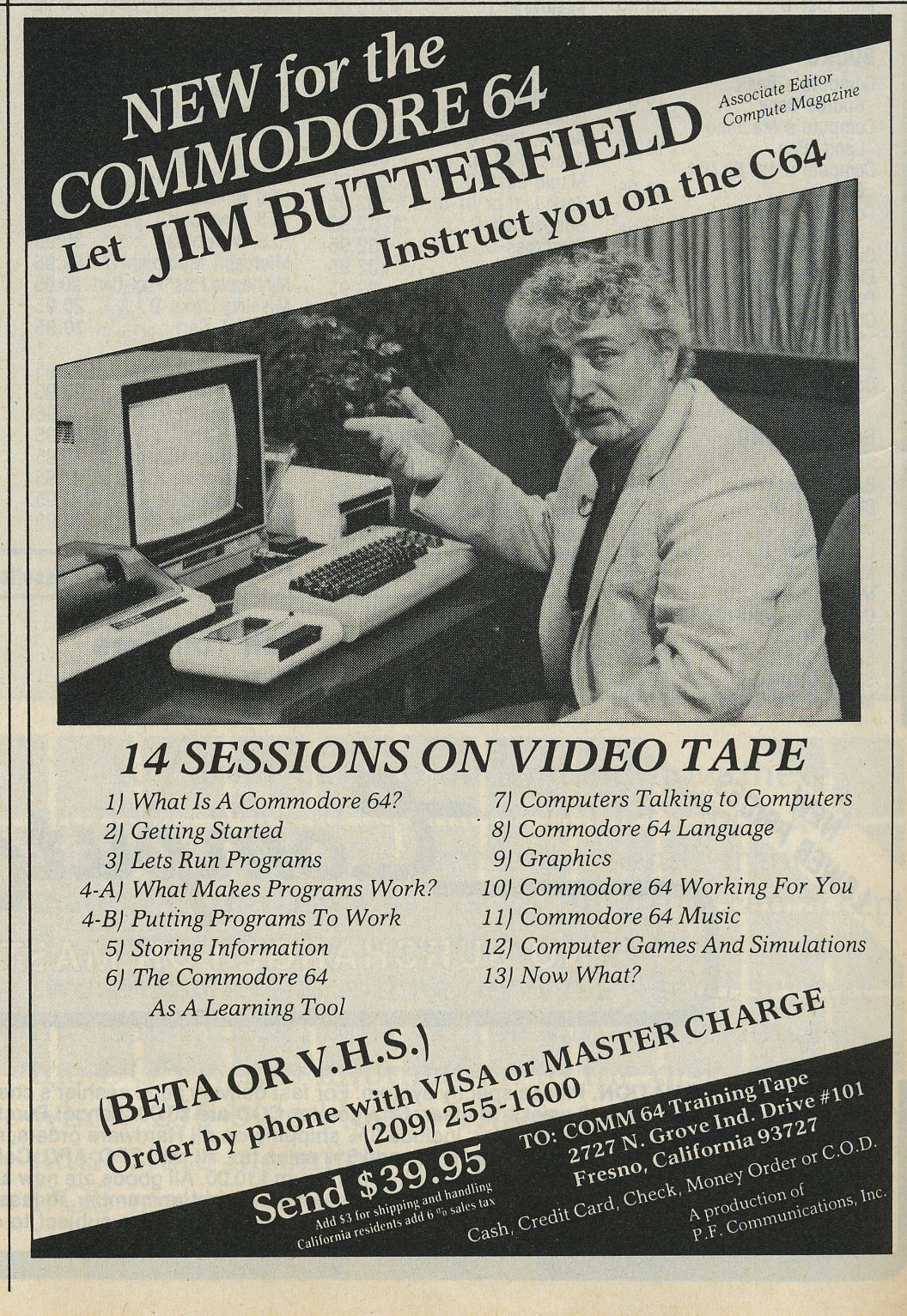
The CBM aficionados on this list no doubt all know the name Jim
Butterfield and that he passed away in June; here's another little
tidbit to add to his bio.
Also see:
http://en.wikipedia.org/wiki/Jim_Butterfield
m
----- Original Message -----
From: <sbolton at gmail.com>
Newsgroups: comp.sys.cbm
Sent: Tuesday, August 28, 2007 10:49 AM
Subject: Jim Butterfield Memorial Tribute in Globe and Mail
There is a tribute to Jim Butterfield in today's (August 28, 2007)
Globe and Mail. Although this link won't remain active long, you can
see it online here as well:
http://www.theglobeandmail.com/liveslived
For those that can't get the tribute, I have reposted the text here.
For those that keep asking, the official memorial HAS NOT BEEN
ANNOUNCED yet but it will happen and I will let you know when it does.
================
August 28, 2007 (Globe and Mail)
FRANK JAMES (JIM) BUTTERFIELD
Husband, father, pioneer of personal computing. Born Feb. 14,1936, in
Ponoka, Alta. Died June 29 of lymphoma in Toronto, aged 71.
by DIANE MCKELVEY
Jim Butterfield was the third of four children born to James and Nancy
Butterfield; they were originally from England, but moved to Alberta
to try farming there.
Jim attended the University of Alberta and the University of British
Columbia, but he soon realized he was more
interested in the Radio Society than in the curriculum. He never
finished his degree.
In 1957, Jim accepted a job in Whitehorse training technicians who
maintained the new microwave system built along the Alaska Highway.
>From the first, he demonstrated a gift for teaching.
Jim was transferred to Toronto in 1962. Soon he had moved out of the
world of microwaves and transistors and, in 1963, began work on the
very large computers that were just coming into use. Jim had also
begun a second career as a writer and educator on computers. He was
intrigued with the microcomputers
that started to arrive in 1976 and was soon publishing programs for
games and utilities for a number of models. He became a regular
contributor to computer magazines and published several successful
books
He left his day job in 1981: rumour has it he was fired after telling
his boss that personal computers would one day wipe out the private
wire teleprinter business. Before leaving, however, he made one
important connection - his wife, Vicki.
Jim's first interest was in Vicki's typewriter: It was top of the line
and could type the symbols used for electrical
terms such as the ohm. When Vicki asked what the heck that thing was
anyhow, Jim came back with a hand-drawn picture of an ohm sitting on
top of a stove, which he said was "an ohm on the range." How could she
resist?
Jim's life took a significant turn in 1988, when his daughter Susannah
was born. Embracing fatherhood at age 52, he immensely enjoyed sharing
his love of books, restaurants and travel with his young daughter.
Never stodgy, Jim enjoyed many a beer with friends at the Toronto
Naval Club. He had a sense of humour - one neighbour remembers a
telephone conversation in which both Jim and she remarked on how the
meow of a Siamese cat had a similar sound to a bagpipe. During the
course of the conversation, this eventually led to each holding their
Siamese cat under their arms like a proper bagpipe and gently
squeezing to produce the requisite wailed duet.
Jim was a dreamer and an entertainer, and nothing made him happier
than to share his knowledge and enthusiasm with an audience - whether
it was a group of machine language programmers or a curious child.
(Diane McKelvey is Jim's niece.)
>
>Subject: Re: Building my own classic style computer update
> From: "Chuck Guzis" <cclist at sydex.com>
> Date: Thu, 23 Aug 2007 19:21:52 -0700
> To: "General Discussion: On-Topic and Off-Topic Posts" <cctalk at classiccmp.org>
>
>On 23 Aug 2007 at 17:20, Mr Ian Primus wrote:
>
>
>> > Zilog Z8442BPS
>> Serial I/O controller
>>
>> > Zilog Z8430BPS
>> Counter timer circuit
>
>It's been a long time--but didn't the "vintage" chips have legends
>such as "Z80-SIO" and "Z80-CTC" as well as "Z80-CPU"? I liked that
>convention--didn't leave much to the "I wonder what the heck this
>chip does" mindset.
Varied from time to time. Early on that was the case, as ZILOG moved
into a greater variety of parts and then CMOS they needed to have part
numbers that wer more unique so the Z80-SIO became 844x (X=1,2,3,4 for
bond options) and later 84C4x for the cmos versions.
Allison
Brent Hilpert sayeth:
> I've had a few problems with mine, mostly failing semiconductors, all of
> which have been unusual and difficult to replace/substitute, although I
> was quite pleased when I found the 4004 inside.
I'll say. It's basically a 4004 microcomputer system in there, so it's no
surprise the support chips have been hard to track down.
> I presume you have the manual, which has the schematic and a listing of
> the base code firmware.
Yes.
> I suppose it's conceivable the 1702 firmware EPROMS are losing their
> contents.
I didn't consider that possibility and don't want to :) But it might be
correct. These are pretty old by now.
> I have taken dumps of the contents of the ones in mine, if of interest.
I have another I can try out. But yes, I would probably want to re-burn
the EPROMS if they have rotted out.
> (Is this a new toy or something you know was working? Also, out of
> interest, which personality module do you have plugged in?)
A new toy, but I assumed it worked. I hope the other one is good at
least.
This one has the 2716 plug-in, which is perfect because that just happens
to be what I need it for currently. When I pull the other one I'll let
you know what module it has. I believe I have also an 800 model,
something like that, but a third unit for sure.
> If you haven't used the unit before, you do have to press one of the
> LIST/DUP/VER/COPY keys initially to get anything to display on the hex
> LEDs (initially blank on power-up), although I expect you've banged on
> all the keys already.
Oh yes, they got thoroughly exercised.
> IIRC, some of the communication adapters if plugged in (serial¶llel
> D plugs) may cause the unit to appear hung.
Interesting. But nothing is plugged into those. Interestingly, the
serial interface is current loop, for interfacing to a TTY. That feature
really dates these things :)
> If all the power supplies levels are OK I suppose the next thing would
> be to 'scope for multiplex/keyboard scan activity to see if the
> processor/firmware is functioning.
Or just try the other and hope it works. I unfortunately don't have time
for troubleshooting :(
--
Sellam Ismail Vintage Computer Festival
------------------------------------------------------------------------------
International Man of Intrigue and Danger http://www.vintage.org
[ Old computing resources for business || Buy/Sell/Trade Vintage Computers ]
[ and academia at www.VintageTech.com || at http://marketplace.vintage.org ]