>
>Subject: Re: FPUs for small computers (Was: What to download for a PDP-8)
> From: "Chuck Guzis" <cclist at sydex.com>
> Date: Wed, 17 Oct 2007 10:21:40 -0700
> To: "General Discussion: On-Topic and Off-Topic Posts" <cctalk at classiccmp.org>
>
>On 17 Oct 2007 at 12:09, Jim Battle wrote:
>
>> Finally, I recall seeing an article where somebody took a pocket
>> calculator chip and essentially poked simulated keystrokes at it and
>> then decoded the LED driver output to determine the answer. It was very
>> slow, though, so all it saved was the space of the floating point
>> library code.
>
>I remember that one. It may have been an early issue of Byte. I
>also wondered at the time if any speed was gained over just running
>plain old x80 code.
If it's the article as I remember it it was a push for Add/subtract
but better for multiply and divide (to 8 digits). An 8080 does a
16x16 multiply in a few milliseconds to compare.
In another Byte there was a simple design and explanation of
hardware multiply by shift and add. That was capable of high speed.
With TTL of the time that was something under 10 microseconds
for 16 bits using a 2mhz clock. At that point a 4mhz Z80 takes
nearly that much time to load and read it. You can do subtract
and shift to implement a divide.
Allison
>
>Subject: FPUs for small computers (Was: What to download for a PDP-8)
> From: Jim Battle <frustum at pacbell.net>
> Date: Wed, 17 Oct 2007 12:09:44 -0500
> To: General Discussion: On-Topic and Off-Topic Posts <cctalk at classiccmp.org>
>
>woodelf wrote:
>> Jules Richardson wrote:
>>
>>> For a math copro to be called as such, does it have to integrate
>>> itself with the CPU's instruction set - or does some sort of box of
>>> tricks sitting on an I/O port and accessed through normal CPU
>>> instructions count? I'm not sure what the correct definition is.
>>
>> It does tricks, but then with only 8 opcodes defined on the PDP-8
>> what do you expect.
>>
>>> What do you mean by 'smallest computer' by the way? Smallest in terms
>>> of spec? I'm pretty sure some of the 1950's stuff had optional
>>> floating point hardware available, although it wouldn't have been
>>> physically small :)
>
>Northstar (of Northstar Horizon fame) sold an S-100 card that had a TTL
>FPU on it. It was a microcoded affair (256 words of 40 bits) that
>processed a nibble (BCD digit) per clock (4 MHz I believe). You could
>also specify how many digits were in the mantissa (2-14, even # digits
>only). Only the four basic functions, +-*/, were supported.
>
>Northstar had a version of BASIC that could use this FPU. As I recall,
>you had to specify how many digits of precision you wanted in your
>floating point numbers when you ordered BASIC (it wasn't dynamically
>specified in the interpreter).
>
>Others sold S-100 cards that used an AMD FPU chip. This too required
>poking data bytes and a command, then waiting for the result to be
>computed and then pulling out the result bytes. It wasn't somehow
>integrated into the instruction set of the host processor.
>
>Finally, I recall seeing an article where somebody took a pocket
>calculator chip and essentially poked simulated keystrokes at it and
>then decoded the LED driver output to determine the answer. It was very
>slow, though, so all it saved was the space of the floating point
>library code.
Actually The article used a CALC chip that was slow on speed but had
an interface that was BCD output and convenient for input.
A few years back I took a 8742 (8048 with a slave interface)
at 11Mhz and programmed it to do 24bit BCD math (+-/*) and it
was faster than a calc chip. It was done because I could.
Overall it was as fast as z80/4mhz.
Allison
Well, here I am again soliciting advice from you guys. One of these
days I'll be able to answer someone else's question and I'll feel useful :).
Anyway. I picked up an IBM 5120 (i.e. the "really big and heavy" (with
emphasis on "heavy") variant of the 5100/5110) awhile back that has a
few issues and I've just now got enough spare time to take a look at
it. Finally got done cleaning out copious amounts of gooey black tar
that used to be foam 25 years ago...
There are two major issues, the first being the monitor, the second
being a ROS error on startup (which I suspect may be quite difficult to
solve...)
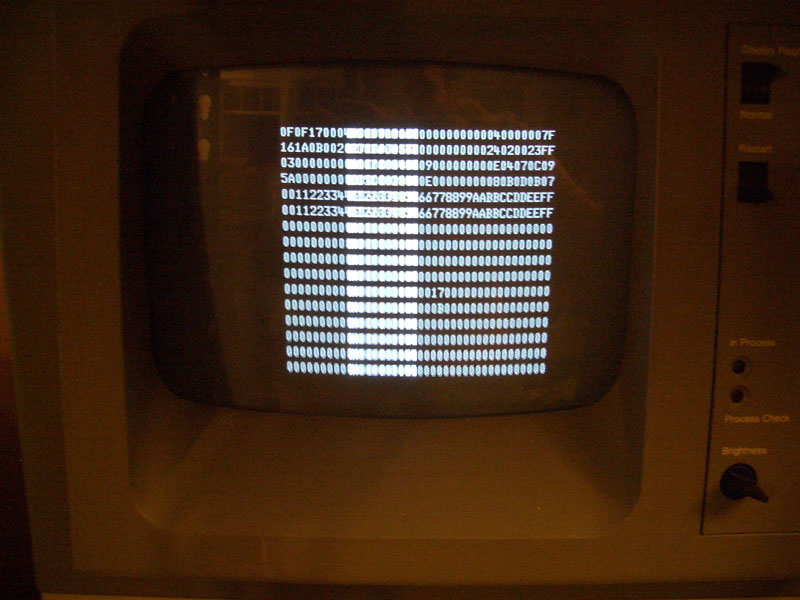
But I'd like to see what I can do about the monitor. The picture
exhibits a strange behavior that I can't say I've seen before. The
horizontal retrace seems to "fold" over itself in the middle (like the
electron gun is doing a "loop" in the center of the screen for each
line). I've taken a (terrible) picture of the fault and put it at:
http://yahozna.dyndns.org/scratch/5120disp.jpg). The picture's also a
bit jumpy. I've tinkered a bit with the various adjustments on the
CRT's PCB but it doesn't make any appreciable difference.
The monitor is labeled as a "Ball TV 90." I've done a bit of
maintenance on old Arcade monitors, mostly of the "cap kit" variety so I
know how to be careful around the HV sections, but I'm not much for
troubleshooting (yet). Any suggestions on where to start?
While I'm at it -- anyone have an archive of software for this thing
anywhere? I haven't found much, I'm looking for floppy images (the 5120
has 2 8" drives).
Thanks again for the advice...
- Josh
>Unlike most mini and microcomputers, the mainframe things tend to get
>slaughtered off about ten years after introduction.
Which is why I feel pity for that system/36.
I talked to the guy and while he never mentioned that he will eventually give up and scrap it
I have a feeling that after a few years with no bites he might re-think scrapping it.
It's currently in a cold storage locker and all that's needed is for someone to contact him and
come with a cube van that you must supply. I think he also tole me that they will even help you load it
all up and wave you goodbye. :)
Okay, how about I cut down to the point:
-I'm 17 and have a wicked case of OCD
-I like old electronics
-I use a 5 1/4" floppy drive on a normal basis
-I like things that have blinkenlites and make cool whirring noises
-I have passed notes written in hex to a friend in class ("what are you doing at lunch?")
Just owning a computer like this would complete my childhood.
Yes, I am a very strange person indeed. :P
_________________________________________________________________
Express yourself with free Messenger emoticons. Get them today!
http://www.freemessengeremoticons.ca/?icid=EMENCA122
As usual, I'll be up at VCF this year with quite a bit of stuff to get rid, er,
sell :). If anyone who will be there is looking for something, let me know and I
can bring it up if I have it ... and it is not too bulky or heavy (unless there
is a committment to buy.) As usual, I'll have quite a few books, some computers,
and some other not easily found items.
I am assuming that there will also be the informal Saturday night dinner at the
usual place (can't remember the name, just how to get there.)
One thing I've been thinking about for some time is a FAQ on cables and
connectors, i.e. something with pictures and what computers, etc. it goes to. As
such, I'll have a variety of cables with me that I'll be talking to others about
to find out what they go to. Examples would be like the Appletalk cables, cables
connecting the Commodore computers to disk drives, etc., video cables, DEC
cables, etc.
The rational is that I frequently find cables and don't know if they are worth
saving or just scraping out, and I think others would benefit as well.
Hello. I'm not sure if this is the correct list to ask about this, but I
accept suggestions about the matter. I have one Sun3/50 and a couple of Sun
3/60. No disks or monitor. I know that they use ECL monitors. In fact I have
the ECL cables, plus one Extron RGB device to (supposed) connect them to
other kind of monitors as VGA and so. Someone has experience about this
matter ? Related resources ?
THanks and Greetings
Sergio
Who's our graphic's system collector on the list? Wasn't there a
Richard or someone? I'm going through an old box of documentation of
mine and I want to send the graphic stuff on to someone who collects/
scans/and post this kind of stuff. It's stuff on graphic chips,
acceleration, etc. Glint, PowerVR and others.
Please write me off the list.
Thanks
Rob
Rob Borsuk
email: rborsuk at colourfull.com
Colourfull Creations
Web: http://www.colourfull.com
If so, Uncle Sam wants you!
Well, not really. I'd be immensely appreciative if someone with one of
these could take a quick gander at a couple of things for me. To get mine
back to functioning order I need to know the following to make certain I
have the right parts. Please note this is specific to an RE2 Onyx - the IR
Onyxes definitely had different Power Boards. The VTX may too, but I'm not
positive - better to be safe than sorry later.
1) The number and types of Power Boards in the upper front card cage.
(512, 505, 303, etc?)
Part numbers would suffice.
2) The part numbers of the Online Switchers (located on the top of the OLS
after it's been slipped out).
And that's it!
Many, many thanks to anyone who takes the time to whip out a screwdriver
and take the front panel off their Onyx to let me know.
JP Hindin
John / all,
Sorry I've been lurkin' on this thread for a bit, though thoroughly amused
that 2 years after I listed the system I can finally say, yes I have a
taker. Or I think I do -- hence I put John's mind at rest by retiring the
listing. If anyone had checked the cctalk archive, you'd see I was whining
on the very subject of this system a couple of weeks back (see
http://www.classiccmp.org/pipermail/cctalk/2007-September/245969.html).
I'm afraid the collective amnesia on this point was kinda amusing me. Rest
assured the system is safe (to the best of my knowledge... I'm 4000 miles
>from it and haven't check on it for a couple of years).
Regards,
Colin Eby
Curse you who mentioned this Mainframe on the list.
My love of big iron couldn't let it go to the dumpster. Check out
the trip for this monster on my family blog at
http://www.borsuk.us
Any ex-Amdahl administrators out there?
Rob
Rob Borsuk
email: rborsuk at colourfull.com
Colourfull Creations
Web: http://www.colourfull.com
I've got a Vector MZ with a ZCB processor and BitStreamer II I/O
board; at present the 4.0 'C' series monitor program uses serial
port A on the BitStreamer for its console, but I want to remove the
BitStreamer and use the serial port on the ZCB instead.
At a fast glance I can't see a jumper setting that would accomplish
that; anybody out there have any experience/ideas by any chance?
TIA,
mike
PublicSurplus.com has an RS6000 server system up for auction
Is this considered a vintage system of any value?
Worth going after?
Auction #217152 - IBM RS/6000 SERVER (TYPE 7017-S7A):
IBM RS/6000 S-SERVER, TYPE 7017-S7A, SN 10-92250. UNIT IS TWO TOWERS,
EACH MEASURING 23"W X 41"D X 62"H. INCLUDES IBM MAGSTAR MP 3570 AND IBM
7133-020.
ss
a newbie to the list
150170304866
____________________________________________________________________________________
Be a better Heartthrob. Get better relationship answers from someone who knows. Yahoo! Answers - Check it out.
http://answers.yahoo.com/dir/?link=list&sid=396545433
>Date: Tue, 16 Oct 2007 14:57:18 -0400
>From: Roger Merchberger <zmerch-cctalk at 30below.com>
>Subject: Re: Taken: AT 286 motherboard with mathco
>Rumor has it that M H Stein may have mentioned these words:
>>You won't convince me that there isn't far more activity in this area today
>>than there was then, in part just because it's so much more affordable and
>>mainstream world-wide; how many people in Russia, China or India were
>>playing with computers in the 70s? Even if only .00001% ever take the
>>cover off their computer, that's still a lot of additional tinkerers.
>When anyone starts out with "You won't convince me..." and you don't have
>_hard numbers_ then it doesn't matter who has what facts...
>... but for that matter, I'd disagree with you anyway... for the simple
>fact that you're looking at *sheer numbers.* I'd look at it as a per-capita
>number: The number of people who dug deep into their computers as a ratio
>of the total number of people who actually had computers (say... 20 years
>ago) IMHO would be higher than today. There might be more projects overall,
>but the number of projects in comparison to the number of people who just
>use their computers as toasters as a ratio is lower.
>But as you're not convinced for anything for any reason, it would be
>pointless for me to tell you about it. ;-)
---------------------
No, you can't *convince* me because I already agreed with your viewpoint ;-).
What are you "disagree"ing with? I think you said exactly the same thing I did,
that it's almost certain that more people are digging into their computers today
than back then just because there are so many more people with computers,
while it *is* probably true that for various reasons fewer people who own or have
access to computers are tinkering with them. Maybe you missed my original
post where I said, "perhaps the *percentage* of computer owners who dug into
the hard/software was higher then, but most of the time you *had to*, whereas
today most of it is done for fun and enjoyment, as well as pride of accomplishment."
(Note the "probably" and "perhaps," since I *don't* have hard numbers ;-) Since
you're picking nits, I'll even amend that to "almost certainly;" happy?
Computers are more reliable and harder to tinker with at the hardware level
today and people have a lot more options how to spend their spare time;
so what? There's still a lot more overall activity and with all the forums and
Web sites like this one it's a lot broader, more fun and not as socially isolated
today, at least as far as I'm concerned; hackers like us were probably (!) more
outside of the mainstream back then, and the chances of someone understanding
what you mean by GHz or MBs are probably (!) better today.
I still don't see why case mods, seeing how far you can push speed with
water-cooling etc., or programming a CPLD instead of burning your fingers on a
hot soldering iron should be excluded; that sounds a little like old-fogey-ism
to me. Times have changed and folks are doing what's relevant and possible today
for mostly the same reasons and satisfaction as then; more often than not that
involves modern approaches to *old* hardware & software because it's almost
impossible to do some of the things we used to, due to the complexity, inaccessibility
and lack of documentation of most of today's hardware.
I think a lower percentage of people having to spend time dealing with flaky and unreliable
hardware, poor/buggy software and tools, incompatible disk formats, etc. is a good
thing; my enjoyment of that sort of thing may well be a symptom of a mental disorder.
Sheesh; like I said, 'nuff said.
m
Sorry to disrupt your photography derailment but...
IT'S GONE!!
I went to check something in the photo and the person has de-listed it.
I don't have his contact info anymore so we will never know what it's fate was. I assume the worst. :(
Wait a sec, they also got rid of my account! Now I'm angry!
_________________________________________________________________
Express yourself with free Messenger emoticons. Get them today!
http://www.freemessengeremoticons.ca/?icid=EMENCA122
250174363572
____________________________________________________________________________________
Take the Internet to Go: Yahoo!Go puts the Internet in your pocket: mail, news, photos & more.
http://mobile.yahoo.com/go?refer=1GNXIC
>
>Subject: Re: VAXen at home
> From: "Ethan Dicks" <ethan.dicks at gmail.com>
> Date: Tue, 16 Oct 2007 17:08:42 -0400
> To: "General Discussion: On-Topic and Off-Topic Posts" <cctalk at classiccmp.org>
>
>On 10/16/07, William Donzelli <wdonzelli at gmail.com> wrote:
>> > I agree that the custom gate arrays make the 11/750 unrepairable
>> > (except for raiding parts), but I still think it's a good compromise
>> > between size and performance, for the VAX-11 line.
>>
>> Has anyone here actually ever come across an 11/750 failure caused by
>> one of the gate arrays? They are remarkably reliable machines.
>
>They are remarkably reliable. I think I've seen one or two gate array
>failures in the 10-15 years that I was around 11/750s on a regular
>basis (and none lately, but that's a sample size of effectively zero).
>
>Even so, that's two out of dozens of problems that were in less
>esoteric arenas (like bad power supplies and such).
Most common problems were power supplies and perpieral related.
Serial lines drivers and recievers were common failures as well
but in the mill we usualy had long lines and occasional ground
faults to deal with.
If the machine is kept reasonably cool it's a rock.
Within DEC 750s were very common and after they were less in vogue
for actual use they serves lat, mop and routing service as they
required near zero attention if any at all.
I have a bigger sample size to look at from being inside DEC.
the gate arrays are as relaible or more so than any other chip
and the likelyhood of failure is highest for chips that talk
off the board this being due to electrical stress (drivers)
and ESD from handling the board. Theother group of possible
failures is in ram arrays as there are so many it's statisiclly
possible to see a part fail.
Allison
>
>> > Neither are _easy_ to find, but I think it's
>> > more likely to find a dusty 11/750 in a corner of a warehouse than an
>> > 11/780.
>>
>> One will find ten /750s for every /780 these days.
>
>I am entirely willing to accept that ratio (and since I have two
>11/750s... that means that somewhere in my pile should be 1/5 of a
>11/780, right ;-)
>
>-ethan
290170979430
____________________________________________________________________________________
Looking for a deal? Find great prices on flights and hotels with Yahoo! FareChase.
http://farechase.yahoo.com/
110179808242
____________________________________________________________________________________
Tonight's top picks. What will you watch tonight? Preview the hottest shows on Yahoo! TV.
http://tv.yahoo.com/
260169460280
____________________________________________________________________________________
Be a better Heartthrob. Get better relationship answers from someone who knows. Yahoo! Answers - Check it out.
http://answers.yahoo.com/dir/?link=list&sid=396545433
230179883509
____________________________________________________________________________________
Take the Internet to Go: Yahoo!Go puts the Internet in your pocket: mail, news, photos & more.
http://mobile.yahoo.com/go?refer=1GNXIC
170157593582
____________________________________________________________________________________
Yahoo! oneSearch: Finally, mobile search
that gives answers, not web links.
http://mobile.yahoo.com/mobileweb/onesearch?refer=1ONXIC
Rumor has it that Alexandre Souza may have mentioned these words:
>>>How cool can the cooling system get?
>>An old friend who worked on SAGE said the operators used to store
>>their lunches inside the machine. Mmmm, toasty...
>
> OT:
>
> Some years ago, I had a serious infeccion...
Ahh.... too much information! ;-)
> Since I was in the parking lot with him, I asked him to open the hood of
> his car. Put the sandwich between the tubes of the exaust manifold and
> asked him to rev up the motor. In 30 seconds the sandwich was "eatable" :o)
http://www.amazon.com/Manifold-Destiny-Guide-Cooking-Engine/dp/0375751408
If you ever wanna go "Emeril" with your engine......
Laterz,
Roger "Merch" Merchberger
--
Roger "Merch" Merchberger -- SysAdmin, Iceberg Computers
zmerch at 30below.com
What do you do when Life gives you lemons,
and you don't *like* lemonade?????????????