I grew up using these things, and have been trying to find one, for nostalgia reasons.
does anyone on the list have one they'd be willing to part with?
Yes, I've tried every other avenue I can think of
PS - sorry if this is "off-topic"
Dan.
_________________________________________________________________
Exercise your brain! Try Flexicon!
http://puzzles.sympatico.msn.ca/chicktionary/index.html?icid=htmlsig
>
>Subject: Re: Hazeltine 1200
> From: Mr Ian Primus <ian_primus at yahoo.com>
> Date: Wed, 05 Dec 2007 11:43:14 -0800 (PST)
> To: "General Discussion: On-Topic and Off-Topic Posts" <cctalk at classiccmp.org>
>
>
>--- Sridhar Ayengar <ploopster at gmail.com> wrote:
>
>>
>> My father just rescued a Hazeltine 1200 from a
>> scrapheap for me. I know
>> nothing about these. Could someone give me some
>> pointers to
>> information? Thanks.
>>
>> Peace... Sridhar
>>
>
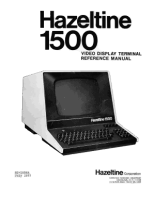
>Nice! I don't know anything about the 1200, but I have
>a 1500 and a 1421. They are both just simple
>terminals, with some fairly basic control functions
>What does it look like? Is the keyboard integral or
>detatched? Does it look like the 1500/1400 series? -
The 14xx and 15xx are late 70s (after 1976) as 1500 used
8080 and the 1400 used 8048 cpus.
>http://vt100.net/manx/covers/14/hi-1056a.png.
>
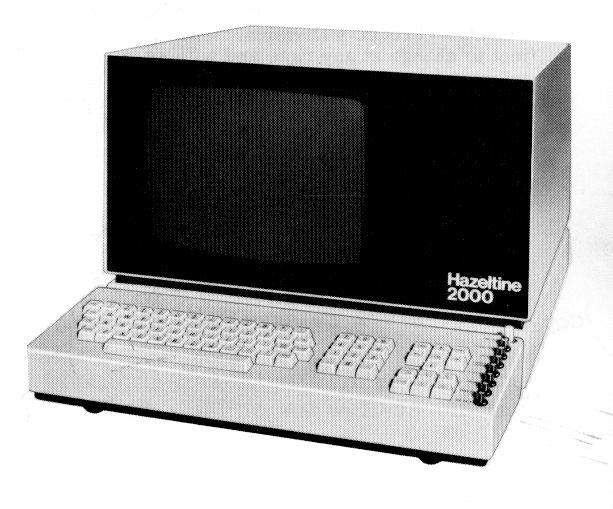
>Now, if it looks like the 2000, you've got a great
>score. Those are some interesting beasts. I've never
>seen one, but they look like this.
>http://www.columbia.edu/acis/history/h2000s.gif
>
>The Hazeltine 2000 was a very early video terminal
>(circa 1972).
The 1200 was a basically glass tty, all uppercase
(may have had a back pannel option for all upper
tty mode or mixed) it was capable of slow baud rates
(I think to 1200 or 4800) and both RS232 or current
loop. I used on on the DEC PDP10 so that means it
was in house there by spring 1972. It was all logic
no cpu used and I belive it used serial PMOS shift
registers for storage.
Allison
>-Ian
My first computer came with a Hazeltine 1000, this was older than the
1200. It had 80 characters wide, but I think it only was 12 lines tall,
I cant remember that part for sure. What I remeber for sure was that it
was upper case only. There was a place of the PCB for a second
character generator rom for lower case which was not loaded. There was
also a switch on the front which enabled lower case for the keyboard.
That was very confusing because sometimes I was typing in lower case,
then when I did a search or search / replace in ed it couldn't find what
I was searching for because it was upper case. I didn't figure that out
until later when I got an intertube terminal to replace the Hazeltine 1000.
Les
Thanks to all that inquired (good grief, we must have a lot of calculator
collectors).
--
------------------------------------ personal: http://www.cameronkaiser.com/ --
Cameron Kaiser * Floodgap Systems * www.floodgap.com * ckaiser at floodgap.com
-- I like work. I could watch people doing work for hours. --------------------
I have received an Amiga 2K with a Toaster board and
Toaster 4 software. I got everything working but find the 4 software
much different from the #2 I have been using. Does anyone know where
I can get a scan of the instructions for the switcher ?
Thanks
Charlie Fox
Charles E. Fox Video Productions
793 Argyle Rd. Windsor, Ontario
519-254-4991 N8Y 3J8
www.chasfoxvideo.com
So the boy (9yr. old) was asking last night about how computers work... any
recommendations for good books for learning the basics from? I think I started
out with a Sinclair Spectrum and its BASIC manual, but I really don't recall
now where I found out about the fundamental building blocks of [typical]
computers and how a CPU worked. There must be a good 'classic' "how computers
work" type of book which avoids going on about PCs and Xboxen...
I figure I should find him one of those kids electronics projects kits too (I
think that was where I got my first exposure to logic gates from at about the
same age) and also some old 8-bit machine to play with.
I can get a Spectrum / BBC micro shipped over in a few months, but something
US-built might be better; any thoughts? I did wonder about a C64, but maybe
it'd be better to start with something a bit more simple? i.e. probably
something Z80 or 6502-based (just because there's more resources devoted to
them), generic cassette data storage, basic video abilities etc.
(You know, I don't recall seeing a 'how to introduce kids to vintage
computing' thread on here before :-)
cheers
Jules
170174269537 is the auction number on Ebay for a Popular Electronics magazine
that has an article on the TRADIC computer. Anyone know what this thing is?
I'm trying to get rid of some stuff I don't collect or want, and among
them is a US*8 that's a little battered and takes a few seconds to "warm
up" when you turn it on, but otherwise seems to work. The badge is missing
but the model number is clearly identified on the backplate.
$9 shipping to Lower 48 if you're interested. There might be some other
stuff, I'm still clearing out boxes.
--
------------------------------------ personal: http://www.cameronkaiser.com/ --
Cameron Kaiser * Floodgap Systems * www.floodgap.com * ckaiser at floodgap.com
-- The best things in life are sold out. --------------------------------------
dear sir
I am interested in getting some parts for the Argus 700GZ computer.
MOhanned
---------------------------------
Never miss a thing. Make Yahoo your homepage.
-------------- Original message from jim s <jwstephens at msm.umr.edu>: --------------
> g-wright at att.net wrote:
> >
> >
> > Well I have a 1000 here and not sure which CPU it has but it is a CPM/ MPM
> > mutliuser system. It has no slots. The serial IO board is on top of the
> Mother board
> > making it hard to find the CPU.
> >
> > I also have a Micro V, Microstar system that uses a 8085 CPU not sure if there
> > related. They certenly have a close name. Just 2 8" floppies.
> >
> > - Jerry
> >
> > Jerry Wright
> > g-wright at att.net
> >
> Micro V and Micro 5 were all the same. They started with an 8086 with 2
> users capability and expanded to a better basic and hardware and the
> 8085 when it came out.
>
> They could have run CPM but they had their own O/S that they sold for
> business purposes.
>
> For what it's worth they were financed by Ken Allen among others, who
> also was a founding backer of Microdata in 1968 or 69. I don't recall
> exactly when they were founded but it was in the 80 to 85 time frame.
> I'll ask some of the culprits at a reunion coming up and try to post
> more accurate info.
>
> There was a special agreement between Microdata and Micro V not to sue
> over the "Micro" in the name, due to the close relation. There was no
> other connection other than the founders that I know of of a business
> nature. Soon after the founding of Micro V, Microdata was acquired by
> McDonnell Douglass and began to change to other identities (MDCSS and
> Novadyne eventually) away from Microdata.
>
> One of the original engineers is John Pitcher, who originally was from
> Microdata. The first President was Cliff Myers. Both were key players
> at Microdata and there is a strong geographic relation to Microdata as
> well as the people being from there.
>
> I believe that John Pitcher has a system he saved which has all the
> software on 3 1/2" floppies, and should probably try to get it to save
> away, since he had most of the software on that format which is much
> easier to handle than the original 8" systems.
>
> Jim
Thanks Jim, for the info. this is the first I have seen so far.
It would be nice to come up with any info or OS for these. I dug out my 1000
and it boots StarDos. I have looked for years for info on either machine and/or
the OS. Not much is out there.
- Jerry
Jerry Wright
JLC inc
g-wright at att.net
I just received an old-ish (1990) Toshiba T1000LE laptop and it wouldn't
boot, so I took a look at the hard drive and there seems to be some type
of goo oozing out of it. It's a Conner hard drive, nothing too abnormal.
I didn't think a hard drive contained anything that could ooze out. Any
idea what it could be and does that mean the drive is pretty much
toast? Let the magic goo out?
>
>Subject: Re: these RTL or what?
> From: "Roy J. Tellason" <rtellason at verizon.net>
> Date: Thu, 04 Oct 2007 01:38:08 -0400
> To: "General Discussion: On-Topic and Off-Topic Posts" <cctalk at classiccmp.org>
>
>On Tuesday 02 October 2007 09:56, Allison wrote:
>> >Subject: these RTL or what?
>> > From: "Roy J. Tellason" <rtellason at verizon.net>
>> > Date: Tue, 02 Oct 2007 02:01:29 -0400
>> > To: "General Discussion: On-Topic and Off-Topic Posts"
>> > <cctalk at classiccmp.org>
>> >
>> >I ran across some data in the pile of what I've been collecting, and
>> > there's some stuff there apparently by Signetics (?) referring to what
>> > they're calling "Utilogic II" -- is this stuff RTL or what? It doesn't
>> > say. Dates are in the late 1960s, and it looks like it, but I figured
>> > I'd ask in here...
>>
>> There are many early families of saturated logic RTL is the oldest,
>
>Which explains why I was seeing it first, and hobby-type projects based on it
>back when.
The big thing of DTL was to add diodes to the input of the basic RTL structure
for increased (noise immunity) input thresholds for better noise immunity.
Both families were easily wired OR and systems built around it usually
exploited that feature.
>> DTL and it's kin "utilogic" where the intermediate sorta TTL like
>> and later TTL( H,LS,S,F,AS,C,HC,HCT flavors).
>
>My first TTL book (which I still have) was a TI book that covered the
>standard, H, and L varieties. LS and S I can understand, F and AS still
>confuse me a bit, I'm not quite sure where they fit in. Then there are all
>those CMOS variants. C parts are pretty uncommon these days, and I'm not
>real clear on the distinction between HC and AC (I know about the ones with T
>in there, just shifted thresholds on the inputs and I have a pile of 'em.)
>
>> In the middle of all that was ECL (also about three or four generations) a
>> fast non saturating logic.
>
>I've read some ECL data, but have never done a darn thing with it, nor even
>seen much of anything that used it. From what I understand it had some weird
>packaging sometimes, very tight board layout requirements (I was mostly
>thinking of wire-wrapping stuff), and was very power-hungry. I guess if I
>ever want a prescaler for a counter to get *way* up there or maybe one or two
>other apps I can think of I might eventually have to go there, depending on
>what parts I can find. But I'm in no hurry. :-)
VAX9000 built of ECL100K, fastest of the fast. The second most common
use of TTL was in very high speed instrumentation and specifically frequency
counters and UHF PLLs.
>> What amazing is when people say "60s" you must do so with care as
>> 1960 was basically germainium transistors but by 1964 silicon
>> transistors are about and ICs were already appearing. Most
>> integrated circuit logic was post '65 and even then from that
>> point speeds went from about 3mhz to 30mhz and RTL was replaced
>> by TTL by 1970.
>
>I did say "late 1960s" up there. :-)
Even then.. ;)
It's hard to imagine the rate of change. An example, Apollo Guidance Computer.
The AGC was designed too be built of RTL, by time it actually flew to the moon
is was actually a generation behind as TTL existed by then. Of course that
really was becase of development time being so long and space systems having
to be man rated (reliability assured). It was a case then of if it was out
the door likely a whole new generation and technology was already in design.
Where commercial computers went from transistors (1965ish PDP-5) to DTL
and early TTL (1967ish PDP-8) in that same time window. Computer design
and packaging underwent significant change and not all of it was grossly
obvious.
>> The evoloutionary scale was very steep from the mid 50s to the mid 70s.
>> That 20 years window we went from computers with tubes to microprocessors,
>> delays lines or other serial storage to semiconductor RAM.
>
>I remember seeing some of the boards from the tube stuff for sale in various
>electronic junk places around. I may have even got one or two for parts,
>though there was nothing to be done with those backplane connectors. I
>remember one set of 9-pin sockets for which it was apparent to me that they
>were using something like a 12AU7, because of the center-tapped heater
>connections. :-)
Yep, back then those were good sources of parts for building radios. Most
however were noncomputer pulled from things like old instruments and the like.
Allison
On Thu, 29 Nov 2007 12:02:05 -0700, J Blaser
<oldcpu2 at rogerwilco.org>wrote:
> In fact, a
> couple of the PS PCBs went through the dishwasher to clean up the
> remains to 'rodent residue'. On the whole, it seems that I got them
> back together properly! ;)
If there are any potentiometers on the boards that you washed, you
might want to ensure that the wipers are making contact. Generally,
pots are installed after a board wash unless they are sealed. An open
wiper will cause many of the symptoms you are describing.
An easy method is to measure the resistance across the pot and then
the resistance from each leg to the wiper. The sum of the wiper to
legs should equal the resistance across the pot.
If the wiper appears to be disconnected, mark its position and then
rotate the wiper through its travel and then back to the mark. If
this fails to restore contact or the wiper contact is intermittent,
replace the pot - it's not worth the effort trying to save a failing
potentiometer.
CRC
> To some, I daresay, using a modern display on a classic machine borders
> on heresy, like using a converter and a modern disk instead of an RP03,
At some point, however, it starts to make sense. For these old 14"
beasts, new/nice packs and heads are starting to get hard to find -
some very hard. I have been looking for several types of IBM packs in
new/nice condition for years now, with no luck. Same with the heads.
And there are probably a dozen people waiting for a 18/36 bit
RP06/RM03 emulator in a box, using a cheap modern disk. Prod, prod.
(Looking for packs 1316, 3336, 3348, and heads for 2311, 3330. And the
Univac equivalent to the 1316.)
--
Will
Anyone out there have a ROM image for the NEC PC-8300? This is NEC's
variant of the Kyocera KC 85, of which the TRS-80 Model 100 was another.
I picked up two of these a long time ago, they had been used as some
sort of data-logging system and had custom ROMs in them which are
useless without special hardware I don't have :). Now that I have a
functional EPROM burner I can get this running in its native state, if
only I can find the right ROM for it. Can't seem to find this on the 'net.
Thanks for any pointers...
Josh
-------Original Message:
Date: Tue, 4 Dec 2007 07:03:32 -0800
From: dwight elvey <dkelvey at hotmail.com>
Subject: RE: VT100 Character ROM image
>> From: derschjo at msu.edu> > >> > > I tried to dump the ROM over the weekend and had no luck whatsoever, > regardless of what I tried to read it as. I suppose it wouldn't be out > of the question to recreate the contents manually based on the patterns > from the tech manual; there's not a ton of data in there, it's just > tedious :).>
Hi
I've rarely seen ROMs that have 100% match between pin of
a 2716. Most have at least one enable pin that is inverted.
Also, to prevent damage, I recommend disconnection the program
voltage wire with a socket adapter. This wire would be either
tied high or low at the ROM depending on selects chosen for
that ROM.
On a 2Kx8 ROM, there are usually 3 enables that need to have
the correct levels on. When I've read ROMs in the past, I've
usually put SPDT switches on these wires. One can then play
with the combinations to get the correct one that reads the
data in the ROM.
Dwight
---------Reply:
Dwight's quite correct; many ROMs included partial address decoding.
Aren't there schematics in any of the bitsavers files (or elsewhere)?
Enable pinouts & levels should be obvious if you have a schematic;
a lot less work than creating a ROM from the dot patterns...
m
Greetings all,
I had heard thst someone was organising a group buy for 2.5" IDE to SCSI adapters (eg for Mac Powerbooks). I couldn't seem to find any reference in the archives.
Can someone point me in the right direction?
Thanks,
Justin.
--
___________________________________________________________________________
Justin M. Dunlop
NB: New email account details....
email: justdun at bigpond.net.au
____________________________________________________________________________
Date: Tue, 04 Dec 2007 10:18:49 +0100
From: "Arno Kletzander" <Arno_1983 at gmx.de>
Subject: Re: Mechanical calculators
<snip>
>Uhh, what have I done to deserve this treatment? You make me long
>for those big ugly heavy boat-anchors even more than before.
>Must...go...chastise myself (before my parents do when I bring home
>the next one :-))
----
Sorrrrryy...
They're not "junk," they're "rare and valuable antiques," just a little
larger than that old teapot belonging to your great-grandmother that your
mother keeps in the buffet...
----
<snip>
>My grandfather detested those, as they used 120V DC to pick the magnets
>and there were lots of unencapsulated contacts within the mechanism...
---
Ouch! Been there, done that...
mike
----------Original Message:
Date: Tue, 04 Dec 2007 01:11:05 +0000
From: Pete Turnbull <pete at dunnington.plus.com>
Subject: Re: Graphics for S-100 machines (MicroAngelo S-100 Graphics
Board by SCION)
On 03/12/2007 23:35, Richard wrote:
> In the 79-81 time frame I remember poring over the ads for machines in
> BYTE on a regular basis. (I really wanted my own computer but couldn't
> afford one.) I recall that Cromemco and SWTPC both had some sort of
> graphics options, although the SWTPC one might have been from a 3rd
> party. Cromemco had the "dazzler" card IIRC.
I have two Dazzlers, I think, and three Matrox cards for my Cromemco.
They're not particularly common, but my Cromemco came from someone who
supported various systems that needed graphics.
--
Pete
-----------Reply:
S-100 Graphics are what got Cromemco started; the founders, Harry Garland
and Roger Melen started out building RAM-chip cameras in their dorm room
at CROthers MEMorial hall (CROMEMco) at Stanford and their Dazzler
graphics card was quite a sensation in its day, stopping traffic and gathering
a crowd when a New York computer shop set up a demo in its store window.
Ironically, after years of selling high-end text-only S-100 systems to governments,
institutions and business, in the end it was also graphics that kept them going
(at least for a little while):
A company called Dynatech (also makers of the famous Fuzz-Buster) was using
Cromemco systems for one of their products, the Colorgraphics Weather System
used by TV stations to display weather maps, and when Cromemco fell on hard
times they "merged with" (were bought by) Dynatech to assure continued support
for their systems.
See:
http://infolab.stanford.edu/pub/voy/museum/pictures/display/3-5-CROMEMCO.ht…
mike
No one was more surprised than me at the selling price - and I'm the one who
sold it! I was expecting maybe $20 - $30. I think I even have another one,
but I haven't found it yet. Anyway, it was a nice surprise and will mean
some extra money for Xmas.
Bob Stek
Saver of Lost Sols
Anyone out there have a dump of the VT100 character ROM? (This is the
ROM located at E4 on the VT100 PCB, labeled as 23-018E2-00)
Over the upcoming holiday break I'm planning to work on my VT100
emulator (that is, an emulation of the VT100 hardware) when I'm not
spending time with the folks; I have all the other ROM images but I'm
missing this one.
Thanks!
Josh
-------------- Original message from "Chuck Guzis" <cclist at sydex.com>: --------------
> One other thing--there's a squib in the "New Products" section of
> January 1984 Microsystems about their System 1000 "multiuser
> expansion".
>
> But I wonder if an early 1984 box would be an 80286 unit.
>
> Cheers,
> Chuck
>
>
Well I have a 1000 here and not sure which CPU it has but it is a CPM/ MPM
mutliuser system. It has no slots. The serial IO board is on top of the Mother board
making it hard to find the CPU.
I also have a Micro V, Microstar system that uses a 8085 CPU not sure if there
related. They certenly have a close name. Just 2 8" floppies.
- Jerry
Jerry Wright
g-wright at att.net