> Hmm... Having said all that, it might be possible to put a state
> machine into a 16V8 that had a 7 bit current state and a next state
> function that corresponded to "counting" is seven segments.
It was just that that I've seen an example of, many years ago, but can't
find now.
Lee.
> 8 74xx30's (8 input NAND) with each output feeding one of the inputs
> of the other stages.
That was my first thought but a quick look at the logic revealed that
pressing one button will make only one of the other seven outputs go
low.
Lee.
It took me longer than I meant to, but I dug up the manual for the AtariLab
package that I'd mentioned in the thread on getting kids into older
computers. In case you weren't reading that discussion, the AtariLab system
was a science kit for the Atari 8-bit home computers that included a
cartridge, an interface box that plugs into the joystick port, and a variety
of measurement probes. Atari must have manufactured them far in excess of
demand (no! not Atari!), because they're still fairly inexpensive NIB.
At any rate, here's the scoop on the interface box: it has 8 phono jacks on
it, arranged into 4 pairs: PADDLE, PTRIG, CONTROL, and POWER.
The PADDLE inputs are the analog inputs; they're simply expecting to see a
variable resistor on the other end, just as you'd except.
The PTRIG inputs are digital inputs corresponding to the joystick fire
buttons.
The CONTROL jacks are indeed digital outputs (this was the question that
came up in the original thread). They are wired to the UP and DOWN pins of
the connector -- the Atari joystick interface can be programmed to use these
pins for output rather than input, it seems. You must use controller jack 3
or 4 on the original 400/800 and 1 or 2 on the XL series. The PTRIG inputs
can be reversed in the same way, giving you a total of four digital output
lines per interface.
The POWER outputs are just connected to the +5V supply of the joystick
interface. The manual doesn't indicate how much current you can draw from
the interface, but I imagine it's not much.
So there you have it: 2 analog inputs, 2 digital input/outputs, 2 digital
outputs, and 2 power connections.
For me, this is exciting because the early transistor research was (to a large extent) encouraged and funded by the Army Signal Corps lab that is now the home of our computer museum.
Yes, Will D., we know for FACT that it was our lab and not just the ASC in general. Will likes to keep us on our toes. :)
Speaking of which -- sorry for the thread hijack -- at the next VCF East we will have a special exhibit of all the computer history that happened or that was directly related to our lab. Bush, Mauchly, Hewlett, Vollum, Shockley -- they all are part of our history here. (Which makes it quite fun for us to roam the hallways looking for ghosts!)
-----Original Message-----
From: Brent Hilpert <hilpert at cs.ubc.ca>
Subj: Re: TRADIC
Date: Sat Dec 8, 2007 2:04 am
Size: 1K
To: General at priv-edmwaa05.telusplanet.net; "Discussion at priv-edmwaa05.telusplanet.net":On-Topic and Off-Topic Posts<cctalk at classiccmp.org>
Evan wrote:
>
> A few days ago, someone asked about TRADIC. Tonight I stumbled upon a mention of this computer on page 204 of the book "Crystal Fire" (Michael Riordan and Lillian Hoddeson, 1997). The authors wrote, "In January 1954 Whippany engineers built a fully transistorized computer for the Air Force. Called TRADIC (for TRAnsistorized DIgital Computer), it used 700 point-contact transistors and more than 10,000 germanium crystal rectifiers in its circuits. Capable of performing a million logical operations every second, TRADIC was the first completely solid-state computer; it approached the speed of computers based on vacuum tubes."
>
> By "Whippany" they meant the Whippany, N.J. location of Bell Labs.
TRADIC is a well-known machine in the history of computing.
A little googling does bring up a lot of refs.
(I think there's another experimental/proof-of-concept machine commonly
mentioned as being one of the first transistorised machines (something from
Philco perhaps?).)
Another anecdote I ran across a few years ago in the IEEE AotHoC (which I wish
had kept a ref to), was of an IBM engineer working on one of the first
transistorised designs in the mid-50s (ECL IIRC), telling the story of how he
chose 5 Volts for the logic supply.
I'll make this quick--I just saw a rerun of a 1970 "Mission
Impossible" episode called "The Innocent". The computer there
definitely looks to be Univac; I'm guessing an 1106. Anyone else see
this one?
...and who has a reference manual for KAZAN IV?
Cheers,
Chuck
I was going through some of my old literature and stumbled upon a
discussion of the HP250 architecture. One statement made was that it
was impossible for the customer to write his own binary executables
on this system. The idea being that the customer would program
everything in HP BASIC, I imagine.
Out of curiosity, was this restriction ever relaxed? How many people
have one of these in their collection?
Cheers,
Chuck
All-
In an appeal to avoid the crusher....
I've got an SUN/Sun Sparcstation 5, GDM-1662B monitor (16" specs say,
1280 x 1024, color), 13W3 video cable, keyboard, mouse, 64 MB, 1 GB drive (I believe).
I live near BWI, Maryland.
If you know someone (who knows someone)* who would like this system,
let me know. BTW, that previous line is a joke of sorts for the
regular expressionists among us.
I'd prefer a local pickup, but will ship on your nickel.
Thanks,
Scott
____________________________________________________________________________________
Be a better friend, newshound, and
know-it-all with Yahoo! Mobile. Try it now. http://mobile.yahoo.com/;_ylt=Ahu06i62sR8HDtDypao8Wcj9tAcJ
Hi Bob
Do you remember the S-100 controller and disk drives
I talked you into buying last year?
I recently dug up some more interesting information.
I've actually found someone that has a manual. This
is a find. These controllers are really quite rare.
Manuals are even rarer.
Second thing is that these Digital Systems controllers
were designed by Torode. These were the first S-100 floppy
system that Kildall release a packaged CP/M for.
I knew these were early controllers but didn't realize
the history of them.
Dwight
So, I turn on the computer this morning, go to www.cnn.com to see the
latest Britney Spears news ('cause CNN reports on ALL of the important
stuff like that) and what do I see on the front page?
A Commodore 64 story!
http://www.cnn.com/2007/TECH/ptech/12/07/c64/index.html
Thomas "PDP-11" Dzubin
Calgary, Vancouver, or Saskatoon
My father just rescued a Hazeltine 1200 from a scrapheap for me. I know
nothing about these. Could someone give me some pointers to
information? Thanks.
Peace... Sridhar
A message I spotted on the CIX online service...
[[
>From Hex
Museum pieces
Before they go into a skip, does anyone want:
Amstrad PC1512 with dual floppies
BBC model B with microvitec monitor and twin 5.25" floppies
Epson EX-100 132-column printer
Epson FX-80
Sinclair ZX Printer
Collect from Edgware, nw London.
Feel free to copy this elsewhere. If you want anything, email
robert at schifreen dot co dot uk ONLY.
]]
--
Liam Proven ? Profile: http://www.linkedin.com/in/liamproven
Email: lproven at cix.co.uk ? GMail/GoogleTalk/Orkut: lproven at gmail.com
Tel: +44 20-8685-0498 ? Cell: +44 7939-087884 ? Fax: + 44 870-9151419
AOL/AIM/iChat: liamproven at aol.com ? MSN/Messenger: lproven at hotmail.com
Yahoo: liamproven at yahoo.co.uk ? Skype: liamproven ? ICQ: 73187508
I'm trying to have a clear out and I think it's time most of the
legacy Mac stuff went.
I have:
- 2 LC 475s (one dead, one alive, as far as I can recall)
- one PowerMac 6100/66 (runs but has a blank hard disk)
- one Beige G3 minitower (300MHz, CD, Zip, 8GB HD)
- UMAX PPC604 Mac compatible minitower machine
I've also got at least 1 21" mono Mac monitor with accompanying mono
NuBus graphics card, 1 or 2 14" Apple colour monitors, and a couple of
boxes of classic Mac apps.
Anyone who wants any or all of these machines, including some free
apps to go with them, is welcome to come and rummage.
--
Liam Proven ? Profile: http://www.linkedin.com/in/liamproven
Email: lproven at cix.co.uk ? GMail/GoogleTalk/Orkut: lproven at gmail.com
Tel: +44 20-8685-0498 ? Cell: +44 7939-087884 ? Fax: + 44 870-9151419
AOL/AIM/iChat: liamproven at aol.com ? MSN/Messenger: lproven at hotmail.com
Yahoo: liamproven at yahoo.co.uk ? Skype: liamproven ? ICQ: 73187508
Ok, I give up. I've searched high, low, sober, etc., and cannot find one
single solitary instance of the file NDIS2SUP.386. It is supposedly on
Disk 7 of the WFWG install set. I have a set that has 8 disks but the
file is nowhere to be found on any of them. I've found references to the
file WG0971.EXE which should be a self-extracting file that contains
NDIS2SUP.386 but it cannot be found, not even where it should be on
Microsoft's FTP server.
I spent hours on Google and it is not there. Maybe someone else has more
Google foo than me, and you're welcome to try, but I'll bet someone out
there has this file. If so, PLEASE e-mail me directly to let me know.
Thanks a thousand times in advance and may all your dreams be naughty.
--
Sellam Ismail Vintage Computer Festival
------------------------------------------------------------------------------
International Man of Intrigue and Danger http://www.vintage.org
[ Old computing resources for business || Buy/Sell/Trade Vintage Computers ]
[ and academia at www.VintageTech.com || at http://marketplace.vintage.org ]
I finally decided to pick up the HP 9000/216 box which had been laying
around at my usual supplier for a few weeks. I spent a little time
looking at google, and can't find much info on them.
>From physical examination, it looks like it has a 1MB and a 256kB
expansion memory card (so 1.5MB total), and a fairly large keyboard,
which is different than the "standard" keyboard that comes with it (it
includes a dial at the top left, and has grey keys instead of brown).
I was wondering if these are actually somewhat rare, or if they're just
not very well sought-after. If anyone is interested in giving me some
$$ for one or has something interesting (mostly old DEC), feel free to
bother me about it.
Pat
--
Purdue University Research Computing --- http://www.rcac.purdue.edu/
The Computer Refuge --- http://computer-refuge.org
> From: Pete Turnbull <pete at dunnington.plus.com>
> Subject: Re: Free "museum pieces" in London
>
> I'm pretty sure it is, and that might even be the Beeb he used. I have
> the modem :-)
>
>> robert at schifreen dot co dot uk
schifreen dot co dot uk goes to
http://www.defeatingthehacker.com/securitysavvy/
Which states - " In 1985, Robert became the first person in the world to
face a jury trial in connection with computer hacking. His ultimate
acquittal on all charges led to the introduction of the UK's Computer Misuse
Act 1990, which now outlaws the practice. "
Mike
Message: 17
Date: Thu, 06 Dec 2007 18:16:44 -0500
From: "Roy J. Tellason" <rtellason at verizon.net>
Subject: Re: Almost OT: Pushbutton switch latching
To: "'cctalk at classiccmp.org'" <cctalk at classiccmp.org>
Message-ID: <200712061816.44523.rtellason at verizon.net>
Content-Type: text/plain; charset=iso-8859-1
On Thursday 06 December 2007 11:24, M H Stein wrote:
>> Date: Wed, 05 Dec 2007 17:55:51 -0800
>> From: "Chuck Guzis" <cclist at sydex.com>>
>> Subject: Re: Almost OT: Pushbutton switch latching
>>
>> (No "almost" about it any more...)
>>
>> >On 5 Dec 2007 at 17:35, Fred Cisin wrote:
>> >> . . . then I guess that a rotary telephone dial is out of the question
>> >
>> >Oooh, cool--Strowger switches!
>
>> -------------
>> Pshaw; a mere 10 positions? I've got a 25-step 12-pole stepper here,
>> just the ticket. Expandable? I'll say; add one of your 10-steps and you've
>> got 250 positions.
>(Trying to picture a 25-hole old-style telephone dial... :-)
-------------
Think bigger - the interrupter doesn't care how many! Or dial 10 at a time...
m
> From: ian_primus at yahoo.com
>
> I guess I should have been more clear... And everyone
> has brought up some good points. I initally didn't
> think about the initial power-up setting, but in this
> application it doesn't much matter - I guess
> defaulting to none pressed (or #1 pressed, even
> better) would be good. I don't intend to press two
> switches at once, but if it were to happen, it doesn't
> much matter - either one could take priority. I'd
> rather not have more than one select output active at
> a time, but it's not a huge problem if it happens.
> Timing is totally non-critical. Two outputs can be
> active for a tiny period, no outputs active during
> switching is fine. The idea is to simply control some
> CBT3244A bus switching chips to switch some analog
> signals. I want to avoid having each chip controlled
> by a toggle on/off switch, because then in order to
> change signals you would have to manually turn off
> one, and turn on the next.
>
> The main thing I'm trying to achieve is simplicity.
> Nothing fancy. No PIC's, no microcontrollers, etc. I
> initially thought of using flip flops and a bunch of
> inverters to reset all the non-selected flip flop, but
> couldn't work out in my head a good way to do it... I
> hadn't taken switch debouncing into the equation - but
> aren't flip flops commonly used to debounce switches
> anyway?
>
Hi
The simplest method would be to use the cross coupled
nands as another described. For 8 inputs, you'll need
4 ea 7400's to make the nand latches. You'l need 8 ea 8 input
nands ( forget the 74 number ) and 3 of the hex inverters,
7404s.
For each switch wire one lead to ground. Wire one lead
to a 4.7K pullup resistor and one of the free inputs to the
cross coupled nand pair. Also wire that switch lead to
7 of the 8 input nands ( not the one on this switch circuit. ).
On the remaining free inputs to the cross coupled nands
pair, wire an inverters output. The input of the inverter
goes to the output of the 8 input nand that wasn't one of the
7 connected to this switch.
Repeat this for each of the 8 switches.
If the active level is to be 0 when selected, you can save
one inverter IC. If it needs to be active high, you need the
inverter. in either case, you need to connect to the nand
that has the inverter to the 8 input nand. This will ensure
that multiple switches won't select anything until only
one is selected.
On the 8 input nand, you'll notice that one input isn't
connected. This can be used to reset. Tie all together
with a 1K resistor to +5. Place a diode across this such
that the band is on the +5 ended.
Add a 10uf tantalum to this net with th plus on the
same net and the negative to ground.
This will reset all on powering up. If you want to
one of the outputs to come on when powering up,
you can add a similar capacitor, resistor and diode
circuit to the desired input switch lead. You'd need to
remove the common input to the 8 input nand and
tie it to +5 as well.
I like this better than using some other clocked method
because if multiple switches are selected at the same time,
non will select but when the last switch is still selected,
that output will go active.
There are no ambiguous states and no oscillations. The switches
are debounced as well.
Dwight
_________________________________________________________________
Connect and share in new ways with Windows Live.
http://www.windowslive.com/connect.html?ocid=TXT_TAGLM_Wave2_newways_112007
-------------- Original message from "Jay West" jwest at classiccmp.org>: ---------
Jay
I have walked over this tandy long enough. send me your address
Before is heads out the door.
- Jerry
Jerry Wright
JLC inc
g-wright at att.net
Date: Wed, 05 Dec 2007 17:55:51 -0800
From: "Chuck Guzis" <cclist at sydex.com>
Subject: Re: Almost OT: Pushbutton switch latching
(No "almost" about it any more...)
>On 5 Dec 2007 at 17:35, Fred Cisin wrote:
>> . . . then I guess that a rotary telephone dial is out of the question
>Oooh, cool--Strowger switches!
-------------
Pshaw; a mere 10 positions? I've got a 25-step 12-pole stepper here,
just the ticket. Expandable? I'll say; add one of your 10-steps and you've
got 250 positions.
mike
>
>Subject: Hazeltine 1200
> From: Les Hildenbrandt <les at hildenbrandt.com>
> Date: Thu, 06 Dec 2007 07:40:14 -0700
> To: cctech at classiccmp.org
>
>My first computer came with a Hazeltine 1000, this was older than the
>1200. It had 80 characters wide, but I think it only was 12 lines tall,
I remember it as 72 (tty width).
>I cant remember that part for sure. What I remeber for sure was that it
>was upper case only. There was a place of the PCB for a second
>character generator rom for lower case which was not loaded. There was
>also a switch on the front which enabled lower case for the keyboard.
>That was very confusing because sometimes I was typing in lower case,
>then when I did a search or search / replace in ed it couldn't find what
>I was searching for because it was upper case. I didn't figure that out
>until later when I got an intertube terminal to replace the Hazeltine 1000.
;)
Allison
>Les
>
>Subject: Re: Hazeltine 1200
> From: Sridhar Ayengar <ploopster at gmail.com>
> Date: Thu, 06 Dec 2007 10:09:00 -0500
> To: General Discussion: On-Topic and Off-Topic Posts <cctalk at classiccmp.org>
>
>Allison wrote:
>>>> My father just rescued a Hazeltine 1200 from a
>>>> scrapheap for me. I know
>>>> nothing about these. Could someone give me some
>>>> pointers to
>>>> information? Thanks.
>>>>
>>> Nice! I don't know anything about the 1200, but I have
>>> a 1500 and a 1421. They are both just simple
>>> terminals, with some fairly basic control functions
>>> What does it look like? Is the keyboard integral or
>>> detatched? Does it look like the 1500/1400 series? -
>>
>> The 14xx and 15xx are late 70s (after 1976) as 1500 used
>> 8080 and the 1400 used 8048 cpus.
>
>Interesting. 8048 is an integrated microcontroller, no?
Yes but it has an external databas and addressing for extended
configurations. Basically a subset of 8051.
Allison
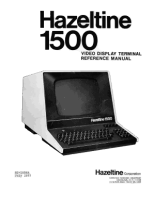
>>> http://vt100.net/manx/covers/14/hi-1056a.png.
>>>
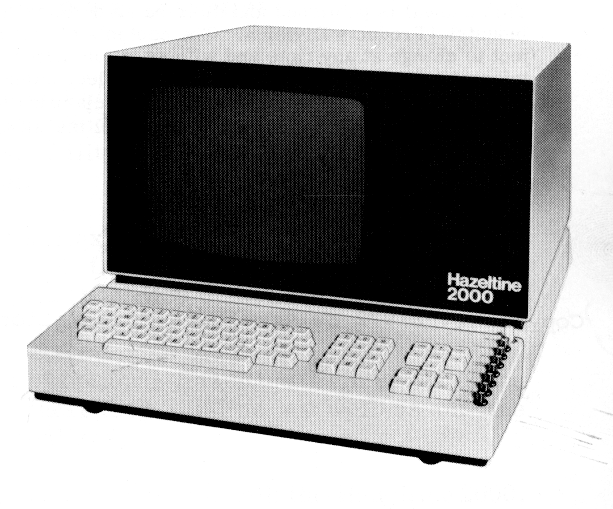
>>> Now, if it looks like the 2000, you've got a great
>>> score. Those are some interesting beasts. I've never
>>> seen one, but they look like this.
>>> http://www.columbia.edu/acis/history/h2000s.gif
>>>
>>> The Hazeltine 2000 was a very early video terminal
>>> (circa 1972).
>>
>> The 1200 was a basically glass tty, all uppercase
>> (may have had a back pannel option for all upper
>> tty mode or mixed) it was capable of slow baud rates
>> (I think to 1200 or 4800) and both RS232 or current
>> loop. I used on on the DEC PDP10 so that means it
>> was in house there by spring 1972. It was all logic
>> no cpu used and I belive it used serial PMOS shift
>> registers for storage.
>
>Wow. Neato!
>
>Peace... Sridhar
>
>Subject: Re: Hazeltine 1200
> From: Dave McGuire <mcguire at neurotica.com>
> Date: Thu, 06 Dec 2007 09:24:29 -0500
> To: "General Discussion: On-Topic Posts Only" <cctech at classiccmp.org>
>
>On Dec 5, 2007, at 10:02 PM, Sridhar Ayengar wrote:
>>>> My father just rescued a Hazeltine 1200 from a scrapheap for me.
>>>> I know nothing about these. Could someone give me some pointers
>>>> to information? Thanks.
>>> Nice! Let us know the date codes on the chips when you get a chance
>>> to peek inside.
>>
>> Will do.
>
> I'm also curious about what processor it's built around, if you
>don't mind checking.
Best of my knowledge only the 15xx and 24xx serius used a processor
and the earlier ones wer random logic and simple state machines.
Allison
>
> -Dave
>
>--
>Dave McGuire
>Port Charlotte, FL
>Farewell Ophelia, 9/22/1991 - 7/25/2007
>
>
>
>Subject: Re: Hazeltine 1200
> From: Dave McGuire <mcguire at neurotica.com>
> Date: Thu, 06 Dec 2007 10:33:17 -0500
> To: "General Discussion: On-Topic Posts Only" <cctech at classiccmp.org>
>
>On Dec 6, 2007, at 10:09 AM, Sridhar Ayengar wrote:
>>>>> My father just rescued a Hazeltine 1200 from a
>>>>> scrapheap for me. I know nothing about these. Could someone
>>>>> give me some
>>>>> pointers to information? Thanks.
>>>>>
>>>> Nice! I don't know anything about the 1200, but I have
>>>> a 1500 and a 1421. They are both just simple
>>>> terminals, with some fairly basic control functions
>>>> What does it look like? Is the keyboard integral or
>>>> detatched? Does it look like the 1500/1400 series? -
>>> The 14xx and 15xx are late 70s (after 1976) as 1500 used
>>> 8080 and the 1400 used 8048 cpus.
>>
>> Interesting. 8048 is an integrated microcontroller, no?
>
> Yes it is; sorta a predecessor to the 8051 family.
Yes, and it can also address up to 4k of program either
internal (up to 2K for the 8049) and axternal. It's possible
to hand external ram on it as well but the pointer is only
8bits so larger ram has to be paged using IO pins.
Allison
> -Dave
>
>--
>Dave McGuire
>Port Charlotte, FL
>Farewell Ophelia, 9/22/1991 - 7/25/2007
>
>
This should be a much simpler problem than I'm making
it, but at the moment my brain doesn't want to come up
with a solution.
Picture this - a number of switches, say, eight.
Momentary contact, normally open switches. And then
eight outputs, one for each switch, TTL level. I want
to be able to push one switch and bring it's
corresponding output high, and have it stay high even
when the switch is released. But, making this more
complicated, I only want to be able to allow one
switch to be active at a time. So, say switch four is
pressed, output four is high. Then, switch one is
pressed, and output four goes low, and output 1 goes
high. Timing is not critical.
I know this should be a simple array of flip flops, in
some fashion, but at the moment, the solution eludes
me. I feel like there is probably even a single/two
chip solution to this.
Now, I know that this is probably off-topic, but I'd
be using this in on-topic hardware...
-Ian