-------------- Original message from "Paxton Hoag" <innfoclassics at gmail.com>: --------------
> One of my favorite reference magazines was Mini-Micro Systems which
> published from 1976 to 1989 by the Cahners Publications. They printed
> 10 issues a year along with a Spring and Fall Peripherals Digest. I
> think Starting in June 1984 they printed a Mini-Micro computers
> special issue.
>
> I have one copy left, the 1983 Fall Peripherals digest. It is what I
> was looking for when Jerry was trying to identify the CDC/QD drive he
> had.
>
> Unfortunately the model numbers and what is printed on the drive don't
> correspond (and from what I remember never did)
>
Hi, Paxton
well you might be right on that. I have looked high and low
and seem to keep coming up with different numbers for the drives.
Here is what is listed on Mfaris site. for CDC and MPI (both names
are on the label).
http://www.mfarris.com/floppy/mpi.htmlhttp://www.mfarris.com/floppy/cdc.html
- jerry
A while back a friend gave me a big tub of pins his father was going
to toss out. His dad did sales and marketing for Zenith, I believe,
and had these pins from a CES show in the early 80s. I've laid them
all out and taken some pics:
http://flickr.com/photos/chiclassiccomp/sets/72157603430282899/
There are many recognizable names in there, some rare ones (Esprit!)
and some I have no idea what they are. Flickr users who can name some
of the oddballs feel free to add Flickr notes to the pics to ID them.
You'll probably want to view the pics full size, or at least larger
than they display by default.
j
--
silent700.blogspot.com
Retrocomputing and collecting in the Chicago area:
http://chiclassiccomp.org
One of my favorite reference magazines was Mini-Micro Systems which
published from 1976 to 1989 by the Cahners Publications. They printed
10 issues a year along with a Spring and Fall Peripherals Digest. I
think Starting in June 1984 they printed a Mini-Micro computers
special issue.
I have one copy left, the 1983 Fall Peripherals digest. It is what I
was looking for when Jerry was trying to identify the CDC/QD drive he
had.
Unfortunately the model numbers and what is printed on the drive don't
correspond (and from what I remember never did)
They have sections on drives, in fact they have separate sections
listing 8", 5 1/4" and Micro Drives. The 5 1/4 " drive listing has 39
makers of internal and external 5 1/4" drives, including simple specs;
sides, capacity, tracks, TPI, access time, transfer rate, dimensions
and model numbers.
Similarly for hard drives of all sizes (14" to 3") and removable cart
drives. They also had a great reference section on Terminals and
Printers. They are great reference magazines for collectors or for
just identifying equipment.
The collection is one of the things I miss the most, losing them in a
house fire.
Doing an Internet search I discovered WorldCat.org which indicates
there is a Microfiche set at Oregon State University in Corvallis. I
will have to go look.
So does anyone have a set or the Microfiche? I think anyone who has a
museum should think of looking for this magazine, especially the
product digests for reference.
--
Paxton Hoag
Astoria, OR
USA
>
>Subject: Re: Hazeltine 1200
> From: Dave McGuire <mcguire at neurotica.com>
> Date: Fri, 07 Dec 2007 00:54:03 -0500
> To: "General Discussion: On-Topic Posts Only" <cctech at classiccmp.org>
>
>On Dec 6, 2007, at 4:22 PM, Tony Duell wrote:
>>> I'm also curious about what processor it's built around, if you
>>> don't mind checking.
>>
>> Why does it have to have a processor at all? A number of the older
>> terminals, both 'glass TTYs' and those with some limited control code
>> response, like cursor positioning, were built from simple TTL (etc)
>> chips. Sometimes the artchitecture was something like a processor (DEC
>> VT5x, for example), sometimes it was just random logic.
>
> Of course it doesn't *need* to have a processor in the traditional
>sense...I was just assuming that it would, as I was guessing it wasn't
>much older than 1420 I had years ago. I could certainly be wrong.
It's much older than 14xx maybe at least two generations. Actually the
14xx series was near the end of the line for Hazeltine designs and I
remember being then for it in mid 78. By then they almost had the
15xx series working in production.
Allison
> -Dave
>
>--
>Dave McGuire
>Port Charlotte, FL
-------------- Original message from "Chuck Guzis" <cclist at sydex.com>: --------------
> Well, I can tell you that MPI made 100 tpi FH drives--I have two of
> them on my shelf here, date codes are 81-82. Unfortunately, the
> labels have dried up and dropped off, so I no longer have any idea of
> what their part number is. I've also got a couple in another
> machine, but it's a bear to get at them.
>
> Does the drive have a little "daughterboard" plugged into the main
> PCB with a 74ls123 on it? That'd be the "Drive Ready' circuit. I
> don't know if all MPI 100 tpi drives had this though.
>
> "Micropolis" type 100tpi drives also have a slightly different pinout
> than normal "Shugart" type drives (this includes the Tandon TM-100-
> 4M). A big difference is that READY is pin 6, not 34. Maybe that's
> what's causing your drive error.
>
> Just guessing...
>
> Cheers,
> Chuck
>
Hi,
Well Chuck and Paxton where right there. I took a chance and pulled a
Quad denisity drive out of a Motorola system I got from Paxon (sorry Tony.
I see your post) and all is well. It took 16 disks to back up close to 10 megs.
I had to bulk erase the disks (DSDD) for them to work with either drive.
Anadisk finds 80 cylinders and is able to read the whole floppy with out errors
( using a 1.2HD drive.)
I have not workd with Image disk yet.
I'm still out in the dark on the OS and how to make a bootable floppy. I cant
get past there Menu system It seems to run on or with some type of basic.
Below is a Boot screen for those with interest. The System is a small desk top
6 serial port business system.
Thanks, Jerry
......................................................
<I-TIMERS><I-USARTS><I-PIC'S ><I-DMA'S >
BOOTSTRAP LOADER VER 120A 31MAR83 S/N:000794
<I-TIMERS><I-USARTS><I-PIC'S ><I-DMA'S >
<I-FLOPPY><I-MEM&CH><MEM DATA><MEM BANK>
<MEM ADDR><HD SETUP><HD READI><VFY INCP>
<HD READL><VFY LOAD>
STARDOS SYSTEM UTILITIES REV 242B 10JAN84
STARDOS BASIC LOADER
1) ENTER MASTER MENU
2) ENTER SYSTEM UTILITIES MENU
ENTER YOUR CHOICE 2
###########################################
# STARDOS SYSTEM UTILITIES - VERSION 242B #
###########################################
1) ENTER MASTER MENU
2) INITIALIZE DEVICE
3) COPY DISKETTE
4) COPY STARDOS
5) RECONFIGURE
6) BINARY BACKUP HARD DISK
7) BINARY RESTORE HARD DISK
8) INITIALIZE FILE SAVE DISKETTE
9) HARDWARE CONFIGURATION
ENTER YOUR CHOICE 1
*** S T A R D O S II ***
BASIC RELEASE 10.7 REV C 05JUN84
snip.................................................
-----------Original Message:
Date: Mon, 03 Dec 2007 16:32:18 -0800
From: Josh Dersch <derschjo at msu.edu>
Subject: ROM image for NEC PC-8300
Anyone out there have a ROM image for the NEC PC-8300? This is NEC's
variant of the Kyocera KC 85, of which the TRS-80 Model 100 was another.
I picked up two of these a long time ago, they had been used as some
sort of data-logging system and had custom ROMs in them which are
useless without special hardware I don't have :). Now that I have a
functional EPROM burner I can get this running in its native state, if
only I can find the right ROM for it. Can't seem to find this on the 'net.
Thanks for any pointers...
Josh
----------Reply:
Go to:
http://www.diginexus.com/web8201/
and get in touch with Gary at the link there; he's Mr. NEC and will have it
for you and he's also a nice guy who'll gladly help you with any other NEC
issues you may have.
mike
-----------Original Messages:
Date: Thu, 6 Dec 2007 22:06:49 -0800
From: dwight elvey <dkelvey at hotmail.com>
Subject: RE: Almost OT: Pushbutton switch latching
> From: ian_primus at yahoo.com
> The main thing I'm trying to achieve is simplicity.
> Nothing fancy. No PIC's, no microcontrollers, etc. I
> initially thought of using flip flops and a bunch of
> inverters to reset all the non-selected flip flop, but
> couldn't work out in my head a good way to do it... I
> hadn't taken switch debouncing into the equation - but
> aren't flip flops commonly used to debounce switches
> anyway?
>
Hi
The simplest method would be to use the cross coupled
nands as another described. For 8 inputs, you'll need
4 ea 7400's to make the nand latches. You'l need 8 ea 8 input
nands ( forget the 74 number ) and 3 of the hex inverters,
7404s.
For each switch wire one lead to ground. Wire one lead
to a 4.7K pullup resistor and one of the free inputs to the
cross coupled nand pair. Also wire that switch lead to
7 of the 8 input nands ( not the one on this switch circuit. ).
On the remaining free inputs to the cross coupled nands
pair, wire an inverters output. The input of the inverter
goes to the output of the 8 input nand that wasn't one of the
7 connected to this switch.
Repeat this for each of the 8 switches.
If the active level is to be 0 when selected, you can save
one inverter IC. If it needs to be active high, you need the
inverter. in either case, you need to connect to the nand
that has the inverter to the 8 input nand. This will ensure
that multiple switches won't select anything until only
one is selected.
On the 8 input nand, you'll notice that one input isn't
connected. This can be used to reset. Tie all together
with a 1K resistor to +5. Place a diode across this such
that the band is on the +5 ended.
Add a 10uf tantalum to this net with th plus on the
same net and the negative to ground.
This will reset all on powering up. If you want to
one of the outputs to come on when powering up,
you can add a similar capacitor, resistor and diode
circuit to the desired input switch lead. You'd need to
remove the common input to the 8 input nand and
tie it to +5 as well.
I like this better than using some other clocked method
because if multiple switches are selected at the same time,
non will select but when the last switch is still selected,
that output will go active.
There are no ambiguous states and no oscillations. The switches
are debounced as well.
Dwight
------------Reply:
15 ICs and a dozen discretes is "the simplest?"
I think some simpler circuits have been suggested...;-)
As a matter of fact, if you add a diode & cap per switch you could do
the job with 2 IC's for each 8 PBs (7430 & '573 (or 2x'75 if you need
complementary outputs)).
mike
Date: Sun, 09 Dec 2007 15:55:19 -0500
From: "Roy J. Tellason" <rtellason at verizon.net>
Subject: Re: Haletine 2000 ? was Re: Hazeltine 1200
To: "General Discussion: On-Topic and Off-Topic Posts"
<cctalk at classiccmp.org>
Message-ID: <200712091555.19523.rtellason at verizon.net>
Content-Type: text/plain; charset=iso-8859-1
On Sunday 09 December 2007 15:47, Richard wrote:
>> In article <ded268c40712091038offab0fbg2bc611169d5c55b7 at mail.gmail.com>,
>>
>> "Paxton Hoag" <innfoclassics at gmail.com> writes:
>> > So if you see one expect to pay for it.
>>
>> I had to outbid other Crommeco collectors for the Beehive. $350.
>Dang! That Cromemco 3101 (?) I have sitting in storage is worth that much?
>Whodathunkit...
---------
And I gave one away... Lesson learned!
m
Hi Guys,
Just thought I'd mention in case anyone is interested...
Having recently acquired a couple of VAXen, I've taken the time to
update my LAPTALK terminal program to provide MUCH more complete
VT-100 emulation. This is a very small (<20k) DOS program, so you
can use it to turn any old PC into a terminal.
First the bad news - Like most PC/text based VT-100 emulators, it
DOES NOT support:
- Double width/Double height lines.
- 132 column mode.
- Split RX/TX speeds.
The good news - It does support "most everything else" now. In fact,
it's the only emulator I've tested which passes all of my "VT-100
Checkup" tests (excepting for the limitations mentioned above) - I've
included the test program in the archive.
It also adds a few extra features you might find useful:
- Fairly power script language for automating sessions.
- 40 programmable function keys (F1-F10, ShiftF1-F10, CtrlF1-F10 and
AltF1-F10) with on-screen labels. (very handy!)
- If you have a VGA display it will load a custom character set to
provide the complete VT-100 character set including the graphics
mode characters. I've also include a font editor so that you can
create your own custom character sets if you like.
I've made the package temporarily available at:
http://www.dunfield.com/pub/index.htm
If there's any interest, I'll find it a permanent home.
Regards,
Dave
--
dave06a (at) Dave Dunfield
dunfield (dot) Firmware development services & tools: www.dunfield.com
com Collector of vintage computing equipment:
http://www.classiccmp.org/dunfield/index.html
-------------- Original message from Fred Cisin <cisin at xenosoft.com>: --------------
> On Sun, 9 Dec 2007 g-wright at att.net wrote:
> > Hi
> > I have a machine with a 77711501 floppy drive and it's bad.. I have
> > tried 3 different 360k drives. I tried to find specs on it but so far have
> not.
> > What is the difference between that drive and a 77711800 used in a PC
> > The computer just says there is a drive error. I'm using the same jumper
> > settings on both. I have also tried a Teac fd-55bv.
> > Is it a 320k drive ??
>
> There ain't no difference.
> 320K drive and 360K drive are the same drive.
>
> There is a way that it would be possible to build a drive that could do
> 320K, but not be able to do 360K, but nobody has done so yet.
>
> Boot something other than WINDOZE. "Drive error" is not specific enough.
>
>
>
And for the rest of the story .....................
This is on a MicroStar machine that runs StarDos. I know nothing about this
but from recent posts I decided to drag one of them down and look into it a
little further. This machine I have running is a Micro Five 1000 with a IMI
10 meg HD. It has a boot menu and back up Menu. It will still boot and
will make its own formatted floppies and back itself up with out much
problems. If I try to read one of the floppies with Image disk or Anadisk
they fail. It tried with both 360 and 1.2 meg drives. I would guess that
the drive in the machine is off enough to cause these problems . If I
install another floppy drive, the System picks up something and errors. So
there must be some other signal or ??? coming from the drive. The
machine date is in the 84 -85 range
The straps on the drive (M 4 x 3 2 1 H) are set with M and 1 jumpered
- thanks, Jerry
------------Original Message:
Date: Sat, 08 Dec 2007 23:50:29 -0800
From: "Chuck Guzis" <cclist at sydex.com>
Subject: Re: Almost OT: Pushbutton switch latching
On 9 Dec 2007 at 0:15, der Mouse wrote:
> Nice idea, but it doesn't work. Draw out three NANDs cross-coupled as
> you described. Mark the logic states for a stable state with one
> output low. Now consider what happens when each of the inputs goes
> low. The only one that does anything is the one feeding the gate whose
> output is low.
Yeah -- I see that. Release a button and the circuit goes into an
unstable state. I wonder what the smallest number of active devices
is for an n-stable circult with n greater than 2.
8 D flip=flops with each switch connected to a PRESET input and a
NAND (or NOR) to edge-clock in a reset state looks to be far from the
minimum. How about some capacitively coupled logic with a few
steering diodes?
Cheers,
Chuck
---------------Reply:
Well, with some diodes and caps, a single 8-bit latch (74564/574) oughta
do the job.
m
Hi Rob,
You may not remember but you posted the following on classiccmp.org about 2 years ago:-
>I have a large pile of magazines dating back to the 70's-mid 80's, mostly
>Hobby Electronics right from the start, quite a lot of ETI (but I don't
>think as late as wanted here, box is buried behind a live server so will
>take time to access and check) also a lot of Practical Electronics
>including, if I still have them, many dating back to the '60s. Lots of
>odds and ends too as to be expected, plus I think some Railway Modeling
>mags to stray off topic..
I am writing this email on the off-chance you might still have these. I grew up with ETI as a child and kept all my magazines from mid-70?s until mid-80?s but unfortunately they were all thrown out when my parents moved house.
I found your post (and the classiccmp.org forum ) from a Google for Electronics Today International.
I am trying to get hold of as many of the magazines from this era as possible. I am particularly hoping to be able to find the issues that covered the ETI System68, which I built when I was 16. Ideally I would like to find these and get them scanned, approach the current copyright owners and see if they would agree to PDF?s of these magazines being made available online. I would also like to try and re-build this design if at all possible.
Anyway, hope to hear from you.
Regards,
Nick Jarmany
London
No virus found in this outgoing message.
Checked by AVG Free Edition.
Version: 7.5.503 / Virus Database: 269.16.17/1177 - Release Date: 07/12/2007 13:11
And a few things I've noticed about it are:
-- It says "digital" (lowercase like that) on the front. :-)
-- it has a third power supply connector to the MB, and that PS is rated to
ptu 33A (!) out on the +5
-- It has the CPU on a separate small daughterboard. A jumper there seems to
select speeds, up to maybe 100 or so. I have a 486dx2/66 chip in it at
present, which will run real flaky at 80, and not at all at 100. :-)
-- It has a _very_ loud beep when you power it up.
-- It wants only _parity_ ram -- there's no option in CMOS to disable that. I
have a couple of 16s and a couple of 4s in there at present, all the parity
parts I was able to scrounge. Anybody have some they might wanna trade?
-- Slots are ISA only, but they're _all_ 16-bit.
-- This thing's built like a tank!
I'd originally planned to put OS/2 in this box. Now I'm lots less enthused
about that OS than I was at one time, so I dunno what I'm gonna do with it.
Thoughts on this?
--
Member of the toughest, meanest, deadliest, most unrelenting -- and
ablest -- form of life in this section of space, ?a critter that can
be killed but can't be tamed. ?--Robert A. Heinlein, "The Puppet Masters"
-
Information is more dangerous than cannon to a society ruled by lies. --James
M Dakin
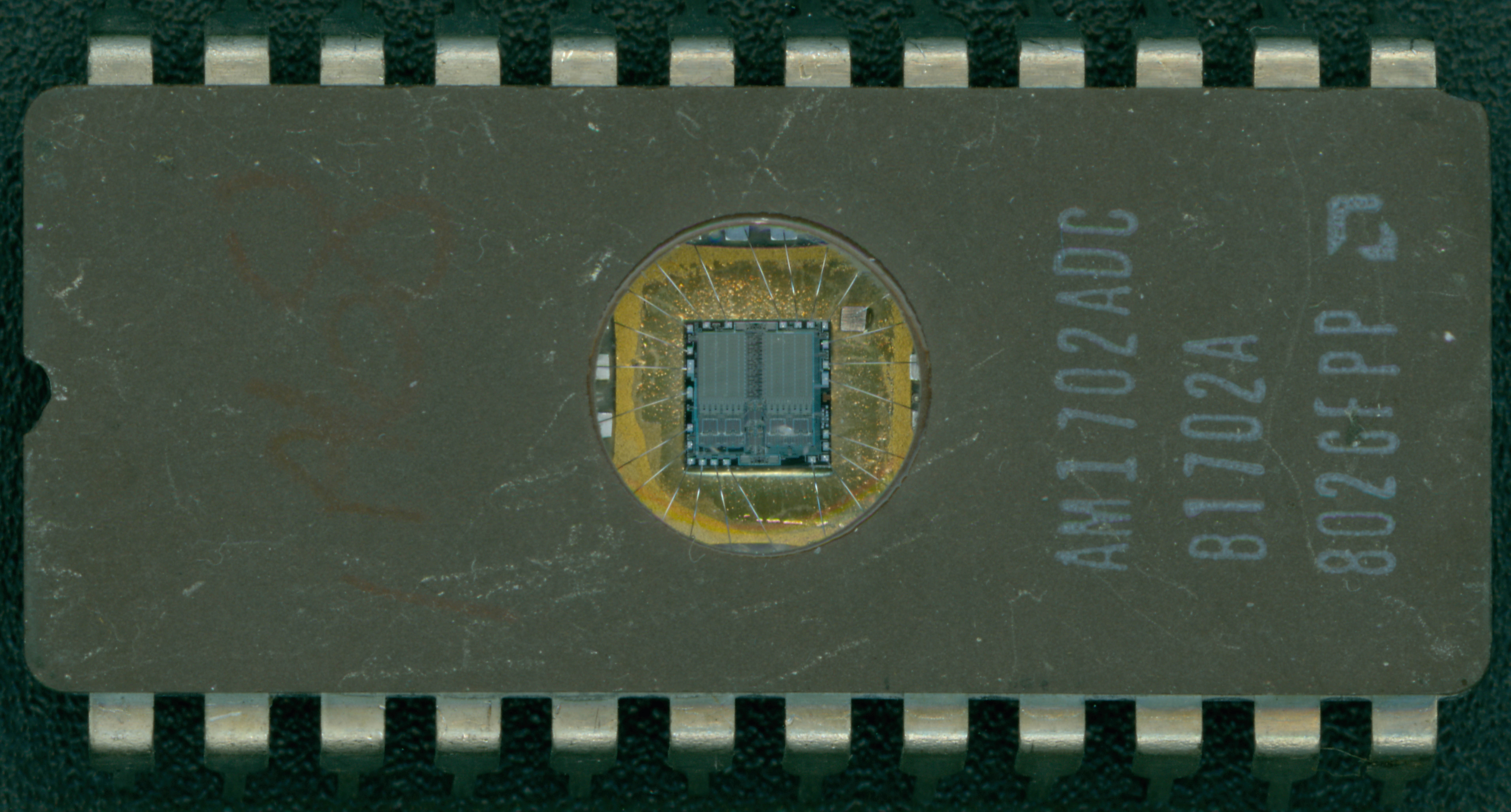
I couldn't help it. I had to scan a 1702A 256byte EPROM.
This one was done at 6400dpi, really 3200dpi along the scanner array
and 6400dpi in the scanning direction. So there is some
interpolation in the image. Still a pretty impressive picture for a
scanner. :)
http://www.stockly.com/images3/071208-1702A-1.jpg
Just playing the new scanner...
Grant
At 18:28 -0600 11/28/07, Sean wrote:
> A Color Computer or Color Computer 2 seems to fit the bill. The CPU is
>the nicest of the 8bits (IMHO) and the video screen is more logical than
>anything you'll find on the C64, Atari or Apple. ...
At 18:28 -0600 11/28/07, Mark M. wrote:
>I'd tend to agree. The 6809 is a lovely processor, and there aren't any of
>the "black box" chips that others have mentioned. ...
I'd agree completely, *except* that if you want to do
Assembly (conveniently), you also need the EDTASM+ ROM cartridge, and
prices/availability for those seem to have gone a little wonky in the
past 6 months. EBay prices yield systems for $5 to $10 (plus
shipping), but the EDTASM cart is over $30. I have not found a
non-eBay source that actually had a cart for sale at all.
I don't quite have the knowledge to do it, but something I'd
really like to see is a reverse-engineered equivalent (editor,
assembler, monitor) implemented and available as an inexpensive
cassette tape or downloadable sound file that could be played into
the cassette port (or even, shudder, READ-DATA/POKE basic program to
type in) and an accompanying public-domain manual. I know this would
be vulnerable to getting overwritten by an out-of-control assembly
program, and the ROM version is preferable, but it sure would turn a
cheap, otherwise very capable BASIC platform into a cheap, very
capable Assembly language platform that one occasionally had to
re-load.
I note that there are good emulators and cross-compilers
available for both Mac OS-X and Windows:
Toolshed for OS-X rocks:
http://sourceforge.net/projects/toolshed/
David Keil's Windows emulator gets excellent reviews:
http://www.discover-net.net/~dmkeil/index.htm
no relation either way.
--
- Mark, 210-379-4635
-----------------------------------------------------------------------
Large Asteroids headed toward planets
inhabited by beings that don't have
technology adequate to stop them:
Think of it as Evolution in Fast-Forward.
------------Original Message:
Date: Sat, 8 Dec 2007 18:30:43 +0000
From: Ethan Dicks <ethan.dicks at usap.gov>
Subject: Re: GAL16V8 as a modern substitute for a 7447?
On Sat, Dec 08, 2007 at 08:12:30AM -0800, Peter C. Wallace wrote:
> On Sat, 8 Dec 2007, Ethan Dicks wrote:
> >Has anyone here worked with or ever plotted silently to create a moderish
> >7-segment decoder/driver from a GAL16V8?
>
> IICRC the 16V8 does not have buried registers so you will lose the 4 of the
> output pins (for the counter) that you needed for the 7 segment outputs
Right.
> If you are using sockets, a 5V or 3.3V (cheaper) 44 pin PLCC CPLD might be
> a better solution, plus they are easier to program. A X9572XL will probably
> do 4 decades of count/decode for about $2.00
That is not feasible. I need 7 or 9 decades of count/decode, and I happen
to have an abundance of GALs and a GAL programmer. If it comes down to a
CPLD-design, I'll probably throw in the towel and use an AVR microcontroller
and perhaps a real 74LS47 or 74LS247 to lower the I/O requirements a touch.
I was just musing about what it might take to put it all in hardware
rather than a combination of hardware and firmware. Using an MCU makes
the entire problem trivial.
Thanks,
-ethan
-----------------
--------------Reply:
Well, since it started one of "those" discussions here as usual anyway,
what's wrong with a 74143?
mike
I have an FAA control room keyboard that I picked up off ebay. Each
key has a little bulb underneath it that lights up the keys for use in
the dark. I need to get some replacement bulbs since some of them
have burned out. I haven't disassembled this thing enough to know if
they have parts numbers on them or not.
Does any of this sound familiar to anyone? I'm thinking that the
bulbs burning out has got to be a regular occurrence and that the
bulbs are therefore probably socketed and not soldered, but again I
didn't disassemble it that far to know. The keyboard assembly inside
is labelled MicroSwitch IIRC.
--
"The Direct3D Graphics Pipeline" -- DirectX 9 draft available for download
<http://www.xmission.com/~legalize/book/download/index.html>
Legalize Adulthood! <http://blogs.xmission.com/legalize/>
Hi
I have a machine with a 77711501 floppy drive and it's bad.. I have
tried 3 different 360k drives. I tried to find specs on it but so far have not.
What is the difference between that drive and a 77711800 used in a PC
The computer just says there is a drive error. I'm using the same jumper
settings on both. I have also tried a Teac fd-55bv.
Is it a 320k drive ??
- jerry
Since our printer has malfunctioning and not working and I am interested in getting a printer for
my computer and the M8000 is what we need. If your Stylewriter printer is working, we would
be happy to pay the shipping to have it shipped here. My email is:
glade at barneygang.com
> In the case of the HP41 calculator, it was physcially impossible to run
> machine code from the machine's internal RAM. The processor was a pseudo
> harvard architecture, RAM was organised in 56 bit 'registers' connected
> to the SPU DATA line, ROM was in 10 bit words connected to the ISA line.
> Some hackers found a way round this, making ROM emulator boxes (normally
> called MLDL (Machine Language Development Lab) units).
Where does the synthetic programming fit in? I thought it was
a case of creating machine language code in RAM. And I remember
it being based on some ugly tricks, rather than an external device.
BLS
Hi list,
I have 7 2000-sheet boxes of tractor-feed plain 11x14.5" listing paper
which I'd like to give away as I need the space back. Located in West
Yorkshire, UK.
Sorry, it isn't greenbar ;)
There are also 3 boxes of A4-ish size (11x9.5" I think they are).
Free, but you'll have to collect. I'd ship if you're desperate, but it
won't be cheap as they're heavy.
Please drop me a mail if you're interested - thanks.
Ed.
>> One thought was to attempt to combine a 7490 _and_ a 7447 in a single
>> GAL16V8. I have blown hundreds of PALs, but have much less experience
> IICRC the 16V8 does not have buried registers so you will lose the 4
> of the output pins (for the counter) that you needed for the 7 segment
> outputs
You can do it but you need to make a counter that counts in segment
patterns and not binary. I did see an example of this and remember
thinking how clever it was but a search of my files and online has
failed to turn up a copy.
Lee.
>>> Camp Evans was just a small part of the Signal Corps. It was not the center, by any means.
I never said otherwise. BUT, in all of the examples I've cited, the sources indicated not just the Signal Corps lab, but specifically the Signal Corps comms lab at Fort Monmouth. That's us (there is plenty of other evidence too, but we're already OT for cctalk ... feel free to carry this over to the local club list.)
> I found a fleeting reference, perhaps, in the ORCAD 4.0 manual,
> chapter 5, on PLDs?
> |GAL16V8 in:RESET,
> | out:(SEG[6~0], CARRY),
Yes that looks like it. So at least I wasn't imagining it.
Lee.