>
>Subject: Re: Keyboard PS/2 to Parallel converter
> From: "Dave Dunfield" <dave06a at dunfield.com>
> Date: Mon, 07 Jan 2008 19:51:21 -0500
> To: "General Discussion: On-Topic and Off-Topic Posts" <cctalk at classiccmp.org>
>
>> > Date: Mon, 7 Jan 2008 08:54:38 -0800 (PST)
>> > From: Fred Cisin <cisin at xenosoft.com>
>>
>> > It would seem that the cheapest way to do it is a discardable PC.
>> >
>> > Input character
>> > print it
>> > loop
Not cheap and noisy. You could yank the 8042 used in 386 through
early P1 boards as the first level interface. But that does not
translate the scan code to ASCII serial or parallel wich is what
most people would like.
>> Only barely possibly the cheapest. A $2 PIC or AVR or even 8051-
>> family chip can do the same job for a fraction of the power and space
>> and noise. And the code is out there--I've seen code for getting
>> PS/2 keyboard data into both PICs and AVRs. The output side would be
>> a piece of soup.
Absolutely. Even an 8048 (8035 or 8748) pull from a older keyboard
is more than enough CPU for the job. The DEC LK20X (30x/40x) series keyboards used an 8051, pull the EA line high and it's a 8031 (add a
latch and external rom).
>>
>> And a PIC could be considered "retro"; certainly an 8051 would be.
>> Both are descended from mid-70's chip designs.
>>
>> But to answer an earlier question--no, a simple serial-in, parallel-
>> out shift register won't do the job with a PS/2 keyboard--the
>> interface has a bidirectional protocol--it just doesn't blindly send
>> out scan codes.
>
>If anyone is interested, I have a very small bit of 8051 code which reads an attached PC keyboard,
>providing the scan codes over an RS-232 link. It also supports commands to set LEDs on/off etc.
I'd be interested. PS2 in and ASCII serial (or parallel with strobe,
output only) out is most useful in vintage designs. Most vintage
machines do not need bidirectional control but the local CPU (8051)
would have to echo the state of the NUM and shiftlock keys to the LEDs
and do code conversion accordingly.
Allison
>
>I specifically avoided using the P1 line in my design (full 8-bits
>parallel I/O available even on an 8031), so these are free, making it very trivial to modify this
>to output parallel instead of serial - it
>would also be very easy to add a translate table and recognition of
>shift/ctrl modifiers so that it would output fully decided ASCII.
>
>
>Dave
>
>
>--
>dave06a (at) Dave Dunfield
>dunfield (dot) Firmware development services & tools: www.dunfield.com
>com Collector of vintage computing equipment:
> http://www.classiccmp.org/dunfield/index.html
>
>Subject: Re: Keyboard PS/2 to Parallel converter
> From: "Roy J. Tellason" <rtellason at verizon.net>
> Date: Mon, 07 Jan 2008 18:51:24 -0500
> To: "General Discussion: On-Topic and Off-Topic Posts" <cctalk at classiccmp.org>
>
>On Monday 07 January 2008 11:54, Fred Cisin wrote:
>> It would seem that the cheapest way to do it is a discardable PC.
>>
>> Input character
>> print it
>> loop
>
>There was some project article in Byte way back when, by Steve Ciarcia,
>which provided a peecee-type keyboard input (AT rather than PS/2 but that
>shouldn't make that much difference). The circuit to deal with this was very
>simple and elegant, though I can't remember any more just how it was done.
It used a Z80 and a PPI rom and ram. At the time that was a easy small
design but still far more cpu than needed. The task is PIC or 8048 sized.
Fornm the At days to current the PS2 keyboard is handled with an 8042
(discrete or embedded) which is a slave bus verion of the 8048..
There are PIC designs for this out there as well as Atmel ATmega. Check
their sites.
>He didn't use a UART or similar, though, just a couple of MSI chips. And I
>remember thinking then how it wouldn't be all that hard to stuff an eprom
>between the output of that circuit (which gave you keycodes rather than
>characters) and have it spit out ASCII.
Ah, you do you handle the key down codes and the key up codes?
>
>Perhaps one of these days I'll run across the article again.
I have it burried somewhere. It does not translate well to an PS2
keyboard as the XT keyboard used for that has slower IO rate and
different keyscan. It would be a pain to do in simple logic as you
need at least a state machine.
Allison
>--
>Member of the toughest, meanest, deadliest, most unrelenting -- and
>ablest -- form of life in this section of space, ?a critter that can
>be killed but can't be tamed. ?--Robert A. Heinlein, "The Puppet Masters"
>-
>Information is more dangerous than cannon to a society ruled by lies. --James
>M Dakin
On the right, is it a computer, or just a dumb terminal?
There's a printer and possibly floppies in the background, but where do they go?
http://oldcomputers.net/temp/1980something.jpg
Thanks-
Steve.
---------------------------------
Be a better friend, newshound, and know-it-all with Yahoo! Mobile. Try it now.
> Date: Mon, 7 Jan 2008 08:54:38 -0800 (PST)
> From: Fred Cisin <cisin at xenosoft.com>
> It would seem that the cheapest way to do it is a discardable PC.
>
> Input character
> print it
> loop
Only barely possibly the cheapest. A $2 PIC or AVR or even 8051-
family chip can do the same job for a fraction of the power and space
and noise. And the code is out there--I've seen code for getting
PS/2 keyboard data into both PICs and AVRs. The output side would be
a piece of soup.
And a PIC could be considered "retro"; certainly an 8051 would be.
Both are descended from mid-70's chip designs.
But to answer an earlier question--no, a simple serial-in, parallel-
out shift register won't do the job with a PS/2 keyboard--the
interface has a bidirectional protocol--it just doesn't blindly send
out scan codes.
Cheers,
Chuck
I just pulled my GridPad 2050SL out of the garage, fired it up, and it
worked fine, for about 15 minutes. Then the screen started to fade,
adjusted contrast and brightness, worked for a few minutes then nothing,
just the backlight. Let it set for a few minutes, it fired up, but
quickly back to the blank screen, with a quicker fade.
Any suggestions on what to check? It has been in storage for the past 4
years, no climate control, so anything is possible. Probably heat
related component failure or solder joint, but where to look. Nothing
found on the web.
But to answer an earlier question--no, a simple serial-in, parallel-
out shift register won't do the job with a PS/2 keyboard--the
interface has a bidirectional protocol--it just doesn't blindly send
out scan codes.
Cheers,
Chuck
And then anybody has suggestion for a READY to USE black box?
Input PS/2
Output D0 to D7 + Strobe signals
Thank to all that will have all useful suggestions.
Enrico
Jason wrote:
> So since mine says "Server" yet has a 13W3 gfx board (haven't opened
> it up to ID it yet, and can't get into the OS to do a gfxinfo) it was
> probably a field-upgrade? I do have the "Elan" badge as well, and the
> owner only had one Crimson, so I'm assuming that's where it came from.
>
Most likely. 13W3 outputs do indicate either Entry or Express graphics,
and the badge indicates "Elan" (though Crimsons did have an Extreme
option).
> I got an internal cdrom recogzined last night. The only Irix distro I
> have now is 6.5. Will the Crimson at least load fx from that? It was
> acting like it couldn't even find the file, though, giving some scsi
> errors if I booted into the hdd's fx and tried 'ls dksc(....)" on the
> CD. I tried an Apple CD600i and a Toshiba model which was listed in
> the SGI cdrom survey. Of course, they could be bad drives, who knows.
> Too many variables!
>
> Next method will be to attach the boot drive to another SGI and edit
> /etc/passwd from there.
>
> Thanks for all the helps
>
No go- IRIX support for IP17 stopped at 6.2 (it's substantially
different from the later ARCS-derived systems, and has more in common
with the R3000/R2000 based systems than the later ones). IRIX 5.3 or
IRIX 6.2 are your best bets, though IRIX 4.0.5 (hard to find software
for), IRIX 5.1 (yuck!), and 5.2 (much better, but still not as good as
5.3) will also run on it. The SCSI errors don't sound good- check your
setup there. You might see file not found errors, but they won't be
SCSI errors.
On Jan 5, 2008 10:46 AM, Scott Quinn <compoobah at valleyimplants.com> wrote:
> Servers (S) didn't come with graphics. Later SGI separated out their
> server lines even more with a different base name (Challenge/Origin),
> but during the late '80s the base model was the same.
So since mine says "Server" yet has a 13W3 gfx board (haven't opened
it up to ID it yet, and can't get into the OS to do a gfxinfo) it was
probably a field-upgrade? I do have the "Elan" badge as well, and the
owner only had one Crimson, so I'm assuming that's where it came from.
> You can, but SGI never wrote a good OpenGL implementation for the
> PowerVision VGX/VGXTgraphics hardware, so much of the work is done by
> the main CPU (IRIS GL is fully supported). So, it depends on what you
> want to do with it...
"Pimp my SGI," I guess, and just make use of the nicer gfx board
before the dead Iris gets scrapped.
> One possible gotcha- IRIX 6.2 fx for the Crimson is broken, so you'll
> need to fx with either an earlier IRIX (4.0.5-5.3) or fx on a different
> SGI.
I got an internal cdrom recogzined last night. The only Irix distro I
have now is 6.5. Will the Crimson at least load fx from that? It was
acting like it couldn't even find the file, though, giving some scsi
errors if I booted into the hdd's fx and tried 'ls dksc(....)" on the
CD. I tried an Apple CD600i and a Toshiba model which was listed in
the SGI cdrom survey. Of course, they could be bad drives, who knows.
Too many variables!
Next method will be to attach the boot drive to another SGI and edit
/etc/passwd from there.
Thanks for all the helps
--
j
Date: Sun, 6 Jan 2008 13:31:52 -0800 (PST)
From: Chris M <chrism3667 at yahoo.com>
> you thanks
>
> what's a grid?
A company in Fremont, CA that manufactured laptops, acquired by Tandy
and utterly destroyed by their incompetence.
http://pages.total.net/~hrothgar/museum/Compass/
Cheers,
Chuck
Hi at all,
please excuse me for my not correct english, i'm writing from Pisa (Italy).
Is there anyone that have any copies of this old magazine already scannered?
This could help me to understand better all about around this board.
Thanks so much to all that would help me giving all kind of info, links and
news.
Enrico
Did/does such a thing exist?
I've got a CP/M .COM file which I believe is BASCOM generated -- running 'strings' over it reveals the line "ALREADY MODIFIED MBASIC 5.21 INTERPRETER" and the initial output when you run it includes what appears to be the original BASIC source file name and the string "COMPILED VERSION".
Is there a tool to recover a reasonable facsimile of the original BASIC source?
Thanks.
_________________________________________________________________
Put your friends on the big screen with Windows Vista? + Windows Live?.
http://www.microsoft.com/windows/shop/specialoffers.mspx?ocid=TXT_TAGLM_CPC…
Date: Sun, 06 Jan 2008 10:33:16 -0800
From: "Chuck Guzis" <cclist at sydex.com>
Scratch the request, please. After a little more looking, it seems
that the application used to create these documents was Wang PC IWP,
not an old WordPerfect. I got a hint that something was wrong when
they wouldn't open with my WP 4.1.
I can handle IWP.
Thanks,
Chuck
Hi at all,
please excuse me for my not correct english, i'm writing from Pisa (Italy).
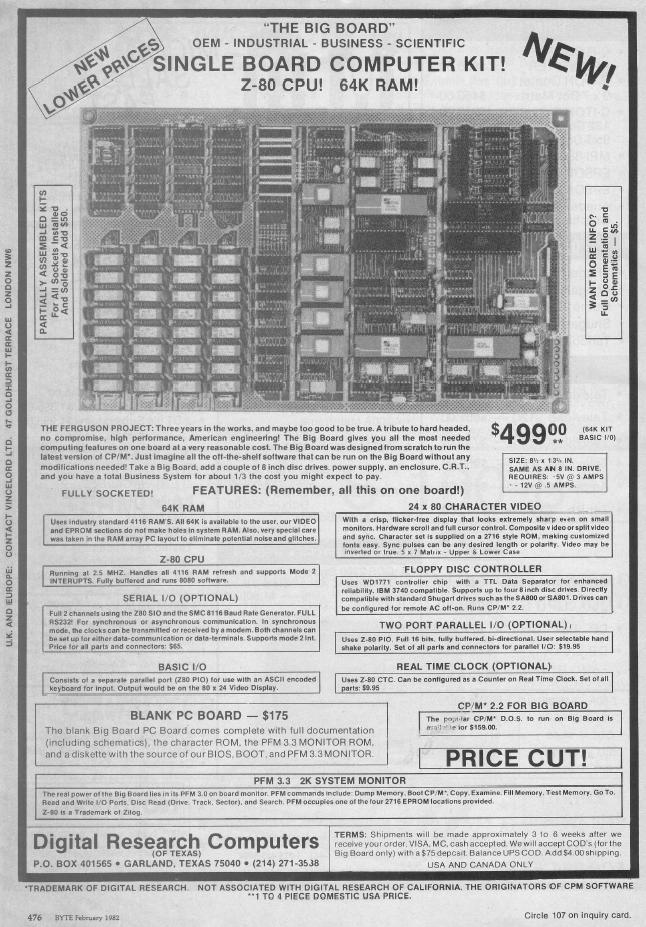
I have a old Ferguson BigBoard1. I played with it almost 20 years ago then I
lost its schematic.
Here its references:
http://www.classiccmp.org/dunfield/miscpm/fbbfeb82.jpg
<http://en.wikipedia.org/wiki/Bigboard>
http://en.wikipedia.org/wiki/Bigboardhttp://www.stevenjohnson.com/big-board.htm
At this moment :
a) I got all doc from here: <http://www.dtweed.com/docs/index.html>
http://www.dtweed.com/docs/index.html
b) I pulled away all chips and I matched the PCB with that schematic
checking all differences.
On the board there is not the Z80 DART so I'll can't try to use
Hyperterminal to connect me to the board.
I think to put the chips asap almost when I'll have:
1) a parallel keyboard: is it anybody could help me to transform a PS/2 or
AT keyboard in a parallel one? Even using the only internal matrix and using
a new keyboard encoder (I prefer less this way cause my limited free time).
In 1983 I used KR-2376 to create the correct character codes.
2) a composite monitor : I have a monochromatic monitor "hantarex boxer 12"
like this
<http://cgi.ebay.it/Monitor-HANTAREX-BOXER-12-RARISSIM-retro-jamma-SuperGun_
W0QQitemZ130182617194QQcmdZViewItem>
http://cgi.ebay.it/Monitor-HANTAREX-BOXER-12-RARISSIM-retro-jamma-SuperGun_W
0QQitemZ130182617194QQcmdZViewItem, but i have not its schematic. Is there
anybody who could help me?
With this working I HOPE to can make the board alive to get its "System
Prompt" . Wow!
3) The second step if it will go fine will be to connect my Mitsubishi
M2896-63 8inc Internal Floppy Drive to it. I have two drives but I have not
its manual. So is there anybody who has its manual?
4) If I will can format a 8inc diskette I will need to rebuild the CP/M 2.2
Operating System: So is there anybody who has info to give me to how to do
this?
Thanks so much to all that would help me giving all kind of info, links and
news.
Enrico Lazzerini
I have a high quality CP-A schematic as a 600 DPI JPEG. I'd prefer to send
it to someone who can host it, but I'll honor a FEW individual requests for
it.
Barry Watzman
Watzman at neo.rr.com
>>Most of the older PROM style systems had an issue booting from a cd drive. You can't just use any with them. >>Many people report that Plextor drives are some of the best and Toshiba drive are right behind. Don't forget >>also that the cd drive must be ID 4 and be set for 512 byte sectors (not 1024 or 2048). I personally have never >>tried booting my crimson with my 6.5 cd's but if you just use FX from an Irix 5.3 cd you should be fine.
>>
>>Is ID 4 essential? I've read conflicting info re: required device IDs
>>for booting. What is the expected behavior using a different ID?
ID 4 is not really essential but it is a preferred address. Just don't forget to set the drive for 512 byte sectors. That is a must.
>
>Here there is a schematic already suggested
>http://eece.ksu.edu/~eece696/beta/digital/A/stop.htm but could it works?
>
>What could be the exact schematic and hardware to use? And at the last is
>there anything "ready-to-use" cause I have not much time to spend to build
>it?
I don't think that circuit will work.
This microcontroller encoder might work
http://www.brielcomputers.com/superencoder.html
Grant
Jochen Kunz <jkunz at unixag-kl.fh-kl.de> wrote:
> "Arno Kletzander" <Arno_1983 at gmx.de> wrote:
> > As I don't have a TGX/TGX+ in any of my easily accessible machines,
>
> Arno, this is quite easy to fix. I'll snail mail you one or two
> GX/TGX/TGX+ later this week. :-)
To Jochen, der Mouse and anybody else eager to help out:
Thanks a bunch, but please, don't bother to! If you have Sun stuff to shed, I'll happily discuss that in private mail, but it's not immediately needed.
I apologize that my message was a bit prone to misunderstand, but I actually meant to say that I *know* I have one of those things buried somewhere in my clutter and my interest is not sufficient at that stage to make me dig for it. If at all possible, I'd like to make do with the onboard cg3 of the SPARCclassic anyway. No, I've got no idea why people always think I'm into pain...
So long,
Arno.
--
Der GMX SmartSurfer hilft bis zu 70% Ihrer Onlinekosten zu sparen!
Ideal f?r Modem und ISDN: http://www.gmx.net/de/go/smartsurfer
I stumbled on "Inside the EISA Computers" by Tony Dowden (ISBN
0-201-52397-3) and AT&T's "SCSI (Small Computer Systems Interface)
Definition" book, both circa 1987. If anyone has any interest in these,
you can have them for the cost of media mail shipping. The SCSI book is
incredibly detailed.
--
Jim Leonard (trixter at oldskool.org) http://www.oldskool.org/
Help our electronic games project: http://www.mobygames.com/
Or check out some trippy MindCandy at http://www.mindcandydvd.com/
A child borne of the home computer wars: http://trixter.wordpress.com/
All:
I have a working Northstar Horizon that I might be looking to sell to
make room for other things. I forget the exact configuration, but it has
somewhere between 32k and 48k of RAM and a dual-floppy drive system. I know
I have a bunch of disks for it (including blanks, maybe 30 or so), and I
think I may even have a version of CP/M for it. The body is in fine shape
but the wood top is original and in just OK condition. I planned on making a
new cover but I never got to it.
How much would something like this go for?
Rich
--
Rich Cini
Collector of Classic Computers
Build Master and lead engineer, Altair32 Emulator
http://www.altair32.comhttp://highgate.comm.sfu.ca/~rcini/classiccmp
> Date: Wed, 02 Jan 2008 08:50:57 -0600
> From: "Michael B. Brutman" <mbbrutman-cctalk at brutman.com>
> I'm confused about this whole thread. I really thought that there was
> another entire OS/2 operating system (not from IBM) that people were
> talking about.
Sure--and OS X is the 10th version of that system. ;)
I'm thinking that there's probably some confusion over the labeling
with this PDP-11 thingie, whatever it is. There would be no good
reason to produce an -11 version of OS/2 at the time as the platform
was obsolete (or at least obsolescent). My guess is that's someone's
OS, but not IBM nor M$. I used DOS on an S/360, but it doesn't
resemble anything called "DOS" nowadays (there was also an S/360 TOS;
Sytos called their product for the PC a "Tape Operating System",
which I found to be very confusing, as it required DOS to run).
I do recall (more vividly than I care to, as it still makes my blood
boil) one aspect of the OS/2-NT charade. Microsoft solicited and
accepted pre-release subscriptions (about $3K each) from OS/2
developers for the "new" OS/2 that was going to be released Real Soon
Now. After they had everyone's money, M$ turned around and said that
they weren't going to do OS/2, but rather Something Better and that
they would be supplying that instead (NT 3.1). IIRC, they nearly had
a lynch mob headed toward Redmond screaming for BillG's corpse. M$
did relent and refunded the advance payment to those who screamed
loudest. Doubtless, quite a number of people got stuck with a dog of
an operating system that they didn't ask for an didn't want. I
don't think NT really caught on until about 3.51.
One thing that I had to hand IBM was that their developer's
documentation was superb for OS/2. The same could not be said for
Windows 3.0. I still have both on my bookshelf. In those pre-CD
days, you could estimate the quality of the documentation simply by
putting the boxes of developer's material on the bathroom scale.
I don't know about Vista, but 2K and XP still host the OS/2 subsystem
as well as HPFS. I've got a couple of 16-bit OS/2 applications that
I still use on 2K.
Cheers,
Chuck
> Date: Sun, 6 Jan 2008 09:25:44 +0100
> From: "Nico de Jong" <nico at farumdata.dk>
> I have a WP 4.3. Would that be useful?
I honestly don't know--it might be and I'd be willing to try to see
if it will import older versions. If I can convert to WP 4.x, I can
take it from there.
Thanks!
Chuck
> Date: Sun, 6 Jan 2008 02:31:02 -0500
> From: "John Floren" <slawmaster at gmail.com>
> It's best if you can work under a microscope; we had binocular
> microscopes that were perfect under low magnifications.
I long ago took a tip from my dentist and use a binocular loupe. Not
cheap, but you can move your head and not the work. Some even have
built-in light sources (mine doesn't).
> Next, I'd take my rather fine-tipped soldering iron, get a blob of
> solder on the tip, and quickly swipe it down the pins along one side.
> Inspection would reveal that almost all the pins now had very nice fills
> and very few were bridged.
Ah, the web sources seem to say "use the biggest tip you've got to
hold the most solder". I'll try the next one with a fine tip.
Thanks,
Chuck
Hi,
winter holidays left me with too much time at my hands and I'm currently trying out some more arcane (or is that "sick"?) stuff with my Sun workstations. According to the Sun Framebuffer FAQ, the TGX/TGX+ framebuffer is quite universally programmable - some OBP Forth magic allows you to select one of several possible dot clock frequencies, adjust front porch/sync/back porch widths in multiples of pixel duration and so on.
(Before anyone asks, this is all just idle experimental proof-of-concept stuff and not intended to work with any off-the-shelf software. If all goes extremely well, it might turn into a sort of SPARC-based videogame console somewhere in time, as I'm looking for TV rate RGB output.)
As I don't have a TGX/TGX+ in any of my easily accessible machines, I'd like to know just how "versatile" other framebuffers (mainly the cg3 built into the SPARCclassic) are in this respect.
I've already extracted some of the corresponding FCode(attributes and words from /iommu/sbus/cgthree) but it doesn't give me much of an idea where to start yet. Has anybody been involved with that stuff far enough to tell me - or just give me some pointers towards figuring out - which lever does what?
Btw, I do have a datasheet of the RAMDAC but could not find any useable information on the LSI L1A4946 chip which obviously, amongst other things, has to generate the video timing. If necessary, I'd even consider replacing the video clock crystal - SPARCclassics are abundant enough here.
Thanks in Advance,
Arno
--
Psssst! Schon vom neuen GMX MultiMessenger geh?rt?
Der kann`s mit allen: http://www.gmx.net/de/go/multimessenger?did=10
Found during cleanup.
1 Microvax maintenance CDrom, contains the diagnostic software.
Complete in caddy and grey storage case.
(Dec partno AG-PCUSE-RE)
I would like to have $15 for it.